

kSIST FprEN IEC 63553:2026
(Main)Fully flexible organic light emitting diode (OLED) panels for general lighting - Performance requirements
- Status
- Not Published
- Public Enquiry End Date
- 30-Sep-2025
- Technical Committee
- STV - Steklo, svetloba in razsvetljava v gradbeništvu
- Current Stage
- 5020 - Formal vote (FV) (Adopted Project)
- Start Date
- 01-Sep-2026
- Due Date
- 20-Oct-2026

kSIST FprEN IEC 63553:2026 is an IEC standard for fully flexible organic light emitting diode (OLED) panels for general lighting. It specifies performance requirements, test conditions and measurement methods for OLED tiles and panels used on supplies up to 120 V ripple free direct current (DC) for indoor and similar general lighting, including panels designed to be bent during manufacture of curved luminaires. The document is intended for manufacturers, responsible vendors and test laboratories that need to declare and verify photometric, electrical and reliability performance.
What does kSIST FprEN IEC 63553:2026 specify?
kSIST FprEN IEC 63553:2026 specifies performance requirements for fully flexible OLED tiles and panels whose configurations are twisted, wavy or helical. kSIST FprEN IEC 63553:2026 applies in addition to IEC 62868-2-3, and in its requirements a reference to a fully flexible OLED panel also includes a fully flexible OLED tile.
The document is organized into:
- Clause 1 Scope
- Clause 2 Normative references
- Clause 3 Terms and definitions
- Clause 4 General statement and test conditions
- Clause 5 Marking
- Clause 6 Initial photometric and electrical characteristics
- Clause 7 Maintained photometric characteristics
- Clause 8 Reliability
- Annex A, normative, measuring methods for bent configurations
| Annex | What it covers |
|---|---|
| Annex A | Measuring methods for bent configurations, including luminous flux and average luminance set-ups |
The requirements relate only to type testing, so the document is used for product qualification and declared performance, not routine production checks.
What are the key requirements of kSIST FprEN IEC 63553:2026?
Test conditions and stabilization
kSIST FprEN IEC 63553:2026 requires measurements to be made at 25 °C ± 5 °C in a draught-free environment unless another condition is stated. Tests are run on the flat configuration under the conditions of IEC 62922 and on a bent configuration chosen by the manufacturer or responsible vendor.
Stabilization is performed in the bent configuration. If stabilization conditions are not reached within 60 minutes, measurement may start and the fluctuations have to be reported. In practice, this means the declared bent shape must be repeatable enough for test work and for the technical file.
Marking and declared information
kSIST FprEN IEC 63553:2026 requires the manufacturer or responsible vendor to provide declared parameters in the product datasheet, leaflet or website. Table 1 covers items such as rated total luminous flux, average luminance, chromaticity coordinates, CCT, CRI, luminous efficacy, luminous intensity distribution, luminance uniformity, surface chromaticity uniformity, minimum bending radius and maximum bending cycles.
This matters because the standard ties performance claims to specific configurations, especially flat and bent. Clause 5.2 also points to information on the reliability of the electrical connection.
Initial performance
kSIST FprEN IEC 63553:2026 sets initial photometric and electrical checks for both flat and bent configurations. The measured input power shall not exceed rated power by more than 10 % after stabilization, luminous flux shall stay within 10 % of the rated initial value, and luminous efficacy shall be at least 90 % of the rated initial value.
Chromaticity is checked either from spectral data or from luminous flux measurements. Where a single chromaticity pair is declared, the difference in u′, v′ shall be less than 0.005; where a range is declared, the measured values shall stay inside it. Initial CRI shall not fall more than 5 points below the rated value.
Luminance and distribution data
kSIST FprEN IEC 63553:2026 requires average luminance and luminance uniformity checks in both flat and bent configurations. The bent configuration uses the manufacturer’s specified shape, and the same measurement points as the flat configuration are used where practical. Luminance uniformity is derived from the measured luminance distribution and shall not be more than 5 % below the rated value.
The document also requires luminous intensity distribution data in an electronic file format based on an established international or regional format. For readers, this means the product data package must support both design work and photometric analysis.
Maintained characteristics and reliability
kSIST FprEN IEC 63553:2026 includes maintained luminous flux, maintained operating voltage and maintained chromaticity, using the referenced IEC 62922 methods. Aging is performed in the bent configuration, and any attachment used to hold the shape must keep the temperature change below 3 K.
Reliability testing includes high temperature and high humidity operation and storage, plus mechanical stress testing. The humidity tests check for visible defects, flux retention, chromaticity shift and electrical drift. The mechanical stress clause checks that claimed robustness is accurate and that no parts detach or show visible defects after testing.
What terms does kSIST FprEN IEC 63553:2026 define?
- fully flexible OLED panel - A flexible OLED panel with freely bending shapes of geometrical curvature.
- wavy shape OLED panel - A flexible OLED panel whose light-emitting surface forms a combined convex and concave configuration.
- twisted shape OLED panel - A flexible OLED panel in which the light-emitting surface forms a helix around the panel axis.
- helical shape OLED panel - A flexible OLED panel whose light-emitting surfaces have shapes generated by equiangular spirals with a common axis and the same defining parameter.
- correlated colour temperature (CCT) - The colour temperature value used to describe the perceived whiteness of the light output.
- colour rendering index (CRI) - The index used to describe how well the light source renders colours compared with a reference.
- image luminance measurement device (ILMD) - A device for measuring luminance by imaging, which Annex A says is not recommended for bent configurations.
- spot luminance measurement device (LMD) - A device used to measure luminance at a targeted spot on the light output surface.
Who uses kSIST FprEN IEC 63553:2026?
kSIST FprEN IEC 63553:2026 is used by manufacturers and responsible vendors of OLED tiles and panels who need to declare performance and prepare product literature. It is also used by test laboratories that perform type tests for photometric, electrical and reliability properties.
Quality managers, certification teams and buyers use it to compare declared ratings with measured values and to check whether a product suits curved or flexible general-lighting designs. Designers of curved luminaires also use the document because it addresses bent configurations and the way they are measured.
Which standards are used with kSIST FprEN IEC 63553:2026?
- IEC 62504 - Provides terms and definitions for LED products and related equipment.
- IEC 62868-2-3 - Gives the safety requirements that this document applies in addition to for flexible OLED tiles and panels.
- IEC TS 62972 - Provides terms and definitions for OLED products and related equipment.
- IEC 62922:2016 and IEC 62922:2016/AMD1:2021 - Provide the main methods and conditions used for flat configurations, stabilization, maintained characteristics and several photometric calculations.
- IEC 63286:2022 - Provides performance requirements for flexible OLED panels and is referenced for semi-cylindrical measurement methods.
- CIE 025:2015 - Provides a test method for LED lamps, LED luminaires and LED modules.
- CIE S 025-SP1:2019 - Provides a test method for OLED luminaires and OLED light sources.
What does the kSIST FprEN IEC 63553:2026 document contain?
kSIST FprEN IEC 63553:2026 contains Table 1 for marking parameters and a formula for luminance uniformity. It also contains procedures for input power, luminous flux, luminous efficacy, chromaticity coordinates, CCT, CRI, average luminance, luminance uniformity and luminous intensity distribution.
Annex A gives the measuring methods for bent configurations. It includes guidance for goniophotometer use on twisted, wavy and helical shapes, plus spot luminance measurement for average luminance where the curved geometry allows it. The annex and the main clauses are written for qualification testing, reporting and product data preparation.
Get Certified
Connect with accredited certification bodies for this standard

IMQ S.p.A. (Certification)
Italian electrical product certification.

SLG Prüf- und Zertifizierungs GmbH
German testing and certification body.

UL Solutions
Global safety science company with testing, inspection and certification.
Sponsored listings
Frequently Asked Questions
kSIST FprEN IEC 63553:2026 is a draft published by the Slovenian Institute for Standardization (SIST). Its full title is "Fully flexible organic light emitting diode (OLED) panels for general lighting - Performance requirements". This standard covers: Fully flexible organic light emitting diode (OLED) panels for general lighting - Performance requirements
Fully flexible organic light emitting diode (OLED) panels for general lighting - Performance requirements
kSIST FprEN IEC 63553:2026 is classified under the following ICS (International Classification for Standards) categories: 29.140.99 - Other standards related to lamps. The ICS classification helps identify the subject area and facilitates finding related standards.
kSIST FprEN IEC 63553:2026 is available in PDF format for immediate download after purchase. The document can be added to your cart and obtained through the secure checkout process. Digital delivery ensures instant access to the complete standard document.
Standards Content (Sample)
SLOVENSKI STANDARD
oSIST prEN IEC 63553:2025
01-september-2025
Popolnoma upogljive plošče iz organskih svetlečih diod (OLED) za splošno
razsvetljavo - Zahtevane lastnosti
Fully flexible organic light emitting diode (OLED) panels for general lighting -
Performance requirements
Ta slovenski standard je istoveten z: prEN IEC 63553:2025
ICS:
29.140.99 Drugi standardi v zvezi z Other standards related to
žarnicami lamps
oSIST prEN IEC 63553:2025 en
2003-01.Slovenski inštitut za standardizacijo. Razmnoževanje celote ali delov tega standarda ni dovoljeno.
oSIST prEN IEC 63553:2025
oSIST prEN IEC 63553:2025
34A/2455/CDV
COMMITTEE DRAFT FOR VOTE (CDV)
PROJECT NUMBER:
IEC 63553 ED1
DATE OF CIRCULATION: CLOSING DATE FOR VOTING:
2025-07-11 2025-10-03
SUPERSEDES DOCUMENTS:
34A/2410/CD, 34A/2426A/CC
IEC SC 34A : ELECTRIC LIGHT SOURCES
SECRETARIAT: SECRETARY:
United Kingdom Mr Petar Luzajic
OF INTEREST TO THE FOLLOWING COMMITTEES: HORIZONTAL FUNCTION(S):
ASPECTS CONCERNED:
SUBMITTED FOR CENELEC PARALLEL VOTING NOT SUBMITTED FOR CENELEC PARALLEL VOTING
Attention IEC-CENELEC parallel voting
The attention of IEC National Committees, members of
CENELEC, is drawn to the fact that this Committee Draft for
Vote (CDV) is submitted for parallel voting.
The CENELEC members are invited to vote through the
CENELEC online voting system.
This document is still under study and subject to change. It should not be used for reference purposes.
Recipients of this document are invited to submit, with their comments, notification of any relevant patent rights of which they
are aware and to provide supporting documentation.
Recipients of this document are invited to submit, with their comments, notification of any relevant “In Some Countries”
clauses to be included should this proposal proceed. Recipients are reminded that the CDV stage is the final stage for
submitting ISC clauses. (SEE AC/22/2007 OR NEW GUIDANCE DOC).
TITLE:
Fully flexible Organic Light Emitting Diode (OLED) panels for general lighting - Performance
requirements
PROPOSED STABILITY DATE: 2029
NOTE FROM TC/SC OFFICERS:
electronic file, to make a copy and to print out the content for the sole purpose of preparing National Committee positions.
You may not copy or "mirror" the file or printed version of the document, or any part of it, for any other purpose without
permission in writing from IEC.
oSIST prEN IEC 63553:2025
IEC CDV 63553 @ IEC 2025
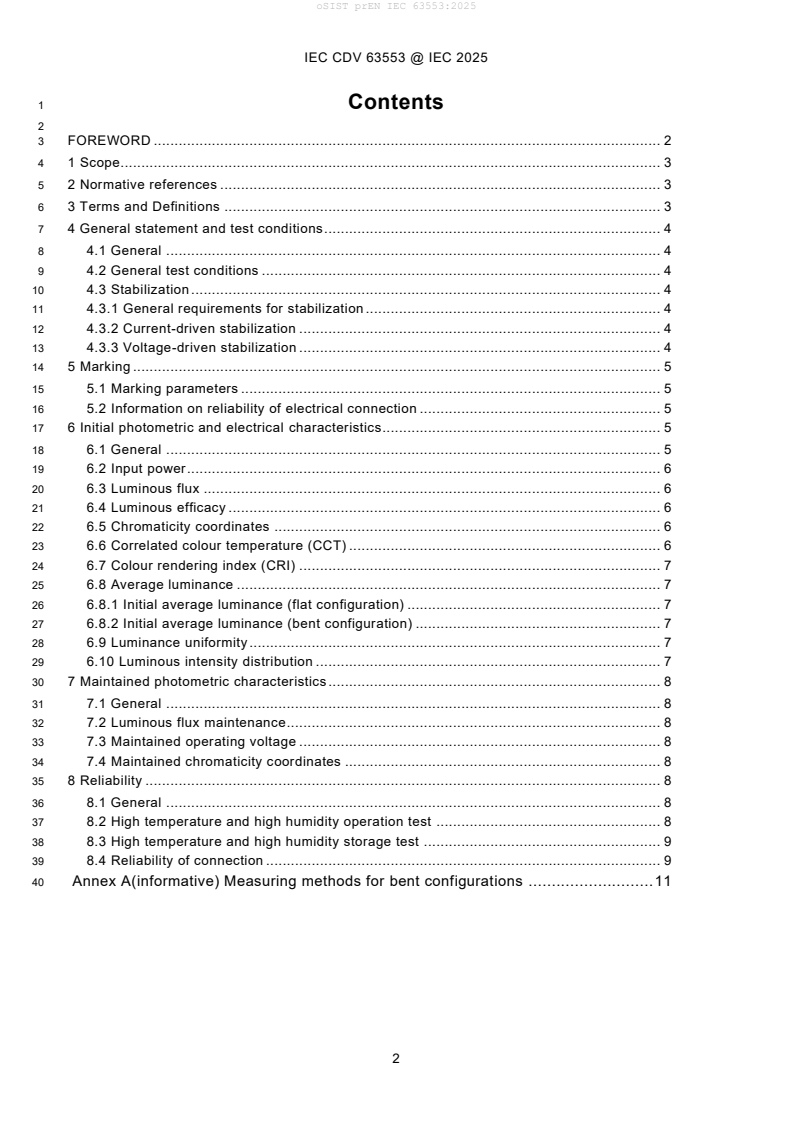
1 Contents
3 FOREWORD . 2
4 1 Scope. 3
5 2 Normative references . 3
6 3 Terms and Definitions . 3
7 4 General statement and test conditions. 4
8 4.1 General . 4
9 4.2 General test conditions . 4
10 4.3 Stabilization . 4
11 4.3.1 General requirements for stabilization . 4
12 4.3.2 Current-driven stabilization . 4
13 4.3.3 Voltage-driven stabilization . 4
14 5 Marking . 5
15 5.1 Marking parameters . 5
16 5.2 Information on reliability of electrical connection . 5
17 6 Initial photometric and electrical characteristics . 5
18 6.1 General . 5
19 6.2 Input power . 6
20 6.3 Luminous flux . 6
21 6.4 Luminous efficacy . 6
22 6.5 Chromaticity coordinates . 6
23 6.6 Correlated colour temperature (CCT) . 6
24 6.7 Colour rendering index (CRI) . 7
25 6.8 Average luminance . 7
26 6.8.1 Initial average luminance (flat configuration) . 7
27 6.8.2 Initial average luminance (bent configuration) . 7
28 6.9 Luminance uniformity . 7
29 6.10 Luminous intensity distribution . 7
30 7 Maintained photometric characteristics . 8
31 7.1 General . 8
32 7.2 Luminous flux maintenance . 8
33 7.3 Maintained operating voltage . 8
34 7.4 Maintained chromaticity coordinates . 8
35 8 Reliability . 8
36 8.1 General . 8
37 8.2 High temperature and high humidity operation test . 8
38 8.3 High temperature and high humidity storage test . 9
39 8.4 Reliability of connection . 9
40 Annex A(informative) Measuring methods for bent configurations . 11
oSIST prEN IEC 63553:2025
IEC CDV 63553 @ IEC 2025
41 INTERNATIONAL ELECTROTECHNICAL COMMISSION
42 ____________
44 FULLY FLEXIBLE ORGANIC LIGHT EMITTING DIODE (OLED) PANELS
45 FOR GENERAL LIGHTING – PERFORMANCE REQUIREMENTS
47 FOREWORD
48 1) The International Electrotechnical Commission (IEC) is a worldwide organization for standardization comprising all national
49 electrotechnical committees (IEC National Committees). The object of IEC is to promote international co -operation on all
50 questions concerning standardization in the electrical and electronic fields. To this end and in addition to other activities ,
51 IEC publishes International Standards, Technical Specifications, Technical Reports, Publicly Available Specifications (PAS)
52 and Guides (hereafter referred to as “IEC Publication(s)”). Their preparation is entrusted to technical committees; any IEC
53 National Committee interested in the subject dealt with may participate in this preparatory work. International, governmental
54 and non-governmental organizations liaising with the IEC also participate in this preparation. IEC collaborates closely with
55 the International Organization for Standardization (ISO) in accordance with conditions determined by agreement between
56 the two organizations.
57 2) The formal decisions or agreements of IEC on technical matters express, as nearly as possible, an international consensus
58 of opinion on the relevant subjects since each technical committee has representation from all interested IEC National
59 Committees.
60 3) IEC Publications have the form of recommendations for international use and are accepted by IEC National Committees in
61 that sense. While all reasonable efforts are made to ensure that the technical content of IEC Publications is accurate, IEC
62 cannot be held responsible for the way in which they are used or for any misinterpretation by any end user.
63 4) In order to promote international uniformity, IEC National Committees undertake to apply IEC Publications transparently to
64 the maximum extent possible in their national and regional publications. Any divergence between any IEC Publication and
65 the corresponding national or regional publication shall be clearly indicated in the latter.
66 5) IEC itself does not provide any attestation of conformity. Independent certification bodies provide conformity assessment
67 services and, in some areas, access to IEC marks of conformity. IEC is not responsible for any services carried out by
68 independent certification bodies.
69 6) All users should ensure that they have the latest edition of this publication.
70 7) No liability shall attach to IEC or its directors, employees, servants or agents including individual experts and members of
71 its technical committees and IEC National Committees for any personal injury, property damage or other damage of any
72 nature whatsoever, whether direct or indirect, or for costs (including legal fees) and expenses arising out of the publicatio n,
73 use of, or reliance upon, this IEC Publication or any other IEC Publications.
74 8) Attention is drawn to the Normative references cited in this publication. Use of the referenced publications is indispensable
75 for the correct application of this publication.
76 9) Attention is drawn to the possibility that some of the elements of this IEC Publication may be the subject of patent rights.
77 IEC shall not be held responsible for identifying any or all such patent rights.
78 International Standard IEC XXXXX has been prepared by subcommittee SC34A: Electric light sources,
79 of IEC technical committee 34: Lighting.
80 The text of this standard is based on the following documents:
FDIS Report on voting
XX/XX/FDIS XX/XX/RVD
82 Full information on the voting for the approval of this standard can be found in the report on voting
83 indicated in the above table.
84 This publication has been drafted in accordance with the ISO/IEC Directives, Part 2.
oSIST prEN IEC 63553:2025
IEC CDV 63553 @ IEC 2025
86 FULLY FLEXIBLE ORGANIC LIGHT EMITTING DIODE (OLED) PANELS FOR GENERAL
87 LIGHTING – PERFORMANCE REQUIREMENTS
88 1 Scope
89 This document specifies performance requirements of fully flexible organic light emitting diode
90 (OLED) tiles and panels whose configurations are twisted, wavy or helical for use on supplies
91 up to 120 V ripple free DC for indoor and similar general lighting purposes and designed for
92 being bent during the manufacturing process of curved luminaires.
93 The requirements of this document relate only to type testing.
95 2 Normative references
96 The following document is referred to in the text in such a way that some or all of their content
97 constitutes requirements of this document. For dated references, only the edition cited applies.
98 For undated references, the latest edition of the referenced document (including any
99 amendments) applies.
100 IEC 62504, General lighting – Light emitting diode (LED) products and related equipment –
101 Terms and definitions
102 IEC 62868-2-3, Organic light emitting diode (OLED) light sources for general lighting – Safety
103 – Part 2-3: Particular requirements – Flexible OLED tiles and panels
104 IEC 62922:2016, Organic light emitting diode (OLED)panels for general lighting – Performance
105 requirements –
106 IEC 62922:2016/AMD1:2021
107 IEC TS 62972, General lighting – Organic light emitting diode (OLED) products and related
108 equipment – Terms and definitions
109 IEC 63286:2022, Flexible organic light emitting diode (OLED)panels for general lighting –
110 Performance requirements –
111 CIE 025:2015, Test Method for LED Lamps, LED Luminaires and LED Modules
112 CIE S 025-SP1:2019, Test Method for OLED Luminaires and OLED Light Sources
113 3 Terms and Definitions
114 For the purposes of this document, the terms and definitions given in IEC 62504, IEC 62868-1
115 and IEC TS 62972 and the following apply.
116 ISO and IEC maintain terminological databases for use in standardization at the following
117 addresses:
118 • IEC Electropedia: available at http://www.electropedia.org/
119 • ISO Online browsing platform: available at http://www.iso.org/obp
oSIST prEN IEC 63553:2025
IEC CDV 63553 @ IEC 2025
121 3.1
122 fully flexible OLED panel
123 flexible OLED panel with freely bending shapes of geometrical curvature
125 3.2
126 wavy shape OLED panel
127 flexible OLED panel whose light emitting surface forms a combined configuration of convex and concave
128 shapes
130 3.3
131 twisted shape OLED panel
132 flexible OLED panel in which the light emitting surface forms a helix around the panel axis
134 3.4
135 helical shape OLED panel
136 flexible OLED panel whose light emitting surfaces have shapes generated by equiangular spirals having
137 a common axis and the same defining parameter
139 4 General statement and test conditions
140 4.1 General
141 The requirements of this document apply in addition to the requirements of IEC 62868-2-3. It
142 is understood that reference to a fully flexible OLED panel also includes reference to fully
143 flexible OLED tiles in the requirements and tests of this document.
144 4.2 General test conditions
145 Unless otherwise specified, all measurements shall be made in an ambient temperature of (25
146 ± 5) °C under a draught-free condition.
147 The tests shall be carried out using a fully flexible OLED panel in two configurations: the flat
148 configuration under the test conditions specified in IEC 62922, and the bent configuration, in
149 which the OLED panels are bent into a shape specified by the manufacturer or responsible
150 vendor.
151 The tests shall be conducted at the rated current or voltage unless otherwise specified in this
152 document.
153 The test conditions for constant current and constant voltage operation according to IEC
154 62922:2016, 4.2 apply.
155 4.3 Stabilization
156 4.3.1 General requirements for stabilization
157 Stabilization is conducted in a draught-free room at a temperature of (25 ± 5) °C. The
158 temperature shall be maintained within ±2 °C during stabilization. The temperature shall be
159 measured in the integrating sphere or the point within 1,5 m from the OLED panel. If
160 stabilization conditions, according to 4.3.2 or 4.3.3, are not achieved within 60 min, the
161 measurement may be started and the observed fluctuations shall be reported.
162 Stabilization shall be carried out using the bent configuration, in which the OLED panel is bent
163 into a shape specified by the manufacturer or responsible vendor.
164 4.3.2 Current-driven stabilization
165 The requirements according to IEC 62922:2022, 4.3.2 apply.
166 4.3.3 Voltage-driven stabilization
167 The requirements according to IEC 62922:2022, 4.3.3 apply.
oSIST prEN IEC 63553:2025
IEC CDV 63553 @ IEC 2025
169 5 Marking
170 5.1 Marking parameters
171 Information on the parameters shown in Table 1 shall be provided by the manufacturer or
172 responsible vendor and be located either in product datasheet, leaflet or website.
174 Table 1 - Marking parameters
Parameters Mandatory Optional
configuration
a) Rated total luminous flux flat x
(lm) bent x
flat x
b) Rated average luminance
(cd/m ) bent x
c) Rated chromaticity flat x
coordinates and bent x
chromaticity coordinate
range
flat x
d) Rated correlated colour
temperature (K) bent x
flat x
e) Rated colour rendering
index bent x
flat x
f) Rated luminous efficacy
(lm/W) bent x
flat x
g) Luminous intensity
distribution bent x
flat x
h) Luminance uniformity
bent x
flat x
i) Surface chromaticity
uniformity bent x
j) Angular chromaticity flat x
uniformity
x
k) Minimum bending radius
(performance) (mm)
l) Maximum bending cycle x
(performance)(times)
177 5.2 Information on reliability of electrical connection
178 The requirements according to IEC 62922:2016, 5.2 apply.
180 6 Initial photometric and electrical characteristics
181 6.1 General
182 The initial photometric and electrical measurements of the OLED panel shall be conducted in
183 the flat configuration and in the specified configurations by the manufacturer or responsible
184 vendor. The measurements under the flat configuration shall be conducted acco
...