

SIST EN 301 908-21 V6.1.1:2016
(Main)IMT cellular networks - Harmonised Standard covering the essential requirements of article 3.2 of the Directive 2014/53/EU - Part 21: OFDMA TDD WMAN (Mobile WiMAXTM) FDD User Equipment (UE)
General Information
- Abstract
The present document applies to the following radio equipment type:
• Mobile WiMAXTM FDD User Equipment for IMTOFDMA TDD WMAN.
The present document contains requirements to demonstrate that Radio equipment both effectively uses and supports the efficient use of radio spectrum in order to avoid harmful interference.
In addition to the present document, other ENs that specify technical requirements in respect of essential requirements under other parts of article 3 of the Radio Equipment Directive 2014/53/EU [i.2] may apply to equipment within the scope of the present document.
- Status
- Published
- Public Enquiry End Date
- 19-Apr-2016
- Publication Date
- 18-May-2016
- Technical Committee
- MOC - Mobile Communications
- Current Stage
- 6060 - National Implementation/Publication (Adopted Project)
- Start Date
- 16-May-2016
- Due Date
- 21-Jul-2016
- Completion Date
- 19-May-2016
Buy Documents


ETSI EN 301 908-21 V6.1.1 (2016-05) - IMT cellular networks; Harmonised Standard covering the essential requirements of article 3.2 of the Directive 2014/53/EU; Part 21: OFDMA TDD WMAN (Mobile WiMAXTM) FDD User Equipment (UE)



Overview
SIST EN 301 908-21 V6.1.1:2016 is a harmonised European standard developed by SIST, identical to ETSI EN 301 908-21 V6.1.1. It defines technical requirements for Mobile WiMAX FDD User Equipment (UE) used in International Mobile Telecommunications (IMT) Orthogonal Frequency-Division Multiple Access (OFDMA) Time Division Duplexing (TDD) Wireless Metropolitan Area Networks (WMAN). This standard is key for demonstrating compliance with Article 3.2 of the EU Radio Equipment Directive (RED) 2014/53/EU, ensuring that such radio equipment makes efficient use of the radio spectrum and minimises harmful interference.
This document forms part of a modular standards series intended for manufacturers, conformity assessment bodies, and regulatory authorities involved with user equipment in WiMAX and IMT cellular networks.
Key Topics
Scope and Target Equipment
- Applies specifically to Mobile WiMAX FDD UE for IMT OFDMA TDD WMAN.
- Covers operation in specified frequency bands, supporting efficient radio spectrum utilisation.
Essential Regulatory Requirements
- Addresses essential requirements of Article 3.2 of Directive 2014/53/EU, specifically regarding spectrum efficiency and avoidance of harmful interference.
- Prescribes transmitter and receiver performance criteria such as output power, spurious emissions, channel selectivity, and unwanted emissions.
Conformance and Testing
- Identifies required test suites and conformance assessment methods necessary to demonstrate compliance.
- Environmental profile: Equipment must comply with all technical requirements under the declared operating conditions.
Reference to Other Harmonised Standards
- Notes that additional technical standards may apply for certain essential requirements specified in other parts of Article 3 of the Radio Equipment Directive.
Applications
Mobile WiMAX Deployments
- Used by manufacturers and integrators of WiMAX-enabled user equipment (UE) designed to operate in FDD mode within IMT cellular networks.
- Essential for mobile broadband devices, terminals, and modules installed in laptops, tablets, and industrial gateways using Mobile WiMAX technology.
Market Access and Certification
- Provides a harmonised path for demonstrating regulatory compliance within the European Union and EFTA states.
- Assists in securing CE marking and ensuring rapid access to European markets by presuming conformity when the requirements are met.
Interference Management
- Ensures that equipment supports efficient radio spectrum use, contributing to stable network operation and coexistence with other radio systems.
- Key for network operators and service providers seeking to deploy compliant equipment in multi-user and multi-service environments.
Related Standards
For complete compliance and broader conformance, the following related and referenced standards should also be considered:
- ETSI EN 301 908-1: IMT cellular networks - Harmonised Standard covering common and introductory requirements for radio equipment under RED Article 3.2.
- ETSI EN 301 908 Series: Additional parts providing requirements for different IMT network types and equipment classes.
- WiMAX Forum Test Procedures: Reference WMF-T25-002 for detailed conformance test methods.
- Directive 2014/53/EU (RED): The primary regulatory framework for radio equipment sold in the EU.
- CEPT/ERC/Recommendation 74-01E: Addresses unwanted emissions in the spurious domain.
Keywords: Mobile WiMAX FDD, IMT cellular networks, OFDMA TDD WMAN, user equipment, harmonised standard, radio equipment directive, efficient use of radio spectrum, spurious emissions, conformance testing.
Buy Documents
ETSI EN 301 908-21 V6.1.1 (2016-05) - IMT cellular networks; Harmonised Standard covering the essential requirements of article 3.2 of the Directive 2014/53/EU; Part 21: OFDMA TDD WMAN (Mobile WiMAXTM) FDD User Equipment (UE)
Get Certified
Connect with accredited certification bodies for this standard

ANCE
Mexican certification and testing association.

Intertek Slovenia
Intertek testing, inspection, and certification services in Slovenia.

LNE (Laboratoire National de Métrologie et d'Essais)
French national laboratory for metrology and testing.
Sponsored listings
Frequently Asked Questions
SIST EN 301 908-21 V6.1.1:2016 is a standard published by the Slovenian Institute for Standardization (SIST). Its full title is "IMT cellular networks - Harmonised Standard covering the essential requirements of article 3.2 of the Directive 2014/53/EU - Part 21: OFDMA TDD WMAN (Mobile WiMAXTM) FDD User Equipment (UE)". This standard covers: The present document applies to the following radio equipment type: • Mobile WiMAXTM FDD User Equipment for IMTOFDMA TDD WMAN. The present document contains requirements to demonstrate that Radio equipment both effectively uses and supports the efficient use of radio spectrum in order to avoid harmful interference. In addition to the present document, other ENs that specify technical requirements in respect of essential requirements under other parts of article 3 of the Radio Equipment Directive 2014/53/EU [i.2] may apply to equipment within the scope of the present document.
The present document applies to the following radio equipment type: • Mobile WiMAXTM FDD User Equipment for IMTOFDMA TDD WMAN. The present document contains requirements to demonstrate that Radio equipment both effectively uses and supports the efficient use of radio spectrum in order to avoid harmful interference. In addition to the present document, other ENs that specify technical requirements in respect of essential requirements under other parts of article 3 of the Radio Equipment Directive 2014/53/EU [i.2] may apply to equipment within the scope of the present document.
SIST EN 301 908-21 V6.1.1:2016 is classified under the following ICS (International Classification for Standards) categories: 33.060.99 - Other equipment for radiocommunications; 33.070.99 - Other mobile services. The ICS classification helps identify the subject area and facilitates finding related standards.
SIST EN 301 908-21 V6.1.1:2016 is associated with the following European legislation: EU Directives/Regulations: 1999/5/EC, 2014/53/EU. When a standard is cited in the Official Journal of the European Union, products manufactured in conformity with it benefit from a presumption of conformity with the essential requirements of the corresponding EU directive or regulation.
SIST EN 301 908-21 V6.1.1:2016 is available in PDF format for immediate download after purchase. The document can be added to your cart and obtained through the secure checkout process. Digital delivery ensures instant access to the complete standard document.
Standards Content (Sample)
HARMONISED EUROPEAN STANDARD
IMT cellular networks;
Harmonised Standard covering the essential requirements
of article 3.2 of the Directive 2014/53/EU;
TM
Part 21: OFDMA TDD WMAN (Mobile WiMAX )
FDD User Equipment (UE)
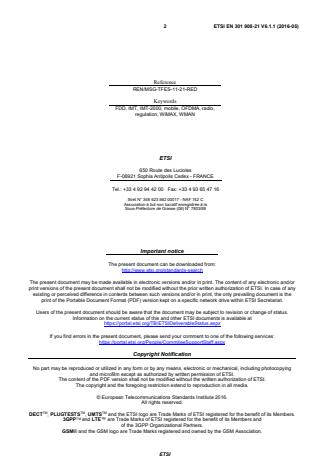
2 ETSI EN 301 908-21 V6.1.1 (2016-05)
Reference
REN/MSG-TFES-11-21-RED
Keywords
FDD, IMT, IMT-2000, mobile, OFDMA, radio,
regulation, WiMAX, WMAN
ETSI
650 Route des Lucioles
F-06921 Sophia Antipolis Cedex - FRANCE
Tel.: +33 4 92 94 42 00 Fax: +33 4 93 65 47 16
Siret N° 348 623 562 00017 - NAF 742 C
Association à but non lucratif enregistrée à la
Sous-Préfecture de Grasse (06) N° 7803/88
Important notice
The present document can be downloaded from:
http://www.etsi.org/standards-search
The present document may be made available in electronic versions and/or in print. The content of any electronic and/or
print versions of the present document shall not be modified without the prior written authorization of ETSI. In case of any
existing or perceived difference in contents between such versions and/or in print, the only prevailing document is the
print of the Portable Document Format (PDF) version kept on a specific network drive within ETSI Secretariat.
Users of the present document should be aware that the document may be subject to revision or change of status.
Information on the current status of this and other ETSI documents is available at
https://portal.etsi.org/TB/ETSIDeliverableStatus.aspx
If you find errors in the present document, please send your comment to one of the following services:
https://portal.etsi.org/People/CommiteeSupportStaff.aspx
Copyright Notification
No part may be reproduced or utilized in any form or by any means, electronic or mechanical, including photocopying
and microfilm except as authorized by written permission of ETSI.
The content of the PDF version shall not be modified without the written authorization of ETSI.
The copyright and the foregoing restriction extend to reproduction in all media.
© European Telecommunications Standards Institute 2016.
All rights reserved.
TM TM TM
DECT , PLUGTESTS , UMTS and the ETSI logo are Trade Marks of ETSI registered for the benefit of its Members.
TM
3GPP and LTE™ are Trade Marks of ETSI registered for the benefit of its Members and
of the 3GPP Organizational Partners.
GSM® and the GSM logo are Trade Marks registered and owned by the GSM Association.
ETSI
3 ETSI EN 301 908-21 V6.1.1 (2016-05)
Contents
Intellectual Property Rights . 6
Foreword . 6
Modal verbs terminology . 6
Introduction . 6
1 Scope . 7
2 References . 7
2.1 Normative references . 7
2.2 Informative references . 7
3 Definitions, symbols and abbreviations . 8
3.1 Definitions . 8
3.2 Symbols . 9
3.3 Abbreviations . 10
4 Technical requirements specification . 10
4.1 Environmental profile . 10
4.2 Conformance requirements . 10
4.2.0 General . 10
4.2.1 Introduction. 10
4.2.2 Transmitter spectrum emission mask . 11
4.2.2.1 Definition . 11
4.2.2.2 Limits . 11
4.2.2.2.1 Requirements for 5 MHz channel bandwidth . 11
4.2.2.2.2 Requirements for 10 MHz channel bandwidth . 12
4.2.2.3 Conformance . 12
4.2.3 Transmitter Adjacent Channel Leakage power Ratio (ACLR) . 12
4.2.3.1 Definition . 12
4.2.3.2 Limits . 12
4.2.3.2.1 ACLR requirements for 5 MHz bandwidth . 12
4.2.3.2.2 ACLR requirements for 10 MHz bandwidth . 12
4.2.3.3 Conformance . 12
4.2.4 Transmitter spurious emis sions . 13
4.2.4.1 Definition . 13
4.2.4.2 Limits . 13
4.2.4.2.1 Requirements for 5 MHz channel bandwidth . 13
4.2.4.2.2 Requirements for 10 MHz channel bandwidth . 13
4.2.4.2.3 Requirements for UE coexistence . 14
4.2.4.3 Conformance . 14
4.2.5 Transmitter Maximum Output Power . 14
4.2.5.1 Definition . 14
4.2.5.2 Limits . 14
4.2.5.3 Conformance . 14
4.2.6 Transmitter Minimum Output Power . 14
4.2.6.1 Definition . 14
4.2.6.2 Limits . 14
4.2.6.3 Conformance . 14
4.2.7 Receiver spurious emissions . 14
4.2.7.1 Definition . 14
4.2.7.2 Limits . 15
4.2.7.3 Conformance . 15
4.2.8 Receiver Adjacent Channel Selectivity (ACS) . 15
4.2.8.1 Definition . 15
4.2.8.2 Limits . 15
4.2.8.3 Conformance . 16
4.2.9 Receiver blocking characteristics . 16
4.2.9.1 Definition . 16
ETSI
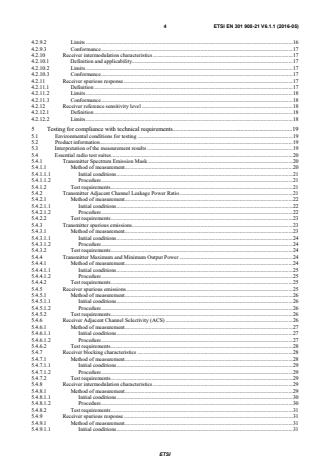
4 ETSI EN 301 908-21 V6.1.1 (2016-05)
4.2.9.2 Limits . 16
4.2.9.3 Conformance . 17
4.2.10 Receiver intermodulation characteristics . 17
4.2.10.1 Definition and applicability . 17
4.2.10.2 Limits . 17
4.2.10.3 Conformance . 17
4.2.11 Receiver spurious response . 17
4.2.11.1 Definition . 17
4.2.11.2 Limits . 18
4.2.11.3 Conformance . 18
4.2.12 Receiver reference sensitivity level . 18
4.2.12.1 Definition . 18
4.2.12.2 Limits . 18
5 Testing for compliance with technical requirements . 19
5.1 Environmental conditions for testing . 19
5.2 Product information . 19
5.3 Interpretation of the measurement results . 19
5.4 Essential radio test suites . 20
5.4.1 Transmitter Spectrum Emission Mask . 20
5.4.1.1 Method of measurement . 20
5.4.1.1.1 Initial conditions . 21
5.4.1.1.2 Procedure . 21
5.4.1.2 Test requirements . 21
5.4.2 Transmitter Adjacent Channel Leakage Power Ratio . 21
5.4.2.1 Method of measurement . 22
5.4.2.1.1 Initial conditions . 22
5.4.2.1.2 Procedure . 22
5.4.2.2 Test requirements . 23
5.4.3 Transmitter spurious emis sions . 23
5.4.3.1 Method of measurement . 23
5.4.3.1.1 Initial conditions . 24
5.4.3.1.2 Procedure . 24
5.4.3.2 Test requirements . 24
5.4.4 Transmitter Maximum and Minimum Output Power . 24
5.4.4.1 Method of measurement . 24
5.4.4.1.1 Initial conditions . 25
5.4.4.1.2 Procedure . 25
5.4.4.2 Test requirements . 25
5.4.5 Receiver spurious emissions . 25
5.4.5.1 Method of measurement . 26
5.4.5.1.1 Initial conditions . 26
5.4.5.1.2 Procedure . 26
5.4.5.2 Test requirements . 26
5.4.6 Receiver Adjacent Channel Selectivity (ACS) . 26
5.4.6.1 Method of measurement . 27
5.4.6.1.1 Initial conditions . 27
5.4.6.1.2 Procedure . 27
5.4.6.2 Test requirements . 28
5.4.7 Receiver blocking characteristics . 28
5.4.7.1 Method of measurement . 28
5.4.7.1.1 Initial conditions . 29
5.4.7.1.2 Procedure . 29
5.4.7.2 Test requirements . 29
5.4.8 Receiver intermodulation characteristics . 29
5.4.8.1 Method of measurement . 29
5.4.8.1.1 Initial conditions . 30
5.4.8.1.2 Procedure . 30
5.4.8.2 Test requirements . 31
5.4.9 Receiver spurious response . 31
5.4.9.1 Method of measurement . 31
5.4.9.1.1 Initial conditions . 31
ETSI
5 ETSI EN 301 908-21 V6.1.1 (2016-05)
5.4.9.1.2 Procedure . 31
5.4.9.2 Test requirements . 32
5.4.10 Receiver reference sensitivity level . 32
5.4.10.1 Method of test . 32
5.4.10.2 Test requirement . 32
Annex A (normative): Relationship between the present document and the essential
requirements of Directive 2014/53/EU . 33
Annex B (normative): Environmental profile specification . 35
Annex C (informative): Void . 36
Annex D (informative): Bibliography . 37
History . 38
ETSI
6 ETSI EN 301 908-21 V6.1.1 (2016-05)
Intellectual Property Rights
IPRs essential or potentially essential to the present document may have been declared to ETSI. The information
pertaining to these essential IPRs, if any, is publicly available for ETSI members and non-members, and can be found
in ETSI SR 000 314: "Intellectual Property Rights (IPRs); Essential, or potentially Essential, IPRs notified to ETSI in
respect of ETSI standards", which is available from the ETSI Secretariat. Latest updates are available on the ETSI Web
server (https://ipr.etsi.org/).
Pursuant to the ETSI IPR Policy, no investigation, including IPR searches, has been carried out by ETSI. No guarantee
can be given as to the existence of other IPRs not referenced in ETSI SR 000 314 (or the updates on the ETSI Web
server) which are, or may be, or may become, essential to the present document.
Foreword
This Harmonised European Standard (EN) has been produced by ETSI Technical Committee Mobile Standards Group
(MSG).
The present document has been prepared under the Commission's standardisation request C(2015) 5376 final [i.7] to
provide one voluntary means of conforming to the essential requirements of Directive 2014/53/EU on the harmonisation
of the laws of the Member States relating to the making available on the market of radio equipment and repealing
Directive 1999/5/EC [i.2].
Once the present document is cited in the Official Journal of the European Union under that Directive, compliance with
the normative clauses of the present document given in table A-1 confers, within the limits of the scope of the present
document, a presumption of conformity with the corresponding essential requirements of that Directive, and associated
EFTA regulations.
The present document is part 21 of a multi-part deliverable. Full details of the entire series can be found in part 1 [i.8].
National transposition dates
Date of adoption of this EN: 20 April 2016
Date of latest announcement of this EN (doa): 31 July 2016
Date of latest publication of new National Standard
or endorsement of this EN (dop/e): 31 January 2017
Date of withdrawal of any conflicting National Standard (dow): 31 January 2018
Modal verbs terminology
In the present document "shall", "shall not", "should", "should not", "may", "need not", "will", "will not", "can" and
"cannot" are to be interpreted as described in clause 3.2 of the ETSI Drafting Rules (Verbal forms for the expression of
provisions).
"must" and "must not" are NOT allowed in ETSI deliverables except when used in direct citation.
Introduction
The present document is part of a set of standards developed by ETSI that is designed to fit in a modular structure to
cover radio equipment within the scope of the Radio Equipment Directive [i.2]. The present document is produced
following the guidance in ETSI EG 203 366 [i.3] as applicable.
ETSI
7 ETSI EN 301 908-21 V6.1.1 (2016-05)
1 Scope
The present document applies to the following radio equipment type:
TM
• Mobile WiMAX FDD User Equipment for IMTOFDMA TDD WMAN.
This radio equipment type is capable of operating in all or any part of the frequency bands given in table 1-1.
TM
Table 1-1: Mobile WiMAX FDD Operating frequency bands
TM
Mobile WiMAX Band Class Direction of transmission Mobile WiMAX FDD frequency bands
Index
Transmit 880 MHz to 915 MHz
7G
Receive 925 MHz to 960 MHz
Transmit 1 710 MHz to 1 785 MHz
6C
Receive 1 805 MHz to 1 880 MHz
The present document contains requirements to demonstrate that Radio equipment both effectively uses and supports
the efficient use of radio spectrum in order to avoid harmful interference.
In addition to the present document, other ENs that specify technical requirements in respect of essential requirements
under other parts of article 3 of the Radio Equipment Directive 2014/53/EU [i.2] may apply to equipment within the
scope of the present document.
NOTE: A list of such ENs is included on the web site http://www.newapproach.org.
2 References
2.1 Normative references
References are either specific (identified by date of publication and/or edition number or version number) or
non-specific. For specific references, only the cited version applies. For non-specific references, the latest version of the
referenced document (including any amendments) applies.
Referenced documents which are not found to be publicly available in the expected location might be found at
http://docbox.etsi.org/Reference.
NOTE: While any hyperlinks included in this clause were valid at the time of publication, ETSI cannot guarantee
their long term validity.
The following referenced documents are necessary for the application of the present document. ®
[1] WMF-T25-002-R010v06 (2012): "WiMAX Forum Test Procedures - Mobile Radio
Conformance Tests" - Release 1 v06.
[2] CEPT/ERC/Recommendation 74-01E (Siófok 98, Nice 99, Sesimbra 02, Hradec Kralove 05,
Cardiff 11) (01-2011): "Unwanted emissions in the spurious domain".
2.2 Informative references
References are either specific (identified by date of publication and/or edition number or version number) or
non-specific. For specific references, only the cited version applies. For non-specific references, the latest version of the
referenced document (including any amendments) applies.
NOTE: While any hyperlinks included in this clause were valid at the time of publication, ETSI cannot guarantee
their long term validity.
The following referenced documents are not necessary for the application of the present document but they assist the
user with regard to a particular subject area.
[i.1] Recommendation ITU-R SM.329-10 (2012): "Unwanted emissions in the spurious domain".
ETSI
8 ETSI EN 301 908-21 V6.1.1 (2016-05)
[i.2] Directive 2014/53/EU of the European Parliament and of the Council of 16 April 2014 on the
harmonisation of the laws of the Member States relating to the making available on the market of
radio equipment and repealing Directive 1999/5/EC (Text with EEA relevance).
[i.3] ETSI EG 203 336 (V1.1.1) (2015): "Electromagnetic compatibility and Radio spectrum Matters
(ERM); Guide for the selection of technical parameters for the production of Harmonized
Standards covering article 3.1(b) and article 3.2 of Directive 2014/53/EU".
[i.4] ETSI EN 300 019-1-0: "Environmental Engineering (EE); Environmental conditions and
environmental tests for telecommunications equipment; Part 1-0: Classification of environmental
conditions; Introduction".
[i.5] ETSI TR 102 215 (V1.3.1): "Electromagnetic compatibility and Radio spectrum Matters (ERM);
Recommended approach, and possible limits for measurement uncertainty for the measurement of
radiated electromagnetic fields above 1 GHz".
[i.6] ETSI TR 100 028 (V1.4.1) (all parts): "Electromagnetic compatibility and Radio spectrum Matters
(ERM); Uncertainties in the measurement of mobile radio equipment characteristics".
[i.7] Commission Implementing Decision C(2015) 5376 final of 4.8.2015 on a standardisation request
to the European Committee for Electrotechnical Standardisation and to the European
Telecommunications Standards Institute as regards radio equipment in support of Directive
2014/53/EU of the European Parliament and of the Council.
[i.8] ETSI EN 301 908-1 (V11.1.1): "IMT cellular networks; Harmonised Standard covering the
essential requirements of article 3.2 of the Directive 2014/53/EU; Part 1: Introduction and
common requirements".
3 Definitions, symbols and abbreviations
3.1 Definitions
For the purposes of the present document, the terms and definitions given in the Directive 2014/53/EU [i.2] and the
following apply:
burst: period during which radio waves are intentionally transmitted, preceded and succeeded by periods during which
no intentional transmission is made
environmental profile: declared range of environmental conditions under which equipment within the scope of the
present document is required to be compliant
Eval_BW 1: test condition where the pass band of a rectangular filter with a bandwidth of 4,75 MHz for 5 MHz
equipment and 9,5 MHz for 10 MHz equipment is used for measurement centred on an operating channel or a victim
channel
Eval_BW 2: measurement for EVAL_BW2 on the operating channel is performed using a rectangular filter with a
4,75 MHz or 9,5 MHz bandwidth and the measurement on the victim channel is performed using an RRC filter with a
3,84 MHz or 7,68 MHz bandwidth (respectively) both with roll-off factor of 0,22 centred on the 1st adjacent victim
channel
integral antenna: antenna which is declared to be part of the radio equipment by the manufacturer
NOTE: Even when equipment with an integral antenna is concerned, it might still be possible to separate the
antenna from the equipment using a special tool. In such cases the assessment of the radio equipment and
of the antenna against requirements of this multi-part deliverable may be done separately.
maximum output power: mean power level per carrier of the base station measured at the antenna connector in a
specified reference condition
ETSI
9 ETSI EN 301 908-21 V6.1.1 (2016-05)
mean power: power (transmitted or received) in a bandwidth when applied to a modulated signal
NOTE: The term "mean" here is used to exclude the amplitude fluctuation related to those theoretical variations
present in signal for example due to amplitude modulation, pulse shaping, pre-equalization, etc. Time
averaging should be applied to estimate mean power with the effect of the theoretical variations. The duty
cycle corresponding to burst activity within a frame should be also incorporated for "mean" power
estimation.
nominal maximum output power: maximum nominal mean power level measured over total allocated channel
bandwidth of the user equipment available at the antenna connector declared by the manufacturer; for equipment
implementing dynamic change of modulation format, it is intended as the maximum nominal mean power associated to
the modulation format delivering the highest power
operating nominal RF channel width: nominal amount of spectrum used by a single device operating on an identified
centre frequency
receiver thermal noise power: equal to k×T×BW×F
TM
WiMAX : trademarked name for the OFDMA TDD WMAN IMT technology
TM
NOTE: WiMAX is an example of a suitable technology available commercially. This information is given for
the convenience of users of the present document and does not constitute an endorsement by ETSI of this
technology.
3.2 Symbols
For the purposes of the present document, the following symbols apply:
A Base Station Interface A
BS
A Mobile Station Interface A
MS
A Unit Under Test Interface A
UUT
dB decibel
dBc decibel relative to P carrier power measured in Eval_BW1
nom
dBm decibel relative to 1 milliwatt
BW Assigned channel bandwidth
f Frequency of measurement
F centre frequency of the assigned channel
c
F Receiver noise figure
k Boltzmann's constant
GHz GigaHertz
M Base Station Interface M
BS
MHz MegaHertz
M Mobile Station Interface M
MS
N Maximum number of antennas in a multiple antenna configuration
N Receiver thermal noise power expressed in dBm
th
-6
P Receiver sensitivity level at BER ≤ 10 (or equivalent PER) performance corresponding to the
SENS
most robust modulation and coding rate supported by the technology
P declared nominal maximum output Power
nom
-6
P sensitivity levels at BER ≤ 10 , for a 5 MHz channel, corresponding to the most robust
SENS5
modulation and coding rate supported by the technology
-6
P sensitivity levels at BER ≤ 10 , for a 10 MHz channel, corresponding to the most robust
SENS10
modulation and coding rate supported by the technology
T Ambient temperature in Kelvin
ETSI
10 ETSI EN 301 908-21 V6.1.1 (2016-05)
3.3 Abbreviations
For the purposes of the present document, the following abbreviations apply:
ACLR Adjacent Channel Leakage power Ratio
ACS Adjacent Channel Selectivity
BER Bit Error Ratio
BS Base Station
BW BandWidth
CW Continuous Wave
EC European Commission
EFTA European Free Trade Association
ERM Electromagnetic compatibility and Radio spectrum Matters
EUT Equipment Under Test
FDD Frequency Division Duplexing
IMT International Mobile Telecommunications
MS Mobile Station
MSG Mobile Standards Group
OFDMA Orthogonal Frequency-Division Multi Access
PER Packet Error Ratio
RED Radio Equipment Directive
RF Radio Frequency
RMS Root Mean Square
SM Spectrum Management
TDD Time Division Duplex
TFES Task Force for European Standards for IMT
TPC Transmit Power Control
UE User Equipment
UUT Unit Under Test
WMAN Wireless Metropolitan Area Network
4 Technical requirements specification
4.1 Environmental profile
The technical requirements of the present document apply under the environmental profile for operation of the
equipment, which shall be declared by the supplier. The equipment shall comply with all the technical requirements of
the present document at all times when operating within the boundary limits of the declared operational environmental
profile.
4.2 Conformance requirements
4.2.0 General
This clause describes the conformance requirements for OFDMA FDD WMAN User Equipment (UE).
4.2.1 Introduction
To meet the essential requirement under article 3.2 of the Directive 2014/53/EU [i.2] (Radio Equipment Directive) for
IMT User Equipment (UE), a set of essential parameters in addition to those in ETSI EN 301 908-1 [i.8] have been
identified. Table 4.2.1-1 provides a cross reference between these essential parameters and the corresponding technical
requirements for equipment within the scope of the present document.
To fulfil an essential parameter the compliance with all the corresponding technical requirements in table 4.2.1-1 shall
be verified.
ETSI
11 ETSI EN 301 908-21 V6.1.1 (2016-05)
Table 4.2.1-1: Cross references
Essential parameter Corresponding technical requirements Corresponding
test suite
Transmitter spectrum mask 5.4.1
4.2.2 Transmitter Spectrum emissions mask
5.4.2
Transmitter unwanted emissions in the
4.2.3 Transmitter adjacent channel leakage power ratio
out of band domain
Transmitter unwanted emissions in the 5.4.4
4.2.4 Transmitter spurious emissions
spurious domain
Transmitter power limits 4.2.5 Transmitter maximum output power 5.4.4
Transmitter power accuracy 4.2.6 Transmitter minimum output power 5.4.4
Receiver unwanted emissions in the 5.4.5
4.2.7 Receiver spurious emissions
spurious domain
Receiver blocking 4.2.9 Receiver Blocking characteristics 5.4.7
Receiver spurious response rejection 4.2.11 Receiver spurious response 5.4.9
Receiver radio-frequency 5.4.8
4.2.10 Receiver Intermodulation characteristics
intermodulation
Receiver adjacent signal selectivity 4.2.8 Receiver Adjacent Channel Selectivity (ACS) 5.4.6
Receiver sensitivity 5.4.10
4.2.12 Receiver Reference Sensitivity level
Antenna
Unless otherwise stated, the transmitter and receiver characteristics are specified at the antenna connector(s) of the UE.
For UE(s) with an integral antenna only, a reference antenna(s) with a gain of 0 dBi should be assumed for each antenna
port(s). A UE with integral antenna(s) may be taken into account by converting these power levels into field strength
requirements, assuming a 0 dBi gain antenna.
4.2.2 Transmitter spectrum emission mask
4.2.2.1 Definition
Spectrum emission mask defines an out of band emission requirement for the transmitter. These out of band emissions
are unwanted emissions outside the channel bandwidth resulting from the modulation process and non-linearity in the
transmitter but excluding spurious emissions.
4.2.2.2 Limits
A user equipment device transmitting on a single RF carrier configured in accordance with the manufacturer's
specification shall meet the requirement. Emissions shall not exceed the maximum level specified in tables 4.2.2.2.1-1
and 4.2.2.2.2-1 for the appropriate UE maximum output power and nominal channel bandwidths of 5 MHz and
10 MHz.
Integration bandwidth refers to the frequency range over which the emission power is integrated.
∆f is defined as the frequency offset in MHz from the channel centre frequency.
4.2.2.2.1 Requirements for 5 MHz channel bandwidth
Table 4.2.2.2.1-1: Spectrum emission mask requirement
Segment Offset from channel centre Integration Allowed emission level within the
number frequency (Δf ) bandwidth integration bandwidth
(kHz) (dBm)
(MHz)
1 2,5 to < 3,5 50 -13
2 3,5 to < 7,5 1 000 -10
3 7,5 to < 8,5 1 000 -13
4 8,5 to ≤ 12,5 1 000 -25
ETSI
12 ETSI EN 301 908-21 V6.1.1 (2016-05)
4.2.2.2.2 Requirements for 10 MHz channel bandwidth
Table 4.2.2.2.2-1: Spectrum emission mask requirement
Segment Offset from channel centre Integration Allowed emission level within the
number frequency (Δf ) bandwidth integration bandwidth
(kHz) (dBm)
(MHz)
1 5,0 to < 6,0 50 -13
2 6,0 to < 10 1 000 -10
3 10,0 to < 11,0 1 000 -13
4 11,0 to ≤ 25,0 1 000 -25
4.2.2.3 Conformance
Conformance tests described in clause 5.4.1 shall be carried out.
4.2.3 Transmitter Adjacent Channel Leakage power Ratio (ACLR)
4.2.3.1 Definition
Adjacent Channel Leakage power Ratio (ACLR) is the ratio of the mean power measured through a filter pass band
centred on the assigned channel frequency to the mean power measured through a filter pass band centred on the first
adjacent channel. The filter pass band, response and nominal bandwidth are set according to Eval_BW 1 or Eval_BW 2.
4.2.3.2 Limits
4.2.3.2.1 ACLR requirements for 5 MHz bandwidth
For 5 MHz BW the ACLR shall be equal to or greater than the limits specified in table 4.2.3.2.1-1.
Table 4.2.3.2.1-1: User equipment ACLR limits for 5 MHz channel BW
ACLR limit relative to assigned channel
frequency (dB)
Adjacent channel
ACLR limit for ACLR limit for
Eval_BW 1 Eval_BW 2
F ± 5,0 MHz
29,2 32,2
c
F ± 10,0 MHz 43,2 42,2
c
4.2.3.2.2 ACLR requirements for 10 MHz bandwidth
For 10 MHz BW the ACLR shall be equal to or greater than the limits specified in table 4.2.3.2.2-1.
Table 4.2.3.2.2-1: User Equipment ACLR limits for 10 MHz Channel BW
ACLR limit relative to assigned channel
frequency (dB)
Adjacent channel
ACLR limit for ACLR limit for
Eval_BW 1 Eval_BW 2
F ± 10,0 MHz 29,2 32,2
c
F ± 20,0 MHz 43,2 42,2
c
4.2.3.3 Conformance
Conformance tests described in clause 5.4.2 shall be carried out.
ETSI
13 ETSI EN 301 908-21 V6.1.1 (2016-05)
4.2.4 Transmitter spurious emissions
4.2.4.1 Definition
Transmitter spurious emissions are emissions which are caused by unwanted transmitter effects such as harmonics
emission, parasitic emission, intermodulation products and frequency conversion products, but exclude out of band
emissions. This conducted measurement is measured at the RF output port. The spurious emission limits are specified in
terms of general requirements in line with Recommendation ITU-R SM.329-10 [i.1] and frequency range specific
requirements to address inter-system co-existence.
4.2.4.2 Limits
The limits of spurious emissions (or more precisely, according latest ITU-R definitions, unwanted emissions in the
spurious domain), shall conform to CEPT/ERC Recommendation 74-01 [2].
The following requirements in tables 4.2.4.2.1-1, 4.2.4.2.2-1 and 4.2.4.2.2-2 are only applicable for frequencies, which
are greater than 250 % of the channel bandwidth (that is 12,5 MHz for the 5 MHz channel bandwidth and 25 MHz for
the 10 MHz channel bandwidth) away from the carrier centre frequency. In the following f is the centre frequency of
c
transmit signal and f is the frequency of spurious emission. BW is the channel bandwidth of choice, i.e. 5 MHz or
10 MHz.
4.2.4.2.1 Requirements for 5 MHz channel bandwidth
Table 4.2.4.2.1-1: Spurious Emission requirement for 5 MHz channel bandwidth
Segment Frequency Range Measurement Bandwidth Maximum allowed
level (dBm)
1 9 kHz ≤ f < 150 kHz 1 kHz -36
2 150 kHz ≤ f < 30 MHz 10 kHz -36
≤ f < 1 000 MHz
3 30 MHz 100 kHz -36
4 1 GHz ≤ f < 12,75 GHz -30
30 kHz If 12,5 MHz ≤ |f -f| < 50 MHz
c
300 kHz If 50 MHz ≤ |fc-f| < 60 MHz
1 MHz If 60 MHz ≤ |f -f|
c
4.2.4.2.2 Requirements for 10 MHz channel bandwidth
Table 4.2.4.2.2-1: Spurious Emission requirement for 10 MHz channel bandwidth
Segment Frequency Range Measurement Bandwidth Maximum allowed
level (dBm)
9 kHz ≤ f < 150 kHz
1 1 kHz -36
2 150 kHz ≤ f < 30 MHz 10 kHz -36
3 30 MHz ≤ f < 1 000 MHz 100 kHz -36
4 1 GHz ≤ f < 12,75 GHz 30 kHz If 25 MHz ≤ |f -f| < 100 MHz -30
c
300 kHz If 100 MHz ≤ |f -f| < 120 MHz
c
1 MHz If 120 MHz ≤ |f -f|
c
ETSI
14 ETSI EN 301 908-21 V6.1.1 (2016-05)
4.2.4.2.3 Requirements for UE coexistence
Table 4.2.4.2.3-1: Spurious Emission requirement for UE coexistence
TM
Mobile WiMAX Band Protected Frequency band Measurement Maximum
(MHz) (MHz) bandwidth Emission Level
(dBm)
880 to 915 791 to 821 1 -50
1 710 to 1 785
925 to 960 1 -50
1 805 to 1 880 1 -50
1 880 to 1 920 1 -50
1 900 to 1 920 1 -50
2 010 to 2 025 1 -50
2 110 to 2 170 1 -50
2 300 to 2 400 1 -50
2 570 to 2 690 1 -50
NOTE: As exceptions, measurements with a level up to the applicable requirements defined in table 4.2.4.2-1 are
TM nd rd
permitted for each assigned WiMAX carrier used in the measurement due to 2 or 3 harmonic spurious
emissions. An exception is allowed if there is at least one individual sub carrier within the transmission
nd rd
bandwidth for which the 2 or 3 harmonic, i.e. the frequency equal to two or three times the frequency of
that sub carrier is within the measurement bandwidth.
4.2.4.3 Conformance
Conformance tests described in clause 5.4.3 shall be carried out.
4.2.
...
2003-01.Slovenski inštitut za standardizacijo. Razmnoževanje celote ali delov tega standarda ni dovoljeno.IMT cellular networks - Harmonised Standard covering the essential requirements of article 3.2 of the Directive 2014/53/EU - Part 21: OFDMA TDD WMAN (Mobile WiMAXTM) FDD User Equipment (UE)33.070.99Druge mobilne storitveOther mobile services33.060.99Druga oprema za radijske komunikacijeOther equipment for radiocommunicationsICS:Ta slovenski standard je istoveten z:ETSI EN 301 908-21 V6.1.1 (2016-05)SIST EN 301 908-21 V6.1.1:2016en01-julij-2016SIST EN 301 908-21 V6.1.1:2016SLOVENSKI
STANDARD
HARMONISED EUROPEAN STANDARD SIST EN 301 908-21 V6.1.1:2016
ETSI ETSI EN 301 908-21 V6.1.1 (2016-05)2
Reference REN/MSG-TFES-11-21-RED Keywords FDD, IMT, IMT-2000, mobile, OFDMA, radio, regulation, WiMAX, WMAN ETSI 650 Route des Lucioles F-06921 Sophia Antipolis Cedex - FRANCE
Tel.: +33 4 92 94 42 00
Fax: +33 4 93 65 47 16
Siret N° 348 623 562 00017 - NAF 742 C Association à but non lucratif enregistrée à la Sous-Préfecture de Grasse (06) N° 7803/88
Important notice The present document can be downloaded from: http://www.etsi.org/standards-search The present document may be made available in electronic versions and/or in print. The content of any electronic and/or print versions of the present document shall not be modified without the prior written authorization of ETSI. In case of any existing or perceived difference in contents between such versions and/or in print, the only prevailing document is the print of the Portable Document Format (PDF) version kept on a specific network drive within ETSI Secretariat. Users of the present document should be aware that the document may be subject to revision or change of status. Information on the current status of this and other ETSI documents is available at https://portal.etsi.org/TB/ETSIDeliverableStatus.aspx If you find errors in the present document, please send your comment to one of the following services: https://portal.etsi.org/People/CommiteeSupportStaff.aspx Copyright Notification No part may be reproduced or utilized in any form or by any means, electronic or mechanical, including photocopying and microfilm except as authorized by written permission of ETSI. The content of the PDF version shall not be modified without the written authorization of ETSI. The copyright and the foregoing restriction extend to reproduction in all media.
© European Telecommunications Standards Institute 2016. All rights reserved.
DECTTM, PLUGTESTSTM, UMTSTM and the ETSI logo are Trade Marks of ETSI registered for the benefit of its Members. 3GPPTM and LTE™ are Trade Marks of ETSI registered for the benefit of its Members and of the 3GPP Organizational Partners. GSM® and the GSM logo are Trade Marks registered and owned by the GSM Association. SIST EN 301 908-21 V6.1.1:2016
ETSI ETSI EN 301 908-21 V6.1.1 (2016-05)3 Contents Intellectual Property Rights . 6 Foreword . 6 Modal verbs terminology . 6 Introduction . 6 1 Scope . 7 2 References . 7 2.1 Normative references . 7 2.2 Informative references . 7 3 Definitions, symbols and abbreviations . 8 3.1 Definitions . 8 3.2 Symbols . 9 3.3 Abbreviations . 10 4 Technical requirements specification . 10 4.1 Environmental profile . 10 4.2 Conformance requirements . 10 4.2.0 General . 10 4.2.1 Introduction. 10 4.2.2 Transmitter spectrum emission mask . 11 4.2.2.1 Definition . 11 4.2.2.2 Limits . 11 4.2.2.2.1 Requirements for 5 MHz channel bandwidth . 11 4.2.2.2.2 Requirements for 10 MHz channel bandwidth . 12 4.2.2.3 Conformance . 12 4.2.3 Transmitter Adjacent Channel Leakage power Ratio (ACLR) . 12 4.2.3.1 Definition . 12 4.2.3.2 Limits . 12 4.2.3.2.1 ACLR requirements for 5 MHz bandwidth . 12 4.2.3.2.2 ACLR requirements for 10 MHz bandwidth . 12 4.2.3.3 Conformance . 12 4.2.4 Transmitter spurious emissions . 13 4.2.4.1 Definition . 13 4.2.4.2 Limits . 13 4.2.4.2.1 Requirements for 5 MHz channel bandwidth . 13 4.2.4.2.2 Requirements for 10 MHz channel bandwidth . 13 4.2.4.2.3 Requirements for UE coexistence . 14 4.2.4.3 Conformance . 14 4.2.5 Transmitter Maximum Output Power . 14 4.2.5.1 Definition . 14 4.2.5.2 Limits . 14 4.2.5.3 Conformance . 14 4.2.6 Transmitter Minimum Output Power . 14 4.2.6.1 Definition . 14 4.2.6.2 Limits . 14 4.2.6.3 Conformance . 14 4.2.7 Receiver spurious emissions . 14 4.2.7.1 Definition . 14 4.2.7.2 Limits . 15 4.2.7.3 Conformance . 15 4.2.8 Receiver Adjacent Channel Selectivity (ACS) . 15 4.2.8.1 Definition . 15 4.2.8.2 Limits . 15 4.2.8.3 Conformance . 16 4.2.9 Receiver blocking characteristics . 16 4.2.9.1 Definition . 16 SIST EN 301 908-21 V6.1.1:2016
ETSI ETSI EN 301 908-21 V6.1.1 (2016-05)4 4.2.9.2 Limits . 16 4.2.9.3 Conformance . 17 4.2.10 Receiver intermodulation characteristics . 17 4.2.10.1 Definition and applicability . 17 4.2.10.2 Limits . 17 4.2.10.3 Conformance . 17 4.2.11 Receiver spurious response . 17 4.2.11.1 Definition . 17 4.2.11.2 Limits . 18 4.2.11.3 Conformance . 18 4.2.12 Receiver reference sensitivity level . 18 4.2.12.1 Definition . 18 4.2.12.2 Limits . 18 5 Testing for compliance with technical requirements . 19 5.1 Environmental conditions for testing . 19 5.2 Product information . 19 5.3 Interpretation of the measurement results . 19 5.4 Essential radio test suites . 20 5.4.1 Transmitter Spectrum Emission Mask . 20 5.4.1.1 Method of measurement . 20 5.4.1.1.1 Initial conditions . 21 5.4.1.1.2 Procedure . 21 5.4.1.2 Test requirements . 21 5.4.2 Transmitter Adjacent Channel Leakage Power Ratio . 21 5.4.2.1 Method of measurement . 22 5.4.2.1.1 Initial conditions . 22 5.4.2.1.2 Procedure . 22 5.4.2.2 Test requirements . 23 5.4.3 Transmitter spurious emissions . 23 5.4.3.1 Method of measurement . 23 5.4.3.1.1 Initial conditions . 24 5.4.3.1.2 Procedure . 24 5.4.3.2 Test requirements . 24 5.4.4 Transmitter Maximum and Minimum Output Power . 24 5.4.4.1 Method of measurement . 24 5.4.4.1.1 Initial conditions . 25 5.4.4.1.2 Procedure . 25 5.4.4.2 Test requirements . 25 5.4.5 Receiver spurious emissions . 25 5.4.5.1 Method of measurement . 26 5.4.5.1.1 Initial conditions . 26 5.4.5.1.2 Procedure . 26 5.4.5.2 Test requirements . 26 5.4.6 Receiver Adjacent Channel Selectivity (ACS) . 26 5.4.6.1 Method of measurement . 27 5.4.6.1.1 Initial conditions . 27 5.4.6.1.2 Procedure . 27 5.4.6.2 Test requirements . 28 5.4.7 Receiver blocking characteristics . 28 5.4.7.1 Method of measurement . 28 5.4.7.1.1 Initial conditions . 29 5.4.7.1.2 Procedure . 29 5.4.7.2 Test requirements . 29 5.4.8 Receiver intermodulation characteristics . 29 5.4.8.1 Method of measurement . 29 5.4.8.1.1 Initial conditions . 30 5.4.8.1.2 Procedure . 30 5.4.8.2 Test requirements . 31 5.4.9 Receiver spurious response . 31 5.4.9.1 Method of measurement . 31 5.4.9.1.1 Initial conditions . 31 SIST EN 301 908-21 V6.1.1:2016
ETSI ETSI EN 301 908-21 V6.1.1 (2016-05)5 5.4.9.1.2 Procedure . 31 5.4.9.2 Test requirements . 32 5.4.10 Receiver reference sensitivity level . 32 5.4.10.1 Method of test . 32 5.4.10.2 Test requirement . 32 Annex A (normative): Relationship between the present document and the essential requirements of Directive 2014/53/EU . 33 Annex B (normative): Environmental profile specification . 35 Annex C (informative): Void . 36 Annex D (informative): Bibliography . 37 History . 38
ETSI ETSI EN 301 908-21 V6.1.1 (2016-05)6 Intellectual Property Rights IPRs essential or potentially essential to the present document may have been declared to ETSI. The information pertaining to these essential IPRs, if any, is publicly available for ETSI members and non-members, and can be found in ETSI SR 000 314: "Intellectual Property Rights (IPRs); Essential, or potentially Essential, IPRs notified to ETSI in respect of ETSI standards", which is available from the ETSI Secretariat. Latest updates are available on the ETSI Web server (https://ipr.etsi.org/). Pursuant to the ETSI IPR Policy, no investigation, including IPR searches, has been carried out by ETSI. No guarantee can be given as to the existence of other IPRs not referenced in ETSI SR 000 314 (or the updates on the ETSI Web server) which are, or may be, or may become, essential to the present document. Foreword This Harmonised European Standard (EN) has been produced by ETSI Technical Committee Mobile Standards Group (MSG). The present document has been prepared under the Commission's standardisation request C(2015) 5376 final [i.7] to provide one voluntary means of conforming to the essential requirements of Directive 2014/53/EU on the harmonisation of the laws of the Member States relating to the making available on the market of radio equipment and repealing Directive 1999/5/EC [i.2]. Once the present document is cited in the Official Journal of the European Union under that Directive, compliance with the normative clauses of the present document given in table A-1 confers, within the limits of the scope of the present document, a presumption of conformity with the corresponding essential requirements of that Directive, and associated EFTA regulations. The present document is part 21 of a multi-part deliverable. Full details of the entire series can be found in part 1 [i.8].
National transposition dates Date of adoption of this EN: 20 April 2016 Date of latest announcement of this EN (doa): 31 July 2016 Date of latest publication of new National Standard or endorsement of this EN (dop/e):
31 January 2017 Date of withdrawal of any conflicting National Standard (dow): 31 January 2018
Modal verbs terminology In the present document "shall", "shall not", "should", "should not", "may", "need not", "will", "will not", "can" and "cannot" are to be interpreted as described in clause 3.2 of the ETSI Drafting Rules (Verbal forms for the expression of provisions). "must" and "must not" are NOT allowed in ETSI deliverables except when used in direct citation. Introduction The present document is part of a set of standards developed by ETSI that is designed to fit in a modular structure to cover radio equipment within the scope of the Radio Equipment Directive [i.2]. The present document is produced following the guidance in ETSI EG 203 366 [i.3] as applicable. SIST EN 301 908-21 V6.1.1:2016
ETSI ETSI EN 301 908-21 V6.1.1 (2016-05)7 1 Scope The present document applies to the following radio equipment type: • Mobile WiMAXTM FDD User Equipment for IMTOFDMA TDD WMAN. This radio equipment type is capable of operating in all or any part of the frequency bands given in table 1-1. Table 1-1: Mobile WiMAXTM FDD Operating frequency bands Mobile WiMAXTM Band Class Index Direction of transmission Mobile WiMAX FDD frequency bands 7G Transmit
880 MHz to 915 MHz Receive 925 MHz to 960 MHz 6C Transmit 1 710 MHz to 1 785 MHz Receive 1 805 MHz to 1 880 MHz
The present document contains requirements to demonstrate that Radio equipment both effectively uses and supports the efficient use of radio spectrum in order to avoid harmful interference.
In addition to the present document, other ENs that specify technical requirements in respect of essential requirements under other parts of article 3 of the Radio Equipment Directive 2014/53/EU [i.2] may apply to equipment within the scope of the present document. NOTE: A list of such ENs is included on the web site http://www.newapproach.org. 2 References 2.1 Normative references References are either specific (identified by date of publication and/or edition number or version number) or non-specific. For specific references, only the cited version applies. For non-specific references, the latest version of the referenced document (including any amendments) applies. Referenced documents which are not found to be publicly available in the expected location might be found at http://docbox.etsi.org/Reference. NOTE: While any hyperlinks included in this clause were valid at the time of publication, ETSI cannot guarantee their long term validity. The following referenced documents are necessary for the application of the present document. [1] WMF-T25-002-R010v06 (2012): "WiMAX Forum® Test Procedures - Mobile Radio Conformance Tests" - Release 1 v06. [2] CEPT/ERC/Recommendation 74-01E (Siófok 98, Nice 99, Sesimbra 02, Hradec Kralove 05, Cardiff 11) (01-2011): "Unwanted emissions in the spurious domain". 2.2 Informative references References are either specific (identified by date of publication and/or edition number or version number) or non-specific. For specific references, only the cited version applies. For non-specific references, the latest version of the referenced document (including any amendments) applies. NOTE: While any hyperlinks included in this clause were valid at the time of publication, ETSI cannot guarantee their long term validity. The following referenced documents are not necessary for the application of the present document but they assist the user with regard to a particular subject area. [i.1] Recommendation ITU-R SM.329-10 (2012): "Unwanted emissions in the spurious domain". SIST EN 301 908-21 V6.1.1:2016
ETSI ETSI EN 301 908-21 V6.1.1 (2016-05)8 [i.2] Directive 2014/53/EU of the European Parliament and of the Council of 16 April 2014 on the harmonisation of the laws of the Member States relating to the making available on the market of radio equipment and repealing Directive 1999/5/EC (Text with EEA relevance). [i.3] ETSI EG 203 336 (V1.1.1) (2015): "Electromagnetic compatibility and Radio spectrum Matters (ERM); Guide for the selection of technical parameters for the production of Harmonized Standards covering article 3.1(b) and article 3.2 of Directive 2014/53/EU". [i.4] ETSI EN 300 019-1-0: "Environmental Engineering (EE); Environmental conditions and environmental tests for telecommunications equipment; Part 1-0: Classification of environmental conditions; Introduction". [i.5] ETSI TR 102 215 (V1.3.1): "Electromagnetic compatibility and Radio spectrum Matters (ERM); Recommended approach, and possible limits for measurement uncertainty for the measurement of radiated electromagnetic fields above 1 GHz". [i.6] ETSI TR 100 028 (V1.4.1) (all parts): "Electromagnetic compatibility and Radio spectrum Matters (ERM); Uncertainties in the measurement of mobile radio equipment characteristics". [i.7] Commission Implementing Decision C(2015) 5376 final of 4.8.2015 on a standardisation request to the European Committee for Electrotechnical Standardisation and to the European Telecommunications Standards Institute as regards radio equipment in support of Directive 2014/53/EU of the European Parliament and of the Council. [i.8] ETSI EN 301 908-1 (V11.1.1): "IMT cellular networks; Harmonised Standard covering the essential requirements of article 3.2 of the Directive 2014/53/EU; Part 1: Introduction and common requirements". 3 Definitions, symbols and abbreviations 3.1 Definitions For the purposes of the present document, the terms and definitions given in the Directive 2014/53/EU [i.2] and the following apply: burst: period during which radio waves are intentionally transmitted, preceded and succeeded by periods during which no intentional transmission is made environmental profile: declared range of environmental conditions under which equipment within the scope of the present document is required to be compliant Eval_BW 1: test condition where the pass band of a rectangular filter with a bandwidth of 4,75 MHz for 5 MHz equipment and 9,5 MHz for 10 MHz equipment is used for measurement centred on an operating channel or a victim channel Eval_BW 2: measurement for EVAL_BW2 on the operating channel is performed using a rectangular filter with a 4,75 MHz or 9,5 MHz bandwidth and the measurement on the victim channel is performed using an RRC filter with a 3,84 MHz or 7,68 MHz bandwidth (respectively) both with roll-off factor of 0,22 centred on the 1st adjacent victim channel integral antenna: antenna which is declared to be part of the radio equipment by the manufacturer NOTE: Even when equipment with an integral antenna is concerned, it might still be possible to separate the antenna from the equipment using a special tool. In such cases the assessment of the radio equipment and of the antenna against requirements of this multi-part deliverable may be done separately. maximum output power: mean power level per carrier of the base station measured at the antenna connector in a specified reference condition SIST EN 301 908-21 V6.1.1:2016
ETSI ETSI EN 301 908-21 V6.1.1 (2016-05)9 mean power: power (transmitted or received) in a bandwidth when applied to a modulated signal NOTE: The term "mean" here is used to exclude the amplitude fluctuation related to those theoretical variations present in signal for example due to amplitude modulation, pulse shaping, pre-equalization, etc. Time averaging should be applied to estimate mean power with the effect of the theoretical variations. The duty cycle corresponding to burst activity within a frame should be also incorporated for "mean" power estimation. nominal maximum output power: maximum nominal mean power level measured over total allocated channel bandwidth of the user equipment available at the antenna connector declared by the manufacturer; for equipment implementing dynamic change of modulation format, it is intended as the maximum nominal mean power associated to the modulation format delivering the highest power operating nominal RF channel width: nominal amount of spectrum used by a single device operating on an identified centre frequency receiver thermal noise power: equal to k×T×BW×F WiMAXTM: trademarked name for the OFDMA TDD WMAN IMT technology NOTE: WiMAXTM is an example of a suitable technology available commercially. This information is given for the convenience of users of the present document and does not constitute an endorsement by ETSI of this technology. 3.2 Symbols For the purposes of the present document, the following symbols apply: ABS Base Station Interface A AMS Mobile Station Interface A AUUT Unit Under Test Interface A dB decibel dBc decibel relative to Pnom carrier power measured in Eval_BW1 dBm decibel relative to 1 milliwatt BW Assigned channel bandwidth f Frequency of measurement
Fc centre frequency of the assigned channel F Receiver noise figure k Boltzmann's constant
GHz GigaHertz MBS Base Station Interface M MHz MegaHertz MMS Mobile Station Interface M N Maximum number of antennas in a multiple antenna configuration Nth Receiver thermal noise power expressed in dBm PSENS Receiver sensitivity level at BER ≤ 10-6 (or equivalent PER) performance corresponding to the most robust modulation and coding rate supported by the technology Pnom declared nominal maximum output Power PSENS5 sensitivity levels at BER ≤ 10-6, for a 5 MHz channel, corresponding to the most robust modulation and coding rate supported by the technology PSENS10 sensitivity levels at BER ≤ 10-6, for a 10 MHz channel, corresponding to the most robust modulation and coding rate supported by the technology T Ambient temperature in Kelvin SIST EN 301 908-21 V6.1.1:2016
ETSI ETSI EN 301 908-21 V6.1.1 (2016-05)10 3.3 Abbreviations For the purposes of the present document, the following abbreviations apply: ACLR Adjacent Channel Leakage power Ratio ACS Adjacent Channel Selectivity BER Bit Error Ratio BS Base Station BW BandWidth CW Continuous Wave EC European Commission EFTA European Free Trade Association ERM Electromagnetic compatibility and Radio spectrum Matters EUT Equipment Under Test FDD Frequency Division Duplexing IMT International Mobile Telecommunications MS Mobile Station MSG Mobile Standards Group OFDMA Orthogonal Frequency-Division Multi Access PER Packet Error Ratio RED Radio Equipment Directive RF Radio Frequency RMS Root Mean Square SM Spectrum Management TDD Time Division Duplex TFES Task Force for European Standards for IMT TPC Transmit Power Control UE User Equipment UUT Unit Under Test WMAN Wireless Metropolitan Area Network 4 Technical requirements specification 4.1 Environmental profile The technical requirements of the present document apply under the environmental profile for operation of the equipment, which shall be declared by the supplier. The equipment shall comply with all the technical requirements of the present document at all times when operating within the boundary limits of the declared operational environmental profile. 4.2 Conformance requirements 4.2.0 General This clause describes the conformance requirements for OFDMA FDD WMAN User Equipment (UE).
4.2.1 Introduction To meet the essential requirement under article 3.2 of the Directive 2014/53/EU [i.2] (Radio Equipment Directive) for IMT User Equipment (UE), a set of essential parameters in addition to those in ETSI EN 301 908-1 [i.8] have been identified. Table 4.2.1-1 provides a cross reference between these essential parameters and the corresponding technical requirements for equipment within the scope of the present document. To fulfil an essential parameter the compliance with all the corresponding technical requirements in table 4.2.1-1 shall be verified. SIST EN 301 908-21 V6.1.1:2016
ETSI ETSI EN 301 908-21 V6.1.1 (2016-05)11 Table 4.2.1-1: Cross references Essential parameter Corresponding technical requirements Corresponding test suite Transmitter spectrum mask 4.2.2 Transmitter Spectrum emissions mask 4.2.3 Transmitter adjacent channel leakage power ratio 5.4.1 5.4.2 Transmitter unwanted emissions in the out of band domain Transmitter unwanted emissions in the spurious domain 4.2.4 Transmitter spurious emissions 5.4.4 Transmitter power limits 4.2.5 Transmitter maximum output power 5.4.4 Transmitter power accuracy 4.2.6 Transmitter minimum output power 5.4.4
Receiver unwanted emissions in the spurious domain 4.2.7 Receiver spurious emissions 5.4.5 Receiver blocking 4.2.9 Receiver Blocking characteristics 5.4.7 Receiver spurious response rejection 4.2.11 Receiver spurious response 5.4.9 Receiver radio-frequency intermodulation 4.2.10 Receiver Intermodulation characteristics 5.4.8 Receiver adjacent signal selectivity 4.2.8 Receiver Adjacent Channel Selectivity (ACS) 5.4.6 Receiver sensitivity 4.2.12 Receiver Reference Sensitivity level 5.4.10 Antenna
Unless otherwise stated, the transmitter and receiver characteristics are specified at the antenna connector(s) of the UE. For UE(s) with an integral antenna only, a reference antenna(s) with a gain of 0 dBi should be assumed for each antenna port(s). A UE with integral antenna(s) may be taken into account by converting these power levels into field strength requirements, assuming a 0 dBi gain antenna. 4.2.2 Transmitter spectrum emission mask 4.2.2.1 Definition Spectrum emission mask defines an out of band emission requirement for the transmitter. These out of band emissions are unwanted emissions outside the channel bandwidth resulting from the modulation process and non-linearity in the transmitter but excluding spurious emissions. 4.2.2.2 Limits A user equipment device transmitting on a single RF carrier configured in accordance with the manufacturer's specification shall meet the requirement. Emissions shall not exceed the maximum level specified in tables 4.2.2.2.1-1 and 4.2.2.2.2-1 for the appropriate UE maximum output power and nominal channel bandwidths of 5 MHz and 10 MHz. Integration bandwidth refers to the frequency range over which the emission power is integrated. ∆f is defined as the frequency offset in MHz from the channel centre frequency. 4.2.2.2.1 Requirements for 5 MHz channel bandwidth Table 4.2.2.2.1-1: Spectrum emission mask requirement Segment number Offset from channel centre frequency (Δf ) (MHz) Integration bandwidth (kHz) Allowed emission level within the integration bandwidth (dBm) 1 2,5 to < 3,5 50 -13 2 3,5 to < 7,5 1 000 -10 3 7,5 to < 8,5 1 000 -13 4 8,5 to ≤ 12,5 1 000 -25
ETSI ETSI EN 301 908-21 V6.1.1 (2016-05)12 4.2.2.2.2 Requirements for 10 MHz channel bandwidth Table 4.2.2.2.2-1: Spectrum emission mask requirement Segment number Offset from channel centre frequency (Δf ) (MHz) Integration bandwidth (kHz) Allowed emission level within the integration bandwidth (dBm) 1 5,0 to < 6,0 50 -13 2 6,0 to < 10 1 000 -10 3 10,0 to < 11,0 1 000 -13 4 11,0 to ≤ 25,0 1 000 -25
4.2.2.3 Conformance Conformance tests described in clause 5.4.1 shall be carried out. 4.2.3 Transmitter Adjacent Channel Leakage power Ratio (ACLR) 4.2.3.1 Definition Adjacent Channel Leakage power Ratio (ACLR) is the ratio of the mean power measured through a filter pass band centred on the assigned channel frequency to the mean power measured through a filter pass band centred on the first adjacent channel. The filter pass band, response and nominal bandwidth are set according to Eval_BW 1 or Eval_BW 2. 4.2.3.2 Limits 4.2.3.2.1 ACLR requirements for 5 MHz bandwidth For 5 MHz BW the ACLR shall be equal to or greater than the limits specified in table 4.2.3.2.1-1. Table 4.2.3.2.1-1: User equipment ACLR limits for 5 MHz channel BW Adjacent channel ACLR limit relative to assigned channel frequency (dB) ACLR limit for Eval_BW 1 ACLR limit for Eval_BW 2 Fc ± 5,0 MHz 29,2 32,2 Fc ± 10,0 MHz 43,2 42,2
4.2.3.2.2 ACLR requirements for 10 MHz bandwidth For 10 MHz BW the ACLR shall be equal to or greater than the limits specified in table 4.2.3.2.2-1. Table 4.2.3.2.2-1: User Equipment ACLR limits for 10 MHz Channel BW Adjacent channel ACLR limit relative to assigned channel frequency (dB) ACLR limit for Eval_BW 1 ACLR limit for Eval_BW 2 Fc ± 10,0 MHz 29,2 32,2 Fc ± 20,0 MHz 43,2 42,2
4.2.3.3 Conformance Conformance tests described in clause 5.4.2 shall be carried out. SIST EN 301 908-21 V6.1.1:2016
ETSI ETSI EN 301 908-21 V6.1.1 (2016-05)13 4.2.4 Transmitter spurious emissions 4.2.4.1 Definition Transmitter spurious emissions are emissions which are caused by unwanted transmitter effects such as harmonics emission, parasitic emission, intermodulation products and frequency conversion products, but exclude out of band emissions. This conducted measurement is measured at the RF output port. The spurious emission limits are specified in terms of general requirements in line with Recommendation ITU-R SM.329-10 [i.1] and frequency range specific requirements to address inter-system co-existence. 4.2.4.2 Limits The limits of spurious emissions (or more precisely, according latest ITU-R definitions, unwanted emissions in the spurious domain), shall conform to CEPT/ERC Recommendation 74-01 [2]. The following requirements in tables 4.2.4.2.1-1, 4.2.4.2.2-1 and 4.2.4.2.2-2 are only applicable for frequencies, which are greater than 250 % of the channel bandwidth (that is 12,5 MHz for the 5 MHz channel bandwidth and 25 MHz for the 10 MHz channel bandwidth) away from the carrier centre frequency. In the following fc is the centre frequency of transmit signal and f is the frequency of spurious emission. BW is the channel bandwidth of choice, i.e. 5 MHz or 10 MHz. 4.2.4.2.1 Requirements for 5 MHz channel bandwidth Table 4.2.4.2.1-1: Spurious Emission requirement for 5 MHz channel bandwidth Segment Frequency Range Measurement Bandwidth Maximum allowed level (dBm) 1 9 kHz ≤ f < 150 kHz 1 kHz -36 2 150 kHz ≤ f < 30 MHz 10 kHz -36 3 30 MHz ≤ f < 1 000 MHz 100 kHz -36 4 1 GHz ≤ f < 12,75 GHz 30 kHz If 12,5 MHz ≤ |fc-f| < 50 MHz 300 kHz If 50 MHz ≤ |fc-f| < 60 MHz 1 MHz If 60 MHz ≤ |fc-f| -30
4.2.4.2.2 Requirements for 10 MHz channel bandwidth Table 4.2.4.2.2-1: Spurious Emission requirement for 10 MHz channel bandwidth Segment Frequency Range Measurement Bandwidth Maximum allowed level (dBm) 1 9 kHz ≤ f < 150 kHz 1 kHz -36 2 150 kHz ≤ f < 30 MHz 10 kHz -36 3 30 MHz ≤ f < 1 000 MHz 100 kHz -36 4 1 GHz ≤ f < 12,75 GHz 30 kHz If 25 MHz ≤ |fc-f| < 100 MHz 300 kHz If 100 MHz ≤ |fc-f| < 120 MHz 1 MHz If 120 MHz ≤ |fc-f| -30
ETSI ETSI EN 301 908-21 V6.1.1 (2016-05)14 4.2.4.2.3 Requirements for UE coexistence Table 4.2.4.2.3-1: Spurious Emission requirement for UE coexistence Mobile WiMAXTM Band (MHz) Protected Frequency band (MHz) Measurement bandwidth Maximum Emission Level (dBm) 880 to 915 1 710 to 1 785 791 to 821 1 -50 925 to 960 1 -50 1 805 to 1 880 1 -50 1 880 to 1 920 1 -50 1 900 to 1 920 1 -50 2 010 to 2 025 1 -50 2 110 to 2 170 1 -50 2 300 to 2 400 1 -50 2 570 to 2 690 1 -50 NOTE: As exceptions, measurements with a level up to the applicable requirements defined in table 4.2.4.2-1 are permitted for each assigned WiMAXTM carrier used in the measurement due to 2nd or 3rd harmonic spurious emissions. An exception is allowed if there is at least one individual sub carrier within the transmission bandwidth for which the 2nd or 3rd harmonic, i.e. the frequency equal to two or three times the frequency of that sub carrier is within the measurement bandwidth.
4.2.4.3 Conformance Conformance tests described in clause 5.4.3 shall be carried out. 4.2.5 Transmitter Maximum Output Power 4.2.5.1 Definition The UE maximum output power is measured over total allocated channel bandwidth available at the antenna connector. 4.2.5.2 Limits The UE maximum output power shall not exceed 23 dBm. 4.2.5.3 Conformance Conformance tests described in clause 5.4.4 shall be carried out. 4.2.6 Transmitter
...