


SIST EN 50617-2:2025
(Main)Railway applications - Technical parameters of train detection systems for the interoperability of the trans-European railway system - Part 2: Axle counters
Railway applications - Technical parameters of train detection systems for the interoperability of the trans-European railway system - Part 2: Axle counters
This document specifies parameters for the design and usage of axle counter systems.
For this, this document specifies the technical parameters of axle counter systems associated with the magnetic field limits for RST in the context of interoperability. In addition, test methods are defined for establishing the conformity and the performance of an axle counter detector.
This document is intended to be used to assess compliance of axle counter systems and other forms of wheel sensors used for train detection, in the context of the European Directive on the interoperability of the trans-European railway system and the associated technical specification for interoperability relating to the control-command and signalling track-side subsystems.
This document can also be used for axle counter systems installed on lines which are not declared as interoperable (including metro and tram lines).
For wheel sensors and wheel detectors in other applications than axle counters but using the same sensors on the rail and detection circuits, transient and continuous interference can be considered as equivalent to axle counter detectors or axle counter sensors.
Under interoperability, the frequency bands and rolling stock emission limits are currently defined in the axle counter FrM as specified in the ERA/ERTMS/033281 document.
Bahnanwendungen - Technische Parameter von Gleisfreimeldesystemen - Teil 2: Achszähler
Applications ferroviaires - Paramètres techniques des systèmes de détection des trains - Partie 2: Compteurs d'essieux
Le présent document spécifie les paramètres de conception et d'utilisation des systèmes de compteurs d’essieux.
Dans cette optique, il spécifie les paramètres techniques des systèmes de compteurs d’essieux associés aux limites de champ magnétique pour le matériel roulant (RST) dans le contexte de l'interopérabilité. En outre, des méthodes d'essai sont définies pour établir la conformité et la performance d’un détecteur de compteurs d’essieux.
Le présent document est destiné à être utilisé pour évaluer la conformité des systèmes de compteurs d’essieux et d'autres types de capteurs de roue utilisés pour la détection de train, dans le contexte de la Directive européenne sur l’interopérabilité du système ferroviaire transeuropéen et de la spécification technique associée pour l’interopérabilité traitant des sous-systèmes au sol « contrôle-commande et signalisation ».
Ce document peut également être utilisé pour les systèmes de compteur d'essieux installés sur des lignes qui ne sont pas déclarées interopérables (y compris les lignes de métro et de tramway).
Pour les capteurs et détecteurs de roues dans d'autres applications que les compteurs d'essieux, mais utilisant les mêmes capteurs sur le rail et les mêmes circuits de détection, les interférences transitoires et continues peuvent être considérées comme équivalentes aux détecteurs de compteurs d'essieux ou aux capteurs de compteurs d'essieux.
Dans le contexte de l'interopérabilité, les bandes de fréquence et les limites d'émission du matériel roulant sont actuellement définies dans la FrM relative aux compteurs d'essieux, telles que spécifiées dans le document ERA/ERTMS/033281.
Železniške naprave - Tehnični parametri sistemov za detekcijo vlaka, ki zagotavljajo interoperabilnost vseevropskega železniškega sistema - 2. del: Števci osi
Ta dokument določa parametre za zasnovo in uporabo sistemov števcev osi.
V ta namen ta dokument določa tehnične parametre sistemov števcev osi, povezanih z omejitvami magnetnih polj za RST v okviru interoperabilnosti. Poleg tega so v njem določene preskusne metode za ugotavljanje skladnosti in delovanja detektorjev števcev osi.
Ta dokument je namenjen ocenjevanju skladnosti sistemov števcev osi in drugih oblik senzorjev na kolesih, ki se uporabljajo za detekcijo vlakov, v okviru evropske direktive o interoperabilnosti vseevropskega železniškega sistema in povezane tehnične specifikacije za interoperabilnost, ki se navezuje na podsistema za upravljanje-vodenje in signaliziranje ob progi.
Ta dokument je mogoče uporabljati tudi za sisteme števcev osi, nameščene na progah, ki niso deklarirane kot interoperabilne (vključno s podzemno železnico in tramvajskimi progami).
Za senzorje na kolesih in detektorje koles pri drugih načinih uporabe, ki niso števci osi, vendar uporabljajo enake tirne senzorje in detektorska vezja, je mogoče prehodne in stalne motnje obravnavati kot enakovredne detektorjem ali senzorjem števcev osi.
V zvezi z interoperabilnostjo so frekvenčni pasovi in omejitve emisij železniških vozil trenutno opredeljeni v okviru upravljanja s frekvencami števcev osi, kot je določeno v dokumentu ERA/ERTMS/033281.
General Information
- Status
- Published
- Public Enquiry End Date
- 30-Jun-2023
- Publication Date
- 07-Jan-2025
- Technical Committee
- ŽEN - Electrical applications for railways
- Current Stage
- 6060 - National Implementation/Publication (Adopted Project)
- Start Date
- 16-Oct-2024
- Due Date
- 21-Dec-2024
- Completion Date
- 08-Jan-2025
Relations
- Effective Date
- 01-Feb-2025
- Effective Date
- 01-Feb-2025
Overview
EN 50617-2:2024 (CLC) defines the technical parameters, test methods and magnetic-field compatibility limits for axle counter train detection systems used to achieve interoperability of the trans‑European railway system. Approved by CENELEC in 2024, this Part 2 of the EN 50617 series specifies how axle counter detectors and related wheel sensors shall be designed, validated and assessed for conformity under the European Directive and the associated TSI for control‑command and signalling (track‑side subsystems). The standard also applies to axle counters on non‑interoperable lines (metro, tram) and addresses equivalence for other wheel‑sensor applications using the same detection circuits.
Key topics and technical requirements
- Scope and system description - System boundaries and functional description of an axle counter system for safety and interoperability assessments.
- RAMS requirements - Reliability, availability, maintainability and safety (including rate of miscounts and hazard analysis).
- Electromagnetic compatibility (EMC) & immunity - In‑band and out‑of‑band magnetic field limits, immunity to traction/short‑circuit currents, harmonics and continuous/transient interference. Frequency management references are aligned with ERA/ERTMS/033281.
- Sensor and detector parameters - Integration time, sensor position integrity control, ACD frequency range and product‑specific parameters.
- Vehicle, track and environmental parameters - Wheel and vehicle geometry, metal‑free space, sleeper/rail types, slab track conditions, ambient temperature, humidity, vibration, IP protection and overvoltage/lightning considerations.
- Test methods and conformity - Normative test procedures, test equipment and reporting (detailed in Annex C), plus guidance on measurement antennas (Annex A) and intermodulation effects (new Annex D).
Practical applications and users
EN 50617-2:2024 is essential for:
- Signalling engineers and system designers specifying axle counter systems for interoperable and non‑interoperable lines.
- Manufacturers of axle counter detectors, wheel sensors and evaluators for product development and type‑approval.
- Testing laboratories and certification bodies performing EMC, immunity and RAMS testing per the normative test methods.
- Infrastructure managers and operators assessing acceptance, deployment and maintenance criteria for track‑side train detection.
- Rolling stock engineers when coordinating emission and compatibility limits with trainborne equipment.
Related standards
- EN 50617 series (other parts governing train detection systems)
- Associated TSI for control‑command and signalling (track‑side subsystems)
- ERA/ERTMS/033281 (axle counter frequency management / FrM)
Keywords: EN 50617-2:2024, axle counters, train detection systems, interoperability, axle counter detector, RAMS, EMC immunity, ERA/ERTMS/033281, control-command and signalling.

Frequently Asked Questions
SIST EN 50617-2:2025 is a standard published by the Slovenian Institute for Standardization (SIST). Its full title is "Railway applications - Technical parameters of train detection systems for the interoperability of the trans-European railway system - Part 2: Axle counters". This standard covers: This document specifies parameters for the design and usage of axle counter systems. For this, this document specifies the technical parameters of axle counter systems associated with the magnetic field limits for RST in the context of interoperability. In addition, test methods are defined for establishing the conformity and the performance of an axle counter detector. This document is intended to be used to assess compliance of axle counter systems and other forms of wheel sensors used for train detection, in the context of the European Directive on the interoperability of the trans-European railway system and the associated technical specification for interoperability relating to the control-command and signalling track-side subsystems. This document can also be used for axle counter systems installed on lines which are not declared as interoperable (including metro and tram lines). For wheel sensors and wheel detectors in other applications than axle counters but using the same sensors on the rail and detection circuits, transient and continuous interference can be considered as equivalent to axle counter detectors or axle counter sensors. Under interoperability, the frequency bands and rolling stock emission limits are currently defined in the axle counter FrM as specified in the ERA/ERTMS/033281 document.
This document specifies parameters for the design and usage of axle counter systems. For this, this document specifies the technical parameters of axle counter systems associated with the magnetic field limits for RST in the context of interoperability. In addition, test methods are defined for establishing the conformity and the performance of an axle counter detector. This document is intended to be used to assess compliance of axle counter systems and other forms of wheel sensors used for train detection, in the context of the European Directive on the interoperability of the trans-European railway system and the associated technical specification for interoperability relating to the control-command and signalling track-side subsystems. This document can also be used for axle counter systems installed on lines which are not declared as interoperable (including metro and tram lines). For wheel sensors and wheel detectors in other applications than axle counters but using the same sensors on the rail and detection circuits, transient and continuous interference can be considered as equivalent to axle counter detectors or axle counter sensors. Under interoperability, the frequency bands and rolling stock emission limits are currently defined in the axle counter FrM as specified in the ERA/ERTMS/033281 document.
SIST EN 50617-2:2025 is classified under the following ICS (International Classification for Standards) categories: 29.280 - Electric traction equipment; 45.020 - Railway engineering in general. The ICS classification helps identify the subject area and facilitates finding related standards.
SIST EN 50617-2:2025 has the following relationships with other standards: It is inter standard links to SIST EN 50617-2:2015, SIST EN 50617-2:2015/AC:2016. Understanding these relationships helps ensure you are using the most current and applicable version of the standard.
SIST EN 50617-2:2025 is associated with the following European legislation: EU Directives/Regulations: 2008/57/EC, 2016/797/EU; Standardization Mandates: M/483. When a standard is cited in the Official Journal of the European Union, products manufactured in conformity with it benefit from a presumption of conformity with the essential requirements of the corresponding EU directive or regulation.
SIST EN 50617-2:2025 is available in PDF format for immediate download after purchase. The document can be added to your cart and obtained through the secure checkout process. Digital delivery ensures instant access to the complete standard document.
Standards Content (Sample)
SLOVENSKI STANDARD
01-februar-2025
Železniške naprave - Tehnični parametri sistemov za detekcijo vlaka, ki
zagotavljajo interoperabilnost vseevropskega železniškega sistema - 2. del: Števci
osi
Railway applications - Technical parameters of train detection systems for the
interoperability of the trans-European railway system - Part 2: Axle counters
Bahnanwendungen - Technische Parameter von Gleisfreimeldesystemen - Teil 2:
Achszähler
Applications ferroviaires - Paramètres techniques des systèmes de détection des trains -
Partie 2: Compteurs d'essieux
Ta slovenski standard je istoveten z: EN 50617-2:2024
ICS:
45.020 Železniška tehnika na Railway engineering in
splošno general
2003-01.Slovenski inštitut za standardizacijo. Razmnoževanje celote ali delov tega standarda ni dovoljeno.
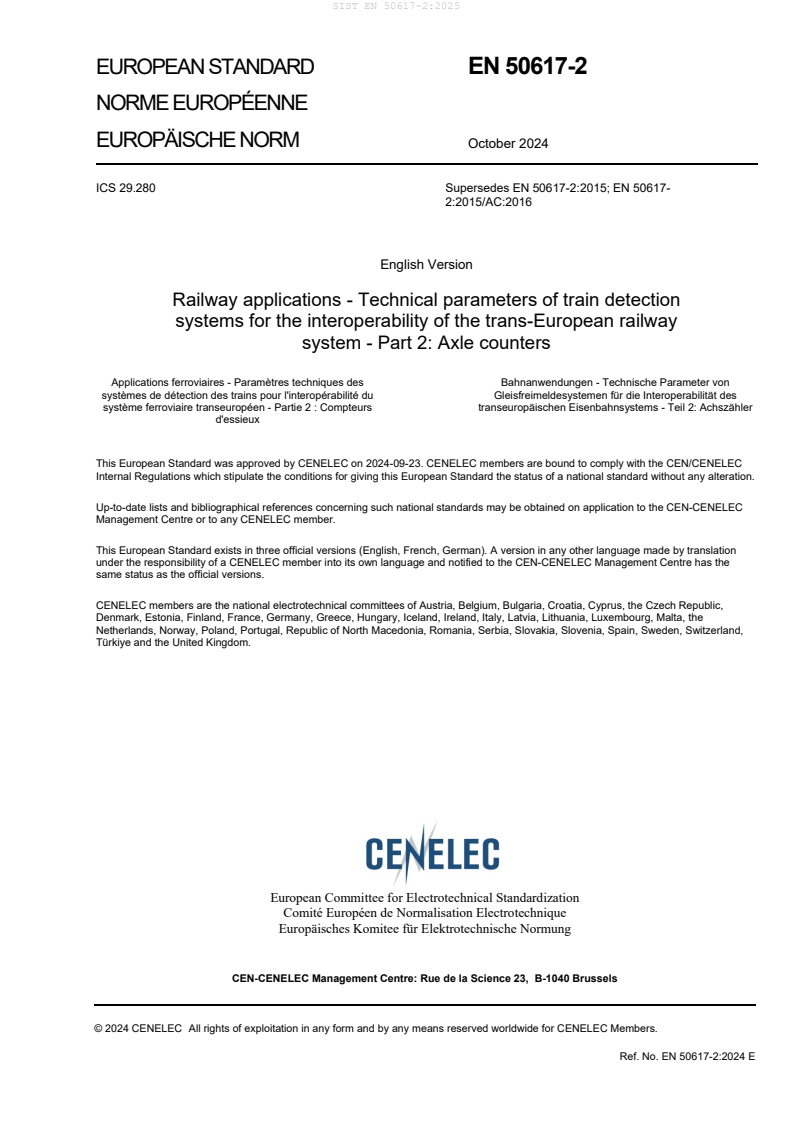
EUROPEAN STANDARD EN 50617-2
NORME EUROPÉENNE
EUROPÄISCHE NORM October 2024
ICS 29.280 Supersedes EN 50617-2:2015; EN 50617-
2:2015/AC:2016
English Version
Railway applications - Technical parameters of train detection
systems for the interoperability of the trans-European railway
system - Part 2: Axle counters
Applications ferroviaires - Paramètres techniques des Bahnanwendungen - Technische Parameter von
systèmes de détection des trains pour l'interopérabilité du Gleisfreimeldesystemen für die Interoperabilität des
système ferroviaire transeuropéen - Partie 2 : Compteurs transeuropäischen Eisenbahnsystems - Teil 2: Achszähler
d'essieux
This European Standard was approved by CENELEC on 2024-09-23. CENELEC members are bound to comply with the CEN/CENELEC
Internal Regulations which stipulate the conditions for giving this European Standard the status of a national standard without any alteration.
Up-to-date lists and bibliographical references concerning such national standards may be obtained on application to the CEN-CENELEC
Management Centre or to any CENELEC member.
This European Standard exists in three official versions (English, French, German). A version in any other language made by translation
under the responsibility of a CENELEC member into its own language and notified to the CEN-CENELEC Management Centre has the
same status as the official versions.
CENELEC members are the national electrotechnical committees of Austria, Belgium, Bulgaria, Croatia, Cyprus, the Czech Republic,
Denmark, Estonia, Finland, France, Germany, Greece, Hungary, Iceland, Ireland, Italy, Latvia, Lithuania, Luxembourg, Malta, the
Netherlands, Norway, Poland, Portugal, Republic of North Macedonia, Romania, Serbia, Slovakia, Slovenia, Spain, Sweden, Switzerland,
Türkiye and the United Kingdom.
European Committee for Electrotechnical Standardization
Comité Européen de Normalisation Electrotechnique
Europäisches Komitee für Elektrotechnische Normung
CEN-CENELEC Management Centre: Rue de la Science 23, B-1040 Brussels
© 2024 CENELEC All rights of exploitation in any form and by any means reserved worldwide for CENELEC Members.
Ref. No. EN 50617-2:2024 E
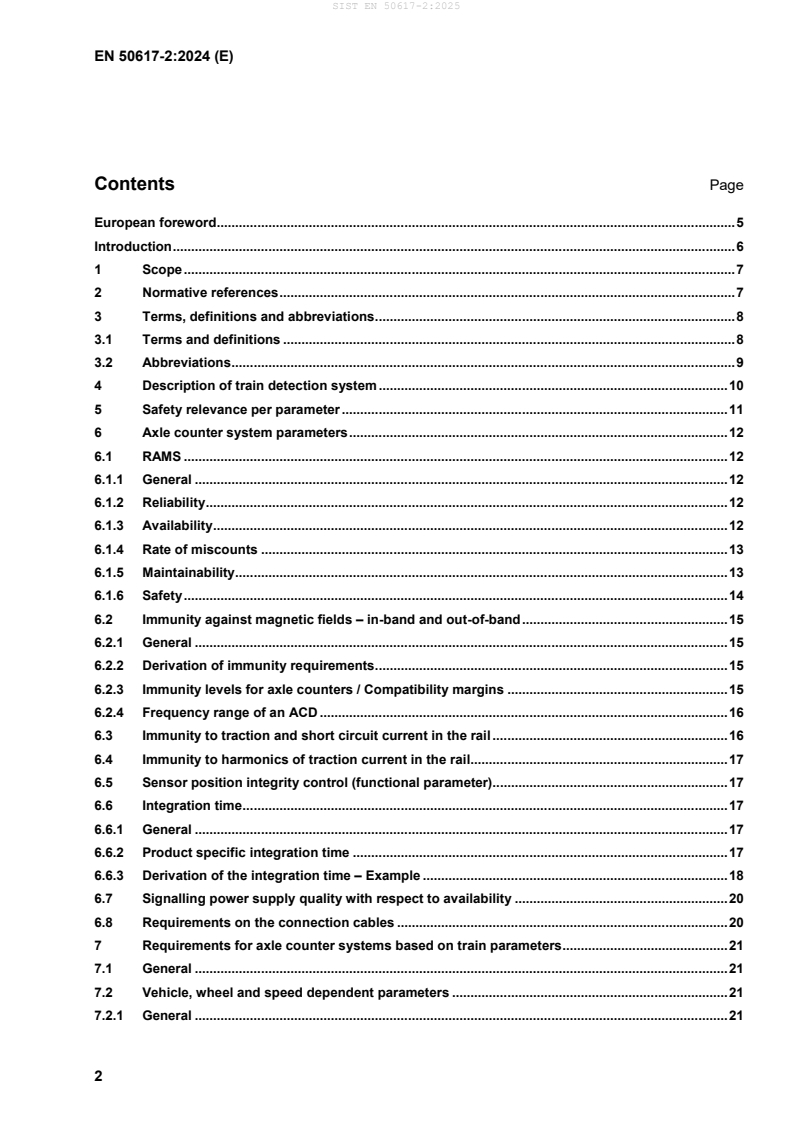
Contents Page
European foreword . 5
Introduction . 6
1 Scope . 7
2 Normative references . 7
3 Terms, definitions and abbreviations . 8
3.1 Terms and definitions . 8
3.2 Abbreviations . 9
4 Description of train detection system . 10
5 Safety relevance per parameter . 11
6 Axle counter system parameters . 12
6.1 RAMS . 12
6.1.1 General . 12
6.1.2 Reliability . 12
6.1.3 Availability . 12
6.1.4 Rate of miscounts . 13
6.1.5 Maintainability . 13
6.1.6 Safety . 14
6.2 Immunity against magnetic fields – in-band and out-of-band . 15
6.2.1 General . 15
6.2.2 Derivation of immunity requirements . 15
6.2.3 Immunity levels for axle counters / Compatibility margins . 15
6.2.4 Frequency range of an ACD . 16
6.3 Immunity to traction and short circuit current in the rail . 16
6.4 Immunity to harmonics of traction current in the rail . 17
6.5 Sensor position integrity control (functional parameter). 17
6.6 Integration time . 17
6.6.1 General . 17
6.6.2 Product specific integration time . 17
6.6.3 Derivation of the integration time – Example . 18
6.7 Signalling power supply quality with respect to availability . 20
6.8 Requirements on the connection cables . 20
7 Requirements for axle counter systems based on train parameters . 21
7.1 General . 21
7.2 Vehicle, wheel and speed dependent parameters . 21
7.2.1 General . 21
7.2.2 Wheel parameters . 22
7.2.3 Vehicle and speed depending parameters . 23
7.3 Material properties of vehicle parts in the detection area (metal free space) . 24
7.4 Sinusoidal sway of train . 24
7.5 Magnetic track brakes and eddy current brakes . 25
8 Track based parameters . 25
8.1 Material of sleepers . 25
8.2 Rail fittings/mounting area . 26
8.3 Slab track . 26
8.4 Other rails installations. 27
9 Environmental and other parameters . 27
9.1 General . 27
9.2 Pressure . 27
9.3 Movement of surrounding air . 27
9.4 Ambient temperatures . 28
9.4.1 General . 28
9.4.2 Ambient temperature for axle counter evaluator equipment . 28
9.4.3 Ambient temperature for ACD (without axle counter sensor) . 28
9.4.4 Ambient temperature for axle counter sensor . 29
9.5 Humidity . 29
9.6 Precipitation . 29
9.7 Protection Level (IP) . 29
9.7.1 General . 29
9.7.2 For components on the rail . 29
9.7.3 Components on the track / near the track . 30
9.8 Solar radiation . 30
9.9 Overvoltage protection (incl. indirect lightning effects) . 30
9.10 Pollution . 30
9.11 Fire protection . 30
9.12 Vibrations / shock . 30
9.13 EMC . 30
9.13.1 General . 30
9.13.2 Requirement and validation for EMC . 31
9.14 Definition of Influence from other components . 31
Annex A (informative) Design guide for measurement antennas . 32
Annex B (normative) Frequency management (reproduced from ERA/ERTMS/033281) . 34
Annex C (normative) Test equipment, test methodologies and reports to be performed . 36
Annex D (informative) Intermodulation effects . 52
Bibliography . 55
Figures
Figure 1 — System boundary of an axle counter system . 11
Figure 2 — Correlation between hazard rate and time between trains . 14
Figure 3 — Areas for evaluation . 16
Figure 4 — Immunity versus duration of interference field . 18
Figure 5 — ACD immunity as a function of time duration of in-band disturbance . 19
Figure 6 — Filter curves measured and calculated . 20
Figure 7 — Definition of the parameters . 22
Figure 8 — Axle to axle distance . 23
Figure 9 — Parameters influencing the sinusoidal sway . 25
Figure A.1 — Side view (Y and Z coils, dimensions 50 mm to 150 mm) . 32
Figure B.1 — Areas for evaluation . 35
Figure C.1 — Homogenity of field generation antenna (FGA) . 37
Figure C.2 — ACD, schematic diagram . 38
Figure C.3 — Test set-up for homogeneous fields in X-Z-direction (front view for α = 0°) . 39
Figure C.4 — Test set-up for homogeneous fields in X-Z-direction (side view for α = 0°) . 39
Figure C.5 — Test set-up for homogeneous fields in Y-Z-direction (front view) . 39
Figure C.6 — Test set-up for homogeneous fields in Y-Z-direction (side view for α = 0°) . 40
Figure C.7 — ACD response to intermittent sinusoidal waves . 41
Figure C.8 — Test set-up for rail current tests . 44
Figure C.9 — Frequency mask . 46
Figure C.10 — Influence zones of magnetic fields . 47
Figure C.11 — Test setup . 48
Figure C.12 — Test set-up for conducted immunity testing . 49
Figure D.1 — Frequency management and amplitude masks . 52
Figure D.2 — Lab test set up to derive saturation behaviour regarding multi-tone signals . 53
Figure D.3 — Trackside test setup . 53
Figure D.4 — Illustration of intermodulation effect . 54
Tables
Table 1 — Overview of safety relevance in the subclauses . 12
Table B.1 — Emission limits and evaluation parameters (narrow band) . 34
Table B.2 — Increased magnetic field limits . 35
European foreword
This document (EN 50617-2:2024) has been prepared by CLC/SC 9XA “Communication, signalling and
processing systems” of CLC/TC 9X “Electrical and electronic applications for railways”.
The following dates are fixed:
• latest date by which this document has to be (dop) 2025-09-23
implemented at national level by publication of
an identical national standard or by
endorsement
• latest date by which the national standards (dow) 2027-09-23
conflicting with this document have to be
withdrawn
This document supersedes EN 50617-2:2015 and all of its amendments and corrigenda (if any).
— Annex D: new informative annex for intermodulation effects potentially affecting the compatibility limits for
Rolling Stock
Attention is drawn to the possibility that some of the elements of this document may be the subject of patent
rights. CENELEC shall not be held responsible for identifying any or all such patent rights.
This document is Part 2 of the EN 50617 series, which consists of the following parts under the common title
“Railway Applications - Technical parameters of train detection systems”:
— Part 1: Track circuits;
— Part 2: Axle counters.
Any feedback and questions on this document should be directed to the users’ national committee. A complete
listing of these bodies can be found on the CENELEC website.
Introduction
The working group SC9XA WGA4-2 has developed the limits for electromagnetic compatibility between rolling
stock and individual train detection systems, specifically track circuits and axle counter systems and
correspondingly published two technical specifications CLC/TS 50238-2 and CLC/TS 50238-3. These limits and
associated measurement methods are based on preferred existing systems (as defined in CLC/TS 50238-2 and
CLC/TS 50238-3) which are well established and still put forward for signalling renewals by infrastructure
managers.
To meet the requirements for compatibility between train detection systems and rolling stock in the future and
to achieve interoperability and free movement within the European Union, ERA/ERTMS/033281 defines the
relevant parameters for compatibility of rolling stock with track circuits and axle counter systems.
The train detection systems, track circuits and axle counters are an integral part of the CCS trackside subsystem
in the context of the Rail Interoperability Directive. The relevant technical parameters are enumerated in the
CCS and LOC&PAS TSI and ERA/ERTMS/033281. ERA/ERTMS/033281 specifies the relevant parameters for
rolling stock for compatibility with the infrastructure. This document covers all relevant technical parameters of
train detection systems (axle counter) in a manner that provides a presumption of conformity with interoperability
requirements, but is not limited to interoperable lines. This document refers whenever needed to
ERA/ERTMS/033281. Although the demand for FrM is driven by Interoperability requirements, it is independent
from the drive to introduce systems like ERTMS level 3 or level 2.
This document is based on the current understanding of the railway experts represented at WGA4-2 that track
circuits and axle counter systems will continue to be the essential two train detection systems for the foreseeable
future.
The published specification EN 50592 can be used to ascertain conformity of rolling stock with the FrM
presented in ERA/ERTMS/033281.
The published specification CLC/TS 50238-3 can be used to ascertain conformity of rolling stock with existing
individual axle counter detectors.
In this document, the defined parameters are structured and allocated according to their basic references as
follows:
— axle counter system parameters;
— train based parameters;
— track based parameters;
— environmental and other parameters.
Where possible, the parameters as defined are consistent with other European Standards.
Each parameter is defined by a short general description, the definition of the requirement, the relation to other
standards and a procedure to show the fulfilment of the requirement as far as necessary. An overview of the
safety relevance of each parameter is given – in the context of this document – in a separate table.
1 Scope
This document specifies parameters for the design and usage of axle counter systems.
For this, this document specifies the technical parameters of axle counter systems associated with the magnetic
field limits for RST in the context of interoperability. In addition, test methods are defined for establishing the
conformity and the performance of an axle counter detector.
This document is intended to be used to assess compliance of axle counter systems and other forms of wheel
sensors used for train detection, in the context of the European Directive on the interoperability of the trans-
European railway system and the associated technical specification for interoperability relating to the control-
command and signalling track-side subsystems.
This document can also be used for axle counter systems installed on lines which are not declared as
interoperable (including metro and tram lines).
For wheel sensors and wheel detectors in other applications than axle counters but using the same sensors on
the rail and detection circuits, transient and continuous interference can be considered as equivalent to axle
counter detectors or axle counter sensors.
Under interoperability, the frequency bands and rolling stock emission limits are currently defined in the axle
counter FrM as specified in the ERA/ERTMS/033281 document.
2 Normative references
The following documents are referred to in the text in such a way that some or all of their content constitutes
requirements of this document. For dated references, only the edition cited applies. For undated references, the
latest edition of the referenced document (including any amendments) applies.
EN 16432-1:2017, Railway applications - Ballastless track systems - Part 1: General requirements
EN 50121-4:2016, Railway applications - Electromagnetic compatibility - Part 4: Emission and immunity of the
signalling and telecommunications apparatus
EN 50124-2:2017, Railway applications - Insulation coordination - Part 2: Overvoltages and related protection
EN 50125-3:2003, Railway applications - Environmental conditions for equipment - Part 3: Equipment for
signalling and telecommunications
EN 50126-1:2017, Railway Applications - The Specification and Demonstration of Reliability, Availability,
Maintainability and Safety (RAMS) - Part 1: Generic RAMS Process
EN 50126-2:2017, Railway Applications - The Specification and Demonstration of Reliability, Availability,
Maintainability and Safety (RAMS) - Part 2: Systems Approach to Safety
EN 50128:2011, Railway applications - Communication, signalling and processing systems - Software for
railway control and protection systems
EN 50129:2018, Railway applications - Communication, signalling and processing systems - Safety related
electronic systems for signalling
EN 50592:2016, Railway applications - Testing of rolling stock for electromagnetic compatibility with axle
counters
EN 60068-2-1:2007, Environmental testing - Part 2-1: Tests - Test A: Cold (IEC 60068-2-1:2007)
EN 60068-2-2:2007, Environmental testing - Part 2-2: Tests - Test B: Dry heat (IEC 60068-2-2:2007)
EN 60068-2-30:2005, Environmental testing - Part 2-30: Tests - Test Db: Damp heat, cyclic (12 h + 12 h cycle)
(IEC 60068-2-30:2005)
EN 60529:1991, Degrees of protection provided by enclosures (IP Code) (IEC 60529)
EN 61000-4-6:2014, Electromagnetic compatibility (EMC) - Part 4-6: Testing and measurement techniques -
Immunity to conducted disturbances, induced by radio-frequency fields (IEC 61000-4-6:2013)
ERA/ERTMS/033281, Interfaces between control-command and signalling trackside and other subsystems
3 Terms, definitions and abbreviations
3.1 Terms and definitions
For the purposes of this document, the following terms and definitions apply.
ISO and IEC maintain terminology databases for use in standardization at the following addresses:
— ISO Online browsing platform: available at https://www.iso.org/obp
— IEC Electropedia: available at https://www.electropedia.org/
3.1.1
antenna for generating magnetic fields
FGA
square loop antenna to generate the magnetic fields for testing of the immunity
3.1.2
axle counter detector
ACD
detector consisting of the axle counter sensor and of the detection circuit, which includes in general filters and
rectifiers
3.1.3
axle counter sensor
sensor head mounted in the track
3.1.4
axle counter system
whole system including the axle counter detector with its sensor, and the evaluation unit
3.1.5
bandwidth
difference between the upper and lower frequencies in a contiguous set of frequencies and is typically measured
in Hz
3.1.6
equipment under test
EUT
set of ACD connected to a rail
3.1.7
immunity level
maximum level of interfering signal at which the correct operation of the equipment is granted to be in line with
expectations
As impacted by EN 60529:1991/A1:2000, EN 60529:1991/A2:2013, EN 60529:1991/AC:2016-12 and
EN 60529:1991/A2:2013/AC:2019-02,
3.1.8
in-band
in the working frequency range of an ACD
3.1.9
inflection point
transition between the static (continuous wave) and dynamic immunity (short duration) behaviour of the ACD
3.1.10
integration time
window size over which the root mean square (RMS) of the output of the band-pass filter is calculated
3.1.11
measurement antenna
antenna mounted on the rail to capture magnetic field
Note 1 to entry: The measurement covers the axes X, Y and Z.
3.1.12
out-of-band
outside of the working frequency range of an ACD
3.1.13
right-side failure
RSF
failure in the signalling system that leaves the system in a safe condition
[SOURCE: IEC 60050-821:2017, 821-05-80, modified – “of an item of signalling equipment which cannot result
in any hazard to the safety of railway traffic” has been replaced with “in the signalling system that leaves the
system in a safe condition”.]
3.1.14
sinusoidal sway
movement of a wheel of a running train in the y-direction, which influences the distance of the wheel flange in
relation to the head of the rail
3.1.15
working frequency range
frequency range or field where the sensors are operating
3.1.16
wrong side failure
WSF
failure in the signalling system which leaves the system in a dangerous condition
3.2 Abbreviations
For the purposes of this document, the following abbreviations apply.
ACD axle counter detector
AM amplitude modulation
CCS control-command and signalling
DC direct current
EMC electromagnetic compatibility
ERTMS European Rail Traffic Management System
ETCS European Train Control System
EUT equipment under test
FFFIS form fit functional interface specification
FGA field generating antenna
FrM frequency management as defined in ERA/ERTMS/033281
FSK frequency shift key
HR hazard rate
IM infrastructure manager
IP International Protection
IR Infrared (electromagnetic radiation)
IPxx ingress protection (rating)
LC inductor/capacitor resonant circuit
MIZ metallic influencing zone
MTBF mean time between failure
MTTR mean time to repair
PS power supply
RMS root mean square
RSF right-side failure
RST rolling stock
SIL safety integrity level
TEU trackside electronic unit
THR tolerable hazard rate
TSI technical specification for interoperability
UV ultraviolet (electromagnetic radiation)
WSF wrong side failure
4 Description of train detection system
Train detection systems for route proving as a fully automatic train detection system are integrated into railway
signalling and safety systems. The train detection is part of the route proving procedure contributing to a safe
and reliable railway operation.
The train detection equipment provides information about whether track sections are clear of or occupied by rail
vehicles.
Axle counter systems operate on the principle of difference calculation. The evaluation unit evaluates the signals
received from each counting head associated with a section, compares the number of axles which have entered
the train detection section with the number of axles which have left this section and generates a “track clear” or
“track occupied” indication.
Figure 1 defines the system boundaries of a train detection system using axle counter systems:
Figure 1 — System boundary of an axle counter system
5 Safety relevance per parameter
There are two degrees of safety relevance which may be assigned to the technical parameters of axle counter
systems (see Table 1):
NOTE The issue safety relevance is defined in general in EN 50126-1:2017, EN 50126-2:2017 and EN 50129:2018
(see also 6.1.5). The information below is given only with respect to the parameters defined in this document. Table 1 gives
an indication on the relationship between individual parameters and functional safety.
— Direct safety relevant parameters:
Failure to meet the direct safety relevant requirement can result directly in a wrong side failure.
— Indirect safety relevant parameters:
Failure to meet the indirect safety relevant requirement can cause a right-side failure but can also result in
the occurrence of a second failure or human error which could subsequently lead to an accident, for
example every not autocorrected fault count will lead to a reset of the section, which itself is a safety issue.
Indirect safety relevant parameters are generally availability related. A deviation can result in a reset being
required. Human error can then lead to an accident.
The consequences of right-side failures and errors shall therefore be evaluated in the context of risk analysis
and appropriately mitigated in the equipment and system design, and in the operational rules.
Table 1 — Overview of safety relevance in the subclauses
Direct safety
relevance
Subclause
(no indicates indirect
safety relevance)
6.1.2 Availability no
6.1.4 Maintainability no
6.1.5 Safety yes
6.2 Immunity against Magnetic fields – in-band and out-of-band no
6.1.6.2 Maximum time between train runs no
6.3 Immunity to traction and short circuit current in the rail no
6.4 Immunity to harmonics of traction current in the rail no
6.5 Sensor position integrity control (functional parameter) yes
6.6 Integration time no
6.7 Signalling power supply quality with respect to availability no
6.8 Requirements on the connection cables no
7.2 Vehicle, wheel and speed dependent parameters yes
7.3 Material properties of vehicle parts in the detection area (metal free space) no
7.4 Sinusoidal sway of train yes
7.5 Magnetic track brakes and eddy current brakes no
8.1 Material of sleepers no
8.2 Rail fittings/mounting area no
8.3 Slab track no
Clause 9 Environmental and other parameters no
C.4.5.3 Immunity to multiple transients no
6 Axle counter system parameters
6.1 RAMS
6.1.1 General
RAMS performance shall be defined for the axle counter system which may control one or more sections. It can
be assumed that one section consists of an average of about 1,3 axle counter detectors.
6.1.2 Reliability
Reliability is defined in EN 50126-1:2017, EN 50126-2:2017. A single reliability figure cannot be harmonized
because it is a combination of qualitative and quantitative aspects.
6.1.3 Availability
The following information and definitions are derived from EN 50126-1:2017, EN 50126-2:2017.
The availability is one of the most significant parameters of an axle counter system. It is dependent on the
sufficient immunity margin (compatibility margin between susceptibility threshold and the radiated emission level
from RST). To ensure an adequate operational availability, a margin of 9 dB between the established immunity
and the limit for rolling stock shall be applied. The value of 9 dB ensures a correct count.
NOTE Concerning the margin 9 dB see also 6.2.3.
For a standardized (typical) axle counter system section the following example of parameters may be used to
determine an acceptable availability in terms of failures per train:
MTBF
Availability
100%⋅
(MTBF+ MTTR)
Mean Time to repair (MTTR): 30 min (best case) – 300 min (worst case)
MTBF is calculated on the basis of component data and is for this reason product specific. The rate of miscounts
is a separate parameter which can be affected by the geometry of wheels and other mechanical subsystems
and EMC characteristics of rolling stock.
MTBF is a parameter of the equipment of the train detection system required for a single detection section. The
integrity of the trackside cables and tracks/rails are excluded from the MTBF requirement calculations.
6.1.4 Rate of miscounts
The axle counter system shall fulfil the requirements derived by EN 50126-1:2017, EN 50126-2:2017.
The quality of service of an axle counter system shall be documented in the manufacturers manuals.
NOTE Quality of service means how often a manual activity of the operator is needed to bring the system to normal
operation.
6.1.5 Maintainability
The following information and definitions are derived from EN 50126-1:2017, EN 50126-2:2017 and
EN 50129:2018.
The proper function of the axle counter system depends on correct installation, initial adjustment, preventive
and corrective maintenance of the cabling, connections to the rail and position of the sensors.
The maintainability of the axle counter system shall be seen in the context of the complete integrated system
including the ACD, the communication links, the evaluator unit and the power supplies.
The maintenance scope and the maintenance frequency of the axle counter system shall be described in the
product specific user’s guide and checked by validation. The maintenance frequency shall be less than or equal
to once per year per ACD.
The supplier shall provide the information related to equipment failure modes and their rates of occurrence. This
will enable infrastructure managers to estimate the corresponding MTTR and clarify the implications for their
maintenance specification. Aspects to be taken into consideration on the trackside maintenance:
— Axle counter sensor has been damaged or knocked off the rail.
— Sensor sensitivity requires readjustment due to a deterioration of rail conditions (e.g. worn rail surface).
— Train wheel conditions changed (introduction of a new type of vehicle).
— Cabling is incorrectly connected to the sensor and or the connection box.
— Short circuit of two or more wires in the outdoor cable.
Other aspects:
— In-house equipment. If there are any then they shall be described in the product specific user’s guide.
— Cabling/wiring/connection boxes.
=
— Time without train runs (see 6.1.6.2).
6.1.6 Safety
6.1.6.1 General
The following information and definitions are derived from EN 50126-1:2017, EN 50126-2:2017, EN 50128:2011
and EN 50129:2018.
The safe movement of the trains on railways relies on the train detection equipment.
The safety integrity shall be validated based on the safety case of the axle counter system. It shall be shown in
the safety case that the safety integrity level required is achieved. The requirements as described in
EN 50126-1:2017, EN 50126-2:2017, EN 50128:2011 and EN 50129:2018 shall be met.
NOTE THR is a term used in evolving safety related standards. It is a calculable failure rate leading to a hazardous
event, which can be converted to a defined SIL level.
6.1.6.2 Maximum time between train runs
To alleviate any remaining hazards, it is recommended to specify a maximum time between trains.
NOTE Compliance with the maximum time between train runs is the responsibility of the IM.
The axle counter system allows a maximum time between train runs for technical and safety related reasons.
The train run allows verification of proper functionality of the axle counter system. The maximum time between
train runs shall be documented in the manufacturer’s manuals and shall be forwarded as an operational rule to
the infrastructure manager. The maximum time between train runs shall be aligned in addition with the safety
and operational requirements of the infrastructure manager.
The validation of the intended operation shall be realized by physical train movement.
Typically, the maximum time allowed without any train runs between two train runs is an input parameter for
safety case and fault tree analysis. Validation is successful if
— the hazard rate (HR) of the overall axle counter system < tolerable hazard rate.
Failures that can only be revealed through a train run influence the hazard rate by increasing the risk when
extending the duration of time between train runs (see Figure 2). The limit for the maximum time is reached
when:
— the hazard rate (HR) ≥ tolerable hazard rate (THR).
Figure 2 — Correlation between hazard rate and time between trains
6.2 Immunity against magnetic fields – in-band and out-of-band
6.2.1 General
ACD can be influenced in different ways. Within the frequency range of the ACD, the influence of magnetic
fields generated by rolling stock is dominant. As a result of these fields, spurious wheel pulses can be generated
in the ACD, potentially creating unreliability which can lead, in the worst case, to a safety risk.
To ensure proper compatibility between rolling stock and ACDs, electromagnetic emission of rolling stock shall
be taken into account. Therefore, it is necessary to test the immunity levels of ACDs to verify their conformity.
The emission limits for rolling stock have been defined in the FrM and are the basis for deriving the immunity
levels of the ACDs.
The following parameters are associated with the immunity of the ACD:
— immunity level to magnetic fields within the working frequency range:
— continuous magnetic fields;
— discontinuous (transient) magnetic fields;
— response bandwidth (3 dB and 20 dB);
— immunity to current in the rail;
— immunity to magnetic fields outside the working frequency range;
— immunity to magnetic field generated by the ETCS vehicle antenna.
The following subclauses describe the requirements for the axle counter immunity. The limits effectively
encompass interference from magnetic fields of all sources which may occur at rail level, either generated by
rail current or equipment on the vehicles, or both.
The associated measurement procedures for the determination of the magnetic field immunity levels of ACDs
in all three directions X, Y and Z are described in Annex C.
6.2.2 Derivation of immunity requirements
The immunity requirements for the axle counters shall be derived from the FrM as specified in the
ERA/ERTMS/033281.
The FrM defined in the ERA/ERTMS/033281 specifies the reserved frequency bands for the ACD with the
corresponding emission limit values for rolling stock.
In addition, out-of-band limits are defined in the FrM.
In the complete frequency range from 10 kHz to 1,3 MHz rolling stock manufacturers are required to fulfil the
specified magnetic field limits (in-band and out-of-band), applying specified evaluation parameters (e.g. filter
bandwidth, filter order and integration time) as listed in Annex B.
6.2.3 Immunity levels for axle counters / Compatibility margins
To ensure sufficient immunity of ACDs to emission from rolling stock, the immunity level of the ACD shall be
higher than the emission limits of the rolling stock within the frequency ranges reserved for axle counters defined
in the FrM in ERA/ERTMS/033281.
The immunity level of an ACD shall be at least 9 dB higher than the rolling stock emission limit in the respective
band 1, 2 or 3.
The immunity level of an ACD shall be at least 3 dB higher than the rolling stock emission limit in the frequency
range 10 kHz to 1,3 MHz, out-of-band.For out-of-band frequencies from 0 kHz to 10 kHz and 1,3 MHz to
30 MHz no limit levels are defined in the FrM and therefore no extra margin for ACD shall be applied.
The measurement shall be made in the laboratory and documented as defined in Clause C.10.
The 9 dB includes the following:
— 6 dB signal-to-noise ratio to guarantee the probability requirements of miscounting within the equipment
operating tolerances;
— 3 dB accounting for:
1) uncertainty of measuring chain,
2) antenna positioning,
3) overlapping effects (analysing methods),
4) other effects like rain, temperature, etc.,
5) presence of wheel.
NOTE 1 The limits for the ACD validation apply only outside the wheel contact zone.
NOTE 2 The 3 dB margin takes into account the uncertainty of magnetic field measurement for vehicle authorization as
well as other indefinable effects.
6.2.4 Frequency range of an ACD
The working frequency range
...
Questions, Comments and Discussion
Ask us and Technical Secretary will try to provide an answer. You can facilitate discussion about the standard in here.
Loading comments...