

ISO/IEC 15408-5:2022
(Main)Information security, cybersecurity and privacy protection — Evaluation criteria for IT security — Part 5: Pre-defined packages of security requirements
General Information
- Abstract
This document provides packages of security assurance and security functional requirements that have been identified as useful in support of common usage by stakeholders. EXAMPLE Examples of provided packages include the evaluation assurance levels (EAL) and the composed assurance packages (CAPs). This document presents: — evaluation assurance level (EAL) family of packages that specify pre-defined sets of security assurance components that may be referenced in PPs and STs and which specify appropriate security assurances to be provided during an evaluation of a target of evaluation (TOE); — composition assurance (CAP) family of packages that specify sets of security assurance components used for specifying appropriate security assurances to be provided during an evaluation of composed TOEs; — composite product (COMP) package that specifies a set of security assurance components used for specifying appropriate security assurances to be provided during an evaluation of a composite product TOEs; — protection profile assurance (PPA) family of packages that specify sets of security assurance components used for specifying appropriate security assurances to be provided during a protection profile evaluation; — security target assurance (STA) family of packages that specify sets of security assurance components used for specifying appropriate security assurances to be provided during a security target evaluation. The users of this document can include consumers, developers, and evaluators of secure IT products.
- Status
- Withdrawn
- Publication Date
- 08-Aug-2022
- Current Stage
- 9599 - Withdrawal of International Standard
- Start Date
- 28-Apr-2026
- Completion Date
- 29-Aug-2026
Overview
ISO/IEC 15408-5:2022 is Part 5 of the Common Criteria family for information security, cybersecurity and privacy protection. It defines pre‑defined packages of security assurance and security functional requirements that stakeholders commonly use when specifying or evaluating IT products (Targets of Evaluation, TOEs). The standard supplies ready‑made assurance packages - including Evaluation Assurance Levels (EALs), Composed Assurance Packages (CAPs), a Composite Product (COMP) package, and assurance families for Protection Profiles (PPA) and Security Targets (STA) - to streamline, harmonize and make evaluations more predictable.
Key topics and requirements
- Evaluation Assurance Levels (EAL1–EAL7): a scale of assurance where each EAL specifies a pre‑defined set of assurance components.
- EAL1 - Functionally tested
- EAL2 - Structurally tested
- EAL3 - Methodically tested and checked
- EAL4 - Methodically designed, tested and reviewed
- EAL5 - Semi‑formally verified design and tested
- EAL6 - Semi‑formally verified design and tested (higher rigor)
- EAL7 - Formally verified design and tested
- Composed Assurance Packages (CAPs): packages tailored for systems composed of multiple components or subsystems. Examples in the standard:
- CAP A - Structurally composed
- CAP B - Methodically composed
- CAP C - Methodically composed, tested and reviewed
- Composite Product (COMP) package: defines assurance components for evaluating composite products made from independently evaluated parts.
- PPA & STA families: predefined assurance sets for Protection Profile and Security Target evaluations, including direct rationale and standard package variants.
- Normative links: aligns with ISO/IEC 15408‑1 (general model) and ISO/IEC 15408‑3 (assurance components).
Applications and who uses it
- Procurement officers / consumers: specify required EALs or CAPs in RFPs to ensure predictable assurance levels.
- Product developers: use packages to design evidence and processes that meet an intended assurance level, reducing development and evaluation effort.
- Evaluation labs / certifiers: apply the predefined packages to assess TOEs consistently against Common Criteria expectations.
- PP and ST authors: leverage PPA/STA packages to simplify and harmonize requirement sets for profiles and targets.
Related standards
- ISO/IEC 15408‑1:2022 - Introduction and general model (normative)
- ISO/IEC 15408‑3:2022 - Security assurance components (normative)
- Common Criteria (CC) material referenced by national certification schemes
Using ISO/IEC 15408-5:2022 helps organizations standardize assurance claims, reduce duplicated effort when creating Protection Profiles and Security Targets, and increase comparability of security evaluations across vendors and evaluators. Keywords: ISO/IEC 15408-5:2022, Common Criteria, EAL, CAP, composite product, protection profile, security target, cybersecurity, security assurance.
Relations
- Effective Date
- 25-Aug-2026
- Effective Date
- 03-Jun-2026
- Effective Date
- 27-May-2026
- Effective Date
- 28-Oct-2023
Get Certified
Connect with accredited certification bodies for this standard

BSI Group
BSI (British Standards Institution) is the business standards company that helps organizations make excellence a habit.

Bureau Veritas
Bureau Veritas is a world leader in laboratory testing, inspection and certification services.

DNV
DNV is an independent assurance and risk management provider.
Sponsored listings
Frequently Asked Questions
ISO/IEC 15408-5:2022 is a standard published by the International Organization for Standardization (ISO). Its full title is "Information security, cybersecurity and privacy protection — Evaluation criteria for IT security — Part 5: Pre-defined packages of security requirements". This standard covers: This document provides packages of security assurance and security functional requirements that have been identified as useful in support of common usage by stakeholders. EXAMPLE Examples of provided packages include the evaluation assurance levels (EAL) and the composed assurance packages (CAPs). This document presents: — evaluation assurance level (EAL) family of packages that specify pre-defined sets of security assurance components that may be referenced in PPs and STs and which specify appropriate security assurances to be provided during an evaluation of a target of evaluation (TOE); — composition assurance (CAP) family of packages that specify sets of security assurance components used for specifying appropriate security assurances to be provided during an evaluation of composed TOEs; — composite product (COMP) package that specifies a set of security assurance components used for specifying appropriate security assurances to be provided during an evaluation of a composite product TOEs; — protection profile assurance (PPA) family of packages that specify sets of security assurance components used for specifying appropriate security assurances to be provided during a protection profile evaluation; — security target assurance (STA) family of packages that specify sets of security assurance components used for specifying appropriate security assurances to be provided during a security target evaluation. The users of this document can include consumers, developers, and evaluators of secure IT products.
This document provides packages of security assurance and security functional requirements that have been identified as useful in support of common usage by stakeholders. EXAMPLE Examples of provided packages include the evaluation assurance levels (EAL) and the composed assurance packages (CAPs). This document presents: — evaluation assurance level (EAL) family of packages that specify pre-defined sets of security assurance components that may be referenced in PPs and STs and which specify appropriate security assurances to be provided during an evaluation of a target of evaluation (TOE); — composition assurance (CAP) family of packages that specify sets of security assurance components used for specifying appropriate security assurances to be provided during an evaluation of composed TOEs; — composite product (COMP) package that specifies a set of security assurance components used for specifying appropriate security assurances to be provided during an evaluation of a composite product TOEs; — protection profile assurance (PPA) family of packages that specify sets of security assurance components used for specifying appropriate security assurances to be provided during a protection profile evaluation; — security target assurance (STA) family of packages that specify sets of security assurance components used for specifying appropriate security assurances to be provided during a security target evaluation. The users of this document can include consumers, developers, and evaluators of secure IT products.
ISO/IEC 15408-5:2022 is classified under the following ICS (International Classification for Standards) categories: 35.030 - IT Security. The ICS classification helps identify the subject area and facilitates finding related standards.
ISO/IEC 15408-5:2022 has the following relationships with other standards: It is inter standard links to EN ISO/IEC 19896-3:2025, EN ISO/IEC 18045:2023, EN ISO/IEC 15408-3:2023, ISO/IEC 15408-5:2026. Understanding these relationships helps ensure you are using the most current and applicable version of the standard.
ISO/IEC 15408-5:2022 is available in PDF format for immediate download after purchase. The document can be added to your cart and obtained through the secure checkout process. Digital delivery ensures instant access to the complete standard document.
Standards Content (Sample)
INTERNATIONAL ISO/IEC
STANDARD 15408-5
First edition
2022-08
Information security, cybersecurity
and privacy protection — Evaluation
criteria for IT security —
Part 5:
Pre-defined packages of security
requirements
Sécurité de l'information, cybersécurité et protection de la vie
privée — Critères d'évaluation pour la sécurité des technologies
de l'information —
Partie 5: Paquets prédéfinis d'exigences de sécurité
Reference number
© ISO/IEC 2022
© ISO/IEC 2022
All rights reserved. Unless otherwise specified, or required in the context of its implementation, no part of this publication may
be reproduced or utilized otherwise in any form or by any means, electronic or mechanical, including photocopying, or posting on
the internet or an intranet, without prior written permission. Permission can be requested from either ISO at the address below
or ISO’s member body in the country of the requester.
ISO copyright office
CP 401 • Ch. de Blandonnet 8
CH-1214 Vernier, Geneva
Phone: +41 22 749 01 11
Email: copyright@iso.org
Website: www.iso.org
Published in Switzerland
ii
© ISO/IEC 2022 – All rights reserved
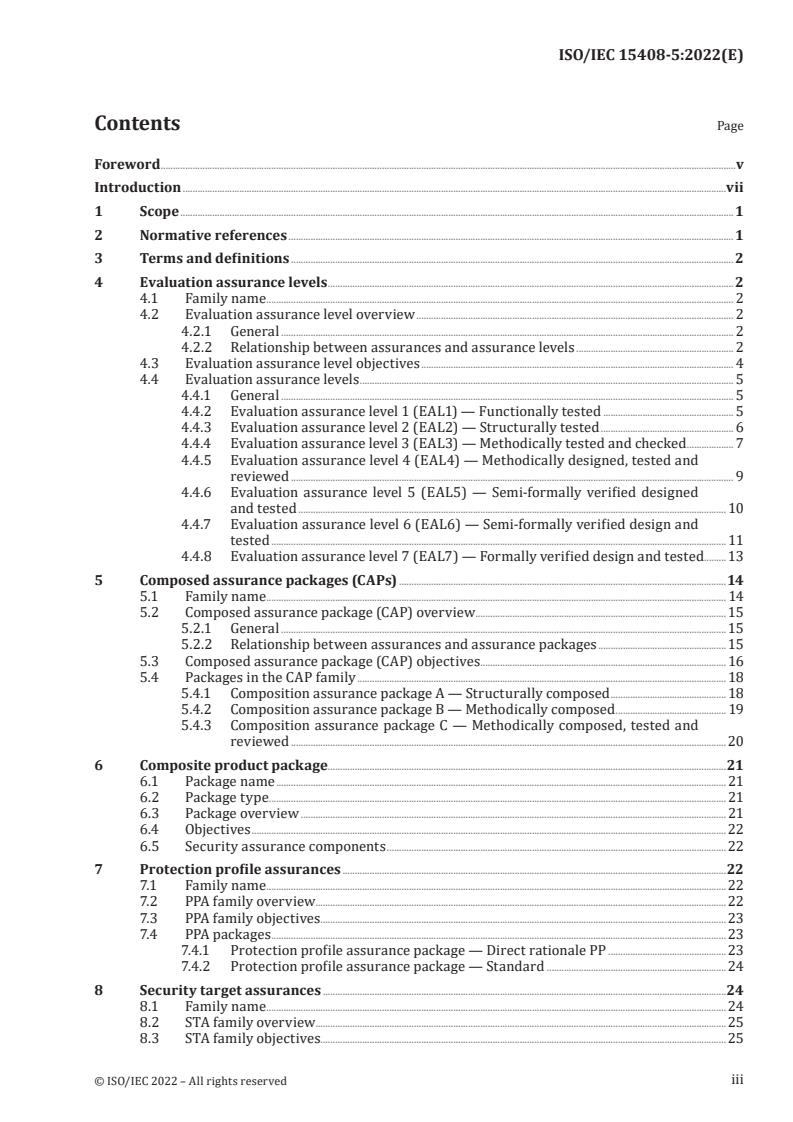
Contents Page
Foreword .v
Introduction .vii
1 Scope . 1
2 Normative references . 1
3 Terms and definitions . 2
4 Evaluation assurance levels .2
4.1 Family name . 2
4.2 Evaluation assurance level overview . 2
4.2.1 General . 2
4.2.2 Relationship between assurances and assurance levels . 2
4.3 Evaluation assurance level objectives . 4
4.4 Evaluation assurance levels . 5
4.4.1 General . 5
4.4.2 Evaluation assurance level 1 (EAL1) — Functionally tested . 5
4.4.3 Evaluation assurance level 2 (EAL2) — Structurally tested . 6
4.4.4 Evaluation assurance level 3 (EAL3) — Methodically tested and checked . 7
4.4.5 Evaluation assurance level 4 (EAL4) — Methodically designed, tested and
reviewed . 9
4.4.6 Evaluation assurance level 5 (EAL5) — Semi-formally verified designed
and tested . 10
4.4.7 Evaluation assurance level 6 (EAL6) — Semi-formally verified design and
tested . 11
4.4.8 Evaluation assurance level 7 (EAL7) — Formally verified design and tested .13
5 Composed assurance packages (CAPs) .14
5.1 Family name . 14
5.2 Composed assurance package (CAP) overview . 15
5.2.1 General .15
5.2.2 Relationship between assurances and assurance packages .15
5.3 Composed assurance package (CAP) objectives . 16
5.4 Packages in the CAP family . 18
5.4.1 Composition assurance package A — Structurally composed . 18
5.4.2 Composition assurance package B — Methodically composed . 19
5.4.3 Composition assurance package C — Methodically composed, tested and
reviewed . 20
6 Composite product package .21
6.1 Package name . 21
6.2 Package type. 21
6.3 Package overview . 21
6.4 Objectives . 22
6.5 Security assurance components . 22
7 Protection profile assurances .22
7.1 Family name .22
7.2 PPA family overview . 22
7.3 PPA family objectives . 23
7.4 PPA packages . 23
7.4.1 Protection profile assurance package — Direct rationale PP .23
7.4.2 Protection profile assurance package — Standard . 24
8 Security target assurances .24
8.1 Family name . 24
8.2 STA family overview . .25
8.3 STA family objectives. 25
iii
© ISO/IEC 2022 – All rights reserved
8.4 STA packages . 25
8.4.1 Security target assurance package — Direct rationale .25
8.4.2 Security target assurance package — Standard . . 26
iv
© ISO/IEC 2022 – All rights reserved
Foreword
ISO (the International Organization for Standardization) and IEC (the International Electrotechnical
Commission) form the specialized system for worldwide standardization. National bodies that are
members of ISO or IEC participate in the development of International Standards through technical
committees established by the respective organization to deal with particular fields of technical
activity. ISO and IEC technical committees collaborate in fields of mutual interest. Other international
organizations, governmental and non-governmental, in liaison with ISO and IEC, also take part in the
work.
The procedures used to develop this document and those intended for its further maintenance
are described in the ISO/IEC Directives, Part 1. In particular, the different approval criteria
needed for the different types of document should be noted. This document was drafted in
accordance with the editorial rules of the ISO/IEC Directives, Part 2 (see www.iso.org/directives or
www.iec.ch/members_experts/refdocs).
Attention is drawn to the possibility that some of the elements of this document may be the subject
of patent rights. ISO and IEC shall not be held responsible for identifying any or all such patent
rights. Details of any patent rights identified during the development of the document will be in the
Introduction and/or on the ISO list of patent declarations received (see www.iso.org/patents) or the IEC
list of patent declarations received (see https://patents.iec.ch).
Any trade name used in this document is information given for the convenience of users and does not
constitute an endorsement.
For an explanation of the voluntary nature of standards, the meaning of ISO specific terms and
expressions related to conformity assessment, as well as information about ISO's adherence to
the World Trade Organization (WTO) principles in the Technical Barriers to Trade (TBT) see
www.iso.org/iso/foreword.html. In the IEC, see www.iec.ch/understanding-standards.
This document was prepared by Joint Technical Committee ISO/IEC JTC 1, Information technology,
Subcommittee SC 27, Information security, cybersecurity and privacy protection.
A list of all parts in the ISO/IEC 15408 series can be found on the ISO website.
Any feedback or questions on this document should be directed to the user’s national standards
body. A complete listing of these bodies can be found at www.iso.org/members.html and
www.iec.ch/national-committees.
v
© ISO/IEC 2022 – All rights reserved
Legal notice
The governmental organizations listed below contributed to the development of this version of the
Common Criteria for Information Technology Security Evaluations. As the joint holders of the copyright
in the Common Criteria for Information Technology Security Evaluations (called CC), they hereby
grant non-exclusive license to ISO/IEC to use CC in the continued development/maintenance of the
ISO/IEC 15408 series of standards. However, these governmental organizations retain the right to use,
copy, distribute, translate or modify CC as they see fit.
Australia The Australian Signals Directorate
Canada Communications Security Establishment
France Agence Nationale de la Sécurité des Systèmes d'Information
Germany Bundesamt für Sicherheit in der Informationstechnik
Japan Information-technology Promotion Agency
Netherlands Netherlands National Communications Security Agency
New Zealand Government Communications Security Bureau
Republic of Korea National Security Research Institute
Spain Ministerio de Asuntos Económicos y Transformación Digital
Sweden FMV, Swedish Defence Materiel Administration
United Kingdom National Cyber Security Centre
United States The National Security Agency
vi
© ISO/IEC 2022 – All rights reserved
Introduction
This document provides pre-defined packages of security requirements. Such security requirements
can be useful for stakeholders as they strive for conformity between evaluations. Packages of security
requirements can also help reduce the effort in developing Protection Profiles (PPs) and Security
Targets (STs).
ISO/IEC 15408-1 defines the term “package” and describes the fundamental concepts.
NOTE This document uses bold and italic type in some cases to distinguish terms from the rest of the text.
The relationship between components within a family is highlighted using a bolding convention. This convention
calls for the use of bold type for all new requirements. For hierarchical components, requirements are presented
in bold type when they are enhanced or modified beyond the requirements of the previous component. In
addition, any new or enhanced permitted operations beyond the previous component are also highlighted using
bold type.
The use of italics indicates text that has a precise meaning. For security assurance requirements the convention
is for special verbs relating to evaluation.
vii
© ISO/IEC 2022 – All rights reserved
INTERNATIONAL STANDARD ISO/IEC 15408-5:2022(E)
Information security, cybersecurity and privacy
protection — Evaluation criteria for IT security —
Part 5:
Pre-defined packages of security requirements
1 Scope
This document provides packages of security assurance and security functional requirements that
have been identified as useful in support of common usage by stakeholders.
EXAMPLE Examples of provided packages include the evaluation assurance levels (EAL) and the composed
assurance packages (CAPs).
This document presents:
— evaluation assurance level (EAL) family of packages that specify pre-defined sets of security
assurance components that may be referenced in PPs and STs and which specify appropriate
security assurances to be provided during an evaluation of a target of evaluation (TOE);
— composition assurance (CAP) family of packages that specify sets of security assurance components
used for specifying appropriate security assurances to be provided during an evaluation of
composed TOEs;
— composite product (COMP) package that specifies a set of security assurance components used for
specifying appropriate security assurances to be provided during an evaluation of a composite
product TOEs;
— protection profile assurance (PPA) family of packages that specify sets of security assurance
components used for specifying appropriate security assurances to be provided during a protection
profile evaluation;
— security target assurance (STA) family of packages that specify sets of security assurance components
used for specifying appropriate security assurances to be provided during a security target
evaluation.
The users of this document can include consumers, developers, and evaluators of secure IT products.
2 Normative references
The following documents are referred to in the text in such a way that some or all of their content
constitutes requirements of this document. For dated references, only the edition cited applies. For
undated references, the latest edition of the referenced document (including any amendments) applies.
ISO/IEC 15408-1:2022, Information security, cybersecurity and privacy protection— Evaluation criteria
for IT security — Part 1: Introduction and general model
ISO/IEC 15408-3:2022, Information security, cybersecurity and privacy protection— Evaluation criteria
for IT security — Part 3: Security assurance components
© ISO/IEC 2022 – All rights reserved
3 Terms and definitions
For the purposes of this document, the terms, definitions and abbreviated terms given in
ISO/IEC 15408-1 and ISO/IEC 15408-3 apply.
ISO and IEC maintain terminology databases for use in standardization at the following addresses:
— ISO Online browsing platform: available at https:// www .iso .org/ obp
— IEC Electropedia: available at https:// www .electropedia .org/
4 Evaluation assurance levels
4.1 Family name
The name of this family of packages is evaluation assurance levels (EAL).
4.2 Evaluation assurance level overview
4.2.1 General
The EALs provide an increasing scale that balances the level of assurance obtained with the cost
and feasibility of acquiring that degree of assurance. The approach of ISO/IEC 15408-1 identifies
the separate concepts of assurance in a TOE at the end of the evaluation, and of maintenance of that
assurance during the operational use of the TOE.
NOTE Not all families and components given in ISO/IEC 15408-3 are included in the EALs. This is not to
say that these do not provide meaningful and desirable assurances. Instead, it is expected that these families
and components can be considered for augmentation of an EAL in those Protection Profiles (PPs) and Security
Targets (STs) for which they provide utility. Additionally, some classes found in ISO/IEC 15408-3 are not relevant
for the EALs. Examples of such classes include the APE and ACO classes.
A set of assurance components have been chosen for each EAL.
A higher level of assurance than that provided by a given EAL can be achieved by:
a) including additional assurance components from other assurance families; or
b) replacing an assurance component with a higher-level assurance component from the same
assurance family.
4.2.2 Relationship between assurances and assurance levels
Figure 1 illustrates the relationship between the security assurance requirements (SARs) found in
ISO/IEC 15408-3 and the assurance levels defined in this document. While assurance components
further decompose into assurance elements, assurance elements cannot be individually referenced by
assurance levels.
© ISO/IEC 2022 – All rights reserved
NOTE The arrow in the figure represents a reference from an EAL to an assurance component within the
class where it is defined.
Figure 1 — Assurance and assurance level association
Table 1 represents a summary of the EALs. The columns represent a hierarchically ordered set of EALs,
while the rows represent assurance families. Each number in the resulting matrix identifies a specific
assurance component where applicable.
Those items marked in grey are not applicable in the EAL specification. However, they can be used to
augment the EAL package.
NOTE Although the ALC_FLR and ALC_TDA families are not shown in Table 1, they are often used as an
augmentation to the EALs.
© ISO/IEC 2022 – All rights reserved
Table 1 — Evaluation assurance level summary
Assurance class Assurance Assurance components by evaluation assurance level
family
EAL1 EAL2 EAL3 EAL4 EAL5 EAL6 EAL7
Development ADV_ARC 1 1 1 1 1 1
ADV_FSP 1 2 3 4 5 5 6
ADV_IMP 1 1 2 2
ADV_INT 2 3 3
ADV_SPM 1 1
ADV_TDS 1 2 3 4 5 6
Guidance documents AGD_OPE 1 1 1 1 1 1 1
AGD_PRE 1 1 1 1 1 1 1
Life-cycle support ALC_CMC 1 2 3 4 4 5 5
ALC_CMS 1 2 3 4 5 5 5
ALC_DEL 1 1 1 1 1 1
ALC_DVS 1 1 1 2 2
ALC_LCD 1 1 1 1 2
ALC_TAT 1 2 3 3
ST evaluation ASE_CCL 1 1 1 1 1 1 1
ASE_ECD 1 1 1 1 1 1 1
ASE_INT 1 1 1 1 1 1 1
ASE_OBJ 1 2 2 2 2 2 2
ASE_REQ 1 2 2 2 2 2 2
ASE_SPD 1 1 1 1 1 1
ASE_TSS 1 1 1 1 1 1 1
Tests ATE_COV 1 2 2 2 3 3
ATE_DPT 1 1 3 3 4
ATE_FUN 1 1 1 1 2 2
ATE_IND 1 2 2 2 2 2 3
Vulnerability assessment AVA_VAN 1 2 2 3 4 5 5
4.3 Evaluation assurance level objectives
As outlined in 4.4, seven hierarchically ordered evaluation assurance levels are defined in this document
for the rating of a TOE's assurance. They are hierarchically ordered inasmuch as each EAL represents
more assurance than all lower EALs. The increase in assurance from EAL to EAL is accomplished by
substitution of a hierarchically higher assurance component from the same assurance family (i.e.
increasing rigour, scope and/or depth) and from the addition of assurance components from other
assurance families (i.e. adding new requirements).
These EALs consist of an appropriate combination of assurance components as described in
ISO/IEC 15408-3. More precisely, each EAL includes no more than one component of each assurance
family and all the assurance dependencies of every component are addressed.
The notion of “augmentation” allows the addition of assurance components (from assurance families not
already included in the EAL) or the substitution of assurance components (with another hierarchically
higher assurance component in the same assurance family) to an EAL. Of the assurance constructs
defined in ISO/IEC 15408-1, only EALs may be augmented. The notion of an “EAL minus a constituent
assurance component” is not recognized in ISO/IEC 15408-1 as a valid claim. Augmentation carries with
© ISO/IEC 2022 – All rights reserved
it the obligation on the part of the claimant to justify the utility and added value of the added assurance
component to the EAL. An EAL may also be augmented with extended assurance requirements.
NOTE An EAL cannot be augmented if it is included in an ST that claims exact conformance to a PP.
4.4 Evaluation assurance levels
4.4.1 General
This subclause provides definitions of the EALs, highlighting differences between the specific
requirements and the prose characterisations of those requirements using bold type.
4.4.2 Evaluation assurance level 1 (EAL1) — Functionally tested
4.4.2.1 Package name
The name of the package is evaluation assurance level 1 (EAL1) — functionally tested.
4.4.2.2 Package type
This is an assurance package.
4.4.2.3 Package overview
EAL1 is applicable where some confidence in correct operation is required, but the threats to security
are not viewed as serious. It is of value where independent assurance is required to support the
contention that due care has been exercised with respect to the protection of personal or similar
information.
EAL1 requires only a limited ST. It is sufficient to simply state the required security functional
requirements (SFRs) for the TOE, rather than deriving them from threats, organizational security
policies (OSPs) and assumptions through security objectives.
EAL1 provides an evaluation of the TOE as made available to the customer, including independent
testing against a specification, and an examination of the guidance documentation provided. It is
intended that an EAL1 evaluation can be successfully conducted without assistance from the developer
of the TOE, and for minimal outlay.
An evaluation at this level provides evidence that the TOE functions in a manner consistent with its
documentation.
4.4.2.4 Package objectives
EAL1 provides a basic level of assurance by a limited ST and an analysis of the SFRs in that ST
using a functional and interface specification and guidance documentation, to understand the
security behaviour.
The analysis is supported by a search for potential vulnerabilities in the public domain and
independent testing (functional and penetration) of the TOE security functionality (TSF).
EAL1 also provides assurance through unique identification of the TOE and of the relevant
evaluation documents.
This EAL provides a meaningful increase in assurance over unevaluated IT.
4.4.2.5 Assurance components
Table 2 gives the assurance components included in EAL 1.
© ISO/IEC 2022 – All rights reserved
Table 2 — EAL1
Assurance class Assurance components
ADV: Development ADV_FSP.1 Basic functional specification
AGD: Guidance documents AGD_OPE.1 Operational user guidance
AGD_PRE.1 Preparative procedures
ALC: Life-cycle support ALC_CMC.1 Labelling of the TOE
ALC_CMS.1 TOE CM coverage
ASE: ST evaluation ASE_CCL.1 Conformance claims
ASE_ECD.1 Extended components definition
ASE_INT.1 ST introduction
ASE_OBJ.1 Security objectives for the operational environment
ASE_REQ.1 Stated security requirements
ASE_TSS.1 TOE summary specification
ATE: Tests ATE_IND.1 Independent testing – conformance
AVA: Vulnerability assessment AVA_VAN.1 Vulnerability survey
4.4.3 Evaluation assurance level 2 (EAL2) — Structurally tested
4.4.3.1 Package name
The name of the package is evaluation assurance level 2 (EAL2) — structurally tested.
4.4.3.2 Package type
This is an assurance package.
4.4.3.3 Package overview
EAL2 requires the co-operation of the developer in terms of the delivery of design information and test
results but should not demand more effort on the part of the developer than is consistent with good
commercial practice. As such, it should not require a substantially increased investment of cost or time.
EAL2 is therefore applicable in those circumstances where developers or users require a low to
moderate level of independently assured security in the absence of ready availability of the complete
development record. Such a situation can arise when securing legacy systems or where access to the
developer can be limited.
4.4.3.4 Objectives
EAL2 provides assurance by a full ST and an analysis of the SFRs in that ST, using a functional and
interface specification, guidance documentation and a basic description of the architecture of the
TOE, to understand the security behaviour.
The analysis is supported by independent testing of the TSF, evidence of developer testing based
on the functional specification, selective independent confirmation of the developer test
results, and a vulnerability analysis (based on the functional specification, TOE design, security
architecture description and guidance evidence provided) demonstrating resistance to
penetration attackers with a basic attack potential.
EAL2 also provides assurance through use of a configuration management system and evidence of
secure delivery procedures.
© ISO/IEC 2022 – All rights reserved
This EAL represents a meaningful increase in assurance from EAL1 by requiring developer testing,
a vulnerability analysis (in addition to the search of the public domain) and independent testing
based on more detailed TOE specifications.
4.4.3.5 Assurance components
Table 3 gives the assurance components included in EAL 2.
Table 3 — EAL2
Assurance class Assurance components
ADV: Development ADV_ARC.1 Security architecture description
ADV_FSP.2 Security-enforcing functional specification
ADV_TDS.1 Basic design
AGD: Guidance documents AGD_OPE.1 Operational user guidance
AGD_PRE.1 Preparative procedures
ALC: Life-cycle support ALC_CMC.2 Use of a CM system
ALC_CMS.2 Parts of the TOE CM coverage
ALC_DEL.1 Delivery procedures
ASE: ST evaluation ASE_CCL.1 Conformance claims
ASE_ECD.1 Extended components definition
ASE_INT.1 ST introduction
ASE_OBJ.2 Security objectives
ASE_REQ.2 Derived security requirements
ASE_SPD.1 Security problem definition
ASE_TSS.1 TOE summary specification
ATE: Tests ATE_COV.1 Evidence of coverage
ATE_FUN.1 Functional testing
ATE_IND.2 Independent testing – sample
AVA: Vulnerability assessment AVA_VAN.2 Vulnerability analysis
4.4.4 Evaluation assurance level 3 (EAL3) — Methodically tested and checked
4.4.4.1 Package name
The name of the package is evaluation assurance level 3 (EAL3) — methodically tested and checked.
4.4.4.2 Package type
This is an assurance package.
4.4.4.3 Package overview
EAL3 permits a conscientious developer to gain maximum assurance from positive security engineering
at the design stage without substantial alteration of existing sound development practices.
EAL3 is applicable in those circumstances where developers or users require a moderate level of
independently assured security and require a thorough investigation of the TOE and its development
without substantial re-engineering.
© ISO/IEC 2022 – All rights reserved
4.4.4.4 Objectives
EAL3 provides assurance by a full ST and an analysis of the SFRs in that ST, using a functional and
interface specification, guidance documentation and an architectural description of the design of the
TOE, to understand the security behaviour.
The analysis is supported by independent testing of the TSF, evidence of developer testing based on
the functional specification and TOE design, selective independent confirmation of the developer
test results, and a vulnerability analysis (based on the functional specification, TOE design, security
architecture description and guidance evidence provided) demonstrating resistance to penetration
attackers with a basic attack potential.
EAL3 also provides assurance through the use of development environment controls, TOE
configuration management and evidence of secure delivery procedures.
This EAL represents a meaningful increase in assurance from EAL2 by requiring more complete
testing coverage of the security functionality and mechanisms and/or procedures that provide
some confidence that the TOE will not be tampered with during development.
4.4.4.5 Assurance components
Table 4 gives the assurance components included in EAL 3.
Table 4 — EAL3
Assurance class Assurance components
ADV_ARC.1 Security architecture description
ADV: Development ADV_FSP.3 Functional specification with complete summary
ADV_TDS.2 Architectural design
AGD_OPE.1 Operational user guidance
AGD: Guidance documents
AGD_PRE.1 Preparative procedures
ALC_CMC.3 Authorization controls
ALC_CMS.3 Implementation representation CM coverage
ALC: Life-cycle support ALC_DEL.1 Delivery procedures
ALC_DVS.1 Identification of security measures
ALC_LCD.1 Developer defined life-cycle model
ASE_CCL.1 Conformance claims
ASE_ECD.1 Extended components definition
ASE_INT.1 ST introduction
ASE: ST evaluation ASE_OBJ.2 Security objectives
ASE_REQ.2 Derived security requirements
ASE_SPD.1 Security problem definition
ASE_TSS.1 TOE summary specification
ATE_COV.2 Analysis of coverage
ATE_DPT.1 Testing: basic design
ATE: Tests
ATE_FUN.1 Functional testing
ATE_IND.2 Independent testing – sample
AVA: Vulnerability assessment AVA_VAN.2 Vulnerability analysis
© ISO/IEC 2022 – All rights reserved
4.4.5 Evaluation assurance level 4 (EAL4) — Methodically designed, tested and reviewed
4.4.5.1 Package name
The name of the package is evaluation assurance level 4 (EAL4) — methodically designed, tested and
reviewed.
4.4.5.2 Package type
This is an assurance package.
4.4.5.3 Package overview
EAL4 permits a developer to gain maximum assurance from positive security engineering based on
good commercial development practices which, although rigorous, do not require substantial specialist
knowledge, skills, and other resources. EAL4 is the highest level at which it is likely to be economically
feasible to retrofit to an existing product line.
EAL4 is therefore applicable in those circumstances where developers or users require a moderate
to high level of independently assured security in conventional commodity TOEs and are prepared to
incur additional security-specific engineering costs.
4.4.5.4 Objectives
EAL4 provides assurance by a full ST and an analysis of the SFRs in that ST, using a functional
and complete interface specification, guidance documentation, a description of the basic modular
design of the TOE and a subset of the implementation, to understand the security behaviour.
The analysis is supported by independent testing of the TSF, evidence of developer testing based on
the functional specification and TOE design, selective independent confirmation of the developer test
results and a vulnerability analysis (based on the functional specification, TOE design, implementation
representation, security architecture description and guidance evidence provided) demonstrating
resistance to penetration attackers with an Enhanced-Basic attack potential.
EAL4 also provides assurance through the use of development environment controls and additional
TOE configuration management including automation and evidence of secure delivery procedures.
This EAL represents a meaningful increase in assurance from EAL3 by requiring more design
description, the implementation representation for the entire TSF and improved mechanisms
and/or procedures that provide confidence that the TOE will not be tampered with during development.
4.4.5.5 Assurance components
Table 5 gives the assurance components included in EAL 4.
Table 5 — EAL4
Assurance class Assurance components
ADV_ARC.1 Security architecture description
ADV_FSP.4 Complete functional specification
ADV: Development
ADV_IMP.1 Implementation representation of the TSF
ADV_TDS.3 Modular design
AGD_OPE.1 Operational user guidance
AGD: Guidance documents
AGD_PRE.1 Preparative procedures
© ISO/IEC 2022 – All rights reserved
Table 5 (continued)
Assurance class Assurance components
ALC_CMC.4 Production support, acceptance procedures and
automation
ALC_CMS.4 Problem tracking CM coverage
ALC_DEL.1 Delivery procedures
ALC: Life-cycle support
ALC_DVS.1 Identification of security measures
ALC_LCD.1 Developer defined life-cycle model
ALC_TAT.1 Well defined developer tools
ASE_CCL.1 Conformance claims
ASE_ECD.1 Extended components definition
ASE_INT.1 ST introduction
ASE: ST evaluation ASE_OBJ.2 Security objectives
ASE_REQ.2 Derived security requirements
ASE_SPD.1 Security problem definition
ASE_TSS.1 TOE summary specification
ATE_COV.2 Analysis of coverage
ATE_DPT.1 Testing: basic design
ATE: Tests
ATE_FUN.1 Functional testing
ATE_IND.2 Independent testing – sample
AVA: Vulnerability assessment AVA_VAN.3 Focused vulnerability analysis
4.4.6 Evaluation assurance level 5 (EAL5) — Semi-formally verified designed and tested
4.4.6.1 Package name
The name of the package is evaluation assurance level 5 (EAL5) — semi-formally designed and tested.
4.4.6.2 Package type
This is an assurance package.
4.4.6.3 Package overview
EAL5 permits a developer to gain maximum assurance from security engineering based on rigorous
commercial development practices supported by moderate application of specialist security
engineering techniques. Such a TOE is probably designed and developed with the intent of achieving
EAL5 assurance. It is likely that the additional costs attributable to the EAL5 requirements, relative to
rigorous development without the application of specialized techniques, are not large.
EAL5 is therefore applicable in those circumstances where developers or users require a high level of
independently assured security in a planned development and require a rigorous development approach
without incurring unreasonable costs attributable to specialist security engineering techniques.
4.4.6.4 Objectives
EAL5 provides assurance by a full ST and an analysis of the SFRs in that ST, using a functional and
complete interface specification, guidance documentation, a description of the design of the TOE and
the implementation, to understand the security behaviour. A modular TSF design is also required.
The analysis is supported by independent testing of the TSF, evidence of developer testing based on the
functional specification, TOE design, selective independent confirmation of the developer test results
© ISO/IEC 2022 – All rights reserved
and an independent vulnerability analysis demonstrating resistance to penetration attackers with a
moderate attack potential.
EAL5 also provides assurance through the use of a development environment controls,
and comprehensive TOE configuration management including automation and evidence of secure
delivery procedures.
This EAL represents a meaningful increase in assurance from EAL4 by requiring semi-formal design
descriptions, a more structured (and hence analysable) architecture and improved mechanisms
and/or procedures that provide confidence that the TOE will not be tampered with during development.
4.4.6.5 Assurance components
Table 6 gives the assurance components included in EAL 5.
Table 6 — EAL5
Assurance class Assurance components
ADV_ARC.1 Security architecture description
ADV_FSP.5 Complete semi-formal functional specification with
additional error information
ADV: Development
ADV_IMP.1 Implementation representation of the TSF
ADV_INT.2 Well-structured internals
ADV_TDS.4 Semi-formal modular design
AGD_OPE.1 Operational user guidance
AGD: Guidance documents
AGD_PRE.1 Preparative procedures
ALC_CMC.4 Production support, acceptance procedures and
automation
ALC_CMS.5 Development tools CM coverage
ALC_DEL.1 Delivery procedures
ALC: Life-cycle support
ALC_DVS.1 Identification of security measures
ALC_LCD.1 Developer defined life-cycle model
ALC_TAT.2 Compliance with implementation standards
ASE_CCL.1 Conformance claims
ASE_ECD.1 Extended components definition
ASE_INT.1 ST introduction
ASE: ST evaluation ASE_OBJ.2 Security objectives
ASE_REQ.2 Derived security requirements
ASE_SPD.1 Security problem definition
ASE_TSS.1 TOE summary specification
ATE_COV.2 Analysis of coverage
ATE_DPT.3 Testing: modular design
ATE: Tests
ATE_FUN.1 Functional testing
ATE_IND.2 Independent testing – sample
AVA: Vulnerability assessment AVA_VAN.4 Methodical vulnerability analysis
4.4.7 Evaluation assurance level 6 (EAL6) — Semi-formally verified design and tested
4.4.7.1 Package name
The name of the package is evaluation assurance level 6 (EAL6) — semi-formally verified design and
tested.
© ISO/IEC 2022 – All rights reserved
4.4.7.2 Package type
This is an assurance package.
4.4.7.3 Package overview
EAL6 permits developers to gain high assurance from application of security engineering techniques
to a rigorous development environment in order to produce a premium TOE for protecting high value
assets against significant risks.
EAL6 is therefore applicable to the development of security TOEs for application in high-risk situations
where the value of the protected assets justifies the additional costs.
4.4.7.4 Objectives
EAL6 provides assurance by a full ST and an analysis of the SFRs in that ST, using a functional and
complete interface specification, guidance documentation, the design of the TOE and the implementation
to understand the security behaviour. Assurance is additionally gained through a formal model of
select TOE security policies and a semi-formal presentation of the functional specification and
TOE design. A modular, layered and simple TSF design is also required.
The analysis is supported by independent testing of the TSF, evidence of developer testing based on the
functional specification, TOE design, selective independent confirmation of the developer test results
and an independent vulnerability analysis demonstrating resistance to penetration attackers with a
high attack potential.
EAL6 also provides assurance through the use of a structured development process,
development environment controls, and comprehensive TOE configuration management including
complete automation, and evidence of secure delivery procedures.
This EAL represents a meaningful increase in assurance from EAL5 by requiring more comprehensive
analysis, a structured representation of the implementation, more architectural structure (e.g.
layering), more comprehensive independent vulnerability analysis and improved configuration
management and development environment controls.
4.4.7.5 Assurance components
Table 7 gives the assurance components included in EAL 6.
Table 7 — EAL6
Assurance class Assurance components
ADV_ARC.1 Security architecture description
ADV_FSP.5 Complete semi-formal functional specification with
additional error information
ADV_IMP.2 Complete mapping of the implementation representa-
ADV: Development
tion of the TSF
ADV_INT.3 Minimally complex internals
ADV_SPM.1 Formal TOE security model policy
ADV_TDS.5 Complete semi-formal modular design
AGD_OPE.1 Operational user guidance
AGD: Guidance documents
AGD_PRE.1 Preparative procedures
© ISO/IEC 2022 – All rights reserved
Table 7 (continued)
Assurance class Assurance components
ALC_CMC.5 Advanced support
ALC_CMS.5 Development tools CM coverage
ALC_DEL.1 Delivery procedures
ALC: Life-cycle support
ALC_DVS.2 Sufficiency of security measures
ALC_LCD.1 Developer defined life-cycle model
ALC_TAT.3 Compliance with implementation standards – all
parts
ASE_CCL.1 Conformance claims
ASE_ECD.1 Extended components definition
ASE_INT.1 ST introduction
ASE: ST evaluation ASE_OBJ.2 Security objectives
ASE_REQ.2 Derived security requirements
ASE_SPD.1 Security problem definition
ASE_TSS.1 TOE summary specification
ATE_COV.3 Rigorous analysis of coverage
ATE_DPT.3 Testing: modular design
ATE: Tests
ATE_FUN.2 Ordered functional testing
ATE_IND.2 Independent testing – sample
AVA: Vulnerability assessment AVA_VAN.5 Advanced methodical vulnerability analysis
4.4.8 Evaluation assurance level 7 (EAL7) — Formally verified design and tested
4.4.8.1 Package name
The name of the package is evaluation assurance level 7 (EAL7) — formally verified design and tested.
4.4.8.2 Package type
This is an assurance package.
4.4.8.3 Package overview
EAL7 is applicable to the development of security TOEs for application in extremely high-risk situations
and/or where the high value of the assets justifies the higher costs. Practical application of EAL7 is
currently limited to TOEs with tightly focused security functionality that is amenable to extensive
formal analysis.
4.4.8.4 Objectives
EAL7 provides assurance by a full ST and an analysis of the SFRs in that ST, using a functional and
complete interface specification, guidance documentation, the design of the TOE, and a structured
presentation of the impl
...