


ISO 13232-3:2005
(Main)Motorcycles — Test and analysis procedures for research evaluation of rider crash protective devices fitted to motorcycles — Part 3: Motorcyclist anthropometric impact dummy
Motorcycles — Test and analysis procedures for research evaluation of rider crash protective devices fitted to motorcycles — Part 3: Motorcyclist anthropometric impact dummy
ISO 13232-3:2005 specifies the minimum requirements for the: biofidelity of the motorcyclist anthropometric impact dummy; compatibility of the dummy with motorcycles, helmets, multi-directional impacts, and the instrumentation; and repeatability and reproducibility of the dummy properties and responses. ISO 13232 specifies minimum requirements for research into the feasibility of protective devices fitted to motorcycles, which are intended to protect the rider in the event of a collision. ISO 13232 is applicable to impact tests involving: two-wheeled motorcycles; the specified type of opposing vehicle; either a stationary and a moving vehicle or two moving vehicles; for any moving vehicle, a steady speed and straight-line motion immediately prior to impact; one helmeted dummy in a normal seating position on an upright motorcycle; the measurement of the potential for specified types of injury, by body region; and evaluation of the results of paired impact tests (i.e. comparisons between motorcycles fitted and not fitted with the proposed devices). ISO 13232 does not apply to testing for regulatory or legislative purposes.
Motocycles — Méthodes d'essai et d'analyse de l'évaluation par la recherche des dispositifs, montés sur les motocycles, visant à la protection des motocyclistes contre les collisions — Partie 3: Mannequin anthropométrique de motocycliste pour essais de choc
General Information
- Status
- Published
- Publication Date
- 07-Dec-2005
- Technical Committee
- ISO/TC 22/SC 38 - Motorcycles and mopeds
- Drafting Committee
- ISO/TC 22/SC 38 - Motorcycles and mopeds
- Current Stage
- 9060 - Close of review
- Completion Date
- 02-Dec-2030
Relations
- Effective Date
- 25-Dec-2021
- Effective Date
- 15-Apr-2008
Overview
ISO 13232-3:2005 defines the minimum requirements for a motorcyclist anthropometric impact dummy used in research evaluation of rider crash protective devices fitted to motorcycles. The standard focuses on dummy biofidelity, compatibility with motorcycles/helmets/multi‑directional impacts and instrumentation, plus repeatability and reproducibility of dummy properties and responses. ISO 13232-3 is part of the ISO 13232 series for research into motorcycle protective devices and is explicitly for research use only - not for regulatory or legislative testing.
Key topics and technical requirements
- Mechanical requirements for the full dummy and major subsystems: head and head skins, neck, upper/lower torso, arms, hands, upper/lower legs and frangible knee assemblies.
- Frangible components (bones, knee, tibia/femur interfaces): sampling, initial and subsequent conformity, static and dynamic tests (bending, torsion, axial fracture) and certification criteria.
- Neck testing: dynamic and static test procedures and corridors to validate neck biofidelity under extension, flexion, lateral and torsional loading.
- Instrumentation and interfaces: compatibility of sensors and transducers (e.g., lumbar spine load cells), mounts and dummy-to-motorcycle interfaces to capture injury metrics by body region.
- Repeatability and reproducibility: procedures and acceptance criteria to ensure consistent dummy performance across production batches and test sessions.
- Marking and documentation: required identification and certification records for frangible parts and complete dummy assemblies.
- Annexes and drawings: normative drawings for special components and informative rationale supporting design and test choices.
Applications
ISO 13232-3 is intended for research programs evaluating proposed motorcycle rider protective systems, including:
- Development and laboratory evaluation of rider airbags, frame-mounted guards, helmet-integrated systems and other crash protective devices.
- Paired impact testing (comparisons of motorcycles with and without a protective device) to measure potential injury reduction by body region.
- Instrumented sled or full-vehicle impact tests that require anthropometric accuracy and repeatable dummy responses.
- Correlating dummy-measured loads/moments with injury risk in biomechanical research.
Who uses this standard
- Motorcycle OEM safety engineers and R&D teams
- Academic and government research laboratories studying rider protection
- Crash test labs developing test protocols for novel protective devices
- Anthropomorphic dummy manufacturers and calibration facilities
- Helmet and protective device designers requiring compatible dummy interfaces
Related standards
- ISO 13232 series (other parts covering test procedures and analysis)
- Anthropometric/ATD guidance and component standards (e.g., reference to Hybrid III interfaces in annexes)
Keywords: ISO 13232-3:2005, motorcyclist anthropometric impact dummy, motorcycle safety testing, frangible components, neck dynamic test, dummy certification, paired impact tests, research evaluation.
Get Certified
Connect with accredited certification bodies for this standard

TÜV Rheinland
TÜV Rheinland is a leading international provider of technical services.

TÜV SÜD
TÜV SÜD is a trusted partner of choice for safety, security and sustainability solutions.

AIAG (Automotive Industry Action Group)
American automotive industry standards and training.
Sponsored listings
Frequently Asked Questions
ISO 13232-3:2005 is a standard published by the International Organization for Standardization (ISO). Its full title is "Motorcycles — Test and analysis procedures for research evaluation of rider crash protective devices fitted to motorcycles — Part 3: Motorcyclist anthropometric impact dummy". This standard covers: ISO 13232-3:2005 specifies the minimum requirements for the: biofidelity of the motorcyclist anthropometric impact dummy; compatibility of the dummy with motorcycles, helmets, multi-directional impacts, and the instrumentation; and repeatability and reproducibility of the dummy properties and responses. ISO 13232 specifies minimum requirements for research into the feasibility of protective devices fitted to motorcycles, which are intended to protect the rider in the event of a collision. ISO 13232 is applicable to impact tests involving: two-wheeled motorcycles; the specified type of opposing vehicle; either a stationary and a moving vehicle or two moving vehicles; for any moving vehicle, a steady speed and straight-line motion immediately prior to impact; one helmeted dummy in a normal seating position on an upright motorcycle; the measurement of the potential for specified types of injury, by body region; and evaluation of the results of paired impact tests (i.e. comparisons between motorcycles fitted and not fitted with the proposed devices). ISO 13232 does not apply to testing for regulatory or legislative purposes.
ISO 13232-3:2005 specifies the minimum requirements for the: biofidelity of the motorcyclist anthropometric impact dummy; compatibility of the dummy with motorcycles, helmets, multi-directional impacts, and the instrumentation; and repeatability and reproducibility of the dummy properties and responses. ISO 13232 specifies minimum requirements for research into the feasibility of protective devices fitted to motorcycles, which are intended to protect the rider in the event of a collision. ISO 13232 is applicable to impact tests involving: two-wheeled motorcycles; the specified type of opposing vehicle; either a stationary and a moving vehicle or two moving vehicles; for any moving vehicle, a steady speed and straight-line motion immediately prior to impact; one helmeted dummy in a normal seating position on an upright motorcycle; the measurement of the potential for specified types of injury, by body region; and evaluation of the results of paired impact tests (i.e. comparisons between motorcycles fitted and not fitted with the proposed devices). ISO 13232 does not apply to testing for regulatory or legislative purposes.
ISO 13232-3:2005 is classified under the following ICS (International Classification for Standards) categories: 43.140 - Motorcycles and mopeds. The ICS classification helps identify the subject area and facilitates finding related standards.
ISO 13232-3:2005 has the following relationships with other standards: It is inter standard links to ISO 13232-3:2005/Amd 1:2012, ISO 13232-3:1996. Understanding these relationships helps ensure you are using the most current and applicable version of the standard.
ISO 13232-3:2005 is available in PDF format for immediate download after purchase. The document can be added to your cart and obtained through the secure checkout process. Digital delivery ensures instant access to the complete standard document.
Standards Content (Sample)
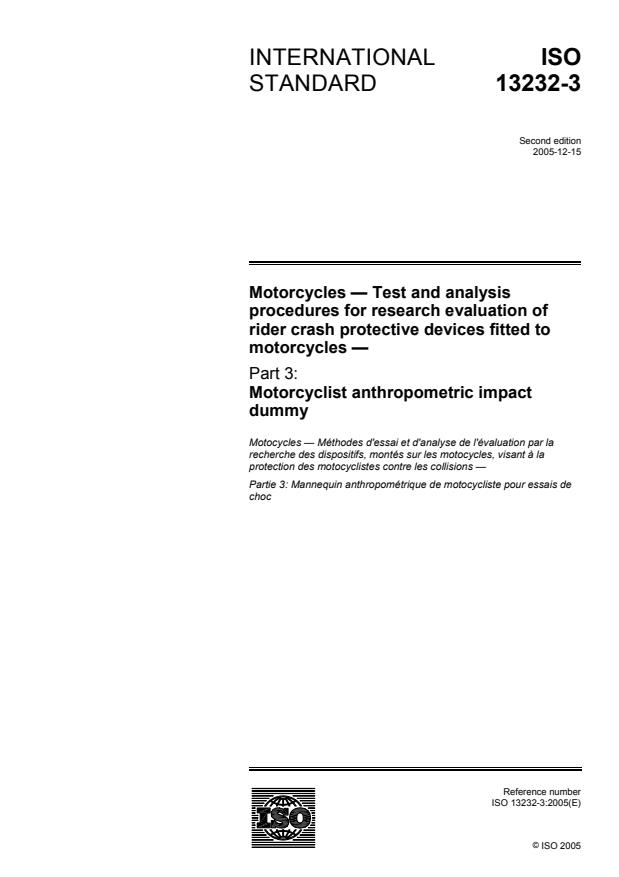
INTERNATIONAL ISO
STANDARD 13232-3
Second edition
2005-12-15
Motorcycles — Test and analysis
procedures for research evaluation of
rider crash protective devices fitted to
motorcycles —
Part 3:
Motorcyclist anthropometric impact
dummy
Motocycles — Méthodes d'essai et d'analyse de l'évaluation par la
recherche des dispositifs, montés sur les motocycles, visant à la
protection des motocyclistes contre les collisions —
Partie 3: Mannequin anthropométrique de motocycliste pour essais de
choc
Reference number
©
ISO 2005
PDF disclaimer
This PDF file may contain embedded typefaces. In accordance with Adobe's licensing policy, this file may be printed or viewed but
shall not be edited unless the typefaces which are embedded are licensed to and installed on the computer performing the editing. In
downloading this file, parties accept therein the responsibility of not infringing Adobe's licensing policy. The ISO Central Secretariat
accepts no liability in this area.
Adobe is a trademark of Adobe Systems Incorporated.
Details of the software products used to create this PDF file can be found in the General Info relative to the file; the PDF-creation
parameters were optimized for printing. Every care has been taken to ensure that the file is suitable for use by ISO member bodies. In
the unlikely event that a problem relating to it is found, please inform the Central Secretariat at the address given below.
© ISO 2005
All rights reserved. Unless otherwise specified, no part of this publication may be reproduced or utilized in any form or by any means,
electronic or mechanical, including photocopying and microfilm, without permission in writing from either ISO at the address below or
ISO's member body in the country of the requester.
ISO copyright office
Case postale 56 • CH-1211 Geneva 20
Tel. + 41 22 749 01 11
Fax + 41 22 749 09 47
E-mail copyright@iso.org
Web www.iso.org
Published in Switzerland
ii © ISO 2005 – All rights reserved
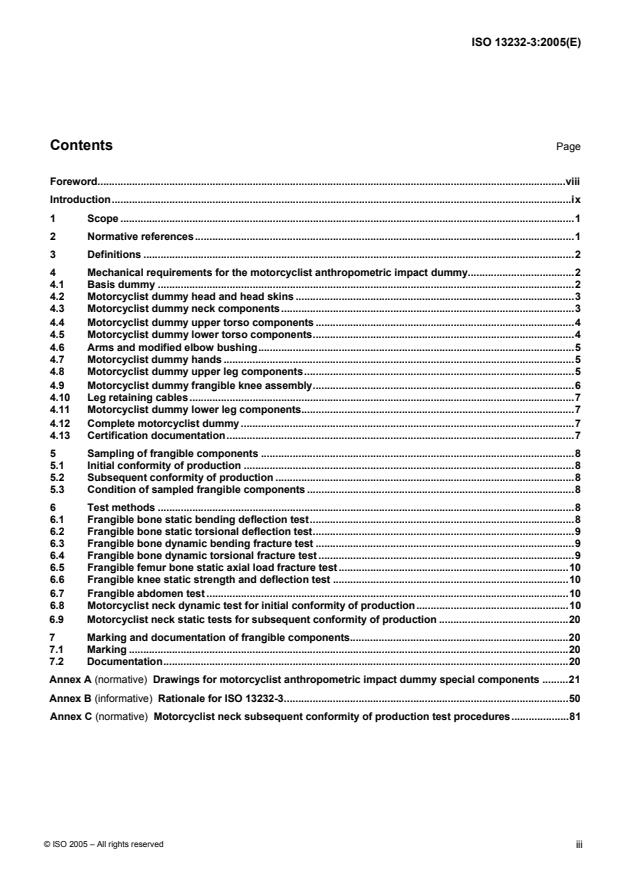
Contents Page
Foreword.viii
Introduction.ix
1 Scope.1
2 Normative references.1
3 Definitions .2
4 Mechanical requirements for the motorcyclist anthropometric impact dummy.2
4.1 Basis dummy .2
4.2 Motorcyclist dummy head and head skins .3
4.3 Motorcyclist dummy neck components.3
4.4 Motorcyclist dummy upper torso components .4
4.5 Motorcyclist dummy lower torso components.4
4.6 Arms and modified elbow bushing.5
4.7 Motorcyclist dummy hands .5
4.8 Motorcyclist dummy upper leg components.5
4.9 Motorcyclist dummy frangible knee assembly.6
4.10 Leg retaining cables.7
4.11 Motorcyclist dummy lower leg components.7
4.12 Complete motorcyclist dummy .7
4.13 Certification documentation.7
5 Sampling of frangible components .8
5.1 Initial conformity of production .8
5.2 Subsequent conformity of production .8
5.3 Condition of sampled frangible components .8
6 Test methods .8
6.1 Frangible bone static bending deflection test.8
6.2 Frangible bone static torsional deflection test.9
6.3 Frangible bone dynamic bending fracture test .9
6.4 Frangible bone dynamic torsional fracture test .9
6.5 Frangible femur bone static axial load fracture test .10
6.6 Frangible knee static strength and deflection test .10
6.7 Frangible abdomen test .10
6.8 Motorcyclist neck dynamic test for initial conformity of production.10
6.9 Motorcyclist neck static tests for subsequent conformity of production .20
7 Marking and documentation of frangible components.20
7.1 Marking .20
7.2 Documentation.20
Annex A (normative) Drawings for motorcyclist anthropometric impact dummy special components .21
Annex B (informative) Rationale for ISO 13232-3.50
Annex C (normative) Motorcyclist neck subsequent conformity of production test procedures.81
iii
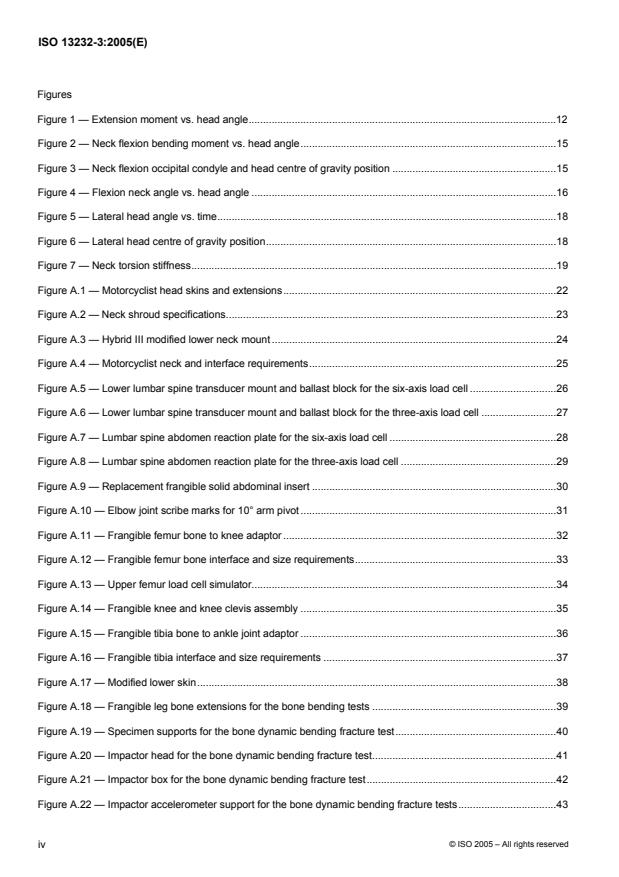
Figures
Figure 1 — Extension moment vs. head angle.12
Figure 2 — Neck flexion bending moment vs. head angle.15
Figure 3 — Neck flexion occipital condyle and head centre of gravity position .15
Figure 4 — Flexion neck angle vs. head angle .16
Figure 5 — Lateral head angle vs. time.18
Figure 6 — Lateral head centre of gravity position.18
Figure 7 — Neck torsion stiffness.19
Figure A.1 — Motorcyclist head skins and extensions.22
Figure A.2 — Neck shroud specifications.23
Figure A.3 — Hybrid III modified lower neck mount .24
Figure A.4 — Motorcyclist neck and interface requirements.25
Figure A.5 — Lower lumbar spine transducer mount and ballast block for the six-axis load cell .26
Figure A.6 — Lower lumbar spine transducer mount and ballast block for the three-axis load cell .27
Figure A.7 — Lumbar spine abdomen reaction plate for the six-axis load cell .28
Figure A.8 — Lumbar spine abdomen reaction plate for the three-axis load cell .29
Figure A.9 — Replacement frangible solid abdominal insert .30
Figure A.10 — Elbow joint scribe marks for 10° arm pivot.31
Figure A.11 — Frangible femur bone to knee adaptor .32
Figure A.12 — Frangible femur bone interface and size requirements.33
Figure A.13 — Upper femur load cell simulator.34
Figure A.14 — Frangible knee and knee clevis assembly .35
Figure A.15 — Frangible tibia bone to ankle joint adaptor .36
Figure A.16 — Frangible tibia interface and size requirements .37
Figure A.17 — Modified lower skin.38
Figure A.18 — Frangible leg bone extensions for the bone bending tests .39
Figure A.19 — Specimen supports for the bone dynamic bending fracture test.40
Figure A.20 — Impactor head for the bone dynamic bending fracture test.41
Figure A.21 — Impactor box for the bone dynamic bending fracture test.42
Figure A.22 — Impactor accelerometer support for the bone dynamic bending fracture tests.43
iv
Figure A.23 — Impactor end plate and bearing mount for the bone dynamic bending fracture test.44
Figure A.24 — Impactor rail support for the bone dynamic bending fracture test.45
Figure A.25 — Frangible femur bone static axial load fracture test apparatus .46
Figure A.26 — Frangible knee test apparatus.47
Figure A.27 — Frangible abdomen test apparatus.48
Figure A.28 — Neck torsion test schematic .49
Figure B.1 — Sample extension acceleration pulse.52
Figure B.2 — Sample flexion acceleration pulse.53
Figure B.3 — Sample lateral acceleration pulse .53
Figure B.4 — Human neck elongation observed in Navy volunteer testing .57
Figure B.5 — Human response corridor and modified lumbar spine response of static moment vs. thoracic angular
displacement.59
Figure B.6 — Lower leg dynamic impact tests impact force vs. time: Hybrid III and cadaver legs.62
Figure B.7 — Lower leg dynamic impact tests impact force vs. time: Hybrid III legs and frangible leg, as defined in
4.11.1.63
Figure B.8 — Instrumented lower leg impact tests mid-tibia moment vs. time for drop height = 1,016 m: Hybrid III
leg and frangible leg, as defined in 4.11.1.63
Figure B.9 — Instrumented lower leg impact tests mid-tibia moment vs. time for drop height = 1,778 m: Hybrid III
leg and frangible leg, as defined in 4.11.1.64
Figure B.10 — Lower leg impact tests mid-tibia bending moment M vs. impact velocity: Hybrid III leg and frangible
y
leg, as defined in 4.11.1 .64
Figure B.11 — View of ATB simulated offset frontal impact, medium conventional motorcycle, with and without
frangible leg bones, as defined in 4.8.1 and 4.11.1.65
Figure B.12 — Head trajectory comparison of frangible and non-frangible legs.65
Figure B.13 — Shoulder trajectory comparison of frangible and non-frangible legs.66
Figure B.14 — Hip trajectory comparison of frangible and non-frangible legs.66
Figure B.15 — Knee trajectory comparison of frangible and non-frangible legs.67
Figure B.16 — Ankle trajectory comparison of frangible and non-frangible legs .67
Figure B.17 — Pelvis trajectory comparison of frangible and non-frangible bones, full-scale test, offset frontal
impact, large conventional motorcycle .67
Figure B.17 — Pelvis trajectory comparison of frangible and non-frangible bones, full-scale test, offset frontal
impact, large conventional motorcycle .68
Figure B.18 — Sensed upper and lower tibia bending moments vs. time in Hybrid III tibia, for three point impact test
sufficient to fracture human tibia.68
v
Figure B.19 — Impactor time histories for nine cadaver tibia specimens from Fuller and Snyder, 1989 .69
Figure B.20 — Comparison of composite tibia fracture force response with envelopes of cadaver tibia fracture force
response .69
Figure B.21 — Lower leg dynamic impact tests impact force vs. time: frangible and cadaver legs .70
Figure C.1 — Neck load cell simulator .85
Figure C.2 — Neck calibration test fixture .86
Figure C.3 — Neck calibration torque extension arm.87
Figure C.4 — Neck calibration assembly .88
Tables
Table 1 — Neck subsequent conformity of production specifications.4
Table 2 — Specified values for certification of replacement abdominal insert .5
Table 3 — Specified values for certification of frangible femur components.6
Table 4 — Specified values for certification of frangible knee assembly components .6
Table 5 — Specified values for certification of frangible tibia components .7
Table 6 — Frangible component subsequent conformity of production characteristics .8
Table 7 — Frangible bone static bending deflection test specifications.9
Table 8 — Neck extension sled pulse criteria.11
Table 9 — Neck extension bending corridor .11
Table 10 — Neck flexion sled pulse criteria.12
Table 11 — Neck flexion bending corridor.13
Table 12 — Neck flexion head centre of gravity corridor .13
Table 13 — Neck flexion occipital condyle corridor .14
Table 14 — Neck flexion change in neck angle vs. change in head angle corridor .14
Table 15 — Lateral sled pulse criteria .16
Table 16 — Lateral head angle vs. time corridor.17
Table 17 — Lateral head centre of gravity corridor .17
Table 18 — Neck torsion stiffness corridor .19
Table B.1 — Neck biofidelity criteria .52
Table B.2 — Subsequent conformity of production test results .54
Table B.3 — Neck FST loads comparison.55
vi
Table B.4 — Neck moments produced by pendulum drop tests.55
Table B.5 — History of subsequent conformity of production test results.56
Table B.6 — Sampled static bending stiffness of composite femurs .72
Table B.7 — Sampled static torsional stiffness of composite femurs.73
Table B.8 — Sampled dynamic bending strength of composite femurs .73
Table B.9 — Sampled dynamic torsional strength of composite femurs .74
Table B.10 — Sampled static bending stiffness of composite tibias.74
Table B.11 — Sampled static torsional stiffness of composite tibias.75
Table B.12 — Sampled dynamic bending strength of composite tibias.75
Table B.13 — Sampled dynamic torsional strength of composite tibias.76
Table B.14 — Sampled deflection of abdominal inserts.76
Table B.15 — Sampled static torsion strength and deflection of knees.77
Table B.16 — Sampled static valgus strength and deflection of knees.77
Table B.17 — Sampled static axial strength of composite femurs.78
Table C.1 — Procedures for flexion bending and head forward displacement static tests.81
Table C.2 — Procedure for extension-bending static test.82
Table C.3 — Procedures for lateral-bending static test.83
Table C.4 — Procedures for torsion static test .84
vii
Foreword
ISO (the International Organization for Standardization) is a worldwide federation of national standards bodies (ISO
member bodies). The work of preparing International Standards is normally carried out through ISO technical
committees. Each member body interested in a subject for which a technical committee has been established has
the right to be represented on that committee. International organizations, governmental and non-governmental, in
liaison with ISO, also take part in the work. ISO collaborates closely with the International Electrotechnical
Commission (IEC) on all matters of electrotechnical standardization.
International Standards are drafted in accordance with the rules given in the ISO/IEC Directives, Part 2.
The main task of technical committees is to prepare International Standards. Draft International Standards adopted
by the technical committees are circulated to the member bodies for voting. Publication as an International
Standard requires approval by at least 75 % of the member bodies casting a vote.
ISO 13232-3 was prepared by Technical Committee ISO/TC 22, Road vehicles, Subcommittee SC 22, Motorcycles.
This second edition cancels and replaces the first version (ISO 13232-3:1996), which has been technically revised.
ISO 13232 consists of the following parts, under the general title Motorcycles — Test and analysis procedures for
research evaluation of rider crash protective devices fitted to motorcycles:
⎯ Part 1: Definitions, symbols and general considerations
⎯ Part 2: Definition of impact conditions in relation to accident data
⎯ Part 3: Motorcyclist anthropometric impact dummy
⎯ Part 4: Variables to be measured, instrumentation and measurement procedures
⎯ Part 5: Injury indices and risk/benefit analysis
⎯ Part 6: Full-scale impact-test procedures
⎯ Part 7: Standardized procedures for performing computer simulations of motorcycle impact tests
⎯ Part 8: Documentation and reports
viii
Introduction
ISO 13232 has been prepared on the basis of existing technology. Its purpose is to define common research
methods and a means for making an overall evaluation of the effect that devices which are fitted to motorcycles
and intended for the crash protection of riders, have on injuries, when assessed over a range of impact conditions
which are based on accident data.
It is intended that all of the methods and recommendations contained in ISO 13232 should be used in all basic
feasibility research. However, researchers should also consider variations in the specified conditions (for example,
rider size) when evaluating the overall feasibility of any protective device. In addition, researchers may wish to vary
or extend elements of the methodology in order to research issues which are of particular interest to them. In all
such cases which go beyond the basic research, if reference is to be made to ISO 13232, a clear explanation of
how the used procedures differ from the basic methodology should be provided.
ISO 13232 was prepared by ISO/TC 22/SC 22 at the request of the United Nations Economic Commission for
Europe Group for Road Vehicle General Safety (UN/ECE/TRANS/SCI/WP29/GRSG), based on original working
documents submitted by the International Motorcycle Manufacturers Association (IMMA), and comprising eight
interrelated parts.
This revision of ISO 13232 incorporates extensive technical amendments throughout all the parts, resulting from
extensive experience with the standard and the development of improved research methods.
In order to apply ISO 13232 properly, it is strongly recommended that all eight parts be used together, particularly if
the results are to be published.
ix
DRAFT INTERNATIONAL STANDARD
Motorcycles — Test and analysis procedures for research
evaluation of rider crash protective devices fitted to
motorcycles —
Part 3:
Motorcyclist anthropometric impact dummy
1 Scope
This part of ISO 13232 specifies the minimum requirements for the:
⎯ biofidelity of the motorcyclist anthropometric impact dummy;
⎯ compatibility of the dummy with motorcycles, helmets, multi-directional impacts, and the instrumentation;
⎯ repeatability and reproducibility of the dummy properties and responses.
ISO 13232 specifies minimum requirements for research into the feasibility of protective devices fitted to
motorcycles, which are intended to protect the rider in the event of a collision.
ISO 13232 is applicable to impact tests involving:
⎯ two-wheeled motorcycles;
⎯ the specified type of opposing vehicle;
⎯ either a stationary and a moving vehicle or two moving vehicles;
⎯ for any moving vehicle, a steady speed and straight-line motion immediately prior to impact;
⎯ one helmeted dummy in a normal seating position on an upright motorcycle;
⎯ the measurement of the potential for specified types of injury, by body region;
⎯ evaluation of the results of paired impact tests (i.e. comparisons between motorcycles fitted and not fitted with
the proposed devices).
ISO 13232 does not apply to testing for regulatory or legislative purposes.
2 Normative references
The following referenced documents are indispensable for the application of this document. For dated
references, only the edition cited applies. For undated references, the latest edition of the referenced
document (including any amendments) applies.
ISO 13232-1, Motorcycles — Test and analysis procedures for research evaluation of rider crash protective
devices fitted to motorcycles — Part 1: Definitions, symbols, and general considerations
ISO 13232-4, Motorcycles — Test and analysis procedures for research evaluation of rider crash protective devices
fitted to motorcycles — Part 4: Variables to be measured, instrumentation and measurement procedures
ISO 13232-6, Motorcycles — Test and analysis procedures for research evaluation of rider crash protective devices
fitted to motorcycles — Part 6: Full-scale impact test procedures
ISO 13232-8, Motorcycles — Test and analysis procedures for research evaluation of rider crash protective devices
fitted to motorcycles — Part 8: Documentation and reports
ISO 6487, Road vehicles — Measurement techniques in impact tests — Instrumentation
49 CFR Part 572, subpart E: 1993, Anthropomorphic test dummies, United States of America Code of Federal
Regulations issued by the National Highway Traffic Safety Administration (NHTSA). Washington, D.C.
3 Definitions
The following terms are defined in ISO 13232-1. For the purposes of this part of ISO 13232, those definitions apply.
Additional definitions which could apply to this part of ISO 13232 are also listed in ISO 13232-1:
⎯ abdominal foam insert;
⎯ alternative products;
⎯ certification, compliance;
⎯ knee compliance element;
⎯ load cell simulator;
⎯ lot;
⎯ specimen.
4 Mechanical requirements for the motorcyclist anthropometric impact dummy
4.1 Basis dummy
1)
The basis dummy shall be the Hybrid III 50th percentile male dummy . The dummy shall be equipped with:
2)
⎯ the sit/stand construction ;
⎯ the head/neck assembly which is compatible with the six axis upper neck load cell which is specified in 4.4.1.2
2)
of ISO 13232-4 ;
2)
⎯ standard, non-sliding knees .
The basis dummy specified components shall be modified or replaced as described below.
1)
Basis dummy as specified in 49 CFR Part 572, subpart E, or equivalent.
2)
A list describing one or more example products which meet these requirements is maintained by the ISO Central Secretariat
and the Secretariat of ISO/TC 22/SC 22. The list is maintained for the convenience of users of ISO 13232 and does not
constitute an endorsement by ISO of the products listed. Alternative products may be used if they can be shown to lead to the
same results.
4.2 Motorcyclist dummy head and head skins
The head skin components shall include the two basis Hybrid III head skins, plus two extensions which provide
helmet compatibility. The geometries of the head skins and extensions are shown in Figure A.1, where 1 and 2 are
the basis Hybrid III head and rear skull cap skins and 3 and 4 are the jaw and nape extensions which provide
helmet compatibility. The masses of the jaw and nape skin extensions shall be 0,27 kg ± 0,05 kg and 0,15 kg ±
2)
0,05 kg, respectively . The head-neck skin modifications to the Hybrid III head shall be attached by means of any
suitable adhesive. Such an adhesive shall be shown to provide a bond between the mating parts in which the
parent material will fail under tensile loading before the bond itself. Cyanoacrylate is an example of a suitable
adhesive.
The complete assembly of the head, head skins, head skin extensions, head accelerometer mount, head
accelerometers and cables, and neck load cell and cables shall have a mass of 5,35 kg ± 0,1 kg.
4.3 Motorcyclist dummy neck components
The complete assembly of the neck, nodding blocks, head attachment pin, bib simulator, and the upper half of the
serrated lower neck mount shall have a mass of 1,55 kg ± 0,1 kg.
4.3.1 Neck shroud
2)
The neck shroud shall be as specified in Figure A.2 . The upper half of the zipper of the neck shroud shall be
attached to the jaw skin extension by means of any suitable adhesive. Such an adhesive shall be shown to provide
a bond between the mating parts in which the parent material will fail under tensile loading before the bond itself.
2)
Note - “Loctite® 401” cyanoacrylate is an example of a suitable adhesive.
4.3.2 Lower neck mount
When mounting the motorcyclist neck the lower neck mount shall be set at the 5,25 degree extension position. This
is appropriate for most dummy rider positioning. However, in cases of extreme dummy posture, the basis Hybrid III
2)
lower neck mount may be modified as shown in Figure A.3 to increase head position adjustability .
4.3.3 Motorcyclist neck
The standard Hybrid III neck and its interfaces with the head and upper torso assembly shall be replaced by the
2)
neck shown in Figure A.4 .
NOTE The neck shown in Figure A.4 is designed specifically for use in motorcycle crash testing. Use and limitation
information is contained in B.2.5.
4.3.4 Replacement nodding blocks
2)
The standard Hybrid III nodding blocks shall be replaced with the pair of nodding blocks shown in Figure A.4 .
4.3.5 Neck initial conformity of production
For certification of a new neck and nodding block production design, material specification or manufacturing
process which otherwise meet the specifications given in Figure A.4, one neck shall be dynamically tested
according to the procedures described in 6.8. The neck responses shall be within the corridors described in 6.8 and
shown in figures 1, 2, 3, 4, 5, 6, and 7.
4.3.6 Neck subsequent conformity of production
Once a production design, material specification or manufacturing process has been certified according to 4.3.5,
each manufactured neck and nodding block assembly produced thereafter shall be tested according to the
procedures in 6.9 to verify the characteristics specified in Table 1.
Table 1 — Neck subsequent conformity of production specifications
Static Test Characteristics Required average value % Required standard deviation
Flexion Flexion angle 10% of average value
17,6 ± 2,6 °
Flexion Slider displacement 14,0 ± 3,0 mm 10% of average value
Extension Extension angle 10% of average value
30,9 ± 4,6 °
Lateral Lateral angle 10% of average value
28,7 ± 4,3 °
Torsion Torsion angle 10% of average value
41,5 ± 6,2 °
4.4 Motorcyclist dummy upper torso components
4.4.1 Replacement thoracic spine
2)
Either a standard Hybrid III thoracic spine, or a replacement thoracic spine shall be used. If a replacement spine is
used, then the replacement thoracic spine shall be compatible with the internal data acquisition system described in
ISO 13232-4. When combined with the internal data acquisition system, the replacement thoracic spine shall:
⎯ maintain the same interface geometry and overall height as the standard Hybrid III spine box, including the
shoulder, rib, lower neck mount, and lumbar spine attachment points;
⎯ not interfere with the motion of the shoulders;
⎯ provide at least 75 mm of sternum deflection in the sagittal plane, measured perpendicularly, relative to the
front surface of the spine box;
⎯ not exceed 125 mm in lateral width;
⎯ result in the same upper torso mass and centre of gravity as specified for a standard Hybrid III upper torso
except that the centre of gravity tolerance shall be ± 30 mm.
4.4.2 Modified chest skin
With the chest skin properly installed on the upper torso, the back of the chest skin may be modified with four holes
which expose the two upper and two lower rib attachment screws in order to enable measurement of the upper
torso angle, using a torso inclinometer such as the example shown in ISO 13232-6, Figure C.1.
4.5 Motorcyclist dummy lower torso components
When fully assembled, the lower torso assembly shall result in the same lower torso mass as specified for the
3)
standard Hybrid III lower torso .
4.5.1 Modified straight lumbar spine
For use with either the six-axis or three-axis lumbar load cell, the straight lumbar spine and cable shall be FTSS
4)
part numbers 1260004 and 1260005 . The lower lumbar spine transducer mount and ballast block shall be
2) 2)
replaced with the part shown in Figure A.5 for a six-axis load cell and in Figure A.6 for a three-axis load cell . An
3)
Refer to General Motors Hybrid III drawing numbers 78051-70 and 78051-338 in 49 CFR Part 572.
4)
Parts 1260004 and 1260005 are products supplied by First Technology Safety Systems, Plymouth, Michigan, USA. This
information is given for the convenience of users of ISO 13232 and does not constitute and endorsement by ISO of the product
named. Alternative products may be used if they can be shown to lead to the same results.
2)
abdomen reaction plate, as shown in Figure A.7 revision 1 for the six-axis load cell or Figure A.8 for the three-axis
2)
load cell , shall be mounted to the lower lumbar spine transducer mount and ballast block.
When assembling the pelvis and ballast block, if hard contact interference prevents the proper positioning of the
parts either part may be trimmed as required to facilitate the assembly.
When using the dummy without either of the permissible lumbar load cells described in 4.4.1.4 of ISO 13232-4, the
2)
load cell shall be replaced with a lumbar load cell simulator .
4.5.2 Motorcyclist dummy abdominal insert
The basis Hybrid III abdominal insert shall be replaced with a frangible solid abdominal insert, as shown in
Figure A.9. The replacement insert shall have a mass of 53 g ± 3 g.
2)
When tested according to the method described in 6.7, the specified values of force shall be as given in Table 2 .
Table 2 — Specified values for certification of replacement abdominal insert
Deflection Force
mm N
20 1 040
40 1 875
60 2 810
4.5.3 Sit/stand pelvis
The internal data acquisition system may be contained within a sit/stand pelvis which has been suitably modified to
2)
accommodate it . Whether modified or not, the sit/stand pelvis shall:
⎯ maintain the same interface geometry and external dimensions as the standard Hybrid III sit/stand pelvis;
⎯ not interfere with the motion of the legs.
4.6 Arms and modified elbow bushing
5)
The Delrin elbow bushing, Hybrid III part number 78051-199 , shall be modified with scribe marks, as shown in
Figure A.10.
The masses of the upper and lower arms shall be as specified for a standard Hybrid III.
4.7 Motorcyclist dummy hands
6)
The basis Hybrid III hands shall be replaced with the Itoh-Seiki Co. part number 065-322048 .
4.8 Motorcyclist dummy upper leg components
The mass of the upper leg assembly shall be 4,89 kg ± 0,2 kg.
5)
Refer to General Motors Hybrid III drawing number 78051-199 in 49 CFR Part 572.
6)
Part number 065-322048 is a product supplied by Itoh-Seiki Co., Tokyo, Japan. This information is given for the
convenience of users of ISO 13232 and does not constitute an endorsement by ISO of the product named. Alternative products
may be used if they can be shown to lead to the same results.
4.8.1 Frangible femur bone and mounting hardware
2)
The frangible femur bone shall be mounted to the knee joint using the adaptor shown in Figure A.11 . The
frangible femur bone shall meet the interface and size requirements shown in Figure A.12, and have a mass 85 g ±
10 g. The frangible bone materials and design shall remain constant in the axial direction along the minimum
frangible length, as shown in Figure A.12.
When statically tested according to the methods described in 6.1, 6.2, and 6.5, the specified values of the static
deflection and strength of the bone shall be as given in Table 3. When dynamically fractured according to the
methods described in 6.3 and 6.4, the specified values of the peak strength of the bone shall be as given in
2)
Table 3 .
Table 3 — Specified values for certification of frangible femur components
Static deflection Dynamic peak strength Static strength
Bending 5,1 mm 360 N·m -
Torsion 205 N·m -
5,8°
Axial loading - 34 680 N
-
4.8.2 Femur load cell simulator
When using the dummy without the permissible femur load cells described in 4.4.1.5 of ISO 13232-4, the load cell
2)
shall be replaced with an upper femur load cell simulator, as shown in Figure A.13 .
4.9 Motorcyclist dummy frangible knee assembly
The frangible knee assembly and the interface with the knee clevis assembly shall be as shown in Figure A.14. The
knee assembly shall have a mass of 1,00 kg ± 0,05 kg.
When statically tested according to the methods described in 6.6, the specified values of the rotational angles for
the defined moments shall be as given in Table 4. The specified values of the rotational angles and moments which
2)
indicate peak strength at shear pin failure shall be as given in Table 4 .
Table 4 — Specified values for certification of frangible knee assembly components
Degree of Freedom Condition Specified value
Rotation at 89 N⋅m 20,0°
Valgus (pre-failure)
Maximum torque 132 N⋅m
Rotation at maximum torque
25,0°
Rotation at 35 N ⋅ m 20,0°
Torsion (pre-failure)
Maximum torque 87 N⋅m
Rotation at maximum torque
40,0°
4.10 Leg retaining cables
Each frangible leg bone shall be installed together with leg retaining cables to prevent the loss of portions of the
dummy leg when the frangible bone fractures. The total cable mass shall not exceed 200 g for each frangible bone.
2)
The cables shall be installed with at least 5 mm of slack .
4.11 Motorcyclist dummy lower leg components
The mass of the lower leg and foot assembly shall be 5,29 kg ± 0,2 kg.
4.11.1 Frangible tibia bone and mounting hardware
2)
The frangible tibia bone shall be mounted to the ankle joint using the adaptor shown in Figure A.15 . The bone
shall meet the interface and size requirements shown in Figure A.16 and have a mass of 120 g ± 10 g. The
frangible bone materials and design shall remain constant in the axial direction along the minimum frangible length,
as shown in Figure A.16.
When statically tested according to the methods described in 6.1 and 6.2, the specified values of the static
deflection of the bone shall be as given in Table 5. When dynamically fractured according to the methods described
2)
in 6.3 and 6.4, the specified values of the peak strength of the bone shall be as given in Table 5 .
Table 5 — Specified values for certification of f
...
Questions, Comments and Discussion
Ask us and Technical Secretary will try to provide an answer. You can facilitate discussion about the standard in here.
Loading comments...