

ISO/TS 5137:2026
(Main)Medical device maintenance management programme for healthcare delivery organizations (HDO)
General Information
- Abstract
This document specifies requirements for the maintenance management programme of reusable medical devices that require maintenance under the supervision of healthcare delivery organizations (HDOs). This document neither provides guidance nor is applicable to modification of medical device. This document does not apply to manufacturers that install, test, maintain, and service their own medical device. This document focuses on HDOs and biomedical engineering services (BES) responsibilities.
- Status
- Published
- Publication Date
- 04-Feb-2026
- Current Stage
- 6060 - International Standard published
- Start Date
- 05-Feb-2026
- Due Date
- 19-Dec-2025
- Completion Date
- 05-Feb-2026

Overview
ISO/TS 5137:2026 establishes the requirements for a comprehensive medical device maintenance management programme specifically for healthcare delivery organizations (HDOs). This technical specification focuses on reusable medical devices that require maintenance under HDO supervision. It clearly defines the responsibilities of healthcare organizations and their biomedical engineering services (BES), ensuring patient safety, optimal device performance, and compliance with relevant regulatory standards.
Designed with flexibility to accommodate various national and local regulations, ISO/TS 5137:2026 does not apply to device manufacturers maintaining their own products or to device modifications. Instead, it provides a robust framework that supports effective planning, documentation, process monitoring, and continual improvement for all phases of medical device maintenance within HDOs.
Key Topics
Maintenance Programme Structure
- Documented maintenance management programme tailored to organizational needs
- Clear procedure for both scheduled and unscheduled maintenance activities
- Application of manufacturers’ maintenance instructions, safety standards, and best practices
Management and Documentation
- Defined quality objectives aligned with regulatory requirements
- Thorough documentation including procedures, method statements, records, and risk assessments
- Control processes for documentation and records ensuring accessibility, traceability, and security
- Use of a maintenance management information system (MMIS) for asset tracking and work order management
- Technical library with manuals, guidance, and training materials
Responsibility and Resources
- Assignment of biomedical engineering services representatives to oversee programme implementation
- Clearly documented responsibilities, authority, and communication structures
- Competence requirements for staff, with structured training and records management
- Adequate provision of infrastructure, maintenance tools, and contamination controls
Maintenance Service Realization
- Planned maintenance intervals based on risk assessment, manufacturer recommendations, and device history
- Procedures for preventive, predictive, and unscheduled maintenance
- Calibration, routine inspection, and reduction of device downtime
- Comprehensive risk management plan to control hazards throughout the device lifecycle
Continuous Improvement
- Ongoing measurement and analysis of maintenance processes
- Incident reporting, internal audits, and nonconformity management
- Medical device replacement planning and advisory services
Applications
ISO/TS 5137:2026 is a vital standard for healthcare facilities such as hospitals, clinics, and specialized treatment centers. It helps ensure:
- Enhanced device safety and compliance by structuring maintenance according to recognized best practices and regulatory requirements
- Operational reliability by minimizing unplanned downtime through effective preventive and predictive maintenance strategies
- Improved process efficiency and standardization, supporting resource optimization and cost control
- Streamlined incident and risk management by documenting processes and actions addressing device failures or hazards
- Simplified quality management system integration for HDOs certified or seeking certification in ISO 13485 or ISO 9001
These outcomes facilitate better health outcomes, secure patient environments, and robust regulatory compliance.
Related Standards
For organizations implementing ISO/TS 5137:2026, the following standards are highly relevant:
- ISO 13485: Quality management systems for medical devices
- ISO 9001: Quality management systems – Requirements
- IEC 62353: Medical electrical equipment – Recurrent test and test after repair
- ISO 14971: Application of risk management to medical devices
ISO/TS 5137:2026 can be used alongside these frameworks to build a cohesive, reliable, and safe medical device maintenance programme for healthcare delivery organizations.
Keywords: medical device maintenance, ISO/TS 5137:2026, healthcare delivery organization, HDO, biomedical engineering services, maintenance management, medical device safety, regulatory compliance, healthcare standards, preventive maintenance, quality management system, ISO 13485.
Get Certified
Connect with accredited certification bodies for this standard

BSI Group
BSI (British Standards Institution) is the business standards company that helps organizations make excellence a habit.

TÜV Rheinland
TÜV Rheinland is a leading international provider of technical services.

TÜV SÜD
TÜV SÜD is a trusted partner of choice for safety, security and sustainability solutions.
Sponsored listings
Frequently Asked Questions
ISO/TS 5137:2026 is a technical specification published by the International Organization for Standardization (ISO). Its full title is "Medical device maintenance management programme for healthcare delivery organizations (HDO)". This standard covers: This document specifies requirements for the maintenance management programme of reusable medical devices that require maintenance under the supervision of healthcare delivery organizations (HDOs). This document neither provides guidance nor is applicable to modification of medical device. This document does not apply to manufacturers that install, test, maintain, and service their own medical device. This document focuses on HDOs and biomedical engineering services (BES) responsibilities.
This document specifies requirements for the maintenance management programme of reusable medical devices that require maintenance under the supervision of healthcare delivery organizations (HDOs). This document neither provides guidance nor is applicable to modification of medical device. This document does not apply to manufacturers that install, test, maintain, and service their own medical device. This document focuses on HDOs and biomedical engineering services (BES) responsibilities.
ISO/TS 5137:2026 is classified under the following ICS (International Classification for Standards) categories: 11.020.01 - Quality and environmental management in health care. The ICS classification helps identify the subject area and facilitates finding related standards.
ISO/TS 5137:2026 is available in PDF format for immediate download after purchase. The document can be added to your cart and obtained through the secure checkout process. Digital delivery ensures instant access to the complete standard document.
Standards Content (Sample)
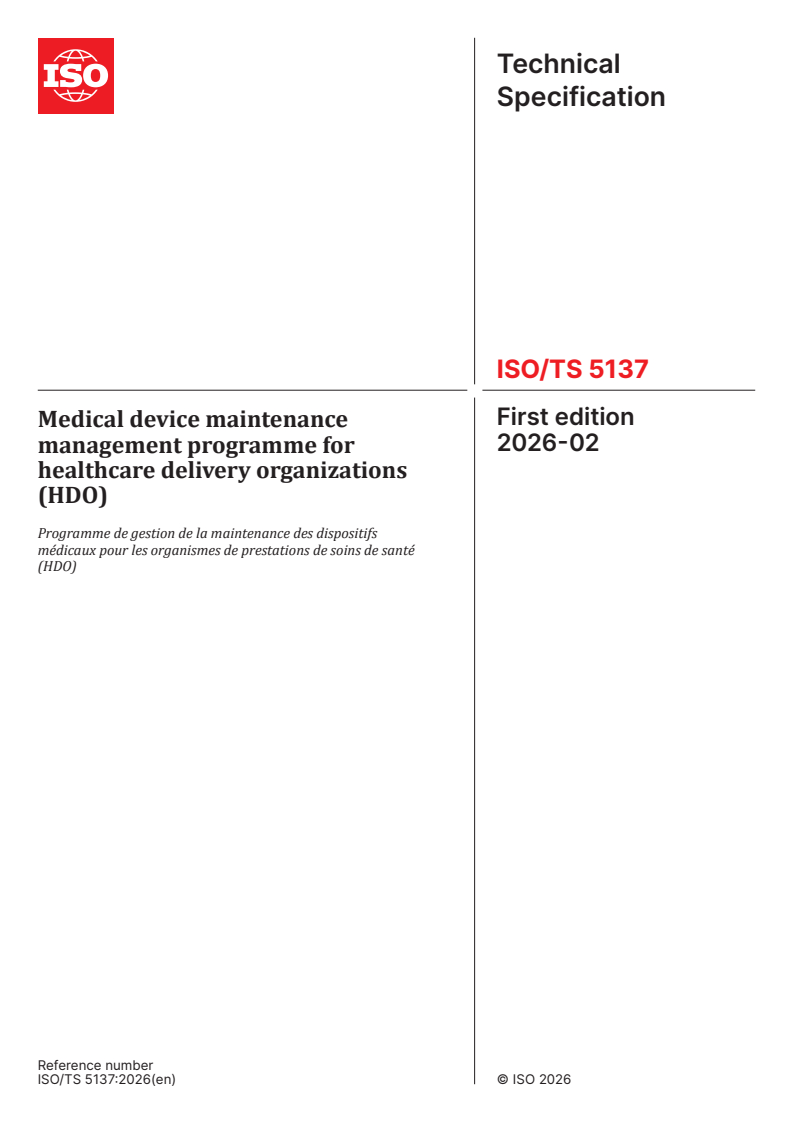
Technical
Specification
ISO/TS 5137
First edition
Medical device maintenance
2026-02
management programme for
healthcare delivery organizations
(HDO)
Programme de gestion de la maintenance des dispositifs
médicaux pour les organismes de prestations de soins de santé
(HDO)
Reference number
© ISO 2026
All rights reserved. Unless otherwise specified, or required in the context of its implementation, no part of this publication may
be reproduced or utilized otherwise in any form or by any means, electronic or mechanical, including photocopying, or posting on
the internet or an intranet, without prior written permission. Permission can be requested from either ISO at the address below
or ISO’s member body in the country of the requester.
ISO copyright office
CP 401 • Ch. de Blandonnet 8
CH-1214 Vernier, Geneva
Phone: +41 22 749 01 11
Email: copyright@iso.org
Website: www.iso.org
Published in Switzerland
ii
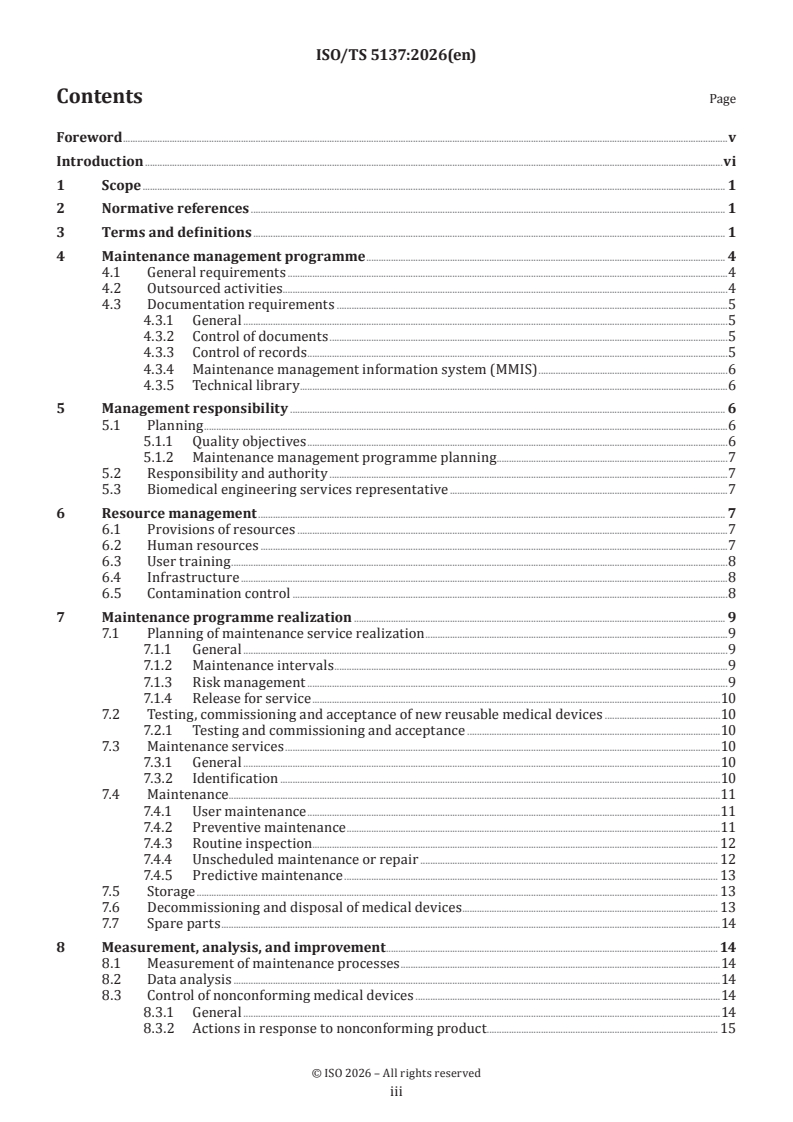
Contents Page
Foreword .v
Introduction .vi
1 Scope . 1
2 Normative references . 1
3 Terms and definitions . 1
4 Maintenance management programme . 4
4.1 General requirements .4
4.2 Outsourced activities . .4
4.3 Documentation requirements .5
4.3.1 General .5
4.3.2 Control of documents .5
4.3.3 Control of records .5
4.3.4 Maintenance management information system (MMIS) .6
4.3.5 Technical library .6
5 Management responsibility . 6
5.1 Planning .6
5.1.1 Quality objectives .6
5.1.2 Maintenance management programme planning .7
5.2 Responsibility and authority .7
5.3 Biomedical engineering services representative .7
6 Resource management . 7
6.1 Provisions of resources .7
6.2 Human resources .7
6.3 User training .8
6.4 Infrastructure .8
6.5 Contamination control .8
7 Maintenance programme realization . 9
7.1 Planning of maintenance service realization .9
7.1.1 General .9
7.1.2 Maintenance intervals .9
7.1.3 Risk management .9
7.1.4 Release for service .10
7.2 Testing, commissioning and acceptance of new reusable medical devices .10
7.2.1 Testing and commissioning and acceptance .10
7.3 Maintenance services .10
7.3.1 General .10
7.3.2 Identification .10
7.4 Maintenance .11
7.4.1 User maintenance .11
7.4.2 Preventive maintenance .11
7.4.3 Routine inspection . 12
7.4.4 Unscheduled maintenance or repair . 12
7.4.5 Predictive maintenance . 13
7.5 Storage . 13
7.6 Decommissioning and disposal of medical devices . 13
7.7 Spare parts .14
8 Measurement, analysis, and improvement . 14
8.1 Measurement of maintenance processes .14
8.2 Data analysis .14
8.3 Control of nonconforming medical devices .14
8.3.1 General .14
8.3.2 Actions in response to nonconforming product . 15
iii
8.4 Adverse effects and incident investigation and reporting . 15
8.5 Alert, safety, field corrective action and recall notices . 15
8.6 Internal audit . 15
8.7 Medical device replacement plan .16
8.8 Advisory services .16
Bibliography .18
iv
Foreword
ISO (the International Organization for Standardization) is a worldwide federation of national standards
bodies (ISO member bodies). The work of preparing International Standards is normally carried out through
ISO technical committees. Each member body interested in a subject for which a technical committee
has been established has the right to be represented on that committee. International organizations,
governmental and non-governmental, in liaison with ISO, also take part in the work. ISO collaborates closely
with the International Electrotechnical Commission (IEC) on all matters of electrotechnical standardization.
The procedures used to develop this document and those intended for its further maintenance are described
in the ISO/IEC Directives, Part 1. In particular, the different approval criteria needed for the different types
of ISO documents should be noted. This document was drafted in accordance with the editorial rules of the
ISO/IEC Directives, Part 2 (see www.iso.org/directives).
ISO draws attention to the possibility that the implementation of this document may involve the use of (a)
patent(s). ISO takes no position concerning the evidence, validity or applicability of any claimed patent
rights in respect thereof. As of the date of publication of this document, ISO had not received notice of (a)
patent(s) which may be required to implement this document. However, implementers are cautioned that
this may not represent the latest information, which may be obtained from the patent database available at
www.iso.org/patents. ISO shall not be held responsible for identifying any or all such patent rights.
Any trade name used in this document is information given for the convenience of users and does not
constitute an endorsement.
For an explanation of the voluntary nature of standards, the meaning of ISO specific terms and expressions
related to conformity assessment, as well as information about ISO’s adherence to the World Trade
Organization (WTO) principles in the Technical Barriers to Trade (TBT), see www.iso.org/iso/foreword.html.
This document was prepared by Technical Committee ISO/TC 210, Quality management and corresponding
general aspects for products with a health purpose including medical devices.
Any feedback or questions on this document should be directed to the user’s national standards body. A
complete listing of these bodies can be found at www.iso.org/members.html.
v
Introduction
This document specifies requirements for use by healthcare delivery organizations (HDO) for a maintenance
management programme of reusable medical devices that require maintenance, including testing and
commissioning, servicing and final decommissioning and disposal of medical devices, or provision of
associated activities (e.g. technical support). The requirements in this document can also be used by
suppliers or other external parties providing maintenance services to such organizations.
Due to different local, national or regional requirements this document can only act as top-level document
providing requirements for the maintenance of medical devices in HDOs. The requirements in this document
are only a framework for the maintenance and general guidance. The HDO or maintenance provider should
establish and maintain an effective maintenance programme for medical devices.
The applicable regulatory requirements differ from nation to nation and region to region. The organization
should understand how the requirements in this document can be implemented in light of regulatory
requirements in the respective jurisdictions in which the medical device is serviced and maintained.
It is not the intent of this document to imply the need for uniformity in the structure of different maintenance
management programmes, uniformity of documentation or alignment of documentation to the clause
structure of this document.
This document follows the structure of ISO 13485. Therefore, if a maintenance service provider in an HDO or
subcontracted by the HDO holds a certification according to ISO 13485 or ISO 9001 or aims to be certified to
aforementioned standards the provider can implement the requirements of this document into the quality
management system.
vi
Technical Specification ISO/TS 5137:2026(en)
Medical device maintenance management programme for
healthcare delivery organizations (HDO)
1 Scope
This document specifies requirements for the maintenance management programme of reusable medical
devices that require maintenance under the supervision of healthcare delivery organizations (HDOs). This
document neither provides guidance nor is applicable to modification of medical device. This document does
not apply to manufacturers that install, test, maintain, and service their own medical device.
This document focuses on HDOs and biomedical engineering services (BES) responsibilities.
2 Normative references
There are no normative references in this document.
3 Terms and definitions
For the purposes of this document, the following terms and definitions apply.
ISO and IEC maintain terminology databases for use in standardization at the following addresses:
— ISO Online browsing platform: available at https:// www .iso .org/ obp
— IEC Electropedia: available at https:// www .electropedia .org/
3.1
authorized representative
AR
natural or legal person established within a specific territory who has received and accepted a written
mandate from a manufacturer, located outside this specific territory, to act on the manufacturer’s behalf for
specified tasks related to manufacturer’s obligations under local regulatory requirements
3.2
biomedical engineering services representative
person representing biomedical engineering services (BES) (3.3)
3.3
biomedical engineering service
BES
in-house or third-party organization responsible and authorized for carrying out, implementing or managing
medical device (3.10) maintenance (3.9) activities
3.4
calibration
operation that establishes, under specified conditions, in a first stage, a relationship between values and
uncertainties of measurement provided by standards and corresponding indications with associated
uncertainties
Note 1 to entry: Adapted from Reference [12].
3.5
competence
documented requirement for an individual to properly perform a specific job, encompassing a combination
of knowledge, skills and behaviour
3.6
downtime
percentage of time that a device is out of service
Note 1 to entry: Adapted from Reference [13].
3.7
healthcare delivery organization
HDO
facility or enterprise such as a clinic or hospital that provides healthcare services
[SOURCE: ISO 81001-1:2021, 3.1.4]
3.8
incident
adverse event involving a medical device (3.10) that results in, or could result in, harm to a person, including
device malfunction, performance deterioration, use error, inadequate information, or undesirable side
effects
3.9
maintenance
combination of all technical and administrative means, including supervisory ones, to keep medical device
(3.10) and systems in a normal working condition, or restored to normal working condition
[SOURCE: IEC 62353:2014, 3.21]
3.10
medical device
instrument, apparatus, implement, machine, appliance, implant, reagent for in vitro use, software, material
or other similar or related article, intended by the manufacturer to be used, alone or in combination, for
human beings, for one or more of the specific medical purpose(s) of:
— diagnosis, prevention, monitoring, treatment or alleviation of disease;
— diagnosis, monitoring, treatment, alleviation of or compensation for an injury;
— investigation, replacement, modification, or support of the anatomy or of a physiological process;
— supporting or sustaining life;
— control of conception;
— disinfection of medical devices;
— providing information by means of in vitro examination of specimens derived from the human body;
and does not achieve its primary intended action by pharmacological, immunological or metabolic means, in
or on the human body, but which may be assisted in its intended function by such means
Note 1 to entry: Products which may be considered to be medical devices in some jurisdictions but not in others
include:
— disinfection substances;
— aids for persons with disabilities;
— devices incorporating animal or human tissues, or both;
— devices for in vitro fertilization or assisted reproduction technologies.
[SOURCE: ISO 13485:2016, 3.11]
3.11
medical device supplier
manufacturer, authorized representative (AR) (3.1), distributor or medical device (3.10) registration holder
3.12
method statement
document in which the biomedical engineering services (BES) (3.3) translates the demands of maintenance
(3.9) into a delivery plan with resources, allocations and methodologies
[SOURCE: ISO 41011:2024, 3.4.7, modified — “service provider” was changed to “biomedical engineering
service”; “demands set out in the specification and service level agreement” was changed to “demands of
maintenance”.]
3.13
nonconforming medical device
medical device (3.10) that does not function as intended
3.14
preventive maintenance
planned maintenance (3.9) programme which specifies intervals, tasks and activities to be done to ensure
that all medical devices (3.10) are operating as per manufacturer’s specifications and are in safe working
condition
3.15
predictive maintenance
use of data-driven, proactive maintenance (3.9) methods to analyse equipment condition and predict when
maintenance should be performed
3.16
verification
confirmation, through the provision of objective evidence, that specified requirements have been fulfilled
Note 1 to entry: The objective evidence needed for a verification can be the result of an inspection or of other forms of
determination, such as performing alternative calculations or reviewing documents.
Note 2 to entry: The activities carried out for verification are sometimes called a qualification process.
Note 3 to entry: The word “verified” is used to designate the corresponding status.
[SOURCE: ISO 9000:2015, 3.8.12]
3.17
risk
combination of the probability of occurrence of harm and the severity of that harm
[SOURCE: ISO/IEC Guide 63:2019, 3.10, modified — Note 1 to entry was removed.]
3.18
risk management
systematic application of management policies, procedures and practices to the tasks of analysing,
evaluating, controlling and monitoring risk (3.17)
[SOURCE: ISO/IEC Guide 63:2019, 3.15]
4 Maintenance management programme
4.1 General requirements
4.1.1 The HDO shall document a maintenance management programme and maintain its effectiveness in
accordance with the requirements of this document. Regulatory requirements can apply.
The HDO shall establish, implement, and maintain any requirement, procedure, activity, or arrangement
required to be documented by this document. Regulatory requirements can apply.
The maintenance management programme shall ensure:
a) the medical device performs as intended;
b) the medical device is safe for patients, users, and others.
Maintenance, which consists of scheduled and unscheduled maintenance, shall be based on instructions
for use and maintenance manuals as provided by the manufacturer and good engineering practice. In
the absence of information from the manufacturer, applicable safety standards and clinical performance
requirements shall be used.
4.1.2 For each maintenance management process, the HDO shall:
a) determine criteria and methods needed to ensure that both the operation and control of these processes
are effective;
b) ensure the availability of resources and information necessary to support the operation and monitoring
of these processes;
c) implement actions necessary to achieve planned results and maintain the effectiveness of these
processes;
d) monitor, measure as appropriate, and analyse these processes;
e) establish and maintain records needed to demonstrate conformance to this document and compliance
with applicable regulatory requirements.
4.1.3 The maintenance management programme may include:
a) training of personnel responsible for maintenance activities;
b) initial inspections, preventive maintenance, safety evaluations and verification of medical devices and
accessories;
c) a responsive repair service that minimizes medical device downtime;
d) quality assurance programme for continuous improvement;
e) standardization of maintenance activities;
f) assistance in training medical personnel on safe and effective operation of medical devices.
4.2 Outsourced activities
When the HDO chooses to outsource any process that affects maintenance activities, it shall monitor and
ensure control over such processes. The HDO shall retain responsibility of conformity to this document and
compliance with applicable regulatory requirements for outsourced processes.
4.3 Documentation requirements
4.3.1 General
The maintenance management programme documentation shall include:
a) documented quality objectives (see 5.1.1);
b) documented procedures and records required by this document;
c) documents, including records, determined by the organization to be necessary to ensure the effective
planning, operation, and control of its processes;
d) other documentation;
NOTE Applicable regulatory requirement can require specific documentation.
e) risk registry/assessments;
f) method statements.
4.3.2 Control of documents
Records are a special type of document and shall be controlled according to the requirements given in 4.3.3.
A documented procedure shall define the controls needed to:
a) review and approve documents for adequacy prior to issue;
b) review, update as necessary and re-approve documents;
c) ensure that the current revision status of and changes to documents are identified;
d) ensure that relevant versions of applicable documents are available at points of use;
e) ensure that documents remain legible and readily identifiable;
f) ensure that documents of external origin, determined by the organization to be necessary for the
planning and operation of the maintenance management system, are identified and their distribution
controlled;
g) prevent deterioration or loss of documents;
h) prevent the unintended use of obsolete documents and apply suitable identification to them.
The HDO shall ensure that changes to documents are reviewed and approved either by the original approving
function or another designated function that has access to pertinent background information upon which to
base its decisions.
The HDO shall define the period for which at least one copy of obsolete documents shall be retained.
4.3.3 Control of records
Records shall be maintained to provide evidence of conformity to requirements of this document and of the
effectiveness operation of the maintenance management programme.
The HDO shall document procedures to define the controls needed for the identification, critical review,
approval, storage, security and integrity, retrieval, retention time and disposition of records.
Records shall remain legible, readily identifiable and retrievable. Cha
...