


ISO 3593:1981
(Main)Starch — Determination of ash
Starch — Determination of ash
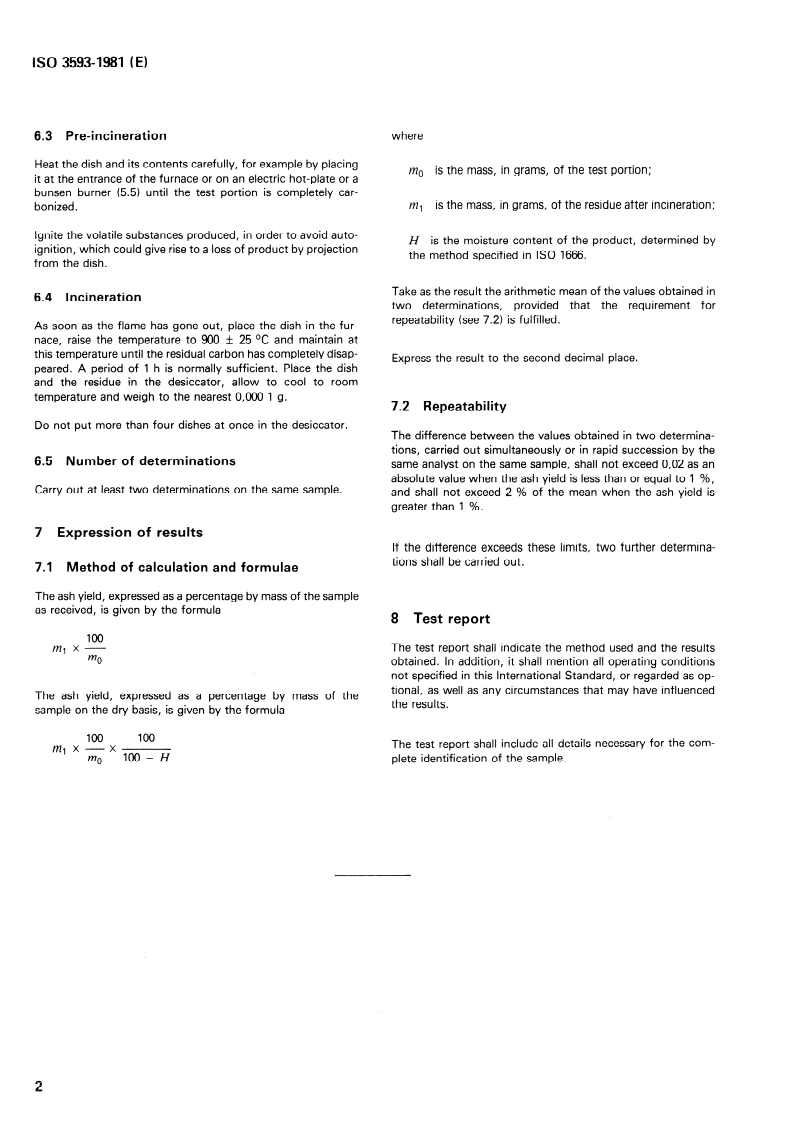
Incineration of a test portion at a temperature of 900 °C, until complete disappearance of the carbon in the residue. The method specifies a procedure for the evaluation of natural and added mineral substances together. It applies to contents up to 2 %. It does not apply to hydrolysis products nor to oxidized starches, nor to other products containing more than 0,2 % of chloride. In other cases, see ISO 5809.
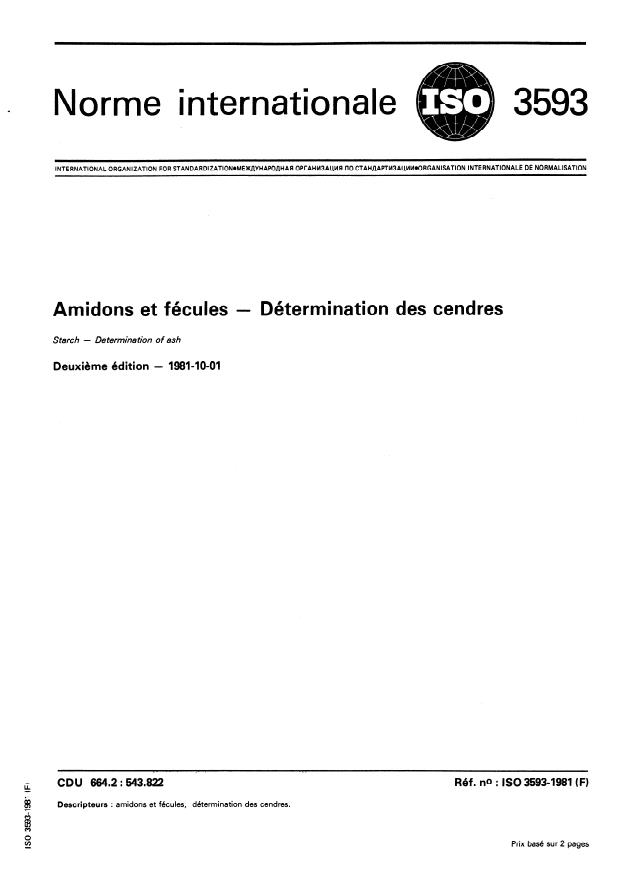
Amidons et fécules — Détermination des cendres
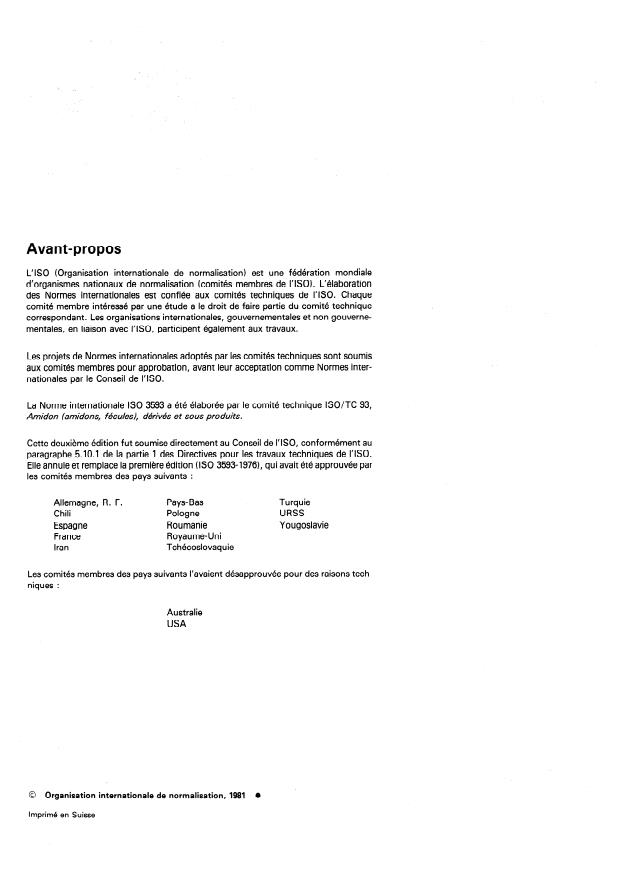
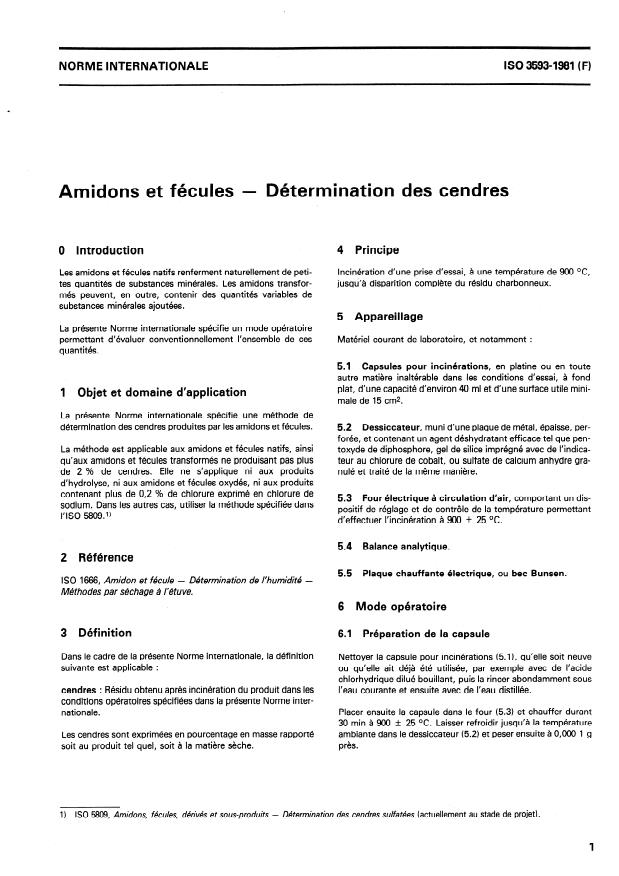
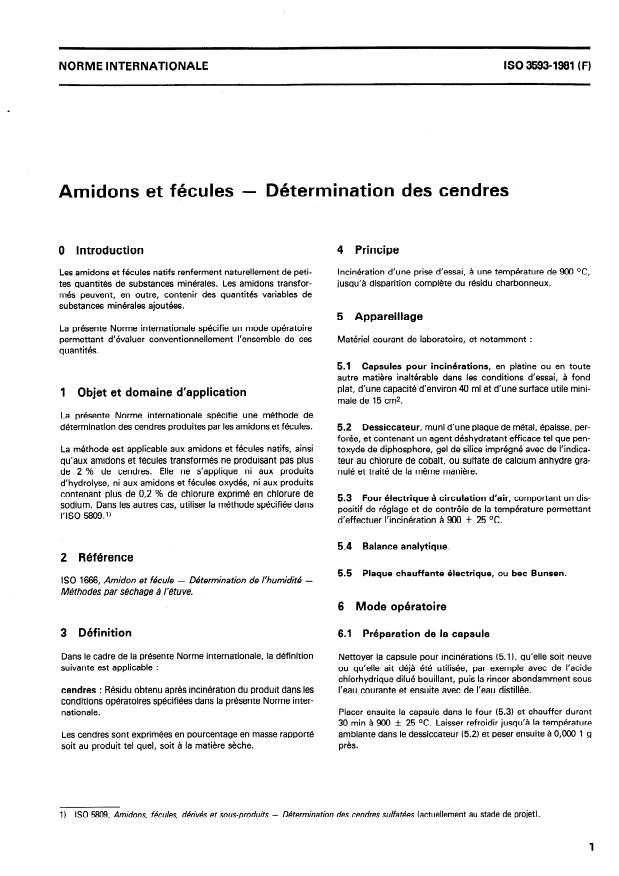
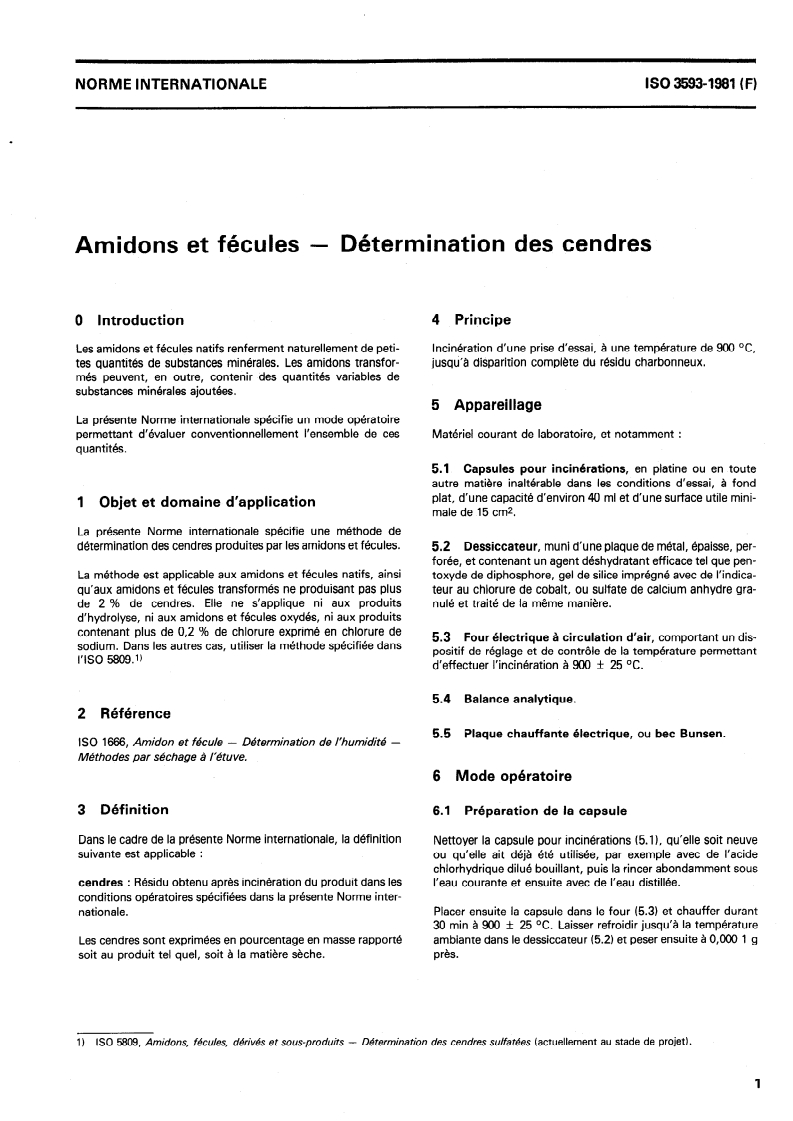
La présente Norme internationale spécifie une méthode de détermination des cendres produites par les amidons et fécules. La méthode est applicable aux amidons et fécules natifs, ainsi qu'aux amidons et fécules transformés ne produisant pas plus de 2 % de cendres. Elle ne s'applique ni aux produits d'hydrolyse, ni aux amidons et fécules oxydés, ni aux produits contenant plus de 0,2 % de chlorure exprimé en chlorure de sodium. Dans les autres cas, utiliser la méthode spécifiée dans l'ISO 5809.1)
General Information
- Status
- Published
- Publication Date
- 30-Sep-1981
- Technical Committee
- ISO/TC 93 - Starch (including derivatives and by-products)
- Drafting Committee
- ISO/TC 93 - Starch (including derivatives and by-products)
- Current Stage
- 9060 - Close of review
- Completion Date
- 02-Sep-2031
Buy Documents

ISO 3593:1981 - Starch — Determination of ash/1/1981

ISO 3593:1981 - Amidons et fécules -- Détermination des cendres

ISO 3593:1981 - Amidons et fécules -- Détermination des cendres
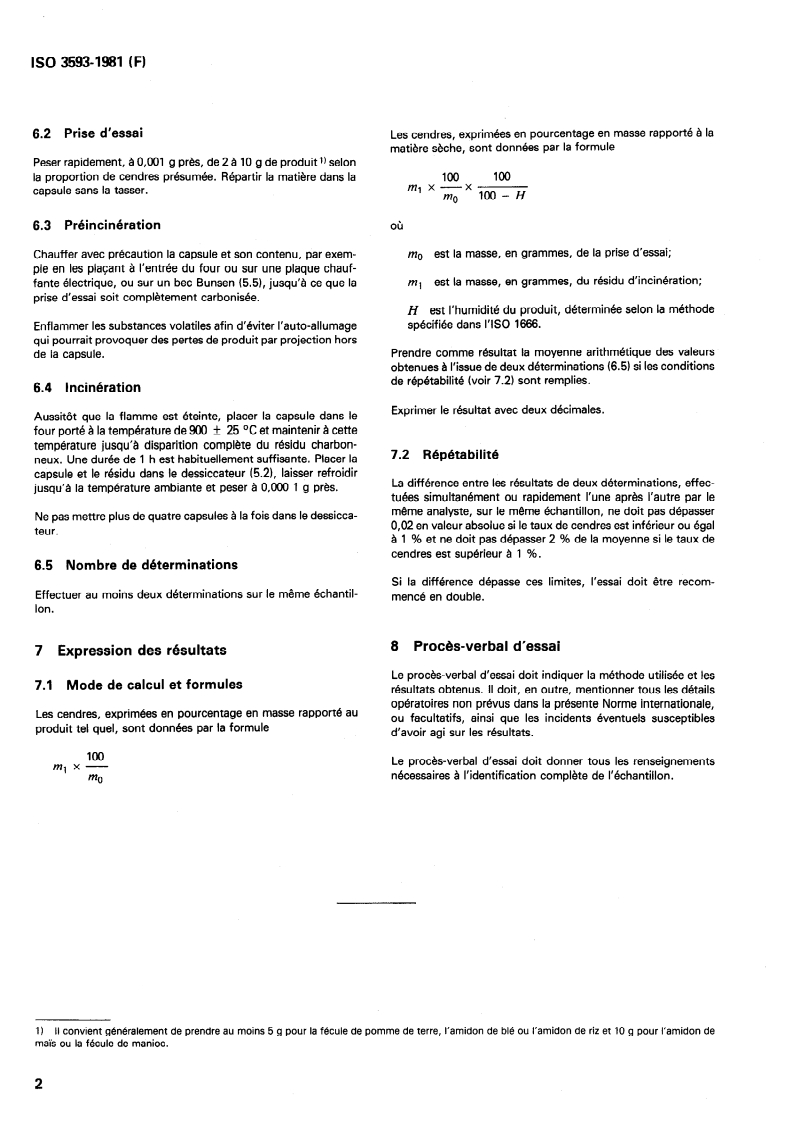
ISO 3593:1981 - Amidons et fécules — Détermination des cendres/1/1981
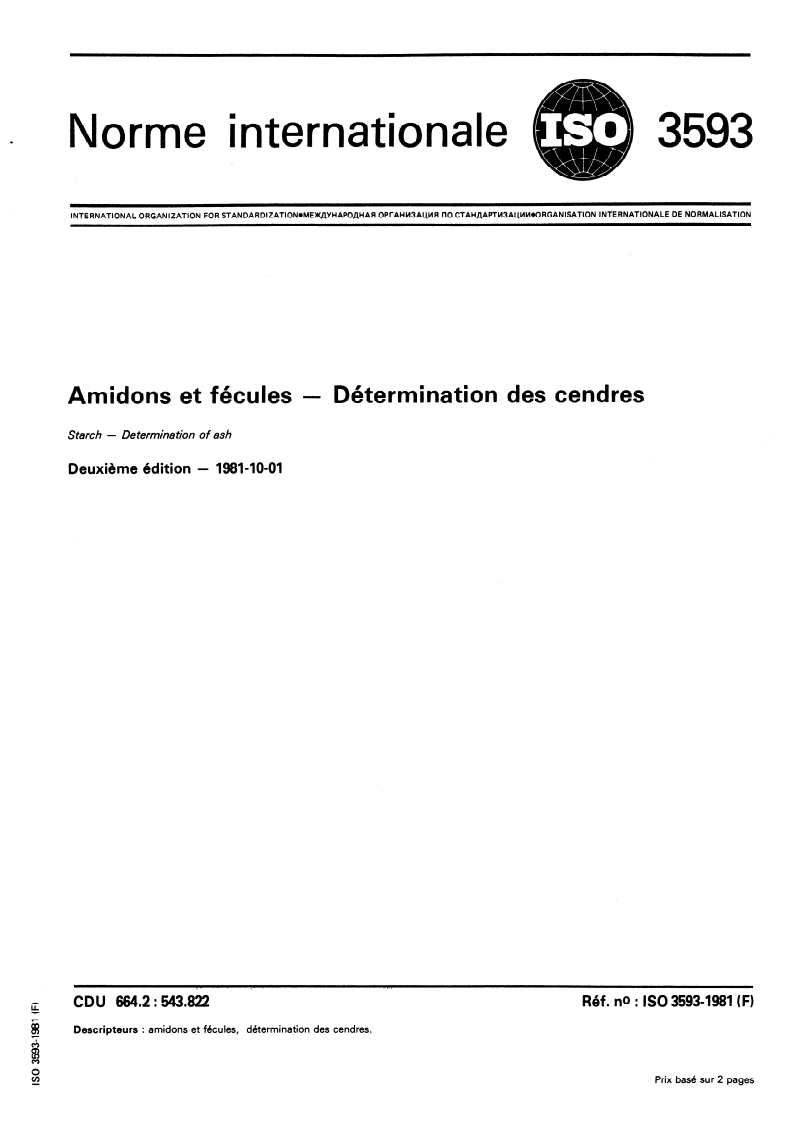
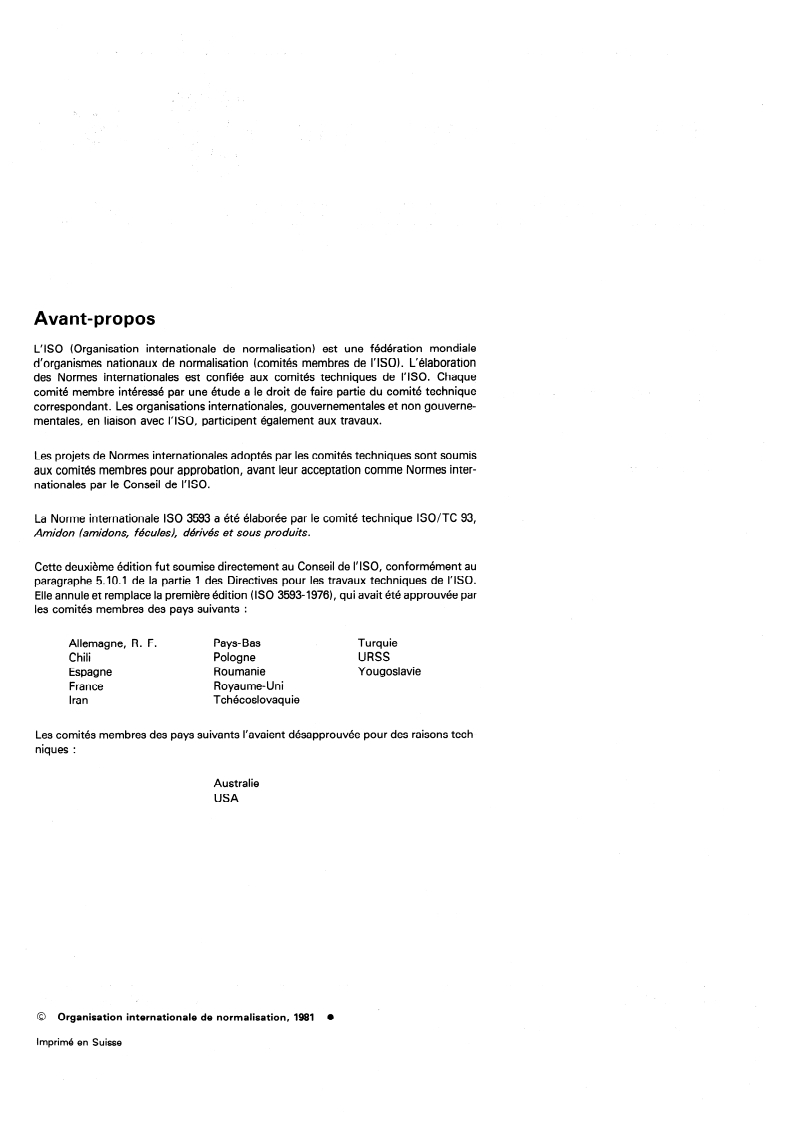
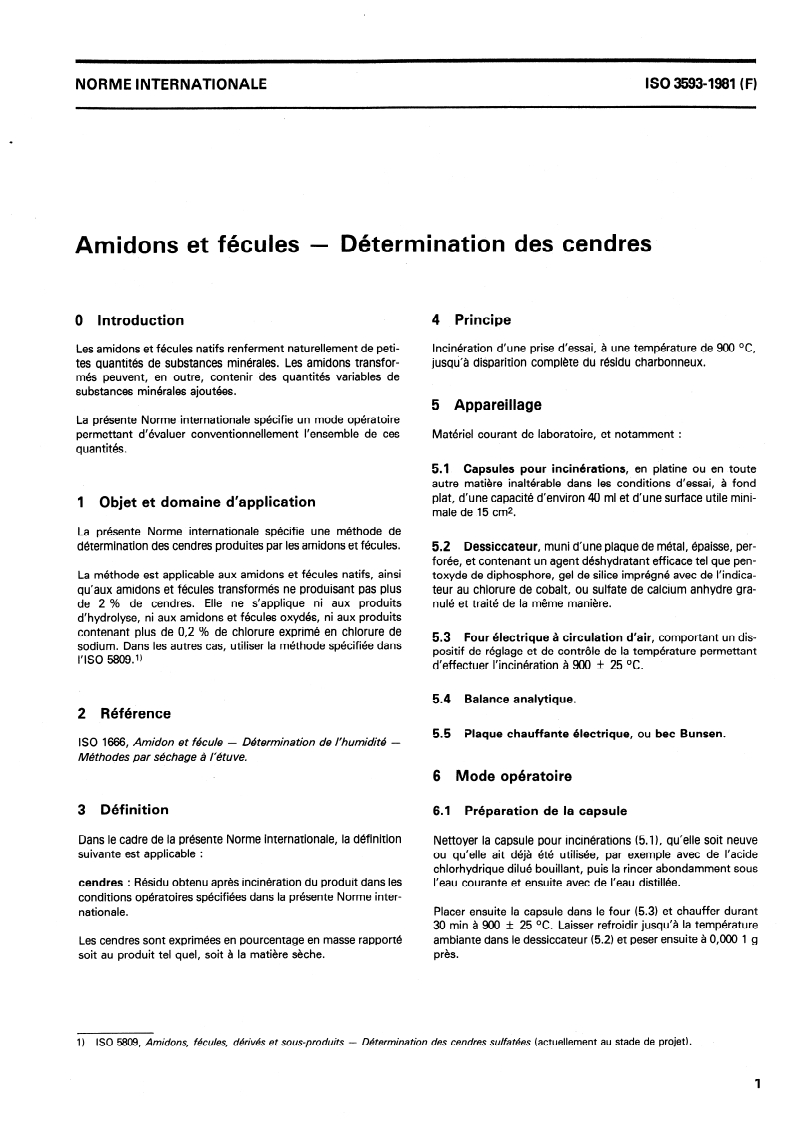
ISO 3593:1981 - Amidons et fécules — Détermination des cendres/1/1981
Overview
ISO 3593:1981 specifies a standardized method for the determination of ash content in starch. This method involves the incineration of a starch test portion at a high temperature (900 °C) until all carbon is completely oxidized. It evaluates both natural mineral substances present in native starches and added mineral substances in modified starches, applicable to ash contents up to 2%. The standard excludes hydrolysis products, oxidized starches, and starches containing more than 0.2% chloride; for those, ISO 5809 is recommended.
This International Standard was developed by ISO Technical Committee ISO/TC 93 for starch and related products. It ensures reliable, repeatable, and internationally recognized results for the mineral residue remaining after starch combustion, supporting quality control and product characterization efforts in the starch industry.
Key Topics
- Scope and Applicability
- Applies to native and modified starches with ash ≤ 2%.
- Does not apply to hydrolysis products, oxidized starch, or high-chloride starches (>0.2%).
- Uses incineration at 900 ± 25 °C until carbon residue disappears.
- Apparatus Required
- Platinum or heat-resistant ashing dishes (approx. 40 ml capacity).
- Electric furnace with temperature control and ventilation.
- Desiccator with efficient desiccant to cool samples post-incineration.
- Analytical balance (precision to 0.0001 g).
- Standard laboratory utensils such as hot plates or burners.
- Test Procedure
- Clean and pre-heat the ashing dish to a constant weight.
- Weigh accurately 2 to 10 grams of starch sample (typically 5-10 g depending on starch type).
- Pre-incinerate the sample to carbonize it without loss by projection of material.
- Incinerate fully at 900 °C until residue is free of carbon (about 1 hour).
- Cool in desiccator and weigh to determine ash weight.
- Calculations and Reporting
- Ash content expressed as percentage by mass on both as-received and dry basis.
- Requires at least two replicate tests, reporting the average.
- Repeatability criteria defined: differences between duplicates must be ≤ 0.02% ash absolute for ≤ 1% ash content or ≤ 2% of mean for >1% ash.
- Complete test report includes sample identification, conditions, and method details.
Applications
ISO 3593:1981 is critical for industries and laboratories involved in:
- Quality control of native and modified starch products.
- Verification of mineral residue limits in starch-based food, pharmaceutical excipients, and industrial starches.
- Compliance with regulatory and customer requirements where ash content affects product usability or purity.
- Supporting research and development by providing accurate measurement of mineral content in starch derivatives.
- Process monitoring in starch production to identify and control added mineral substances or impurities.
The standard’s precision and repeatability enable consistent evaluation across global supply chains, helping stakeholders maintain quality and safety standards in starch-related products.
Related Standards
- ISO 5809 – Starch including derivatives and by-products – alternative ash determination method for products with chloride content over 0.2%.
- ISO 1666 – Starch – Determination of moisture content using oven drying, essential for converting ash results to dry basis.
- Other ISO standards from Technical Committee ISO/TC 93 related to starch derivative testing and characterization.
Understanding and applying ISO 3593:1981 supports conformity with international best practices for ash determination in starch, ensuring reliable data for product quality, regulatory compliance, and manufacturing efficiency.
Buy Documents
ISO 3593:1981 - Starch — Determination of ash/1/1981
ISO 3593:1981 - Amidons et fécules -- Détermination des cendres
ISO 3593:1981 - Amidons et fécules -- Détermination des cendres
ISO 3593:1981 - Amidons et fécules — Détermination des cendres/1/1981
ISO 3593:1981 - Amidons et fécules — Détermination des cendres/1/1981
Get Certified
Connect with accredited certification bodies for this standard

BSI Group
BSI (British Standards Institution) is the business standards company that helps organizations make excellence a habit.

Bureau Veritas
Bureau Veritas is a world leader in laboratory testing, inspection and certification services.

DNV
DNV is an independent assurance and risk management provider.
Sponsored listings
Frequently Asked Questions
ISO 3593:1981 is a standard published by the International Organization for Standardization (ISO). Its full title is "Starch — Determination of ash". This standard covers: Incineration of a test portion at a temperature of 900 °C, until complete disappearance of the carbon in the residue. The method specifies a procedure for the evaluation of natural and added mineral substances together. It applies to contents up to 2 %. It does not apply to hydrolysis products nor to oxidized starches, nor to other products containing more than 0,2 % of chloride. In other cases, see ISO 5809.
Incineration of a test portion at a temperature of 900 °C, until complete disappearance of the carbon in the residue. The method specifies a procedure for the evaluation of natural and added mineral substances together. It applies to contents up to 2 %. It does not apply to hydrolysis products nor to oxidized starches, nor to other products containing more than 0,2 % of chloride. In other cases, see ISO 5809.
ISO 3593:1981 is classified under the following ICS (International Classification for Standards) categories: 67.180.20 - Starch and derived products. The ICS classification helps identify the subject area and facilitates finding related standards.
ISO 3593:1981 is available in PDF format for immediate download after purchase. The document can be added to your cart and obtained through the secure checkout process. Digital delivery ensures instant access to the complete standard document.
Standards Content (Sample)
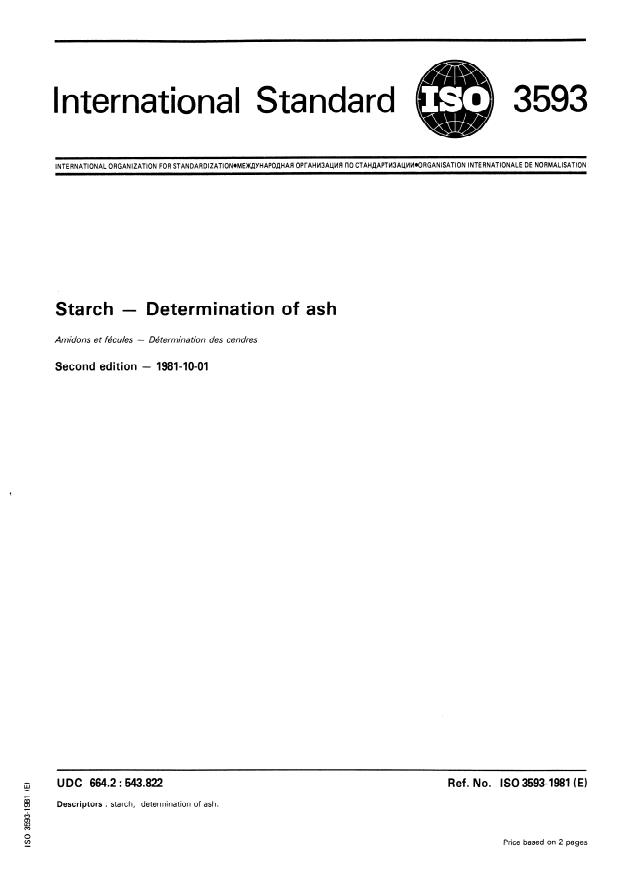
International Standard 3593
INTERNATIONAL ORGANIZATION FOR STANDARDIZATION.MEIKAYHAPOAHAR OPf-AHM3AWlR l-l0 CTAH~APTM3ALWl@ORGANISATION INTERNATIONALE DE NORMALISATION
Starch - Determination of ash
Amidons et fhcules - Dhtermina tion des cendres
Second edition - 1981-10-01
UDC 664.2 : 543.822
Ref. No. ISO35934981 (EI
Descriptors : starch, determination of ash.
Price based on 2 pages
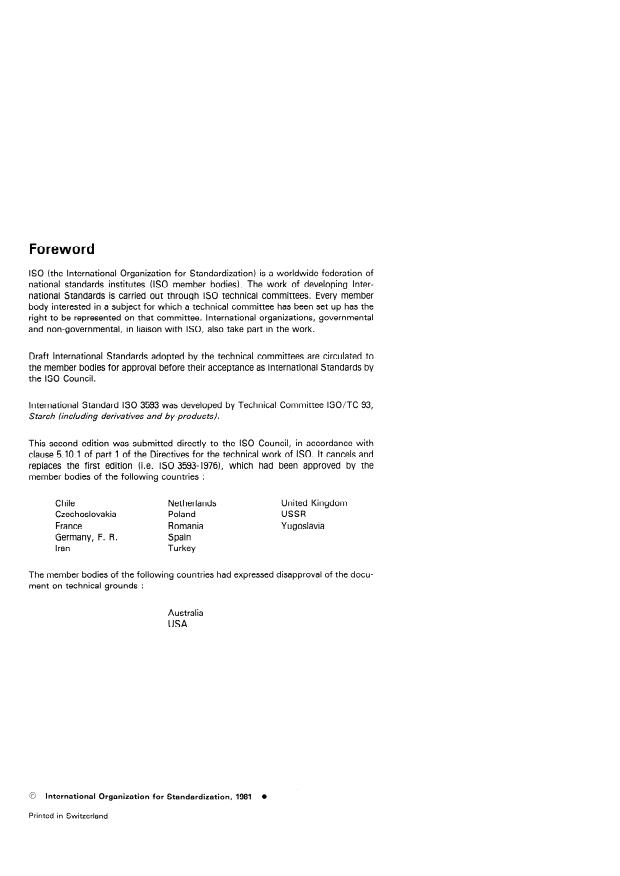
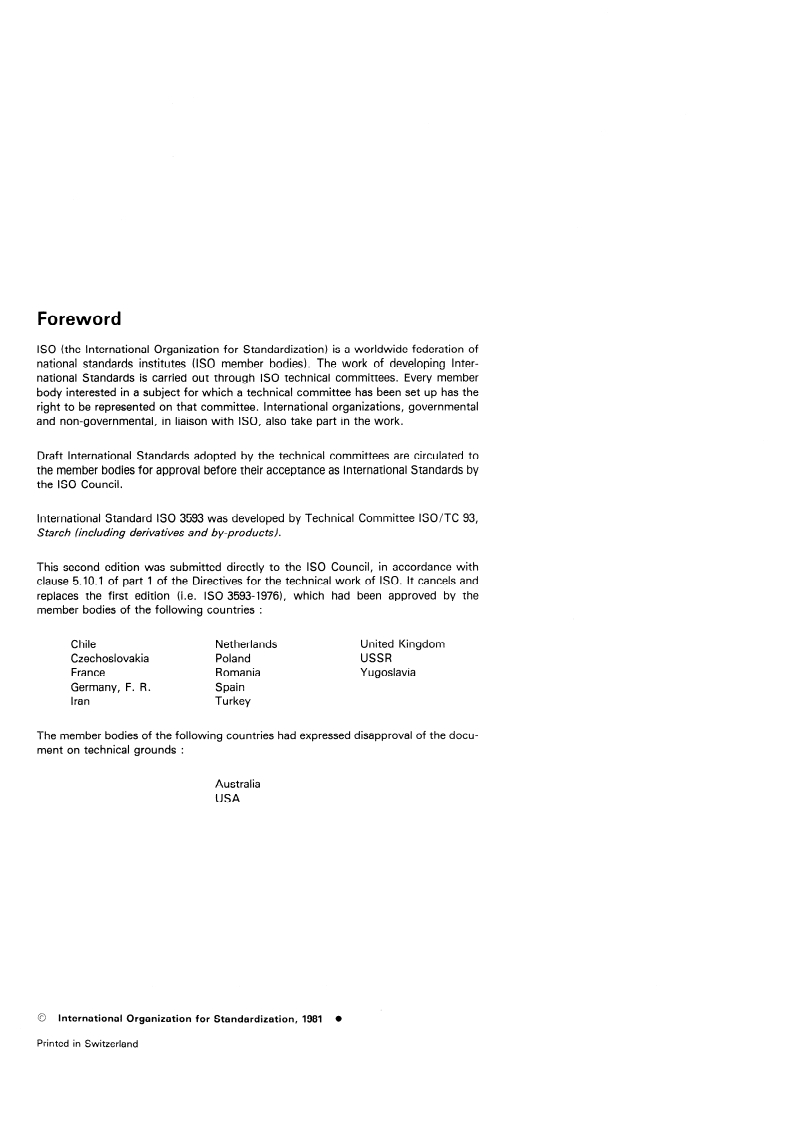
Foreword
ISO (the International Organization for Standardization) is a worldwide federation of
national Standards institutes (ISO member bodies). The work of developing Inter-
national Standards is carried out through ISO technical committees. Every member
body interested in a subject for which a technical committee has been set up has the
right to be represented on that committee. International organizations, governmental
and non-governmental, in liaison with ISO, also take part in the work.
Draft International Standards adopted by the technical committees are circulated to
the member bodies for approval before their acceptance as International Standards by
the ISO Council.
International Standard ISO 3593 was developed by Technical Committee ISO/TC 93,
Starch (including derivatives and b y-produc ts).
This second edition was submitted directly to the ISO Council, in accordance with
clause 5.10.1 of part 1 of the Directives for the technical work of ISO. lt cancels and
replaces the first edition (i.e. ISO 3593-1976), which had been approved by the
member bodies of the following countries :
Chile Netherlands United Kingdom
Czec hoslova kia Poland USSR
Y ugoslavia
France Romania
Spain
Germany, F. R.
Iran Turkey
The member bodies of the following countries had expressed disapproval of the docu-
ment on technical grounds :
Australia
USA
0 International Organkation for Standardkation, 1981
Printed in Switzerland
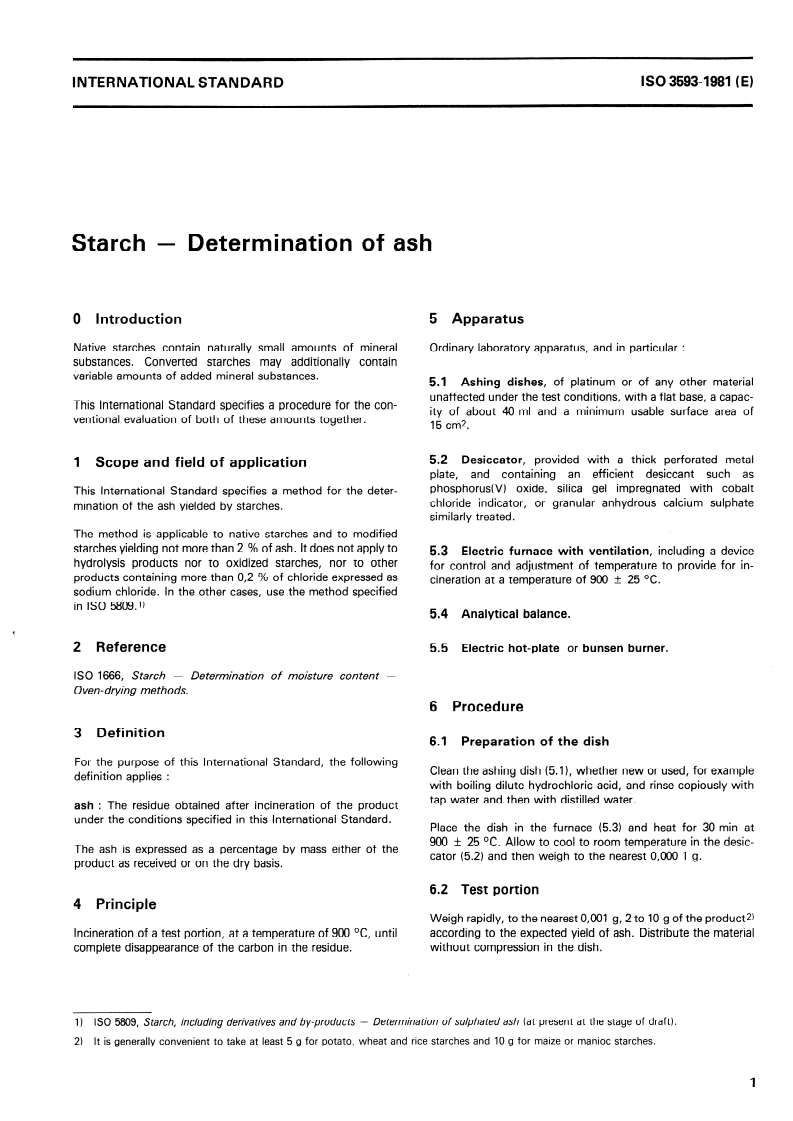
ISO 3593-1981 (E)
INTERNATIONAL STANDARD
Determination of ash
Starch -
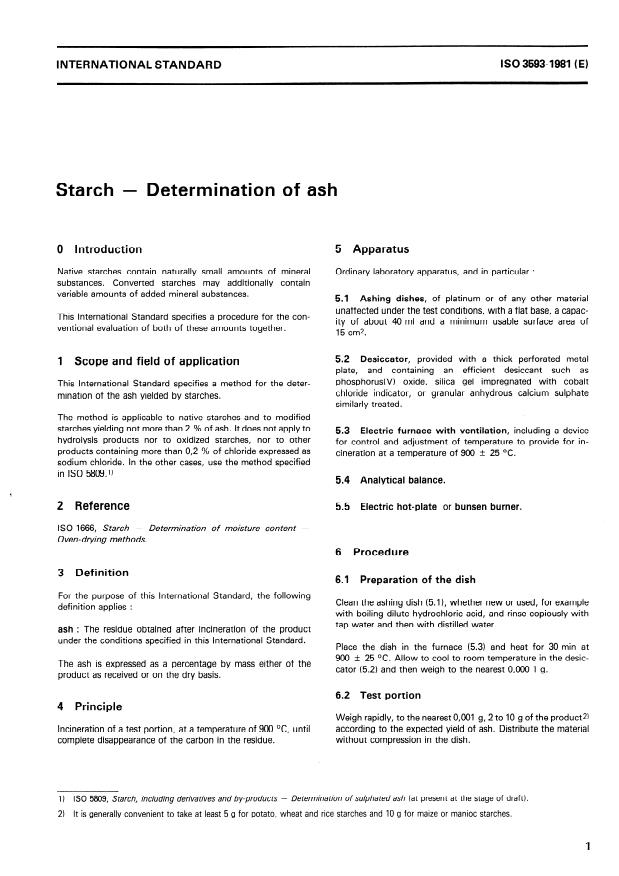
0 Introduction 5 Apparatus
Native starches contain naturally small amounts of mineral Ordinary laboratory apparatus, and in particular :
substances. Converted starches may additionally contain
variable amounts of added mineral substances.
5.1 Ashing dishes, of platinum or of any other material
unaffected under the test conditions, with a flat base, a capac-
This International Standard specifies a procedure for the con-
ity of about 40 ml and a minimum usable surface area of
ventional evaluation of both of these amounts together.
15 cm*.
5.2 Desiccator, provided with a thick perforated rnetal
1 Scope and field of application
plate, and containing an efficient desiccant such as
phosphorus(V) Oxide, silica gel impregnated with Cobalt
This International Standard specifies a method for the deter-
chloride indicator, or granular anhydrous Calcium sulphate
mination of the ash yielded by starches.
similarly treated.
The method is applicable to native starches and to modified
starches yielding not more than 2 % of ash. lt does not apply to
5.3 Electric furnace with Ventilation, including a device
hydrolysis products nor to oxidized starches, nor to other
for control and adjustment of temperature to provide for in-
products containing more than 0,2 % of chloride expressed as
cineration at a temperature of 900 + 25 OC.
sodium chloride. In the other cases, use the method specified
in ISO 5809.1)
5.4 Analytical balance.
2 Reference 5.5 Electric hot-plate or bunsen burner.
ISO 1666, Starch - Determination o f moisture con tent -
Oven-drying methods.
6 Procedure
3 Definition
6.1 Preparation of the dish
For the purpose of this International Standard, the following
Clean the ashi
...
International Standard 3593
INTERNATIONAL ORGANIZATION FOR STANDARDIZATION.MEIKAYHAPOAHAR OPf-AHM3AWlR l-l0 CTAH~APTM3ALWl@ORGANISATION INTERNATIONALE DE NORMALISATION
Starch - Determination of ash
Amidons et fhcules - Dhtermina tion des cendres
Second edition - 1981-10-01
UDC 664.2 : 543.822
Ref. No. ISO35934981 (EI
Descriptors : starch, determination of ash.
Price based on 2 pages
Foreword
ISO (the International Organization for Standardization) is a worldwide federation of
national Standards institutes (ISO member bodies). The work of developing Inter-
national Standards is carried out through ISO technical committees. Every member
body interested in a subject for which a technical committee has been set up has the
right to be represented on that committee. International organizations, governmental
and non-governmental, in liaison with ISO, also take part in the work.
Draft International Standards adopted by the technical committees are circulated to
the member bodies for approval before their acceptance as International Standards by
the ISO Council.
International Standard ISO 3593 was developed by Technical Committee ISO/TC 93,
Starch (including derivatives and b y-produc ts).
This second edition was submitted directly to the ISO Council, in accordance with
clause 5.10.1 of part 1 of the Directives for the technical work of ISO. lt cancels and
replaces the first edition (i.e. ISO 3593-1976), which had been approved by the
member bodies of the following countries :
Chile Netherlands United Kingdom
Czec hoslova kia Poland USSR
Y ugoslavia
France Romania
Spain
Germany, F. R.
Iran Turkey
The member bodies of the following countries had expressed disapproval of the docu-
ment on technical grounds :
Australia
USA
0 International Organkation for Standardkation, 1981
Printed in Switzerland
ISO 3593-1981 (E)
INTERNATIONAL STANDARD
Determination of ash
Starch -
0 Introduction 5 Apparatus
Native starches contain naturally small amounts of mineral Ordinary laboratory apparatus, and in particular :
substances. Converted starches may additionally contain
variable amounts of added mineral substances.
5.1 Ashing dishes, of platinum or of any other material
unaffected under the test conditions, with a flat base, a capac-
This International Standard specifies a procedure for the con-
ity of about 40 ml and a minimum usable surface area of
ventional evaluation of both of these amounts together.
15 cm*.
5.2 Desiccator, provided with a thick perforated rnetal
1 Scope and field of application
plate, and containing an efficient desiccant such as
phosphorus(V) Oxide, silica gel impregnated with Cobalt
This International Standard specifies a method for the deter-
chloride indicator, or granular anhydrous Calcium sulphate
mination of the ash yielded by starches.
similarly treated.
The method is applicable to native starches and to modified
starches yielding not more than 2 % of ash. lt does not apply to
5.3 Electric furnace with Ventilation, including a device
hydrolysis products nor to oxidized starches, nor to other
for control and adjustment of temperature to provide for in-
products containing more than 0,2 % of chloride expressed as
cineration at a temperature of 900 + 25 OC.
sodium chloride. In the other cases, use the method specified
in ISO 5809.1)
5.4 Analytical balance.
2 Reference 5.5 Electric hot-plate or bunsen burner.
ISO 1666, Starch - Determination o f moisture con tent -
Oven-drying methods.
6 Procedure
3 Definition
6.1 Preparation of the dish
For the purpose of this International Standard, the following
Clean the ashi
...
Norme internationale
INTERNATIONAL ORGANIZATION FOR STANDARDiZATION.ME)I(L1YHAPOL1HAR OPl=AHH3Al.&lR ll0 CTAH~APTM3A~Wl.ORGANISATlON INTERNATIONALE DE NORMALISATION
Détermination des cendres
Amidons et fécules -
Starch - Determination of ash
Deuxième édition - 198140-01
CDU 664.2: 543.822 Réf. no : ISO 35934981 (FI
Descripteurs : amidons et fécules, détermination des cendres.
Prix basé sur 2 pages
Avant-propos
L’ISO (Organisation internationale de normalisation) est une fédération mondiale
d’organismes nationaux de normalisation (comités membres de I’ISO). L’élaboration
des Normes internationales est confiée aux comités techniques de I’ISO. Chaque
comité membre intéressé par une étude a le droit de faire partie du comité technique
correspondant. Les organisations internationales, gouvernementales et non gouverne-
mentales, en liaison avec I’ISO, participent également aux travaux.
Les projets de Normes internationales adoptés par les comités techniques sont soumis
aux comités membres pour approbation, avant leur acceptation comme Normes inter-
nationales par le Conseil de I’ISO.
La Norme internationale ISO 3593 a été élaborée par le comité technique ISO/TC 93,
Amidon (amidons, fécules), dérr’vés et sous produits.
Cette deuxiéme édition fut soumise directement au Conseil de I’ISO, conformément au
paragraphe 5.10.1 de la partie 1 des Directives pour les travaux techniques de I’ISO.
Elle annule et remplace la première édition (ISO 3593-19761, qui avait été approuvée par
les comités membres des pays suivants :
Allemagne, R. F. Pays- Bas Turquie
Chili Pologne URSS
Espagne Roumanie Yougoslavie
Royaume-Uni
France
Iran Tchécoslovaquie
Les comités membres des pays suivants l’avaient désapprouvée pour des raisons tech-
niques :
Australie
USA
@ Organisation internationale de normalisation, 1981 0
Imprimé en Suisse
NORME INTERNATIONALE ISO 3593-1981 (F)
Détermination des cendres
Amidons et fécules -
4 Principe
0 Introduction
Incinération d’une prise d’essai, à une température de 900 OC,
Les amidons et fécules natifs renferment naturellement de peti-
jusqu’à disparition complète du résidu charbonneux.
tes quantités de substances minérales. Les amidons transfor-
més peuvent, en outre, contenir des quantités variables de
substances minérales ajoutées.
5 Appareillage
La présente Norme internationale spécifie un mode opératoire
permettant d’évaluer conventionnellement l’ensemble de ces Matériel courant de laboratoire, et notamment :
quantités.
5.1 Capsules pour incinérations, en platine ou en toute
autre matière inaltérable dans les conditions d’essai, à fond
plat, d’une capacité d’environ 40 ml et d’une surface utile mini-
1 Objet et domaine d’application
male de 15 cm*.
La présente Norme internationale spécifie une méthode de
détermination des cendres produites par les amidons et fécules. 5.2 Dessiccateur, muni d’une plaque de métal, épaisse, per-
forée, et contenant un agent déshydratant efficace tel que pen-
La méthode est applicable aux amidons et fécules natifs, ainsi toxyde de diphosphore, gel de silice imprégné avec de I’indica-
qu’aux amidons et fécules transformés ne produisant pas plus teur au chlorure de cobalt, ou sulfate de calcium anhydre gra-
de 2 % de cendres. Elle ne s’applique ni aux produits nulé et traité de la même manière.
d’hydrolyse, ni aux amidons et fécules oxydés, ni aux produits
contenant plus de 0,2 % de chlorure exprimé en chlorure de
5.3 Four électrique à circulation d’air, comportant un dis-
sodium. Dans les autres cas, utiliser la méthode spécifiée dans
positif de réglage et de contrôle de la température permettant
I’ISO 5809.‘)
d’effectuer l’incinération à 900 + 25 OC.
5.4 Balance analytique.
2 Référence
5.5 Plaque chauffante électrique, ou bec Bunsen.
ISO 1666, Amidon et fécule - Détermination de l’humidité -
A&thodes par séchage à l’étuve.
6 Mode opératoire
3 Dé
...
Norme internationale
INTERNATIONAL ORGANIZATION FOR STANDARDiZATION.ME)I(L1YHAPOL1HAR OPl=AHH3Al.&lR ll0 CTAH~APTM3A~Wl.ORGANISATlON INTERNATIONALE DE NORMALISATION
Détermination des cendres
Amidons et fécules -
Starch - Determination of ash
Deuxième édition - 198140-01
CDU 664.2: 543.822 Réf. no : ISO 35934981 (FI
Descripteurs : amidons et fécules, détermination des cendres.
Prix basé sur 2 pages
Avant-propos
L’ISO (Organisation internationale de normalisation) est une fédération mondiale
d’organismes nationaux de normalisation (comités membres de I’ISO). L’élaboration
des Normes internationales est confiée aux comités techniques de I’ISO. Chaque
comité membre intéressé par une étude a le droit de faire partie du comité technique
correspondant. Les organisations internationales, gouvernementales et non gouverne-
mentales, en liaison avec I’ISO, participent également aux travaux.
Les projets de Normes internationales adoptés par les comités techniques sont soumis
aux comités membres pour approbation, avant leur acceptation comme Normes inter-
nationales par le Conseil de I’ISO.
La Norme internationale ISO 3593 a été élaborée par le comité technique ISO/TC 93,
Amidon (amidons, fécules), dérr’vés et sous produits.
Cette deuxiéme édition fut soumise directement au Conseil de I’ISO, conformément au
paragraphe 5.10.1 de la partie 1 des Directives pour les travaux techniques de I’ISO.
Elle annule et remplace la première édition (ISO 3593-19761, qui avait été approuvée par
les comités membres des pays suivants :
Allemagne, R. F. Pays- Bas Turquie
Chili Pologne URSS
Espagne Roumanie Yougoslavie
Royaume-Uni
France
Iran Tchécoslovaquie
Les comités membres des pays suivants l’avaient désapprouvée pour des raisons tech-
niques :
Australie
USA
@ Organisation internationale de normalisation, 1981 0
Imprimé en Suisse
NORME INTERNATIONALE ISO 3593-1981 (F)
Détermination des cendres
Amidons et fécules -
4 Principe
0 Introduction
Incinération d’une prise d’essai, à une température de 900 OC,
Les amidons et fécules natifs renferment naturellement de peti-
jusqu’à disparition complète du résidu charbonneux.
tes quantités de substances minérales. Les amidons transfor-
més peuvent, en outre, contenir des quantités variables de
substances minérales ajoutées.
5 Appareillage
La présente Norme internationale spécifie un mode opératoire
permettant d’évaluer conventionnellement l’ensemble de ces Matériel courant de laboratoire, et notamment :
quantités.
5.1 Capsules pour incinérations, en platine ou en toute
autre matière inaltérable dans les conditions d’essai, à fond
plat, d’une capacité d’environ 40 ml et d’une surface utile mini-
1 Objet et domaine d’application
male de 15 cm*.
La présente Norme internationale spécifie une méthode de
détermination des cendres produites par les amidons et fécules. 5.2 Dessiccateur, muni d’une plaque de métal, épaisse, per-
forée, et contenant un agent déshydratant efficace tel que pen-
La méthode est applicable aux amidons et fécules natifs, ainsi toxyde de diphosphore, gel de silice imprégné avec de I’indica-
qu’aux amidons et fécules transformés ne produisant pas plus teur au chlorure de cobalt, ou sulfate de calcium anhydre gra-
de 2 % de cendres. Elle ne s’applique ni aux produits nulé et traité de la même manière.
d’hydrolyse, ni aux amidons et fécules oxydés, ni aux produits
contenant plus de 0,2 % de chlorure exprimé en chlorure de
5.3 Four électrique à circulation d’air, comportant un dis-
sodium. Dans les autres cas, utiliser la méthode spécifiée dans
positif de réglage et de contrôle de la température permettant
I’ISO 5809.‘)
d’effectuer l’incinération à 900 + 25 OC.
5.4 Balance analytique.
2 Référence
5.5 Plaque chauffante électrique, ou bec Bunsen.
ISO 1666, Amidon et fécule - Détermination de l’humidité -
A&thodes par séchage à l’étuve.
6 Mode opératoire
3 Dé
...
Norme internationale
INTERNATIONAL ORGANIZATION FOR STANDARDiZATION.ME)I(L1YHAPOL1HAR OPl=AHH3Al.&lR ll0 CTAH~APTM3A~Wl.ORGANISATlON INTERNATIONALE DE NORMALISATION
Détermination des cendres
Amidons et fécules -
Starch - Determination of ash
Deuxième édition - 198140-01
CDU 664.2: 543.822 Réf. no : ISO 35934981 (FI
Descripteurs : amidons et fécules, détermination des cendres.
Prix basé sur 2 pages
Avant-propos
L’ISO (Organisation internationale de normalisation) est une fédération mondiale
d’organismes nationaux de normalisation (comités membres de I’ISO). L’élaboration
des Normes internationales est confiée aux comités techniques de I’ISO. Chaque
comité membre intéressé par une étude a le droit de faire partie du comité technique
correspondant. Les organisations internationales, gouvernementales et non gouverne-
mentales, en liaison avec I’ISO, participent également aux travaux.
Les projets de Normes internationales adoptés par les comités techniques sont soumis
aux comités membres pour approbation, avant leur acceptation comme Normes inter-
nationales par le Conseil de I’ISO.
La Norme internationale ISO 3593 a été élaborée par le comité technique ISO/TC 93,
Amidon (amidons, fécules), dérr’vés et sous produits.
Cette deuxiéme édition fut soumise directement au Conseil de I’ISO, conformément au
paragraphe 5.10.1 de la partie 1 des Directives pour les travaux techniques de I’ISO.
Elle annule et remplace la première édition (ISO 3593-19761, qui avait été approuvée par
les comités membres des pays suivants :
Allemagne, R. F. Pays- Bas Turquie
Chili Pologne URSS
Espagne Roumanie Yougoslavie
Royaume-Uni
France
Iran Tchécoslovaquie
Les comités membres des pays suivants l’avaient désapprouvée pour des raisons tech-
niques :
Australie
USA
@ Organisation internationale de normalisation, 1981 0
Imprimé en Suisse
NORME INTERNATIONALE ISO 3593-1981 (F)
Détermination des cendres
Amidons et fécules -
4 Principe
0 Introduction
Incinération d’une prise d’essai, à une température de 900 OC,
Les amidons et fécules natifs renferment naturellement de peti-
jusqu’à disparition complète du résidu charbonneux.
tes quantités de substances minérales. Les amidons transfor-
més peuvent, en outre, contenir des quantités variables de
substances minérales ajoutées.
5 Appareillage
La présente Norme internationale spécifie un mode opératoire
permettant d’évaluer conventionnellement l’ensemble de ces Matériel courant de laboratoire, et notamment :
quantités.
5.1 Capsules pour incinérations, en platine ou en toute
autre matière inaltérable dans les conditions d’essai, à fond
plat, d’une capacité d’environ 40 ml et d’une surface utile mini-
1 Objet et domaine d’application
male de 15 cm*.
La présente Norme internationale spécifie une méthode de
détermination des cendres produites par les amidons et fécules. 5.2 Dessiccateur, muni d’une plaque de métal, épaisse, per-
forée, et contenant un agent déshydratant efficace tel que pen-
La méthode est applicable aux amidons et fécules natifs, ainsi toxyde de diphosphore, gel de silice imprégné avec de I’indica-
qu’aux amidons et fécules transformés ne produisant pas plus teur au chlorure de cobalt, ou sulfate de calcium anhydre gra-
de 2 % de cendres. Elle ne s’applique ni aux produits nulé et traité de la même manière.
d’hydrolyse, ni aux amidons et fécules oxydés, ni aux produits
contenant plus de 0,2 % de chlorure exprimé en chlorure de
5.3 Four électrique à circulation d’air, comportant un dis-
sodium. Dans les autres cas, utiliser la méthode spécifiée dans
positif de réglage et de contrôle de la température permettant
I’ISO 5809.‘)
d’effectuer l’incinération à 900 + 25 OC.
5.4 Balance analytique.
2 Référence
5.5 Plaque chauffante électrique, ou bec Bunsen.
ISO 1666, Amidon et fécule - Détermination de l’humidité -
A&thodes par séchage à l’étuve.
6 Mode opératoire
3 Dé
...
Norme internationale
INTERNATIONAL ORGANIZATION FOR STANDARDiZATION.ME)I(L1YHAPOL1HAR OPl=AHH3Al.&lR ll0 CTAH~APTM3A~Wl.ORGANISATlON INTERNATIONALE DE NORMALISATION
Détermination des cendres
Amidons et fécules -
Starch - Determination of ash
Deuxième édition - 198140-01
CDU 664.2: 543.822 Réf. no : ISO 35934981 (FI
Descripteurs : amidons et fécules, détermination des cendres.
Prix basé sur 2 pages
Avant-propos
L’ISO (Organisation internationale de normalisation) est une fédération mondiale
d’organismes nationaux de normalisation (comités membres de I’ISO). L’élaboration
des Normes internationales est confiée aux comités techniques de I’ISO. Chaque
comité membre intéressé par une étude a le droit de faire partie du comité technique
correspondant. Les organisations internationales, gouvernementales et non gouverne-
mentales, en liaison avec I’ISO, participent également aux travaux.
Les projets de Normes internationales adoptés par les comités techniques sont soumis
aux comités membres pour approbation, avant leur acceptation comme Normes inter-
nationales par le Conseil de I’ISO.
La Norme internationale ISO 3593 a été élaborée par le comité technique ISO/TC 93,
Amidon (amidons, fécules), dérr’vés et sous produits.
Cette deuxiéme édition fut soumise directement au Conseil de I’ISO, conformément au
paragraphe 5.10.1 de la partie 1 des Directives pour les travaux techniques de I’ISO.
Elle annule et remplace la première édition (ISO 3593-19761, qui avait été approuvée par
les comités membres des pays suivants :
Allemagne, R. F. Pays- Bas Turquie
Chili Pologne URSS
Espagne Roumanie Yougoslavie
Royaume-Uni
France
Iran Tchécoslovaquie
Les comités membres des pays suivants l’avaient désapprouvée pour des raisons tech-
niques :
Australie
USA
@ Organisation internationale de normalisation, 1981 0
Imprimé en Suisse
NORME INTERNATIONALE ISO 3593-1981 (F)
Détermination des cendres
Amidons et fécules -
4 Principe
0 Introduction
Incinération d’une prise d’essai, à une température de 900 OC,
Les amidons et fécules natifs renferment naturellement de peti-
jusqu’à disparition complète du résidu charbonneux.
tes quantités de substances minérales. Les amidons transfor-
més peuvent, en outre, contenir des quantités variables de
substances minérales ajoutées.
5 Appareillage
La présente Norme internationale spécifie un mode opératoire
permettant d’évaluer conventionnellement l’ensemble de ces Matériel courant de laboratoire, et notamment :
quantités.
5.1 Capsules pour incinérations, en platine ou en toute
autre matière inaltérable dans les conditions d’essai, à fond
plat, d’une capacité d’environ 40 ml et d’une surface utile mini-
1 Objet et domaine d’application
male de 15 cm*.
La présente Norme internationale spécifie une méthode de
détermination des cendres produites par les amidons et fécules. 5.2 Dessiccateur, muni d’une plaque de métal, épaisse, per-
forée, et contenant un agent déshydratant efficace tel que pen-
La méthode est applicable aux amidons et fécules natifs, ainsi toxyde de diphosphore, gel de silice imprégné avec de I’indica-
qu’aux amidons et fécules transformés ne produisant pas plus teur au chlorure de cobalt, ou sulfate de calcium anhydre gra-
de 2 % de cendres. Elle ne s’applique ni aux produits nulé et traité de la même manière.
d’hydrolyse, ni aux amidons et fécules oxydés, ni aux produits
contenant plus de 0,2 % de chlorure exprimé en chlorure de
5.3 Four électrique à circulation d’air, comportant un dis-
sodium. Dans les autres cas, utiliser la méthode spécifiée dans
positif de réglage et de contrôle de la température permettant
I’ISO 5809.‘)
d’effectuer l’incinération à 900 + 25 OC.
5.4 Balance analytique.
2 Référence
5.5 Plaque chauffante électrique, ou bec Bunsen.
ISO 1666, Amidon et fécule - Détermination de l’humidité -
A&thodes par séchage à l’étuve.
6 Mode opératoire
3 Dé
...