

ISO 8355:2023
(Main)Starch acetates — Specifications and test methods
General Information
- Abstract
This document specifies the physical, chemical and microbiological requirements for, and test methods of, starch acetates.
- Status
- Published
- Publication Date
- 14-Jun-2023
- Technical Committee
- ISO/TC 93 - Starch (including derivatives and by-products)
- Drafting Committee
- ISO/TC 93 - Starch (including derivatives and by-products)
- Current Stage
- 6060 - International Standard published
- Start Date
- 15-Jun-2023
- Due Date
- 21-Sep-2024
- Completion Date
- 15-Jun-2023
Overview
ISO 8355:2023 - Starch acetates: Specifications and test methods - defines physical, chemical and microbiological requirements and standardized test methods for starch acetates (acetylated starches). The standard covers appearance and solubility, chemical composition (acetyl/ester content, sulfur dioxide, moisture, pH), contaminant limits (heavy metals, fat, protein) and microbiological criteria, plus methods for sampling, analysis, marking, packaging, transport and storage.
Key topics and requirements
- Scope: Physical, chemical and microbiological requirements for starch acetates and associated test procedures (ISO 8355:2023).
- Physical indexes: Appearance (powder/granule), colour (white to nearly white), granular structure, insolubility in cold water/ether/alcohol, absence of foreign matter.
- Chemical indexes:
- Acetyl groups: Not more than 2.5% (dry weight).
- Ester groups: Not more than 0.5% (dry weight).
- pH:3.0–9.0 (10% w/v solution).
- Moisture: ≤ 14% (ISO 1666).
- Sulfur dioxide: Limits specified for modified cereal starches and other modified starches; method detailed in subclause 5.3 (titration procedure).
- Iodine stain: Colour change from dark blue to red (subclause 5.1).
- Copper reduction: Copious red precipitate expected for positive qualitative reduction test.
- Infrared test: Ester absorption band at ~1720 cm−1; detection threshold for acetyl groups ~0.5%.
- Contaminant limits: Specified limits for arsenic, lead, mercury, manganese, cadmium, crude fat and protein (see standard for exact values and test methods such as ISO 11212 series and AOAC 2011.14).
- Microbiological limits: Aerobic plate count ≤ 1 000 CFU/g, yeasts & moulds ≤ 1 000 CFU/g, total coliform ≤ 10 CFU/g (ISO microbiological methods referenced).
- Packaging & storage: Marking, transport and storage requirements to preserve product integrity.
Applications and practical value
- Ensures quality control and consistent performance of starch acetates used as stabilizers, thickeners, binders and emulsifiers in food and cosmetic formulations.
- Helps manufacturers, ingredient suppliers, QC laboratories and regulatory authorities verify compliance, safety and labeling claims.
- Standardized test methods (iodine stain, pH, sulfur dioxide titration, acetyl/ester analyses, ICP/AAS for metals) enable reproducible acceptance testing and supplier audits.
Who should use this standard
- Food ingredient producers and processors, cosmetic formulators, contract manufacturers, quality assurance labs, regulatory inspectors, and importers/exporters of modified starch products.
Related standards (normative references)
- ISO 1666 (moisture), ISO 3188 (nitrogen/Kjeldahl), ISO 3947 (fat), ISO 11212-1/2/3/4 (heavy metals), AOAC 2011.14, ISO 4832 / 4833 / 21527-2 (microbiology).
For product specification, compliance checks or method adoption, consult the full ISO 8355:2023 text for procedural details, calculation formulas and sampling instructions.
Get Certified
Connect with accredited certification bodies for this standard

BSI Group
BSI (British Standards Institution) is the business standards company that helps organizations make excellence a habit.

Bureau Veritas
Bureau Veritas is a world leader in laboratory testing, inspection and certification services.

DNV
DNV is an independent assurance and risk management provider.
Sponsored listings
Frequently Asked Questions
ISO 8355:2023 is a standard published by the International Organization for Standardization (ISO). Its full title is "Starch acetates — Specifications and test methods". This standard covers: This document specifies the physical, chemical and microbiological requirements for, and test methods of, starch acetates.
This document specifies the physical, chemical and microbiological requirements for, and test methods of, starch acetates.
ISO 8355:2023 is classified under the following ICS (International Classification for Standards) categories: 67.180.20 - Starch and derived products. The ICS classification helps identify the subject area and facilitates finding related standards.
ISO 8355:2023 is available in PDF format for immediate download after purchase. The document can be added to your cart and obtained through the secure checkout process. Digital delivery ensures instant access to the complete standard document.
Standards Content (Sample)
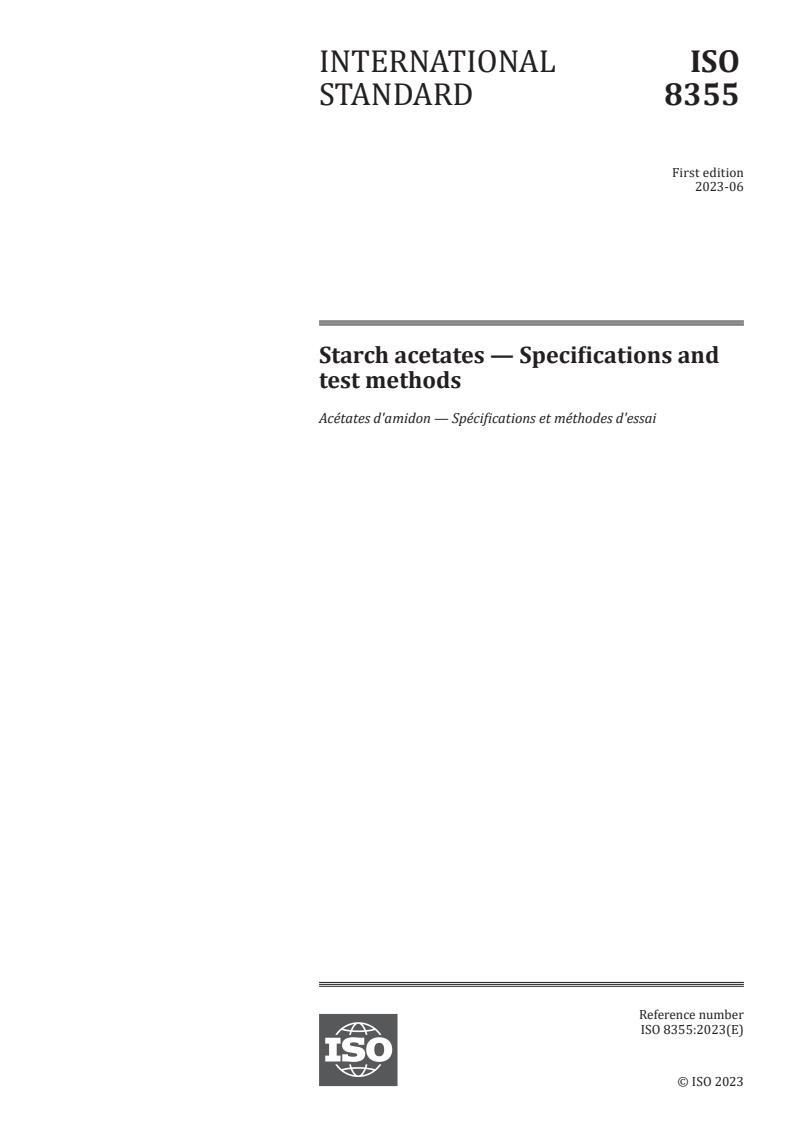
INTERNATIONAL ISO
STANDARD 8355
First edition
2023-06
Starch acetates — Specifications and
test methods
Acétates d'amidon — Spécifications et méthodes d'essai
Reference number
© ISO 2023
All rights reserved. Unless otherwise specified, or required in the context of its implementation, no part of this publication may
be reproduced or utilized otherwise in any form or by any means, electronic or mechanical, including photocopying, or posting on
the internet or an intranet, without prior written permission. Permission can be requested from either ISO at the address below
or ISO’s member body in the country of the requester.
ISO copyright office
CP 401 • Ch. de Blandonnet 8
CH-1214 Vernier, Geneva
Phone: +41 22 749 01 11
Email: copyright@iso.org
Website: www.iso.org
Published in Switzerland
ii
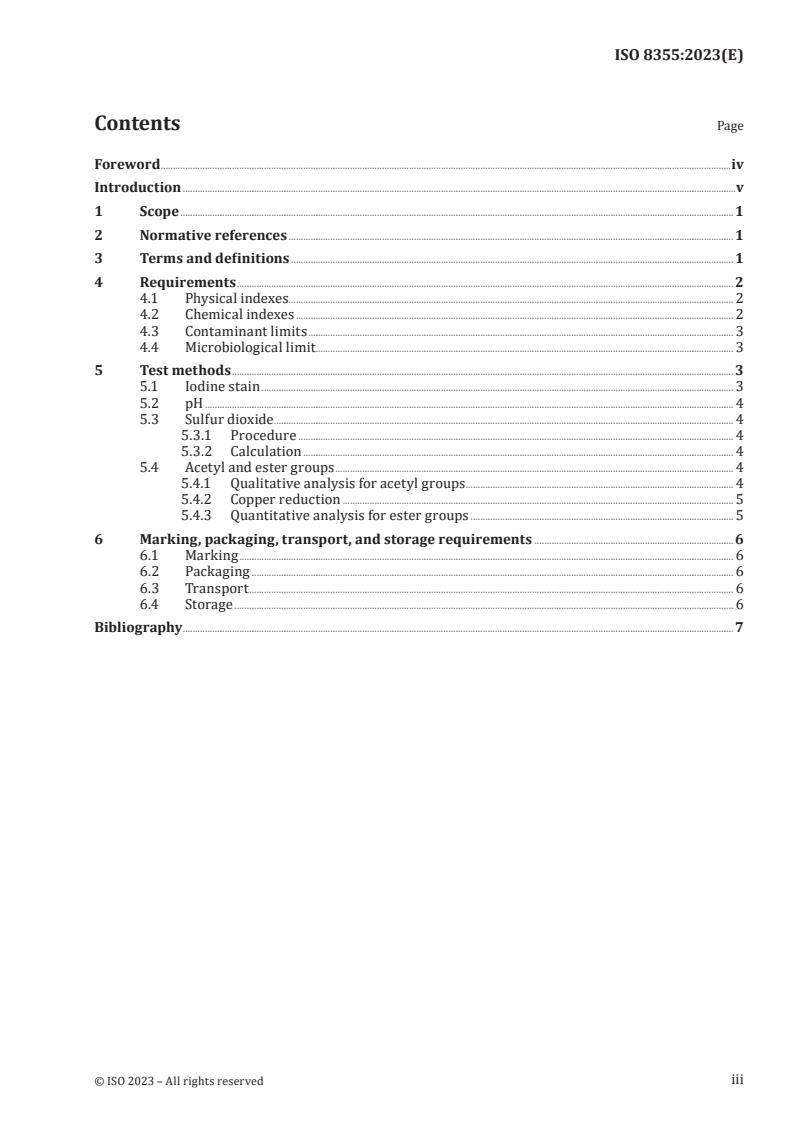
Contents Page
Foreword .iv
Introduction .v
1 Scope . 1
2 Normative references . 1
3 Terms and definitions . 1
4 Requirements . 2
4.1 Physical indexes. 2
4.2 Chemical indexes . 2
4.3 Contaminant limits . 3
4.4 Microbiological limit. 3
5 Test methods . 3
5.1 Iodine stain . 3
5.2 pH . 4
5.3 Sulfur dioxide . . 4
5.3.1 Procedure . 4
5.3.2 Calculation . 4
5.4 Acetyl and ester groups . 4
5.4.1 Qualitative analysis for acetyl groups . 4
5.4.2 Copper reduction . 5
5.4.3 Quantitative analysis for ester groups . 5
6 Marking, packaging, transport, and storage requirements . 6
6.1 Marking . 6
6.2 Packaging . 6
6.3 Transport . 6
6.4 Storage . 6
Bibliography . 7
iii
Foreword
ISO (the International Organization for Standardization) is a worldwide federation of national standards
bodies (ISO member bodies). The work of preparing International Standards is normally carried out
through ISO technical committees. Each member body interested in a subject for which a technical
committee has been established has the right to be represented on that committee. International
organizations, governmental and non-governmental, in liaison with ISO, also take part in the work.
ISO collaborates closely with the International Electrotechnical Commission (IEC) on all matters of
electrotechnical standardization.
The procedures used to develop this document and those intended for its further maintenance are
described in the ISO/IEC Directives, Part 1. In particular, the different approval criteria needed for the
different types of ISO document should be noted. This document was drafted in accordance with the
editorial rules of the ISO/IEC Directives, Part 2 (see www.iso.org/directives).
ISO draws attention to the possibility that the implementation of this document may involve the use
of (a) patent(s). ISO takes no position concerning the evidence, validity or applicability of any claimed
patent rights in respect thereof. As of the date of publication of this document, ISO had not received
notice of (a) patent(s) which may be required to implement this document. However, implementers are
cautioned that this may not represent the latest information, which may be obtained from the patent
database available at www.iso.org/patents. ISO shall not be held responsible for identifying any or all
such patent rights.
Any trade name used in this document is information given for the convenience of users and does not
constitute an endorsement.
For an explanation of the voluntary nature of standards, the meaning of ISO specific terms and
expressions related to conformity assessment, as well as information about ISO's adherence to
the World Trade Organization (WTO) principles in the Technical Barriers to Trade (TBT), see
www.iso.org/iso/foreword.html.
This document was prepared by Technical Committee ISO/TC 93, Starch (including derivatives and by-
products).
Any feedback or questions on this document should be directed to the user’s national standards body. A
complete listing of these bodies can be found at www.iso.org/members.html.
iv
Introduction
Starch consists mainly of amylose and amylopectin. Amylose is a linear molecule of α-D-glucopyranosyl
units, linked by (1-4)-α-linkages. Amylopectin is a highly branched polymer of α-D-glucopyranosyl
units, linked by (1-4)-α-linkages and by (1-6)-α- linkages that constitute the branch points. In general,
each glucose unit possesses a maximum of three hydroxyls that can undergo chemical substitution. A
fourth substitution is also possible at carbon four (4) if that carbon is not involved in a glycosidic bond.
Native starches can be chemically modified for improved functionality. The most common sources
of native starch used in these modifications are various roots, tubers, cereals and legumes. Modified
starches are used in applications requiring special properties that are not attainable by their respective
native starches.
Acetylated forms of food starches (including those extracted from hybrid crops such as high-amylose
1)
maize) are widely accepted additives that are used in the food industry globally. Starch acetate (INS
No. 1420), is produced by esterification of food starch with acetic anhydride or vinyl acetate, with the
acetyl groups not exceeding more than 2,5 % of the acetylated product.
1) International Numbering System for Food Additives.
v
INTERNATIONAL STANDARD ISO 8355:2023(E)
Starch acetates — Specifications and test methods
1 Scope
This document specifies the physical, chemical and microbiological requirements for, and test methods
of, starch acetates.
2 Normative references
The following documents are referred to in the text in such a way that some or all of their content
constitutes requirements of this document. For dated references, only the edition cited applies. For
undated references, the latest edition of the referenced document (including any amendments) applies.
ISO 1666, Starch — Determination of moisture content — Oven-drying method
ISO 3188, Starches and derived products — Determination of nitrogen content by the Kjeldahl method —
Titrimetric method
ISO 3947, Starches, native or modified — Determination of total fat content
ISO 11212-1, Starch and derived products — Heavy metals content — Part 1: Determination of arsenic
content by atomic absorption spectrometry
ISO 11212-2, Starch and derived products — Heavy metals content — Part 2: Determination of mercury
content by atomic absorption spectrometry
ISO 11212-3, Starch and derived products — Heavy metals content — Part 3: Determination of lead content
by atomic absorption spectrometry with electrothermal atomization
ISO 11212-4, Starch and derived products — Heavy metals
...