

ISO/IEC 24793-1:2010
(Main)Information technology — Mobile multicast communications: Framework — Part 1:
General Information
- Abstract
ISO/IEC 24793 specifies mobile multicast communications (MMC), which can be used to support a variety of multimedia multicasting services in IP-based wireless mobile networks as well as wired fixed networks. MMC targets real-time, one-to-many multicast services and applications over mobile communications networks. This implies that MMC focuses on multicast services rather than broadcast services, and that only authenticated users could be allowed in the multicast session. MMC also considers the one-to-many multicast session wherein a single multicast sender is allowed in the session rather than many-to-many multicast services. In addition, MMC is targeted in the real-time multicast session rather than the reliable multicast session; the timely delivery of multicast data is considered a key factor. ISO/IEC 24793-1:2010 specifies the MMC framework as part of the MMC standard describing the framework and functional architecture of MMC. Based on this framework, the two protocols for MMC will be developed in two parts of the MMC project: protocol over native IP multicast networks and protocol over overlay multicast networks.
- Status
- Published
- Publication Date
- 14-Dec-2010
- Drafting Committee
- ISO/IEC JTC 1/SC 6/WG 7 - Network, transport and future network
- Current Stage
- 9093 - International Standard confirmed
- Start Date
- 06-Jan-2025
- Completion Date
- 29-Aug-2026

Overview
ISO/IEC 24793-1:2010 - Information technology - Mobile multicast communications: Framework - Part 1 defines the framework and functional architecture for mobile multicast communications (MMC). The standard targets real-time, one-to-many multicast services over IP-based wireless and fixed networks, emphasizing timely delivery and authenticated participation in multicast sessions. This Part 1 document sets out design considerations, network models, functional entities and high-level information flows that guide subsequent protocol specifications (e.g., protocol over native IP multicast and protocol over overlay multicast networks).
Key Topics and Requirements
- Scope and focus: MMC is intended for real-time one-to-many multicast (single sender) rather than broadcast, many-to-many, or fully reliable multicast.
- Authentication requirement: Only authenticated users are permitted to join MMC sessions.
- Timeliness over reliability: The standard prioritizes low-latency delivery suitable for live audio/video and interactive services.
- Network environments: Covers heterogeneous deployments including IP-based core networks and a mix of wireless access (WLAN, 3G/4G, BWA) and wired networks under Fixed Mobile Convergence (FMC).
- Functional architecture: Defines functional entities (e.g., multicast agents, session managers, multicast content servers) and reference configurations for MMC operation.
- Information flows: Specifies high-level procedures for service subscription and announcement, session join/leave, multicast data transport, configuration of MMC agents, status monitoring, and mobility support (handover).
- Protocol applicability: Framework supports development of protocols for both native IP multicast networks and overlay multicast networks (unicast relay or tunneling where IP multicast is not fully supported).
Practical Applications
ISO/IEC 24793-1:2010 applies to services that require timely one-to-many delivery over mobile and converged networks, including:
- Mobile IPTV and live event streaming
- Remote education and distance learning
- Mobile commerce (m‑commerce) push sessions
- Digital Multimedia Broadcasting (DMB) and operator-managed multicast services
It is particularly relevant where users move between heterogeneous access networks and seamless multicast mobility support is required.
Who Should Use This Standard
- Network architects and operators planning multicast service delivery over mobile or converged networks.
- Protocol designers and implementers developing MMC protocols and agents.
- Equipment vendors building multicast-capable routers, base stations and mobile clients.
- Standards bodies and service developers aligning multicast services with NGN and FMC deployments.
Related Standards
ISO/IEC 24793-1:2010 references and aligns with related work such as ITU‑T X.603 / ISO/IEC 16512 (Relayed Multicast Protocol) and IETF multicast specifications (IGMP, MLD, PIM-SM). It complements mobile multicast efforts in 3GPP (MBMS) and 3GPP2 (BCMCS).
Get Certified
Connect with accredited certification bodies for this standard

BSI Group
BSI (British Standards Institution) is the business standards company that helps organizations make excellence a habit.

NYCE
Mexican standards and certification body.
Sponsored listings
Frequently Asked Questions
ISO/IEC 24793-1:2010 is a standard published by the International Organization for Standardization (ISO). Its full title is "Information technology — Mobile multicast communications: Framework — Part 1:". This standard covers: ISO/IEC 24793 specifies mobile multicast communications (MMC), which can be used to support a variety of multimedia multicasting services in IP-based wireless mobile networks as well as wired fixed networks. MMC targets real-time, one-to-many multicast services and applications over mobile communications networks. This implies that MMC focuses on multicast services rather than broadcast services, and that only authenticated users could be allowed in the multicast session. MMC also considers the one-to-many multicast session wherein a single multicast sender is allowed in the session rather than many-to-many multicast services. In addition, MMC is targeted in the real-time multicast session rather than the reliable multicast session; the timely delivery of multicast data is considered a key factor. ISO/IEC 24793-1:2010 specifies the MMC framework as part of the MMC standard describing the framework and functional architecture of MMC. Based on this framework, the two protocols for MMC will be developed in two parts of the MMC project: protocol over native IP multicast networks and protocol over overlay multicast networks.
ISO/IEC 24793 specifies mobile multicast communications (MMC), which can be used to support a variety of multimedia multicasting services in IP-based wireless mobile networks as well as wired fixed networks. MMC targets real-time, one-to-many multicast services and applications over mobile communications networks. This implies that MMC focuses on multicast services rather than broadcast services, and that only authenticated users could be allowed in the multicast session. MMC also considers the one-to-many multicast session wherein a single multicast sender is allowed in the session rather than many-to-many multicast services. In addition, MMC is targeted in the real-time multicast session rather than the reliable multicast session; the timely delivery of multicast data is considered a key factor. ISO/IEC 24793-1:2010 specifies the MMC framework as part of the MMC standard describing the framework and functional architecture of MMC. Based on this framework, the two protocols for MMC will be developed in two parts of the MMC project: protocol over native IP multicast networks and protocol over overlay multicast networks.
ISO/IEC 24793-1:2010 is classified under the following ICS (International Classification for Standards) categories: 35.100.70 - Application layer. The ICS classification helps identify the subject area and facilitates finding related standards.
ISO/IEC 24793-1:2010 is available in PDF format for immediate download after purchase. The document can be added to your cart and obtained through the secure checkout process. Digital delivery ensures instant access to the complete standard document.
Standards Content (Sample)
INTERNATIONAL ISO/IEC
STANDARD 24793-1
First edition
2010-12-15
Information technology — Mobile
multicast communications: Framework
Technologies de l'information — Communications de diffusion groupée
mobile: cadre de travail
Reference number
©
ISO/IEC 2010
PDF disclaimer
This PDF file may contain embedded typefaces. In accordance with Adobe's licensing policy, this file may be printed or viewed but
shall not be edited unless the typefaces which are embedded are licensed to and installed on the computer performing the editing. In
downloading this file, parties accept therein the responsibility of not infringing Adobe's licensing policy. The ISO Central Secretariat
accepts no liability in this area.
Adobe is a trademark of Adobe Systems Incorporated.
Details of the software products used to create this PDF file can be found in the General Info relative to the file; the PDF-creation
parameters were optimized for printing. Every care has been taken to ensure that the file is suitable for use by ISO member bodies. In
the unlikely event that a problem relating to it is found, please inform the Central Secretariat at the address given below.
© ISO/IEC 2010
All rights reserved. Unless otherwise specified, no part of this publication may be reproduced or utilized in any form or by any means,
electronic or mechanical, including photocopying and microfilm, without permission in writing from either ISO at the address below or
ISO's member body in the country of the requester.
ISO copyright office
Case postale 56 • CH-1211 Geneva 20
Tel. + 41 22 749 01 11
Fax + 41 22 749 09 47
E-mail copyright@iso.org
Web www.iso.org
Published by ISO in 2011
Published in Switzerland
ii © ISO/IEC 2010 – All rights reserved
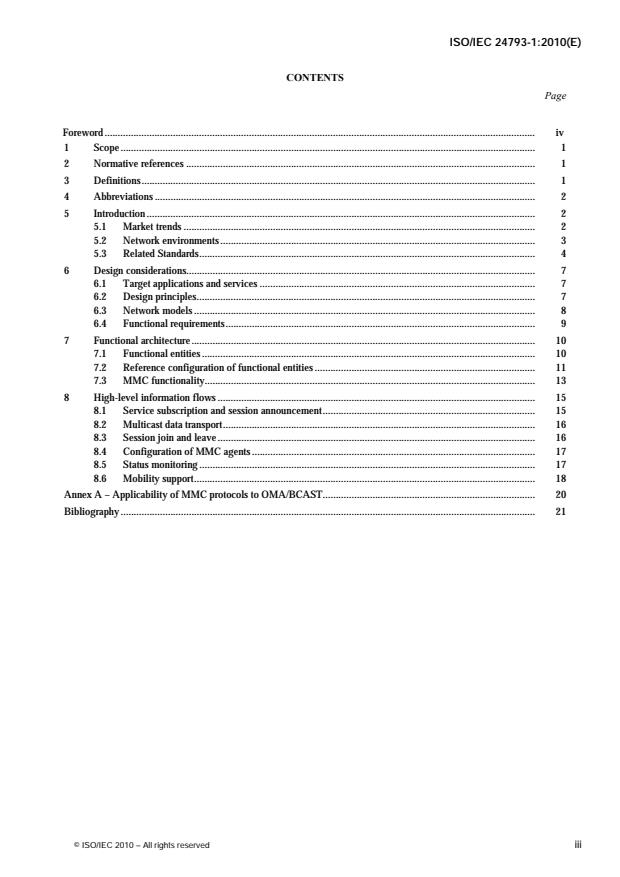
CONTENTS
Page
Foreword . iv
1 Scope . 1
2 Normative references . 1
3 Definitions . 1
4 Abbreviations . 2
5 Introduction . 2
5.1 Market trends . 2
5.2 Network environments . 3
5.3 Related Standards . 4
6 Design considerations . 7
6.1 Target applications and services . 7
6.2 Design principles . 7
6.3 Network models . 8
6.4 Functional requirements . 9
7 Functional architecture . 10
7.1 Functional entities . 10
7.2 Reference configuration of functional entities . 11
7.3 MMC functionality . 13
8 High-level information flows . 15
8.1 Service subscription and session announcement . 15
8.2 Multicast data transport . 16
8.3 Session join and leave . 16
8.4 Configuration of MMC agents . 17
8.5 Status monitoring . 17
8.6 Mobility support . 18
Annex A – Applicability of MMC protocols to OMA/BCAST . 20
Bibliography . 21
© ISO/IEC 2010 – All rights reserved iii
Foreword
ISO (the International Organization for Standardization) and IEC (the International Electrotechnical
Commission) form the specialized system for worldwide standardization. National bodies that are members of
ISO or IEC participate in the development of International Standards through technical committees
established by the respective organization to deal with particular fields of technical activity. ISO and IEC
technical committees collaborate in fields of mutual interest. Other international organizations, governmental
and non-governmental, in liaison with ISO and IEC, also take part in the work. In the field of information
technology, ISO and IEC have established a joint technical committee, ISO/IEC JTC 1.
International Standards are drafted in accordance with the rules given in the ISO/IEC Directives, Part 2.
The main task of the joint technical committee is to prepare International Standards. Draft International
Standards adopted by the joint technical committee are circulated to national bodies for voting. Publication as
an International Standard requires approval by at least 75 % of the national bodies casting a vote.
Attention is drawn to the possibility that some of the elements of this document may be the subject of patent
rights. ISO and IEC shall not be held responsible for identifying any or all such patent rights.
ISO/IEC 24793-1 was prepared by Joint Technical Committee ISO/IEC JTC 1, Information technology,
Subcommittee SC 6, Telecommunications and information exchange between systems, in collaboration with
ITU-T. The identical text is published as ITU-T Rec. X.604 (2010).
ISO/IEC 24793 consists of the following parts, under the general title Information technology — Mobile
multicast communications:
⎯ Part 1: Framework
⎯ Part 2: Protocol over native IP multicast networks
iv © ISO/IEC 2010 – All rights reserved
INTERNATIONAL STANDARD
RECOMMENDATION ITU-T
Information technology –
Mobile multicast communications: Framework
1 Scope
This Recommendation | International Standard describes the mobile multicast communications (MMC), which can be
used to support a variety of multimedia multicasting services in IP-based wireless mobile networks as well as wired
fixed networks. MMC targets real-time, one-to-many multicast services and applications over mobile communications
networks. This implies that MMC focuses on multicast services rather than broadcast services, and that only
authenticated users could be allowed in the multicast session. MMC also considers the one-to-many multicast session
wherein a single multicast sender is allowed in the session rather than many-to-many multicast services. In addition,
MMC is targeted in the real-time multicast session rather than the reliable multicast session; the timely delivery of
multicast data is considered a key factor.
This Recommendation | International Standard specifies the MMC framework as part of the MMC standard describing
the framework and functional architecture of MMC. Based on this framework, the two protocols for MMC will be
developed in two parts of the MMC project: protocol over native IP multicast networks and protocol over overlay
multicast networks.
2 Normative references
The following Recommendations and International Standards contain provisions which, through reference in this text,
constitute provisions of this Recommendation | International Standard. At the time of publication, the editions indicated
were valid. All Recommendations and Standards are subject to revision, and parties to agreements based on this
Recommendation | International Standard are encouraged to investigate the possibility of applying the most recent
edition of the Recommendations and Standards listed below. Members of IEC and ISO maintain registers of currently
valid International Standards. The Telecommunication Standardization Bureau of the ITU maintains a list of currently
valid ITU-T Recommendations.
– Recommendation ITU-T X.603 (2004) | ISO/IEC 16512-1:2005, Information technology – Relayed
multicast protocol: Framework.
– Recommendation ITU-T X.603.1 (2007) | ISO/IEC 16512-2:2008, Information technology – Relayed
multicast protocol: Specification for simplex group applications.
The following IETF standard track RFCs specify the multicast forwarding capability in IP multicast networks:
– IETF RFC 2236 (1997), Internet Group Management Protocol, Version 2, Proposed Standard.
– IETF RFC 3810 (2004), Multicast Listener Discovery Version 2 (MLDv2) for IPv6, Proposed Standard.
– IETF RFC 4601 (2006), Protocol Independent Multicast – Sparse Mode (PIM-SM): Protocol
Specification (Revised), Proposed Standard.
3 Definitions
This Recommendation | International Standard uses the terms defined in the relayed multicast protocol
(Rec. ITU-T X.603 | ISO/IEC 16512-1). The following terms are also used in this Recommendation | International
Standard:
3.1 multicast network: Multicast network refers to any of the networks wherein legacy IP multicasting schemes
are enabled with the help of multicast routing protocols, multicast forwarding capability of multicast routers in the
networks, link-layer multicasting of the points of attachment in the network, and multicast membership signalling in the
subnet such as IGMP/MLD. MMC services could be provisioned over the multicast network.
3.2 overlay multicast network: An overlay multicast network pertains to a network wherein legacy IP
multicasting schemes are not fully supported. In this network, multicast application data are delivered using unicast
transport such as TCP, UDP, or IP-in-IP tunnelling schemes. In particular, the unicast delivery of multicast data may be
done in backbone networks. In the overlay multicast network, IP multicast transport may be used in a portion of the
network. For example, as shown in the RMCP protocol (Rec. ITU-T X.603 | ISO/IEC 16512-1), subnet multicasting
may be used in the end subnets where the multicast sender or receiver is located. In the overlay multicast network,
Rec. ITU-T X.604 (03/2010) 1
multicast data may be delivered using the unicast relay of multicast agents and subnet multicasting capability. MMC
services could be provisioned over the overlay multicast network.
4 Abbreviations
For the purposes of this Recommendation | International Standard, the following abbreviations apply:
AAA Authentication, Authorization, and Accounting
AS Authentication Server
BCMCS Broadcast Multicast Services
BWA Broadband Wireless Access
ECTP Enhanced Communications Transport Protocol
FMC Fixed Mobile Convergence
IGMP Internet Group Management Protocol
IP Internet Protocol
IPTV IP-based TV
MA Multicast Agent
MBMS Multimedia Broadcast Multicast Services
MCS Multicast Contents Server
MLD Multicast Listener Discovery
MMC Mobile Multicast Communications
MMCF MMC Framework
MN Mobile Node
MS Mobile Station
NGN Next Generation Networks
RMCP Relayed Multicast Protocol
SDO Standards Development Organization
SM Session Manager
WLAN Wireless Local Area Network
5 Introduction
This Recommendation | International Standard deals with mobile multicast communications (MMC). MMC is targeted
to enable and support a variety of multimedia multicast applications and services over the wireless/mobile networks as
well as the wired/fixed networks.
This Recommendation | International Standard describes the MMC framework (MMCF). Based on this framework, the
two protocols required for MMC will be developed. This clause will first describe the rationale for MMC from the
perspective of market trends and evolving network environments. In addition, some related works that have been made
in other SDOs will be reviewed.
5.1 Market trends
From the market perspective, the work on MMC is driven by the following observations:
a) Growth of IP-based multimedia broadcast/multicast services markets
In telecommunications markets, there is a crucial need to provide multimedia multicasting and
broadcasting services all over the world. With the help of broadband networks, efficient multimedia
platforms including audio/video codecs, and IP-based network transport and application technologies, the
2 Rec. ITU-T X.604 (03/2010)
markets for IP-based multimedia broadcasting and multicasting services are expected to grow in next
generation communications networks.
Examples of these multimedia multicast/broadcast services include Internet TV (IPTV), remote
education, broadcasting of special live events, etc.
b) Increasing needs of multimedia broadcast/multicast services over wireless mobile networks
The recent trend in the mobile communications industry reflects the increasing demands of multimedia
multicast/broadcast applications and services over wireless/mobile networks. In fact, IP-based
multimedia broadcasting/multicasting services will be some of the primary killer applications from the
perspective of mobile service providers.
Examples of these mobile multicast applications/services include mobile IPTV, mobile commerce
(m-commerce), and digital multimedia broadcasting (DMB) using mobile devices such as cellular phone,
PDA, handheld PCs, etc. These mobile multicasting services are expected to be provisioned through a
variety of wireless access networks such as cdma2000, W-CDMA, wireless LAN (WLAN) based on
IEEE 802.11, and broadband wireless access (BWA) based on IEEE 802.16. Most of the mobile service
providers are expected to provide IP-based multimedia multicasting services over these various wireless
networks.
c) MBMS and BCMCS standardizations in 3GPP and 3GPP2
Given the demand for mobile multicasting, 3GPP and 3GPP2 are working on standardization to develop
the relevant protocols or schemes. In 3GPP, the "Multimedia Broadcast and Multicast Services
(MBMS)" is being developed to support IP-based multimedia multicasting services in its own systems.
On the other hand, 3GPP2 started to come up with standardization works on the "Broadcast & Multicast
Services (BCMCS)" for their own cdma2000-based networks and systems.
5.2 Network environments
In next generation communications networks, a variety of heterogeneous access networks using different wireless/wired
access technologies are expected to coexist under the same administrative domain or network operator. In this
environment, those heterogeneous access networks may be interconnected with each other via the IP-based core
network; thus ensuring that identical multimedia multicast/broadcast services could be provided to users regardless of
the access network where the user is connected.
With this trend of fixed mobile convergence (FMC), there is a crucial need to provide multimedia multicasting
services/applications over wireless/mobile networks as well as wired/fixed communications networks.
Figure 1 illustrates the network environment to be considered in the MMC.
Figure 1 – Network environments in MMC
As shown in Figure 1, the NGN environment is featured in the "IP-based core network" and a variety of "heterogeneous
access networks". In this scenario (Figure 1), the network operator (or service provider) will provide various multimedia
multicasting services/applications for users over the IP-based core network. Each (mobile) user will benefit from such
comprehensive services through the various access networks. Each access network could be a fixed/wired network such
as the conventional PSTN, ISDN, and Internet or a mobile/wireless network such as WLAN, BWA, and 3G cellular
networks. Under the FMC feature, users shall benefit from identical multimedia multicasting services regardless of the
specific access network where they are connected.
Rec. ITU-T X.604 (03/2010) 3
Note that the user may move around across a variety of access networks in the NGN environment. Accordingly, the
issue of mobility support for mobile users needs to be addressed from the MMC perspective, i.e., seamless mobility
(specifically handover) shall be supported even when mobile users move across those heterogeneous networks. The
mobility issue on MMC shall deal with how to support seamless multicast services against the movement of users
(terminals).
These observations suggest the need for some schemes or protocols in providing seamless mobile multicasting services
under FMC and mobility environments of NGN. Such schemes or protocols shall be commonly applied for a variety of
heterogeneous wireless and wired access networks regardless of the movement of users.
5.3 Related Standards
This Recommendation | International Standard seeks to design the framework of MMC. MMCF shall be designed based
on existing works that have been made to date in SDOs. Thus, this clause describes the relevant works in IETF, ITU-T,
JTC 1, and 3GPPs.
5.3.1 IETF
As a leading SDO in the area of IP multicasting, IETF has so far developed the protocols required for multicast data
transport including IGMP/MLD and multicasting routing protocols for multicast tree construction to deliver multicast
data packets in the Internet.
IGMP/MLD protocols are used for signalling between multicast routers and hosts in the network. These protocols
ensure that network routers can determine whether there is any multicast user (specific to the group IP address); this
information will in turn be used by multicast routers to construct the multicast tree using the multicast routing protocols.
To date, the following IGMP/MLD protocols have been developed:
• Internet group management protocol (IGMP) for IPv4: IGMPv2, IGMPv3
• Multicast listener discovery (MLD) for IPv6: MLDv1, MLDv2
Multicast routing protocols are used as signalling protocols to construct a multicast tree for a specific multicast IP
address that will require multicast network routers to configure the associated multicast forwarding table as the routing
path for multicast data packets. To date, the following multicast routing protocols have been developed:
• Distance vector multicast routing protocol (DVMRP)
• Core-based tree (CBT)
• Protocol-independent multicast – Dense mode (PIM-DM)
• Protocol-independent multicast – Sparse mode (PIM-SM)
• Source-specific multicast (SSM), which uses IGMPv3 (IPv4) or MLDv2 (IPv6)
In the IETF, further works are in progress for works on the deployment of IP multicasting (e.g., IGMP snooping in the
MBONED WG). Based on the discussion above, works made in the IETF can be summarized as follows:
Table 1 – IETF protocols related to IP multicasting
Technical Areas Protocols (year) Reference (RFC)
IGMPv2 (1997) IETF RFC 2236
IGMPv3 (2002) IETF RFC 3376
IGMP/MLD
MLDv1 for IPv6 (1999) IETF RFC 2710
MLDv2 for IPv6 (2004) IETF RFC 3810
DVMRP (1988) IETF RFC 1075
CBT (1997) IETF RFC 2189
Multicast Routing Protocols PIM-SM (1998) IETF RFC 2362
PIM-DM (2005) IETF RFC 3973
SSM (2003) IETF RFC 3569
5.3.2 ITU-T and ISO/IEC JTC 1
The main focus in JTC 1/SC6 and ITU-T Study Group (SG) 17 is on the protocols that can provide the reliable
multicast transport and QoS management for IP multicasting in networks as described in the enhanced communications
transport protocol (ECTP). The ECTP is a reliable multicast protocol designed to support Internet multicast applications
running over multicast-capable networks. ECTP may be provisioned over UDP; it is designed to support tightly
controlled multicast connections in simplex, duplex, and N-plex applications.
4 Rec. ITU-T X.604 (03/2010)
ECTP consists of the following parts:
a) ECTP-1: Simplex multicast transport (Rec. ITU-T X.606 | ISO/IEC 14476-1)
b) ECTP-2: QoS management for simplex multicast transport (Rec. ITU-T X.606.1 | ISO/IEC 14476-2)
c) ECTP-3: Duplex multicast transport (Rec. ITU-T X.607 | ISO/IEC 14476-3)
d) ECTP-4: QoS management for duplex multicast transport (Rec. ITU-T X.607.1 | ISO/IEC 14476-4)
e) ECTP-5: N-plex multicast transport (Rec. ITU-T X.608 | ISO/IEC 14476-5)
f) ECTP-6: QoS management for N-plex multicast transport (Rec. ITU-T X.608.1 | ISO/IEC 14476-6)
The JTC 1/SC6 and ITU-T SG 17 groups are also developing the relayed multicast protocol (RMCP). The RMCP is
designed to ensure that multicast applications and services can be realized over the current Internet environments
wherein IP multicast has not been deployed completely. Also known as application-level multicast, the RMCP is a
multicast data transport protocol used for multicast applications wherein intermediate multicast agents (MA) are
employed for relaying multicast data from a sender to many receivers over unicast networks.
RMCP consists of the following parts:
a) RMCP-1: RMCP framework (Rec. ITU-T X.603 | ISO/IEC 16512-1)
b) RMCP-2: RMCP for simplex group applications (Rec. ITU-T X.603.1 | ISO/IEC 16512-2)
c) RMCP-3: RMCP for N-plex group applications (Rec. ITU-T X.603.2 | ISO/IEC 16512-3)
5.3.3 3GPP/MBMS, 3GPP2/BCMCS, and WiMax/MBS
For the provisioning of multimedia multicast and broadcast services over wireless mobile systems, 3GPP is developing
the "Multimedia Broadcast and Multicast Services (MBMS)" that can be used to support IP-based multimedia
multicasting services in its own W-CDMA access networks and systems.
For the MBMS subsystem, 3GPP defines a new functional entity called "Broadcast and Multicast – Service Centre"
(BM-SC) and two new interfaces: Gmb for the control plane (authorization and management) and Gi for the user plane
(IP packet transmission). BM-SC is responsible for overall session management and multicast data transport in the
3GPP system. The MBMS of 3GPP is featured in the service-oriented, security-oriented multicast framework in
3GPP2's own networks and systems using legacy IP multicast protocols as much as possible.
The 3GPP documents associated with MBMS include:
a) 3GPP TS 22.246, MBMS User Services
b) 3GPP TS 23.246, MBMS Architecture
c) 3GPP TS 25.346, MBMS in RAN: Stage 2
d) 3GPP TS 26.346, MBMS Protocols and Codecs
e) 3GPP TS 33.246, Security of MBMS
On the other hand, 3GPP2 started to pursue standardization in "Broadcast & Multicast Services (BCMCS)" to provide
broadcast/multicast services and applications over its own cdma2000 systems.
Similar to the MBMS of 3GPP, BCMCS plans to design a secure multicast in cdma2000 networks and to develop some
technical specifications for provisioning multimedia multicasting services over 3GPP2's own networks and systems
using legacy IP multicast protocols as much as possible. BCMCS can be regarded as the subsystems for adding the
services-specific, security-oriented features to the IETF multicasting protocols.
For this purpose, BCMCS introduces new entities together with the security framework: BCMCS Controller for control
purposes and BCMCS supporting node (BSN) for data transport purposes.
The 3GPP2 documents associated with BCMCS include:
a) 3GPP2 S.R0030-A, Broadcast/Multicast Services – Stage 1
b) 3GPP2 S.S0083-A, Broadcast-Multicast Security Framework
c) 3GPP2 X.S0022, BCMCS in cdma2000 wireless IP network
d) 3GPP2 A.S0019, Interoperability Specification for BCMCS
e) 3GPP2 C.S0054, cdma2000 High-Rate BCMCS Packet Data Air Interface Specification
The WiMax forum has been developing a set of standards for IEEE 802.16-based wireless access technology, which is
also known as wireless broadband (WiBro). In particular, the network working group of the WiMax forum is
considering the multicast broadcast services (MBS) that can be used for WiMax-based wireless access networks. MBS
is aimed at developing the specification that enables multicast and broadcast transmissions over WiMax-based wireless
Rec. ITU-T X.604 (03/2010) 5
access networks. For this purpose, two kinds of MBS zones are being considered: embedded MBS and standalone
MBS, which will be additionally defined in the MAC frame. In the embedded MBS zone, the downlink (DL) frame will
be provided along with the unicast service; the standalone MBS will contain the entire DL frame dedicated to MBS
transmissions.
5.3.4 DVB/CBMS and OMA/BCAST
In the digital video broadcasting (DVB) forum, a new broadcasting technology that includes DVB-H (handheld) devices
and associated broadcasting transmission facilities has been developed. DVB-H can be viewed as a technology specific
to broadcasting rather than telecommunications. The DBV forum is also developing the system-wide standard
specifying the management and operating platform to provide broadcast and multicast services over 3G cellular
networks as well as DVB-H-based broadcasting networks, i.e., convergence of broadcast and mobile services (CBMS).
On the other hand, the Open Mobile Alliance (OMA) forum is defining a set of standards for enabling mobile
broadcasting and multicasting services called "BCAST". The OMA/BCAST can also be a kind of system-wide standard
that defines the framework of mobile multicasting and broadcasting services over wireless networks such as
3GPP/MBMS and 3GPP2/BCMCS as well as the broadcasting network such as DVB-H.
5.3.5 Relationship between MMC and related standards
Figure 2 summarizes the relationship between the MMC standards and other standards related to mobile multicasting.
Figure 2 – Relationship between MMC and other related standards
As shown in Figure 2, the other standards related to mobile multicasting can be classified into three categories:
multicast-enabling network technologies as the bearer (3GPP/MBMS, 3GPP2/BCMCS, WiMax/MBS, DVB/DVB-H),
IP multicast protocols such as IGMP/MLD as defined in the IETF, and system-wide standards for defining the
framework of mobile multicast services (OMA/BCAST, DVB/CBMS).
The standards for bearer capability specify how to enable multicast transmissions over the existing wireless and mobile
networks. For example, the 3GPP/MBMS standard seeks to define the components of 3GPP-based wireless access
networks for supporting the multicast transmission over the air interface; 3GPP2/BCMCS is for multicasting over
3GPP2-based radio access networks. WiMax/MBS is a technology designed to deliver multicast data over the
IEEE 802.16-based wireless networks. In contrast, DVB/DVB-H is a broadcasting network.
The IETF has come up with several protocols supporting multicast routing and forwarding over the Internet such as
IGMP/MLD and multicast routing protocols. Those protocols can also be used as IP-layer protocols over a variety of
wireless networks such as MBMS, BCMCS, MBS, and DVB-H.
The OMA/BCAST and DVB/CBMS can be viewed as system-level standards that define the framework of multicast
and broadcast services over several wireless/mobile networks. Such standard consists of a set of various components
including service provisioning, stream distribution, service/contents protection, roaming, and handover. Note that such
6 Rec. ITU-T X.604 (03/2010)
framework standards define the service and session management for multicasting services as well as interfaces with
multicast data transport using IGMP/MLD and multicast routing protocols over wireless access networks such as
MBMS, BCMCS, etc.
On the other hand, MMC protocols will be running on top of IETF multicast-related protocols as well as a variety of
wireless and broadcasting networks. Based on such IP-based protocols and networks, the MMC protocols will specify
the session and membership management for multicast sessions and overlay multicasting functionality as described in
the MMC-3 specification. MMC protocols also seek to provide the mobility functionality for mobile terminals such as
handover.
In this respect, note that the MMC-2 and MMC-3 protocols can be used as the component protocols of OMA/BCAST or
DVB/CBMS for supporting multicast transmission and services in wireless and broadcasting networks. For example,
the MMC-2 or MMC-3 protocol may be incorporated into the framework of OMA/BCAST or DVB/CBMS standard to
enable the session and membership management of multicast sessions and handover support for mobile terminals in
multicast networks. More detailed usage scenarios of MMC protocols for OMA/BCAST and DVB/CBMS are described
in Annex A.
6 Design considerations
This Recommendation | International Standard seeks to design the framework of MMC, which can be used to support a
variety of multimedia multicast applications and services over wireless mobile networks as well as fixed networks in
NGN environments.
For this purpose, this clause discusses the considerations in designing MMCF.
6.1 Target applications and services
The MMCF shall be designed to support IP-based multimedia multicast applications with the following characteristics:
a) Multicast applications/services
The MMCF will be targeted for multicast applications and services rather than broadcast applications
and services. Multicast-based services will allow only the authenticated, authorized users to use the
MMC services, whereas broadcast applications/services may be provided to any user without any
authentication and authorization procedure.
To support the provision of MMC services to authenticated, authorized users only, MMCF shall be
interworking with legacy AAA schemes. As such, MMCF shall also require appropriate steps for users
such as "service subscription" and "session join".
b) One-to-many multicast applications/services
The MMCF will also be targeted for one-to-many multicast applications rather than many-to-many
multicast ones. One-to-many multicast services shall consist of a single data sender – which is also called
multicast contents server (MCS) – and many receivers (multicast users or clients). In other words, only a
single sender shall be allowed in the multicast session.
Note that most of the commercial multicast applications and services are based on the one-to-many
multicast scenario. The case of many-to-many application is intended for further study.
c) Real-time multicast applications/services
The MMCF shall be designed to support one-to-many, "real-time" multicast applications rather than non-
real-time and/or reliable multicast applications. Note that a real-time multicast application focuses on the
delivery of data in a timely manner, whereas a reliable multicast application exerts efforts to perform
reliability control (e.g., error recovery through the retransmission of lost/corrupted packets) as shown in
the ECTP protocol (Rec. ITU-T X.606 | ISO/IEC 14476-1).
MMCF is targeted for real-time multicast applications such as IPTV multicasting or live broadcasting of
live events, since timely delivery is preferred to reliable delivery for such real-time applications and
services. In MMCF, reliability control is assumed to be executed in the application itself.
6.2 Design principles
This Recommendation | International Standard describes the design of MMCF for MMC services and applications over
wireless mobile networks as well as fixed communications networks. Based on MMCF, the development of one or more
associated control protocols for MMC is planned.
Rec. ITU-T X.604 (03/2010) 7
For this purpose, the MMCF shall be designed based on the following design principles:
a) Generic IP-based control schemes for MMC
The MMC shall operate on the IP-based network. Accordingly, MMCF shall be designed to integrate the
existing IP-based schemes and protocols (e.g., AAA, multicast routing protocols) required for the
realization of MMC services.
Note that MBMS and BCMCS systems are based on their own 3GPP- and 3GPP2-specific access
systems rather than on the generic IP-based scheme. On the other hand, MMCF shall be designed to
ensure that MMC-related protocols could be generically and commonly used on IP-based mobile
networks such as WLAN (IEEE 802.11) or BWA (IEEE 802.16).
b) Flexible integration of legacy multicast applications with MMCF
The MMCF is mainly targeted to develop a new "control" protocol used for MMC applications over
mobile networks. Accordingly, all kinds of existing legacy multicast applications shall be usable together
with the MMC protocol without further modifications.
c) Interworking with the conventional protocols for security and authentication/authorization
For commercial deployment of mobile application services, security is an essential issue on the service
provider side. In particular, authentication and authorization schemes (e.g., AAA servers) for session
users will be required through the session join phase. In addition, any security scheme such as IPSec or
TLS may be used to secure MMC services. As such, associated legacy schemes/protocols shall be
interworking with the MMC protocol.
6.3 Network models
The MMCF is designed for multicast delivery networks wherein multicast data transport may be realized using IP
multicast transport (with the help of IGMP/MLD) and multicast routing protocols or using the overlay multicast
transport (with the help of the RMCP).
More specifically, the MMC considers the two types of networks for multicast data transport: multicast network and
overlay multicast network.
6.3.1 Multicast networks
Figure 3 shows the multicast transport network model using IP multicast:
Figure 3 – Multicast data transport in MMC networks
As shown in Figure 3, the MMC network consists of a backbone network (administration by the service provider) and a
variety of wireless access networks. In this MMC network, multimedia data shall be delivered in real time from the
multicast contents server (MCS) to mobile nodes (MN).
8 Rec. ITU-T X.604 (03/2010)
For the delivery of multicast data, the networks shall be equipped with several multicast routers (MR) and points of
attachment (PoA) in the wireless access network. For the IP multicast transport, multicast routing protocols are
supported between MRs; IGMP/MLD protocols shall be used between MRs and MNs.
6.3.2 Overlay multicast networks
In networks wherein IP multicast has not been deployed, overlay multicast may be used for the delivery of multicast
data in the network. As such, RMCP may be used to configure an overlay multicast tree in the networks. Figure 4 shows
the overlay multicast:
Figure 4 – Overlay multicast data transport in MMC networks
As shown in Figure 4, one or more multicast agents (MAs) will be deployed for overlay multicasting in the network.
Each MN will receive the multicast data of MCS from one of the MAs using unicast or subnet multicast.
6.4 Functional requirements
For multicast transport over the Internet, IETF has so far developed several protocols for IP multicasting including
IGMP/MLD and multicast routing protocols such as DVMRP, CBT, PIM, and SSM. With the help of these protocols,
networks providers will realize the deployment of multicast-capable networks.
Nevertheless, there is still a need for multicast session control and management schemes to provide commercial
multicast services including session management and status monitoring. In addition, in the case of mobile multicasting,
a control scheme for mobility support for mobile users shall be required.
Accordingly, to support mobile multimedia multicast applications and services over wireless mobile networks, MMC
shall be designed based on the following functional requirements:
a) Control functionality for mobile multicast sessions
The MMC shall be realized with the help of conventional IP multicasting protocols such as IGMP/MLD,
multicast routing protocols made in IETF, and RMCP made in ITU-T and JTC 1. Accordingly, MMCF
shall provide the "control" and "management" functions for the MMC sessions as well as the multicast
data transport functionality. These control functions may include "session join" for a new joining user,
"membership monitoring" for active users, QoS monitoring for the data packets received by end users,
etc.
b) Support of membership monitoring
The MMCF shall be designed to support the monitoring of active session membership of users for each
multicast session. Such monitored information could be used for charging and billing by the contents
providers.
Rec. ITU-T X.604 (03/2010) 9
c) Support of QoS monitoring in wireless environments
Note that wireless links generically have lower quality than wired links. Accordingly, mobile users may
be affected by the quality of services for mobile application services. In this context, MMCF shall be
designed to provide the monitoring of QoS as perceived by end users. Such monitored QoS information
may be used by contents servers to adjust the data transmission rate. For example, the MPEG-based
transcoding or SVC (scalable video coding) techniques could be used to reflect on the QoS status of end
users. The monitored QoS information may also be used by the content providers to charge the end users
for the use of contents/services.
d) Support of the mobility of mobile terminals
The mobility of a mobile terminal is one of the key issues to be dealt with for the MMC services. In
mobile networks, each MN user tends to move into other networks; thus changing a new access point and
the IP address in the newly attached network. The MMCF shall be designed to support such mobility or
handover for the mobile terminals during the MMC session. With the help of this handover control
functionality, mobile users could continue the multicast session seamlessly.
e) Support of the authentication and authorization of multicast users
The MMCF shall be designed to support the AAA functionality for the multicast session. For this
purpose, the MMC shall be able to interwork with legacy AAA servers and/or user profile databases, etc.
These servers and databases may be used for the authentication and authorization of the newly joining
multicast user.
7 Functional architecture
7.1 Functional entities
In this clause, a set of functional entities for MMC are described; they shall be involved with the multicast transport and
control functionality required for the MMC sessions.
7.1.1 Mobile node (MN)
A mobile node (MN) represents a multicast receiving user for a mobile multicast application session. MN will receive
the MMC application data services from the multicast contents server (MCS) with the help of multicast or overlay
multicast transport in the networks. Each MN will join an MMC session by contacting the session manager (SM).
Each MN shall perform the following operations for an MMC session:
• Service subscription to the MMC services before an MMC session is activated;
• Joining and leaving an MMC session by contacting SM;
• Status reporting (membership and QoS) to the SM;
• Mobility (handover) support by movement in the network.
For the MMC session, only the authenticated or pre-subscribed users will be allowed; this will be checked in the session
join phase.
7.1.2 Multicast contents server (MCS)
The multicast contents server (MCS) is a single multicast data sender in an MMC session. When an MMC session
begins, MCS starts to send multicast data to MNs using multicast or overlay multicast transport.
7.1.3 Session manager (SM)
The session manager (SM) is a functional entity that is responsible for the overall control operations for an MMC
session. The SM shall be interworking with the corresponding MCS for the MMC session; it may or may not be co-
located with the MCS.
The SM shall provide the following control operations for the MMC session:
• Session creation and termination by interworking with MCS through which SM will keep the list of
active sessions at the time;
• Response to the request of session join from MN; in this phase, the SM may perform appropriate
authentication and authorization procedures with the AAA server;
• Status monitoring for active membership and perceived QoS of MNs.
10 Rec. ITU-T X.604 (03/2010)
The authentication and authorization step for a newly joining MN may be implemented by interworking with an
appropriate AAA server (not covered by the scope of MMC).
The SM may be implemented either on the same machine with MCS or separately on a different machine. Note that the
SM and the MCS perform different functionalities; the SM manages the overall control functionality for the MMC
session, whereas the MCS is the multicast sender in the data transport plane.
7.1.4 Multicast agent (MA)
This entity is used to relay multicast data from the MCS to MNs in the overlay multicast network. In overlay multicast
networks, some MAs will be deployed in the network or dynamically configured using RMCP protocol mechanisms. In
MMC, each MA performs the control operations (e.g., tree configuration, status monitoring) as well as data transport
operations (relaying multicast data from the upstream MA to the downstream MAs). The MA can be classified into
MMA (MA for mobile user) and MA (MA for fixed user). Details of MAs are described in the RMCP specification.
7.1.5 Local mobility controller (LMC)
This entity is used in the multicast network only – not in overlay multicast – to control the mobility of MNs locally in
the access network. The local mobility controller (LMC) is used to manage locally the session in the access network for
the enhancement of scalability of the MMC functional operations. For this purpose, one or more LMCs may be
deployed in the network. The deployment of LMC for each access network (one for each IP subnet) is recommended.
For session management, the SM may assign an appropriate LMC to the MN contacting the SM to join an MMC
session after processing the session join procedure. Afterward (i.e., during the session), the MN will contact the LMC
instead of the SM for all MMC operations.
...