

ISO 9525:1988
(Main)Cinematography — Recording head gaps for two sound records on 17,5 mm magnetic film — Positions and width dimensions
General Information
- Abstract
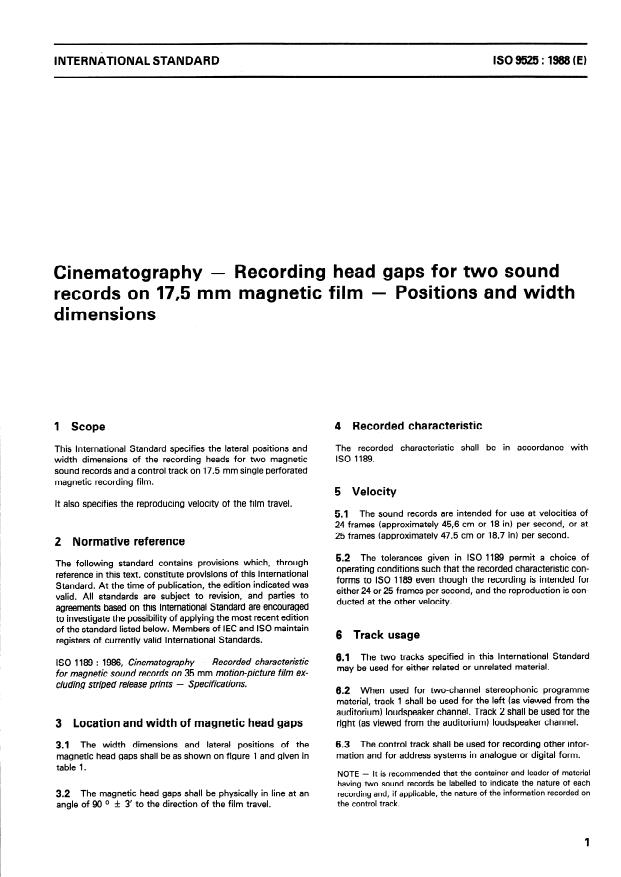
This International Standard specifies the lateral positions and width dimensions of the recording heads for two magnetic Sound records and a control track on 17,5 mm Single perforated magnetic recording film. lt also specifies the reproducing velocity of the film travel.
- Status
- Published
- Publication Date
- 27-Jul-1988
- Technical Committee
- ISO/TC 36 - Cinematography
- Drafting Committee
- ISO/TC 36/WG 3 - Audio technology
- Current Stage
- 9093 - International Standard confirmed
- Start Date
- 10-Jul-2023
- Completion Date
- 29-Aug-2026
Buy Documents


ISO 9525:1988 - Cinematography — Recording head gaps for two sound records on 17,5 mm magnetic film — Positions and width dimensions Released:7/28/1988



ISO 9525:1988 - Cinématographie — Entrefers des tetes magnétiques pour l'enregistrement de deux pistes sonores sur film magnétique de 17,5 mm — Position et largeur Released:7/28/1988



ISO 9525:1988 - Cinématographie — Entrefers des tetes magnétiques pour l'enregistrement de deux pistes sonores sur film magnétique de 17,5 mm — Position et largeur Released:7/28/1988
Overview
ISO 9525:1988 is an international standard developed by the International Organization for Standardization (ISO) that specifies the technical requirements for recording head gaps used in cinematography sound recording. This standard focuses on two sound records on 17.5 mm single-perforated magnetic film, detailing the precise lateral positions and width dimensions of the recording heads. Additionally, it defines the film reproducing velocity to ensure consistent sound playback. First published in 1988 under Technical Committee ISO/TC 36 (Cinematography), ISO 9525:1988 supports uniformity and compatibility in magnetic sound recording for motion pictures.
Key Topics
Recording Head Gaps
Specifies the exact physical dimensions and lateral locations of the magnetic recording heads to accommodate two sound tracks and one control track on 17.5 mm magnetic film. The recording head gaps must be aligned perpendicularly (90° ± 3') to the direction of film travel for optimal magnetic sound capture.Film Reproducing Velocity
Establishes that the film runs at either 24 frames per second (approximately 45.6 cm/s or 18 inches/s) or 25 frames per second (approximately 47.5 cm/s or 18.7 inches/s). The standard tolerances allow operating conditions at either speed to maintain sound quality in accordance with ISO 1189.Sound Tracks and Control Track Usage
Defines the usage of two magnetic tracks: either for related or unrelated audio material. For stereophonic programmes, Track 1 commonly carries the left channel, and Track 2 the right channel (from the auditorium perspective). The control track stores auxiliary data or address information in analog or digital format.Compatibility with Other Standards
References ISO 1189:1986 for recorded characteristics of magnetic sound records on motion-picture films, ensuring the audio quality conforms to established parameters.
Applications
ISO 9525:1988 is vital for professionals in the film and cinema sound industry aiming to standardize the magnetic recording of soundtracks on 17.5 mm magnetic film. Practical applications include:
Film Production and Post-Production
Ensures sound recording equipment aligns magnetic heads accurately for reliable and high-quality sound on motion-picture film, facilitating efficient stereo or multi-channel audio tracks.Sound Equipment Manufacturing
Guides manufacturers in designing and producing magnetic recording heads and related devices compatible with 17.5 mm motion-picture film formats.Archival and Restoration
Provides reference dimensions and playback velocities needed for accurate reproduction of archived film soundtracks using magnetic film technology.Quality Control and Testing
Offers measurement criteria for verifying recording head gaps and film speeds to comply with international standards, ensuring consistent sound quality across different systems and regions.
Related Standards
ISO 1189:1986 – Specifies recorded characteristics for magnetic sound records on 35 mm motion-picture film, which ISO 9525 aligns with for maintaining consistent audio quality.
Other ISO Cinematography Standards – ISO/TC 36 develops various standards related to film and cinematography, providing comprehensive technical frameworks for motion-picture production and reproduction.
Keywords: ISO 9525, magnetic film sound recording, cinematography standards, recording head gaps, 17.5 mm film, soundtracks, control track, film reproducing velocity, stereophonic sound, ISO sound standards.
Buy Documents
ISO 9525:1988 - Cinematography — Recording head gaps for two sound records on 17,5 mm magnetic film — Positions and width dimensions Released:7/28/1988
ISO 9525:1988 - Cinématographie — Entrefers des tetes magnétiques pour l'enregistrement de deux pistes sonores sur film magnétique de 17,5 mm — Position et largeur Released:7/28/1988
ISO 9525:1988 - Cinématographie — Entrefers des tetes magnétiques pour l'enregistrement de deux pistes sonores sur film magnétique de 17,5 mm — Position et largeur Released:7/28/1988
Frequently Asked Questions
ISO 9525:1988 is a standard published by the International Organization for Standardization (ISO). Its full title is "Cinematography — Recording head gaps for two sound records on 17,5 mm magnetic film — Positions and width dimensions". This standard covers: This International Standard specifies the lateral positions and width dimensions of the recording heads for two magnetic Sound records and a control track on 17,5 mm Single perforated magnetic recording film. lt also specifies the reproducing velocity of the film travel.
This International Standard specifies the lateral positions and width dimensions of the recording heads for two magnetic Sound records and a control track on 17,5 mm Single perforated magnetic recording film. lt also specifies the reproducing velocity of the film travel.
ISO 9525:1988 is classified under the following ICS (International Classification for Standards) categories: 37.060.20 - Motion picture films. Cartridges. The ICS classification helps identify the subject area and facilitates finding related standards.
ISO 9525:1988 is available in PDF format for immediate download after purchase. The document can be added to your cart and obtained through the secure checkout process. Digital delivery ensures instant access to the complete standard document.
Standards Content (Sample)
ISO
INTERNATIONAL sm~mm
First edition
1988-08-01
INTERNATIONAL ORGANIZATION FOR STANDARDKATION
ORGANISATION INTERNATIONALE DE NORMALISATION
ME>KAYHAPOAHAR OPTAHM3A~MR fl0 CTAHflAPTM3A~MM
Cinematography - Recording head gaps for two
Sound records on 17,5 mm magnetic film - Positions
and width dimensions
Ci&matographie - Entrefers des t&es magnbtiques pour l’enregistrement de deux pistes
sonores sur film magnhtique de 173 mm - Position et largeur
Reference number
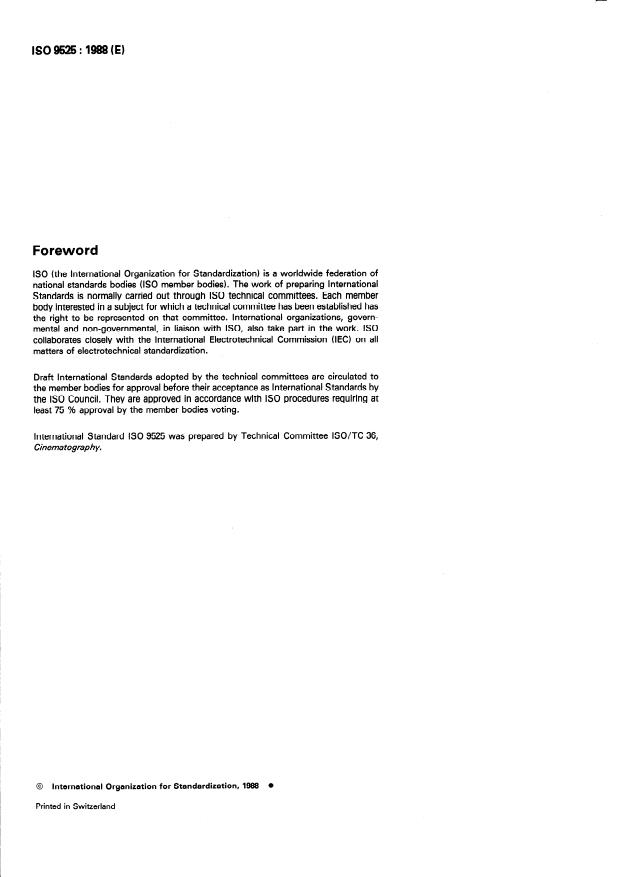
ISO 9525 : 1988 (E)
ISO 9525 : 1988 (El
Foreword
ISO (the International Organization for Standardization) is a worldwide federation of
national Standards bodies (ISO member bodies). The work of preparing International
Standards is normally carried out through ISO technical committees. Esch member
body interested in a subject for which a technical committee has been established has
the right to be represented on that committee. International organizations, govern-
mental and non-governmental, in liaison with ISO, also take part in the work. ISO
collaborates closely with the International Electrotechnical Commission (IEC) on all
matters of electrotechnical standardization.
Draft International Standards adopted by the technical committees are circulated to
the member bodies for approval before their acceptance as International Standards by
the ISO Council. They are approved in accordance with ISO procedures requiring at
least 75 % approval by the member bodies voting.
International Standard ISO 9525 was prepared by Technical Committee ISO/TC 36,
Cinema tograph y.
0 International Organkation for Standardkation, 1988
Printed in Switzerland
INTERNATIONAL STANDARD ISO 9525 : 1966 (EI
Cinematography - Recording head gaps for two Sound
records on 17,5 mm magnetic film - Positions and width
dimensions
1 Scope 4 Recorded characteristic
This International Standard specifies the lateral positions and The recorded characteristic shall be in accordance with
width dimensions of the recording heads for two magnetic ISO 1189.
Sound records and a control track on 17,5 mm Single perforated
magnetic recording film.
5 Velocity
lt also specifies the reproducing velocity of the film travel.
5.1 The Sound records are intended for use at velocities of
24 frames (approximately 45,6 cm or 18 in) per second, or at
25 frames (approximately 47,5 cm or 18,7 in) per second.
2 Normative reference
5.2 The tolerantes given in ISO 1189 permit a choice of
The following Standard contains provisions which, through
operat
...
ISO
NORME INTERNATIONALE
Premiére édition
1988-08-01
INTERNATIONAL ORGANIZATION FOR STANDARDIZATION
ORGANISATION INTERNATIONALE DE NORMALISATION
. MEXAYHAPOflHAR OPrAHM3A~MR fl0 CTAH~APTl43A~MM
Cinématographie - Entrefers des têtes magnétiques
pour l’enregistrement de deux pistes sonores sur film
magnétique de 17,5 mm - Position et largeur
Cinematogfaphy - Recording head gaps for two sound records on 173 mm magnetic film -
Positions and wïdth dimensions
Numéro de référence
ISO 9525 : 1988 (F)
ISO9525:1988(F)
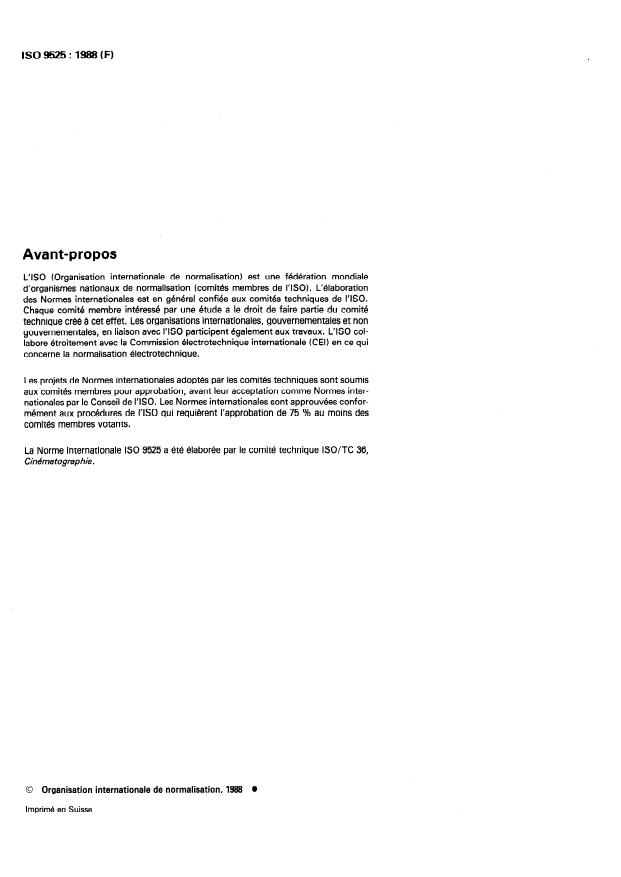
Avant-propos
L’ISO (Organisation internationale de normalisation) est une fédération mondiale
d’organismes nationaux de normalisation (comités membres de I’ISO). L’élaboration
des Normes internationales est en général confiée aux comites techniques de I’ISO,
Chaque comité membre intéressé par une étude a le droit de faire partie du comite
technique creé à cet effet. Les organisations internationales, gouvernementales et non
gouvernementales, en liaison avec I’ISO participent également aux travaux. L’ISO col-
labore étroitement avec la Commission électrotechnique internationale (CEI) en ce qui
concerne la normalisation électrotechnique.
Les projets de Normes internationales adoptés par les comités techniques sont soumis
aux comités membres pour approbation, avant leur acceptation comme Normes inter-
nationales par le Conseil de I’ISO. Les Normes internationales sont approuvées confor-
mément aux procédures de I’ISO qui requièrent l’approbation de 75 % au moins des
comités membres votants.
La Norme internationale ISO 9525 a été élaborée par le comité technique ISO/TC 36,
Cinbma tograpbie.
0 Organisation internationale de normalisation, 1988 0
Imprimé en Suisse
NORME INTERNATIONALE ISO 9525 : 1988 (FI
Entrefers des têtes magnétiques
Cinématographie -
pour l’enregistrement de deux pistes sonores sur film
magnétique de 17,5 mm - Position et largeur
4 Caractéristique d’enregistrement
1 Domaine d’application
La présente Norme internationale prescrit la position et la lar- La caractéristique d’enregistrement doit être conforme à
. I’ISO 1189.
geur des têtes d’enregistrement pour enregistrer deux pistes
sonores et une piste de contrôle sur film magnétique de
I7,5 mm à une seule rangée de perforations.
5 Vitesse de défilement
Elle prescrit aussi la vitesse de défilement du film lors de la lec-
5.1 Les enregistrements sonores sont prévus pour être lus à
ture.
une vitesse de 24 images par seconde (environ 45,6 cm/s ou
18 in/s) ou de 25 images par seconde (environ 47,5 cm/s ou
2 Référence normative 18,7 in/s).
La norme suivante contient des dispositions qui, par suite de la
5.2 Les tolérances données dans I’ISO 1189 permettent un
référence qui en est faite, constituent des dispositions valables
choix de conditions de fonctionnement telles que la
...
ISO
NORME INTERNATIONALE
Premiére édition
1988-08-01
INTERNATIONAL ORGANIZATION FOR STANDARDIZATION
ORGANISATION INTERNATIONALE DE NORMALISATION
. MEXAYHAPOflHAR OPrAHM3A~MR fl0 CTAH~APTl43A~MM
Cinématographie - Entrefers des têtes magnétiques
pour l’enregistrement de deux pistes sonores sur film
magnétique de 17,5 mm - Position et largeur
Cinematogfaphy - Recording head gaps for two sound records on 173 mm magnetic film -
Positions and wïdth dimensions
Numéro de référence
ISO 9525 : 1988 (F)
ISO9525:1988(F)
Avant-propos
L’ISO (Organisation internationale de normalisation) est une fédération mondiale
d’organismes nationaux de normalisation (comités membres de I’ISO). L’élaboration
des Normes internationales est en général confiée aux comites techniques de I’ISO,
Chaque comité membre intéressé par une étude a le droit de faire partie du comite
technique creé à cet effet. Les organisations internationales, gouvernementales et non
gouvernementales, en liaison avec I’ISO participent également aux travaux. L’ISO col-
labore étroitement avec la Commission électrotechnique internationale (CEI) en ce qui
concerne la normalisation électrotechnique.
Les projets de Normes internationales adoptés par les comités techniques sont soumis
aux comités membres pour approbation, avant leur acceptation comme Normes inter-
nationales par le Conseil de I’ISO. Les Normes internationales sont approuvées confor-
mément aux procédures de I’ISO qui requièrent l’approbation de 75 % au moins des
comités membres votants.
La Norme internationale ISO 9525 a été élaborée par le comité technique ISO/TC 36,
Cinbma tograpbie.
0 Organisation internationale de normalisation, 1988 0
Imprimé en Suisse
NORME INTERNATIONALE ISO 9525 : 1988 (FI
Entrefers des têtes magnétiques
Cinématographie -
pour l’enregistrement de deux pistes sonores sur film
magnétique de 17,5 mm - Position et largeur
4 Caractéristique d’enregistrement
1 Domaine d’application
La présente Norme internationale prescrit la position et la lar- La caractéristique d’enregistrement doit être conforme à
. I’ISO 1189.
geur des têtes d’enregistrement pour enregistrer deux pistes
sonores et une piste de contrôle sur film magnétique de
I7,5 mm à une seule rangée de perforations.
5 Vitesse de défilement
Elle prescrit aussi la vitesse de défilement du film lors de la lec-
5.1 Les enregistrements sonores sont prévus pour être lus à
ture.
une vitesse de 24 images par seconde (environ 45,6 cm/s ou
18 in/s) ou de 25 images par seconde (environ 47,5 cm/s ou
2 Référence normative 18,7 in/s).
La norme suivante contient des dispositions qui, par suite de la
5.2 Les tolérances données dans I’ISO 1189 permettent un
référence qui en est faite, constituent des dispositions valables
choix de conditions de fonctionnement telles que la
...