

ISO/IEC 30113-62:2026
(Main)Information technology — Gesture-based interfaces across devices and methods — Part 62: Multi-point gestures for screen readers
General Information
- Abstract
This document defines multi-point gestures for screen readers. It specifies movements for clear and classified multi-point gestures recognized by the screen readers. It describes multi-point gestures performed by multiple point of interest (POI) for the screen readers. NOTE Multiple POI can be manipulated by using multiple objects such as fingertips, etc.
- Status
- Published
- Publication Date
- 27-Jan-2026
- Technical Committee
- ISO/IEC JTC 1/SC 35 - User interfaces
- Drafting Committee
- ISO/IEC JTC 1/SC 35 - User interfaces
- Current Stage
- 6060 - International Standard published
- Start Date
- 28-Jan-2026
- Due Date
- 09-Aug-2026
- Completion Date
- 28-Jan-2026
Overview
ISO/IEC 30113-62:2026 - Multi-point Gestures for Screen Readers is an international standard from the ISO/IEC JTC 1/SC 35 technical committee. This document defines clear and classified multi-point gesture-based interactions recognized by screen readers, with a focus on accessibility for people who are visually impaired or blind. By standardizing multi-point gestures across different information and communication technology (ICT) devices and methods, this standard helps developers, manufacturers, and content creators ensure consistent and intuitive user experiences for screen reader users.
Screen readers are essential tools that make digital information accessible by converting text and graphical content to speech or braille. Multi-point gestures-such as those performed with multiple fingertips-are commonly used to control screen readers on devices like smartphones, tablets, and computers. Consistency in the design and implementation of these gestures helps reduce user confusion and enhances the usability of accessible ICT products.
Key Topics
- Definition and Classification of Multi-point Gestures: The standard outlines a comprehensive set of gestures involving multiple points of interest (POI), typically performed with several fingertips simultaneously or in sequence.
- Screen Reader-Specific Gestures: It details specific multi-point movements and their recognized actions, such as navigation, text manipulation, or invoking context menus, optimized for use with screen readers.
- Gestures Covered: Included are 2-point, 3-point, and 4-point gestures such as tap, double-tap, triple-tap, swipe left/right/up/down, pinch, spread, and their various combinations like double-tap-and-hold.
- Metaphors and User Models: The standard recommends using the "window-mover" metaphor for gesture direction, ensuring that movement directions align with the flow of digital information, which is especially important for non-visual contexts.
- General Requirements: ISO/IEC 30113-62:2026 builds on principles defined in ISO/IEC 30113-12, focusing on alternatives, prioritization, and clarity in gesture assignment for system actions.
Applications
ISO/IEC 30113-62:2026 is highly relevant for:
- Developers and Designers: Ensuring screen reader software and applications across platforms offer consistent, predictable multi-point gesture controls, directly improving accessibility.
- ICT Manufacturers: Integrating standardized gestures at the operating system or device level to support users with visual impairments.
- Software Accessibility Auditors: Evaluating products for compliance with international standards in gesture-based user interfaces for screen readers.
- Assistive Technology Trainers: Educating end-users on consistent gesture interactions across various devices.
- Public and Private Sector Organizations: Fulfilling digital inclusivity policies and procurement requirements by relying on standardized accessibility features.
Practical benefits include:
- Simplified training and onboarding for users of screen readers.
- Reduced errors, improving user confidence and independence.
- Interoperability and harmonization of accessible user interfaces across ecosystems.
Related Standards
When developing or evaluating gesture-based user interfaces for screen readers, the following related standards may also be relevant:
- ISO/IEC 30113-12:2019: User interfaces - Gesture-based interfaces across devices and methods - Multi-point gestures for common system actions.
- ISO/IEC 14754:1999: Pen-based interfaces and gestures.
- ISO/IEC 24786:2009: Access to information and communication technology (ICT) equipment and services.
- ISO/IEC JTC 1/SC 35 Standards Series: Related guidelines for user interfaces, with additional parts focusing on single-point gestures and other accessible interaction methods.
For the most up-to-date series and amendments, consult the latest listings at the ISO and IEC official websites.
Keywords: ISO/IEC 30113-62, multi-point gestures, screen readers, accessibility, gesture-based interfaces, visually impaired user interaction, assistive technology standard, ICT accessibility compliance
Get Certified
Connect with accredited certification bodies for this standard

BSI Group
BSI (British Standards Institution) is the business standards company that helps organizations make excellence a habit.

NYCE
Mexican standards and certification body.
Sponsored listings
Frequently Asked Questions
ISO/IEC 30113-62:2026 is a standard published by the International Organization for Standardization (ISO). Its full title is "Information technology — Gesture-based interfaces across devices and methods — Part 62: Multi-point gestures for screen readers". This standard covers: This document defines multi-point gestures for screen readers. It specifies movements for clear and classified multi-point gestures recognized by the screen readers. It describes multi-point gestures performed by multiple point of interest (POI) for the screen readers. NOTE Multiple POI can be manipulated by using multiple objects such as fingertips, etc.
This document defines multi-point gestures for screen readers. It specifies movements for clear and classified multi-point gestures recognized by the screen readers. It describes multi-point gestures performed by multiple point of interest (POI) for the screen readers. NOTE Multiple POI can be manipulated by using multiple objects such as fingertips, etc.
ISO/IEC 30113-62:2026 is classified under the following ICS (International Classification for Standards) categories: 35.240.20 - IT applications in office work. The ICS classification helps identify the subject area and facilitates finding related standards.
ISO/IEC 30113-62:2026 is available in PDF format for immediate download after purchase. The document can be added to your cart and obtained through the secure checkout process. Digital delivery ensures instant access to the complete standard document.
Standards Content (Sample)
International
Standard
ISO/IEC 30113-62
First edition
Information technology — Gesture-
2026-01
based interfaces across devices and
methods —
Part 62:
Multi-point gestures for screen
readers
Technologies de l'information — Interface fondée sur les gestes
sur divers appareils et utilisant différentes méthodes —
Partie 62: Gestes multipoints pour les lecteurs d'écran
Reference number
© ISO/IEC 2026
All rights reserved. Unless otherwise specified, or required in the context of its implementation, no part of this publication may
be reproduced or utilized otherwise in any form or by any means, electronic or mechanical, including photocopying, or posting on
the internet or an intranet, without prior written permission. Permission can be requested from either ISO at the address below
or ISO’s member body in the country of the requester.
ISO copyright office
CP 401 • Ch. de Blandonnet 8
CH-1214 Vernier, Geneva
Phone: +41 22 749 01 11
Email: copyright@iso.org
Website: www.iso.org
Published in Switzerland
© ISO/IEC 2026 – All rights reserved
ii
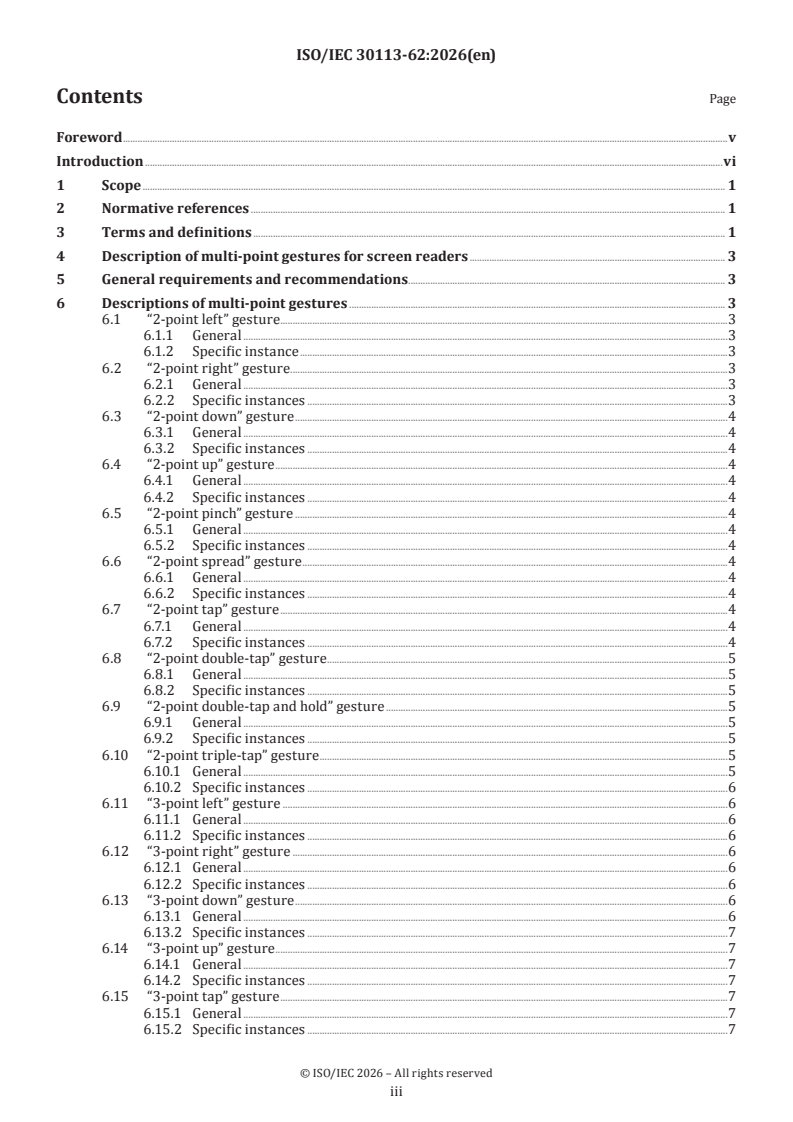
Contents Page
Foreword .v
Introduction .vi
1 Scope . 1
2 Normative references . 1
3 Terms and definitions . 1
4 Description of multi-point gestures for screen readers . 3
5 General requirements and recommendations. 3
6 Descriptions of multi-point gestures . 3
6.1 “2-point left” gesture .3
6.1.1 General .3
6.1.2 Specific instance .3
6.2 “2-point right” gesture.3
6.2.1 General .3
6.2.2 Specific instances .3
6.3 “2-point down” gesture .4
6.3.1 General .4
6.3.2 Specific instances .4
6.4 “2-point up” gesture .4
6.4.1 General .4
6.4.2 Specific instances .4
6.5 “2-point pinch” gesture .4
6.5.1 General .4
6.5.2 Specific instances .4
6.6 “2-point spread” gesture .4
6.6.1 General .4
6.6.2 Specific instances .4
6.7 “2-point tap” gesture .4
6.7.1 General .4
6.7.2 Specific instances .4
6.8 “2-point double-tap” gesture . .5
6.8.1 General .5
6.8.2 Specific instances .5
6.9 “2-point double-tap and hold” gesture .5
6.9.1 General .5
6.9.2 Specific instances .5
6.10 “2-point triple-tap” gesture .5
6.10.1 General .5
6.10.2 Specific instances .6
6.11 “3-point left” gesture .6
6.11.1 General .6
6.11.2 Specific instances .6
6.12 “3-point right” gesture .6
6.12.1 General .6
6.12.2 Specific instances .6
6.13 “3-point down” gesture .6
6.13.1 General .6
6.13.2 Specific instances .7
6.14 “3-point up” gesture .7
6.14.1 General .7
6.14.2 Specific instances .7
6.15 “3-point tap” gesture .7
6.15.1 General .7
6.15.2 Specific instances .7
© ISO/IEC 2026 – All rights reserved
iii
6.16 “3-point double-tap” gesture .7
6.16.1 General .7
6.16.2 Specific instances .7
6.17 “3-point double-tap and hold” gesture .7
6.17.1 General .7
6.17.2 Specific instances .8
6.18 “3-point triple-tap” gesture . .8
6.18.1 General .8
6.18.2 Specific instances .8
6.19 “4-point tap” gesture .9
6.19.1 General .9
6.19.2 Specific instances .9
6.20 “4-point double-tap” gesture .9
6.20.1 General .9
6.20.2 Specific instances .10
6.21 “4-point triple-tap” gesture .10
6.21.1 General .10
6.21.2 Specific instances .10
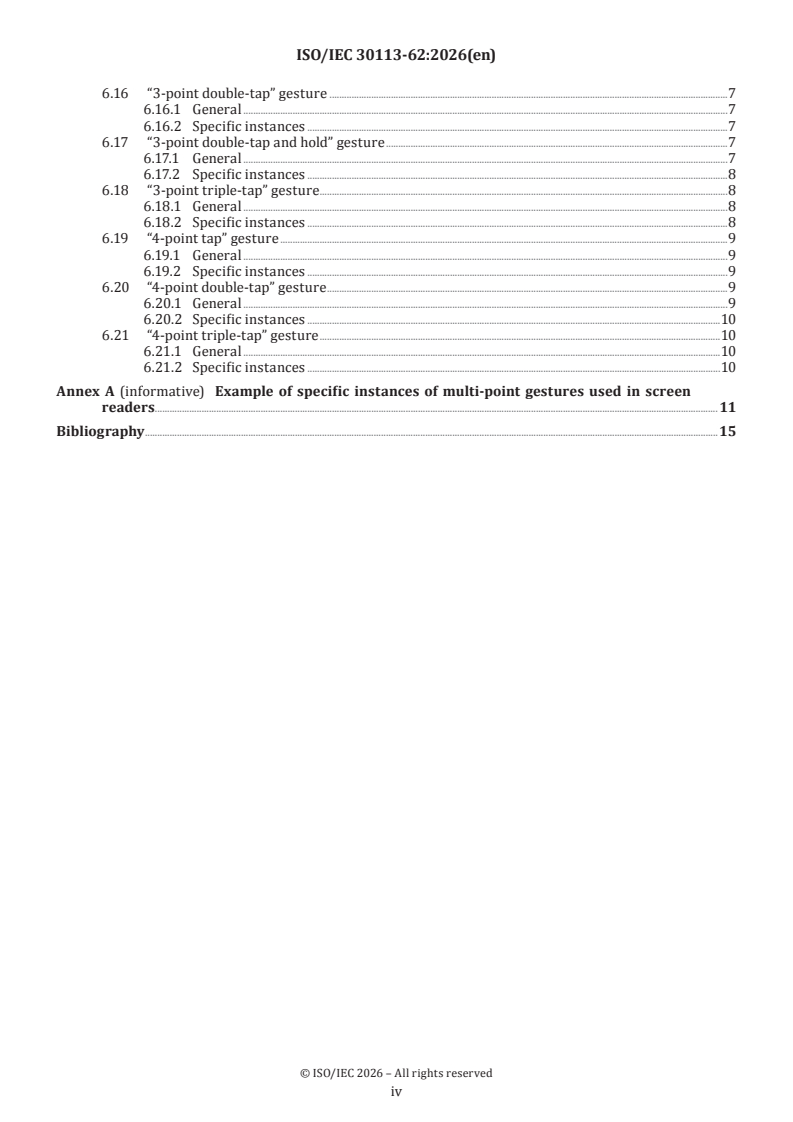
Annex A (informative) Example of specific instances of multi-point gestures used in screen
readers .11
Bibliography .15
© ISO/IEC 2026 – All rights reserved
iv
Foreword
ISO (the International Organization for Standardization) and IEC (the International Electrotechnical
Commission) form the specialized system for worldwide standardization. National bodies that are
members of ISO or IEC participate in the development of International Standards through technical
committees established by the respective organization to deal with particular fields of technical activity.
ISO and IEC technical committees collaborate in fields of mutual interest. Other international organizations,
governmental and non-governmental, in liaison with ISO and IEC, also take part in the work.
The procedures used to develop this document and those intended for its further maintenance are described
in the ISO/IEC Directives, Part 1. In particular, the different approval criteria needed for the different types
of document should be noted. This document was drafted in accordance with the editorial rules of the ISO/
IEC Directives, Part 2 (see www.iso.org/directives or www.iec.ch/members_experts/refdocs).
ISO and IEC draw attention to the possibility that the implementation of this document may involve the
use of (a) patent(s). ISO and IEC take no position concerning the evidence, validity or applicability of any
claimed patent rights in respect thereof. As of the date of publication of this document, ISO and IEC had not
received notice of (a) patent(s) which may be required to implement this document. However, implementers
are cautioned that this may not represent the latest information, which may be obtained from the patent
database available at www.iso.org/patents and https://patents.iec.ch. ISO and IEC shall not be held
responsible for identifying any or all such patent rights.
Any trade name used in this document is information given for the convenience of users and does not
constitute an endorsement.
For an explanation of the voluntary nature of standards, the meaning of ISO specific terms and expressions
related to conformity assessment, as well as information about ISO's adherence to the World Trade
Organization (WTO) principles in the Technical Barriers to Trade (TBT) see www.iso.org/iso/foreword.html.
In the IEC, see www.iec.ch/understanding-standards.
This document was prepared by Joint Technical Committee ISO/IEC JTC 1, Information technology,
Subcommittee SC 35, User interfaces.
A list of all parts in the ISO/IEC 30113 series can be found on the ISO and IEC websites.
Any feedback or questions on this document should be directed to the user’s national standards
body. A complete listing of these bodies can be found at www.iso.org/members.html and
www.iec.ch/national-committees.
© ISO/IEC 2026 – All rights reserved
v
Introduction
Screen readers are regarded as a default method of accessing ICT devices for people with visual impairments
who are unable to see and understand the screens of these devices. The content on the screens, such as
letters, words, numbers, punctuation, elements and so on, are spoken out loud by screen readers. Speakers
or headphones connected to the ICT device become the main output components.
Multi-point gestures are used for screen readers of several commercially available ICT devices including
smart phones, personal computers and so on. Potential variety and inconsistency among the multi-point
gestures can cause serious accessibility problems for people with visually impairments. There is a strong
need for international standards to define the multi-point gestures so that users with visual impairments do
not get confused while they use ICT devices.
When gesture controls are used, the functions of screen readers include reading the item under the user’s
finger, pausing or resuming speech output, and announcing the location of the user’s fingers on the screen,
such as page numbers or rows. This document presents descriptions of multi-point gestures and the
corresponding functions of the screen readers.
The document’s multi-point gestures can harmonize with single-point gestures for the screen readers. It is
expected that users can use the screen readers easily and without confusion by executing the multi-point
gestures. The gestures are performed by the users regardless of a specific recognition technique, a certain
interaction method or a device.
In Annex A, specific instances of multi-point gestures used in various screen readers are provided for
comparison.
© ISO/IEC 2026 – All rights reserved
vi
International Standard ISO/IEC 30113-62:2026(en)
Information technology — Gesture-based interfaces across
devices and methods —
Part 62:
Multi-point gestures for screen readers
1 Scope
This document defines multi-point gestures for screen readers.
It specifies movements for clear and classified multi-point gestures recognized by the screen readers.
It describes multi-point gestures performed by multiple point of interest (POI) for the screen readers.
NOTE Multiple POI can be manipulated by using multiple objects such as fingertips, etc.
2 Normative references
The following documents are referred to in the text in such a way that some or all of their content constitutes
requirements of this document. For dated references, only the edition cited applies. For undated references,
the latest edition of the referenced document (including any amendments) applies.
ISO/IEC 30113-12:2019, Information technology — User interfaces — Gesture-based interfaces across devices
and methods — Part 12: Multi-point gestures for common system actions
3 Terms and definitions
For the purposes of this document, the following terms and definitions apply.
ISO and IEC maintain terminology databases for use in standardization at the following addresses:
— ISO Online browsing platform: available at https:// www .iso .org/ obp
— IEC Electropedia: available at https:// www .electropedia .org/
3.1
screen reader
function that reads characters and other information on a screen aloud to a user in order to allow access to
the information on the screen without viewing the screen
1)
[SOURCE: ISO/IEC 24786:2009 , 4.11]
3.2
tap
touch a real (or virtual) surface briefly, typically less than one second, with point(s) of interest (POI) and
then lift-off in approximately the same position
Note 1 to entry: Example points of interest are a fingertip, pen point, hand, etc.
[SOURCE: ISO/IEC 14754:1999, 4.13, modified — changed from digitizer to "real (or virtual) surface" and
from pen to "point(s) of interest" and Note 1 to entry added.]
1) Withdrawn.
© ISO/IEC 2026 – All rights reserved
3.3
double-tap
touch twice rapidly a surface with point(s) of interest (POI)
Note 1 to entry: The split-tap gesture can be used as a substitute for the double-tap gesture. In this gesture, a user
touches and holds an element on the screen with one finger, then taps anywhere on the screen with a second finger.
The action is interpreted as a double-tap on the element under the first finger. This gesture is commonly used in screen
reader environments to assist users with visual impairments.
[SOURCE: ISO/IEC 30113-12:2019, 3.15]
3.4
triple-tap
touch three times rapidly a surface with point(s) of interest
3.5
touch and hold
tap and hold
touch surface for extended period of time
[SOURCE: ISO/IEC 30113-12:2019, 3.16]
3.6
pinch
touch surface with two or more point(s) of interest (POI) to bring the POIs closer together
[SOURCE: ISO/IEC 30113-12:2019, 3.19]
3.7
context menu
contextual menu
menu in graphical user
...