

ISO/IEC TR 30150-2:2024
(Main)Information technology — Affective computing user interface (AUI) — Part 2: Affective characteristics
General Information
- Abstract
This document identifies the affective characteristics for affective computing user interface (AUI), including universal, cultural, individual and situational issues relating to the affective needs of users. This document also describes the selection criteria of these affective characteristics, and the methods to identify or apply them. This document focuses on developers of affective computing user interfaces who want to meet the needs of users. This document does not specify the implementation of affective computing.
- Status
- Published
- Publication Date
- 14-Feb-2024
- Technical Committee
- ISO/IEC JTC 1/SC 35 - User interfaces
- Drafting Committee
- ISO/IEC JTC 1/SC 35 - User interfaces
- Current Stage
- 6060 - International Standard published
- Start Date
- 15-Feb-2024
- Completion Date
- 15-Feb-2024


Overview
ISO/IEC TR 30150-2:2024 is a Technical Report from ISO/IEC JTC 1/SC 35 that defines the affective characteristics relevant to affective computing user interfaces (AUI). The document identifies, organizes and explains affective properties - universal, cultural, individual and situational - and describes selection criteria and methods to identify or apply them. It is intended for developers and designers of AUI who need to meet users’ affective needs. The report does not specify implementation or algorithms for emotion recognition or synthesis.
Key topics
- Organization of affective characteristics: classification into Universal, Cultural, Individual and Situational types to guide design decisions.
- Universal characteristics: human needs (Maslow-inspired hierarchy - physiological, safety, belonging, esteem, self‑actualization) and implications for application design.
- Cultural characteristics: how culture shapes beliefs, behaviors and group traits, and how interfaces should recognize cultural effects and trade-offs.
- Individual characteristics: personality, attitudes, beliefs, achievement motivation and risk taking/aversion as factors that make each user unique.
- Situational characteristics: transient nature of emotions, relationship to satisfaction and UX, and the role of context-of-use.
- Identification methods: non-normative guidance on how to identify affective characteristics, including physiological signals, direct questions, inference from user customizations, actions, vocabulary, and associative techniques.
- Affective vs cognitive domains: relationship and distinctions (see informative Annex A).
- Terminology: definitions for affective characteristic, affective, satisfaction and cognition (references include ISO 9241-11:2018 and ISO 21801-1:2020).
Applications and who should use it
- AUI developers and software engineers designing emotion-aware interfaces and adaptive experiences.
- UX/UI designers and product managers aiming to incorporate affect-sensitive features while respecting cultural and individual differences.
- Accessibility specialists ensuring affective adaptations do not reduce usability for diverse users.
- Researchers and HCI practitioners studying affective interactions, user satisfaction and context-driven emotion modeling.
- Systems integrators and stakeholders planning affective components in healthcare, education, assistive technologies, customer service, automotive UX and consumer devices.
Practical uses include selecting which affective attributes to monitor or respect in a product, designing consent and privacy-aware data collection strategies for affective signals, and informing user-testing and localization strategies.
Related standards
- ISO/IEC TR 30150 series (other parts) - for broader AUI guidance.
- ISO 9241-11:2018 (usability and satisfaction definitions).
- ISO 21801-1:2020 (cognition terminology).
- Documents from ISO/IEC JTC 1/SC 35 on user interfaces.
Keywords: ISO/IEC TR 30150-2:2024, affective computing, AUI, affective characteristics, emotion recognition, human‑computer interaction, user experience (UX), accessibility, cultural adaptation.
Get Certified
Connect with accredited certification bodies for this standard

BSI Group
BSI (British Standards Institution) is the business standards company that helps organizations make excellence a habit.

NYCE
Mexican standards and certification body.
Sponsored listings
Frequently Asked Questions
ISO/IEC TR 30150-2:2024 is a technical report published by the International Organization for Standardization (ISO). Its full title is "Information technology — Affective computing user interface (AUI) — Part 2: Affective characteristics". This standard covers: This document identifies the affective characteristics for affective computing user interface (AUI), including universal, cultural, individual and situational issues relating to the affective needs of users. This document also describes the selection criteria of these affective characteristics, and the methods to identify or apply them. This document focuses on developers of affective computing user interfaces who want to meet the needs of users. This document does not specify the implementation of affective computing.
This document identifies the affective characteristics for affective computing user interface (AUI), including universal, cultural, individual and situational issues relating to the affective needs of users. This document also describes the selection criteria of these affective characteristics, and the methods to identify or apply them. This document focuses on developers of affective computing user interfaces who want to meet the needs of users. This document does not specify the implementation of affective computing.
ISO/IEC TR 30150-2:2024 is classified under the following ICS (International Classification for Standards) categories: 35.240.20 - IT applications in office work. The ICS classification helps identify the subject area and facilitates finding related standards.
ISO/IEC TR 30150-2:2024 is available in PDF format for immediate download after purchase. The document can be added to your cart and obtained through the secure checkout process. Digital delivery ensures instant access to the complete standard document.
Standards Content (Sample)
Technical
Report
ISO/IEC TR 30150-2
First edition
Information technology — Affective
2024-02
computing user interface (AUI) —
Part 2:
Affective characteristics
Technologies de l'information — Interface pour la
reconnaissance et la simulation des émotions (AUI) —
Partie 2: Caractéristiques de reconnaissance et de simulation des
émotions
Reference number
© ISO/IEC 2024
All rights reserved. Unless otherwise specified, or required in the context of its implementation, no part of this publication may
be reproduced or utilized otherwise in any form or by any means, electronic or mechanical, including photocopying, or posting on
the internet or an intranet, without prior written permission. Permission can be requested from either ISO at the address below
or ISO’s member body in the country of the requester.
ISO copyright office
CP 401 • Ch. de Blandonnet 8
CH-1214 Vernier, Geneva
Phone: +41 22 749 01 11
Email: copyright@iso.org
Website: www.iso.org
Published in Switzerland
© ISO/IEC 2024 – All rights reserved
ii
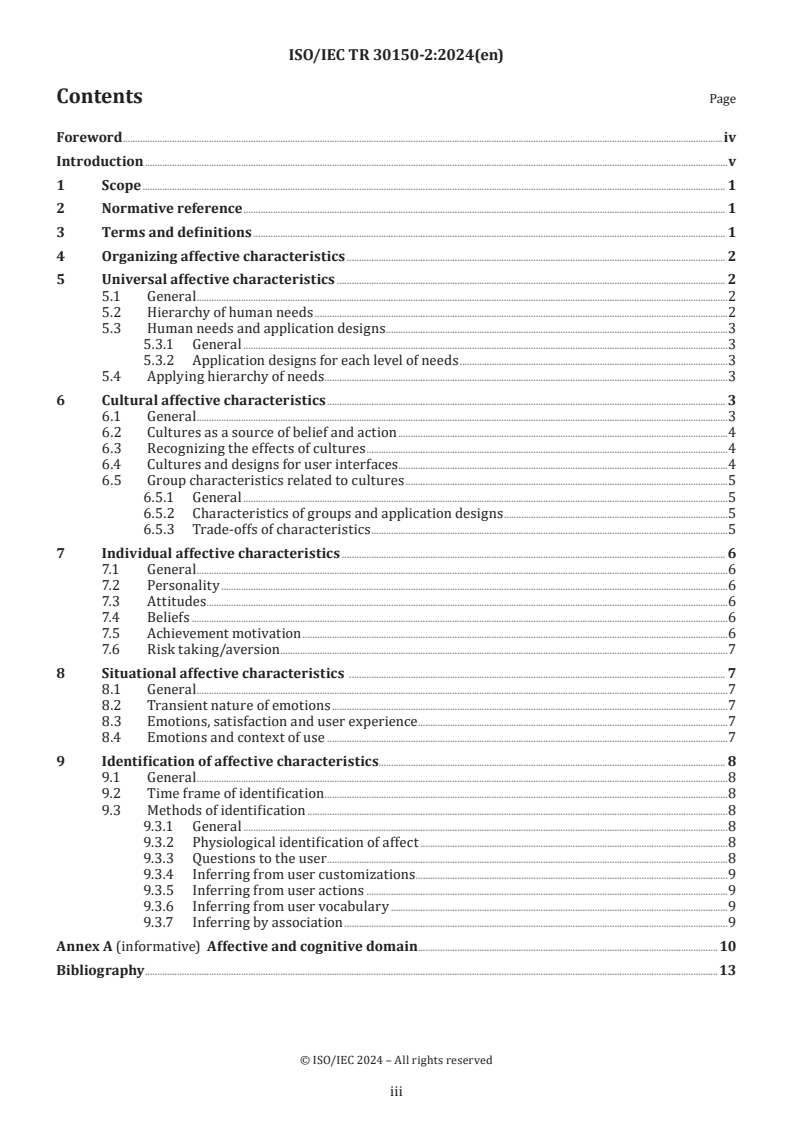
Contents Page
Foreword .iv
Introduction .v
1 Scope . 1
2 Normative reference . 1
3 Terms and definitions . 1
4 Organizing affective characteristics . 2
5 Universal affective characteristics . 2
5.1 General .2
5.2 Hierarchy of human needs .2
5.3 Human needs and application designs .3
5.3.1 General .3
5.3.2 Application designs for each level of needs .3
5.4 Applying hierarchy of needs . .3
6 Cultural affective characteristics . 3
6.1 General .3
6.2 Cultures as a source of belief and action .4
6.3 Recognizing the effects of cultures .4
6.4 Cultures and designs for user interfaces .4
6.5 Group characteristics related to cultures .5
6.5.1 General .5
6.5.2 Characteristics of groups and application designs .5
6.5.3 Trade-offs of characteristics .5
7 Individual affective characteristics . 6
7.1 General .6
7.2 Personality .6
7.3 Attitudes .6
7.4 Beliefs .6
7.5 Achievement motivation .6
7.6 Risk taking/aversion .7
8 Situational affective characteristics . 7
8.1 General .7
8.2 Transient nature of emotions .7
8.3 Emotions, satisfaction and user experience .7
8.4 Emotions and context of use .7
9 Identification of affective characteristics. 8
9.1 General .8
9.2 Time frame of identification .8
9.3 Methods of identification .8
9.3.1 General .8
9.3.2 Physiological identification of affect .8
9.3.3 Questions to the user .8
9.3.4 Inferring from user customizations .9
9.3.5 Inferring from user actions .9
9.3.6 Inferring from user vocabulary .9
9.3.7 Inferring by association .9
Annex A (informative) Affective and cognitive domain . 10
Bibliography .13
© ISO/IEC 2024 – All rights reserved
iii
Foreword
ISO (the International Organization for Standardization) and IEC (the International Electrotechnical
Commission) form the specialized system for worldwide standardization. National bodies that are
members of ISO or IEC participate in the development of International Standards through technical
committees established by the respective organization to deal with particular fields of technical activity.
ISO and IEC technical committees collaborate in fields of mutual interest. Other international organizations,
governmental and non-governmental, in liaison with ISO and IEC, also take part in the work.
The procedures used to develop this document and those intended for its further maintenance are described
in the ISO/IEC Directives, Part 1. In particular, the different approval criteria needed for the different types
of document should be noted. This document was drafted in accordance with the editorial rules of the ISO/
IEC Directives, Part 2 (see www.iso.org/directives or www.iec.ch/members_experts/refdocs).
ISO and IEC draw attention to the possibility that the implementation of this document may involve the
use of (a) patent(s). ISO and IEC take no position concerning the evidence, validity or applicability of any
claimed patent rights in respect thereof. As of the date of publication of this document, ISO and IEC had not
received notice of (a) patent(s) which may be required to implement this document. However, implementers
are cautioned that this may not represent the latest information, which may be obtained from the patent
database available at www.iso.org/patents and https://patents.iec.ch. ISO and IEC shall not be held
responsible for identifying any or all such patent rights.
Any trade name used in this document is information given for the convenience of users and does not
constitute an endorsement.
For an explanation of the voluntary nature of standards, the meaning of ISO specific terms and expressions
related to conformity assessment, as well as information about ISO's adherence to the World Trade
Organization (WTO) principles in the Technical Barriers to Trade (TBT) see www.iso.org/iso/foreword.html.
In the IEC, see www.iec.ch/understanding-standards.
This document was prepared by Joint Technical Committee ISO/IEC JTC1, Information technology,
Subcommittee SC 35, User interfaces.
A list of all parts in the ISO/IEC 30150 series can be found on the ISO and IEC websites.
Any feedback or questions on this document should be directed to the user’s national standards
body. A complete listing of these bodies can be found at www.iso.org/members.html and
www.iec.ch/national-committees.
© ISO/IEC 2024 – All rights reserved
iv
Introduction
Affective computing builds a harmonious human-computer environment by enabling computing systems
to recognize, interpret, and simulate human affects. Affective applications promise new insights into what
people are feeling and can better serve their needs. It is important to consider affective characteristics of
humans in the design and presentation of affective computing user interface (AUI).
Limitations on affective computing include diverse affective characteristics currently used and the way to
interpret and identify these affective characteristics. A general and systematic technical report is needed
to identify and distinguish different affective characteristics in different levels within human-computer
interaction regarding usability and accessibility.
This document identifies a range of affective characteristics that are designed for development of affective
computing. This can be a general principle for affective computing user interface. It also provides references
to the selection of specific characteristics of particular interest, and to the identification of affective
characteristics in affective computing user interface (AUI).
© ISO/IEC 2024 – All rights reserved
v
Technical Report ISO/IEC TR 30150-2:2024(en)
Information technology — Affective computing user interface
(AUI) —
Part 2:
Affective characteristics
1 Scope
This document identifies the affective characteristics for affective computing user interface (AUI), including
universal, cultural, individual and situational issues relating to the affective needs of users. This document
also describes the selection criteria of these affective characteristics, and the methods to identify or apply
them.
This document focuses on developers of affective computing user interfaces who want to meet the needs of
users.
This document does not specify the implementation of affective computing.
2 Normative reference
There are no normative references in this document.
3 Terms and definitions
For the purposes of this document, the following terms and definitions apply.
ISO and IEC maintain terminology databases for use in standardization at the following addresses:
— ISO Online browsing platform: available at https:// www .iso .org/ obp
— IEC Electropedia: available at https:// www .electropedia .org/
3.1
affective characteristic
particular type of affect that is believed to be useful
Note 1 to entry: A complex compound of interests, attitudes, and self-views. Affective characteristics are considered
as properties that are used to describe users’ affective experience in AUI.
[SOURCE: ISO/IEC 30150-1:2022, 3.3, modified — A note to entry has been added.]
3.2
affective
relating to moods, feelings, and attitudes
3.3
satisfaction
extent to which the user's physical, cognitive and emotional responses that result from the use of a system,
product or service meet the user’s needs and expectations
[SOURCE: ISO 9241-11:2018, 3.1.14, modified — Notes to entry have been omitted.]
© ISO/IEC 2024 – All rights reserved
3.4
cognition
mental actions or processes of acquiring knowledge and understanding through thought, experience, and
the senses
[SOURCE: ISO 21801-1:2020, 3.2]
4 Organizing affective characteristics
This document organizes affective characteristics in terms of how broadly they apply:
a) Universal – relating to all users
b) Cultural – relating to well-defined groups of users
c) Individual – relating to single users, combining to make each user unique
d) Situational – relating to a single user only in some situations
The organization of this document is one possible way of identifying and organizing affective characteristics.
There are many other possible groupings of affective characteristics, and this grouping has been chosen
because it clearly distinguishes between emotions (which are situational) and other major types of affective
characteristic.
This document focuses on a selection of characteristics that are particularly likely to be dealt with in
affective computing applications, but that there are many other possible ones that can also be used.
Affective characteristics are considered in the affective domain. Both the affective domain and the cognitive
domain are related to affective computing applications, see Annex A.
Clauses 5 to 8 describe universal, cultural, individual and situational affective characteristics, respectively.
5 Universal affective characteristics
5.1 General
Universal affective characteristics refer to affective characteristics that affect all people equally and at
all times. These characteristics are based on human needs and can be identified and treated in a similar
manner for all users.
5.2 Hierarchy of human needs
[5]
According to Maslow’s hierarchy of needs , there are a set of affective needs that are shared by all
humankind, including:
a) Physiological needs: the needs for basic physical stability by the provision of food, clothing, shelter and
other basic physical needs.
b) Safety and security needs: the needs to ensure that a person will continue to have their physiological
needs met and that they will be free from threats of harm.
c) Belonging needs: the needs for the individual to have family and friends.
d) Esteem needs: the needs for receiving the esteem of others, having self-esteem, and even providing
esteem to those others who have earned it.
e) Self-actualization: the needs for realizing personal ideal and ambition and giving full play to personal
ability.
© ISO/IEC 2024 – All rights reserved
Maslow assumed a person’s needs can be satisfied at lower levels before a person will concentrate on
meeting needs at a higher level. But this trend of needs is not completely fixed, it can change under different
circumstances. Individual differences in the level required to satisfy an individual’s needs occur between
different users.
5.3 Human needs and application designs
5.3.1 General
The designers and developers can take considerations in users’ needs and motivations involving in a certain
system or application.
5.3.2 Application designs for each level of needs
Physiological needs can disrupt computing processes, which cannot readily be predicted for most users. The
guidance for designers and developers is that tasks can either be short or easily interruptible so that users
can attend to physiological needs when they arise.
The need for safety and security demands designer to seek and prevent potential threats of applications
from users, which can cause anxiety and feelings of inadequacy.
The users unsuccessful in achieving sense of belonging usually turn to new groups. Social applications and
systems that provide groups and communities can help these users fill the need of belonging with inner
communications and mutual commitments.
Esteem usually can be receiving within the systems or applications from users themselves or others. Apps
and web sites can use the need for esteem to motivate users by means of communication tasks that can
provide opportunity for users to increase esteem from others and tasks that can help users succeed in
completing to increase self-esteem and avoiding decreasing self-esteem.
Self-actualization involves being fulfilled and doing what one “is fitted for”. Apps and websites can avoid
attempts at faking motivations that might appeal to self-actualized people, since they are likely to discover
the fakes anyhow. Rather, apps and websites will find that honest disclosure of intent and providing quality
content that meets widespread needs will be most motivating to self-actualized people.
5.4 Applying hierarchy of needs
Even though the needs in the hierarchy can be in different levels, some activities in a lower level can also
satisfy some higher-level needs. The overlap of different levels of needs and motivations can help find the
substitutes for other activities or designs.
The hierarchy of need is also important in its concept of satisfaction of specific motivations and needs. It
suggests that individuals determine unique levels at which they consider a need to be satisfied. There is
little or no motivation for them to go beyond that level. This same relationship holds true for functionality
and usability. Users will shift their attention from functionality to usability once a basic level of functionality
is achieved. They might again shift their focus once a basic level of usability is achieved to more specific
motivations. At this point, further changes cannot be allowed to bring either factor below its basic required
level.
6 Cultural affective characteristics
6.1 General
Culture is a set of customs, traditions and values shared by members of a society, community, organization
or other groups. Cultural issues relate to well-defined groups of people at all or most times. Cultural issues
affect large groups of people (at all or most times) and are different for different groups of people.
© ISO/IEC 2024 – All rights reserved
6.2 Cultures as a source of belief and action
Cultures teach their members beliefs and methods/actions of responding to a variety of situations. While
these beliefs and actions are generally based on widespread experience of members of the culture, they can
be as dependent on the affective experiences as they are on the factual experiences of those members. These
beliefs and actions are shared among the members.
It is difficult to try and evaluate these characteristics (loyalty, susceptibility, conformity, obedience to
authority) because individuals can have and apply these characteristics at either a public or private level.
These characteristics can vary depending on the particulars of a given situation. It is easier to evaluate the
potential consequences of individuals acting on the beliefs and with the methods of different groups.
6.3 Recognizing the effects of cultures
There are two basic approaches to recognizing the influences of a culture on an individual: an exclusive
approach and an inclusive approach.
The exclusive approach assumes that one culture will always take precedence over another culture. Given
a situation, response can be made by individuals based on the beliefs and methods exclusively from user
groups, dominant social group, personal experience and other social groups in sequence.
The inclusive approach requires that each social relationship of individuals can and may affect the responses
of an individual to a given situation. It also recognizes that different cultures will take precedence,
intentionally or unintentionally, at different times. Actual precedence is based on the importance of the
current relationship to the task and the importance of relevant beliefs from that culture to the individual.
6.4 Cultures and designs for user interfaces
The major types of cultures include family relationship, ethnicity and nationality, religion, professions,
business relationships, organizational relationships, and casual relationships.
The types of cultures indicate similarities, diversities and needs of certain groups of people. Considerations
can be taken once the cultures that users involve have been recognized.
Membership in a family generally develops over a long period of time with loyalties and expectations. Family
affiliations can be considered in the design of many applications and websites. Social computing applications
can be performed in a family setting or for family purpose. Users cannot be made to choose between their
loyalty to their families and loyalty to another social grouping.
Ethnicity and nationality mean different values, myths and laws, which regulate the members in some
manners, reflecting the certain symbols and taboos. Once the ethnicity and nationality are recognized by
designers and developers, the systems and applications can follow the rules of conducts of certain ethnicity
and nationality.
The designs of application concerning religions are similar to that concerning ethnicity and nationality.
Additionally, the religious controversies and denominational biases can be avoided due to the religious
culture.
Various professions and occupations have developed their own cultures to deal with issues within their
"professional" scope of interest. These cultures can act similarly to how ethnic and national cultures act,
and due to their large number of members can be treated in a similar manner.
There are an infinite set of possible business relationships, organizational relationships, and casual
relationships that can provide cultural effects on individuals. However, like families, their large number of
members makes it infeasible to utilize these relationships in affective computing.
© ISO/IEC 2024 – All rights reserved
6.5 Group characteristics related to cultures
6.5.1 General
There can be a considerable overlap between characteristics of groups and cultures of the individuals
who are members of these groups. Individual members of groups can be more willing to discuss these
characteristics of groups than t
...