

ISO 1841-1:1996
(Main)Meat and meat products — Determination of chloride content — Part 1: Volhard method
General Information
- Abstract
Gives a method for the determination of the chloride content of meat and meat products, including poultry, with sodium chloride contents equal to or greater than 1,0 % (m/m).
- Status
- Published
- Publication Date
- 26-Jun-1996
- Technical Committee
- ISO/TC 34/SC 6 - Meat, poultry, fish, eggs and their products
- Drafting Committee
- ISO/TC 34/SC 6 - Meat, poultry, fish, eggs and their products
- Current Stage
- 9093 - International Standard confirmed
- Start Date
- 20-Feb-2024
- Completion Date
- 29-Aug-2026
Buy Documents
ISO 1841-1:1996 - Meat and meat products -- Determination of chloride content
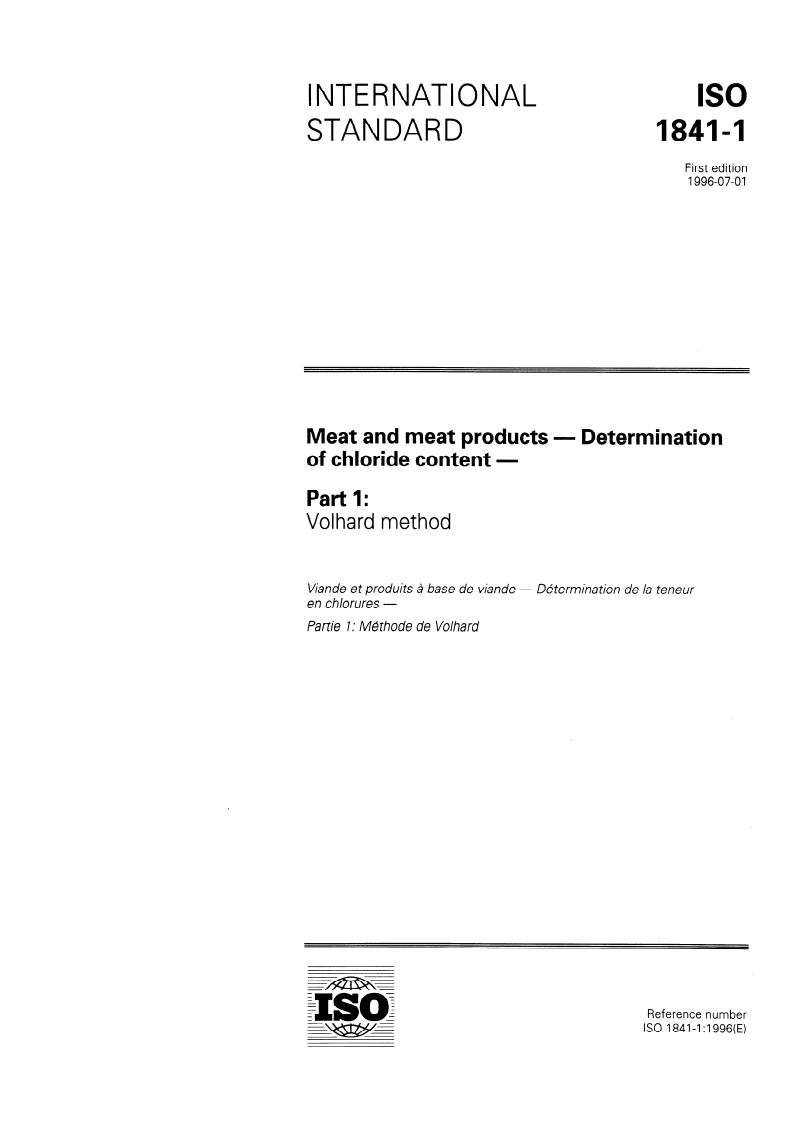
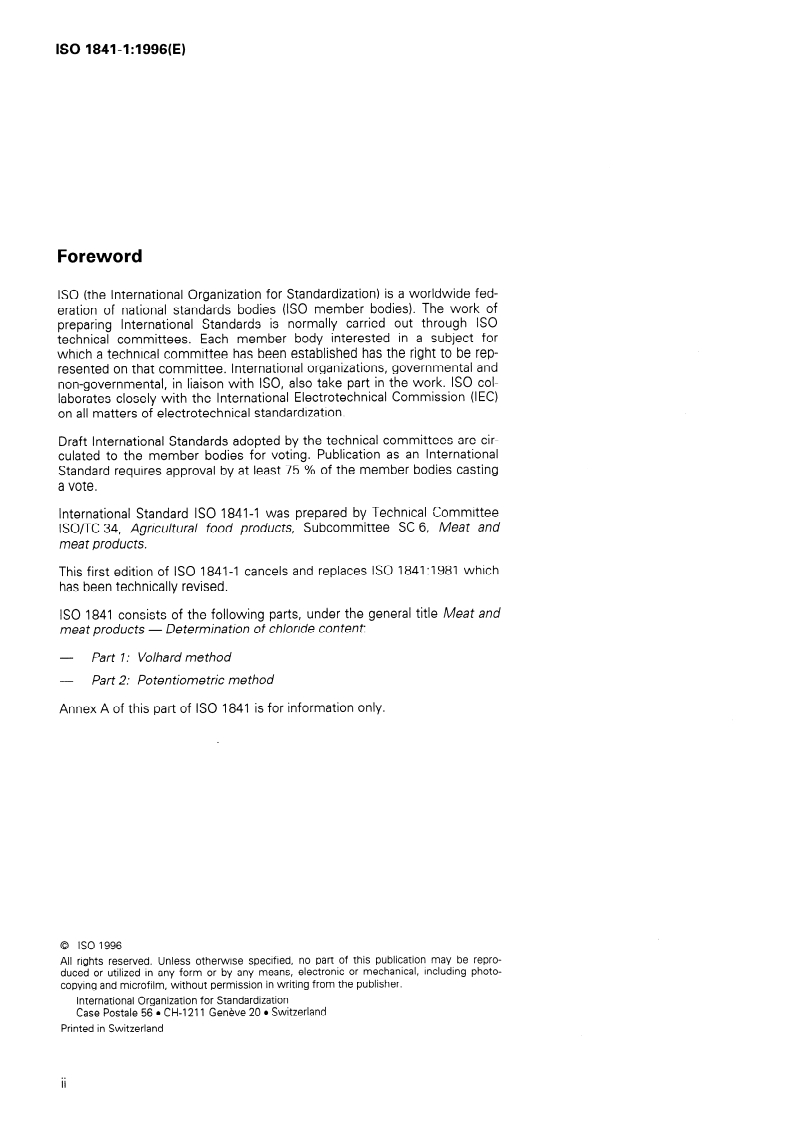
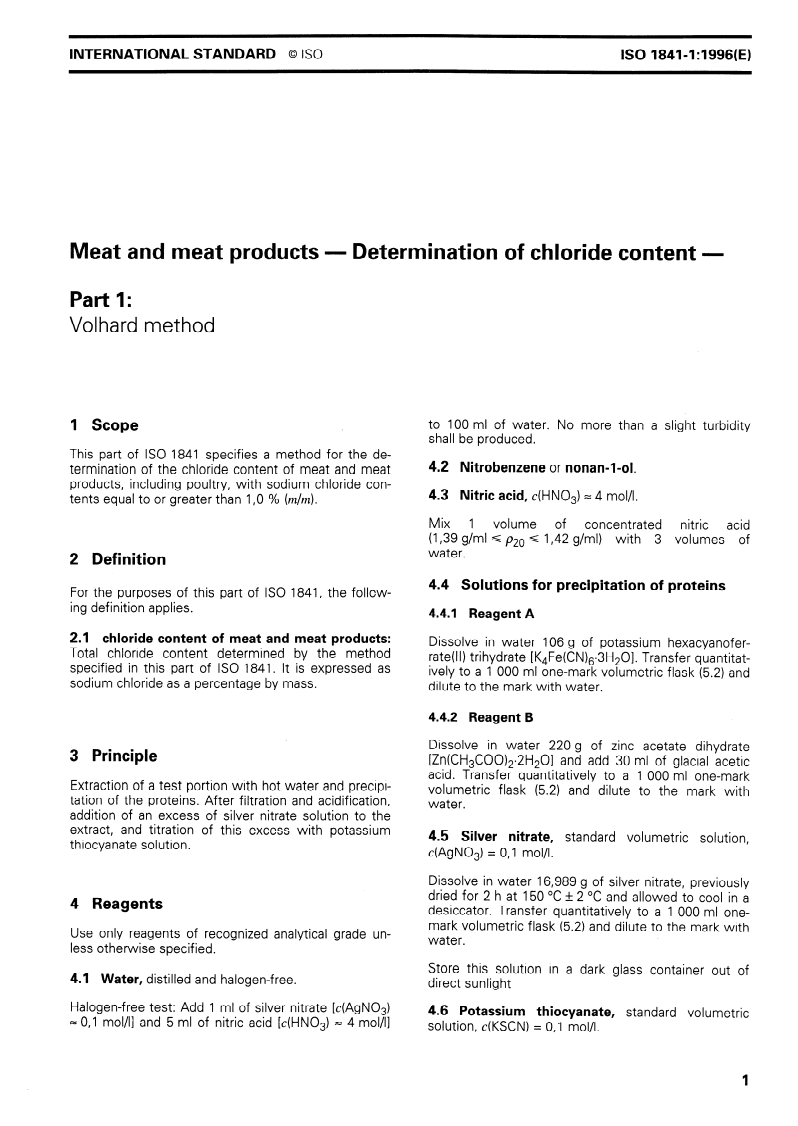
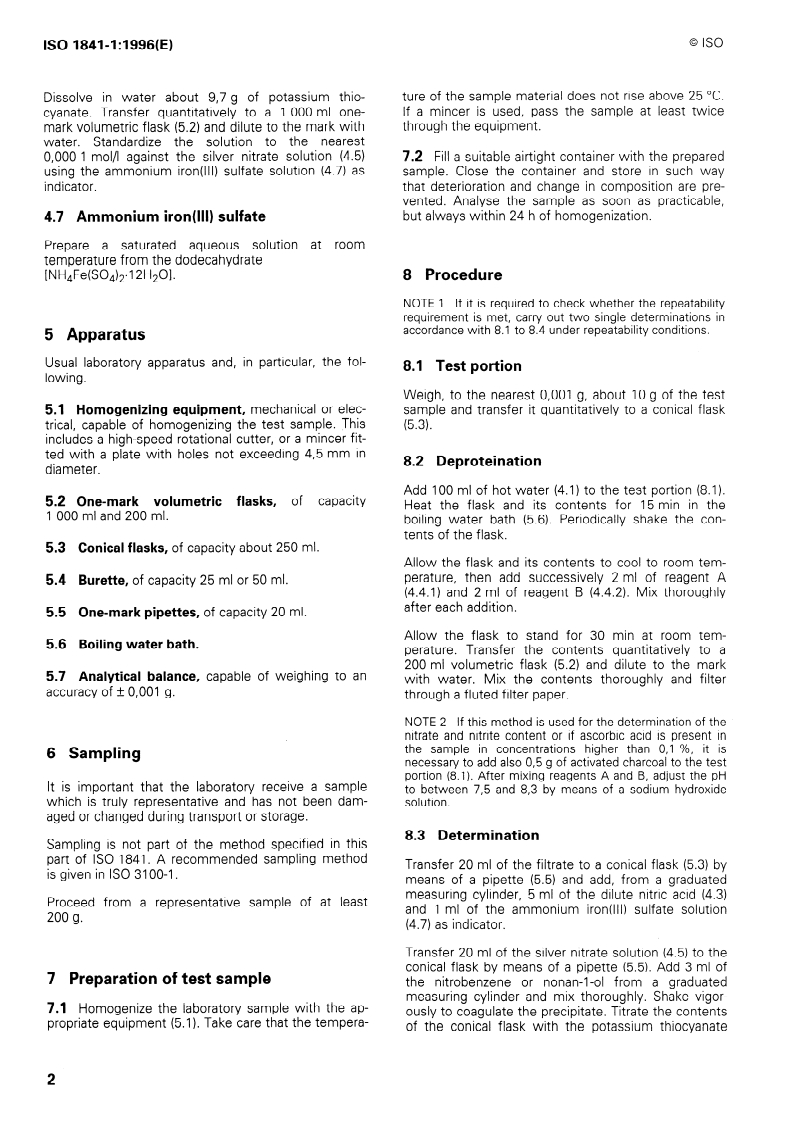
ISO 1841-1:1996 - Meat and meat products — Determination of chloride content — Part 1: Volhard method/27/1996

ISO 1841-1:1996 - Viande et produits a base de viande -- Détermination de la teneur en chlorures
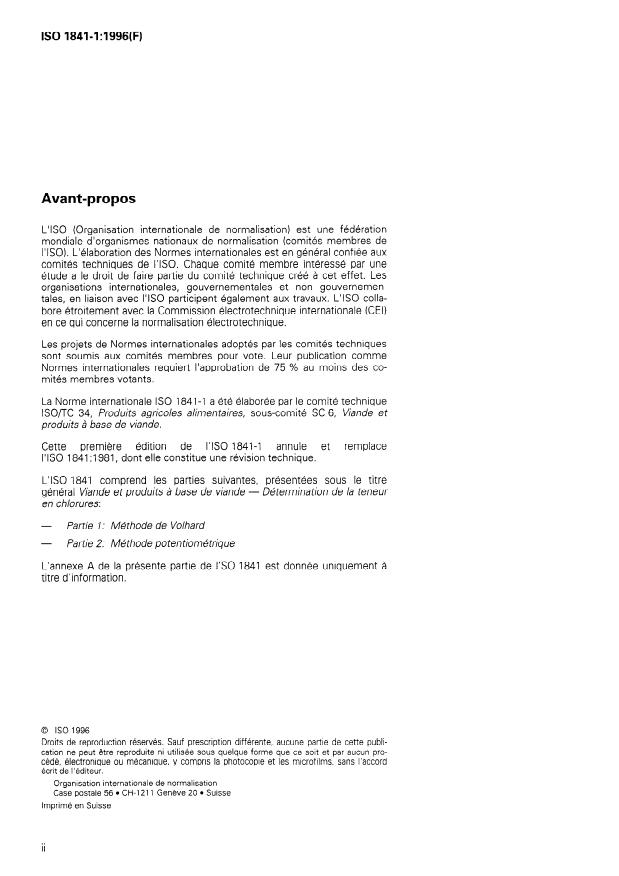

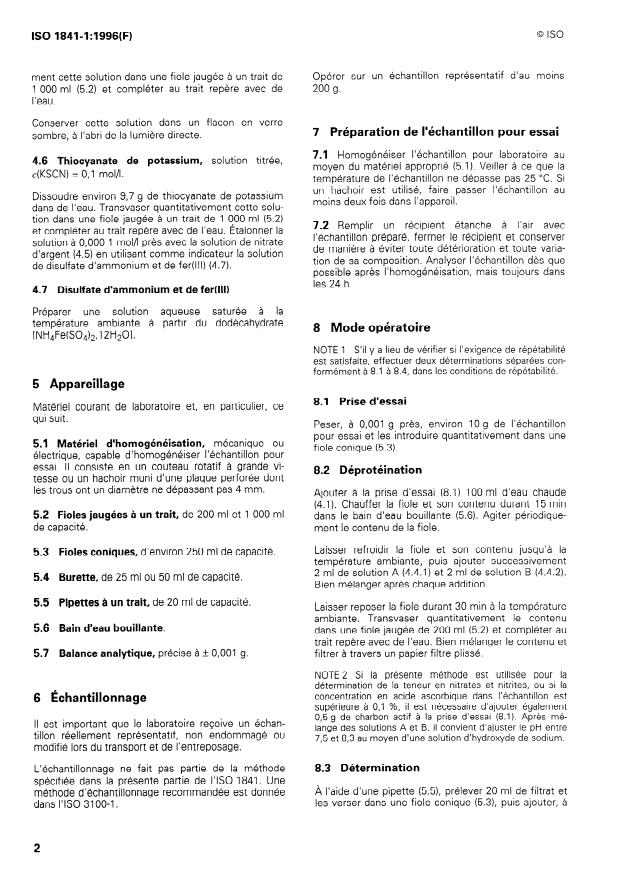
ISO 1841-1:1996 - Viande et produits a base de viande -- Détermination de la teneur en chlorures
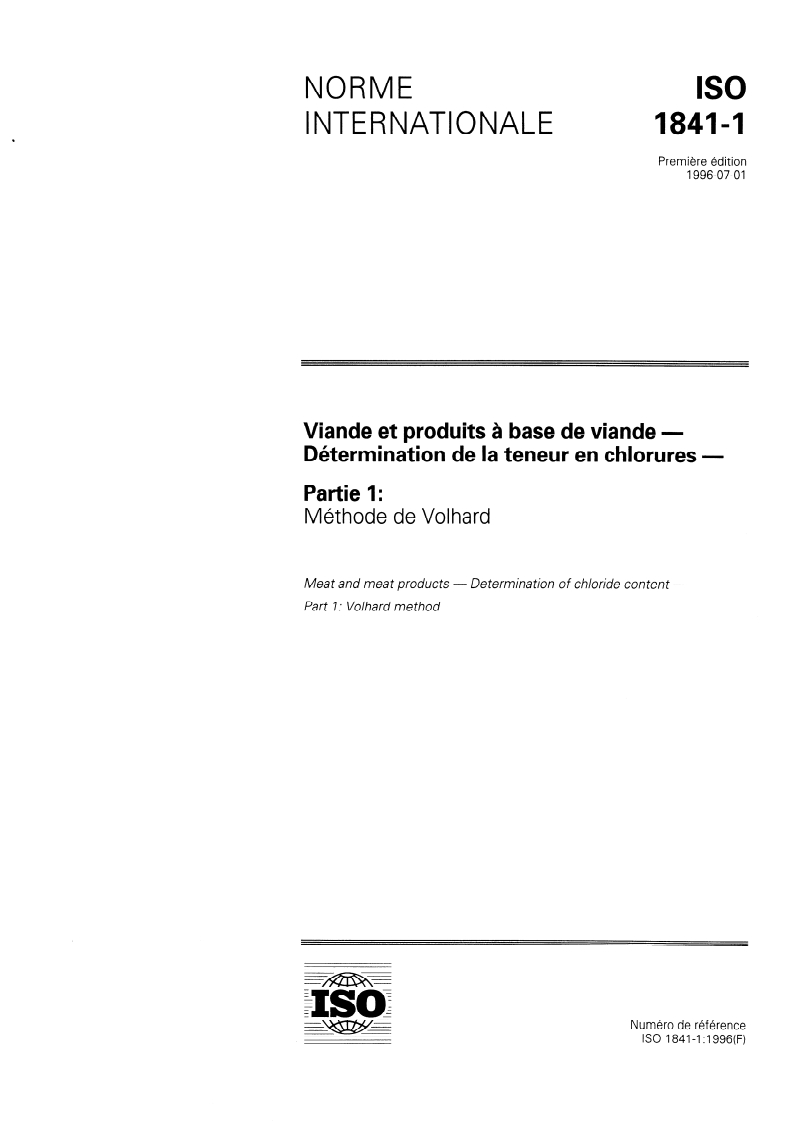
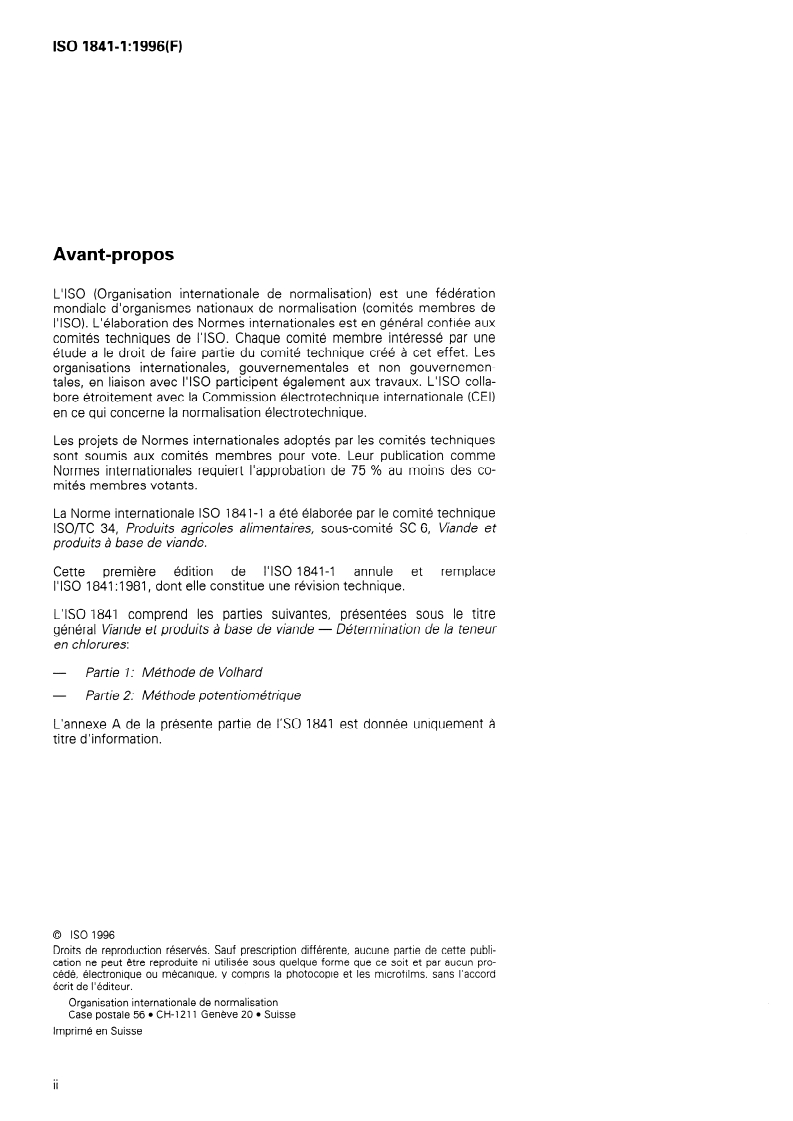
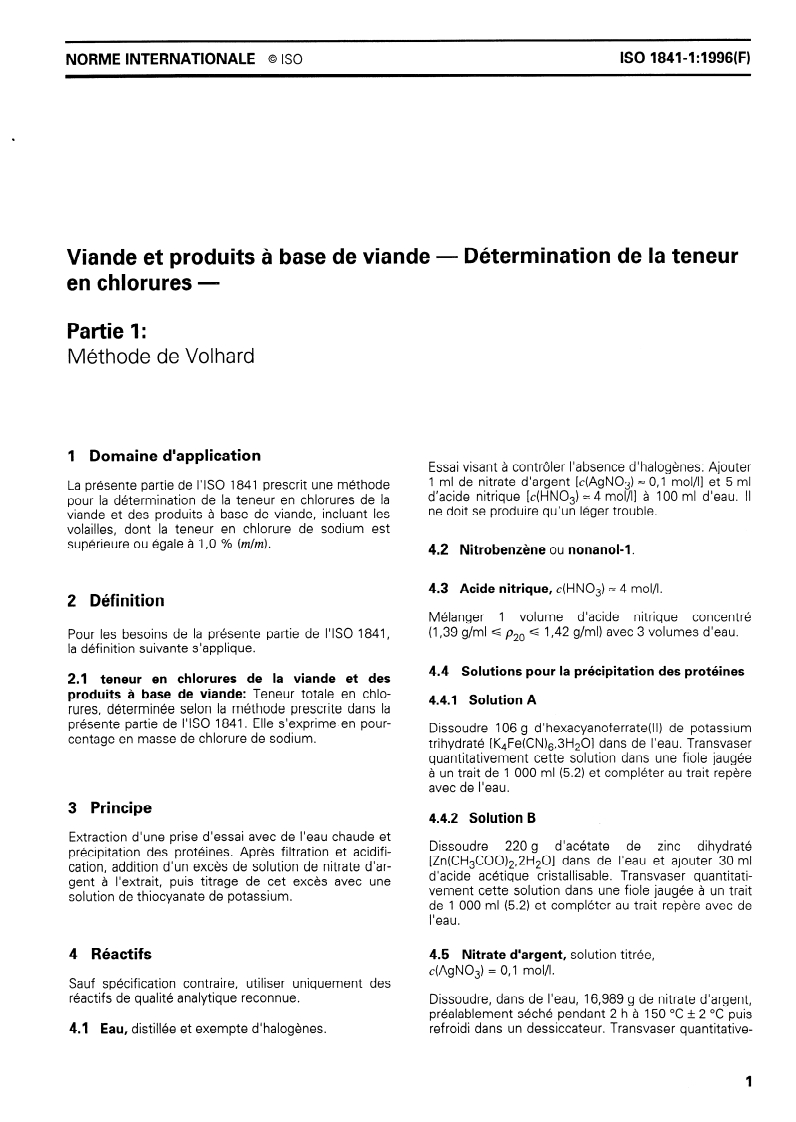
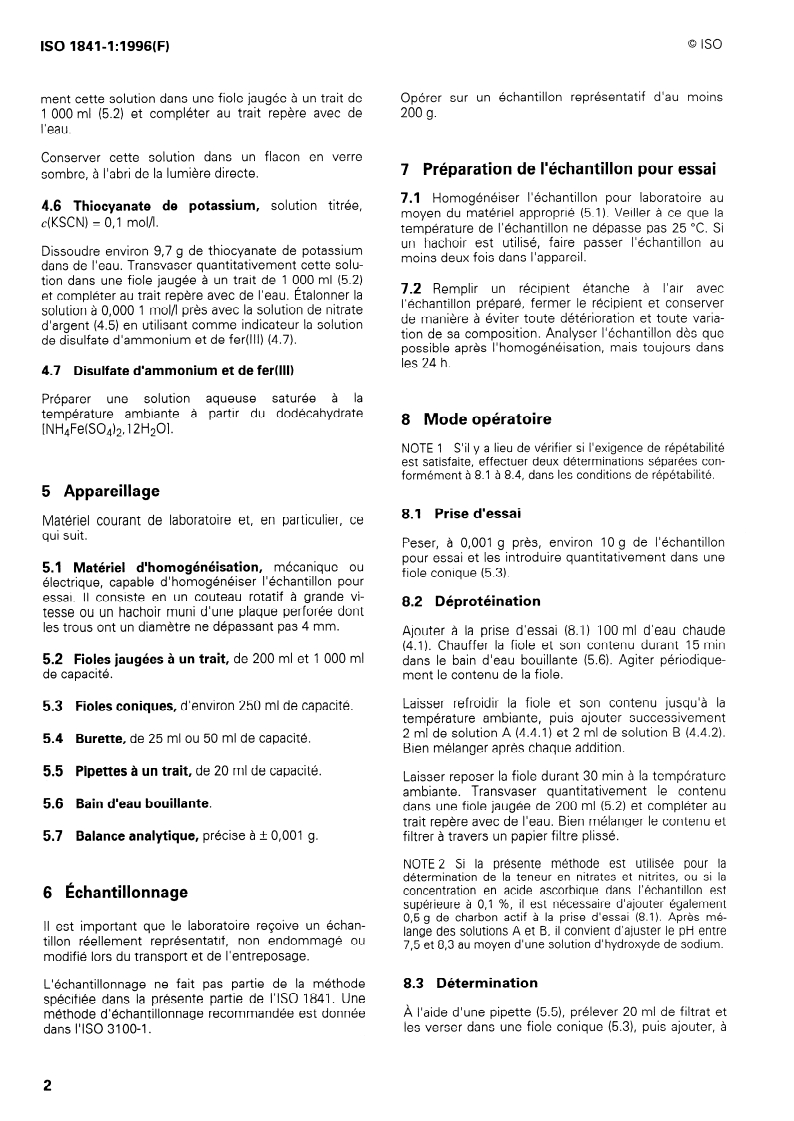
ISO 1841-1:1996 - Viande et produits à base de viande — Détermination de la teneur en chlorures — Partie 1: Méthode de Volhard/27/1996
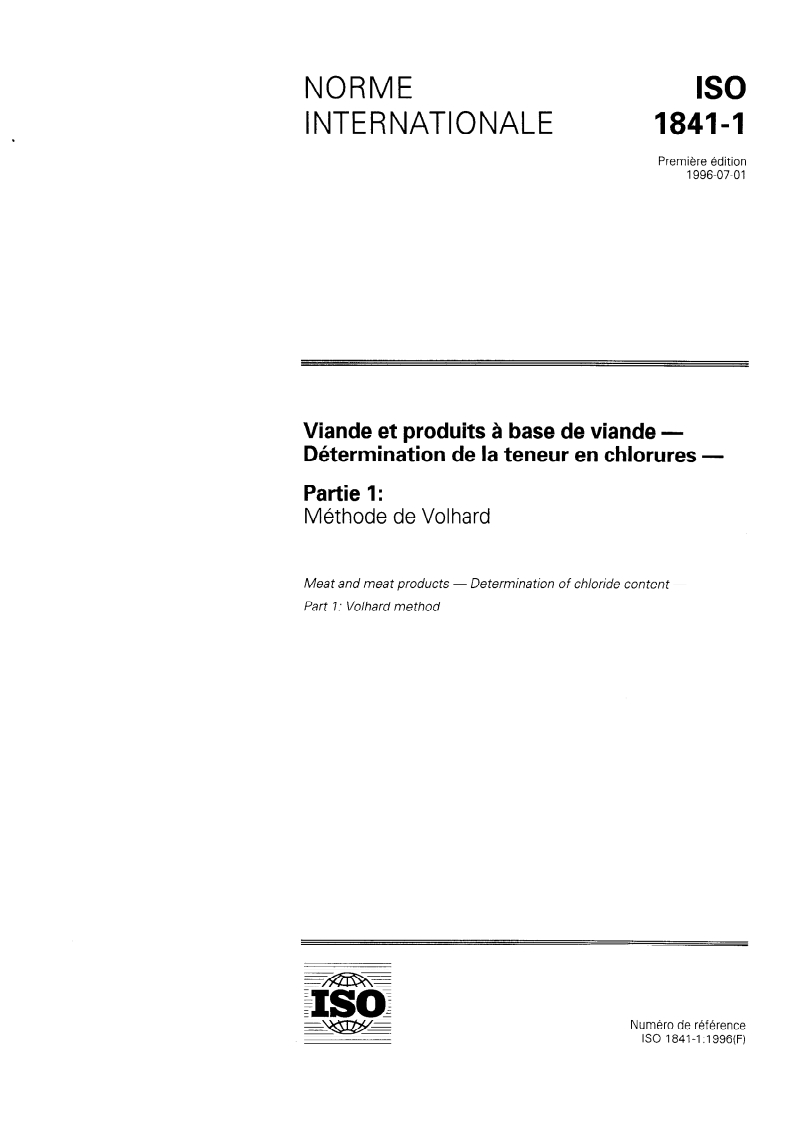
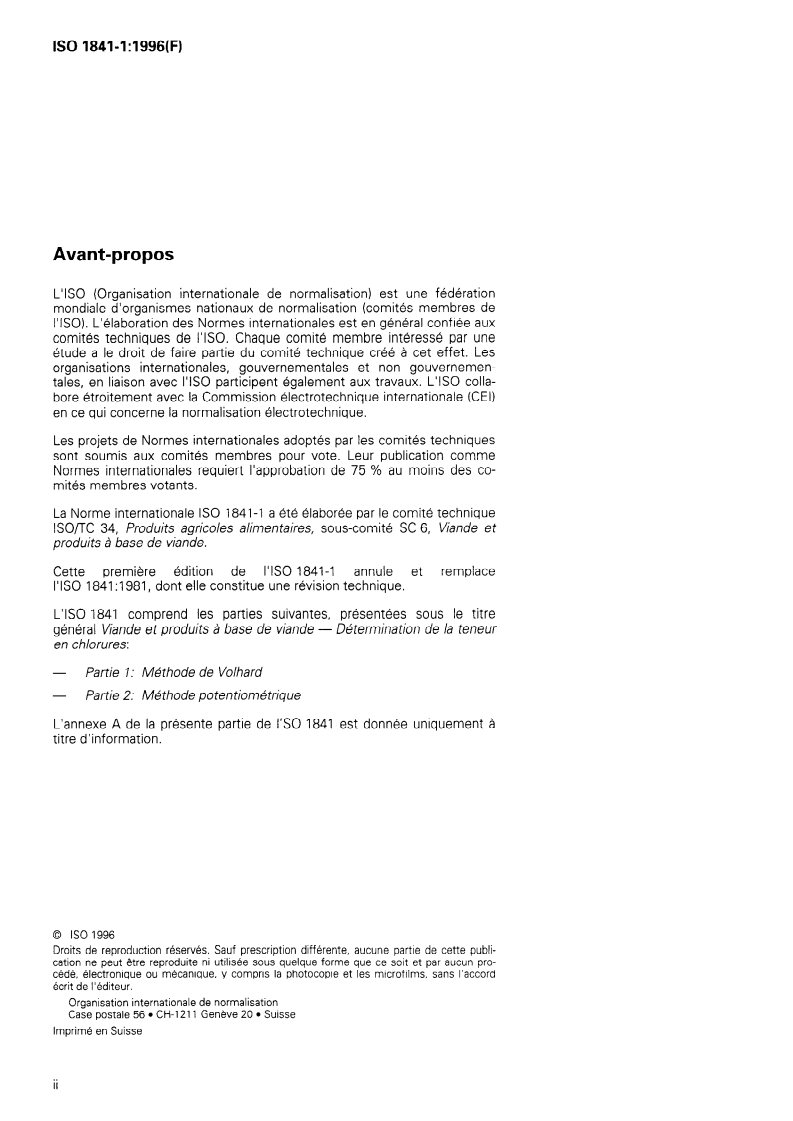
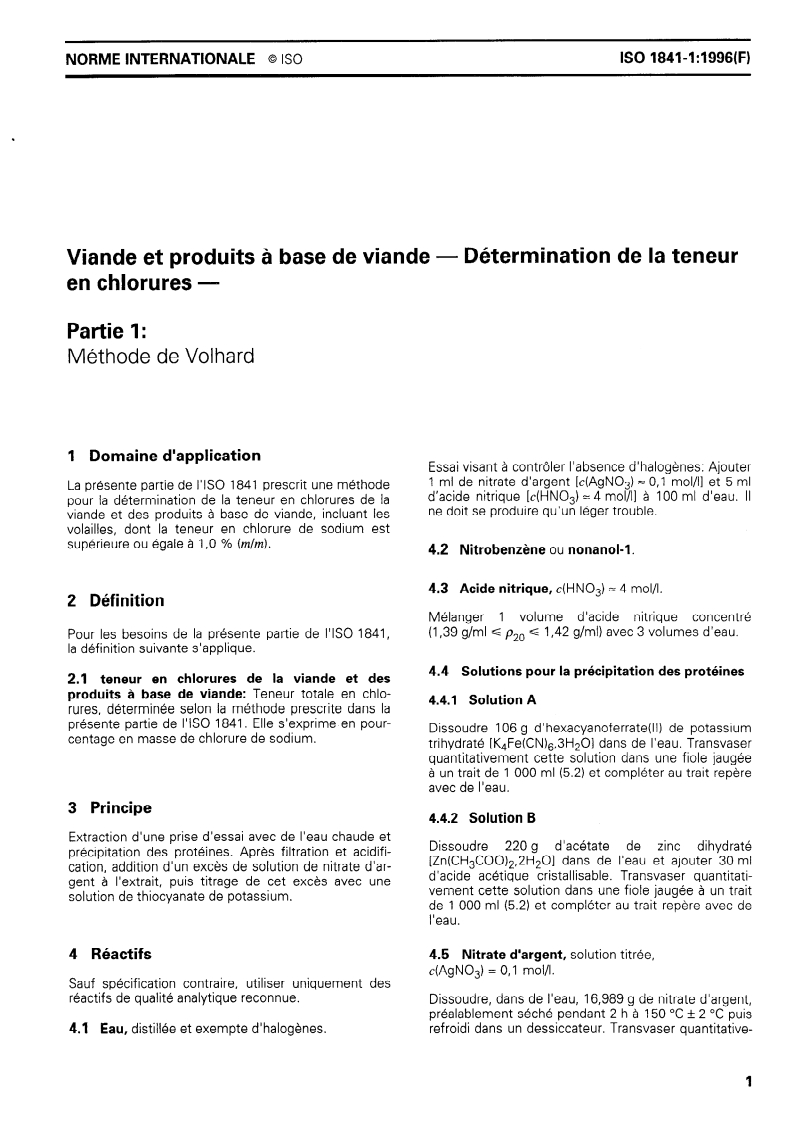
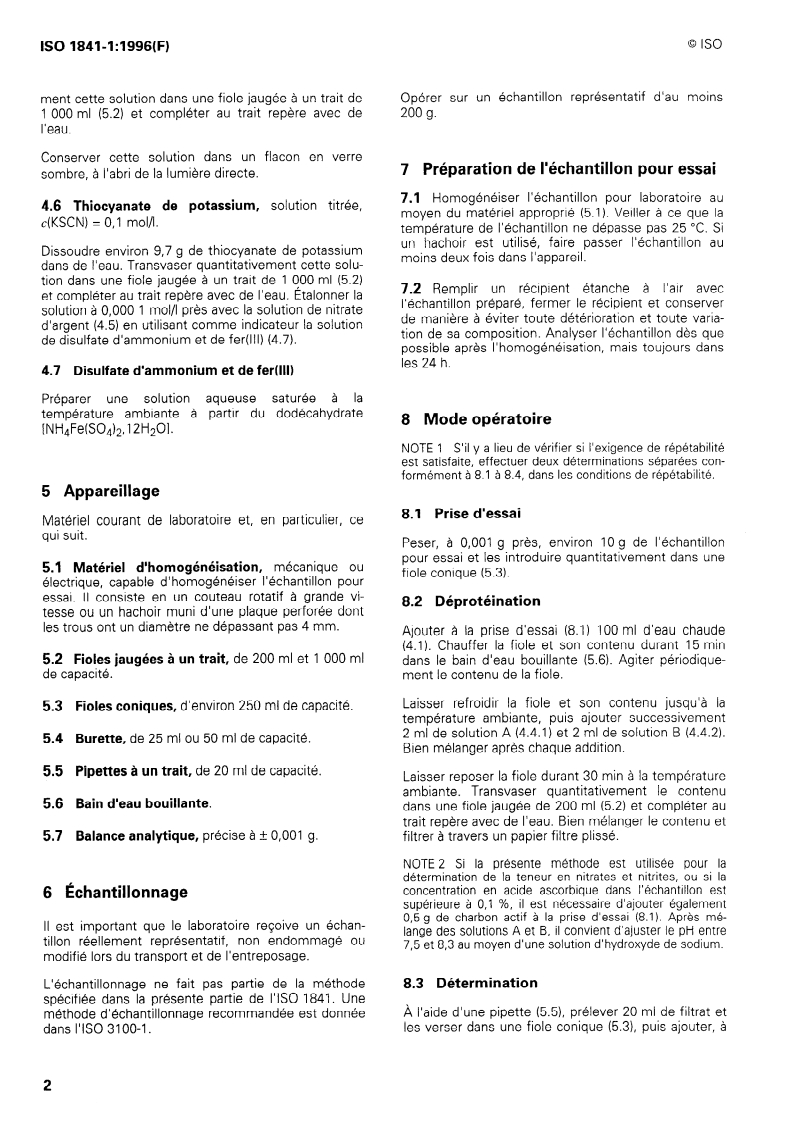
ISO 1841-1:1996 - Viande et produits à base de viande — Détermination de la teneur en chlorures — Partie 1: Méthode de Volhard/27/1996
ISO 1841-1:1996 Overview
ISO 1841-1:1996 is an international standard published by the International Organization for Standardization (ISO). It specifies a Volhard titrimetric method for the precise determination of chloride content in meat and meat products, including poultry. This method applies to samples with sodium chloride concentrations of 1.0% (m/m) or higher. The standard ensures accurate chloride quantification, critical for quality control, food safety, and regulatory compliance in the meat industry.
This first part of the standard updates and replaces the earlier 1981 version and is part of a two-part series, with Part 2 covering the potentiometric method.
Key Topics in ISO 1841-1:1996
Scope and Application
The method is applicable to various meat products containing sodium chloride, essential for verifying salt content in processed meats to meet labeling and safety requirements.Volhard Method Principle
It involves extracting chloride ions from the meat sample, precipitating proteins, and titrating an excess of silver nitrate with potassium thiocyanate. The chloride concentration is then calculated from titration results.Sample Preparation
Homogenization of the meat sample is critical, followed by extraction with hot distilled water, protein precipitation, and filtration prior to titration.Reagents and Equipment
The method requires high-purity reagents such as silver nitrate, potassium thiocyanate, and ammonium iron(III) sulfate as an indicator, alongside standard laboratory apparatus like volumetric flasks, burettes, and a boiling water bath.Precision and Accuracy
ISO 1841-1 provides guidance on method precision, including repeatability and reproducibility limits. For sodium chloride content:- Repeatability varies from 0.15% to 0.20% (m/m) depending on the salt level.
- Reproducibility ranges from 0.20% to 0.30% (m/m).
Calculation and Reporting
The standard includes a precise formula to convert titration volumes into chloride mass percentage, emphasizing methodological rigor and consistent reporting.Sampling Note
While sampling itself is not detailed in this method, ISO 1841-1 recommends following ISO 3100-1:1991 for representative sample preparation.
Practical Applications of ISO 1841-1:1996
Quality Control in Meat Processing
Enables meat producers to monitor and control sodium chloride content ensuring products meet defined standards for taste, preservation, and safety.Regulatory Compliance
Food safety authorities and manufacturers rely on this standardized method to verify compliance with legal limits on salt content in meat and poultry products.Research and Development
Laboratories developing new meat products use this method to accurately assess chloride levels affecting texture and shelf life.International Trade
Provides a harmonized and validated procedure for consistent chloride determination, facilitating trade and conformity assessments globally.
Related Standards and References
ISO 1841-2:1996
Specifies the potentiometric method for chloride determination in meat products, offering an alternative to the Volhard method.ISO 3100-1:1991
Details sampling and preparation of meat and meat product samples to ensure representativeness and accuracy prior to chemical analysis.ISO 5725 Series
Provides guidelines on the precision of test methods, which underpin the accuracy and reproducibility criteria referenced in ISO 1841-1.Analytical Chemistry References
Studies comparing Volhard and potentiometric methods highlight the robustness and reliability of the titrimetric approach in chloride determination in food matrices.
Keywords: ISO 1841-1, chloride determination, Volhard method, meat products, sodium chloride content, meat analysis, food quality control, meat processing standards, chemical analysis of meat, international food standards.
Relations
- Revises
ISO 1841:1981 - Meat and meat products — Determination of chloride content (Reference method) - Effective Date
- 15-Apr-2008
Buy Documents
ISO 1841-1:1996 - Meat and meat products -- Determination of chloride content
ISO 1841-1:1996 - Meat and meat products — Determination of chloride content — Part 1: Volhard method/27/1996
ISO 1841-1:1996 - Viande et produits a base de viande -- Détermination de la teneur en chlorures
ISO 1841-1:1996 - Viande et produits a base de viande -- Détermination de la teneur en chlorures
ISO 1841-1:1996 - Viande et produits à base de viande — Détermination de la teneur en chlorures — Partie 1: Méthode de Volhard/27/1996
ISO 1841-1:1996 - Viande et produits à base de viande — Détermination de la teneur en chlorures — Partie 1: Méthode de Volhard/27/1996
Get Certified
Connect with accredited certification bodies for this standard

BSI Group
BSI (British Standards Institution) is the business standards company that helps organizations make excellence a habit.

Bureau Veritas
Bureau Veritas is a world leader in laboratory testing, inspection and certification services.

DNV
DNV is an independent assurance and risk management provider.
Sponsored listings
Frequently Asked Questions
ISO 1841-1:1996 is a standard published by the International Organization for Standardization (ISO). Its full title is "Meat and meat products — Determination of chloride content — Part 1: Volhard method". This standard covers: Gives a method for the determination of the chloride content of meat and meat products, including poultry, with sodium chloride contents equal to or greater than 1,0 % (m/m).
Gives a method for the determination of the chloride content of meat and meat products, including poultry, with sodium chloride contents equal to or greater than 1,0 % (m/m).
ISO 1841-1:1996 is classified under the following ICS (International Classification for Standards) categories: 67.120.10 - Meat and meat products. The ICS classification helps identify the subject area and facilitates finding related standards.
ISO 1841-1:1996 has the following relationships with other standards: It is inter standard links to ISO 1841:1981. Understanding these relationships helps ensure you are using the most current and applicable version of the standard.
ISO 1841-1:1996 is available in PDF format for immediate download after purchase. The document can be added to your cart and obtained through the secure checkout process. Digital delivery ensures instant access to the complete standard document.
Standards Content (Sample)
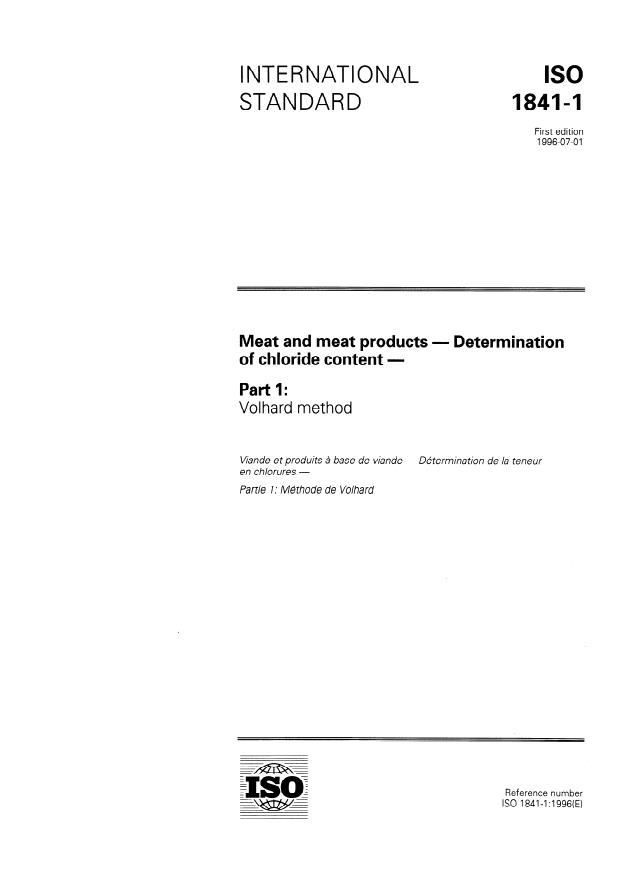
IS0
INTERNATIONAL
STANDARD 18414
First edition
1996-07-o 1
Meat and meat products - Determination
of chloride content -
Part 1:
Volhard method
Viande et produits ;j base de viande - D&termination de la teneur
en chlorures -
Partie I: M&hode de Volhard
Reference number
IS0 1841-1:1996(E)
IS0 1841-1:1996(E)
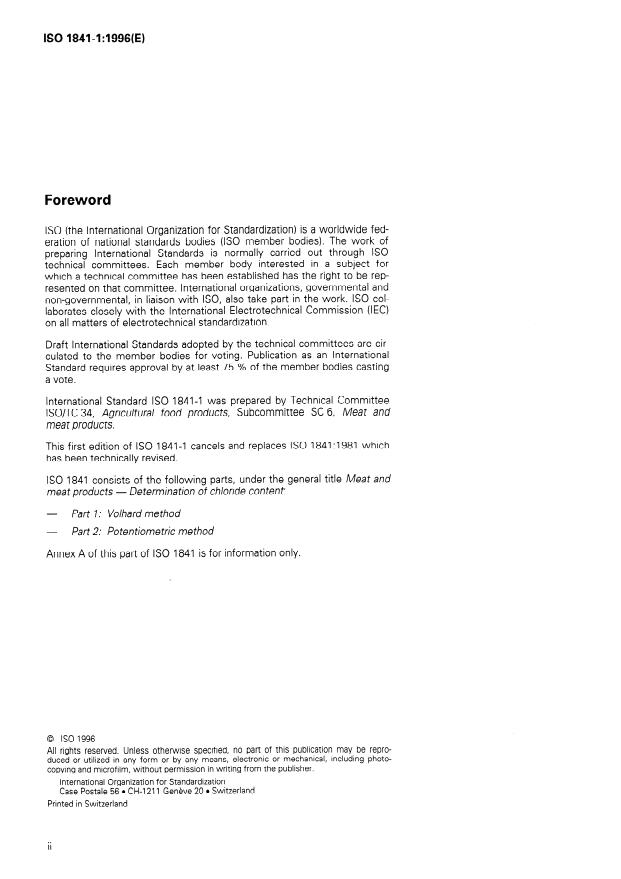
Foreword
IS0 (the International Organization for Standardization) is a worldwide fed-
eration of national standards bodies (IS0 member bodies). The work of
preparing International Standards is normally carried out through IS0
technical committees. Each member body interested in a subject for
which a technical committee has been established has the right to be rep-
resented on that committee. International organizations, governmental and
non-governmental, in liaison with ISO, also take part in the work. IS0 col-
laborates closely with the International Electrotechnical Commission (IEC)
on all matters of electrotechnical standardization.
Draft International Standards adopted by the technical committees are cir-
culated to the member bodies for voting. Publication as an International
Standard requires approval by at least 75 % of the member bodies casting
a vote.
International Standard IS0 1841-1 was prepared by Technical Committee
ISOnC 34, Agricultural food products, Subcommittee SC 6, Meat and
meat products.
This first edition of IS0 1841-I cancels and replaces IS0 1841 :I 981 which
has been technically revised.
IS0 1841 consists of the following parts, under the general title Meat and
Determination of chloride con tent:
meat products -
- Part 7: Volhard method
Part 2: Po ten tiome tric method
Annex A of this part of IS0 1841 is for information only.
0 IS0 1996
All rights reserved. Unless otherwise specified, no part of this publication may be repro-
duced or utilized in any form or by any means, electronic or mechanical, including photo-
copying and microfilm, without permission in writing from the publisher.
International Organization for Standardization
Case Postale 56 l CH-121 1 Geneve 20 l Switzerland
Printed in Switzerland
II
IS0 1841-1:1996(E)
INTERNATIONAL STANDARD @ IS0
Meat and meat products - Determination of chloride content -
Part I:
Volhard method
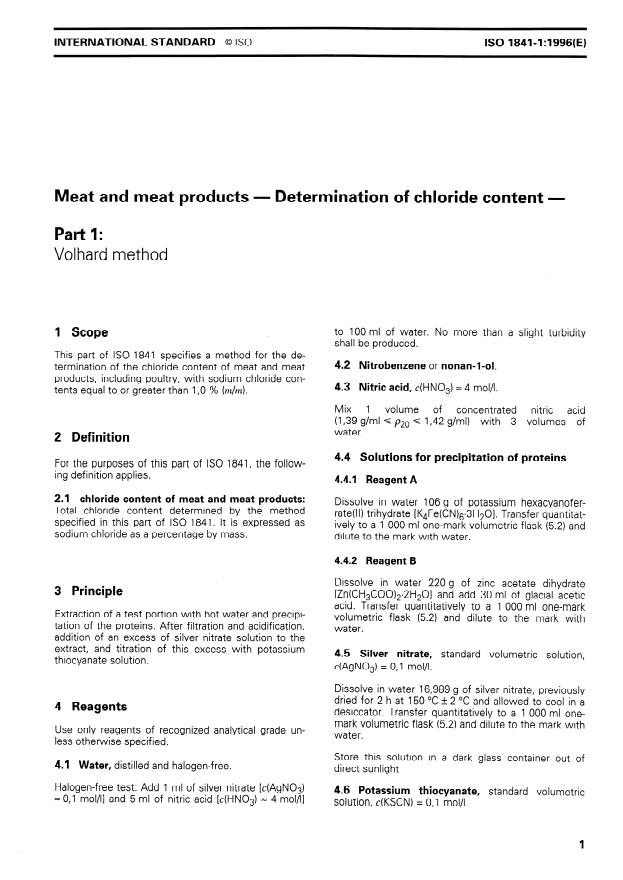
to 100 ml of water. No more than a slight turbidity
1 Scope
shall be produced.
This part of IS0 1841 specifies a method for the de-
4.2 Nitrobenzene or nonan-l-01.
termination of the chloride content of meat and meat
products, including poultry, with sodium chloride con-
4.3 Nitric acid, c(HNO$ = 4 mol/l.
tents equal to or greater than I,0 % (m/m).
Mix 1 volume of concentrated nitric acid
G I,42 g/ml) with 3 volumes of
(13 g/ml c ~20
water.
2 Definition
4.4 Solutions for precipitation of proteins
For the purposes of this part of IS0 1841, the follcw-
ing definition applies.
4.4.1 Reagent A
2.1 chloride content of meat and meat products:
Dissolve in water 106 g of potassium hexacyanofer-
Total chloride content determined by the method
rate(ll) trihydrate [K4Fe(CN)6.3H20]. Transfer quantitat-
specified in this part of IS0 1841. It is expressed as
ively to a 1 000 ml one-mark volumetric flask (5.2) and
sodium chloride as a percentage by mass.
dilute to the mark with water.
4.42 Reagent B
Dissolve in water 220 g of zinc acetate dihydrate
3 Principle [Zn(CH3COO)2.2H201 and add 30 ml of glacial acetic
acid. Transfer quantitatively to a 1 000 ml one-mark
Extraction of a test portion with hot water and precipi-
volumetric flask (5.2) and dilute to the mark with
tation of the proteins. After filtration and acidification,
water.
addition of an excess of silver nitrate solution to the
extract, and titration of this excess with potassium
4.5 Silver nitrate, standard volumetric solution,
thiocyanate solution.
c(AgNOs) = 0,l mol/l.
Dissolve in water 16,989 g of silver nitrate, previously
dried for 2 h at 150 “C + 2 “C and allowed to cool in a
4 Reagents
desiccator. Transfer quantitatively to a 1 000 ml one-
mark volumetric flask (5.2) and dilute to the mark with
Use only reagents of recognized analytical grade un-
water.
less otherwise specified.
Store this solution in a dark glass container out of
4.1 Water, distilled and halogen-free.
direct sunlight
Halogen-free test: Add 1 ml of silver nitrate [c(AgN03)
4.6 Potassium thiocyanate, standard volumetric
= 0,l mol/l] and 5 ml of nitric acid [c(HNOs) = 4 mol/l]
solution, c(KSCN) = 0,l mol/l.
@ IS0
IS0 1841-1:1996(E)
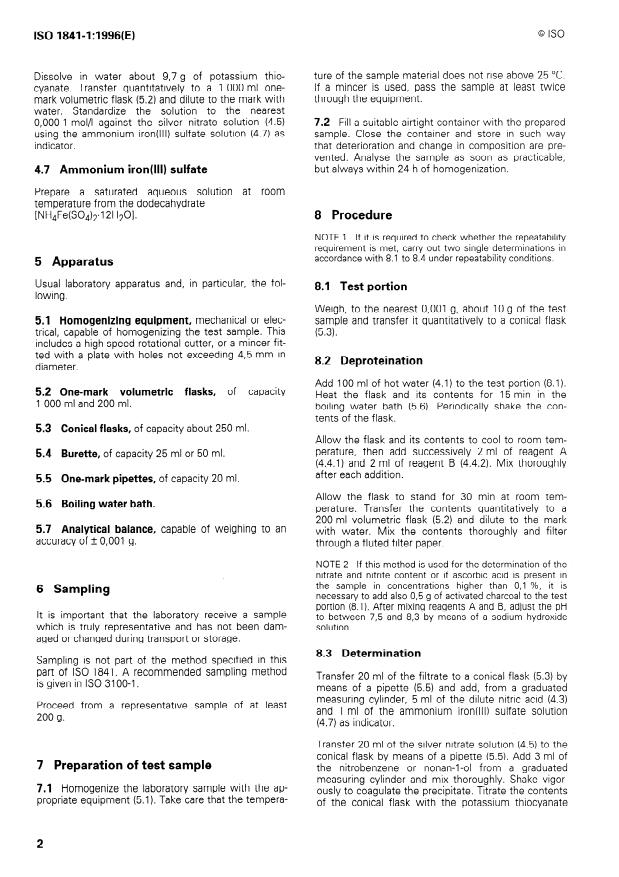
ture of the sample material does not rise above 25 “C.
Dissolve in water about 9,7 g of potassium thio-
If a mincer is used, pass the sample at least twice
cyanate. Transfer quantitatively to a 1 000 ml one-
through the equipment.
mark volumetric flask (5.2) and dilute to the mark with
water. Standardize the solution to the nearest
7.2 Fill a suitable airtight container with the prepared
0,000 1 mol/l against the silver nitrate solution (4.5)
sample. Close the container and store in such way
using the ammonium iron(lll) sulfate solution (4.7) as
indicator. that deterioration and change in composition are pre-
vented. Analyse the sample as soon as practicable,
but always within 24 h of homogenization.
4.7 Ammonium iron(lll) sulfate
Prepare a saturated aqueous solution at room
temperature from the dodecahydrate
[NH4Fe(S04)2.1 2H20].
8 Procedure
NOTE 1 If it is required to check whether the repeatability
requirement is met, carry out two single determinations in
accordance with 8.1 to 8.4 under repeatability conditions.
5 Apparatus
Usual la boratory apparatus and, in particular, the fol-
8.1 Test portion
lowing.
Weigh, to the nearest 0,001 g, about 10 g of the test
sample and transfer it quantitatively to a conical flask
5.1 Homogenizing equipment, mechanical or elec-
(5.3).
trical, capable of homogenizing the test sample. This
includes a high-speed rotational cutter, or a mincer fit-
ted with a plate with holes not exceeding 4,5 mm in
8.2 Deproteination
diameter.
Add 100 ml of hot water (4.1) to the test portion
...
IS0
INTERNATIONAL
STANDARD 18414
First edition
1996-07-o 1
Meat and meat products - Determination
of chloride content -
Part 1:
Volhard method
Viande et produits ;j base de viande - D&termination de la teneur
en chlorures -
Partie I: M&hode de Volhard
Reference number
IS0 1841-1:1996(E)
IS0 1841-1:1996(E)
Foreword
IS0 (the International Organization for Standardization) is a worldwide fed-
eration of national standards bodies (IS0 member bodies). The work of
preparing International Standards is normally carried out through IS0
technical committees. Each member body interested in a subject for
which a technical committee has been established has the right to be rep-
resented on that committee. International organizations, governmental and
non-governmental, in liaison with ISO, also take part in the work. IS0 col-
laborates closely with the International Electrotechnical Commission (IEC)
on all matters of electrotechnical standardization.
Draft International Standards adopted by the technical committees are cir-
culated to the member bodies for voting. Publication as an International
Standard requires approval by at least 75 % of the member bodies casting
a vote.
International Standard IS0 1841-1 was prepared by Technical Committee
ISOnC 34, Agricultural food products, Subcommittee SC 6, Meat and
meat products.
This first edition of IS0 1841-I cancels and replaces IS0 1841 :I 981 which
has been technically revised.
IS0 1841 consists of the following parts, under the general title Meat and
Determination of chloride con tent:
meat products -
- Part 7: Volhard method
Part 2: Po ten tiome tric method
Annex A of this part of IS0 1841 is for information only.
0 IS0 1996
All rights reserved. Unless otherwise specified, no part of this publication may be repro-
duced or utilized in any form or by any means, electronic or mechanical, including photo-
copying and microfilm, without permission in writing from the publisher.
International Organization for Standardization
Case Postale 56 l CH-121 1 Geneve 20 l Switzerland
Printed in Switzerland
II
IS0 1841-1:1996(E)
INTERNATIONAL STANDARD @ IS0
Meat and meat products - Determination of chloride content -
Part I:
Volhard method
to 100 ml of water. No more than a slight turbidity
1 Scope
shall be produced.
This part of IS0 1841 specifies a method for the de-
4.2 Nitrobenzene or nonan-l-01.
termination of the chloride content of meat and meat
products, including poultry, with sodium chloride con-
4.3 Nitric acid, c(HNO$ = 4 mol/l.
tents equal to or greater than I,0 % (m/m).
Mix 1 volume of concentrated nitric acid
G I,42 g/ml) with 3 volumes of
(13 g/ml c ~20
water.
2 Definition
4.4 Solutions for precipitation of proteins
For the purposes of this part of IS0 1841, the follcw-
ing definition applies.
4.4.1 Reagent A
2.1 chloride content of meat and meat products:
Dissolve in water 106 g of potassium hexacyanofer-
Total chloride content determined by the method
rate(ll) trihydrate [K4Fe(CN)6.3H20]. Transfer quantitat-
specified in this part of IS0 1841. It is expressed as
ively to a 1 000 ml one-mark volumetric flask (5.2) and
sodium chloride as a percentage by mass.
dilute to the mark with water.
4.42 Reagent B
Dissolve in water 220 g of zinc acetate dihydrate
3 Principle [Zn(CH3COO)2.2H201 and add 30 ml of glacial acetic
acid. Transfer quantitatively to a 1 000 ml one-mark
Extraction of a test portion with hot water and precipi-
volumetric flask (5.2) and dilute to the mark with
tation of the proteins. After filtration and acidification,
water.
addition of an excess of silver nitrate solution to the
extract, and titration of this excess with potassium
4.5 Silver nitrate, standard volumetric solution,
thiocyanate solution.
c(AgNOs) = 0,l mol/l.
Dissolve in water 16,989 g of silver nitrate, previously
dried for 2 h at 150 “C + 2 “C and allowed to cool in a
4 Reagents
desiccator. Transfer quantitatively to a 1 000 ml one-
mark volumetric flask (5.2) and dilute to the mark with
Use only reagents of recognized analytical grade un-
water.
less otherwise specified.
Store this solution in a dark glass container out of
4.1 Water, distilled and halogen-free.
direct sunlight
Halogen-free test: Add 1 ml of silver nitrate [c(AgN03)
4.6 Potassium thiocyanate, standard volumetric
= 0,l mol/l] and 5 ml of nitric acid [c(HNOs) = 4 mol/l]
solution, c(KSCN) = 0,l mol/l.
@ IS0
IS0 1841-1:1996(E)
ture of the sample material does not rise above 25 “C.
Dissolve in water about 9,7 g of potassium thio-
If a mincer is used, pass the sample at least twice
cyanate. Transfer quantitatively to a 1 000 ml one-
through the equipment.
mark volumetric flask (5.2) and dilute to the mark with
water. Standardize the solution to the nearest
7.2 Fill a suitable airtight container with the prepared
0,000 1 mol/l against the silver nitrate solution (4.5)
sample. Close the container and store in such way
using the ammonium iron(lll) sulfate solution (4.7) as
indicator. that deterioration and change in composition are pre-
vented. Analyse the sample as soon as practicable,
but always within 24 h of homogenization.
4.7 Ammonium iron(lll) sulfate
Prepare a saturated aqueous solution at room
temperature from the dodecahydrate
[NH4Fe(S04)2.1 2H20].
8 Procedure
NOTE 1 If it is required to check whether the repeatability
requirement is met, carry out two single determinations in
accordance with 8.1 to 8.4 under repeatability conditions.
5 Apparatus
Usual la boratory apparatus and, in particular, the fol-
8.1 Test portion
lowing.
Weigh, to the nearest 0,001 g, about 10 g of the test
sample and transfer it quantitatively to a conical flask
5.1 Homogenizing equipment, mechanical or elec-
(5.3).
trical, capable of homogenizing the test sample. This
includes a high-speed rotational cutter, or a mincer fit-
ted with a plate with holes not exceeding 4,5 mm in
8.2 Deproteination
diameter.
Add 100 ml of hot water (4.1) to the test portion
...
NORME ISO
INTERNATIONALE 18414
Première édition
1996-07-01
Viande et produits à base de viande -
Détermination de la teneur en chlorures -
Partie 1:
Méthode de Volhard
Meat and meat products - Determination of chloride content -
Part 7: Volhard method
Numéro de référence
ISO 1841-I :1996(F)
Avant-propos
L’ISO (Organisation internationale de normalisation) est une fédération
mondiale d’organismes nationaux de normalisation (comités membres de
I’ISO). L’élaboration des Normes internationales est en général confiée aux
comités techniques de I’ISO. Chaque comité membre intéressé par une
étude a le droit de faire partie du comité technique créé à cet effet. Les
organisations internationales, gouvernementales et non gouvernemen-
tales, en liaison avec I’ISO participent également aux travaux. L’ISO colla-
bore étroitement avec la Commission électrotechnique internationale (CEI)
en ce qui concerne la normalisation électrotechnique.
Les projets de Normes internationales adoptés par les comités techniques
sont soumis aux comités membres pour vote. Leur publication comme
Normes internationales requiert l’approbation de 75 % au moins des co-
mités membres votants.
La Norme internationale ISO 1841-1 a été élaborée par le comité technique
lSO/TC 34, Produits agricoles alimentaires, sous-comité SC 6, Viande et
produits à base de viande.
Cette première édition de I’ISO 1841-1 annule et remplace
I’ISO 1841 :1981, dont elle constitue une révision technique.
L’ISO 1841 comprend les parties suivantes, présentées sous le titre
général Viande et produits à base de viande - Détermination de la teneur
en chlorures:
- Partie 7: Méthode de Volhard
- Partie 2: Méthode poten tiomé trique
L’annexe A de la présente partie de I’SO 1841 est donnée uniquement à
titre d’information.
0 ISO 1996
Droits de reproduction réservés. Sauf prescription différente, aucune partie de cette publi-
cation ne peut être reproduite ni utilisée sous quelque forme que ce soit et par aucun pro-
cédé, électronique ou mécanique, y compris la photocopie et les microfilms, sans l’accord
écrit de l’éditeur.
Organisation internationale de normalisation
Case postale 56 l CH-l 211 Genève 20 l Suisse
Imprimé en Suisse
ii
NORME INTERNATIONALE @ ISO ISO 1841~1:1996(F)
Viande et produits à base de viande - Détermination de la teneur
en chlorures -
Partie 1:
Méthode de Volhard
1 Domaine d”application
Essai visant à contrôler l’absence d’halogènes: Ajouter
1 ml de nitrate d’argent [c(AgNOs) = 0,l mol/l] et 5 ml
La présente partie de I’ISO 1841 prescrit une méthode
d’acide nitrique [c(HNOs) = 4 mol/l] à 100 ml d’eau. II
pour la détermination de la teneur en chlorures de la
ne doit se produire qu’un léger trouble.
viande et des produits à base de viande, incluant les
volailles, dont la teneur en chlorure de sodium est
supérieure ou égale à 1,O % (mlm).
4.2 Nitrobenzène ou nonanol-1.
4.3 Acide nitrique, c( HNOS) = 4 mol/l.
2 Définition
Mélanger 1 volume d’acide nitrique concentré
G 1,42 g/mI) avec 3 volumes d’eau.
Pour les besoins de la présente partie de I’ISO 1841, (13 g/ml s p20
la définition suivante s’applique.
4.4 Solutions pour la précipitation des protéines
2.1 teneur en chlorures de la viande et des
produits à base de viande: Teneur totale en chlo-
4.4.1 Solution A
rures, déterminée selon la méthode prescrite dans la
présente partie de I’ISO 1841. Elle s’exprime.en pour-
Dissoudre 106 g d’hexacyanoferrate(lI) de potassium
centage en masse de chlorure de sodium.
trihydraté [K4Fe(CN)6,3H20] dans de l’eau. Transvaser
quantitativement cette solution dans une fiole jaugée
à un trait de 1 000 ml (5.2) et compléter au trait repère
avec de l’eau.
3 Principe
4.4.2 Solution B
Extraction d’une prise d’essai avec de l’eau chaude et
Dissoudre 220 g d’acétate de zinc dihydraté
précipitation des protéines. Après filtration et acidifi-
[Zn(CH3COO)2,2H20] dans de l’eau et ajouter 30 ml
cation, addition d’un excès de solution de nitrate d’ar-
d’acide acétique cristallisable. Transvaser quantitati-
gent à l’extrait, puis titrage de cet excès avec une
vement cette solution dans une fiole jaugée à un trait
solution de thiocyanate de potassium.
de 1 000 ml (5.2) et compléter au trait repère avec de
l’eau.
4 Réactifs 4.5 Nitrate d’argent, solution titrée,
c(AgN03) = 0,l mol/l.
Sauf spécification contraire, utiliser uniquement des
réactifs de qualité analytique reconnue.
Dissoudre, dans de l’eau, 16,989 g de nitrate d’argent,
préalablement séché pendant 2 h à 150 “C + 2 OC puis
4.1 Eau, distillée et exempte d’halogènes refroidi dans un dessiccateur. Transvaser quantitative-
0 ISO
Opérer sur un échantillon représentatif d’au moins
ment cette solution dans une fiole jaugée à un trait de
1 000 ml (5.2) et compléter au trait Tepère avec de 2oog.
l’eau.
flacon en verre
Conserver cette solution dans un
7 Préparation de l’échantillon pour essai
sombre, à l’abri de la lumière directe.
7.1 Homogénéiser l’échantillon pour laboratoire au
4.6 Thiocyanate de potassium, solution titrée,
moyen du matériel approprié (5.1). Veiller à ce que la
c(KSCN) = 0,l mol/l.
température de l’échantillon ne dépasse pas 25 OC. Si
un hachoir est utilisé, faire passer l’échantillon au
Dissoudre environ 9,7 g de thiocyanate de potassium
moins deux fois dans l’appareil.
dans de l’eau. Transvaser quantitativement cette solu-
tion dans une fiole jaugée à un trait de 1 000 ml (5.2)
récipient étanche à l’air avec
7.2 Remplir un
et compléter au trait repère avec de l’eau. Étalonner la
l’échantillon préparé, fermer le récipient et conserver
solution à 0,000 1 mol/1 près avec la solution de nitrate
de manière à éviter toute détérioration et toute varia-
d’argent (4.5) en utilisant comme indicateur la solution
tion de sa composition. Analyser l’échantillon dès que
de disulfate d’ammonium et de fer(lll) (4.7).
possible après l’homogénéisation, mais toujours dans
les 24 h.
4.7 Disulfate d’ammonium et de fer(lll)
Préparer une solution aqueuse saturée à la
température ambiante à partir du dodécahydrate
,
8 Mode opératoire
[NHiFe(SOd)2,1 2H201.
NOTE 1 S’il y a lieu de vérifier si l’exigence de répétabilité
est satisfaite, effectuer deux déterminations séparées con-
formément à 8.1 à 8.4, dans les conditions de répétabilité.
5 Appareillage
8.1 Prise d’essai
Matériel courant de laboratoire et, en particulier, ce
qui suit.
Peser, à 0,001 g près, environ 10 g de l’échantillon
pour essai et les introduire quantitativement dans une
5.1 Matériel d’homogénéisation, mécanique ou
fiole conique (5.3).
électrique, capable
...
NORME ISO
INTERNATIONALE 18414
Première édition
1996-07-01
Viande et produits à base de viande -
Détermination de la teneur en chlorures -
Partie 1:
Méthode de Volhard
Meat and meat products - Determination of chloride content -
Part 7: Volhard method
Numéro de référence
ISO 1841-I :1996(F)
Avant-propos
L’ISO (Organisation internationale de normalisation) est une fédération
mondiale d’organismes nationaux de normalisation (comités membres de
I’ISO). L’élaboration des Normes internationales est en général confiée aux
comités techniques de I’ISO. Chaque comité membre intéressé par une
étude a le droit de faire partie du comité technique créé à cet effet. Les
organisations internationales, gouvernementales et non gouvernemen-
tales, en liaison avec I’ISO participent également aux travaux. L’ISO colla-
bore étroitement avec la Commission électrotechnique internationale (CEI)
en ce qui concerne la normalisation électrotechnique.
Les projets de Normes internationales adoptés par les comités techniques
sont soumis aux comités membres pour vote. Leur publication comme
Normes internationales requiert l’approbation de 75 % au moins des co-
mités membres votants.
La Norme internationale ISO 1841-1 a été élaborée par le comité technique
lSO/TC 34, Produits agricoles alimentaires, sous-comité SC 6, Viande et
produits à base de viande.
Cette première édition de I’ISO 1841-1 annule et remplace
I’ISO 1841 :1981, dont elle constitue une révision technique.
L’ISO 1841 comprend les parties suivantes, présentées sous le titre
général Viande et produits à base de viande - Détermination de la teneur
en chlorures:
- Partie 7: Méthode de Volhard
- Partie 2: Méthode poten tiomé trique
L’annexe A de la présente partie de I’SO 1841 est donnée uniquement à
titre d’information.
0 ISO 1996
Droits de reproduction réservés. Sauf prescription différente, aucune partie de cette publi-
cation ne peut être reproduite ni utilisée sous quelque forme que ce soit et par aucun pro-
cédé, électronique ou mécanique, y compris la photocopie et les microfilms, sans l’accord
écrit de l’éditeur.
Organisation internationale de normalisation
Case postale 56 l CH-l 211 Genève 20 l Suisse
Imprimé en Suisse
ii
NORME INTERNATIONALE @ ISO ISO 1841~1:1996(F)
Viande et produits à base de viande - Détermination de la teneur
en chlorures -
Partie 1:
Méthode de Volhard
1 Domaine d”application
Essai visant à contrôler l’absence d’halogènes: Ajouter
1 ml de nitrate d’argent [c(AgNOs) = 0,l mol/l] et 5 ml
La présente partie de I’ISO 1841 prescrit une méthode
d’acide nitrique [c(HNOs) = 4 mol/l] à 100 ml d’eau. II
pour la détermination de la teneur en chlorures de la
ne doit se produire qu’un léger trouble.
viande et des produits à base de viande, incluant les
volailles, dont la teneur en chlorure de sodium est
supérieure ou égale à 1,O % (mlm).
4.2 Nitrobenzène ou nonanol-1.
4.3 Acide nitrique, c( HNOS) = 4 mol/l.
2 Définition
Mélanger 1 volume d’acide nitrique concentré
G 1,42 g/mI) avec 3 volumes d’eau.
Pour les besoins de la présente partie de I’ISO 1841, (13 g/ml s p20
la définition suivante s’applique.
4.4 Solutions pour la précipitation des protéines
2.1 teneur en chlorures de la viande et des
produits à base de viande: Teneur totale en chlo-
4.4.1 Solution A
rures, déterminée selon la méthode prescrite dans la
présente partie de I’ISO 1841. Elle s’exprime.en pour-
Dissoudre 106 g d’hexacyanoferrate(lI) de potassium
centage en masse de chlorure de sodium.
trihydraté [K4Fe(CN)6,3H20] dans de l’eau. Transvaser
quantitativement cette solution dans une fiole jaugée
à un trait de 1 000 ml (5.2) et compléter au trait repère
avec de l’eau.
3 Principe
4.4.2 Solution B
Extraction d’une prise d’essai avec de l’eau chaude et
Dissoudre 220 g d’acétate de zinc dihydraté
précipitation des protéines. Après filtration et acidifi-
[Zn(CH3COO)2,2H20] dans de l’eau et ajouter 30 ml
cation, addition d’un excès de solution de nitrate d’ar-
d’acide acétique cristallisable. Transvaser quantitati-
gent à l’extrait, puis titrage de cet excès avec une
vement cette solution dans une fiole jaugée à un trait
solution de thiocyanate de potassium.
de 1 000 ml (5.2) et compléter au trait repère avec de
l’eau.
4 Réactifs 4.5 Nitrate d’argent, solution titrée,
c(AgN03) = 0,l mol/l.
Sauf spécification contraire, utiliser uniquement des
réactifs de qualité analytique reconnue.
Dissoudre, dans de l’eau, 16,989 g de nitrate d’argent,
préalablement séché pendant 2 h à 150 “C + 2 OC puis
4.1 Eau, distillée et exempte d’halogènes refroidi dans un dessiccateur. Transvaser quantitative-
0 ISO
Opérer sur un échantillon représentatif d’au moins
ment cette solution dans une fiole jaugée à un trait de
1 000 ml (5.2) et compléter au trait Tepère avec de 2oog.
l’eau.
flacon en verre
Conserver cette solution dans un
7 Préparation de l’échantillon pour essai
sombre, à l’abri de la lumière directe.
7.1 Homogénéiser l’échantillon pour laboratoire au
4.6 Thiocyanate de potassium, solution titrée,
moyen du matériel approprié (5.1). Veiller à ce que la
c(KSCN) = 0,l mol/l.
température de l’échantillon ne dépasse pas 25 OC. Si
un hachoir est utilisé, faire passer l’échantillon au
Dissoudre environ 9,7 g de thiocyanate de potassium
moins deux fois dans l’appareil.
dans de l’eau. Transvaser quantitativement cette solu-
tion dans une fiole jaugée à un trait de 1 000 ml (5.2)
récipient étanche à l’air avec
7.2 Remplir un
et compléter au trait repère avec de l’eau. Étalonner la
l’échantillon préparé, fermer le récipient et conserver
solution à 0,000 1 mol/1 près avec la solution de nitrate
de manière à éviter toute détérioration et toute varia-
d’argent (4.5) en utilisant comme indicateur la solution
tion de sa composition. Analyser l’échantillon dès que
de disulfate d’ammonium et de fer(lll) (4.7).
possible après l’homogénéisation, mais toujours dans
les 24 h.
4.7 Disulfate d’ammonium et de fer(lll)
Préparer une solution aqueuse saturée à la
température ambiante à partir du dodécahydrate
,
8 Mode opératoire
[NHiFe(SOd)2,1 2H201.
NOTE 1 S’il y a lieu de vérifier si l’exigence de répétabilité
est satisfaite, effectuer deux déterminations séparées con-
formément à 8.1 à 8.4, dans les conditions de répétabilité.
5 Appareillage
8.1 Prise d’essai
Matériel courant de laboratoire et, en particulier, ce
qui suit.
Peser, à 0,001 g près, environ 10 g de l’échantillon
pour essai et les introduire quantitativement dans une
5.1 Matériel d’homogénéisation, mécanique ou
fiole conique (5.3).
électrique, capable
...
NORME ISO
INTERNATIONALE 18414
Première édition
1996-07-01
Viande et produits à base de viande -
Détermination de la teneur en chlorures -
Partie 1:
Méthode de Volhard
Meat and meat products - Determination of chloride content -
Part 7: Volhard method
Numéro de référence
ISO 1841-I :1996(F)
Avant-propos
L’ISO (Organisation internationale de normalisation) est une fédération
mondiale d’organismes nationaux de normalisation (comités membres de
I’ISO). L’élaboration des Normes internationales est en général confiée aux
comités techniques de I’ISO. Chaque comité membre intéressé par une
étude a le droit de faire partie du comité technique créé à cet effet. Les
organisations internationales, gouvernementales et non gouvernemen-
tales, en liaison avec I’ISO participent également aux travaux. L’ISO colla-
bore étroitement avec la Commission électrotechnique internationale (CEI)
en ce qui concerne la normalisation électrotechnique.
Les projets de Normes internationales adoptés par les comités techniques
sont soumis aux comités membres pour vote. Leur publication comme
Normes internationales requiert l’approbation de 75 % au moins des co-
mités membres votants.
La Norme internationale ISO 1841-1 a été élaborée par le comité technique
lSO/TC 34, Produits agricoles alimentaires, sous-comité SC 6, Viande et
produits à base de viande.
Cette première édition de I’ISO 1841-1 annule et remplace
I’ISO 1841 :1981, dont elle constitue une révision technique.
L’ISO 1841 comprend les parties suivantes, présentées sous le titre
général Viande et produits à base de viande - Détermination de la teneur
en chlorures:
- Partie 7: Méthode de Volhard
- Partie 2: Méthode poten tiomé trique
L’annexe A de la présente partie de I’SO 1841 est donnée uniquement à
titre d’information.
0 ISO 1996
Droits de reproduction réservés. Sauf prescription différente, aucune partie de cette publi-
cation ne peut être reproduite ni utilisée sous quelque forme que ce soit et par aucun pro-
cédé, électronique ou mécanique, y compris la photocopie et les microfilms, sans l’accord
écrit de l’éditeur.
Organisation internationale de normalisation
Case postale 56 l CH-l 211 Genève 20 l Suisse
Imprimé en Suisse
ii
NORME INTERNATIONALE @ ISO ISO 1841~1:1996(F)
Viande et produits à base de viande - Détermination de la teneur
en chlorures -
Partie 1:
Méthode de Volhard
1 Domaine d”application
Essai visant à contrôler l’absence d’halogènes: Ajouter
1 ml de nitrate d’argent [c(AgNOs) = 0,l mol/l] et 5 ml
La présente partie de I’ISO 1841 prescrit une méthode
d’acide nitrique [c(HNOs) = 4 mol/l] à 100 ml d’eau. II
pour la détermination de la teneur en chlorures de la
ne doit se produire qu’un léger trouble.
viande et des produits à base de viande, incluant les
volailles, dont la teneur en chlorure de sodium est
supérieure ou égale à 1,O % (mlm).
4.2 Nitrobenzène ou nonanol-1.
4.3 Acide nitrique, c( HNOS) = 4 mol/l.
2 Définition
Mélanger 1 volume d’acide nitrique concentré
G 1,42 g/mI) avec 3 volumes d’eau.
Pour les besoins de la présente partie de I’ISO 1841, (13 g/ml s p20
la définition suivante s’applique.
4.4 Solutions pour la précipitation des protéines
2.1 teneur en chlorures de la viande et des
produits à base de viande: Teneur totale en chlo-
4.4.1 Solution A
rures, déterminée selon la méthode prescrite dans la
présente partie de I’ISO 1841. Elle s’exprime.en pour-
Dissoudre 106 g d’hexacyanoferrate(lI) de potassium
centage en masse de chlorure de sodium.
trihydraté [K4Fe(CN)6,3H20] dans de l’eau. Transvaser
quantitativement cette solution dans une fiole jaugée
à un trait de 1 000 ml (5.2) et compléter au trait repère
avec de l’eau.
3 Principe
4.4.2 Solution B
Extraction d’une prise d’essai avec de l’eau chaude et
Dissoudre 220 g d’acétate de zinc dihydraté
précipitation des protéines. Après filtration et acidifi-
[Zn(CH3COO)2,2H20] dans de l’eau et ajouter 30 ml
cation, addition d’un excès de solution de nitrate d’ar-
d’acide acétique cristallisable. Transvaser quantitati-
gent à l’extrait, puis titrage de cet excès avec une
vement cette solution dans une fiole jaugée à un trait
solution de thiocyanate de potassium.
de 1 000 ml (5.2) et compléter au trait repère avec de
l’eau.
4 Réactifs 4.5 Nitrate d’argent, solution titrée,
c(AgN03) = 0,l mol/l.
Sauf spécification contraire, utiliser uniquement des
réactifs de qualité analytique reconnue.
Dissoudre, dans de l’eau, 16,989 g de nitrate d’argent,
préalablement séché pendant 2 h à 150 “C + 2 OC puis
4.1 Eau, distillée et exempte d’halogènes refroidi dans un dessiccateur. Transvaser quantitative-
0 ISO
Opérer sur un échantillon représentatif d’au moins
ment cette solution dans une fiole jaugée à un trait de
1 000 ml (5.2) et compléter au trait Tepère avec de 2oog.
l’eau.
flacon en verre
Conserver cette solution dans un
7 Préparation de l’échantillon pour essai
sombre, à l’abri de la lumière directe.
7.1 Homogénéiser l’échantillon pour laboratoire au
4.6 Thiocyanate de potassium, solution titrée,
moyen du matériel approprié (5.1). Veiller à ce que la
c(KSCN) = 0,l mol/l.
température de l’échantillon ne dépasse pas 25 OC. Si
un hachoir est utilisé, faire passer l’échantillon au
Dissoudre environ 9,7 g de thiocyanate de potassium
moins deux fois dans l’appareil.
dans de l’eau. Transvaser quantitativement cette solu-
tion dans une fiole jaugée à un trait de 1 000 ml (5.2)
récipient étanche à l’air avec
7.2 Remplir un
et compléter au trait repère avec de l’eau. Étalonner la
l’échantillon préparé, fermer le récipient et conserver
solution à 0,000 1 mol/1 près avec la solution de nitrate
de manière à éviter toute détérioration et toute varia-
d’argent (4.5) en utilisant comme indicateur la solution
tion de sa composition. Analyser l’échantillon dès que
de disulfate d’ammonium et de fer(lll) (4.7).
possible après l’homogénéisation, mais toujours dans
les 24 h.
4.7 Disulfate d’ammonium et de fer(lll)
Préparer une solution aqueuse saturée à la
température ambiante à partir du dodécahydrate
,
8 Mode opératoire
[NHiFe(SOd)2,1 2H201.
NOTE 1 S’il y a lieu de vérifier si l’exigence de répétabilité
est satisfaite, effectuer deux déterminations séparées con-
formément à 8.1 à 8.4, dans les conditions de répétabilité.
5 Appareillage
8.1 Prise d’essai
Matériel courant de laboratoire et, en particulier, ce
qui suit.
Peser, à 0,001 g près, environ 10 g de l’échantillon
pour essai et les introduire quantitativement dans une
5.1 Matériel d’homogénéisation, mécanique ou
fiole conique (5.3).
électrique, capable
...
NORME ISO
INTERNATIONALE 18414
Première édition
1996-07-01
Viande et produits à base de viande -
Détermination de la teneur en chlorures -
Partie 1:
Méthode de Volhard
Meat and meat products - Determination of chloride content -
Part 7: Volhard method
Numéro de référence
ISO 1841-I :1996(F)
Avant-propos
L’ISO (Organisation internationale de normalisation) est une fédération
mondiale d’organismes nationaux de normalisation (comités membres de
I’ISO). L’élaboration des Normes internationales est en général confiée aux
comités techniques de I’ISO. Chaque comité membre intéressé par une
étude a le droit de faire partie du comité technique créé à cet effet. Les
organisations internationales, gouvernementales et non gouvernemen-
tales, en liaison avec I’ISO participent également aux travaux. L’ISO colla-
bore étroitement avec la Commission électrotechnique internationale (CEI)
en ce qui concerne la normalisation électrotechnique.
Les projets de Normes internationales adoptés par les comités techniques
sont soumis aux comités membres pour vote. Leur publication comme
Normes internationales requiert l’approbation de 75 % au moins des co-
mités membres votants.
La Norme internationale ISO 1841-1 a été élaborée par le comité technique
lSO/TC 34, Produits agricoles alimentaires, sous-comité SC 6, Viande et
produits à base de viande.
Cette première édition de I’ISO 1841-1 annule et remplace
I’ISO 1841 :1981, dont elle constitue une révision technique.
L’ISO 1841 comprend les parties suivantes, présentées sous le titre
général Viande et produits à base de viande - Détermination de la teneur
en chlorures:
- Partie 7: Méthode de Volhard
- Partie 2: Méthode poten tiomé trique
L’annexe A de la présente partie de I’SO 1841 est donnée uniquement à
titre d’information.
0 ISO 1996
Droits de reproduction réservés. Sauf prescription différente, aucune partie de cette publi-
cation ne peut être reproduite ni utilisée sous quelque forme que ce soit et par aucun pro-
cédé, électronique ou mécanique, y compris la photocopie et les microfilms, sans l’accord
écrit de l’éditeur.
Organisation internationale de normalisation
Case postale 56 l CH-l 211 Genève 20 l Suisse
Imprimé en Suisse
ii
NORME INTERNATIONALE @ ISO ISO 1841~1:1996(F)
Viande et produits à base de viande - Détermination de la teneur
en chlorures -
Partie 1:
Méthode de Volhard
1 Domaine d”application
Essai visant à contrôler l’absence d’halogènes: Ajouter
1 ml de nitrate d’argent [c(AgNOs) = 0,l mol/l] et 5 ml
La présente partie de I’ISO 1841 prescrit une méthode
d’acide nitrique [c(HNOs) = 4 mol/l] à 100 ml d’eau. II
pour la détermination de la teneur en chlorures de la
ne doit se produire qu’un léger trouble.
viande et des produits à base de viande, incluant les
volailles, dont la teneur en chlorure de sodium est
supérieure ou égale à 1,O % (mlm).
4.2 Nitrobenzène ou nonanol-1.
4.3 Acide nitrique, c( HNOS) = 4 mol/l.
2 Définition
Mélanger 1 volume d’acide nitrique concentré
G 1,42 g/mI) avec 3 volumes d’eau.
Pour les besoins de la présente partie de I’ISO 1841, (13 g/ml s p20
la définition suivante s’applique.
4.4 Solutions pour la précipitation des protéines
2.1 teneur en chlorures de la viande et des
produits à base de viande: Teneur totale en chlo-
4.4.1 Solution A
rures, déterminée selon la méthode prescrite dans la
présente partie de I’ISO 1841. Elle s’exprime.en pour-
Dissoudre 106 g d’hexacyanoferrate(lI) de potassium
centage en masse de chlorure de sodium.
trihydraté [K4Fe(CN)6,3H20] dans de l’eau. Transvaser
quantitativement cette solution dans une fiole jaugée
à un trait de 1 000 ml (5.2) et compléter au trait repère
avec de l’eau.
3 Principe
4.4.2 Solution B
Extraction d’une prise d’essai avec de l’eau chaude et
Dissoudre 220 g d’acétate de zinc dihydraté
précipitation des protéines. Après filtration et acidifi-
[Zn(CH3COO)2,2H20] dans de l’eau et ajouter 30 ml
cation, addition d’un excès de solution de nitrate d’ar-
d’acide acétique cristallisable. Transvaser quantitati-
gent à l’extrait, puis titrage de cet excès avec une
vement cette solution dans une fiole jaugée à un trait
solution de thiocyanate de potassium.
de 1 000 ml (5.2) et compléter au trait repère avec de
l’eau.
4 Réactifs 4.5 Nitrate d’argent, solution titrée,
c(AgN03) = 0,l mol/l.
Sauf spécification contraire, utiliser uniquement des
réactifs de qualité analytique reconnue.
Dissoudre, dans de l’eau, 16,989 g de nitrate d’argent,
préalablement séché pendant 2 h à 150 “C + 2 OC puis
4.1 Eau, distillée et exempte d’halogènes refroidi dans un dessiccateur. Transvaser quantitative-
0 ISO
Opérer sur un échantillon représentatif d’au moins
ment cette solution dans une fiole jaugée à un trait de
1 000 ml (5.2) et compléter au trait Tepère avec de 2oog.
l’eau.
flacon en verre
Conserver cette solution dans un
7 Préparation de l’échantillon pour essai
sombre, à l’abri de la lumière directe.
7.1 Homogénéiser l’échantillon pour laboratoire au
4.6 Thiocyanate de potassium, solution titrée,
moyen du matériel approprié (5.1). Veiller à ce que la
c(KSCN) = 0,l mol/l.
température de l’échantillon ne dépasse pas 25 OC. Si
un hachoir est utilisé, faire passer l’échantillon au
Dissoudre environ 9,7 g de thiocyanate de potassium
moins deux fois dans l’appareil.
dans de l’eau. Transvaser quantitativement cette solu-
tion dans une fiole jaugée à un trait de 1 000 ml (5.2)
récipient étanche à l’air avec
7.2 Remplir un
et compléter au trait repère avec de l’eau. Étalonner la
l’échantillon préparé, fermer le récipient et conserver
solution à 0,000 1 mol/1 près avec la solution de nitrate
de manière à éviter toute détérioration et toute varia-
d’argent (4.5) en utilisant comme indicateur la solution
tion de sa composition. Analyser l’échantillon dès que
de disulfate d’ammonium et de fer(lll) (4.7).
possible après l’homogénéisation, mais toujours dans
les 24 h.
4.7 Disulfate d’ammonium et de fer(lll)
Préparer une solution aqueuse saturée à la
température ambiante à partir du dodécahydrate
,
8 Mode opératoire
[NHiFe(SOd)2,1 2H201.
NOTE 1 S’il y a lieu de vérifier si l’exigence de répétabilité
est satisfaite, effectuer deux déterminations séparées con-
formément à 8.1 à 8.4, dans les conditions de répétabilité.
5 Appareillage
8.1 Prise d’essai
Matériel courant de laboratoire et, en particulier, ce
qui suit.
Peser, à 0,001 g près, environ 10 g de l’échantillon
pour essai et les introduire quantitativement dans une
5.1 Matériel d’homogénéisation, mécanique ou
fiole conique (5.3).
électrique, capable
...