

ISO/TR 22710:2019
(Main)Dentistry — Vocabulary of process chain from dental CT to CAD/CAM for implant prosthetic restorations — Backward planning in the digital process chain
General Information
- Abstract
This document specifies terms, synonyms of terms and definitions used in the process chain from initial implant treatment imaging until the placement of the finished prosthesis. This process chain includes different steps from dental CT to CAD/CAM for implant prosthetic restorations. Some aspects of this process chain are also called backward planning.
- Status
- Published
- Publication Date
- 30-Jan-2019
- Technical Committee
- ISO/TC 106/SC 9 - Dental CAD/CAM systems
- Drafting Committee
- ISO/TC 106/SC 9 - Dental CAD/CAM systems
- Current Stage
- 6060 - International Standard published
- Start Date
- 31-Jan-2019
- Completion Date
- 29-Aug-2026
Buy Documents

ISO/TR 22710:2019 - Dentistry — Vocabulary of process chain from dental CT to CAD/CAM for implant prosthetic restorations — Backward planning in the digital process chain Released:1/31/2019

ISO/TR 22710:2019 - Dentistry — Vocabulary of process chain from dental CT to CAD/CAM for implant prosthetic restorations — Backward planning in the digital process chain/31/2019

ISO/TR 22710:2019 - Médecine bucco-dentaire — Vocabulaire de la chaîne de procédé, de la TAO dentaire à la CFAO, pour restaurations prothétiques implantaires — Planification amont dans la chaîne de procédé numérique Released:3/22/2019

ISO/TR 22710:2019 - Médecine bucco-dentaire — Vocabulaire de la chaîne de procédé, de la TAO dentaire à la CFAO, pour restaurations prothétiques implantaires — Planification amont dans la chaîne de procédé numérique/22/2019
Overview
ISO/TR 22710:2019 provides a standardized vocabulary for the entire digital process chain in dental implant prosthetics, with a primary focus on the workflow from dental CT imaging to CAD/CAM for implant-supported restorations. Developed by ISO/TC 106 (Dentistry), this technical report addresses the terminology inconsistencies present in product documentation and user instructions across dental CT, CAD/CAM, and implant prosthesis systems. The standard consolidates preferred terms, synonyms, and clear definitions, focusing on processes such as backward planning, enabling effective communication among dental professionals, manufacturers, and technicians.
Key Topics
- Digital Process Chain in Implant Dentistry: Standardizes terms for each step from initial dental computed tomography (CT) imaging to the placement of the finished dental prosthesis using CAD/CAM technologies.
- Backward Planning: Defines the concept and workflow where the ideal prosthesis position determines the position and orientation of the dental implant using digital data, improving treatment predictability and patient outcomes.
- Terminology Alignment: Unifies varying terms used for identical system parts and procedures, including dental CT (such as cone beam CT), sectional planes (axial, coronal, sagittal), planning and surgical templates, sleeves (outer, inner, guide), and digital tools such as virtual articulators.
- System Interoperability: Provides vocabulary for open and closed digital systems, supporting integration and data exchange across platforms and suppliers in digital dentistry.
- Guided and Navigated Surgeries: Clarifies terms for different types of digitally-assisted oral surgical procedures, from template-guided and computer-assisted to robotic-assisted surgeries.
Applications
The standardized vocabulary in ISO/TR 22710:2019 serves several practical purposes in modern digital dentistry:
- Implant Treatment Planning: Facilitates clear communication among team members when planning implant positions, using both anatomical diagnostics from dental CT and prosthetic requirements via CAD/CAM.
- Interoperability and Integration: Supports seamless sharing of digital dental data across different brands and types of equipment, reducing errors caused by terminology confusion.
- Quality Assurance and Training: Provides dentists, dental technicians, and students with consistent, up-to-date terminology, supporting better training outcomes and regulatory compliance.
- Procurement and Documentation: Enables buyers and users to more accurately evaluate digital dental equipment, software, and component compatibility, streamlining specification and procurement processes.
- Manufacturers and Developers: Assists manufacturers of dental CT, CAD/CAM, and surgical template systems in creating clearer product documentation, improving market acceptance and safety.
Related Standards
ISO/TR 22710:2019 references and complements several key international dentistry standards, including:
- ISO 1942 - Dentistry - Vocabulary: General dental terminology.
- ISO 16443 - Dentistry - Vocabulary for dental implants systems and related procedures: Terms specific to implants.
- ISO 18739 - Dentistry - Vocabulary of process chain for CAD/CAM systems: Focused vocabulary for CAD/CAM workflow.
These standards together ensure comprehensive, internationally accepted language throughout dental digital workflows, supporting greater consistency and innovation in implant prosthetic restorations.
For anyone involved in dental implantology, digital dentistry, or the manufacture and supply of dental technology, ISO/TR 22710:2019 is an essential resource for harmonizing communication and enhancing workflow efficiency within the rapidly advancing field of digital prosthodontics.
Buy Documents
ISO/TR 22710:2019 - Dentistry — Vocabulary of process chain from dental CT to CAD/CAM for implant prosthetic restorations — Backward planning in the digital process chain Released:1/31/2019
ISO/TR 22710:2019 - Dentistry — Vocabulary of process chain from dental CT to CAD/CAM for implant prosthetic restorations — Backward planning in the digital process chain/31/2019
ISO/TR 22710:2019 - Médecine bucco-dentaire — Vocabulaire de la chaîne de procédé, de la TAO dentaire à la CFAO, pour restaurations prothétiques implantaires — Planification amont dans la chaîne de procédé numérique Released:3/22/2019
ISO/TR 22710:2019 - Médecine bucco-dentaire — Vocabulaire de la chaîne de procédé, de la TAO dentaire à la CFAO, pour restaurations prothétiques implantaires — Planification amont dans la chaîne de procédé numérique/22/2019
Get Certified
Connect with accredited certification bodies for this standard

BSI Group
BSI (British Standards Institution) is the business standards company that helps organizations make excellence a habit.

TÜV Rheinland
TÜV Rheinland is a leading international provider of technical services.

TÜV SÜD
TÜV SÜD is a trusted partner of choice for safety, security and sustainability solutions.
Sponsored listings
Frequently Asked Questions
ISO/TR 22710:2019 is a technical report published by the International Organization for Standardization (ISO). Its full title is "Dentistry — Vocabulary of process chain from dental CT to CAD/CAM for implant prosthetic restorations — Backward planning in the digital process chain". This standard covers: This document specifies terms, synonyms of terms and definitions used in the process chain from initial implant treatment imaging until the placement of the finished prosthesis. This process chain includes different steps from dental CT to CAD/CAM for implant prosthetic restorations. Some aspects of this process chain are also called backward planning.
This document specifies terms, synonyms of terms and definitions used in the process chain from initial implant treatment imaging until the placement of the finished prosthesis. This process chain includes different steps from dental CT to CAD/CAM for implant prosthetic restorations. Some aspects of this process chain are also called backward planning.
ISO/TR 22710:2019 is classified under the following ICS (International Classification for Standards) categories: 11.060.01 - Dentistry in general. The ICS classification helps identify the subject area and facilitates finding related standards.
ISO/TR 22710:2019 is available in PDF format for immediate download after purchase. The document can be added to your cart and obtained through the secure checkout process. Digital delivery ensures instant access to the complete standard document.
Standards Content (Sample)
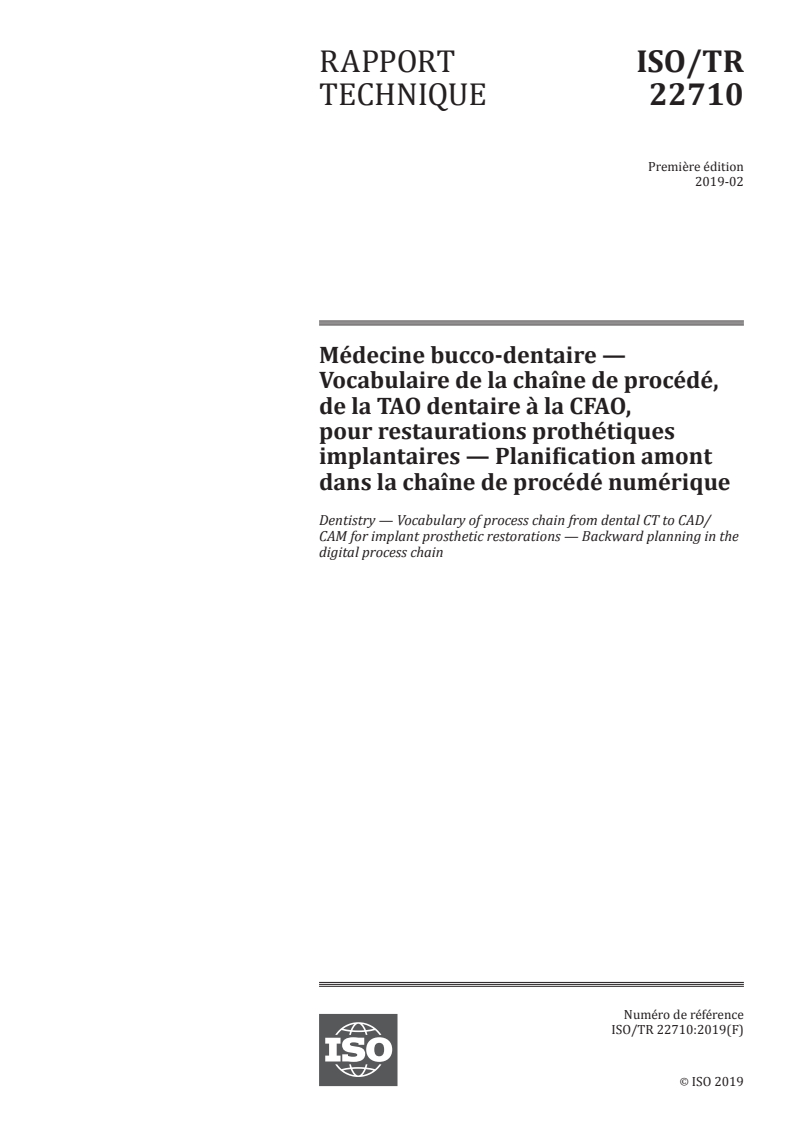
TECHNICAL ISO/TR
REPORT 22710
First edition
2019-02
Dentistry — Vocabulary of process
chain from dental CT to CAD/CAM
for implant prosthetic restorations
— Backward planning in the digital
process chain
Reference number
©
ISO 2019
© ISO 2019
All rights reserved. Unless otherwise specified, or required in the context of its implementation, no part of this publication may
be reproduced or utilized otherwise in any form or by any means, electronic or mechanical, including photocopying, or posting
on the internet or an intranet, without prior written permission. Permission can be requested from either ISO at the address
below or ISO’s member body in the country of the requester.
ISO copyright office
CP 401 • Ch. de Blandonnet 8
CH-1214 Vernier, Geneva
Phone: +41 22 749 01 11
Fax: +41 22 749 09 47
Email: copyright@iso.org
Website: www.iso.org
Published in Switzerland
ii © ISO 2019 – All rights reserved
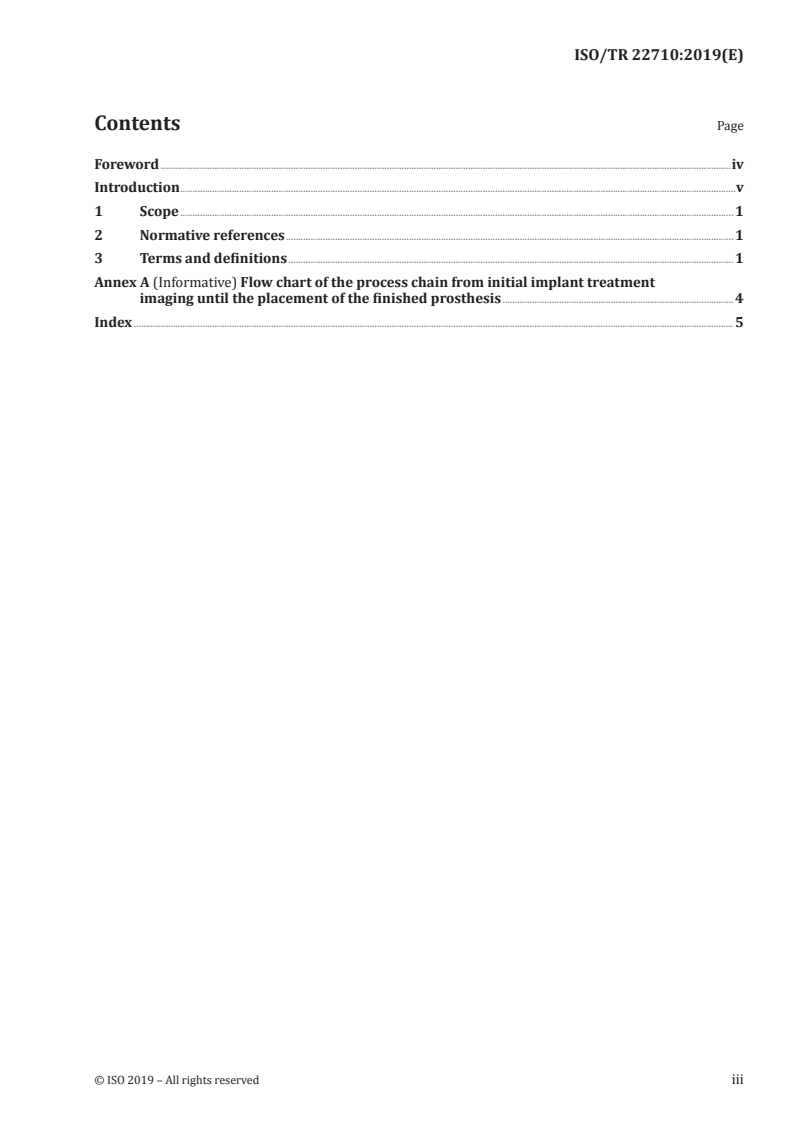
Contents Page
Foreword .iv
Introduction .v
1 Scope . 1
2 Normative references . 1
3 Terms and definitions . 1
Annex A (Informative) Flow chart of the process chain from initial implant treatment
imaging until the placement of the finished prosthesis . 4
Index . 5
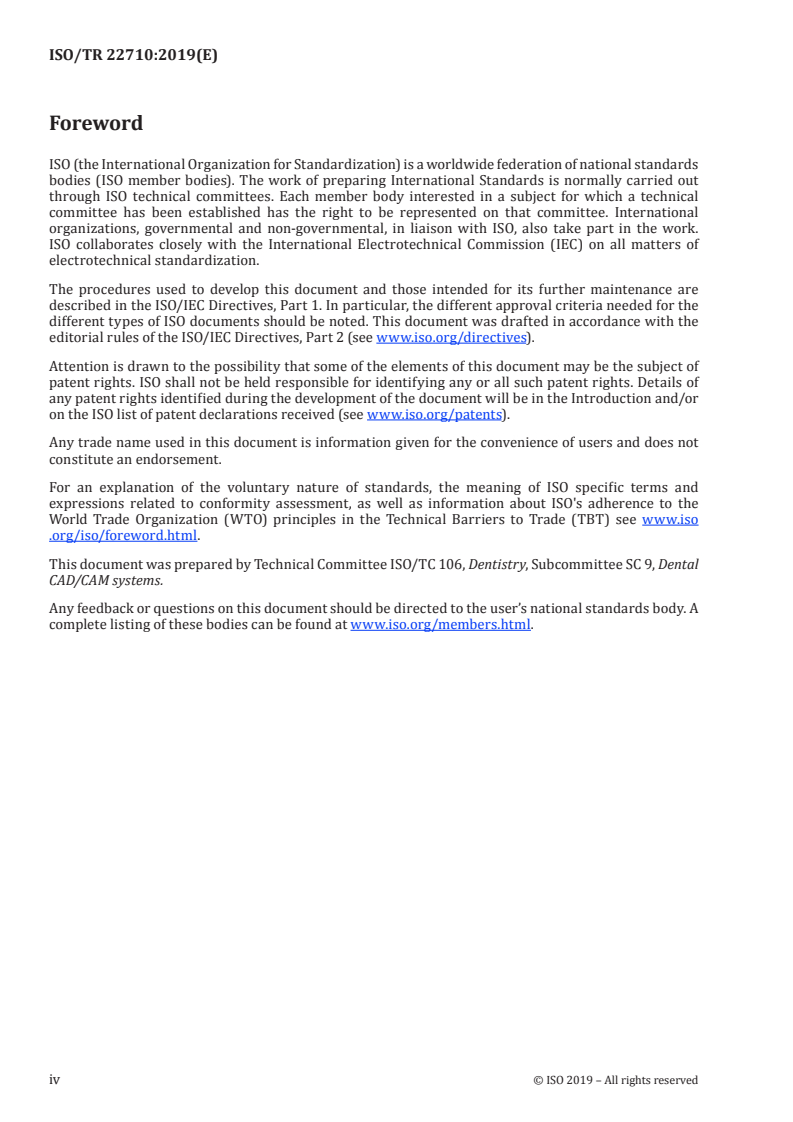
Foreword
ISO (the International Organization for Standardization) is a worldwide federation of national standards
bodies (ISO member bodies). The work of preparing International Standards is normally carried out
through ISO technical committees. Each member body interested in a subject for which a technical
committee has been established has the right to be represented on that committee. International
organizations, governmental and non-governmental, in liaison with ISO, also take part in the work.
ISO collaborates closely with the International Electrotechnical Commission (IEC) on all matters of
electrotechnical standardization.
The procedures used to develop this document and those intended for its further maintenance are
described in the ISO/IEC Directives, Part 1. In particular, the different approval criteria needed for the
different types of ISO documents should be noted. This document was drafted in accordance with the
editorial rules of the ISO/IEC Directives, Part 2 (see www .iso .org/directives).
Attention is drawn to the possibility that some of the elements of this document may be the subject of
patent rights. ISO shall not be held responsible for identifying any or all such patent rights. Details of
any patent rights identified during the development of the document will be in the Introduction and/or
on the ISO list of patent declarations received (see www .iso .org/patents).
Any trade name used in this document is information given for the convenience of users and does not
constitute an endorsement.
For an explanation of the voluntary nature of standards, the meaning of ISO specific terms and
expressions related to conformity assessment, as well as information about ISO's adherence to the
World Trade Organization (WTO) principles in the Technical Barriers to Trade (TBT) see www .iso
.org/iso/foreword .html.
This document was prepared by Technical Committee ISO/TC 106, Dentistry, Subcommittee SC 9, Dental
CAD/CAM systems.
Any feedback or questions on this document should be directed to the user’s national standards body. A
complete listing of these bodies can be found at www .iso .org/members .html.
iv © ISO 2019 – All rights reserved
Introduction
Terms and designations for individual system parts and process steps used in product descriptions and
instructions for use provided by the manufacturers of dental CAD/CAM systems, dental CT systems
and prosthetic implant systems differ from each other, thus creating confusion among dentists and
dental technicians. In order to overcome these ambiguities, it was decided to produce this document for
terminology used in the digital process chain for backward planning.
For the purposes of illustrating the logic sequence of the process chain for backward planning, a flow
chart of this process chain is shown in Annex A.
In Clause 3, there are some entries with more than one term. The first term is the preferred term,
followed by admitted term(s). In the future, it is recommended to use the first term.
TECHNICAL REPORT ISO/TR 22710:2019(E)
Dentistry — Vocabulary of process chain from dental CT to
CAD/CAM for implant prosthetic restorations — Backward
planning in the digital process chain
1 Scope
This document specifies terms, synonyms of terms and definitions used in the process chain from initial
implant treatment imaging until the placement of the finished prosthesis. This process chain includes
different steps from dental CT to CAD/CAM for implant prosthetic restorations.
Some aspects of this process chain are also called backward planning.
2 Normative references
The following documents are referred to in the text in such a way that some or all of their content
constitutes requirements of this document. For dated references, only the edition cited applies. For
undated references, the latest edition of the referenced document (including any amendments) applies.
ISO 1942, Dentistry — Vocabular
...
TECHNICAL ISO/TR
REPORT 22710
First edition
2019-02
Dentistry — Vocabulary of process
chain from dental CT to CAD/CAM
for implant prosthetic restorations
— Backward planning in the digital
process chain
Reference number
©
ISO 2019
© ISO 2019
All rights reserved. Unless otherwise specified, or required in the context of its implementation, no part of this publication may
be reproduced or utilized otherwise in any form or by any means, electronic or mechanical, including photocopying, or posting
on the internet or an intranet, without prior written permission. Permission can be requested from either ISO at the address
below or ISO’s member body in the country of the requester.
ISO copyright office
CP 401 • Ch. de Blandonnet 8
CH-1214 Vernier, Geneva
Phone: +41 22 749 01 11
Fax: +41 22 749 09 47
Email: copyright@iso.org
Website: www.iso.org
Published in Switzerland
ii © ISO 2019 – All rights reserved
Contents Page
Foreword .iv
Introduction .v
1 Scope . 1
2 Normative references . 1
3 Terms and definitions . 1
Annex A (Informative) Flow chart of the process chain from initial implant treatment
imaging until the placement of the finished prosthesis . 4
Index . 5
Foreword
ISO (the International Organization for Standardization) is a worldwide federation of national standards
bodies (ISO member bodies). The work of preparing International Standards is normally carried out
through ISO technical committees. Each member body interested in a subject for which a technical
committee has been established has the right to be represented on that committee. International
organizations, governmental and non-governmental, in liaison with ISO, also take part in the work.
ISO collaborates closely with the International Electrotechnical Commission (IEC) on all matters of
electrotechnical standardization.
The procedures used to develop this document and those intended for its further maintenance are
described in the ISO/IEC Directives, Part 1. In particular, the different approval criteria needed for the
different types of ISO documents should be noted. This document was drafted in accordance with the
editorial rules of the ISO/IEC Directives, Part 2 (see www .iso .org/directives).
Attention is drawn to the possibility that some of the elements of this document may be the subject of
patent rights. ISO shall not be held responsible for identifying any or all such patent rights. Details of
any patent rights identified during the development of the document will be in the Introduction and/or
on the ISO list of patent declarations received (see www .iso .org/patents).
Any trade name used in this document is information given for the convenience of users and does not
constitute an endorsement.
For an explanation of the voluntary nature of standards, the meaning of ISO specific terms and
expressions related to conformity assessment, as well as information about ISO's adherence to the
World Trade Organization (WTO) principles in the Technical Barriers to Trade (TBT) see www .iso
.org/iso/foreword .html.
This document was prepared by Technical Committee ISO/TC 106, Dentistry, Subcommittee SC 9, Dental
CAD/CAM systems.
Any feedback or questions on this document should be directed to the user’s national standards body. A
complete listing of these bodies can be found at www .iso .org/members .html.
iv © ISO 2019 – All rights reserved
Introduction
Terms and designations for individual system parts and process steps used in product descriptions and
instructions for use provided by the manufacturers of dental CAD/CAM systems, dental CT systems
and prosthetic implant systems differ from each other, thus creating confusion among dentists and
dental technicians. In order to overcome these ambiguities, it was decided to produce this document for
terminology used in the digital process chain for backward planning.
For the purposes of illustrating the logic sequence of the process chain for backward planning, a flow
chart of this process chain is shown in Annex A.
In Clause 3, there are some entries with more than one term. The first term is the preferred term,
followed by admitted term(s). In the future, it is recommended to use the first term.
TECHNICAL REPORT ISO/TR 22710:2019(E)
Dentistry — Vocabulary of process chain from dental CT to
CAD/CAM for implant prosthetic restorations — Backward
planning in the digital process chain
1 Scope
This document specifies terms, synonyms of terms and definitions used in the process chain from initial
implant treatment imaging until the placement of the finished prosthesis. This process chain includes
different steps from dental CT to CAD/CAM for implant prosthetic restorations.
Some aspects of this process chain are also called backward planning.
2 Normative references
The following documents are referred to in the text in such a way that some or all of their content
constitutes requirements of this document. For dated references, only the edition cited applies. For
undated references, the latest edition of the referenced document (including any amendments) applies.
ISO 1942, Dentistry — Vocabular
...
RAPPORT ISO/TR
TECHNIQUE 22710
Première édition
2019-02
Médecine bucco-dentaire —
Vocabulaire de la chaîne de procédé,
de la TAO dentaire à la CFAO,
pour restaurations prothétiques
implantaires — Planification amont
dans la chaîne de procédé numérique
Dentistry — Vocabulary of process chain from dental CT to CAD/
CAM for implant prosthetic restorations — Backward planning in the
digital process chain
Numéro de référence
©
ISO 2019
DOCUMENT PROTÉGÉ PAR COPYRIGHT
© ISO 2019
Tous droits réservés. Sauf prescription différente ou nécessité dans le contexte de sa mise en œuvre, aucune partie de cette
publication ne peut être reproduite ni utilisée sous quelque forme que ce soit et par aucun procédé, électronique ou mécanique,
y compris la photocopie, ou la diffusion sur l’internet ou sur un intranet, sans autorisation écrite préalable. Une autorisation peut
être demandée à l’ISO à l’adresse ci-après ou au comité membre de l’ISO dans le pays du demandeur.
ISO copyright office
Case postale 401 • Ch. de Blandonnet 8
CH-1214 Vernier, Genève
Tél.: +41 22 749 01 11
Fax: +41 22 749 09 47
E-mail: copyright@iso.org
Web: www.iso.org
Publié en Suisse
ii © ISO 2019 – Tous droits réservés
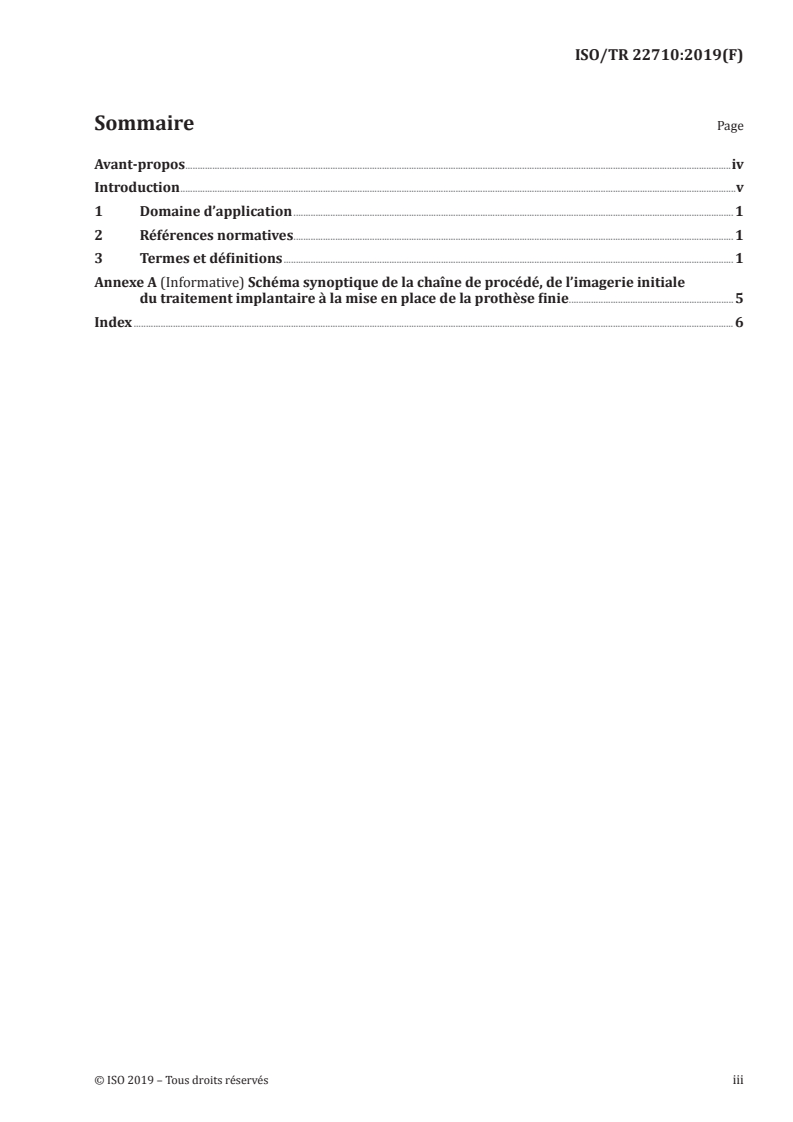
Sommaire Page
Avant-propos .iv
Introduction .v
1 Domaine d’application . 1
2 Références normatives . 1
3 Termes et définitions . 1
Annexe A (Informative) Schéma synoptique de la chaîne de procédé, de l’imagerie initiale
du traitement implantaire à la mise en place de la prothèse finie .5
Index . 6
Avant-propos
L'ISO (Organisation internationale de normalisation) est une fédération mondiale d'organismes
nationaux de normalisation (comités membres de l'ISO). L'élaboration des Normes internationales est
en général confiée aux comités techniques de l'ISO. Chaque comité membre intéressé par une étude
a le droit de faire partie du comité technique créé à cet effet. Les organisations internationales,
gouvernementales et non gouvernementales, en liaison avec l'ISO participent également aux travaux.
L'ISO collabore étroitement avec la Commission électrotechnique internationale (IEC) en ce qui
concerne la normalisation électrotechnique.
Les procédures utilisées pour élaborer le présent document et celles destinées à sa mise à jour sont
décrites dans les Directives ISO/IEC, Partie 1. Il convient, en particulier, de prendre note des différents
critères d'approbation requis pour les différents types de documents ISO. Le présent document a été
rédigé conformément aux règles de rédaction données dans les Directives ISO/IEC, Partie 2 (voir www
.iso .org/directives).
L'attention est appelée sur le fait que certains des éléments du présent document peuvent faire l'objet de
droits de propriété intellectuelle ou de droits analogues. L'ISO ne saurait être tenue pour responsable
de ne pas avoir identifié de tels droits de propriété et averti de leur existence. Les détails concernant
les références aux droits de propriété intellectuelle ou autres droits analogues identifiés lors de
l'élaboration du document sont indiqués dans l'Introduction et/ou dans la liste des déclarations de
brevets reçues par l'ISO (voir www .iso .org/brevets).
Les appellations commerciales éventuellement mentionnées dans le présent document sont données
pour information, par souci de commodité, à l'intention des utilisateurs et ne sauraient constituer un
engagement.
Pour une explication de la nature volontaire des normes, la signification des termes et expressions
spécifiques de l'ISO liés à l'évaluation de la conformité, ou pour toute information au sujet de l'adhésion
de l'ISO aux principes de l’Organisation mondiale du commerce (OMC) concernant les obstacles
techniques au commerce (OTC), voir le lien suivant : www .iso .org/iso/foreword .html.
Le présent document a été élaboré par le Comité technique ISO/TC 106, Médecine bucco-dentaire, Sous-
comité SC 9, Systèmes de CFAO dentaires.
Il convient que l’utilisateur adresse tout retour d’information ou toute question concernant le présent
document à l’organisme national de normalisation de son pays. Une liste exhaustive desdits organismes
se trouve à l’adresse www .iso .org/members .html.
iv © ISO 2019 – Tous droits réservés
Introduction
Les termes et les désignations des différents composants du système et des étapes du procédé utilisés
dans les descriptions et les instructions d’utilisation du produit fournies par les fabricants de systèmes
de CFAO dentaires, de TAO dentaire et de prothèses implantaires diffèrent les uns des autres, ce qui
génère une certaine confusion parmi les chirurgiens-dentistes et les techniciens dentaires. Pour lever
ces ambiguïtés, il a été décidé d’élaborer le présent document relatif à la terminologie employée dans la
chaîne de procédé numérique applicable à la planification amont.
Pour illustrer l’ordre logique de la chaîne de procédé applicable à la planification amont, un schéma
synoptique de cette chaîne est donné dans l’Annexe A.
Dans l’Article 3, certaines entrées regroupent plusieurs termes. Le premier terme est le terme
privilégié, lequel est suivi d’un ou de plusieurs termes admis. Pour l’avenir, il est recommandé d’utiliser
le premier terme.
RAPPORT TECHNIQUE ISO/TR 22710:2019(F)
Médecine bucco-dentaire — Vocabulaire de la chaîne de
procédé, de la TAO dentaire à la CFAO, pour restaurations
prothétiques implantaires — Planification amont dans la
chaîne de procédé numérique
1 Domaine d’application
Le présent document spécifie les termes, leurs synonymes, et les définitions utilisés dans la chaîne de
procédé, de l’imagerie initiale du traitement implantaire à la mise en place de la prothèse finie. Cette
chaîne de procédé comprend différentes étapes, de la TAO dentaire à la CFAO, pour les restaurations
prothétiques implantaires.
Certains aspects de cette chaîne de procédé sont également appelés planification amont.
2 Références normatives
Les documents suivants cités dans le texte constituent, pour tout ou partie de leur contenu, des
exigences du présent document. Pour les références datées, seule l’édition citée s’applique. Pour les
références non datées, la dernière édition du document de référence s'applique (y compris les éventuels
amendements)
ISO 1942, Médecine bucco-dentaire — Vocabulaire
ISO 16443, Médecine bucco-dentaire — Vocabulaire des systèmes d'implants dentaires et procédures
associées
ISO 18739, Médecine bucco-dentaire — Vocabu
...
RAPPORT ISO/TR
TECHNIQUE 22710
Première édition
2019-02
Médecine bucco-dentaire —
Vocabulaire de la chaîne de procédé,
de la TAO dentaire à la CFAO,
pour restaurations prothétiques
implantaires — Planification amont
dans la chaîne de procédé numérique
Dentistry — Vocabulary of process chain from dental CT to CAD/
CAM for implant prosthetic restorations — Backward planning in the
digital process chain
Numéro de référence
©
ISO 2019
DOCUMENT PROTÉGÉ PAR COPYRIGHT
© ISO 2019
Tous droits réservés. Sauf prescription différente ou nécessité dans le contexte de sa mise en œuvre, aucune partie de cette
publication ne peut être reproduite ni utilisée sous quelque forme que ce soit et par aucun procédé, électronique ou mécanique,
y compris la photocopie, ou la diffusion sur l’internet ou sur un intranet, sans autorisation écrite préalable. Une autorisation peut
être demandée à l’ISO à l’adresse ci-après ou au comité membre de l’ISO dans le pays du demandeur.
ISO copyright office
Case postale 401 • Ch. de Blandonnet 8
CH-1214 Vernier, Genève
Tél.: +41 22 749 01 11
Fax: +41 22 749 09 47
E-mail: copyright@iso.org
Web: www.iso.org
Publié en Suisse
ii © ISO 2019 – Tous droits réservés
Sommaire Page
Avant-propos .iv
Introduction .v
1 Domaine d’application . 1
2 Références normatives . 1
3 Termes et définitions . 1
Annexe A (Informative) Schéma synoptique de la chaîne de procédé, de l’imagerie initiale
du traitement implantaire à la mise en place de la prothèse finie .5
Index . 6
Avant-propos
L'ISO (Organisation internationale de normalisation) est une fédération mondiale d'organismes
nationaux de normalisation (comités membres de l'ISO). L'élaboration des Normes internationales est
en général confiée aux comités techniques de l'ISO. Chaque comité membre intéressé par une étude
a le droit de faire partie du comité technique créé à cet effet. Les organisations internationales,
gouvernementales et non gouvernementales, en liaison avec l'ISO participent également aux travaux.
L'ISO collabore étroitement avec la Commission électrotechnique internationale (IEC) en ce qui
concerne la normalisation électrotechnique.
Les procédures utilisées pour élaborer le présent document et celles destinées à sa mise à jour sont
décrites dans les Directives ISO/IEC, Partie 1. Il convient, en particulier, de prendre note des différents
critères d'approbation requis pour les différents types de documents ISO. Le présent document a été
rédigé conformément aux règles de rédaction données dans les Directives ISO/IEC, Partie 2 (voir www
.iso .org/directives).
L'attention est appelée sur le fait que certains des éléments du présent document peuvent faire l'objet de
droits de propriété intellectuelle ou de droits analogues. L'ISO ne saurait être tenue pour responsable
de ne pas avoir identifié de tels droits de propriété et averti de leur existence. Les détails concernant
les références aux droits de propriété intellectuelle ou autres droits analogues identifiés lors de
l'élaboration du document sont indiqués dans l'Introduction et/ou dans la liste des déclarations de
brevets reçues par l'ISO (voir www .iso .org/brevets).
Les appellations commerciales éventuellement mentionnées dans le présent document sont données
pour information, par souci de commodité, à l'intention des utilisateurs et ne sauraient constituer un
engagement.
Pour une explication de la nature volontaire des normes, la signification des termes et expressions
spécifiques de l'ISO liés à l'évaluation de la conformité, ou pour toute information au sujet de l'adhésion
de l'ISO aux principes de l’Organisation mondiale du commerce (OMC) concernant les obstacles
techniques au commerce (OTC), voir le lien suivant : www .iso .org/iso/foreword .html.
Le présent document a été élaboré par le Comité technique ISO/TC 106, Médecine bucco-dentaire, Sous-
comité SC 9, Systèmes de CFAO dentaires.
Il convient que l’utilisateur adresse tout retour d’information ou toute question concernant le présent
document à l’organisme national de normalisation de son pays. Une liste exhaustive desdits organismes
se trouve à l’adresse www .iso .org/members .html.
iv © ISO 2019 – Tous droits réservés
Introduction
Les termes et les désignations des différents composants du système et des étapes du procédé utilisés
dans les descriptions et les instructions d’utilisation du produit fournies par les fabricants de systèmes
de CFAO dentaires, de TAO dentaire et de prothèses implantaires diffèrent les uns des autres, ce qui
génère une certaine confusion parmi les chirurgiens-dentistes et les techniciens dentaires. Pour lever
ces ambiguïtés, il a été décidé d’élaborer le présent document relatif à la terminologie employée dans la
chaîne de procédé numérique applicable à la planification amont.
Pour illustrer l’ordre logique de la chaîne de procédé applicable à la planification amont, un schéma
synoptique de cette chaîne est donné dans l’Annexe A.
Dans l’Article 3, certaines entrées regroupent plusieurs termes. Le premier terme est le terme
privilégié, lequel est suivi d’un ou de plusieurs termes admis. Pour l’avenir, il est recommandé d’utiliser
le premier terme.
RAPPORT TECHNIQUE ISO/TR 22710:2019(F)
Médecine bucco-dentaire — Vocabulaire de la chaîne de
procédé, de la TAO dentaire à la CFAO, pour restaurations
prothétiques implantaires — Planification amont dans la
chaîne de procédé numérique
1 Domaine d’application
Le présent document spécifie les termes, leurs synonymes, et les définitions utilisés dans la chaîne de
procédé, de l’imagerie initiale du traitement implantaire à la mise en place de la prothèse finie. Cette
chaîne de procédé comprend différentes étapes, de la TAO dentaire à la CFAO, pour les restaurations
prothétiques implantaires.
Certains aspects de cette chaîne de procédé sont également appelés planification amont.
2 Références normatives
Les documents suivants cités dans le texte constituent, pour tout ou partie de leur contenu, des
exigences du présent document. Pour les références datées, seule l’édition citée s’applique. Pour les
références non datées, la dernière édition du document de référence s'applique (y compris les éventuels
amendements)
ISO 1942, Médecine bucco-dentaire — Vocabulaire
ISO 16443, Médecine bucco-dentaire — Vocabulaire des systèmes d'implants dentaires et procédures
associées
ISO 18739, Médecine bucco-dentaire — Vocabu
...