


ISO 4593:1993
(Main)Plastics — Film and sheeting — Determination of thickness by mechanical scanning
Plastics — Film and sheeting — Determination of thickness by mechanical scanning
Specifies a method for the determination of the thickness of a sample of plastics film or sheeting by mechanical scanning. The method is not suitable for use with embossed film or sheeting.
Plastiques — Film et feuille — Détermination de l'épaisseur par examen mécanique
General Information
- Status
- Published
- Publication Date
- 17-Nov-1993
- Technical Committee
- ISO/TC 61/SC 11 - Products
- Drafting Committee
- ISO/TC 61/SC 11/WG 3 - Plastics films and sheeting
- Current Stage
- 9093 - International Standard confirmed
- Start Date
- 18-Jul-2025
- Completion Date
- 14-Feb-2026
Relations
- Revises
ISO 4593:1979 - Plastics — Film and sheeting — Determination of thickness by mechanical scanning - Effective Date
- 23-Apr-2020
Overview
ISO 4593:1993 is an international standard published by the International Organization for Standardization (ISO) that specifies a mechanical scanning method for determining the thickness of plastics film and sheeting. This method enables precise thickness measurement critical to quality control and product specification in the plastics industry. However, it is important to note that this method is not suitable for embossed films or sheeting. Developed by ISO/TC 61 (Plastics), Subcommittee SC 11 (Products), this standard replaces the 1979 edition with updated technical revisions to improve accuracy and applicability.
Key Topics
Scope and Application
ISO 4593:1993 applies specifically to plastics films and sheets, providing guidelines for mechanical scanning thickness measurement. It excludes embossed films or sheets due to the surface irregularities that affect measurement accuracy.Measurement Equipment
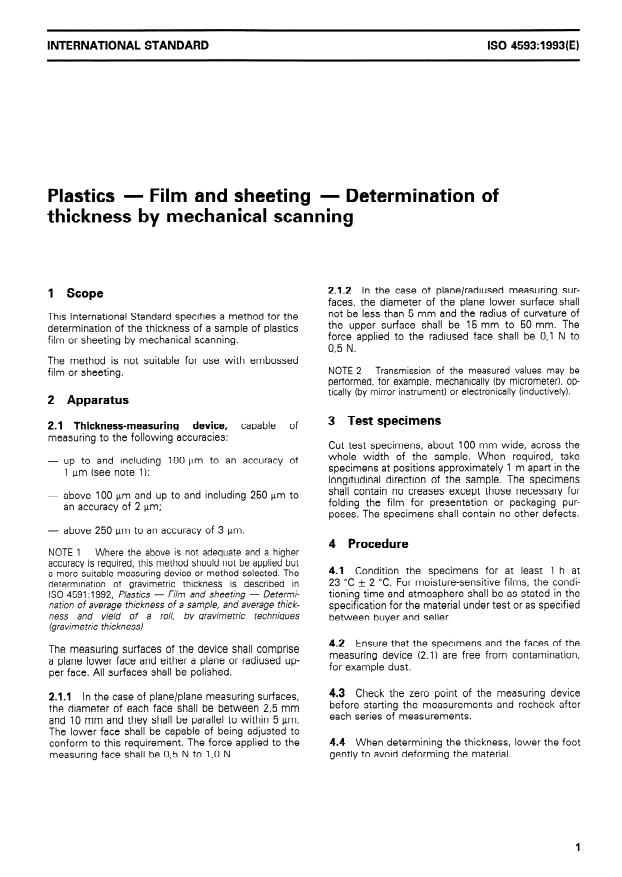
The standard defines requirements for the measuring device, including:- Use of a device providing mechanical thickness measurements with precision depending on the thickness range.
- Precision tolerances: 1 µm for thickness up to 100 µm, 2 µm for thickness between 100 µm and 250 µm, and 3 µm for thickness above 250 µm.
- Measuring device surfaces must be polished, with flat or rounded measuring faces under defined geometric parameters.
- Applied force during measurement is specified to avoid deforming the material (0.1 N to 1.0 N depending on the probe face).
Sample Preparation
Samples, or test specimens, are cut approximately 100 mm wide from the plastic film or sheet without folds or defects. Conditioning of specimens at controlled temperature (23 °C ± 2 °C) and humidity is recommended prior to measurement, especially for moisture-sensitive films.Procedure
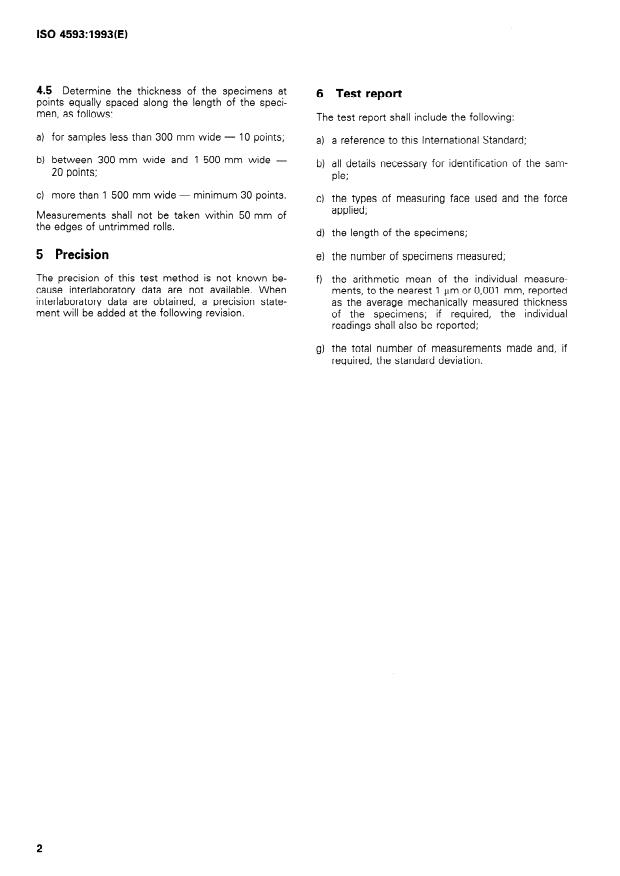
Measurement points are taken at defined intervals along the sample length:- 10 points for widths less than 300 mm,
- 20 points for widths between 300 mm and 1500 mm,
- At least 30 points for widths greater than 1500 mm.
Measurements near edges are avoided (minimum 50 mm from edges for non-slit rolls).
The device zero calibration is checked regularly to ensure consistent results.
Reporting
Test reports must include:- Reference to ISO 4593 standard,
- Identification details of the sample,
- Description of measuring equipment and applied force,
- Sample length and number of measurements,
- Arithmetic mean thickness expressed to 0.001 mm precision,
- Optional individual measurement values and statistical data such as standard deviation.
Applications
ISO 4593:1993 provides a reliable method for assessing thickness of plastic films and sheets used in:
- Packaging materials manufacturing – ensuring uniformity and compliance with product specifications.
- Quality control laboratories – to verify production consistency and tolerance adherence.
- Research and development – to analyze new materials where precise thickness measurement is essential.
- Regulatory compliance – where thickness specifications are mandated for safety or performance reasons.
This mechanical scanning method aids manufacturers and users in making informed decisions about material suitability, processing parameters, and end-use characteristics.
Related Standards
Professionals working with ISO 4593:1993 may also refer to other relevant ISO standards for comprehensive plastics testing:
- ISO 4591:1992 – Plastics Film and Sheeting - Determination of Thickness by Gravimetric Method (alternative thickness measurement).
- ISO 527 – Plastics - Determination of Tensile Properties (mechanical performance testing).
- ISO 9001 – Quality Management Systems (general quality requirements pertinent to production and testing).
Understanding and applying ISO 4593 in conjunction with these documents helps ensure full compliance with industry best practices for plastics film and sheeting evaluation.
Keywords: ISO 4593, plastics film thickness, plastic sheeting measurement, mechanical scanning, thickness determination, plastic film testing, quality control plastics, plastic sheet thickness standard.
Buy Documents

ISO 4593:1993 - Plastics -- Film and sheeting -- Determination of thickness by mechanical scanning
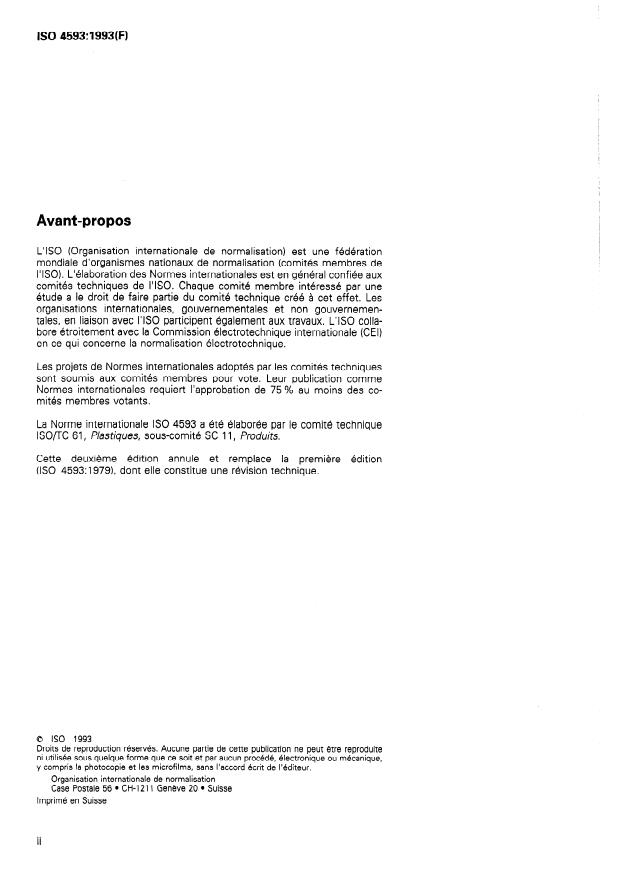
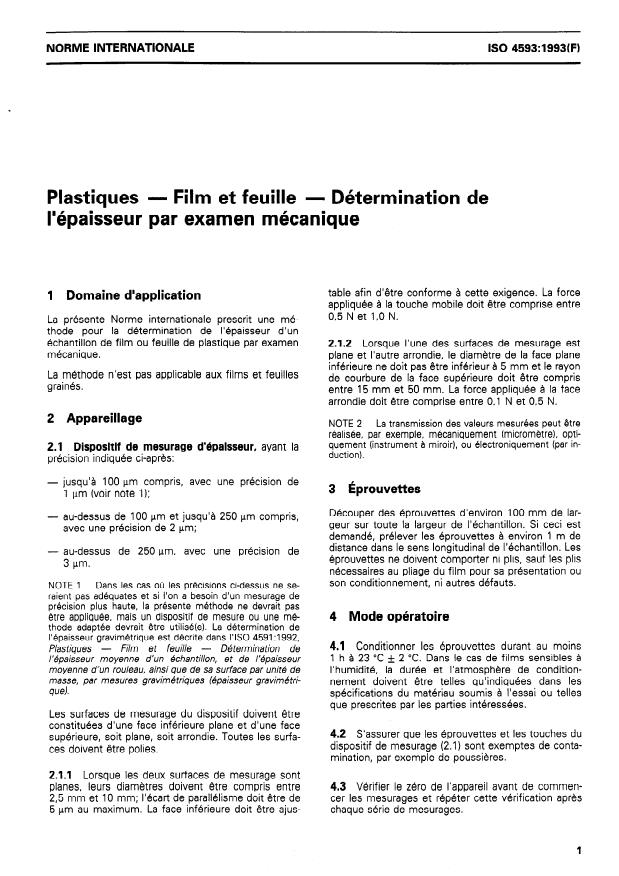
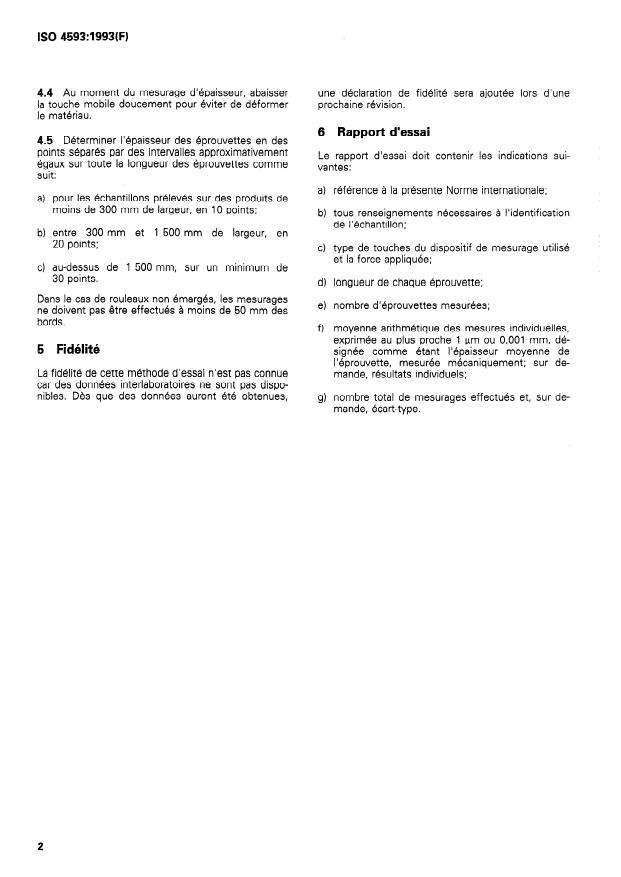
ISO 4593:1993 - Plastiques -- Film et feuille -- Détermination de l'épaisseur par examen mécanique
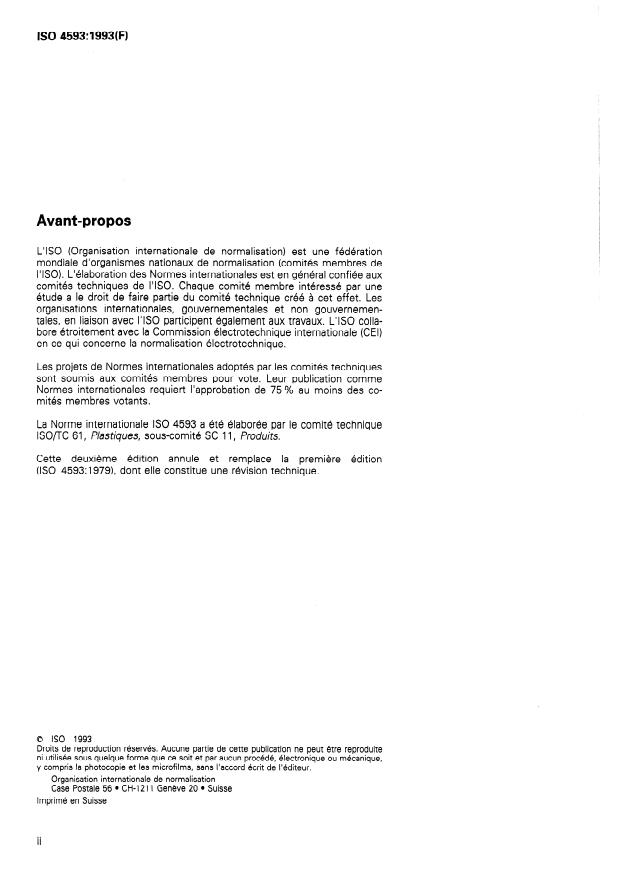
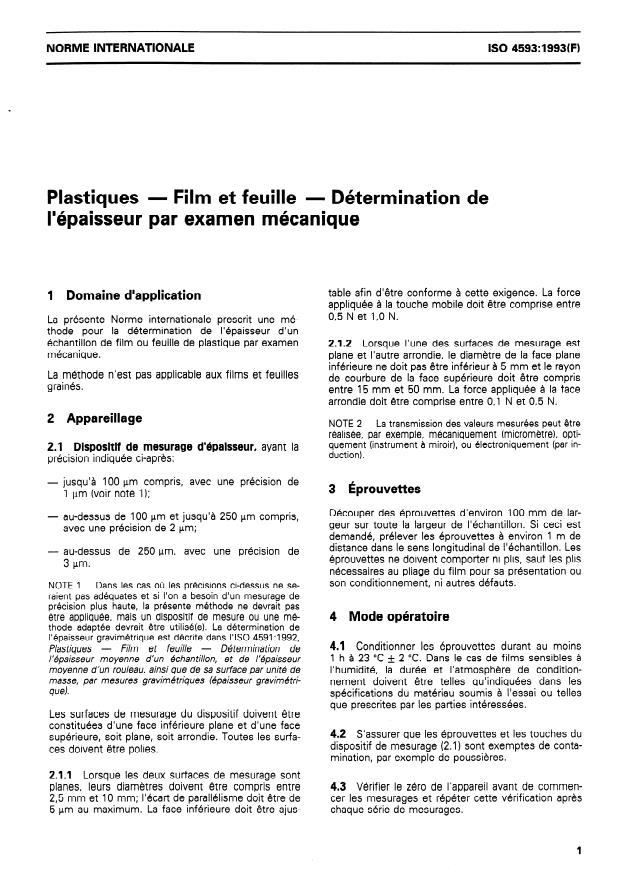
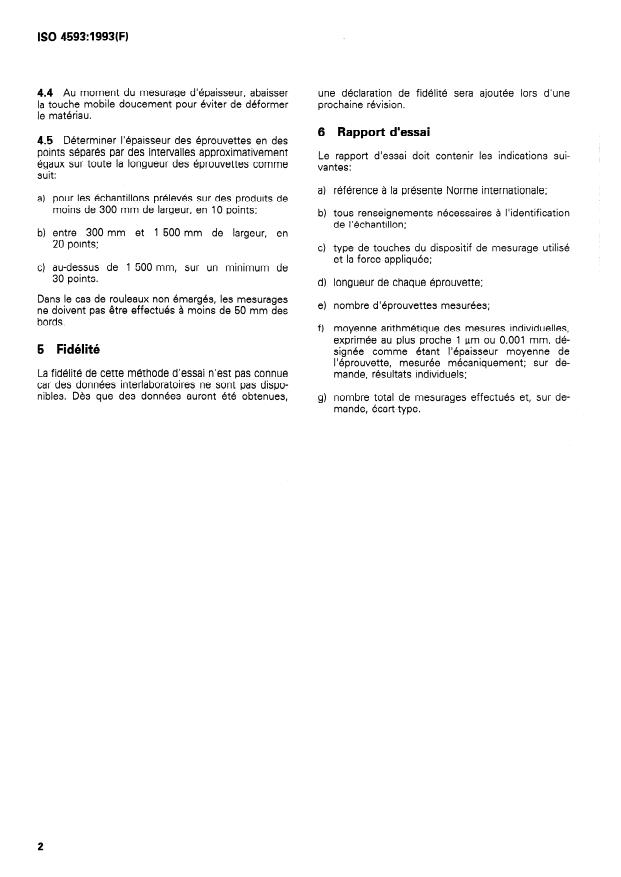
ISO 4593:1993 - Plastiques -- Film et feuille -- Détermination de l'épaisseur par examen mécanique
Get Certified
Connect with accredited certification bodies for this standard

Smithers Quality Assessments
US management systems and product certification.

DIN CERTCO
DIN Group product certification.
Sponsored listings
Frequently Asked Questions
ISO 4593:1993 is a standard published by the International Organization for Standardization (ISO). Its full title is "Plastics — Film and sheeting — Determination of thickness by mechanical scanning". This standard covers: Specifies a method for the determination of the thickness of a sample of plastics film or sheeting by mechanical scanning. The method is not suitable for use with embossed film or sheeting.
Specifies a method for the determination of the thickness of a sample of plastics film or sheeting by mechanical scanning. The method is not suitable for use with embossed film or sheeting.
ISO 4593:1993 is classified under the following ICS (International Classification for Standards) categories: 83.140.10 - Films and sheets. The ICS classification helps identify the subject area and facilitates finding related standards.
ISO 4593:1993 has the following relationships with other standards: It is inter standard links to ISO 4593:1979. Understanding these relationships helps ensure you are using the most current and applicable version of the standard.
ISO 4593:1993 is available in PDF format for immediate download after purchase. The document can be added to your cart and obtained through the secure checkout process. Digital delivery ensures instant access to the complete standard document.
Standards Content (Sample)
INTERNATIONAL
ISO
STANDARD
Second edition
1993-1 l-l 5
Plastics - Film and sheeting -
Determination of thickness by mechanical
scanning
Plas tiques - Film et feuille - Dhermination de I’epaisseur par examen
mbcanique
Reference number
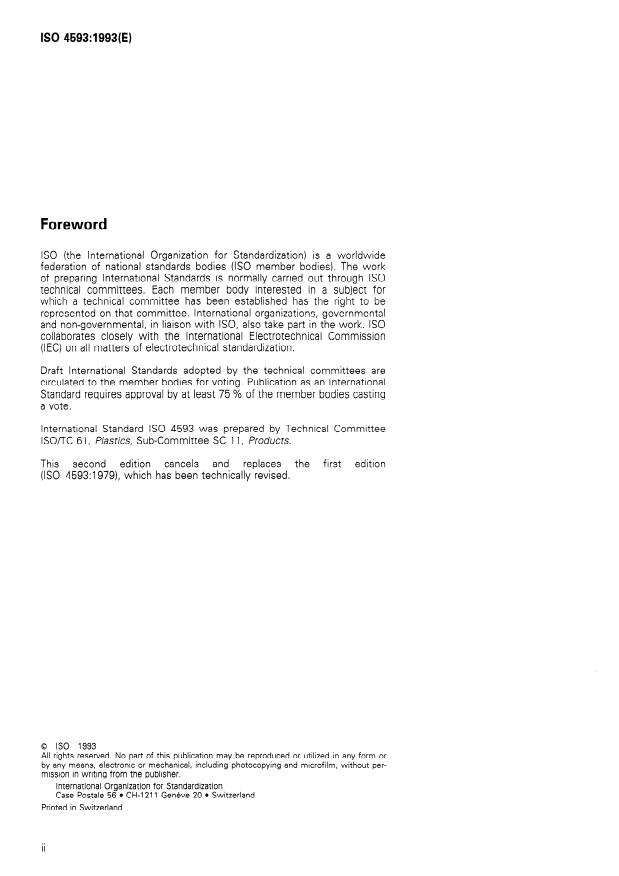
Foreword
ISO (the International Organization for Standardization) is a worldwide
federation of national Standards bodies (ISO member bodies). The work
of preparing International Standards is normal& carried out through ISO
technical committees. Esch member body interested in a subject for
which a technical committee has been established has the right to be
represented on that committee. International organizations, governmental
and non-governmental, in liaison with ISO, also take part in the work. ISO
collaborates closely with the International Electrotechnical Commission
(IEC) on all matters of electrotechnical standardization.
Draft International Standards adopted by the technical committees are
circulated to the member bodies for voting. Publication as an International
Standard requires approval by at least 75 % of the member bodies casting
a vote.
International Standard ISO 4593 was prepared by Technical Committee
ISOnC 61, Plastics, Sub-Committee SC 11, Products.
This second edition cancels and replaces the first edition
(ISO 4593:1979), which has been technically revised.
0 ISO 1993
All rights reserved. No patt of this publication may be reproduced or utilized in any form or
by any means, electronie or mechanical, including photocopying and microfilm, without per-
mission in writing from the publisher.
International Organization for Standardization
Case Postale 56 l CH-l 211 Geneve 20 l Switzerland
Printed in Switzerland
INTERNATIONAL STANDARD
Plastics - Film and sheeting - Determination of
thickness by mechanical scanning
2.1.2 In the case of planelradiused measuring sur-
1 Scope
faces, the diameter of the plane lower surface shall
not be less than 5 mm and the radius of curvature of
This International Standard specifies a method for the
the upper surface shall be 15 mm to 50 mm. The
determination of the thickness of a Sample of plastics
forte applied to the radiused face shall be 0,l N to
film or sheeting by mechanical scanning.
0,5 N.
The method is not suitable for use with embossed
film or sheeting. NOTE 2 Transmission of the measured values may be
performed, for example, mechanically (by micrometer), op-
tically (by mirror instrument) or electronically (inductively).
2 Apparatus
3 Test specimens
2.1 Thickness-measuring device, capable of
measuring to the following accuracies:
Cut test specimens, about 100 mm wide, across the
whole width of the Sample. When required, take
- up to and including 100 Pm to an accuracy of
specimens at positions approximately 1 m apart in the
1 Pm (see note 1);
longitudinal direction of the Sample. The specimens
shall contain no creases except those necessary for
- above 100 Pm and up to and including 250 Pm to
folding the film for presentation or packaging pur-
an accuracy of 2 Pm;
poses. The specimens shall contain no other defects.
- above 250 Pm to an accuracy of 3 Pm.
4 Procedur
...
Iso
NORME
INTERNATIONALE 4593
Deuxième édition
1993-I l-l 5
Film et feuille -
Plastiques -
Détermination de l’épaisseur par examen
mécanique
P/as tics - Film and sheeting - Determination of thickness by
mechanical scanning
Numéro de référence
ISO 4593: 1993(F)
Avant-propos
L’ISO (Organisation internationale de normalisation) est une fédération
mondiale d’organismes nationaux de normalisation (comités membres de
I’ISO). L’élaboration des Normes internationales est en général confiee aux
comités techniques de I’ISO. Chaque comité membre intéressé par une
étude a le droit de faire partie du comité technique créé a cet effet. Les
organisations internationales, gouvernementales et non gouvernemen-
tales, en liaison avec I’ISO participent également aux travaux. L’ISO colla-
bore étroitement avec la Commission électrotechnique internationale (CEI)
en ce qui concerne la normalisation électrotechnique.
Les projets de Normes internationales adoptes par les comités techniques
sont soumis aux comités membres pour vote. Leur publication comme
Normes internationales requiert l’approbation de 75 % au moins des co-
mites membres votants.
La Norme internationale ISO 4593 a éte elaboree par le comité technique
ISO/TC 61, Plastiques, sous-comite SC 11, Produits.
Cette deuxième édition annule et remplace la premier-e édition
(ISO 4593:1979), dont elle constitue une revision technique.
0 ISO 1993
Droits de reproduction réservés. Aucune partie de cette publication ne peut être reproduite
ni utilisée sous quelque forme que ce soit et par aucun procédé, électronique ou mécanique,
y compris la photocopie et les microfilms, sans l’accord Ecrit de Mditeur.
Organisation internationale de normalisation
Case Postale 56 l CH-l 211 Genhe 20 l Suisse
Imtximé en Suisse
ii
NORME INTERNATIONALE ISO 4593:1993(F)
Plastiques - Film et feuille - Détermination de
l’épaisseur par examen mécanique
table afin d’être conforme à cette exigence. La force
1 Domaine d’application
appliquée à la touche mobile doit être comprise entre
0,5 N et 1,0 N.
La présente Norme internationale prescrit une me-
thode pour la détermination de l’épaisseur d’un
echantillon de film ou feuille de plastique par examen
2.1.2 Lorsque l’une des surfaces de mesurage est
mécanique.
plane et l’autre arrondie, le diametre de la face plane
inférieure ne doit pas être inférieur a 5 mm et le rayon
La methode n’est pas applicable aux films et feuilles
de courbure de la face supérieure doit être compris
graines.
entre 15 mm et 50 mm. La force appliquée à la face
arrondie doit être comprise entre 0,l N et 0,5 N.
2 Appareillage
NOTE 2 La transmission des valeurs mesurées peut être
réalisée, par exemple, mécaniquement (micromètre), opti-
quement (instrument a miroir), ou électroniquement (par in-
2.1 Dispositif de mesurage d’épaisseur, ayant la
duction).
précision indiquée ci-après:
- jusqu’à 100 prn compris, avec une précision de
3 Éprouvettes
1 prn (voir note 1);
Découper des éprouvettes d’environ 100 mm de lar-
- au-dessus de 100 prn et jusqu’à 250 prn compris,
geur sur toute la largeur de l’échantillon. Si ceci est
avec une précision de 2 prn;
demande, prélever les éprouvettes à environ 1 m de
distance dans le sens longitudinal de I’echantillon. Les
- au-dessus de 250 prn, avec une précision de
eprouvettes ne doivent comporter ni plis, sauf les plis
3 prn.
necessaires au pliage du film pour sa présentation ou
son conditionnement, ni autres défauts.
Dans les cas où les p
...
Iso
NORME
INTERNATIONALE 4593
Deuxième édition
1993-I l-l 5
Film et feuille -
Plastiques -
Détermination de l’épaisseur par examen
mécanique
P/as tics - Film and sheeting - Determination of thickness by
mechanical scanning
Numéro de référence
ISO 4593: 1993(F)
Avant-propos
L’ISO (Organisation internationale de normalisation) est une fédération
mondiale d’organismes nationaux de normalisation (comités membres de
I’ISO). L’élaboration des Normes internationales est en général confiee aux
comités techniques de I’ISO. Chaque comité membre intéressé par une
étude a le droit de faire partie du comité technique créé a cet effet. Les
organisations internationales, gouvernementales et non gouvernemen-
tales, en liaison avec I’ISO participent également aux travaux. L’ISO colla-
bore étroitement avec la Commission électrotechnique internationale (CEI)
en ce qui concerne la normalisation électrotechnique.
Les projets de Normes internationales adoptes par les comités techniques
sont soumis aux comités membres pour vote. Leur publication comme
Normes internationales requiert l’approbation de 75 % au moins des co-
mites membres votants.
La Norme internationale ISO 4593 a éte elaboree par le comité technique
ISO/TC 61, Plastiques, sous-comite SC 11, Produits.
Cette deuxième édition annule et remplace la premier-e édition
(ISO 4593:1979), dont elle constitue une revision technique.
0 ISO 1993
Droits de reproduction réservés. Aucune partie de cette publication ne peut être reproduite
ni utilisée sous quelque forme que ce soit et par aucun procédé, électronique ou mécanique,
y compris la photocopie et les microfilms, sans l’accord Ecrit de Mditeur.
Organisation internationale de normalisation
Case Postale 56 l CH-l 211 Genhe 20 l Suisse
Imtximé en Suisse
ii
NORME INTERNATIONALE ISO 4593:1993(F)
Plastiques - Film et feuille - Détermination de
l’épaisseur par examen mécanique
table afin d’être conforme à cette exigence. La force
1 Domaine d’application
appliquée à la touche mobile doit être comprise entre
0,5 N et 1,0 N.
La présente Norme internationale prescrit une me-
thode pour la détermination de l’épaisseur d’un
echantillon de film ou feuille de plastique par examen
2.1.2 Lorsque l’une des surfaces de mesurage est
mécanique.
plane et l’autre arrondie, le diametre de la face plane
inférieure ne doit pas être inférieur a 5 mm et le rayon
La methode n’est pas applicable aux films et feuilles
de courbure de la face supérieure doit être compris
graines.
entre 15 mm et 50 mm. La force appliquée à la face
arrondie doit être comprise entre 0,l N et 0,5 N.
2 Appareillage
NOTE 2 La transmission des valeurs mesurées peut être
réalisée, par exemple, mécaniquement (micromètre), opti-
quement (instrument a miroir), ou électroniquement (par in-
2.1 Dispositif de mesurage d’épaisseur, ayant la
duction).
précision indiquée ci-après:
- jusqu’à 100 prn compris, avec une précision de
3 Éprouvettes
1 prn (voir note 1);
Découper des éprouvettes d’environ 100 mm de lar-
- au-dessus de 100 prn et jusqu’à 250 prn compris,
geur sur toute la largeur de l’échantillon. Si ceci est
avec une précision de 2 prn;
demande, prélever les éprouvettes à environ 1 m de
distance dans le sens longitudinal de I’echantillon. Les
- au-dessus de 250 prn, avec une précision de
eprouvettes ne doivent comporter ni plis, sauf les plis
3 prn.
necessaires au pliage du film pour sa présentation ou
son conditionnement, ni autres défauts.
Dans les cas où les p
...
Questions, Comments and Discussion
Ask us and Technical Secretary will try to provide an answer. You can facilitate discussion about the standard in here.
Loading comments...