

EN ISO 15106-1:2005
(Main)Plastics - Film and sheeting - Determination of water vapour transmission rate - Part 1: Humidity detection sensor method (ISO 15106-1:2003)
- Abstract
ISO 15106-1:2003 specifies an instrumental method for determining the water vapour transmission rate of plastic film, plastic sheeting and multi-layer structures including plastics, using a humidity detection sensor.
NOTE The method provides rapid measurement over a wide range of water vapour transmission rates.
- Status
- Published
- Publication Date
- 15-Feb-2005
- Withdrawal Date
- 30-Aug-2005
- Technical Committee
- CEN/TC 249 - Plastics
- Drafting Committee
- CEN/TC 249 - Plastics
- Current Stage
- 6060 - Definitive text made available (DAV) - Publishing
- Start Date
- 16-Feb-2005
- Completion Date
- 16-Feb-2005

Overview
EN ISO 15106-1:2005 is a European-adopted international standard specifying a precise instrumental method for determining the water vapour transmission rate (WVTR) of plastic films, plastic sheeting, and multi-layer plastic structures. This standard employs a humidity detection sensor technique, enabling rapid and reliable measurement of moisture permeation across plastic materials under controlled environmental conditions. It is applicable for quality control, research, and development in plastics manufacturing and packaging industries, providing essential data to assess barrier properties against water vapour transmission.
Key Topics
- Water Vapour Transmission Rate (WVTR): Quantifies the amount of water vapour passing through a unit area of plastic film or sheeting over a 24-hour period, expressed as grams per square meter per 24 hours [g/(m²·24h)].
- Humidity Detection Sensor Method: Uses an instrumental setup with a humidity sensor in a dry chamber separated from a wet chamber by the plastic specimen. The humidity sensor detects changes as water vapour passes through the material.
- Test Setup Components:
- Two-chamber transmission cell with upper (dry) and lower (humid) compartments
- Humidity sensor with high precision and quick response (<1 second)
- Temperature control system to maintain ±0.5 °C around the test temperature
- Distilled or deionized water reservoir to saturate the wet chamber
- Specimen Preparation and Conditioning: Specimens must be free from defects, have measured thickness per ISO 4593, and be conditioned at 23 °C ± 2 °C with 50% ± 10% relative humidity before testing.
- Test Procedure:
- Mount specimen hermetically to avoid leaks
- Establish humidity differential between chambers according to specified test conditions
- Measure time for humidity increase in the dry chamber and calculate WVTR based on a reference specimen
- Calculation and Reporting:
- WVTR is computed relative to a calibrated reference specimen using an established formula
- Test reports detail specimen characteristics, conditions, results, and any deviations
Applications
- Packaging Industry: Evaluating moisture barrier properties of plastic films used in food, pharmaceuticals, and electronic device packaging to enhance shelf life and product protection.
- Plastic Film Manufacturing: Quality control to ensure consistent WVTR values meet specifications for intended applications.
- Multi-layer Structures: Assessment of composite films containing multiple plastic layers to optimize barrier performance.
- Research & Development: Material scientists utilize this method to develop new polymers or coatings improving water vapour resistance.
- Compliance & Certification: Supports conformity to regulatory and commercial standards where water vapour transmission is a critical parameter.
Related Standards
- ISO 2528:1995 - Sheet materials - Determination of water vapour transmission rate - Gravimetric (dish) method
- ISO 4593:1993 - Plastics - Film and sheeting - Determination of thickness by mechanical scanning
- ISO 15106-2 & ISO 15106-3 - Other parts of ISO 15106 series detailing infrared and electrolytic detection sensor methods for WVTR determination, respectively
By adopting EN ISO 15106-1:2005, industries gain access to a scientifically robust and standardized method for measuring water vapour permeability in plastics, ensuring product reliability and enhancing material performance evaluation.
Relations
- Effective Date
- 25-Aug-2026
- Refers
ISO 4593:1993 - Plastics — Film and sheeting — Determination of thickness by mechanical scanning - Effective Date
- 25-Aug-2026
- Effective Date
- 28-Jan-2026
- Effective Date
- 09-Feb-2026
Get Certified
Connect with accredited certification bodies for this standard

DIN CERTCO
DIN Group product certification.

Smithers Quality Assessments
US management systems and product certification.
Sponsored listings
Frequently Asked Questions
EN ISO 15106-1:2005 is a standard published by the European Committee for Standardization (CEN). Its full title is "Plastics - Film and sheeting - Determination of water vapour transmission rate - Part 1: Humidity detection sensor method (ISO 15106-1:2003)". This standard covers: ISO 15106-1:2003 specifies an instrumental method for determining the water vapour transmission rate of plastic film, plastic sheeting and multi-layer structures including plastics, using a humidity detection sensor. NOTE The method provides rapid measurement over a wide range of water vapour transmission rates.
ISO 15106-1:2003 specifies an instrumental method for determining the water vapour transmission rate of plastic film, plastic sheeting and multi-layer structures including plastics, using a humidity detection sensor. NOTE The method provides rapid measurement over a wide range of water vapour transmission rates.
EN ISO 15106-1:2005 is classified under the following ICS (International Classification for Standards) categories: 83.140.10 - Films and sheets. The ICS classification helps identify the subject area and facilitates finding related standards.
EN ISO 15106-1:2005 has the following relationships with other standards: It is inter standard links to ISO 2528:1995, ISO 4593:1993, EN 4343:2002, EN IEC 62788-6-2:2020. Understanding these relationships helps ensure you are using the most current and applicable version of the standard.
EN ISO 15106-1:2005 is available in PDF format for immediate download after purchase. The document can be added to your cart and obtained through the secure checkout process. Digital delivery ensures instant access to the complete standard document.
Standards Content (Sample)
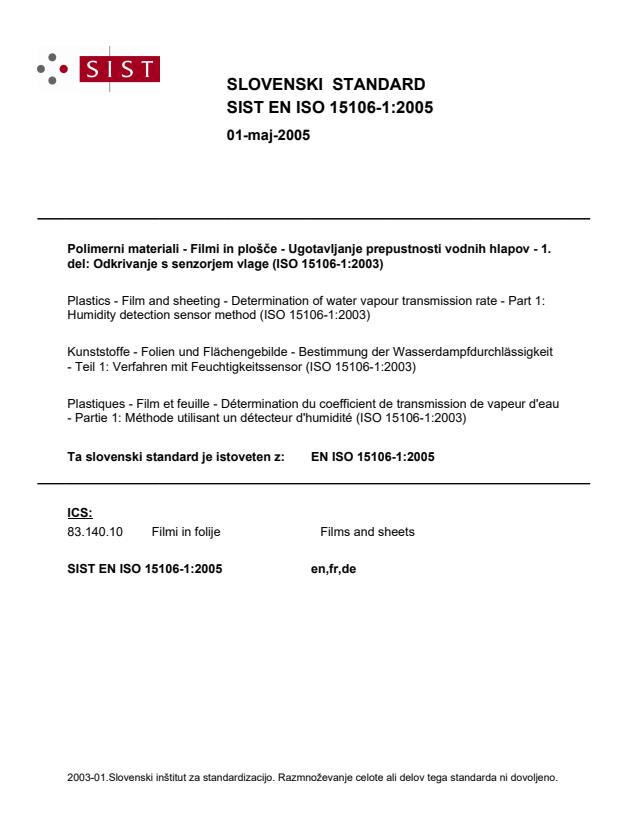
2003-01.Slovenski inštitut za standardizacijo. Razmnoževanje celote ali delov tega standarda ni dovoljeno.Kunststoffe - Folien und Flächengebilde - Bestimmung der Wasserdampfdurchlässigkeit - Teil 1: Verfahren mit Feuchtigkeitssensor (ISO 15106-1:2003)Plastiques - Film et feuille - Détermination du coefficient de transmission de vapeur d'eau - Partie 1: Méthode utilisant un détecteur d'humidité (ISO 15106-1:2003)Plastics - Film and sheeting - Determination of water vapour transmission rate - Part 1: Humidity detection sensor method (ISO 15106-1:2003)83.140.10Filmi in folijeFilms and sheetsICS:Ta slovenski standard je istoveten z:EN ISO 15106-1:2005SIST EN ISO 15106-1:2005en,fr,de01-maj-2005SIST EN ISO 15106-1:2005SLOVENSKI
STANDARD
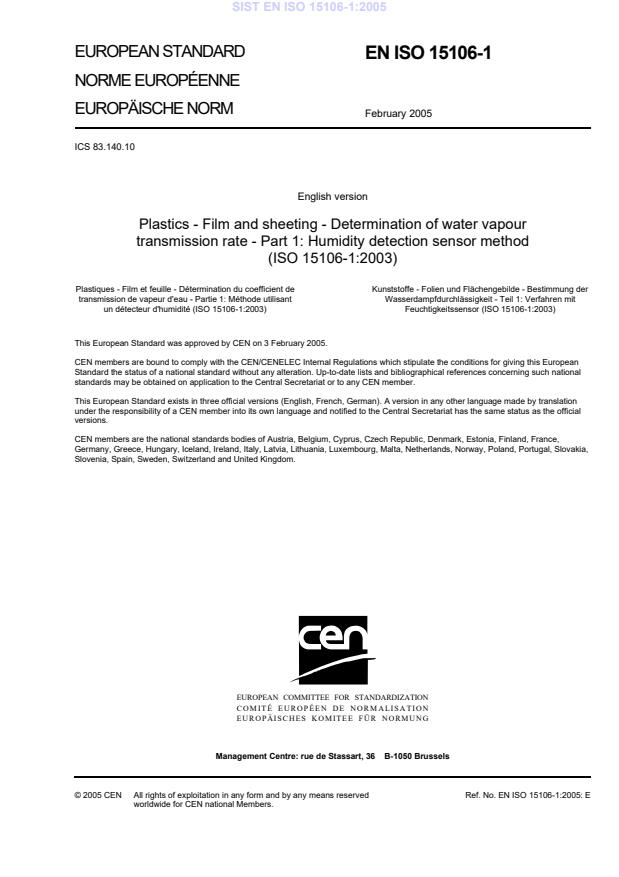
EUROPEAN STANDARDNORME EUROPÉENNEEUROPÄISCHE NORMEN ISO 15106-1February 2005ICS 83.140.10English versionPlastics - Film and sheeting - Determination of water vapourtransmission rate - Part 1: Humidity detection sensor method(ISO 15106-1:2003)Plastiques - Film et feuille - Détermination du coefficient detransmission de vapeur d'eau - Partie 1: Méthode utilisantun détecteur d'humidité (ISO 15106-1:2003)Kunststoffe - Folien und Flächengebilde - Bestimmung derWasserdampfdurchlässigkeit - Teil 1: Verfahren mitFeuchtigkeitssensor (ISO 15106-1:2003)This European Standard was approved by CEN on 3 February 2005.CEN members are bound to comply with the CEN/CENELEC Internal Regulations which stipulate the conditions for giving this EuropeanStandard the status of a national standard without any alteration. Up-to-date lists and bibliographical references concerning such nationalstandards may be obtained on application to the Central Secretariat or to any CEN member.This European Standard exists in three official versions (English, French, German). A version in any other language made by translationunder the responsibility of a CEN member into its own language and notified to the Central Secretariat has the same status as the officialversions.CEN members are the national standards bodies of Austria, Belgium, Cyprus, Czech Republic, Denmark, Estonia, Finland, France,Germany, Greece, Hungary, Iceland, Ireland, Italy, Latvia, Lithuania, Luxembourg, Malta, Netherlands, Norway, Poland, Portugal, Slovakia,Slovenia, Spain, Sweden, Switzerland and United Kingdom.EUROPEAN COMMITTEE FOR STANDARDIZATIONCOMITÉ EUROPÉEN DE NORMALISATIONEUROPÄISCHES KOMITEE FÜR NORMUNGManagement Centre: rue de Stassart, 36
B-1050 Brussels© 2005 CENAll rights of exploitation in any form and by any means reservedworldwide for CEN national Members.Ref. No. EN ISO 15106-1:2005: ESIST EN ISO 15106-1:2005
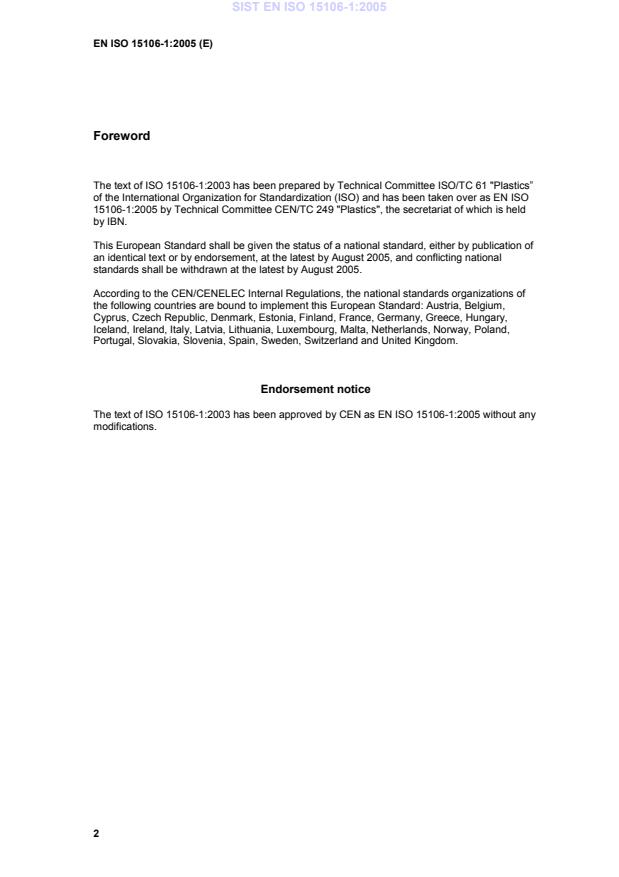
Foreword
The text of ISO 15106-1:2003 has been prepared by Technical Committee ISO/TC 61 "Plastics” of the International Organization for Standardization (ISO) and has been taken over as EN ISO 15106-1:2005 by Technical Committee CEN/TC 249 "Plastics", the secretariat of which is held by IBN.
This European Standard shall be given the status of a national standard, either by publication of an identical text or by endorsement, at the latest by August 2005, and conflicting national standards shall be withdrawn at the latest by August 2005.
According to the CEN/CENELEC Internal Regulations, the national standards organizations of the following countries are bound to implement this European Standard: Austria, Belgium, Cyprus, Czech Republic, Denmark, Estonia, Finland, France, Germany, Greece, Hungary, Iceland, Ireland, Italy, Latvia, Lithuania, Luxembourg, Malta, Netherlands, Norway, Poland, Portugal, Slovakia, Slovenia, Spain, Sweden, Switzerland and United Kingdom.
Endorsement notice
The text of ISO 15106-1:2003 has been approved by CEN as EN ISO 15106-1:2005 without any modifications.
Reference numberISO 15106-1:2003(E)© ISO 2003
INTERNATIONAL STANDARD ISO15106-1First edition2003-01-15Plastics — Film and sheeting — Determination of water vapour transmission rate — Part 1: Humidity detection sensor method Plastiques — Film et feuille — Détermination du coefficient de transmission de vapeur d'eau — Partie 1: Méthode utilisant un détecteur d'humidité
ISO 15106-1:2003(E) PDF disclaimer This PDF file may contain embedded typefaces. In accordance with Adobe's licensing policy, this file may be printed or viewed but shall not be edited unless the typefaces which are embedded are licensed to and installed on the computer performing the editing. In downloading this file, parties accept therein the responsibility of not infringing Adobe's licensing policy. The ISO Central Secretariat accepts no liability in this area. Adobe is a trademark of Adobe Systems Incorporated. Details of the software products used to create this PDF file can be found in the General Info relative to the file; the PDF-creation parameters were optimized for printing. Every care has been taken to ensure that the file is suitable for use by ISO member bodies. In the unlikely event that a problem relating to it is found, please inform the Central Secretariat at the address given below.
©
ISO 2003 All rights reserved. Unless otherwise specified, no part of this publication may be reproduced or utilized in any form or by any means, electronic or mechanical, including photocopying and microfilm, without permission in writing from either ISO at the address below or ISO's member body in the country of the requester. ISO copyright office Case postale 56 • CH-1211 Geneva 20 Tel.
+ 41 22 749 01 11 Fax
+ 41 22 749 09 47 E-mail
copyright@iso.org Web
www.iso.org Published in Switzerland
ii © ISO 2003 — All rights reserved
ISO 15106-1:2003(E) © ISO 2003 — All rights reserved iii Contents Page Foreword.iv 1 Scope.1 2 Normative references.1 3 Terms and definitions.1 4 Principle.2 5 Test specimens.2 6 Conditioning.2 7 Apparatus.2 8 Test conditions.3 9 Procedure.4 10 Calculation.4 11 Test result.5 12 Precision.5 13 Test report.5
ISO 15106-1:2003(E) iv © ISO 2003 — All rights reserved Foreword ISO (the International Organization for Standardization) is a worldwide federation of national standards bodies (ISO member bodies). The work of preparing International Standards is normally carried out through ISO technical committees. Each member body interested in a subject for which a technical committee has been established has the right to be represented on that committee. International organizations, governmental and non-governmental, in liaison with ISO, also take part in the work. ISO collaborates closely with the International Electrotechnical Commission (IEC) on all matters of electrotechnical standardization. International Standards are drafted in accordance with the rules given in the ISO/IEC Directives, Part 2. The main task of technical committees is to prepare International Standards. Draft International Standards adopted by the technical committees are circulated to the member bodies for voting. Publication as an International Standard requires approval by at least 75 % of the member bodies casting a vote. Attention is drawn to the possibility that some of the elements of this document may be the subject of patent rights. ISO shall not be held responsible for ident
...