

ISO 4386-3:2018
(Main)Plain bearings — Metallic multilayer plain bearings — Part 3: Non-destructive penetrant testing
General Information
- Abstract
This document specifies a non‑destructive penetrant testing for determining bond defects and discontinuities in the sliding surface of the bearing. The penetration method is used to detect a) bond defects in the transitional area between the bearing backing/bearing material on the end faces and joint faces of multilayer plain bearings which cannot be detected by the ultrasonic testing method specified in ISO 4386‑1, and b) discontinuities in the sliding surface of the bearing. The penetration method is applicable, in principle, to finished multilayer plain bearings. The bond test is usually carried out on cast multilayer plain bearings, with a backing consisting of steel, cast steel or cast bronze. It can also be used as a non-production method to aid detection of manufacturing process defects with other bearing material types. Bearing backings which cannot be tin-plated, or only with difficulty, such as perlitic cast iron, rust-resistant steel and cast aluminium, cannot be tested since no bond is possible between the bearing material and bearing backing.
- Status
- Published
- Publication Date
- 16-Jul-2018
- Current Stage
- 9060 - Close of review
- Completion Date
- 04-Mar-2029
Buy Documents


ISO 4386-3:2018 - Plain bearings -- Metallic multilayer plain bearings
ISO 4386-3:2018 - Plain bearings — Metallic multilayer plain bearings — Part 3: Non-destructive penetrant testing/17/2018
Overview
ISO 4386-3:2018 specifies a non‑destructive penetrant testing (liquid penetrant inspection, LPI) method for metallic multilayer plain bearings. The standard is focused on detecting bond defects in transitional areas between bearing backing and bearing material (end faces and joint faces) and on identifying surface discontinuities on the sliding surface that are not always detectable by ultrasonic methods. It applies, in principle, to finished multilayer plain bearings-most commonly cast bearings with steel, cast steel or cast bronze backings-and is intended for use by trained NDT personnel.
Key topics and requirements
- Scope of inspection
- Detects bond defects in transitional areas and discontinuities in sliding surfaces.
- Not suitable for backings that cannot be tin‑plated (e.g., perlitic cast iron, stainless steels, cast aluminium).
- Preparation
- Surfaces must be clean and dry; maximum drying temperature 55 °C.
- Surface roughness requirement: R ≤ 5 µm.
- Mechanical and chemical pre‑cleaning procedures are specified to avoid sealing defects.
- Penetrant application
- Use water‑removable or solvent‑removable penetrants.
- Test surface temperature: 10 °C to 50 °C.
- Penetration time: 10–20 minutes (≥20 min for very viscous penetrants).
- Removal of excess penetrant
- Water‑based: rinse with water at hydrostatic pressure < 2 bar (no detergents).
- Solvent‑based: wipe with cloth lightly moistened with appropriate solvent.
- Developer
- Apply immediately after drying; ensure a thin, uniform film as per manufacturer instructions.
- Observe indications within 10–20 minutes after developer application.
- Inspection and acceptance
- Surface inspection classified into five quality classes (A–E) with defined limits for mark size, number and total area per 1 dm² (see Annex A).
- Isolated marks ≤ 1.5 mm are disregarded. Re‑machining and re‑testing recommended for unassessable marks.
- Safety
- Use trained personnel and appropriate precautions with flammable/volatile chemicals.
- Test report requirements
- Reference ISO 4386-3:2018, component dimensions/material, penetrant/developer details (manufacturer, product, batch), bond and sliding-surface findings, inspector and date.
Applications and users
- Practical applications
- Production and final‑inspection quality control of multilayer plain bearings.
- Non‑production troubleshooting to identify manufacturing defects.
- Complementary inspection where ISO 4386‑1 ultrasonic testing cannot reveal boundary defects.
- Who uses it
- Bearing manufacturers, NDT technicians, OEM quality engineers in automotive, aerospace, heavy machinery and industrial equipment.
Related standards
- ISO 4386‑1 - Non‑destructive ultrasonic testing of bond (thickness ≥ 0.5 mm)
- ASTM E1417 - Standard practice for liquid penetrant testing (chemical/media conformity)
Keywords: ISO 4386-3:2018, plain bearings, non-destructive penetrant testing, penetrant inspection, multilayer plain bearings, bond defects, sliding surface, LPI, acceptance criteria, NDT.
Relations
- Effective Date
- 04-Nov-2015
Buy Documents
ISO 4386-3:2018 - Plain bearings -- Metallic multilayer plain bearings
ISO 4386-3:2018 - Plain bearings — Metallic multilayer plain bearings — Part 3: Non-destructive penetrant testing/17/2018
Frequently Asked Questions
ISO 4386-3:2018 is a standard published by the International Organization for Standardization (ISO). Its full title is "Plain bearings — Metallic multilayer plain bearings — Part 3: Non-destructive penetrant testing". This standard covers: This document specifies a non‑destructive penetrant testing for determining bond defects and discontinuities in the sliding surface of the bearing. The penetration method is used to detect a) bond defects in the transitional area between the bearing backing/bearing material on the end faces and joint faces of multilayer plain bearings which cannot be detected by the ultrasonic testing method specified in ISO 4386‑1, and b) discontinuities in the sliding surface of the bearing. The penetration method is applicable, in principle, to finished multilayer plain bearings. The bond test is usually carried out on cast multilayer plain bearings, with a backing consisting of steel, cast steel or cast bronze. It can also be used as a non-production method to aid detection of manufacturing process defects with other bearing material types. Bearing backings which cannot be tin-plated, or only with difficulty, such as perlitic cast iron, rust-resistant steel and cast aluminium, cannot be tested since no bond is possible between the bearing material and bearing backing.
This document specifies a non‑destructive penetrant testing for determining bond defects and discontinuities in the sliding surface of the bearing. The penetration method is used to detect a) bond defects in the transitional area between the bearing backing/bearing material on the end faces and joint faces of multilayer plain bearings which cannot be detected by the ultrasonic testing method specified in ISO 4386‑1, and b) discontinuities in the sliding surface of the bearing. The penetration method is applicable, in principle, to finished multilayer plain bearings. The bond test is usually carried out on cast multilayer plain bearings, with a backing consisting of steel, cast steel or cast bronze. It can also be used as a non-production method to aid detection of manufacturing process defects with other bearing material types. Bearing backings which cannot be tin-plated, or only with difficulty, such as perlitic cast iron, rust-resistant steel and cast aluminium, cannot be tested since no bond is possible between the bearing material and bearing backing.
ISO 4386-3:2018 is classified under the following ICS (International Classification for Standards) categories: 21.100.10 - Plain bearings. The ICS classification helps identify the subject area and facilitates finding related standards.
ISO 4386-3:2018 has the following relationships with other standards: It is inter standard links to ISO 4386-3:1992. Understanding these relationships helps ensure you are using the most current and applicable version of the standard.
ISO 4386-3:2018 is available in PDF format for immediate download after purchase. The document can be added to your cart and obtained through the secure checkout process. Digital delivery ensures instant access to the complete standard document.
Standards Content (Sample)
SLOVENSKI STANDARD
01-september-2020
Drsni ležaji - Večslojni kovinski ležaji - 3. del: Preskušanje s penetracijo brez
porušitve
Plain bearings - Metallic multilayer plain bearings - Part 3: Non-destructive penetrant
testing
Paliers lisses - Paliers lisses métalliques multicouches - Partie 3: Contrôle non destructif
par ressuage
Ta slovenski standard je istoveten z: ISO 4386-3:2018
ICS:
21.100.10 Drsni ležaji Plain bearings
2003-01.Slovenski inštitut za standardizacijo. Razmnoževanje celote ali delov tega standarda ni dovoljeno.
INTERNATIONAL ISO
STANDARD 4386-3
Second edition
2018-07
Plain bearings — Metallic multilayer
plain bearings —
Part 3:
Non-destructive penetrant testing
Paliers lisses — Paliers lisses métalliques multicouches —
Partie 3: Contrôle non destructif par ressuage
Reference number
©
ISO 2018
© ISO 2018
All rights reserved. Unless otherwise specified, or required in the context of its implementation, no part of this publication may
be reproduced or utilized otherwise in any form or by any means, electronic or mechanical, including photocopying, or posting
on the internet or an intranet, without prior written permission. Permission can be requested from either ISO at the address
below or ISO’s member body in the country of the requester.
ISO copyright office
CP 401 • Ch. de Blandonnet 8
CH-1214 Vernier, Geneva
Phone: +41 22 749 01 11
Fax: +41 22 749 09 47
Email: copyright@iso.org
Website: www.iso.org
Published in Switzerland
ii © ISO 2018 – All rights reserved
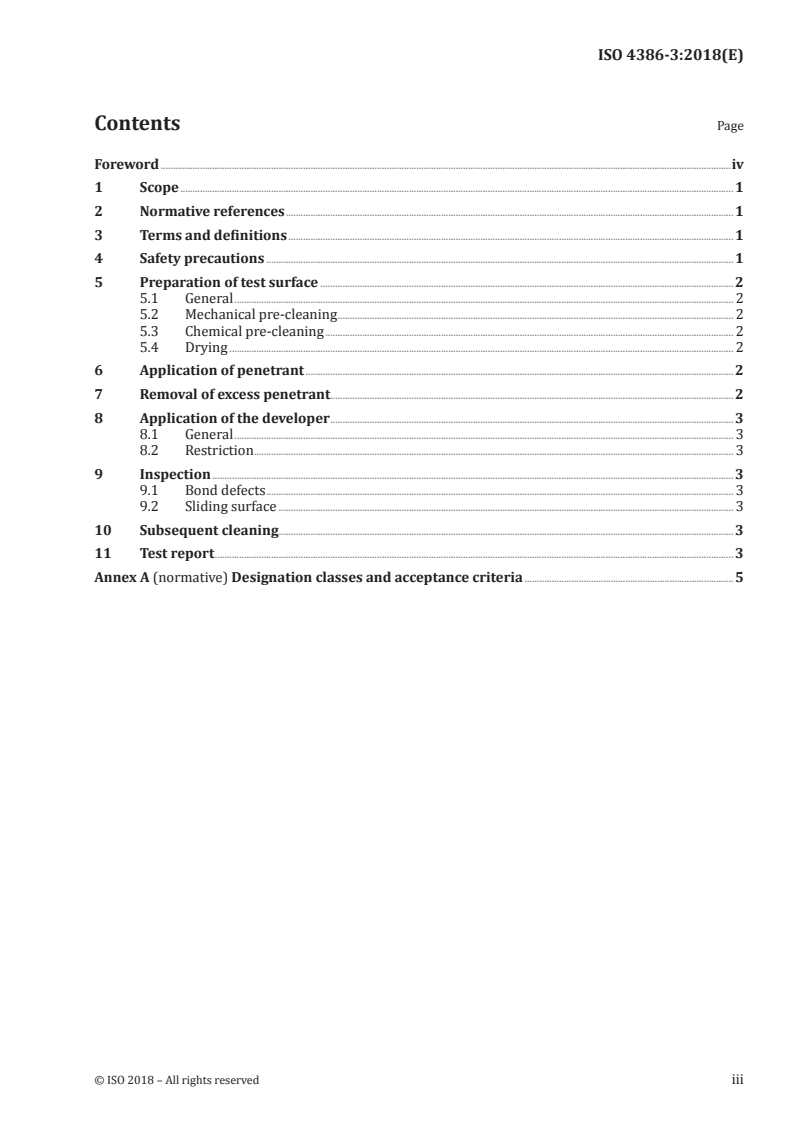
Contents Page
Foreword .iv
1 Scope . 1
2 Normative references . 1
3 Terms and definitions . 1
4 Safety precautions . 1
5 Preparation of test surface . 2
5.1 General . 2
5.2 Mechanical pre-cleaning . 2
5.3 Chemical pre-cleaning . 2
5.4 Drying . 2
6 Application of penetrant . 2
7 Removal of excess penetrant. 2
8 Application of the developer . 3
8.1 General . 3
8.2 Restriction . 3
9 Inspection . 3
9.1 Bond defects . 3
9.2 Sliding surface . 3
10 Subsequent cleaning . 3
11 Test report . 3
Annex A (normative) Designation classes and acceptance criteria . 5
Foreword
ISO (the International Organization for Standardization) is a worldwide federation of national standards
bodies (ISO member bodies). The work of preparing International Standards is normally carried out
through ISO technical committees. Each member body interested in a subject for which a technical
committee has been established has the right to be represented on that committee. International
organizations, governmental and non-governmental, in liaison with ISO, also take part in the work.
ISO collaborates closely with the International Electrotechnical Commission (IEC) on all matters of
electrotechnical standardization.
The procedures used to develop this document and those intended for its further maintenance are
described in the ISO/IEC Directives, Part 1. In particular the different approval criteria needed for the
different types of ISO documents should be noted. This document was drafted in accordance with the
editorial rules of the ISO/IEC Directives, Part 2 (see www .iso .org/directives).
Attention is drawn to the possibility that some of the elements of this document may be the subject of
patent rights. ISO shall not be held responsible for identifying any or all such patent rights. Details of
any patent rights identified during the development of the document will be in the Introduction and/or
on the ISO list of patent declarations received (see www .iso .org/patents).
Any trade name used in this document is information given for the convenience of users and does not
constitute an endorsement.
For an explanation on the voluntary nature of standards, the meaning of ISO specific terms and
expressions related to conformity assessment, as well as information about ISO's adherence to the
World Trade Organization (WTO) principles in the Technical Barriers to Trade (TBT) see the following
URL: www .iso .org/iso/foreword .html.
This document was prepared by Technical Committee ISO/TC 123, Plain bearings, Subcommittee SC 2,
Materials and lubricants, their properties, characteristics, test methods and testing conditions.
Any feedback or questions on this document should be directed to the user’s national standards body. A
complete listing of these bodies can be found at www .iso .org/members .html.
This second edition cancels and replaces the first edition (ISO 4386-3:1992), which has been technically
revised. The main changes compared to the previous edition are as follows:
— The Scope has been changed.
— Normative references have been updated.
— A new Clause 3 Terms and definitions has been added.
— The document has been restructured.
— All clauses have been technically revised.
— The figures in Annex A have been updated.
— The Bibliography has been deleted.
A list of all the parts in the ISO 4386 series can be found on the ISO website.
iv © ISO 2018 – All rights reserved
INTERNATIONAL STANDARD ISO 4386-3:2018(E)
Plain bearings — Metallic multilayer plain bearings —
Part 3:
Non-destructive penetrant testing
1 Scope
This document specifies a non-destructive penetrant testing for determining bond defects and
discontinuities in the sliding surface of the bearing.
The penetration method is used to detect
a) bond defects in the transitional area between the bearing backing/bearing material on the end
faces and joint faces of multilayer plain bearings which cannot be detected by the ultrasonic testing
method specified in ISO 4386-1, and
b) discontinuities in the sliding surface of the bearing.
The penetration method is applicable, in principle, to finished multilayer plain bearings.
The bond test is usually carried out on cast multilayer plain bearings, with a backing consis
...
INTERNATIONAL ISO
STANDARD 4386-3
Second edition
2018-07
Plain bearings — Metallic multilayer
plain bearings —
Part 3:
Non-destructive penetrant testing
Paliers lisses — Paliers lisses métalliques multicouches —
Partie 3: Contrôle non destructif par ressuage
Reference number
©
ISO 2018
© ISO 2018
All rights reserved. Unless otherwise specified, or required in the context of its implementation, no part of this publication may
be reproduced or utilized otherwise in any form or by any means, electronic or mechanical, including photocopying, or posting
on the internet or an intranet, without prior written permission. Permission can be requested from either ISO at the address
below or ISO’s member body in the country of the requester.
ISO copyright office
CP 401 • Ch. de Blandonnet 8
CH-1214 Vernier, Geneva
Phone: +41 22 749 01 11
Fax: +41 22 749 09 47
Email: copyright@iso.org
Website: www.iso.org
Published in Switzerland
ii © ISO 2018 – All rights reserved
Contents Page
Foreword .iv
1 Scope . 1
2 Normative references . 1
3 Terms and definitions . 1
4 Safety precautions . 1
5 Preparation of test surface . 2
5.1 General . 2
5.2 Mechanical pre-cleaning . 2
5.3 Chemical pre-cleaning . 2
5.4 Drying . 2
6 Application of penetrant . 2
7 Removal of excess penetrant. 2
8 Application of the developer . 3
8.1 General . 3
8.2 Restriction . 3
9 Inspection . 3
9.1 Bond defects . 3
9.2 Sliding surface . 3
10 Subsequent cleaning . 3
11 Test report . 3
Annex A (normative) Designation classes and acceptance criteria . 5
Foreword
ISO (the International Organization for Standardization) is a worldwide federation of national standards
bodies (ISO member bodies). The work of preparing International Standards is normally carried out
through ISO technical committees. Each member body interested in a subject for which a technical
committee has been established has the right to be represented on that committee. International
organizations, governmental and non-governmental, in liaison with ISO, also take part in the work.
ISO collaborates closely with the International Electrotechnical Commission (IEC) on all matters of
electrotechnical standardization.
The procedures used to develop this document and those intended for its further maintenance are
described in the ISO/IEC Directives, Part 1. In particular the different approval criteria needed for the
different types of ISO documents should be noted. This document was drafted in accordance with the
editorial rules of the ISO/IEC Directives, Part 2 (see www .iso .org/directives).
Attention is drawn to the possibility that some of the elements of this document may be the subject of
patent rights. ISO shall not be held responsible for identifying any or all such patent rights. Details of
any patent rights identified during the development of the document will be in the Introduction and/or
on the ISO list of patent declarations received (see www .iso .org/patents).
Any trade name used in this document is information given for the convenience of users and does not
constitute an endorsement.
For an explanation on the voluntary nature of standards, the meaning of ISO specific terms and
expressions related to conformity assessment, as well as information about ISO's adherence to the
World Trade Organization (WTO) principles in the Technical Barriers to Trade (TBT) see the following
URL: www .iso .org/iso/foreword .html.
This document was prepared by Technical Committee ISO/TC 123, Plain bearings, Subcommittee SC 2,
Materials and lubricants, their properties, characteristics, test methods and testing conditions.
Any feedback or questions on this document should be directed to the user’s national standards body. A
complete listing of these bodies can be found at www .iso .org/members .html.
This second edition cancels and replaces the first edition (ISO 4386-3:1992), which has been technically
revised. The main changes compared to the previous edition are as follows:
— The Scope has been changed.
— Normative references have been updated.
— A new Clause 3 Terms and definitions has been added.
— The document has been restructured.
— All clauses have been technically revised.
— The figures in Annex A have been updated.
— The Bibliography has been deleted.
A list of all the parts in the ISO 4386 series can be found on the ISO website.
iv © ISO 2018 – All rights reserved
INTERNATIONAL STANDARD ISO 4386-3:2018(E)
Plain bearings — Metallic multilayer plain bearings —
Part 3:
Non-destructive penetrant testing
1 Scope
This document specifies a non-destructive penetrant testing for determining bond defects and
discontinuities in the sliding surface of the bearing.
The penetration method is used to detect
a) bond defects in the transitional area between the bearing backing/bearing material on the end
faces and joint faces of multilayer plain bearings which cannot be detected by the ultrasonic testing
method specified in ISO 4386-1, and
b) discontinuities in the sliding surface of the bearing.
The penetration method is applicable, in principle, to finished multilayer plain bearings.
The bond test is usually carried out on cast multilayer plain bearings, with a backing consisting
of steel, cast steel or cast bronze. It can also be used as a non-production method to aid detection of
manufacturing process defects with other bearing material types. Bearing backings which cannot be
tin-plated, or only with difficulty, such as perlitic cast iron, rust-resistant steel and cast aluminium,
cannot be tested since no bond is possible between the bearing material and bea
...
INTERNATIONAL ISO
STANDARD 4386-3
Second edition
2018-07
Plain bearings — Metallic multilayer
plain bearings —
Part 3:
Non-destructive penetrant testing
Paliers lisses — Paliers lisses métalliques multicouches —
Partie 3: Contrôle non destructif par ressuage
Reference number
©
ISO 2018
© ISO 2018
All rights reserved. Unless otherwise specified, or required in the context of its implementation, no part of this publication may
be reproduced or utilized otherwise in any form or by any means, electronic or mechanical, including photocopying, or posting
on the internet or an intranet, without prior written permission. Permission can be requested from either ISO at the address
below or ISO’s member body in the country of the requester.
ISO copyright office
CP 401 • Ch. de Blandonnet 8
CH-1214 Vernier, Geneva
Phone: +41 22 749 01 11
Fax: +41 22 749 09 47
Email: copyright@iso.org
Website: www.iso.org
Published in Switzerland
ii © ISO 2018 – All rights reserved
Contents Page
Foreword .iv
1 Scope . 1
2 Normative references . 1
3 Terms and definitions . 1
4 Safety precautions . 1
5 Preparation of test surface . 2
5.1 General . 2
5.2 Mechanical pre-cleaning . 2
5.3 Chemical pre-cleaning . 2
5.4 Drying . 2
6 Application of penetrant . 2
7 Removal of excess penetrant. 2
8 Application of the developer . 3
8.1 General . 3
8.2 Restriction . 3
9 Inspection . 3
9.1 Bond defects . 3
9.2 Sliding surface . 3
10 Subsequent cleaning . 3
11 Test report . 3
Annex A (normative) Designation classes and acceptance criteria . 5
Foreword
ISO (the International Organization for Standardization) is a worldwide federation of national standards
bodies (ISO member bodies). The work of preparing International Standards is normally carried out
through ISO technical committees. Each member body interested in a subject for which a technical
committee has been established has the right to be represented on that committee. International
organizations, governmental and non-governmental, in liaison with ISO, also take part in the work.
ISO collaborates closely with the International Electrotechnical Commission (IEC) on all matters of
electrotechnical standardization.
The procedures used to develop this document and those intended for its further maintenance are
described in the ISO/IEC Directives, Part 1. In particular the different approval criteria needed for the
different types of ISO documents should be noted. This document was drafted in accordance with the
editorial rules of the ISO/IEC Directives, Part 2 (see www .iso .org/directives).
Attention is drawn to the possibility that some of the elements of this document may be the subject of
patent rights. ISO shall not be held responsible for identifying any or all such patent rights. Details of
any patent rights identified during the development of the document will be in the Introduction and/or
on the ISO list of patent declarations received (see www .iso .org/patents).
Any trade name used in this document is information given for the convenience of users and does not
constitute an endorsement.
For an explanation on the voluntary nature of standards, the meaning of ISO specific terms and
expressions related to conformity assessment, as well as information about ISO's adherence to the
World Trade Organization (WTO) principles in the Technical Barriers to Trade (TBT) see the following
URL: www .iso .org/iso/foreword .html.
This document was prepared by Technical Committee ISO/TC 123, Plain bearings, Subcommittee SC 2,
Materials and lubricants, their properties, characteristics, test methods and testing conditions.
Any feedback or questions on this document should be directed to the user’s national standards body. A
complete listing of these bodies can be found at www .iso .org/members .html.
This second edition cancels and replaces the first edition (ISO 4386-3:1992), which has been technically
revised. The main changes compared to the previous edition are as follows:
— The Scope has been changed.
— Normative references have been updated.
— A new Clause 3 Terms and definitions has been added.
— The document has been restructured.
— All clauses have been technically revised.
— The figures in Annex A have been updated.
— The Bibliography has been deleted.
A list of all the parts in the ISO 4386 series can be found on the ISO website.
iv © ISO 2018 – All rights reserved
INTERNATIONAL STANDARD ISO 4386-3:2018(E)
Plain bearings — Metallic multilayer plain bearings —
Part 3:
Non-destructive penetrant testing
1 Scope
This document specifies a non-destructive penetrant testing for determining bond defects and
discontinuities in the sliding surface of the bearing.
The penetration method is used to detect
a) bond defects in the transitional area between the bearing backing/bearing material on the end
faces and joint faces of multilayer plain bearings which cannot be detected by the ultrasonic testing
method specified in ISO 4386-1, and
b) discontinuities in the sliding surface of the bearing.
The penetration method is applicable, in principle, to finished multilayer plain bearings.
The bond test is usually carried out on cast multilayer plain bearings, with a backing consisting
of steel, cast steel or cast bronze. It can also be used as a non-production method to aid detection of
manufacturing process defects with other bearing material types. Bearing backings which cannot be
tin-plated, or only with difficulty, such as perlitic cast iron, rust-resistant steel and cast aluminium,
cannot be tested since no bond is possible between the bearing material and bea
...