

ISO/IEC 9834-1:2012
(Main)Information technology — Procedures for the operation of object identifier registration authorities — Part 1: General procedures and top arcs of the international object identifier tree
General Information
- Abstract
ISO/IEC 9834-1:2012: specifies a tree structure for allocations made by a hierarchical structure of Registration Authorities, called the international object identifier (OID) tree, which supports the ASN.1 OBJECT IDENTIFIER type and the ASN.1 OID-IRI type (ISO/IEC 8824-1); registers top-level arcs of the international OID tree; specifies procedures which are generally applicable to registration at any level of the international OID tree; provides guidelines for the establishment and operation of International Registration Authorities for use, when needed, by other ITU-T Recommendations and/or International Standards; provides guidelines for additional ITU-T Recommendations and/or International Standards which choose to reference the procedures in ISO/IEC 9834-1:2012; provides a recommended fee structure for lower-level Registration Authorities. Information about registration for specific objects is contained in separate ITU-T Recommendations and/or International Standards. ISO/IEC 9834-1:2012 applies to registration by ITU-T Recommendations and/or International Standards, by International Registration Authorities, and by any other Registration Authority.
- Status
- Published
- Publication Date
- 10-May-2012
- Current Stage
- 9093 - International Standard confirmed
- Start Date
- 23-May-2025
- Completion Date
- 29-Aug-2026
Buy Documents
ISO/IEC 9834-1:2012 - Information technology — Procedures for the operation of object identifier registration authorities — Part 1: General procedures and top arcs of the international object identifier tree Released:5/11/2012
Overview
ISO/IEC 9834-1:2012 - Information technology - Procedures for the operation of object identifier registration authorities (Part 1) - defines the international framework for allocating and managing Object Identifiers (OIDs). The standard specifies the international OID tree structure that supports ASN.1 OBJECT IDENTIFIER and OID-IRI types, registers top-level arcs, and sets out general procedures, governance guidelines and a recommended fee model for Registration Authorities (RAs). The text is published jointly with ITU-T as Rec. ITU‑T X.660.
Key topics and technical requirements
- International OID tree structure: Defines a hierarchical tree of OID arcs and how allocations are made by parent Registration Authorities.
- Top-level arcs registration: Formal registration and publication rules for root/top arcs of the OID tree.
- General registration procedures: Processes applicable at any level of the tree, including request, assignment, publication and management of OID components.
- International Registration Authorities (IRAs): Guidelines for establishing and operating IRAs responsible for international-level allocations.
- Identifier semantics: Support for ASN.1 OBJECT IDENTIFIER and OID-IRI types and requirements for integer-valued and Unicode labels.
- Unicode labels and normalization: Rules for assigning Unicode labels (including integer-valued labels), normalization for unambiguous comparisons, and handling of long arcs (Unicode labels that shortcut multi-level paths).
- Secondary identifiers and long arcs: Procedures for assigning additional secondary identifiers and Unicode labels by joint ITU‑T / ISO/IEC action where applicable.
- Governance and fees: Recommended fee structure for lower-level RAs and procedures for joint approvals and publication.
- Normative references: Cross-references to ASN.1 (ISO/IEC 8824-1), X.500/X.501 directory recommendations, ISO/IEC 10646 (Unicode/UCS), ISO 3166, and other identification standards.
Practical applications and users
ISO/IEC 9834-1:2012 is used by:
- Standards bodies and Registration Authorities that allocate and publish OIDs (ITU‑T, ISO/IEC JTC 1 subcommittees and other RAs).
- Protocol and systems architects implementing ASN.1-based specifications and OID-IRI identifiers.
- Software developers and implementers of directory services, management protocols, and registration systems that rely on globally unique OIDs.
- Organizations needing structured identification for protocols, object types, organization schemes or standards that require a formal registration path.
The standard ensures consistent, globally interoperable OID assignment, governance and lookup practices across telecommunications, IT standards, and other domains that depend on ASN.1 identifiers.
Related standards
- ITU‑T X.660 (identical text)
- ISO/IEC 8824-1 / Rec. ITU‑T X.680 (ASN.1)
- Rec. ITU‑T X.500 / ISO/IEC 9594 (Directory)
- ISO/IEC 10646 (UCS/Unicode), ISO 3166 (country codes)
- Other parts of ISO/IEC 9834 (Parts 2–9) for domain-specific registration procedures
Keywords: ISO/IEC 9834-1:2012, object identifier, OID tree, ASN.1, OID-IRI, Registration Authority, International Registration Authority, Unicode label, top-level arcs.
Relations
- Effective Date
- 20-Feb-2026
- Effective Date
- 20-Feb-2026
- Effective Date
- 20-Feb-2026
- Effective Date
- 09-Feb-2026
- Effective Date
- 09-Feb-2026
- Effective Date
- 15-Jan-2011
Buy Documents
ISO/IEC 9834-1:2012 - Information technology — Procedures for the operation of object identifier registration authorities — Part 1: General procedures and top arcs of the international object identifier tree Released:5/11/2012
Get Certified
Connect with accredited certification bodies for this standard

BSI Group
BSI (British Standards Institution) is the business standards company that helps organizations make excellence a habit.

NYCE
Mexican standards and certification body.
Sponsored listings
Frequently Asked Questions
ISO/IEC 9834-1:2012 is a standard published by the International Organization for Standardization (ISO). Its full title is "Information technology — Procedures for the operation of object identifier registration authorities — Part 1: General procedures and top arcs of the international object identifier tree". This standard covers: ISO/IEC 9834-1:2012: specifies a tree structure for allocations made by a hierarchical structure of Registration Authorities, called the international object identifier (OID) tree, which supports the ASN.1 OBJECT IDENTIFIER type and the ASN.1 OID-IRI type (ISO/IEC 8824-1); registers top-level arcs of the international OID tree; specifies procedures which are generally applicable to registration at any level of the international OID tree; provides guidelines for the establishment and operation of International Registration Authorities for use, when needed, by other ITU-T Recommendations and/or International Standards; provides guidelines for additional ITU-T Recommendations and/or International Standards which choose to reference the procedures in ISO/IEC 9834-1:2012; provides a recommended fee structure for lower-level Registration Authorities. Information about registration for specific objects is contained in separate ITU-T Recommendations and/or International Standards. ISO/IEC 9834-1:2012 applies to registration by ITU-T Recommendations and/or International Standards, by International Registration Authorities, and by any other Registration Authority.
ISO/IEC 9834-1:2012: specifies a tree structure for allocations made by a hierarchical structure of Registration Authorities, called the international object identifier (OID) tree, which supports the ASN.1 OBJECT IDENTIFIER type and the ASN.1 OID-IRI type (ISO/IEC 8824-1); registers top-level arcs of the international OID tree; specifies procedures which are generally applicable to registration at any level of the international OID tree; provides guidelines for the establishment and operation of International Registration Authorities for use, when needed, by other ITU-T Recommendations and/or International Standards; provides guidelines for additional ITU-T Recommendations and/or International Standards which choose to reference the procedures in ISO/IEC 9834-1:2012; provides a recommended fee structure for lower-level Registration Authorities. Information about registration for specific objects is contained in separate ITU-T Recommendations and/or International Standards. ISO/IEC 9834-1:2012 applies to registration by ITU-T Recommendations and/or International Standards, by International Registration Authorities, and by any other Registration Authority.
ISO/IEC 9834-1:2012 is classified under the following ICS (International Classification for Standards) categories: 35.100.01 - Open systems interconnection in general. The ICS classification helps identify the subject area and facilitates finding related standards.
ISO/IEC 9834-1:2012 has the following relationships with other standards: It is inter standard links to EN IEC 63047:2021, EN 62351-9:2017, EN IEC 62351-9:2023, CEN/TS 17241:2019, CEN/TS 16157-13:2025, ISO/IEC 9834-1:2008. Understanding these relationships helps ensure you are using the most current and applicable version of the standard.
ISO/IEC 9834-1:2012 is available in PDF format for immediate download after purchase. The document can be added to your cart and obtained through the secure checkout process. Digital delivery ensures instant access to the complete standard document.
Standards Content (Sample)
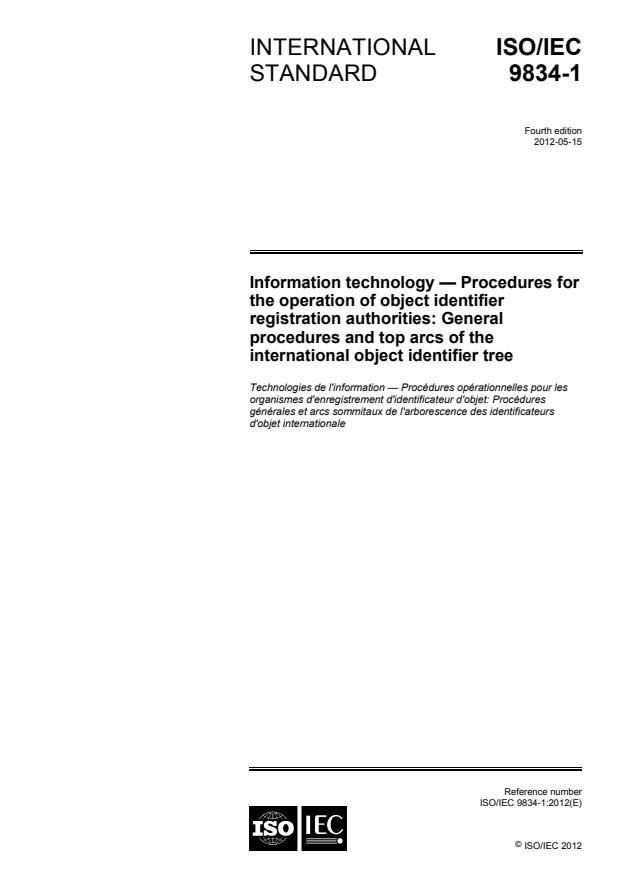
INTERNATIONAL ISO/IEC
STANDARD 9834-1
Fourth edition
2012-05-15
Information technology — Procedures for
the operation of object identifier
registration authorities: General
procedures and top arcs of the
international object identifier tree
Technologies de l'information — Procédures opérationnelles pour les
organismes d'enregistrement d'identificateur d'objet: Procédures
générales et arcs sommitaux de l'arborescence des identificateurs
d'objet internationale
Reference number
©
ISO/IEC 2012
© ISO/IEC 2011
All rights reserved. Unless otherwise specified, no part of this publication may be reproduced or utilized in any form or by any means,
electronic or mechanical, including photocopying and microfilm, without permission in writing from either ISO at the address below or
ISO's member body in the country of the requester.
ISO copyright office
Case postale 56 CH-1211 Geneva 20
Tel. + 41 22 749 01 11
Fax + 41 22 749 09 47
E-mail copyright@iso.org
Web www.iso.org
Published by ISO in 2012
Published in Switzerland
ii © ISO/IEC 2012 – All rights reserved
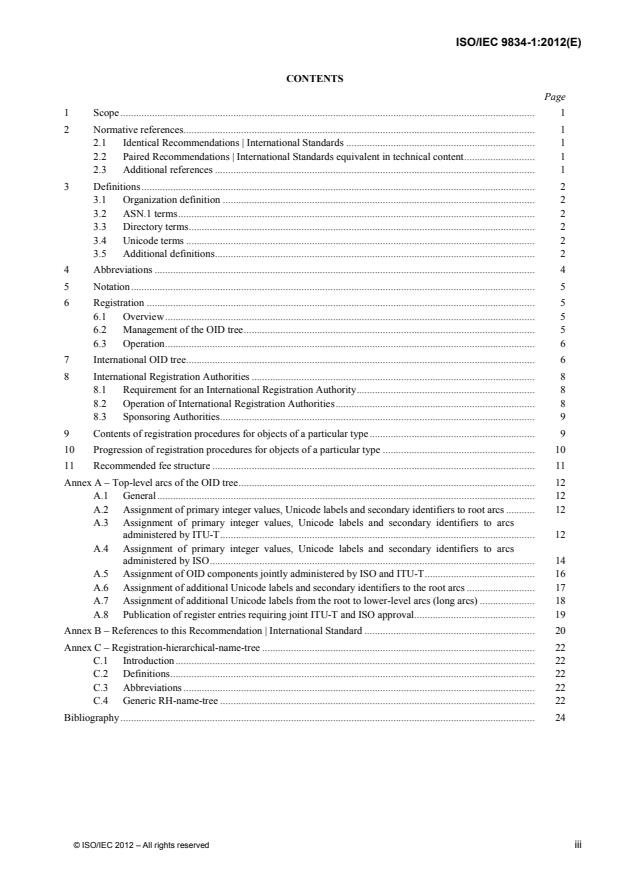
CONTENTS
Page
1 Scope . 1
2 Normative references. 1
2.1 Identical Recommendations | International Standards . 1
2.2 Paired Recommendations | International Standards equivalent in technical content . 1
2.3 Additional references . 1
3 Definitions . 2
3.1 Organization definition . 2
3.2 ASN.1 terms . 2
3.3 Directory terms. 2
3.4 Unicode terms . 2
3.5 Additional definitions . 2
4 Abbreviations . 4
5 Notation . 5
6 Registration . 5
6.1 Overview . 5
6.2 Management of the OID tree . 5
6.3 Operation . 6
7 International OID tree. 6
8 International Registration Authorities . 8
8.1 Requirement for an International Registration Authority . 8
8.2 Operation of International Registration Authorities . 8
8.3 Sponsoring Authorities . 9
9 Contents of registration procedures for objects of a particular type . 9
10 Progression of registration procedures for objects of a particular type . 10
11 Recommended fee structure . 11
Annex A – Top-level arcs of the OID tree . 12
A.1 General . 12
A.2 Assignment of primary integer values, Unicode labels and secondary identifiers to root arcs . 12
A.3 Assignment of primary integer values, Unicode labels and secondary identifiers to arcs
administered by ITU-T . 12
A.4 Assignment of primary integer values, Unicode labels and secondary identifiers to arcs
administered by ISO . 14
A.5 Assignment of OID components jointly administered by ISO and ITU-T . 16
A.6 Assignment of additional Unicode labels and secondary identifiers to the root arcs . 17
A.7 Assignment of additional Unicode labels from the root to lower-level arcs (long arcs) . 18
A.8 Publication of register entries requiring joint ITU-T and ISO approval . 19
Annex B – References to this Recommendation | International Standard . 20
Annex C – Registration-hierarchical-name-tree . 22
C.1 Introduction . 22
C.2 Definitions . 22
C.3 Abbreviations . 22
C.4 Generic RH-name-tree . 22
Bibliography . 24
© ISO/IEC 2012 – All rights reserved iii
Foreword
ISO (the International Organization for Standardization) and IEC (the International Electrotechnical
Commission) form the specialized system for worldwide standardization. National bodies that are members of
ISO or IEC participate in the development of International Standards through technical committees
established by the respective organization to deal with particular fields of technical activity. ISO and IEC
technical committees collaborate in fields of mutual interest. Other international organizations, governmental
and non-governmental, in liaison with ISO and IEC, also take part in the work. In the field of information
technology, ISO and IEC have established a joint technical committee, ISO/IEC JTC 1.
International Standards are drafted in accordance with the rules given in the ISO/IEC Directives, Part 2.
The main task of the joint technical committee is to prepare International Standards. Draft International
Standards adopted by the joint technical committee are circulated to national bodies for voting. Publication as
an International Standard requires approval by at least 75 % of the national bodies casting a vote.
Attention is drawn to the possibility that some of the elements of this document may be the subject of patent
rights. ISO and IEC shall not be held responsible for identifying any or all such patent rights.
ISO/IEC 9834-1 was prepared by Joint Technical Committee ISO/IEC JTC 1, Information technology,
Subcommittee SC 6, Telecommunications and information exchange between systems, in collaboration with
ITU-T. The identical text is published as Rec. ITU-T X.660 (07/2011).
This fourth edition cancels and replaces the third edition (ISO/IEC 9834-1:2008), which has been technically
revised.
ISO/IEC 9834 consists of the following parts, under the general title Information technology — Procedures for
the operation of object identifier registration authorities:
Part 1: General procedures and top arcs of the international object identifier tree
Part 2: Registration procedures for OSI document types
Part 3: Registration of Object Identifier arcs beneath the top-level arc jointly administered by ISO and
ITU-T
Part 4: Register of VTE Profiles
Part 5: Register of VT Control Object Definitions
Part 6: Registration of application processes and application entities
Part 7: Joint ISO and ITU-T Registration of International Organizations
Part 8: Generation and registration of Universally Unique Identifiers (UUIDs) and their use as ASN.1
Object Identifier components
Part 9: Registration of object identifier arcs for applications and services using tag-based identification
iv © ISO/IEC 2012 – All rights reserved
INTERNATIONAL STANDARD
RECOMMENDATION ITU-T
Information technology – Procedures for the operation
of object identifier registration authorities: General procedures
and top arcs of the international object identifier tree
1 Scope
This Recommendation | International Standard:
a) specifies a tree structure for allocations made by a hierarchical structure of Registration Authorities,
called the international OID tree, which supports the ASN.1 OBJECT IDENTIFIER type and the ASN.1
OID-IRI type (see Rec. ITU-T X.680 | ISO/IEC 8824-1);
b) registers top-level arcs of the international object identifier tree;
c) specifies procedures which are generally applicable to registration at any level of the international OID
tree;
d) provides guidelines for the establishment and operation of International Registration Authorities for use,
when needed, by other ITU-T Recommendations and/or International Standards;
e) provides guidelines for additional ITU-T Recommendations and/or International Standards which choose
to reference the procedures in this Recommendation | International Standard;
f) provides a recommended fee structure for lower-level Registration Authorities.
NOTE – Information about registration for specific objects is contained in separate ITU-T Recommendations and/or International
Standards.
This Recommendation | International Standard applies to registration by ITU-T Recommendations and/or International
Standards, by International Registration Authorities (see clause 8), and by any other Registration Authority.
2 Normative references
The following Recommendations and International Standards contain provisions which, through reference in this text,
constitute provisions of this Recommendation | International Standard. At the time of publication, the editions indicated
were valid. All Recommendations and Standards are subject to revision, and parties to agreements based on this
Recommendation | International Standard are encouraged to investigate the possibility of applying the most recent
edition of the Recommendations and Standards listed below. Members of IEC and ISO maintain registers of currently
valid International Standards. The Telecommunication Standardization Bureau of the ITU maintains a list of currently
valid ITU-T Recommendations.
2.1 Identical Recommendations | International Standards
– Recommendation ITU-T X.500 (2008) | ISO/IEC 9594-1:2008, Information technology – Open Systems
Interconnection – The Directory: Overview of concepts, models and services.
– Recommendation ITU-T X.501 (2008) | ISO/IEC 9594-2:2008, Information technology – Open Systems
Interconnection – The Directory: Models.
– Recommendation ITU-T X.662 (2008) | ISO/IEC 9834-3:2008, Information technology – Open Systems
Interconnection – Procedures for the operation of OSI Registration Authorities: Registration of object
identifier arcs beneath the top-level arc jointly administered by ISO and ITU-T.
– Recommendation ITU-T X.680 (2008) | ISO/IEC 8824-1:2008, Information technology – Abstract
Syntax Notation One (ASN.1): Specification of basic notation.
2.2 Paired Recommendations | International Standards equivalent in technical content
None.
2.3 Additional references
– Recommendation ITU-T X.121 (2000), International numbering plan for public data networks.
– Recommendation ITU-T X.669 (2008), Procedures for ITU-T registration of identified organizations.
Rec. ITU-T X.660 (07/2011) 1
– IETF RFC 5891 (2010), Internationalized Domain Names in Applications (IDNA): Protocol.
– ISO 3166-1:2006, Codes for the representation of names of countries and their subdivisions – Part 1:
Country codes.
– ISO 3166-3:1999, Codes for the representation of names of countries and their subdivisions – Part 3:
Codes for formerly used names of countries.
– ISO/IEC 6523-1:1998, Information technology – Structure for the identification of organizations and
organization parts – Part 1: Identification of organization identification schemes.
– ISO/IEC 6523-2:1998, Information technology – Structure for the identification of organizations and
organization parts – Part 2: Registration of organization identification schemes.
– ISO/IEC 10646:2011, Information technology – Universal Multiple-Octet Coded Character Set (UCS).
NOTE – Recommendation ITU-T T.55 [2] recommends the use of ISO/IEC 10646 for the representation of the
languages of the world.
3 Definitions
For the purposes of this Recommendation | International Standard, the following definitions apply:
3.1 Organization definition
This Recommendation | International Standard uses the following term defined in ISO/IEC 6523-1:
a) organization.
3.2 ASN.1 terms
This Recommendation | International Standard uses the following terms defined in Rec. ITU-T X.680 | ISO/IEC
8824-1:
a) (ASN.1) identifier;
b) object;
c) object descriptor type;
d) (ASN.1) object identifier type.
3.3 Directory terms
3.3.1 This Recommendation | International Standard uses the following terms defined in Rec. ITU-T X.500 |
ISO/IEC 9594-1:
a) Directory.
3.3.2 This Recommendation | International Standard uses the following terms defined in Rec. ITU-T X.501 |
ISO/IEC 9594-2:
a) attribute;
b) attribute type;
c) attribute value;
d) Directory name;
e) object class;
f) relative distinguished name.
3.4 Unicode terms
This Recommendation | International Standard uses the following terms defined in ISO/IEC 10646:
a) coded character.
3.5 Additional definitions
3.5.1 additional secondary identifier: A secondary identifier for a top-level arc of the international object
identifier tree that is assigned from time-to-time by a simple Resolution of both the relevant ITU-T study group and the
2 Rec. ITU-T X.660 (07/2011)
relevant ISO/IEC JTC 1 Sub-Committee, without requiring any change to this or any other ITU-T Recommendation
and/or International Standard (see A.6.4).
3.5.2 additional Unicode label: A Unicode label for one of the top-level arcs of the international object identifier
tree that is assigned from time-to-time by a simple Resolution of both the relevant ITU-T study group and the relevant
ISO/IEC JTC 1 Sub-Committee, without requiring any change to this or any other ITU-T Recommendation |
International Standard (see A.6.4).
3.5.3 administrative role (of a Registration Authority): Assigning and making available unambiguous names
according to the ITU-T Recommendation and/or International Standard defining the procedures for the Registration
Authority.
3.5.4 integer-valued Unicode label: A Unicode label for an arc that is the character representation (with no leading
zeros) of the primary integer value of that arc.
NOTE – An arc of the international object identifier tree can have no other Unicode label that is the character representation
(with or without leading zeros) of an integer value (see 7.4).
3.5.5 international object identifier tree: A tree whose root corresponds to this Recommendation | International
Standard and whose nodes correspond to Registration Authorities responsible for allocating arcs from a parent node.
3.5.6 International Registration Authority: A Registration Authority (see 3.5.17) acting at the international level
where the procedures for its operation, defined in a relevant ITU-T Recommendation and/or International Standard,
declare it to operate as an International Registration Authority (see clause 8).
3.5.7 Joint ITU-T | ISO/IEC JTC 1 Collaborative Team for object identifiers: A group established in
accordance with Rec. ITU-T A.23, Annex A | ISO/IEC JTC 1 Standing Document [1], clause 8, to progress work on
joint text in relation to object identifiers (OIDs).
3.5.8 long arc: A Unicode label from a superior node in the international object identifier tree that identifies a node
that is not immediately beneath the superior node.
NOTE 1 – The long arc (in addition to normal arcs) has to satisfy the unambiguity requirements (after normalization) for all arcs
from that superior node (see 7.8).
NOTE 2 – The only property of a long arc (see 3.5.15) is its Unicode label. It does not have a primary integer value or a
secondary identifier. It is essentially a short-cut for a series of arcs, each of which has a primary integer value and its own
Unicode labels.
NOTE 3 – The long arc can therefore not be used to define the value of an ASN.1 OBJECT IDENTIFIER type. It can only be
used in an OID-internationalized resource identifier (see 3.5.12).
NOTE 4 – Joint action by ITU-T and ISO/IEC can allocate a Unicode label for a long arc that identifies a node which is two
levels beneath the root (see A.7). This Recommendation | International Standard only allows long arcs for arcs beneath the
top-level arc with primary integer value 2.
3.5.9 normalization (of a Unicode label): Transformation of any Unicode label into a form suitable for
comparison (see 7.5.5).
3.5.10 object (of interest): Anything in some world, generally the world of telecommunications and information
processing or some part thereof,
a) which is identifiable (can be named); and
b) which may be registered.
NOTE – Examples of objects are ASN.1 modules (see Rec. ITU-T X.680 | ISO/IEC 8824-1), information objects [6], managed
objects [9], XML namespaces [15] and any other object that can be identified by an OID, URI or IRI.
3.5.11 object identifier: An ordered list of primary integer values from the root of the international object identifier
tree to a node, which unambiguously identifies that node (see 7.8).
3.5.12 OID-internationalized resource identifier: An ordered list of Unicode labels from the root of the
international object identifier tree that unambiguously identifies a node in that tree (see 7.8).
NOTE – The ASN.1 OID-IRI type (see Rec. ITU-T X.680 | ISO/IEC 8824-1) is the set of all OID-internationalized resource
identifier values, and provides value notations for all OID-internationalized resource identifiers based on the international object
identifier tree. The corresponding encodings are specified in [8].
3.5.13 primary integer value: A primary value of type integer used to unambiguously identify an arc of the
international object identifier tree.
NOTE – An arc of the international object identifier tree has precisely one primary integer value, apart from long arcs, which
have only Unicode labels.
3.5.14 primary value: A value of a specified type assigned to an arc of the OID tree that can provide an
unambiguous identification of that arc within the set of arcs from its superior node.
Rec. ITU-T X.660 (07/2011) 3
3.5.15 properties of an arc: The primary integer value, Unicode labels and secondary identifiers assigned to that
arc.
NOTE – Long arcs (see 3.5.8) have only Unicode labels. All other arcs have precisely one primary integer value.
3.5.16 registration: The assignment of an unambiguous name to an object in a way which makes the assignment
available to interested parties.
3.5.17 Registration Authority: An entity such as an organization, a standard or an automated facility that performs
registration of one or more types of objects (see also 3.5.6).
NOTE – For this Recommendation | International Standard, the above definition of Registration Authority extends the term to
cover registration by organizations acting at international, regional and national levels, and by other means.
3.5.18 registration procedures: The specified procedures for performing registration and amending (or deleting)
existing registrations.
3.5.19 relevant ISO/IEC JTC 1 Sub-Committee: The ISO/IEC JTC 1 Sub-Committee that is responsible for the
Joint ITU-T | ISO/IEC JTC 1 Collaborative Team for object identifiers.
3.5.20 relevant ITU-T study group: The ITU-T study group that is responsible for the Joint ITU-T | ISO/IEC JTC 1
Collaborative Team for object identifiers.
3.5.21 root arc: One of the three arcs from the root of the international object identifier tree.
3.5.22 secondary identifier: A secondary value restricted to the characters forming an (ASN.1) identifier (see Rec.
ITU-T X.680 | ISO/IEC 8824-1), assigned either in an ITU-T Recommendation, an International Standard or by some
other Registration Authority to an arc of the OID tree.
NOTE – An arc of the international object identifier tree can have zero or more secondary identifiers.
3.5.23 secondary value: A value of some type associated with an arc that provides additional identification useful
for human readers, but that does not in general unambiguously identify that arc, and is not normally included in
computer communications.
3.5.24 Sponsoring Authority: An organization recognized to receive proposals for registration and to submit
applications to an International Registration Authority as defined by a given ITU-T Recommendation and/or
International Standard (see clause 8).
3.5.25 synonym: An OID for an object that is also identified by another distinct OID.
3.5.26 technical role (of a Registration Authority): Verifying that an application for registration of an OID arc is
in accordance with the ITU-T Recommendation and/or International Standard defining the form of the application.
3.5.27 top-level arcs (top arcs): The subset of arcs of the international object identifier tree that are assigned
identifiers in this Recommendation | International Standard (supplemented by references to the Rec. ITU-T X.660
series | ISO/IEC 9834 multipart Standards, or by a Resolution from time-to-time of both the relevant ITU-T study group
and the relevant ISO/IEC JTC 1 Sub-Committee).
3.5.28 Unicode character: A character from the Unicode character set.
3.5.29 Unicode character set: The set of coded characters specified in ISO/IEC 10646.
NOTE – This is the same character set as that defined by the Unicode Consortium in [16].
3.5.30 Unicode label: A primary value that consists of an unbounded sequence of Unicode characters that does not
contain the SPACE character (see 7.5 for other restrictions) used to unambiguously identify an arc of the OID tree.
NOTE 1 – Unicode labels are always case sensitive for matching purposes and when determining unambiguity. However, all
Unicode labels from a given OID node shall be distinct after normalization.
NOTE 2 – An arc of the international object identifier tree can have multiple Unicode labels.
NOTE 3 – The ability to include effectively the full range of Unicode characters may make it easier to execute certain forms of
OID-IRI mimicking (also called "spoofing"). Applications that will present OID-IRIs to human users shall adhere to best
practices regarding address mimicking in order to help prevent attacks that result from spoofed addresses (e.g., the phenomenon
known as "phishing" (see details in [11]).
4 Abbreviations
For the purposes of this Recommendation | International Standard, the following abbreviations apply:
ACSE Association Control Service Element
ASN.1 Abstract Syntax Notation One
FTAM File Transfer, Access and Management
4 Rec. ITU-T X.660 (07/2011)
IANA Internet Assigned Numbers Authority
ICD International Code Designator
IRI Internationalized Resource Identifier
OID Object Identifier
OID-IRI OID-Internationalized Resource Identifier
OSI Open Systems Interconnection
RA Registration Authority
ROA Recognized Operating Agency
TSB Telecommunication Standardization Bureau
URI Uniform Resource Identifier
5 Notation
5.1 Unicode characters are specified in two ways. For a single character, it is normal to use the Unicode character
name in a special font followed by the word "character". For example:
SPACE character
5.2 For a range of characters, it is normal to use the letter U followed by eight hex digits for the start and end of
the range (both in a special font) in accordance with the notation defined in ISO/IEC 10646. For example:
U0000F900 to U0000FDCF
6 Registration
6.1 Overview
6.1.1 Many ITU-T Recommendations and International Standards define certain objects for which unambiguous
identification is required. This is achieved by registration.
NOTE – Examples of these objects are given in 3.5.10.
6.1.2 Registration is the assignment of a name to an object in a way which makes the assignment available to
interested parties. It is carried out by a Registration Authority.
6.1.3 Registration can be effected by an ITU-T Recommendation and/or International Standard, by publishing in
the ITU-T Recommendation and/or International Standard the names and the corresponding definitions of the object.
Such a mechanism requires an amendment of the ITU-T Recommendation and/or International Standard for each
registration, and hence is not appropriate in cases where the registration activity is high.
6.1.4 Alternatively, registration can be effected by permitting one or more organizations to act as Registration
Authorities to perform registration on a flexible basis.
6.1.5 The form of name used and the registration procedures ensure independent assignment of unambiguous names
by different Registration Authorities.
6.2 Management of the OID tree
6.2.1 The management of the entire OID tree is accomplished by a process of delegation of authority. In this
process, the Registration Authority responsible for a given OID may delegate the registration responsibility for each
subsequent OID to a subordinate Registration Authority. This delegation of registration responsibility can be applied
repeatedly.
6.2.2 The Registration Authority responsible for a given OID must assign a name to the subsequent OID that a
given sub-authority will manage. The name assigned shall be globally unambiguous, and shall be concatenated as a
prefix to all names assigned by that sub-authority. The repeated application of this process through a hierarchy of
registration agents ensures the generation of unambiguous names. The generation of names for registration purposes is
discussed further in clause 7.
NOTE – An organization, an ITU-T Recommendation and/or International Standard or an automated facility can be the
Registration Authority for more than one level of the OID tree.
Rec. ITU-T X.660 (07/2011) 5
6.3 Operation
6.3.1 A Registration Authority may concern itself only with unambiguous assignment of names (the administrative
role), or may in addition need to concern itself with recording definitions of objects and verifying that these definitions
are in accordance with the ITU-T Recommendation and/or International Standard defining the form of the definition
(the technical role).
6.3.2 The criteria for registering an object may vary among Registration Authorities. It is the responsibility of each
authority to establish those criteria. A Registration Authority may also choose to define criteria for any authorities
which are subordinate to it.
NOTE – Among the criteria to be considered in the registration of an object is the level at which registration is appropriate. For
example, it may be that the definition of an object registered by a particular Registration Authority may find wide use beyond the
community serviced by that Registration Authority. Although the assigned name is globally unambiguous and can be used
outside that community, it may be desirable to restate the definition in the style acceptable to the larger community of interest. If
so, the restated definition should be registered with the Registration Authority appropriate for that larger community.
6.3.3 Synonyms are created when an instance of a type of object is registered more than once. There may be valid
reasons for creating synonyms. It is difficult to detect occurrences of synonyms. In case where synonyms are
undesirable, it may be possible to reduce the number by such means as technical review or administrative fees (in the
case of Registration Authorities). It must be decided in each case whether this is necessary and practical.
NOTE – There is no practical way to ensure that the same object has not been registered by multiple Registration Authorities,
and the procedures in this Recommendation | International Standard do not ensure that only a single name is assigned to an
object.
7 International OID tree
7.1 The ASN.1 object identifier (OBJECT IDENTIFIER) and OID-internationalized resource identifier (OID-IRI)
types, as specified in Rec. ITU-T X.680 | ISO/IEC 8824-1, are ASN.1 types whose abstract values are associated with
the OID tree. The semantics of the values of these types is defined by reference to the OID tree.
7.2 Each arc of the OID tree shall be labelled with a primary integer value that automatically defines an integer-
valued Unicode label (see 7.4). It may also have zero or more non-integer Unicode labels, and zero or more secondary
identifiers. Some of the non-integer Unicode labels and secondary identifiers may be additional Unicode labels or
additional secondary identifiers.
NOTE – ITU-T Recommendations and/or International Standards (including this Recommendation | International Standard)
assign a primary integer value (that defines an integer-valued Unicode label), a Unicode label that is not integer-valued, and a
secondary identifier to all top-level arcs. Additional Unicode labels and additional secondary identifiers are assigned from time-
to-time in accordance with A.6 (by a simple Resolution of the relevant ITU-T study group and of the relevant ISO/IEC JTC 1
Sub-Committee).
7.3 The integer-valued Unicode label shall contain no characters other than those in the range from the DIGIT
ZERO character to the DIGIT NINE character and shall not commence with a DIGIT ZERO character, unless it has
only a single character and the primary integer value of the arc is zero.
7.4 The integer-valued Unicode label, when treated as the representation of an integer value in accordance with
normal conventions for the decimal representation of an integer value, shall produce the value of the primary integer
value.
7.5 A non-integer Unicode label shall satisfy the following constraints.
7.5.1 It shall contain at least one character that is not in the range from the DIGIT ZERO character to the DIGIT
NINE character.
7.5.2 It shall contain only the following characters, subject to clause 7.5.3:
HYPHEN-MINUS character
FULL STOP character
LOW LINE character
TILDE character
DIGIT ZERO to DIGIT NINE
LATIN CAPITAL LETTER A to LATIN CAPITAL LETTER Z
LATIN SMALL LETTER A to LATIN SMALL LETTER Z
U000000A0 to U0000DFFE
U0000F900 to U0000FDCF
U0000FDF0 to U0000FFEF
U00010000 to U0001FFFD
U00020000 to U0002FFFD
6 Rec. ITU-T X.660 (07/2011)
U00030000 to U0003FFFD
U00040000 to U0004FFFD
U00050000 to U0005FFFD
U00060000 to U0006FFFD
U00070000 to U0007FFFD
U00080000 to U0008FFFD
U00090000 to U0009FFFD
U000A0000 to U000AFFFD
U000B0000 to U000BFFFD
U000C0000 to U000CFFFD
U000D0000 to U000DFFFD
U000E1000 to U000EFFFD
NOTE 1 – This allows all the characters that are not reserved in [11].
NOTE 2 – The forbidden characters arise from their use (or reservation) for special purposes in ISO/IEC 10646.
7.5.3 Characters within the above ranges that are identified by ISO/IEC 10646 as "(This position shall not be used)"
are excluded from the range.
NOTE – Tool implementers should note that this designation may be removed in future versions of ISO/IEC 10646 and may
choose to be tolerant of violations of this constraint.
7.5.4 A Unicode label shall not start or end with a HYPHEN-MINUS character, and shall not contain two
HYPHEN-MINUS characters in the third and fourth character positions.
NOTE – This is to avoid ambiguity when Unicode labels are normalized (see clause 7.5.5).
7.5.5 Two Unicode labels are considered to be the same if, after normalization, their sequence of characters are
equal. The normalization consists of a conversion to an A-label as specified in IETF RFC 5891, section 5.3.
7.6 Primary integer values for arcs (and the corresponding integer-valued Unicode label) are unbounded, except
that:
a) the root arcs are restricted to three arcs with primary integer values 0 to 2; and
b) the arcs beneath the root arcs 0 and 1 are restricted to forty arcs with primary integer values 0 to 39.
NOTE – This enables optimized encodings to be used in which the primary integer values of the top-level arcs under root arcs 0
and 1, and arcs 0 to 47 under root arc 2 encode in a single octet in an ASN.1 object identifier encoding [8].
7.7 An arc may (but need not) also have assigned to it zero or more secondary identifiers that are human-readable
values but are not necessarily unambiguous. The secondary identifiers of an arc are required to commence with a
lowercase letter, and to contain only letters, digits, and hyphens. The last character shall not be a HYPHEN-MINUS
character, nor shall there be two consecutive HYPHEN-MINUS characters in the name (see Rec. ITU-T X.680 |
ISO/IEC 8824-1).
NOTE 1 – This lexical constraint is inherited from the ASN.1 notation for object identifiers specified in Rec. ITU-T X.680 |
ISO/IEC 8824-1.
NOTE 2 – It is recommended not to use the same secondary identifier for two different arcs beneath a given node.
7.8 From any given node, the primary integer value from that node is required to be distinct from all those
assigned to other arcs from the same node, and all Unicode labels assigned to an arc (including long arcs) from that
node are required to be distinct after normalization (see 7.5.5) from all those assigned to other arcs (including long arcs)
from the same node.
NOTE 1 – In the case of the root arc with primary identifier 2, it is possible to allocate a long arc from the root to a node directly
beneath arc 2. The above requirement for Unicode labels from a node to be unambiguous applies to these long arcs in addition to
labels to nodes directly beneath the root.
NOTE 2 – There is no concept of style or font, which relates to display and printed representations. All that matters is the
Unicode character code.
7.9 Each object to be identified is allocated precisely one node (normally, but not necessarily, a leaf), and no
other object (of the same or a different type) is allocated to that same node. Thus, an object is uniquely and
unambiguously identified by the sequence of primary integer values of the arcs in the path from the root to the node
allocated to the object. It is also unambiguously (but not necessarily uniquely) identified by a sequence of Unicode
labels (one for each arc) for the arcs in the path from the root to the node allocated to the object.
NOTE – The authorities allocating primary integer values (which define an integer-valued Unicode label), secondary identifiers,
and additional secondary identifiers to the top-level arcs are identified in Annex A.
7.10 Arcs beneath the root arc with primary integer value 2 are allocated by joint agreement between ITU-T and
ISO/IEC. The allocation of Unicode labels to root arcs is also determined by joint agreement between ITU-T and
ISO/IEC.
Rec. ITU-T X.660 (07/2011) 7
NOTE – It is also possible for a long arc to be allocated which directly identifies a path consisting of two arcs from the root to an
arc beneath the root arc that has a primary integer value 2 (Unicode label "Joint-ISO-ITU-T" – see A.7).
7.11 An ASN.1 OID value is semantically an ordered list of OID components. Starting with the root of the OID
tree, each OID component identifies an arc in the tree using the primary integer value for that arc. The last OID
component identifies an arc leading to a node to which the object has been assigned. It is this object that is identified by
the ASN.1 OBJECT IDENTIFIER value.
NOTE – The Rec. ITU-T X.690-series | ISO/IEC 8825 multipart Standard [8] defines encodings of OBJECT IDENTIFIER
values that can be used in computer communication.
7.12 An ASN.1 OID-IRI value is semantically an ordered list of OID-IRI components. Starting with the root of
the OID tree, each OID-IRI component identifies an arc in the tree using one of the Unicode labels for that arc. The last
OID-IRI component identifies an arc leading to a node to which the object has been assigned. It is this object that is
identified by the OID-IRI value.
NOTE – The Rec. ITU-T X.690-series | ISO/IEC 8825 multipart Standard [8] defines encodings of OID-IRI values that can be
used in computer communication.
7.13 The value notation for an ASN.1 OBJECT IDENTIFIER type can contain secondary identifiers but not
Unicode labels. The value notation for an OID-IRI can contain only Unicode labels.
7.14 It is recommended that, whenever an ITU-T Recommendation, International Standard or other document
assigns primary integer values, Unicode labels and/or secondary identifiers to identify objects, there should be an
appendix or annex which summarizes the assignments made therein, using either or both of OBJECT IDENTIFIER or
OID-IRI value notation, and recording all the variants of the names that can be used to identify that object (using some
appropriate convention if there are many variants).
7.15 It is also recommended that an authority assigning an OBJECT IDENTIFIER value or an OID-IRI value to
identify an object should also assign a value of the ASN.1 object descriptor type (see Rec. ITU-T X.680 |
ISO/IEC 8824-1) to describe that object.
7.16 The ASN.1 value notation for an OID-IRI can be used outside of an ASN.1 module to identify an object. The
ASN.1 value notation for an OBJECT IDENTIFIER can be used outside of an ASN.1 module to identify an object,
provided it does not contain an ASN.1 value reference.
8 International Registration Authorities
NOTE – Although this clause applies only to International Registration Authorities defined by other ITU-T Recommendations
and/or International Standards, other Registration Authorities may wish to implement similar rules for their operation. The
concept of Sponsoring Authorities applies only in the case of an International Registration Authority.
8.1 Requirement for an International Registration Authority
The identification of, and formal agreement on the need for, an International Registration Authority is established in the
ITU-T Recommendation and/or International Standard which defines the type of object. Procedures which are generally
applicable to the operation of International Registration Authorities are defined in this clause. Procedures which are
specific to the type of object are defined in a separate ITU-T Recommendation and/or International Standard developed
for that purpose.
NOTE – The identity of the organization operating any specific International Registration Authority can be obtained from the
).
ITU-T TSB or ISO Central Secretariat (see http://www.iso.org/iso/standards_development/maintenance_agencies.htm
8.2 Operation of International Registration Authorities
8.2.1 Each International Registration Authority shall maintain a register of the names assigned to objects and
(where the Registration Authority performs a technical role) the associated definitions of the objects. The form of name
to be used and the form of register entry are defined in a separate ITU-T Recommendation and/or International
Standard.
8.2.2 With regard to the initial assignment of names and definitions to objects and of subsequent additions to the
register, the responsibilities of an International Registration Authority shall be as follows:
a) to receive from Sponsoring Authorities (see 8.3) proposals for register entries;
b) to process proposals for entries according to the procedures specified in the applicable ITU-T
Recommendation and/or International Standard;
c) to record names for each register entry that is accepted, in accordance with the procedures specified in
the applicable ITU-T Recommendation and/or International Standard;
8 Rec. ITU-T X.660 (07/2011)
d) to promulgate the register entries according to the procedures specified in the applicable ITU-T
Recommendation and/or International Standard; and
e) to convey the results in a specified form to the appropriate Sponsoring Authority when the processing of
a proposal has been completed.
8.2.3 With regard to deletions from the register, the responsibilities of an International Registration Authority shall
be as follows:
a) to receive proposals from Sponsoring Authorities (see 8.3);
b) to process the proposals for deletion, according to the procedures specified in the applicable ITU-T
Recommendation and/or International Standard;
c) to promulgate the register deletions according to the procedures specified in the applicable ITU-T
Recommendation and/or International Standard; and
d) to convey the results in a specified form to the appropriate Sponsoring Authority when the processing of
a proposal has been completed.
NOTE – The name of a deleted object should not be reused.
8.3 Sponsoring Authorities
8.3.1 A Sponsoring Authority is an ITU-T study group, an ISO/IEC JTC 1 Sub-Committee, an ISO Technical
Committee, an IEC Technical Committee, a national administration of an ITU Member State, an ISO Member Body or
an IEC National Committee.
8.3.2 The responsibilities of a Sponsoring Authority shall be as follows:
a) to receive proposals concerning objects from within their respective countries or organization;
b) to effect any necessary rationalizations or coordination of these proposals and to forward them to the
International Registration Authority; and
c) to make known within their respective countries or organizations the decisions taken on their proposals
as transmitted to them
...