

ISO/IEC 22536:2013
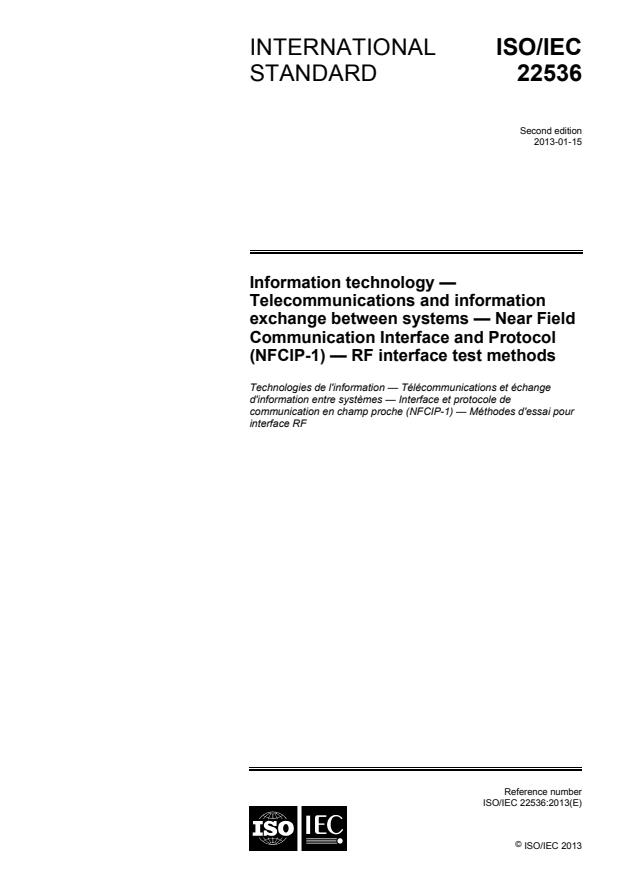
(Main)Information technology — Telecommunications and information exchange between systems — Near Field Communication Interface and Protocol (NFCIP-1) — RF interface test methods
General Information
- Abstract
ISO/IEC 22536:2013 is part of a suite of standards that specify tests for ISO/IEC 18092. It defines test methods for the RF-interface. ISO/IEC 22536:2013 specifies RF-test methods for NFCIP-1 devices with antennas fitting within the rectangular area of 50 mm by 40 mm. This test standard, the first of two parts, specifies compliance tests for the RF interface of ISO/IEC 18092 devices. The companion test standard ISO/IEC 23917 specifies protocol tests for ISO/IEC 18092.
- Status
- Published
- Publication Date
- 02-Jan-2013
- Current Stage
- 9092 - International Standard to be revised
- Start Date
- 19-Dec-2023
- Completion Date
- 29-Aug-2026
Overview
ISO/IEC 22536:2013 - Information technology - NFCIP-1 - RF interface test methods - defines standardized RF test methods for Near Field Communication Interface and Protocol (NFCIP-1) devices. It is the RF-focused part of the test suite for ISO/IEC 18092 (NFCIP-1) and applies to devices whose antennas fit within a 50 mm × 40 mm rectangular area (antenna Class 3). The standard specifies test set-up, measurement tolerances and conformance criteria used to verify RF behaviour of NFC devices.
Key topics and requirements
- Scope & conformance
- Tests apply to NFCIP-1 implementations and are mandatory for devices claiming compliance.
- Test set-up and equipment
- Required instrumentation includes a digital sampling oscilloscope, calibration coil, test assembly and a defined Reference Device for controlled field generation and reception.
- Reference Device
- Construction, dimensions and resonance tuning are specified (references made to ISO/IEC 10373-6 for detailed coil layouts and tuning procedures).
- Functional RF tests (Initiator and Target)
- Initiator tests: RF field detection threshold, field strength in active and passive modes, modulation index and waveform transmission (rise/fall times, overshoot), load-modulation reception, and optional maximum loading-effect tests.
- Target tests: Load-modulation transmission (passive mode), field strength and modulation in active mode, reception characteristics, and optional maximum loading-effect tests.
- Measurements and reporting
- Specifies measurement tolerances, spurious inductance considerations, total measurement uncertainty and required contents of the test report (pass/fail counts, sample info, dates).
- Antenna classes
- Tests are defined for Class 3 antennas; larger antennas may require Class 1 reference arrangements as per ISO/IEC 10373-6 amendments.
Applications and who uses it
- Device manufacturers perform RF compliance testing during product development to ensure NFCIP-1 devices (readers, peer-to-peer initiators/targets, embedded modules) meet RF interface requirements.
- Test laboratories and certification bodies use the test methods to produce reproducible RF test reports for regulatory compliance and interoperability.
- Product integrators and QA teams rely on these methods to validate NFC performance (field strength, modulation, detection thresholds) in contactless payment, access control, ticketing, and peer-to-peer NFC applications.
Related standards
- ISO/IEC 18092 - NFCIP-1 specification (interface & protocol)
- ISO/IEC 23917 - Protocol tests for ISO/IEC 18092 (companion standard)
- ISO/IEC 10373-6 - Test methods for proximity cards (normative references used for coils, tolerances and test assembly)
Keywords: ISO/IEC 22536:2013, NFCIP-1, RF interface test methods, NFC testing, ISO/IEC 18092, calibration coil, digital sampling oscilloscope, Reference Device, antenna Class 3, compliance testing.
Relations
- Effective Date
- 06-Aug-2011
Get Certified
Connect with accredited certification bodies for this standard

BSI Group
BSI (British Standards Institution) is the business standards company that helps organizations make excellence a habit.

NYCE
Mexican standards and certification body.
Sponsored listings
Frequently Asked Questions
ISO/IEC 22536:2013 is a standard published by the International Organization for Standardization (ISO). Its full title is "Information technology — Telecommunications and information exchange between systems — Near Field Communication Interface and Protocol (NFCIP-1) — RF interface test methods". This standard covers: ISO/IEC 22536:2013 is part of a suite of standards that specify tests for ISO/IEC 18092. It defines test methods for the RF-interface. ISO/IEC 22536:2013 specifies RF-test methods for NFCIP-1 devices with antennas fitting within the rectangular area of 50 mm by 40 mm. This test standard, the first of two parts, specifies compliance tests for the RF interface of ISO/IEC 18092 devices. The companion test standard ISO/IEC 23917 specifies protocol tests for ISO/IEC 18092.
ISO/IEC 22536:2013 is part of a suite of standards that specify tests for ISO/IEC 18092. It defines test methods for the RF-interface. ISO/IEC 22536:2013 specifies RF-test methods for NFCIP-1 devices with antennas fitting within the rectangular area of 50 mm by 40 mm. This test standard, the first of two parts, specifies compliance tests for the RF interface of ISO/IEC 18092 devices. The companion test standard ISO/IEC 23917 specifies protocol tests for ISO/IEC 18092.
ISO/IEC 22536:2013 is classified under the following ICS (International Classification for Standards) categories: 35.100.01 - Open systems interconnection in general. The ICS classification helps identify the subject area and facilitates finding related standards.
ISO/IEC 22536:2013 has the following relationships with other standards: It is inter standard links to ISO/IEC 22536:2005. Understanding these relationships helps ensure you are using the most current and applicable version of the standard.
ISO/IEC 22536:2013 is available in PDF format for immediate download after purchase. The document can be added to your cart and obtained through the secure checkout process. Digital delivery ensures instant access to the complete standard document.
Standards Content (Sample)
INTERNATIONAL ISO/IEC
STANDARD 22536
Second edition
2013-01-15
Information technology —
Telecommunications and information
exchange between systems — Near Field
Communication Interface and Protocol
(NFCIP-1) — RF interface test methods
Technologies de l'information — Télécommunications et échange
d'information entre systèmes — Interface et protocole de
communication en champ proche (NFCIP-1) — Méthodes d'essai pour
interface RF
Reference number
©
ISO/IEC 2013
© ISO/IEC 2013
All rights reserved. Unless otherwise specified, no part of this publication may be reproduced or utilized in any form or by any means,
electronic or mechanical, including photocopying and microfilm, without permission in writing from either ISO at the address below or
ISO's member body in the country of the requester.
ISO copyright office
Case postale 56 CH-1211 Geneva 20
Tel. + 41 22 749 01 11
Fax + 41 22 749 09 47
E-mail copyright@iso.org
Web www.iso.org
Published in Switzerland
ii © ISO/IEC 2013 – All rights reserved
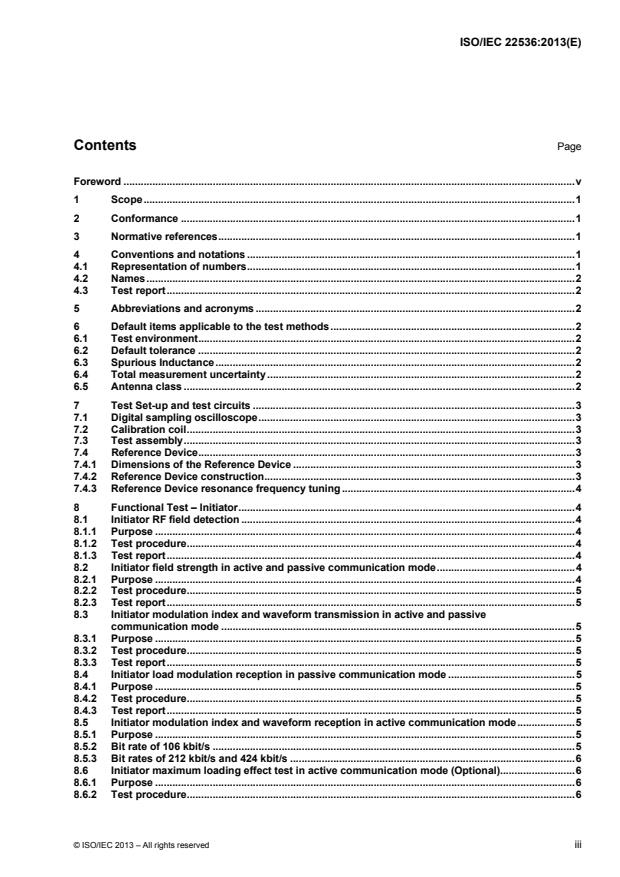
Contents Page
Foreword . v
1 Scope . 1
2 Conformance . 1
3 Normative references . 1
4 Conventions and notations . 1
4.1 Representation of numbers . 1
4.2 Names . 2
4.3 Test report . 2
5 Abbreviations and acronyms . 2
6 Default items applicable to the test methods . 2
6.1 Test environment . 2
6.2 Default tolerance . 2
6.3 Spurious Inductance . 2
6.4 Total measurement uncertainty . 2
6.5 Antenna class . 2
7 Test Set-up and test circuits . 3
7.1 Digital sampling oscilloscope . 3
7.2 Calibration coil . 3
7.3 Test assembly . 3
7.4 Reference Device . 3
7.4.1 Dimensions of the Reference Device . 3
7.4.2 Reference Device construction . 3
7.4.3 Reference Device resonance frequency tuning . 4
8 Functional Test – Initiator . 4
8.1 Initiator RF field detection . 4
8.1.1 Purpose . 4
8.1.2 Test procedure . 4
8.1.3 Test report . 4
8.2 Initiator field strength in active and passive communication mode . 4
8.2.1 Purpose . 4
8.2.2 Test procedure . 5
8.2.3 Test report . 5
8.3 Initiator modulation index and waveform transmission in active and passive
communication mode . 5
8.3.1 Purpose . 5
8.3.2 Test procedure . 5
8.3.3 Test report . 5
8.4 Initiator load modulation reception in passive communication mode . 5
8.4.1 Purpose . 5
8.4.2 Test procedure . 5
8.4.3 Test report . 5
8.5 Initiator modulation index and waveform reception in active communication mode . 5
8.5.1 Purpose . 5
8.5.2 Bit rate of 106 kbit/s . 5
8.5.3 Bit rates of 212 kbit/s and 424 kbit/s . 6
8.6 Initiator maximum loading effect test in active communication mode (Optional). 6
8.6.1 Purpose . 6
8.6.2 Test procedure . 6
© ISO/IEC 2013 – All rights reserved iii
8.6.3 Test report .6
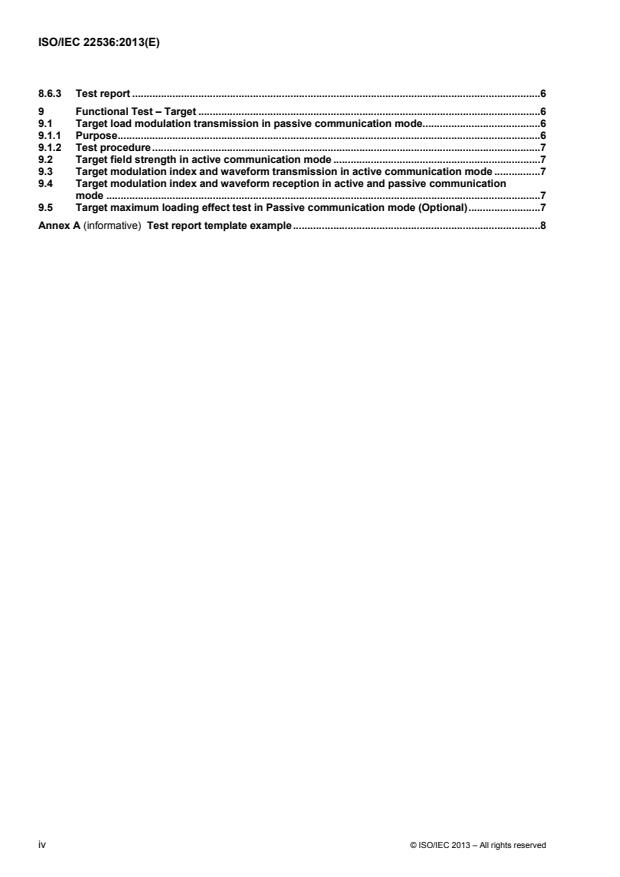
9 Functional Test – Target .6
9.1 Target load modulation transmission in passive communication mode .6
9.1.1 Purpose .6
9.1.2 Test procedure .7
9.2 Target field strength in active communication mode .7
9.3 Target modulation index and waveform transmission in active communication mode .7
9.4 Target modulation index and waveform reception in active and passive communication
mode .7
9.5 Target maximum loading effect test in Passive communication mode (Optional) .7
Annex A (informative) Test report template example .8
iv © ISO/IEC 2013 – All rights reserved
Foreword
ISO (the International Organization for Standardization) and IEC (the International Electrotechnical
Commission) form the specialized system for worldwide standardization. National bodies that are members of
ISO or IEC participate in the development of International Standards through technical committees
established by the respective organization to deal with particular fields of technical activity. ISO and IEC
technical committees collaborate in fields of mutual interest. Other international organizations, governmental
and non-governmental, in liaison with ISO and IEC, also take part in the work. In the field of information
technology, ISO and IEC have established a joint technical committee, ISO/IEC JTC 1.
International Standards are drafted in accordance with the rules given in the ISO/IEC Directives, Part 2.
The main task of the joint technical committee is to prepare International Standards. Draft International
Standards adopted by the joint technical committee are circulated to national bodies for voting. Publication as
an International Standard requires approval by at least 75 % of the national bodies casting a vote.
Attention is drawn to the possibility that some of the elements of this document may be the subject of patent
rights. ISO and IEC shall not be held responsible for identifying any or all such patent rights.
Ecma International purposefully aligned this International Standard with ISO/IEC 10373-6 to allow testing
laboratories to reuse equipment and expertise.
technology, Subcommittee SC 6, Telecommunications and information exchange between systems.
This second edition cancels and replaces the first edition (ISO/IEC 22536:2005), which has been technically
revised.
© ISO/IEC 2013 – All rights reserved v
INTERNATIONAL STANDARD ISO/IEC 22536:2013(E)
Information technology — Telecommunications and information
exchange between systems — Near Field Communication
Interface and Protocol (NFCIP-1) — RF interface test methods
1 Scope
This International Standard is part of a suite of standards that specify tests for ISO/IEC 18092. It defines test
methods for the RF-interface. This International Standard specifies RF-test methods for NFCIP-1 devices with
antennas fitting within the rectangular area of 50 mm by 40 mm.
This test standard, the first of two parts, specifies compliance tests for the RF interface of ISO/IEC 18092
devices. The companion test standard ISO/IEC 23917 specifies protocol tests for ISO/IEC 18092.
2 Conformance
A system implementing ISO/IEC 18092 is in conformance with this International Standard if it meets all the
mandatory requirements specified herein.
3 Normative references
The following referenced documents are indispensable for the application of this document. For dated
references, only the edition cited applies. For undated references, the latest edition of the referenced
document (including any amendments) applies.
ISO/IEC 18092:— , Information technology — Telecommunications and information exchange between
systems — Near Field Communication — Interface and Protocol (NFCIP-1)
ISO/IEC 10373-6:2011, Identification cards — Test methods — Part 6: Proximity cards
4 Conventions and notations
4.1 Representation of numbers
The following conventions and notations apply in this document unless otherwise stated.
Letters and digits in single quotes represent numbers in hexadecimal notation.
The value of a bit is denoted by (0)b or (1)b.
Bit patterns are represented by strings of digits 0 and 1 shown with the most significant bit to the left
within parentheses. Within such strings, X may be used to indicate that the value of a bit is not specified
within the string.
To be published.
© ISO/IEC 2013 – All rights reserved 1
4.2 Names
The names of basic elements, e.g. specific fields, are written with a capital initial letter.
4.3 Test report
The test report includes the number of passed tests versus the total number of tests, the number of different
samples and the date of the tests, see Annex A.
5 Abbreviations and acronyms
In addition to the abbreviations and acronyms in ISO/IEC 18092, the following apply.
DFT Discrete Fourier Transformation
DUT Device Under Test
fc Frequency of the operating field
fs Frequency of subcarrier at 106 kbit/s in passive communication mode
H Maximum external field strength for not preventing the Initiator to switch on its RF field
m
H Maximum field strength of the Initiator antenna field
max
H Minimum field strength of the Initiator antenna field
min
H Minimum field strength for the RF level detector
Threshold
PCB Printed Circuit Board
RF Radio Frequency
6 Default items applicable to the test methods
6.1 Test environment
See 4.1 of ISO/IEC 10373-6.
6.2 Default tolerance
See 4.3 of ISO/IEC 10373-6.
6.3 Spurious Inductance
See 4.4 of ISO/IEC 10373-6.
6.4 Total measurement uncertainty
See 4.5 of ISO/IEC 10373-6.
6.5 Antenna class
Tests shall be executed for class 3 antenna as specified in ISO/IEC 10373-6:2010/Amd.1.
NOTE When the antenna size used for NFCIP-1 device is larger than “Class 3” antenna, “Class 1” antenna as
specified in ISO/IEC 10373-6:2011/Amd.1 may be used in addition to “Class 3” antenna.
2 © ISO/IEC 2013 – All rights reserved
7 Test Set-up and test circuits
The test set-up includes:
Digital sam
...