


ISO 18581
(Main)Compressed natural gas (CNG) and liquefied natural gas (LNG) equipment and accessories - CNG and LNG propulsion systems for small craft - Installation requirements
Compressed natural gas (CNG) and liquefied natural gas (LNG) equipment and accessories - CNG and LNG propulsion systems for small craft - Installation requirements
This International Standard specifies the requirements for the CNG/LNG propulsion systems and components installation on small crafts, including those defined by Directive 2013/53/EU. This International Standard does not cover appliances with directly attached gas cylinders, such as portable
Équipements et accessoires pour le gaz naturel comprimé (GNC) et le gaz naturel liquéfié (GNL) — Systèmes de propulsion au GNC et au GNL pour petits bateaux — Exigences d'installation
General Information
- Status
- Not Published
- Technical Committee
- ISO/TC 22 - Road vehicles
- Drafting Committee
- ISO/TC 22 - Road vehicles
- Current Stage
- 6000 - International Standard under publication
- Start Date
- 04-Dec-2025
- Completion Date
- 10-Jan-2026
Overview
ISO 18581:2025 is an international standard developed by the International Organization for Standardization (ISO) that specifies installation requirements for compressed natural gas (CNG) and liquefied natural gas (LNG) propulsion systems on small craft. This standard addresses critical safety and performance considerations for integrating gaseous fuel systems into marine vessels, helping manufacturers, installers, and operators adhere to best practices and regulatory compliance, such as Directive 2013/53/EU.
The standard focuses exclusively on fixed CNG/LNG systems used for propulsion and excludes appliances with directly attached gas cylinders like portable devices. Its comprehensive scope ranges from component specifications to testing and commissioning protocols, emphasizing safe installation while minimizing environmental and health risks related to the use of gaseous fuels.
Key Topics
Installation Requirements
Detailed mandates for installing propulsion system components, including CNG cylinders and LNG containers, fuel system parts, gas pipes, hoses, and electrical wiring to ensure safety and operational integrity.Component Specifications
Outlines requirements for individual system elements such as high-pressure cylinders (ISO 11439), LNG storage tanks, refuelling connectors (ISO 14469, ISO 12617), valves, and sensors to maintain compatibility and reliability.Safety Measures
Covers essential safeguards including gas detection, forced ventilation, fire extinguishing equipment, and the implementation of automatic and excess flow valves to prevent leaks, explosions, or fires on board.Installation by Qualified Personnel
Specifies the competence criteria for system installers to guarantee proper assembly and compliance with safety: only a qualified person with appropriate certification should conduct installations.Testing and Commissioning
Includes protocols for tightness and leakage tests, initial filling of fuel containers, fuel system operational checks, and water trials to validate installation integrity before vessel use.Owner Guidance and Documentation
Mandates the preparation of a detailed owner’s manual and installation certificates, ensuring that boat operators receive essential information for safe operation, maintenance, and emergency procedures.
Applications
ISO 18581:2025 is designed primarily for manufacturers and installers of small watercraft propulsion systems that utilize CNG or LNG fuels. Its practical applications include:
Manufacturing and Retrofitting
Helps manufacturers integrate environmentally cleaner gaseous fuel propulsion systems during vessel production or retrofit existing crafts to CNG/LNG specifications under stringent safety regimes.Regulatory Compliance
Enables small craft builders and operators to meet EU directives and international maritime safety regulations regarding gaseous fuel use, thereby enhancing market access and operational legitimacy.Safety Engineering
Supports naval architects, marine engineers, and safety inspectors in assessing installations for conformity with industry standards to reduce risks of fuel leaks, fires, and gas exposure onboard.Environmental Sustainability
Facilitates the adoption of natural gas propulsion technologies, promoting lower emissions and alignment with circular economy principles in maritime transport.
Related Standards
Installation practices under ISO 18581:2025 should be considered in tandem with several complementary standards to ensure a holistic approach to gaseous fuel systems on small craft:
- ISO 11439: High-pressure gas cylinders for on-board storage of natural gas as a fuel for vehicles
- ISO 12991: Cryogenic LNG tanks for onboard fuel storage
- ISO 12614 & ISO 12617: Components and connectors for LNG fuel systems
- ISO 14469 & ISO 15500: Refuelling connectors and CNG fuel system components
- ISO 13297: Electrical system installations for small craft
- ISO 9094: Fire protection for small craft
- ISO 10240: Owner's manual requirements for small craft
- EN 14291: Leak detection foam solutions
- EN 28846: Electrical device protection against gas ignition
- EN 3-7: Portable fire extinguisher performance requirements
Adhering to ISO 18581 and these associated standards ensures a safe, reliable, and environmentally responsible installation of CNG and LNG propulsion systems, facilitating the marine industry's shift towards greener fuel technologies for small vessels.

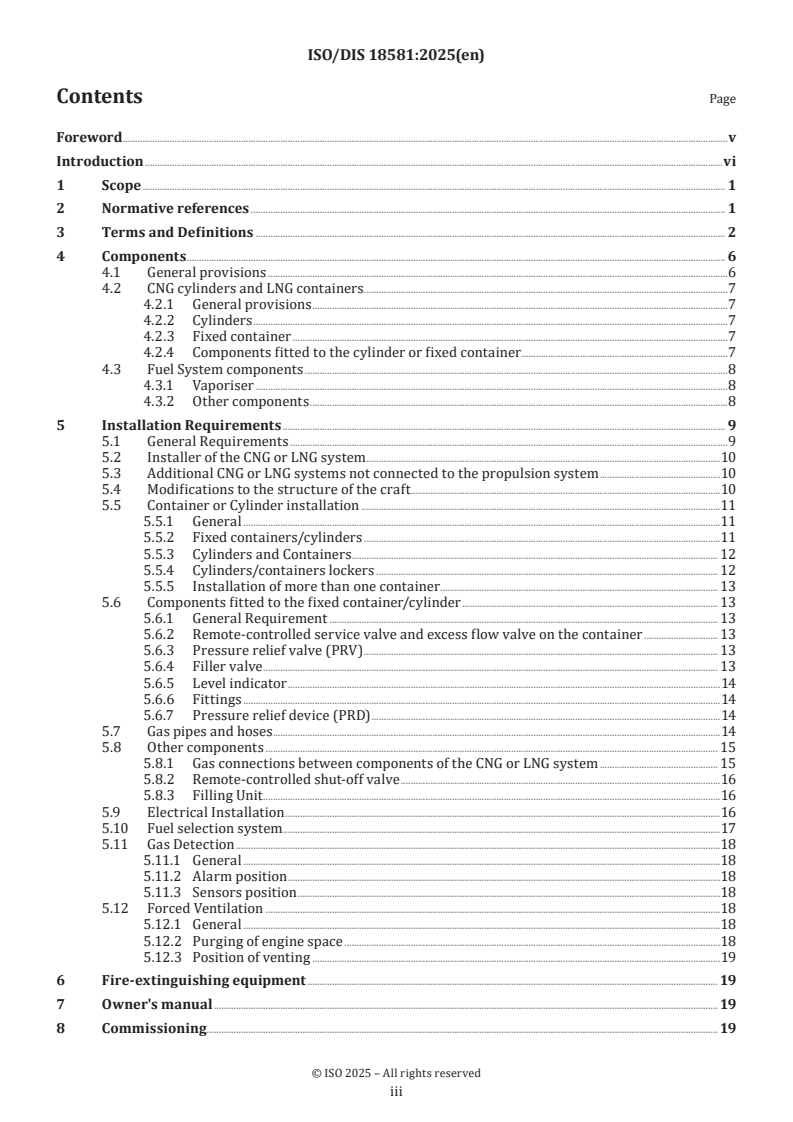
ISO/CD 18581 - CNG and LNG equipment and accessories — CNG and LNG propulsion system for small craft — installation requirements Released:11/30/2024

ISO/FDIS 18581 - Compressed natural gas (CNG) and liquefied natural gas (LNG) equipment and accessories — CNG and LNG propulsion systems for small craft — Installation requirements Released:9/24/2025
REDLINE ISO/FDIS 18581 - Compressed natural gas (CNG) and liquefied natural gas (LNG) equipment and accessories — CNG and LNG propulsion systems for small craft — Installation requirements Released:9/24/2025
Frequently Asked Questions
ISO 18581 is a draft published by the International Organization for Standardization (ISO). Its full title is "Compressed natural gas (CNG) and liquefied natural gas (LNG) equipment and accessories - CNG and LNG propulsion systems for small craft - Installation requirements". This standard covers: This International Standard specifies the requirements for the CNG/LNG propulsion systems and components installation on small crafts, including those defined by Directive 2013/53/EU. This International Standard does not cover appliances with directly attached gas cylinders, such as portable
This International Standard specifies the requirements for the CNG/LNG propulsion systems and components installation on small crafts, including those defined by Directive 2013/53/EU. This International Standard does not cover appliances with directly attached gas cylinders, such as portable
ISO 18581 is classified under the following ICS (International Classification for Standards) categories: 47.020.20 - Marine engines and propulsion systems. The ICS classification helps identify the subject area and facilitates finding related standards.
ISO 18581 is available in PDF format for immediate download after purchase. The document can be added to your cart and obtained through the secure checkout process. Digital delivery ensures instant access to the complete standard document.
Standards Content (Sample)
DRAFT
International
Standard
ISO/DIS 18581
ISO/TC 22/SC 41
CNG and LNG equipment and
Secretariat: UNI
accessories — CNG and LNG
Voting begins on:
propulsion system for small craft —
2025-01-27
installation requirements
Voting terminates on:
2025-04-21
Equipements et accessoires pour le GNC et le GNL- Système de
propulsion au GNC et au GNL pour les petites embarcations —
Exigences d'installation
ICS: 47.020.20
THIS DOCUMENT IS A DRAFT CIRCULATED
FOR COMMENTS AND APPROVAL. IT
IS THEREFORE SUBJECT TO CHANGE
AND MAY NOT BE REFERRED TO AS AN
INTERNATIONAL STANDARD UNTIL
PUBLISHED AS SUCH.
IN ADDITION TO THEIR EVALUATION AS
BEING ACCEPTABLE FOR INDUSTRIAL,
TECHNOLOGICAL, COMMERCIAL AND
USER PURPOSES, DRAFT INTERNATIONAL
STANDARDS MAY ON OCCASION HAVE TO
This document is circulated as received from the committee secretariat.
BE CONSIDERED IN THE LIGHT OF THEIR
POTENTIAL TO BECOME STANDARDS TO
WHICH REFERENCE MAY BE MADE IN
NATIONAL REGULATIONS.
RECIPIENTS OF THIS DRAFT ARE INVITED
TO SUBMIT, WITH THEIR COMMENTS,
NOTIFICATION OF ANY RELEVANT PATENT
RIGHTS OF WHICH THEY ARE AWARE AND TO
PROVIDE SUPPORTING DOCUMENTATION.
Reference number
ISO/DIS 18581:2025(en)
DRAFT
ISO/DIS 18581:2025(en)
International
Standard
ISO/DIS 18581
ISO/TC 22/SC 41
CNG and LNG equipment and
Secretariat: UNI
accessories — CNG and LNG
Voting begins on:
propulsion system for small craft —
installation requirements
Voting terminates on:
Equipements et accessoires pour le GNC et le GNL- Système de
propulsion au GNC et au GNL pour les petites embarcations —
Exigences d'installation
ICS: 47.020.20
THIS DOCUMENT IS A DRAFT CIRCULATED
FOR COMMENTS AND APPROVAL. IT
IS THEREFORE SUBJECT TO CHANGE
AND MAY NOT BE REFERRED TO AS AN
INTERNATIONAL STANDARD UNTIL
PUBLISHED AS SUCH.
IN ADDITION TO THEIR EVALUATION AS
BEING ACCEPTABLE FOR INDUSTRIAL,
© ISO 2025
TECHNOLOGICAL, COMMERCIAL AND
USER PURPOSES, DRAFT INTERNATIONAL
All rights reserved. Unless otherwise specified, or required in the context of its implementation, no part of this publication may
STANDARDS MAY ON OCCASION HAVE TO
be reproduced or utilized otherwise in any form or by any means, electronic or mechanical, including photocopying, or posting on
This document is circulated as received from the committee secretariat. BE CONSIDERED IN THE LIGHT OF THEIR
the internet or an intranet, without prior written permission. Permission can be requested from either ISO at the address below
POTENTIAL TO BECOME STANDARDS TO
WHICH REFERENCE MAY BE MADE IN
or ISO’s member body in the country of the requester.
NATIONAL REGULATIONS.
ISO copyright office
RECIPIENTS OF THIS DRAFT ARE INVITED
CP 401 • Ch. de Blandonnet 8
TO SUBMIT, WITH THEIR COMMENTS,
CH-1214 Vernier, Geneva
NOTIFICATION OF ANY RELEVANT PATENT
Phone: +41 22 749 01 11
RIGHTS OF WHICH THEY ARE AWARE AND TO
PROVIDE SUPPORTING DOCUMENTATION.
Email: copyright@iso.org
Website: www.iso.org
Published in Switzerland Reference number
ISO/DIS 18581:2025(en)
ii
ISO/DIS 18581:2025(en)
Contents Page
Foreword .v
Introduction .vi
1 Scope . 1
2 Normative references . 1
3 Terms and Definitions . 2
4 Components . 6
4.1 General provisions .6
4.2 CNG cylinders and LNG containers . .7
4.2.1 General provisions .7
4.2.2 Cylinders .7
4.2.3 Fixed container .7
4.2.4 Components fitted to the cylinder or fixed container .7
4.3 Fuel System components .8
4.3.1 Vaporiser .8
4.3.2 Other components .8
5 Installation Requirements . 9
5.1 General Requirements .9
5.2 Installer of the CNG or LNG system .10
5.3 Additional CNG or LNG systems not connected to the propulsion system .10
5.4 Modifications to the structure of the craft.10
5.5 Container or Cylinder installation .11
5.5.1 General .11
5.5.2 Fixed containers/cylinders .11
5.5.3 Cylinders and Containers . . . 12
5.5.4 Cylinders/containers lockers . 12
5.5.5 Installation of more than one container . 13
5.6 Components fitted to the fixed container/cylinder . 13
5.6.1 General Requirement . 13
5.6.2 Remote-controlled service valve and excess flow valve on the container . 13
5.6.3 Pressure relief valve (PRV) . 13
5.6.4 Filler valve . 13
5.6.5 Level indicator .14
5.6.6 Fittings .14
5.6.7 Pressure relief device (PRD) .14
5.7 Gas pipes and hoses .14
5.8 Other components . 15
5.8.1 Gas connections between components of the CNG or LNG system . 15
5.8.2 Remote-controlled shut-off valve .16
5.8.3 Filling Unit .16
5.9 Electrical Installation .16
5.10 Fuel selection system .17
5.11 Gas Detection .18
5.11.1 General .18
5.11.2 Alarm position .18
5.11.3 Sensors position .18
5.12 Forced Ventilation .18
5.12.1 General .18
5.12.2 Purging of engine space .18
5.12.3 Position of venting .19
6 Fire-extinguishing equipment . 19
7 Owner's manual . 19
8 Commissioning. 19
iii
ISO/DIS 18581:2025(en)
8.1 Tightness test .19
8.2 Leakage test .19
8.3 Initial filling of the container/cylinder and the system with LNG/CNG . 20
8.4 Fuel System test . 20
8.5 Water trial. 20
Annex A (normative) Fixing requirements for containers with a capacity up to and including
150 l.21
Annex B (normative) Fixing requirements for containers/cylinders with a capacity over 150 l .23
Annex C (normative) Cylinder/container securing requirements .24
Annex D (normative) Owner's manual .27
Annex E (normative) Additional test requirements for vaporisers .30
Annex F (informative) Installation of more than one container .31
Annex G (informative) Example of installation certificate .33
Annex H (informative) Example CNG or LNG identification label .34
Bibliography .36
iv
ISO/DIS 18581:2025(en)
Foreword
ISO (the International Organization for Standardization) is a worldwide federation of national standards
bodies (ISO member bodies). The work of preparing International Standards is normally carried out through
ISO technical committees. Each member body interested in a subject for which a technical committee
has been established has the right to be represented on that committee. International organizations,
governmental and non-governmental, in liaison with ISO, also take part in the work. ISO collaborates closely
with the International Electrotechnical Commission (IEC) on all matters of electrotechnical standardization.
The procedures used to develop this document and those intended for its further maintenance are described
in the ISO/IEC Directives, Part 1. In particular, the different approval criteria needed for the different types
of ISO document should be noted. This document was drafted in accordance with the editorial rules of the
ISO/IEC Directives, Part 2 (see www.iso.org/directives).
ISO draws attention to the possibility that the implementation of this document may involve the use of (a)
patent(s). ISO takes no position concerning the evidence, validity or applicability of any claimed patent
rights in respect thereof. As of the date of publication of this document, ISO had not received notice of (a)
patent(s) which may be required to implement this document. However, implementers are cautioned that
this may not represent the latest information, which may be obtained from the patent database available at
www.iso.org/patents. ISO shall not be held responsible for identifying any or all such patent rights.
Any trade name used in this document is information given for the convenience of users and does not
constitute an endorsement.
For an explanation of the voluntary nature of standards, the meaning of ISO specific terms and expressions
related to conformity assessment, as well as information about ISO's adherence to the World Trade
Organization (WTO) principles in the Technical Barriers to Trade (TBT), see www.iso.org/iso/foreword.html.
This document was prepared by Technical Committee ISO/TC 22, Road vehicles, Subcommittee SC 41, Specific
aspects for gaseous fuels.
Any feedback or questions on this document should be directed to the user’s national standards body. A
complete listing of these bodies can be found at www.iso.org/members.html.
v
ISO/DIS 18581:2025(en)
Introduction
This document specifies requirements for the installation of equipment for the use of Compressed Natural
Gas (hereafter referred to as CNG) and Liquified Natural Gas (hereafter referred to as LNG) in the propulsion
systems for small crafts.
This document includes procedures which the use substances and procedures that can be injurious to health
if adequate precautions are not taken. This document refers only to technical suitability.
Natural gas, either in gaseous (CNG) or liquid phase (LNG), is a very efficient and ready-to-use solution which
can facilitate compliance with the more stringent environmental regulations as well as the compliance with
the principles of the circular economy. In this context, regulations can concern the impact of a product on the
environment during its entire life cycle, including the expenditure of energy and during all phases such as
use, scrapping and recycling of materials. Some parts of this document address also environmental aspects.
vi
DRAFT International Standard ISO/DIS 18581:2025(en)
CNG and LNG equipment and accessories — CNG and LNG
propulsion system for small craft — installation requirements
1 Scope
This document specifies the requirements for the installation of compressed natural gas (CNG) and liquefied
natural gas (LNG) propulsion systems and components on small crafts.
This document does not cover appliances with directly attached gas cylinders, such as portable container.
2 Normative references
The following documents are referred to in the text in such a way that some or all of their content constitutes
requirements of this document. For dated references, only the edition cited applies. For undated references,
the latest edition of the referenced document (including any amendments) applies.
ISO 630, Structural steels — Plates, wide flats, bars, sections and profiles
ISO 11439, Gas cylinders — High pressure cylinders for the on-board storage of natural gas as a fuel for
automotive vehicles
ISO 12991, Liquefied natural gas (LNG) — Tanks for on-board storage as a fuel for automotive vehicles
ISO 12614, Road vehicles — Liquefied natural gas (LNG) fuel system components
ISO 12617:2015, Road vehicles — Liquefied natural gas (LNG) refuelling connector — 3,1 MPa connector
ISO 14469, Road vehicles — Compressed natural gas (CNG) refuelling connector
ISO 15500, Road vehicles — Compressed natural gas (CNG) fuel system components
EN 14291, Foam producing solutions for leak detection on gas installations
EN 28846, Small craft — Electrical devices — Protection against ignition of surrounding flammable gases
EN 60529, Degrees of protection provided by enclosures (IP Code) (IEC 60529:1989)
ISO 898-1, Mechanical properties of fasteners made of carbon steel and alloy steel — Part 1: Bolts, screws and
studs with specified property classes — Coarse thread and fine pitch thread
ISO 9094-1, Small craft — Fire protection — Part 1: Craft with a hull length of up to and including 15 m
ISO 9094-2, Small craft — Fire protection — Part 2: Craft with a hull length of over 15 m
ISO 10133, Small craft — Electrical systems — Extra-low-voltage d.c. installations
ISO 10239, Small craft — Liquefied petroleum gas (LPG) systems
ISO 10240, Small craft — Owner's manual
ISO 11105, Small craft — Ventilation of petrol engine and/or petrol tank compartments
ISO 11591, Small craft — Field of vision from the steering position
EN ISO 12217 (all parts), Small craft — Stability and buoyancy assessment and categorization
ISO 13297, Small craft — Electrical systems — Alternating and direct current installations
ISO/DIS 18581:2025(en)
3 Terms and Definitions
For the purposes of this document, the terms and definitions given in EN 12806:2003 and the following apply.
ISO and IEC maintain terminology databases for use in standardization at the following addresses:
— ISO Online Browsing Platform: available at https:// www .iso .org/ obp
— IEC Electropedia: available at https:// www .electropedia .org/
3.1
accessible
capable of being reached for inspection, removal or maintenance without removal of permanent craft
structures
Note 1 to entry: Hatches are not regarded as permanent craft structures in this sense, even if tools such as wrenches
or screwdrivers are needed to open them.
3.2
appliance
appliance that is designed for heating, cooking, lighting, refrigeration, hot water production or electricity
production (fuel cell or generator), using natural gas as its energy source
3.3
automatic cylinder valve
automatic valve rigidly fixed to the cylinder which controls the flow of gas to the fuel system
3.4
automatic valve
valve which is not operated manually
3.5
bi-fuel engine
Engine that has two independent fuel systems (one of them for natural gas) and can run alternatively on
either fuel, but only on one at a time
3.6
Capacitive Fuel Content Indicator
Fuel content indicator based on the ratio of mass to natural gas capacity
3.7
check valve
automatic valve (3.4) which allows gas to flow in only one direction
3.8
cockpit
area that may retain water, however briefly, due to rain, waves, boat heeling, etc.
Note 1 to entry: Cockpits are normally designed for accommodation of people but, for the purpose of this Standard,
the term "cockpit” is used either for a proper cockpit or for any recess. This means that bulwarks may create a large
cockpit, open boats can effectively comprise a cockpit which includes nearly all the boat, cockpit(s) can be situated
anywhere in the boat and a cockpit can open aft to the sea.
3.9
CNG propulsion system
fuel system which includes cylinder or cylinders according to ISO 11439, the assembly, one or more refuelling
connectors according to ISO 14469, and the components described in the standards from ISO 15500-3 to
ISO 15500-20.
Note 1 to entry: Cylinders are replaceable items and may not be supplied with the boat system
ISO/DIS 18581:2025(en)
3.10
qualified person
individual subjected to a qualification process, and who has passed the qualification
[SOURCE: ISO 23684:2023, 3.26]
3.11
compressed natural gas CNG
natural gas which has been compressed and stored for use as a fuel
3.12
Connector
fittings used to join a conduit, tubing, or hose systems
3.13
container
cryogenic vessel used for the storage of liquefied natural gas (LNG)
3.14
container housing
ventilated enclosure intended solely for storage of one or more CNG cylinders or LNG containers, pressure
regulators and safety devices and located on the exterior of the boat where any leakage would flow overboard
3.15
container locker
gas-tight (to the craft) enclosure with an overboard drain, where any leakage would flow overboard, intended
solely for storage of one or more CNG cylinders or LNG containers in a cockpit or recessed into the craft
3.16
cylinder
transportable, refillable container with a water capacity from 0,5 l up to and including 150 l for the
storage of CNG
3.17
design pressure
highest pressure related to the circumstances for which the system has been designed and is intended to be used
3.18
dual-fuel engine
engine system that is designed to simultaneously operate with liquid fuel and a gaseous fuel, both fuels
being metered separately, where the consumed amount of one of the fuels relative to the other one may vary
depending on the operation
[SOURCE: ISO 8178-4:2020, 3.17]
3.19
excess flow valve
valve which automatically shuts off, or limits, the gas flow when the flow exceeds a set design value
3.20
filler valve
valve system for fill service
3.21
filter
component containing a screen or media that is intended to remove foreign debris from the gas stream
3.22
fixed container
CNG cylinder or LNG container permanently installed to the structure of the craft
ISO/DIS 18581:2025(en)
3.23
flexible fuel line
flexible tubing or hose through which natural gas flows
3.24
fuel rail
pipe or duct that connects the gas injectors
3.25
gas/air mixer
device for mixing the gaseous fuel and intake air for the engine
3.26
gas detection
revealing of the presence of NG due to exposure outside the NG containment system
3.27
gas flow adjuster
gas flow restricting device, installed downstream of a pressure regulator, controlling gas flow to the engine
3.28
gas injector
device for introducing gaseous fuel into the engine or associated intake system
3.29
gas-tight housing
device which vents gas leakage to outside the vehicle including the gas ventilation hose, the clear opening of
which is at least 450 mm
3.30
inspection body
independent inspection and testing body approved by the qualified authority
3.31
installer
person or organisation, who by qualification, training, experience and resources can assume technical
responsibility for the installation of the CNG and LNG propulsion system
3.32
level indicator
fuel content gauge based on the pressure difference between the top and bottom of the container.
Note 1 to entry: The system measures the weight of the liquid in case of LNG
Note 2 to entry: other systems can be used to measure the level of LNG inside the tanks.
3.33
liquefied natural gas (LNG)
natural gas which has been liquefied after processing for storage, transportation, or use as a fuel
[SOURCE: ISO 12614-1:2021, 3.11]
3.34
LNG propulsion system
Liquefied natural gas fuel system which includes container(s) according to ISO 12991, mounting, one or
more fuelling connectors and the components described in this standard
Note 1 to entry: LNG containers are replaceable items and may not be supplied with the boat system
Note 2 to entry: See ISO 12991 for further details on containers; see ISO 21593 for further details on connectors; and
see ISO 22547 and ISO 22548 for details on the components described.
ISO/DIS 18581:2025(en)
3.35
manual valve
valve which is operated manually and controls the flow of gas to the fuel system
3.36
manual cylinder valve
manual valve rigidly fixed to the cylinder
3.37
mono-fuel engine
Engine which operates on natural gas only
3.38
Natural gas
Complex gaseous mixture of hydrocarbons primarily methane, but generally includes ethane, propane and
higher hydrocarbons, and some non-combustible gases such as nitrogen and carbon dioxide.
3.39
permanently installed
securely fastened so that tools have to be used for removal
3.40
pressure indicator
pressurized device that indicates the gas pressure; it can be an indicator or a sensor
3.41
pressure regulator
device used to control the delivery pressure of gaseous fuel to the engine
3.42
pressure relief device PRD
safety device that releases gases or liquids above a specified pressure value in cases of emergency or
abnormal conditions
Note 1 to entry: PRDs can be activated by pressure or another parameter, such as temperature, and can be either
re-closing devices (such as valves) or non-re-closing devices (such as rupture disks and fusible plugs). Common
designations for these specific types of PRDs are as follows:
— Pressure safety valve (PSV) — pressure activated valve that opens at specified set point to protect a system from
rupture and re-closes when the pressure falls below the set point.
— Thermally-activated pressure relief device (TPRD) — a PRD that opens at a specified temperature to protect a
system from rupture and remains open.
[SOURCE: ISO 19880-1:2020, 3.59, modified — Note 2 to entry removed.]
3.43
pressure relief valve (discharge valve) PRV
self-closing device which opens to prevent a pre-determined pressure being exceeded
3.44
quality management system
the organization framework whose structure provides the policies, processes, procedures, and resources
required to implement the quality management plan
Note 1 to entry: The typical project quality management plan should be compatible to the organization's quality
management system.
[SOURCE: ISO 9000:2015, 3.5.4, modified; ISO/IEC 30105-4:2016 3.41]
ISO/DIS 18581:2025(en)
3.45
readily accessible
capable of being reached for operation, inspection or maintenance without the removal of any craft structure
or the use of any tools or the removal of any item of portable equipment stowed in places intended for storage
of portable equipment such as lockers, drawers or shelves
Note 1 to entry: Hatches are not regarded as permanent craft structures in this sense.
3.46
rigid fuel line
tubing which has been designed not to flex in normal operation and through which natural gas flows
3.47
service valve
manual valve which is closed only when servicing the engine
3.48
shut-off valve
valve to provide a leak-tight seal which is operated either manually, remotely or is self-closing
3.49
valve
device by which the flow of a fluid may be controlled
3.50
vaporiser
device intended to vaporise the cryogenic liquid fuel to a gaseous state with a gas range from -40 °C to +85 °C
3.51
ventilation system
assembly of ducts and an electrical ventilator that is capable of extracting hydrocarbons from the inside of
the craft and allowing the entrance of fresh air
3.52
venting tube
duct that connects the gas-tight housing to the atmosphere
4 Components
4.1 General provisions
4.1.1 All operations on the CNG and LNG systems and propulsion systems shall be operated by a
qualified person.
4.1.2 Individual components of the system, and the system as a whole, shall be designed to withstand
the combined conditions of pressure, vibration, shocks, corrosion and movement encountered under normal
operation.
4.1.3 All materials used in CNG or LNG systems shall be compatible with CNG and LNG and with other
liquids or compounds with which it might come into contact under normal operating conditions, e.g. grease,
lubricating oil, bilge solvents, fresh and sea water.
4.1.4 Efforts should be made to prevent grease, lubricating oil, bilge solvents and other chemicals
contaminating the marine environment.
ISO/DIS 18581:2025(en)
4.2 CNG cylinders and LNG containers
4.2.1 General provisions
The CNG cylinders and LNG container(s) shall be protected from corrosion in the marine environment by an
adequate surface treatment system, or be constructed from materials suitable for the marine environment.
For the purpose of this document, two types of NG containers are identified:
— cylinders; and
— fixed containers.
4.2.2 Cylinders
4.2.2.1 CNG cylinders can be used to fuel the engine of a craft in gaseous phase depending on the choice of
technology (e.g. mono fuel, bi-fuel, dual-fuel) and the required power.
4.2.2.2 The cylinders used on craft shall conform to ISO 11439.
4.2.2.3 The quantity of fuel on board shall be indicated by the use a pressure indicator
4.2.2.4 A PRV shall be fitted to any cylinder.
4.2.3 Fixed container
4.2.3.1 Fixed containers shall conform to ISO 12991.
4.2.3.2 The quantity of fuel on board shall be indicated by the use of a level indicator.
4.2.3.3 A primary and secondary PRV shall be fitted to any container.
4.2.4 Components fitted to the cylinder or fixed container
4.2.4.1 The cylinders shall be equipped with the following components, which can be either separate or
combined (e.g. multivalve):
a) Filler valve;
b) Manual valve;
c) Automatic valve;
d) Pressure indicator;
e) Pressure Relief Device (PRD);
f) Excess flow valve.
4.2.4.2 The cylinders can be equipped with a:
a) Gas-tight housing; or
b) Pressure relief valve (PRV).
4.2.4.3 All components fitted to the container shall conform with the applicable part of ISO 15500 series.
ISO/DIS 18581:2025(en)
4.2.4.4 Containers shall be equipped with the following components, either separated or combined
a) Filler valve;
b) Manual valve;
c) Automatic valve;
d) Level indicator;
e) Pressure Relief Device (PRD);
f) Excess flow valve;
g) Pressure regulator;
h) Pressure relief valve (PRV) primary or secondary;
i) Check valve;
j) Excess flow valve.
4.2.4.5 All components fitted to the container shall conform to the applicable part of ISO 12614 series.
4.3 Fuel System components
4.3.1 Vaporiser
4.3.1.1 The vaporiser shall conform with ISO 12614-16 and shall be suitable for use in the marine
environment with anticorrosion treatment and stainless-steel bolts.
4.3.1.2 The materials of the vaporiser, which are in contact with the engine coolant, shall be compatible
with the coolant and shall be designed to withstand a working pressure as per ISO 12614-16.
4.3.1.3 An additional test procedure for metal vaporizers, in the case of using the vaporizer with open
circuit and heat exchange with sea water, is indicated in Annex E
4.3.2 Other components
The following components of the CNG fuel system, where used, shall conform with the following parts of the
ISO 15500 series:
— the gas injector shall be in accordance with ISO 15500-7;
— the pressure regulator shall be in accordance with ISO 15500-9;
— the gas flow adjuster shall be in accordance with ISO 15500-10;
— the gas/air mixer shall be in accordance with ISO 15500-11;
— PRV shall be in accordance with ISO 15500-12;
— rigid fuel lines in stainless steel shall be in accordance with ISO 15500-16;
— flexible fuel lines shall be in accordance with ISO 15500-17;
— the filter shall be in accordance with ISO 15500-18;
— fittings shall be in accordance with ISO 15500-19;
— rigid fuel lines in material other than stainless steel shall be in accordance with ISO 15500-20.
ISO/DIS 18581:2025(en)
These components shall also be suitable for use in the marine environment.
The following components of the LNG fuel system, where used, shall conform with the following part of
ISO 12614 series::
— the overpressure regulator shall be in accordance with ISO 12614-6;
— rigid fuel lines in stainless steel shall be in accordance with ISO 12614-10;
— fittings shall be in accordance with ISO 12614-11;
— rigid fuel lines in copper and its alloys shall be in accordance with ISO 12614-12.
These components shall also be suitable for use in the marine environment.
5 Installation Requirements
5.1 General Requirements
5.1.1 The CNG or LNG system shall be installed by a qualified person taking into account manufacturers’
instructions and sound engineering practice.
5.1.2 All parts of the CNG or LNG system, shall be permanently installed.
5.1.3 All parts of the CNG or LNG system shall be securely fastened.
5.1.4 The completed CNG or LNG system shall be adequately protected against corrosion.
5.1.5 All valves and other components intended to be manually operated, or observed during normal
operation of the craft, or for emergency purposes, shall be readily accessible.
5.1.6 All other components of the CNG or LNG system shall be accessible.
5.1.7 No component of the fuel system shall be located within 100 mm of the exhaust, unless adequate
shielding against heat is provided.
5.1.8 Clearance between dry exhaust components and an LNG container or CNG cylinder shall not be less
than 250 mm, unless an equivalent thermal barrier is provided.
5.1.9 Fuel containers andcylinders and components of fuel systems shall not be installed directly above
batteries, unless the batteries are protected against the effects of fuel leakage.
5.1.10 The fuel system shall function in such a manner that the pressure for which it has been designed and
approved cannot be exceeded.
5.1.11 The fuel system shall be adequately protected against every kind of damage (e.g. those caused by the
movement of the goods stored on board).
5.1.12 No component of the CNG or LNG system shall obstruct the field of vision from the helm position in
accordance with the requirements of EN ISO 11591.
5.1.13 Permanent and clearly visible labels indicating CNG or LNG shall be fixed on one or more of the
following locations:
— on or close to the engine(s);
ISO/DIS 18581:2025(en)
— on or adjacent to the container housing(s);
— on or close to container/cylinder lockers(s); and
— on the exterior of the craft.
NOTE Annex H provides an example of a suitable label.
5.2 Installer of the CNG or LNG system
5.2.1 The installer shall possess the competence and expertise necessary for the proper installation of the
CNG or LNG system and ensures that the installation of the system meets the requirements of this document.
The competence and expertise of the installer is assumed if the installation activities are made by or under
the control of a technical manager qualified in accordance with ISO 23684 and ISO 24671.
5.2.2 The installer shall install components in accordance with the manufacturer's instructions or other
limitations.
5.2.3 The installer shall endeavour to minimize wastage of materials used and shall dispose of surplus
materials in an environmentally friendly manner.
5.2.4 Material segregation bins should be used for recycling materials.
5.2.5 The installer shall maintain records of the commissioning tests as detailed in Clause 8.
5.2.6 The installer shall issue a signed installation certificate incorporating a certificate of conformity to
this document upon satisfactory completion of the CNG or LNG system installation and commissioning.
NOTE An example of an installation certificate is given in Annex G.
5.2.7 The installer shall supply an owner's manual for the CNG or LNG system as per Clause 7.
5.3 Additional CNG or LNG systems not connected to the propulsion system
The operation of the propulsion system shall not be affected by the introduction of additional CNG or LNG
systems.
5.4 Modifications to the structure of the craft
5.4.1 Any alteration or modification to any craft resulting from the installation of CNG or LNG equipment
shall be carried out in accordance with sound engineering practices.
5.4.2 The installation of CNG cylinders/LNG containers shall not adversely affect the stability and
buoyancy of the craft when evaluated in accordance with ISO 12217-1, ISO 12217-2 and ISO 12217-3.
5.4.3 Where any substantial modification is made to the craft structure to facilitate the installation
of the fuel system, a written agreement, accompanied by a detailed drawing, shall be obtained from the
manufacturer of the craft or a notified body.
ISO/DIS 18581:2025(en)
5.5 Container or Cylinder installation
5.5.1 General
5.5.1.1 The container or cylinder shall:
— be stowed either in the open air or in a container locker;
— not be stowed in the engine compartment, unless in a container locker (see 5.5.4);
— not be stowed in accommodation spaces;
— be securely fastened to the craft;
— be installed in the correct orientation according to the container manufacturer instructions;
— be installed in such a manner that it does not form an obstruction;
— be installed in such a way that provisions for escape in the event of fire or inversion, or both, are not
negatively affected; and
— allow drainage from their surfaces when the craft is in its static flotation position.
5.5.1.2 When stored in open air CNG cylinder/ LNG containers, pressure regulators and safety devices
shall be shielded from direct solar radiation and shall have the vents protected against the ingress of dirt
and water by positioning or shielding.
5.5.1.3 Containers/cylinders, pressure regulators and safety devices located below decks or in cockpits
shall be mounted in container lockers.
5.5.1.4 No provision shall be made in a container locker or container housing for the storage of loose
components that could damage the container/cylinder, pressure regulator, piping or hose installation or
obstruct the locker drain.
5.5.1.5 Containers and cylinders shall be installed and fixed so that a 3 g acceleration can be absorbed
without any damage in any direction of movement while the container is fully loaded.
5.5.1.6 Containers and cylinders shall not be directly in contact with the floor and shall be spaced a
minimum of 20 mm from the floor.
5.5.1.7 The container/cylinders shall be installed so that there is no metal-to-metal contact, other than at
any permanent fixing points.
5.5.2 Fixed containers/cylinders
5.5.2.1 Containers and cylinders shall be permanently installed in such a manner that they do not support
decks, bulkheads or other craft structures, unless they are designed for the purpose.
5.5.2.2 Containers and cylinders shall not be integral with the hull.
5.5.2.3 Containers and cylinders shall be installed in a manner that allows inspection and maintenance of
fittings, hose connections, etc.
NOTE Hatches for inspection or maintenance of cylinders and LNG containers can be covered by uncut carpet,
provided that all cylinder and container fittings can be inspected and maintained through other openings.
ISO/DIS 18581:2025(en)
5.5.2.4 Where the container/cylinder is secured to the craft by a container frame and/or container straps,
the container shall be installed according to the requirements of Annex A or Annex B as appropriate.
5.5.2.5 Supports, chocks or hangers shall be separated from the surface of metal containers by a non-
metallic, non-hygroscopic, non-abrasive material unless welded to the container.
5.5.2.6 Foa
...
FINAL DRAFT
International
Standard
ISO/FDIS 18581
ISO/TC 22/SC 41
Compressed natural gas (CNG)
Secretariat: UNI
and liquefied natural gas (LNG)
Voting begins on:
equipment and accessories —
2025-10-08
CNG and LNG propulsion systems
Voting terminates on:
for small craft — Installation
2025-12-03
requirements
Équipements et accessoires pour le gaz naturel comprimé (GNC)
et le gaz naturel liquéfié (GNL) — Systèmes de propulsion au GNC
et au GNL pour petits bateaux — Exigences d'installation
RECIPIENTS OF THIS DRAFT ARE INVITED TO SUBMIT,
WITH THEIR COMMENTS, NOTIFICATION OF ANY
RELEVANT PATENT RIGHTS OF WHICH THEY ARE AWARE
AND TO PROVIDE SUPPOR TING DOCUMENTATION.
IN ADDITION TO THEIR EVALUATION AS
BEING ACCEPTABLE FOR INDUSTRIAL, TECHNO
LOGICAL, COMMERCIAL AND USER PURPOSES, DRAFT
INTERNATIONAL STANDARDS MAY ON OCCASION HAVE
TO BE CONSIDERED IN THE LIGHT OF THEIR POTENTIAL
TO BECOME STAN DARDS TO WHICH REFERENCE MAY BE
MADE IN NATIONAL REGULATIONS.
Reference number
ISO/FDIS 18581:2025(en) © ISO 2025
FINAL DRAFT
ISO/FDIS 18581:2025(en)
International
Standard
ISO/FDIS 18581
ISO/TC 22/SC 41
Compressed natural gas (CNG)
Secretariat: UNI
and liquefied natural gas (LNG)
Voting begins on:
equipment and accessories —
CNG and LNG propulsion systems
Voting terminates on:
for small craft — Installation
requirements
Équipements et accessoires pour le gaz naturel comprimé (GNC)
et le gaz naturel liquéfié (GNL) — Systèmes de propulsion au GNC
et au GNL pour petits bateaux — Exigences d'installation
RECIPIENTS OF THIS DRAFT ARE INVITED TO SUBMIT,
WITH THEIR COMMENTS, NOTIFICATION OF ANY
RELEVANT PATENT RIGHTS OF WHICH THEY ARE AWARE
AND TO PROVIDE SUPPOR TING DOCUMENTATION.
© ISO 2025
IN ADDITION TO THEIR EVALUATION AS
All rights reserved. Unless otherwise specified, or required in the context of its implementation, no part of this publication may
BEING ACCEPTABLE FOR INDUSTRIAL, TECHNO
LOGICAL, COMMERCIAL AND USER PURPOSES, DRAFT
be reproduced or utilized otherwise in any form or by any means, electronic or mechanical, including photocopying, or posting on
INTERNATIONAL STANDARDS MAY ON OCCASION HAVE
the internet or an intranet, without prior written permission. Permission can be requested from either ISO at the address below
TO BE CONSIDERED IN THE LIGHT OF THEIR POTENTIAL
or ISO’s member body in the country of the requester.
TO BECOME STAN DARDS TO WHICH REFERENCE MAY BE
MADE IN NATIONAL REGULATIONS.
ISO copyright office
CP 401 • Ch. de Blandonnet 8
CH-1214 Vernier, Geneva
Phone: +41 22 749 01 11
Email: copyright@iso.org
Website: www.iso.org
Published in Switzerland Reference number
ISO/FDIS 18581:2025(en) © ISO 2025
ii
ISO/FDIS 18581:2025(en)
Contents Page
Foreword .v
Introduction .vi
1 Scope . 1
2 Normative references . 1
3 Terms and definitions . 2
4 Components . 7
4.1 General provisions .7
4.2 CNG cylinders and LNG containers . .8
4.2.1 General provisions .8
4.2.2 Cylinders .8
4.2.3 Fixed container .8
4.2.4 Components fitted to the cylinder or fixed container .8
4.3 Fuel system components .9
4.3.1 Vaporiser .9
4.3.2 Other components .9
5 Installation requirements .10
5.1 General requirements .10
5.2 Installer of the CNG or LNG system .11
5.3 Additional CNG or LNG systems not connected to the propulsion system .11
5.4 Modifications to the structure of the craft.11
5.5 Container or cylinder installation .11
5.5.1 General .11
5.5.2 Fixed containers/cylinders . 12
5.5.3 Cylinders and containers . 13
5.5.4 Cylinders/containers lockers . 13
5.6 Components fitted to the fixed container/cylinder .14
5.6.1 General Requirement .14
5.6.2 Remote-controlled service valve and excess flow valve on the container .14
5.6.3 Pressure relief valve (PRV) .14
5.6.4 Refuelling nozzle .14
5.6.5 Level indicator .14
5.6.6 Fittings .14
5.6.7 Pressure relief device (PRD) .14
5.7 Gas pipes and hoses . 15
5.8 Other components .16
5.8.1 Gas connections between components of the CNG or LNG system .16
5.8.2 Remote-controlled shut-off valve .17
5.8.3 Refuelling connector .17
5.9 Electrical installation .17
5.10 Fuel selection system .18
5.11 Gas detection .18
5.11.1 General .18
5.11.2 Alarm position .19
5.11.3 Sensors position .19
5.12 Forced ventilation .19
5.12.1 General .19
5.12.2 Purging of engine space .19
5.12.3 Position of venting .19
6 Fire-extinguishing equipment . 19
7 Owner's manual . 19
8 Commissioning.20
8.1 General . 20
iii
ISO/FDIS 18581:2025(en)
8.2 Tightness test . 20
8.3 Leakage test . 20
8.4 Initial filling of the container/cylinder and the system with LNG/CNG . 20
8.5 Fuel system test . 20
8.6 Water trial.21
Annex A (normative) Fixing requirements for containers with a capacity up to and including
150 l.22
Annex B (normative) Fixing requirements for containers/cylinders with a capacity over 150 l .24
Annex C (normative) Cylinder/container securing requirements .25
Annex D (normative) Owner's manual .30
Annex E (informative) Example of installation certificate .33
Annex F (informative) Example CNG or LNG identification label .34
Bibliography .36
iv
ISO/FDIS 18581:2025(en)
Foreword
ISO (the International Organization for Standardization) is a worldwide federation of national standards
bodies (ISO member bodies). The work of preparing International Standards is normally carried out through
ISO technical committees. Each member body interested in a subject for which a technical committee
has been established has the right to be represented on that committee. International organizations,
governmental and non-governmental, in liaison with ISO, also take part in the work. ISO collaborates closely
with the International Electrotechnical Commission (IEC) on all matters of electrotechnical standardization.
The procedures used to develop this document and those intended for its further maintenance are described
in the ISO/IEC Directives, Part 1. In particular, the different approval criteria needed for the different types
of ISO document should be noted. This document was drafted in accordance with the editorial rules of the
ISO/IEC Directives, Part 2 (see www.iso.org/directives).
ISO draws attention to the possibility that the implementation of this document may involve the use of (a)
patent(s). ISO takes no position concerning the evidence, validity or applicability of any claimed patent
rights in respect thereof. As of the date of publication of this document, ISO had not received notice of (a)
patent(s) which may be required to implement this document. However, implementers are cautioned that
this may not represent the latest information, which may be obtained from the patent database available at
www.iso.org/patents. ISO shall not be held responsible for identifying any or all such patent rights.
Any trade name used in this document is information given for the convenience of users and does not
constitute an endorsement.
For an explanation of the voluntary nature of standards, the meaning of ISO specific terms and expressions
related to conformity assessment, as well as information about ISO's adherence to the World Trade
Organization (WTO) principles in the Technical Barriers to Trade (TBT), see www.iso.org/iso/foreword.html.
This document was prepared by Technical Committee ISO/TC 22, Road vehicles, Subcommittee SC 41, Specific
aspects for gaseous fuels, in collaboration with Technical Committee ISO/TC 188, Small craft.
Any feedback or questions on this document should be directed to the user’s national standards body. A
complete listing of these bodies can be found at www.iso.org/members.html.
v
ISO/FDIS 18581:2025(en)
Introduction
This document specifies requirements for the installation of equipment for the use of compressed natural
gas (CNG) and liquified natural gas (LNG) in the propulsion systems for small crafts.
This document includes procedures which the use substances and procedures that can be injurious to health
if adequate precautions are not taken. This document refers only to technical suitability.
Natural gas, either in gaseous (CNG) or liquid phase (LNG), is a very efficient and ready-to-use solution which
can facilitate compliance with the more stringent environmental regulations as well as the compliance with
the principles of the circular economy. In this context, regulations can concern the impact of a product on the
environment during its entire life cycle, including the expenditure of energy and during all phases such as
use, scrapping and recycling of materials. Some parts of this document address also environmental aspects.
vi
FINAL DRAFT International Standard ISO/FDIS 18581:2025(en)
Compressed natural gas (CNG) and liquefied natural gas
(LNG) equipment and accessories — CNG and LNG propulsion
systems for small craft — Installation requirements
1 Scope
This document specifies the requirements for the installation of compressed natural gas (CNG) and liquefied
natural gas (LNG) propulsion systems and components on small crafts.
This document does not cover appliances with directly attached gas cylinders, such as portable container.
2 Normative references
The following documents are referred to in the text in such a way that some or all of their content constitutes
requirements of this document. For dated references, only the edition cited applies. For undated references,
the latest edition of the referenced document (including any amendments) applies.
ISO 630-2, Structural steels — Part 2: Technical delivery conditions for structural steels for general purposes
ISO 898-1, Mechanical properties of fasteners made of carbon steel and alloy steel — Part 1: Bolts, screws and
studs with specified property classes — Coarse thread and fine pitch thread
ISO 9094, Small craft — Fire protection
ISO 10240, Small craft — Owner's manual
ISO 11105, Small craft — Ventilation of petrol engine and/or petrol tank compartments
ISO 11439, Gas cylinders — High pressure cylinders for the on-board storage of natural gas as a fuel for
automotive vehicles
ISO 11591, Small craft — Field of vision from the steering position
ISO 12217 (all parts), Small craft — Stability and buoyancy assessment and categorization
ISO 12614 (all parts), Road vehicles — Liquefied natural gas (LNG) fuel system components
ISO 12617, Road vehicles — Liquefied natural gas (LNG) refuelling connector — 3,1 MPa connector
ISO 12991, Liquefied natural gas (LNG) — Tanks for on-board storage as a fuel for automotive vehicles
ISO 13297, Small craft — Electrical systems — Alternating and direct current installations
ISO 14469, Road vehicles — Compressed natural gas (CNG) refuelling connector
ISO 15500 (all parts), Road vehicles — Compressed natural gas (CNG) fuel system components
EN 14291, Foam producing solutions for leak detection on gas installations
EN 28846, Small craft — Electrical devices — Protection against ignition of surrounding flammable gases
EN 60529, Degrees of protection provided by enclosures (IP Code) (IEC 60529:1989)
EN 3-7:2004+A1:2007, Portable fire extinguishers – Part 7: Characteristics, performance requirements and
test methods
ISO/FDIS 18581:2025(en)
3 Terms and definitions
For the purposes of this document, the following terms and definitions apply.
ISO and IEC maintain terminology databases for use in standardization at the following addresses:
— ISO Online Browsing Platform: available at https:// www .iso .org/ obp
— IEC Electropedia: available at https:// www .electropedia .org/
3.1
accessible
capable of being reached for inspection, removal or maintenance without removal of permanent craft
structures
Note 1 to entry: Hatches are not regarded as permanent craft structures in this sense, even if tools such as wrenches
or screwdrivers are needed to open them.
[SOURCE: ISO 10665:2024, 3.1]
3.2
appliance
device designed for heating, cooking, lighting, refrigeration, hot water production or electricity production
(fuel cell or generator), using natural gas (3.36) as its energy source
[SOURCE: ISO 10665:2024, 3.2]
3.3
automatic valve
valve (3.46) which is not operated manually
[SOURCE: ISO 10665:2024, 3.3]
3.4
bi-fuel engine
engine that has two independent fuel systems [one of them for natural gas (3.36)] and can run alternatively
on either fuel, but only on one at a time
[SOURCE: ISO 10665:2024, 3.4]
3.5
check valve
automatic valve (3.3) which allows gas to flow in only one direction
[SOURCE: ISO 10665:2024, 3.5]
3.6
cockpit
area that may retain water, however briefly, due to rain, waves, boat heeling, etc.
Note 1 to entry: Cockpits are normally designed for accommodation of people but, for the purpose of this document,
the term “cockpit” is used either for a proper cockpit or for any recess. This means that bulwarks may create a large
cockpit, open boats can effectively comprise a cockpit which includes nearly all the boat, cockpit(s) can be situated
anywhere in the boat and a cockpit can open aft to the sea.
3.7
CNG propulsion system
compressed natural gas propulsion system
fuel system which includes a cylinder (3.14) or cylinders according to ISO 11439, the assembly, one or
more refuelling connectors (3.20) according to ISO 14469, and the components described in ISO 15500-3 to
ISO 15500-20
Note 1 to entry: Cylinders are replaceable items and may not be supplied with the boat system.
ISO/FDIS 18581:2025(en)
3.8
qualified person
individual subjected to a qualification process, and who has passed the qualification
[SOURCE: ISO 23684:2023, 3.26]
3.9
compressed natural gas
CNG
natural gas (3.36) which has been compressed and stored for use as a fuel
[SOURCE: ISO 10665:2024, 3.8]
3.10
connector
fittings used to join a conduit, tubing, or hose systems
[SOURCE: ISO 10665:2024, 3.9]
3.11
container
cryogenic vessel used for the storage of liquefied natural gas (LNG) (3.32)
[SOURCE: ISO 10665:2024, 3.10]
3.12
container housing
ventilated enclosure intended solely for storage of one or more compressed natural gas(CNG) (3.9)cylinders
(3.14) or liquefied natural gas (LNG) (3.32)containers (3.11), pressure regulators and safety devices and
located on the exterior of the boat where any leakage would flow overboard
[SOURCE: ISO 10665:2024, 3.11, modified —"ship or craft" has been replaced by "boat".]
3.13
container locker
gas-tight (to the craft) enclosure with an overboard drain, where any leakage would flow overboard,
intended solely for storage of one or more compressed natural gas(CNG) (3.9)cylinders (3.14) or liquefied
natural gas (LNG) (3.32)containers (3.11) in a cockpit (3.6) or recessed into the craft
[SOURCE: ISO 10665:2024, 3.12, modified — "gas-tight enclosure on a ship or craft" has been replaced by
"gas-tight (to the craft) enclosure". ]
3.14
cylinder
transportable, refillable container (3.11) with a water capacity from 0,5 l up to and including 150 l for the
storage of compressed natural gas(CNG) (3.9)
[SOURCE: ISO 10665:2024, 3.13]
3.15
design pressure
highest pressure related to the circumstances for which the system has been designed and is intended to be used
[SOURCE: ISO 10665:2024, 3.14]
3.16
dual-fuel engine
engine system that is designed to simultaneously operate with liquid fuel and a gaseous fuel, both fuels
being metered separately, where the consumed amount of one of the fuels relative to the other one may vary
depending on the operation
[SOURCE: ISO 8178-4:2020, 3.17]
ISO/FDIS 18581:2025(en)
3.17
excess flow valve
valve (3.46) which automatically shuts off, or limits, the gas flow when the flow exceeds a set design value
[SOURCE: ISO 10665:2024, 3.16]
3.18
refuelling nozzle
device which permits quick connection and disconnection of fuel supply to the filling unit [receptacle (3.19)]
in a safe manner
Note 1 to entry: Refuelling nozzle refers to filler valve in ISO 10665:2024.
[SOURCE: ISO 14469:2017, 3.6, modified — The term was originally "CNG refuelling nozzle", Note 1 to entry
has been added and "hereafter referred to as nozzle" has been removed from the definition.]
3.19
refuelling receptacle
receptacle
device connected to a craft or storage system which receives the refuelling nozzle (3.18) and permits safe
transfer of fuel
[SOURCE: ISO 14469:2017, 3.7, modified — The term was originally "CNG refuelling receptacle" and "vehicle"
was replaced by "craft".]
3.20
refuelling connector
joined assembly of refuelling nozzle (3.18) and receptacle (3.19)
[SOURCE: ISO 14469:2017, 3.7, modified — The term was originally "CNG refuelling connector", CNG
refuelling nozzle" has been replaced by "refuelling nozzle" and "hereafter referred to as connector" has been
removed from the definition.]
3.21
filter
component containing a screen or media that is intended to remove foreign debris from the gas stream
[SOURCE: ISO 10665:2024, 3.18]
3.22
fixed container
compressed natural gas(CNG) (3.9)cylinder (3.14) or liquefied natural gas (LNG) (3.32)container (3.11)
permanently installed (3.37) to the structure of the craft
[SOURCE: ISO 10665:2024, 3.19, modified — "ship and craft" has been replaced by "craft".]
3.23
flexible fuel line
flexible tubing or hose through which natural gas (3.36) flows
[SOURCE: ISO 15500-1:2015, 3.5]
3.24
gas/air mixer
device for mixing the gaseous fuel and intake air for the engine
[SOURCE: ISO 10665:2024, 3.21]
3.25
gas detection
process that reveals the presence of natural gas(NG) (3.36) due to exposure outside the NG containment system
[SOURCE: ISO 10665:2024, 3.22, modified — "revealing" has been replaced by "process that reveals".]
ISO/FDIS 18581:2025(en)
3.26
gas flow adjuster
gas flow restricting device, installed downstream of a pressure regulator, controlling gas flow to the engine
[SOURCE: ISO 10665:2024, 3.23]
3.27
gas injector
device for introducing gaseous fuel into the engine or associated intake system
[SOURCE: ISO 10665:2024, 3.24]
3.28
gas-tight housing
enclosure that prevents gas from communicating with the craft interior and is connected to the atmosphere
via a venting tube (3.49) having a minimum clear cross-sectional area of 450 mm
3.29
inspection body
independent inspection and testing body approved by the qualified authority
[SOURCE: ISO 10286:2025, 3.4.16, modified — "competent" has been replaced by "qualified".]
3.30
installer
person or organisation, who by qualification, training, experience and resources can assume technical
responsibility for the installation of the compressed natural gas(CNG) (3.9) and liquefied natural gas (LNG)
propulsion system (3.33)
[SOURCE: ISO 10665:2024, 3.26, modified — "person or" has been added to the definition.]
3.31
level indicator
fuel content gauge based on the pressure difference between the top and bottom of the container (3.11)
Note 1 to entry: The system measures the weight of the liquid in case of liquefied natural gas (LNG) (3.32).
Note 2 to entry: other systems can be used to measure the level of LNG inside the tanks.
3.32
liquefied natural gas
LNG
natural gas (3.36) which has been liquefied after processing for storage, transportation, or use as a fuel
[SOURCE: ISO 12614-1:2021, 3.11]
3.33
LNG propulsion system
liquefied natural gas (LNG) (3.32) fuel system which includes container(s) (3.11) according to ISO 12991,
mounting, one or more fuelling connectors (3.10) and the components described in this document
Note 1 to entry: LNG containers are replaceable items and may not be supplied with the boat system.
Note 2 to entry: See ISO 12991 for further details on containers; see ISO 21593 for further details on connectors; and
see ISO 22547 and ISO 22548 for details on the components described.
3.34
manual valve
valve (3.46) which is operated manually and controls the flow of gas to the fuel system
[SOURCE: ISO 10665:2024, 3.30]
ISO/FDIS 18581:2025(en)
3.35
mono-fuel engine
engine which operates on natural gas (3.36) only
[SOURCE: ISO 10665:2024, 3.31]
3.36
natural gas
NG
complex gaseous mixture of hydrocarbons primarily methane, but generally includes ethane, propane and
higher hydrocarbons, and some non-combustible gases such as nitrogen and carbon dioxide
[SOURCE: ISO 10665:2024, 3.32]
3.37
permanently installed
securely fastened so that tools are required for removal
3.38
pressure indicator
pressurized device that indicates the gas pressure; it can be an indicator or a sensor
[SOURCE: ISO 10665:2024, 3.34]
3.39
pressure regulator
device used to control the delivery pressure of gaseous fuel to the engine
[SOURCE: ISO 10665:2024, 3.35]
3.40
pressure relief device
PRD
safety device that releases gases or liquids above a specified pressure value in cases of emergency or
abnormal conditions
Note 1 to entry: PRDs can be activated by pressure or another parameter, such as temperature, and can be either re-
closing devices [such as valves (3.46)] or non-re-closing devices (such as rupture disks and fusible plugs). Common
designations for these specific types of PRDs are as follows:
— pressure safety valve (PSV) — pressure activated valve that opens at specified set point to protect a system from
rupture and re-closes when the pressure falls below the set point;
— thermally-activated pressure relief device (TPRD) — a PRD that opens at a specified temperature to protect a
system from rupture and remains open.
[SOURCE: ISO 19880-1:2020, 3.59, modified — Note 2 to entry was removed.]
3.41
pressure relief valve
PRV
discharge valve
self-closing device which opens to prevent a pre-determined pressure being exceeded
[SOURCE: ISO 10665:2024, 3.37]
3.42
readily accessible
capable of being reached for operation, inspection or maintenance without the removal of any craft structure
or the use of any tools or the removal of any item of portable equipment stowed in places intended for storage
of portable equipment such as lockers, drawers or shelves
Note 1 to entry: Hatches are not regarded as permanent craft structures in this sense.
ISO/FDIS 18581:2025(en)
[SOURCE: ISO 10665:2024, 3.40, modified — "ship or craft" has been replaced by "craft" and Note 1 to entry
has been added.]
3.43
rigid fuel line
tubing which has been designed not to flex in normal operation and through which natural gas flows
[SOURCE: ISO 10665:2024, 3.41]
3.44
service valve
manual valve (3.34) which is closed only when servicing the engine
[SOURCE: ISO 10665:2024, 3.42]
3.45
shut-off valve
valve (3.46) to provide a leak-tight seal which is operated either manually, remotely or is self-closing
[SOURCE: ISO 10665:2024, 3.43]
3.46
valve
device by which the flow of a fluid may be controlled
[SOURCE: ISO 10665:2024, 3.44]
3.47
vaporiser
device intended to vaporise the cryogenic liquid fuel to a gaseous state with a gas range from −40 °C to +85 °C
[SOURCE: ISO 10665:2024, 3.45]
3.48
ventilation system
assembly of ducts and an electrical ventilator that is capable of extracting hydrocarbons from the inside of
the craft and allowing the entrance of fresh air
[SOURCE: ISO 10665:2024, 3.46]
3.49
venting tube
duct that connects the gas-tight housing (3.28) to the atmosphere
4 Components
4.1 General provisions
4.1.1 All operations on the CNG and LNG systems and propulsion systems shall be operated by a
qualified person.
4.1.2 Individual components of the system, and the system as a whole, shall be designed to withstand
the combined conditions of pressure, vibration, shocks, corrosion and movement encountered under normal
operation.
4.1.3 All materials used in CNG or LNG systems shall be compatible with CNG and LNG and with other
liquids or compounds with which it might come into contact under normal operating conditions, e.g. grease,
lubricating oil, bilge solvents, fresh and sea water.
ISO/FDIS 18581:2025(en)
4.1.4 Efforts should be made to prevent grease, lubricating oil, bilge solvents and other chemicals
contaminating the marine environment.
4.2 CNG cylinders and LNG containers
4.2.1 General provisions
The CNG cylinders and LNG container(s) shall be protected from corrosion in the marine environment by an
adequate surface treatment system, or be constructed from materials suitable for the marine environment.
For the purpose of this document, two types of NG containers are identified:
— cylinders; and
— fixed containers.
4.2.2 Cylinders
4.2.2.1 CNG cylinders can be used to fuel the engine of a craft in gaseous phase depending on the choice of
technology (e.g. with mono-fuel engine, bi-fuel engine, dual-fuel engine) and the required power.
4.2.2.2 The cylinders used on craft shall conform to ISO 11439.
4.2.2.3 The quantity of fuel on board shall be indicated by the use a pressure indicator.
4.2.2.4 A PRV shall be fitted to any cylinder.
4.2.3 Fixed container
4.2.3.1 Fixed containers shall conform to ISO 12991.
4.2.3.2 The quantity of fuel on board shall be indicated by the use of a level indicator.
4.2.3.3 A primary and secondary PRV shall be fitted to any container.
4.2.4 Components fitted to the cylinder or fixed container
4.2.4.1 The cylinders shall be equipped with the following components, which can be either separate or
combined (e.g. multivalve):
a) refuelling nozzle;
b) manual valve;
c) automatic valve;
d) pressure indicator;
e) pressure relief device (PRD);
f) excess flow valve.
4.2.4.2 The cylinders can be equipped with a:
a) gas-tight housing; or
b) pressure relief valve (PRV).
ISO/FDIS 18581:2025(en)
4.2.4.3 All components fitted to the container shall conform with the applicable part of ISO 15500 series.
4.2.4.4 Containers shall be equipped with the following components, either separated or combined:
a) refuelling nozzle;
b) manual valve;
c) automatic valve;
d) level indicator;
e) pressure relief device (PRD);
f) excess flow valve;
g) pressure regulator;
h) pressure relief valve (PRV) primary or secondary;
i) check valve;
j) excess flow valve.
4.2.4.5 All components fitted to the container shall conform to the applicable part of ISO 12614 series.
4.3 Fuel system components
4.3.1 Vaporiser
4.3.1.1 The vaporiser shall conform with ISO 12614-16 and shall be suitable for use in the marine
environment with anticorrosion treatment and stainless-steel bolts.
4.3.1.2 The materials of the vaporiser, which are in contact with the engine coolant, shall be compatible
with the coolant and shall be designed to withstand a working pressure as per ISO 12614-16.
4.3.2 Other components
The following components of the CNG fuel system, where used, shall conform with the following parts of the
ISO 15500 series:
— the gas injector shall be in accordance with ISO 15500-7;
— the pressure regulator shall be in accordance with ISO 15500-9;
— the gas flow adjuster shall be in accordance with ISO 15500-10;
— the gas/air mixer shall be in accordance with ISO 15500-11;
— the PRV shall be in accordance with ISO 15500-12;
— rigid fuel lines in stainless steel shall be in accordance with ISO 15500-16;
— flexible fuel lines shall be in accordance with ISO 15500-17;
— the filter shall be in accordance with ISO 15500-18;
— fittings shall be in accordance with ISO 15500-19;
— rigid fuel lines in material other than stainless steel shall be in accordance with ISO 15500-20.
These components shall also be suitable for use in the marine environment.
ISO/FDIS 18581:2025(en)
The following components of the LNG fuel system, where used, shall conform with the following part of
ISO 12614 series:
— the overpressure regulator shall be in accordance with ISO 12614-6;
— rigid fuel lines in stainless steel shall be in accordance with ISO 12614-10;
— fittings shall be in accordance with ISO 12614-11;
— rigid fuel lines in copper and its alloys shall be in accordance with ISO 12614-12.
These components shall also be suitable for use in the marine environment.
5 Installation requirements
5.1 General requirements
5.1.1 The CNG or LNG system shall be installed by a qualified person taking into account manufacturers’
instructions and sound engineering practice.
5.1.2 All parts of the CNG or LNG system shall be permanently installed.
5.1.3 All parts of the CNG or LNG system shall be securely fastened.
5.1.4 The completed CNG or LNG system shall be adequately protected against corrosion.
5.1.5 All valves and other components intended to be manually operated, or observed during normal
operation of the craft, or for emergency purposes, shall be readily accessible.
5.1.6 All other components of the CNG or LNG system shall be accessible.
5.1.7 No component of the fuel system shall be located within 100 mm of the exhaust, unless adequate
shielding against heat is provided.
5.1.8 Clearance between dry exhaust components and an LNG container or CNG cylinder shall not be less
than 250 mm, unless an equivalent thermal barrier is provided.
5.1.9 Fuel containers and cylinders and components of fuel systems shall not be installed directly above
batteries, unless the batteries are protected against the effects of fuel leakage.
5.1.10 The fuel system shall function in such a manner that the pressure for which it has been designed and
approved cannot be exceeded.
5.1.11 The fuel system shall be adequately protected against every kind of damage (e.g. those caused by the
movement of the goods stored on board).
5.1.12 No component of the CNG or LNG system shall obstruct the field of vision from the helm position in
accordance with the requirements of ISO 11591.
5.1.13 Permanent and clearly visible labels indicating CNG or LNG shall be fixed on one or more of the
following locations:
— on or close to the engine(s);
— on or adjacent to the container housing(s);
ISO/FDIS 18581:2025(en)
— on or close to container/cylinder lockers(s); and
— on the exterior of the craft.
NOTE Annex F provides an example of a suitable label.
5.2 Installer of the CNG or LNG system
5.2.1 The installer shall possess the competence and expertise necessary for the proper installation of the
CNG or LNG system and ensures that the installation of the system meets the requirements of this document.
The competence and expertise of the installer is assumed if the installation activities are made by or under
the control of a technical manager qualified in accordance with ISO 23684 and ISO 24671.
5.2.2 The installer shall install components in accordance with the manufacturer's instructions or other
limitations.
5.2.3 The installer shall endeavour to minimize wastage of materials used and shall dispose of surplus
materials in an environmentally friendly manner.
5.2.4 Material segregation bins should be used for recycling materials.
5.2.5 The installer shall maintain records of the commissioning tests as detailed in Clause 8.
5.2.6 The installer shall issue a signed installation certificate incorporating a certificate of conformity to
this document upon satisfactory completion of the CNG or LNG system installation and commissioning.
NOTE An example of an installation certificate is given in Annex E.
5.2.7 The installer shall supply an owner's manual for the CNG or LNG system as per Clause 7.
5.3 Additional CNG or LNG systems not connected to the propulsion system
The operation of the propulsion system shall not be affected by the introduction of additional CNG or LNG
systems.
5.4 Modifications to the structure of the craft
5.4.1 Any alteration or modification to any craft resulting from the installation of CNG or LNG equipment
shall be carried out in accordance with sound engineering practices.
5.4.2 The installation of CNG cylinders/LNG containers shall not adversely affect the stability and
buoyancy of the craft when evaluated in accordance with ISO 12217-1, ISO 12217-2 and ISO 12217-3.
5.4.3 Where any substantial modification is made to the craft structure to facilitate the installation
of the fuel system, a written agreement, accompanied by a detailed drawing, shall be obtained from the
manufacturer of the craft or a notified body.
5.5 Container or cylinder installation
5.5.1 General
5.5.1.1 The container or cylinder shall:
— be stowed either in the open air or in a container locker;
ISO/FDIS 18581:2025(en)
— not be stowed in the engine compartment, unless in a container locker (see 5.5.4);
— not be stowed in accommodation spaces;
— be securely fastened to the craft;
— be installed in the correct orientation in accordance with the container manufacturer instructions;
— be installed in such a manner that it does not form an obstruction;
— be installed in such a way that provisions for escape in the event of fire or inversion, or both, are not
negatively affected; and
— allow drainage from their surfaces when the craft is in its static flotation position.
5.5.1.2 When stored in open air CNG cylinder/LNG containers, pressure regulators and safety devices
shall be shielded from direct solar radiation and shall have the vents protected against the ingress of dirt
and water by positioning or shielding.
5.5.1.3 Containers/cylinders, pressure regulators and safety devices located below decks or in cockpits
shall be mounted in container lockers.
5.5.1.4 No provision shall be made in a container locker or container housing for the storage of loose
components that could damage the container/
...
ISO/DISFDIS 18581:2025(en)
ISO/TC 22/SC 41
Secretariat: UNI
Date: 2025-0409
Compressed natural gas (CNG) and liquefied natural gas (LNG)
equipment and accessories — CNG and LNG propulsion systems for
small craft — Installation requirements
Équipements et accessoires pour le gaz naturel comprimé (GNC) et le gaz naturel liquéfié (GNL) — Systèmes de
propulsion au GNC et au GNL pour petits bateaux — Exigences d'installation
FDIS stage
MUST BE USED
FOR FINAL
ISO/FDIS 10665:202418581:2025(en)
All rights reserved. Unless otherwise specified, or required in the context of its implementation, no part of this publication
may be reproduced or utilized otherwise in any form or by any means, electronic or mechanical, including photocopying,
or posting on the internet or an intranet, without prior written permission. Permission can be requested from either ISO
at the address below or ISO'sISO’s member body in the country of the requester.
ISO Copyright Officecopyright office
CP 401 • Ch. de Blandonnet 8
CH-1214 Vernier, Geneva
Phone: + 41 22 749 01 11
Email: E-mail: copyright@iso.org
Website: www.iso.org
Published in Switzerland.
ii
ISO/DISFDIS 18581:2025(en)
Contents
Foreword . iv
Introduction . v
1 Scope . 1
2 Normative references . 1
3 Terms and definitions . 2
4 Components . 9
4.1 General provisions . 9
4.2 CNG cylinders and LNG containers . 9
4.3 Fuel system components . 11
5 Installation requirements . 12
5.1 General requirements . 12
5.2 Installer of the CNG or LNG system . 13
5.3 Additional CNG or LNG systems not connected to the propulsion system . 13
5.4 Modifications to the structure of the craft . 13
5.5 Container or cylinder installation . 13
5.6 Components fitted to the fixed container/cylinder. 16
5.7 Gas pipes and hoses . 16
5.8 Other components . 17
5.9 Electrical installation . 19
5.10 Fuel selection system . 20
5.11 Gas detection . 20
5.12 Forced ventilation . 21
6 Fire-extinguishing equipment. 21
7 Owner's manual . 21
8 Commissioning . 22
8.1 General. 22
8.2 Tightness test . 22
8.3 Leakage test . 22
8.4 Initial filling of the container/cylinder and the system with LNG/CNG . 22
8.5 Fuel system test . 22
8.6 Water trial . 23
Annex A (normative) Fixing requirements for containers with a capacity up to and including
150 l . 24
Annex B (normative) Fixing requirements for containers/cylinders with a capacity over 150 l. 27
Annex C (normative) Cylinder/container securing requirements . 28
Annex D (normative) Owner's manual . 35
Annex E (informative) Example of installation certificate . 39
Annex F (informative) Example CNG or LNG identification label . 40
Bibliography . 42
MUST BE USED
FOR FINAL
iii
ISO/FDIS 10665:202418581:2025(en)
Foreword
ISO (the International Organization for Standardization) is a worldwide federation of national standards
bodies (ISO member bodies). The work of preparing International Standards is normally carried out through
ISO technical committees. Each member body interested in a subject for which a technical committee has been
established has the right to be represented on that committee. International organizations, governmental and
non-governmental, in liaison with ISO, also take part in the work. ISO collaborates closely with the
International Electrotechnical Commission (IEC) on all matters of electrotechnical standardization.
The procedures used to develop this document and those intended for its further maintenance are described
in the ISO/IEC Directives, Part 1. In particular, the different approval criteria needed for the different types of
ISO document should be noted. This document was drafted in accordance with the editorial rules of the
ISO/IEC Directives, Part 2 (see www.iso.org/directives).
ISO draws attention to the possibility that the implementation of this document may involve the use of (a)
patent(s). ISO takes no position concerning the evidence, validity or applicability of any claimed patent rights
in respect thereof. As of the date of publication of this document, ISO had not received notice of (a) patent(s)
which may be required to implement this document. However, implementers are cautioned that this may not
represent the latest information, which may be obtained from the patent database available at
www.iso.org/patents. ISO shall not be held responsible for identifying any or all such patent rights.
Any trade name used in this document is information given for the convenience of users and does not
constitute an endorsement.
For an explanation of the voluntary nature of standards, the meaning of ISO specific terms and expressions
related to conformity assessment, as well as information about ISO's adherence to the World Trade
Organization (WTO) principles in the Technical Barriers to Trade (TBT), see www.iso.org/iso/foreword.html.
This document was prepared by Technical Committee ISO/TC 22, Road vehicles, Subcommittee SC 41, Specific
aspects for gaseous fuels, in collaboration with Technical Committee ISO/TC 188, Small craft.
Any feedback or questions on this document should be directed to the user’s national standards body. A
complete listing of these bodies can be found at www.iso.org/members.html.
iv
ISO/DISFDIS 18581:2025(en)
Introduction
This document specifies requirements for the installation of equipment for the use of compressed natural gas
(CNG) and liquified natural gas (LNG) in the propulsion systems for small crafts.
This document includes procedures which the use substances and procedures that can be injurious to health
if adequate precautions are not taken. This document refers only to technical suitability.
Natural gas, either in gaseous (CNG) or liquid phase (LNG), is a very efficient and ready-to-use solution which
can facilitate compliance with the more stringent environmental regulations as well as the compliance with
the principles of the circular economy. In this context, regulations can concern the impact of a product on the
environment during its entire life cycle, including the expenditure of energy and during all phases such as use,
scrapping and recycling of materials. Some parts of this document address also environmental aspects.
MUST BE USED
FOR FINAL
v
DRAFT International Standard ISO/DIS 18581:2025(en)
Compressed natural gas (CNG) and liquefied natural gas (LNG)
equipment and accessories — CNG and LNG propulsion systems for
small craft — installationInstallation requirements
1 Scope
This document specifies the requirements for the installation of compressed natural gas (CNG) and liquefied
natural gas (LNG) propulsion systems and components on small crafts.
This document does not cover appliances with directly attached gas cylinders, such as portable container.
2 Normative references
The following documents are referred to in the text in such a way that some or all of their content constitutes
requirements of this document. For dated references, only the edition cited applies. For undated references,
the latest edition of the referenced document (including any amendments) applies.
ISO 630-2, Structural steels — Part 2: Technical delivery conditions for structural steels for general purposes
ISO 11439, Gas cylinders — High pressure cylinders for the on-board storage of natural gas as a fuel for
automotive vehicles
ISO 12991, Liquefied natural gas (LNG) — Tanks for on-board storage as a fuel for automotive vehicles
ISO 12614 (all parts), Road vehicles — Liquefied natural gas (LNG) fuel system components
ISO 12617, Road vehicles — Liquefied natural gas (LNG) refuelling connector — 3,1 MPa connector
ISO 14469, Road vehicles — Compressed natural gas (CNG) refuelling connector
ISO 15500 (all parts), Road vehicles — Compressed natural gas (CNG) fuel system components
ISO 898--1, Mechanical properties of fasteners made of carbon steel and alloy steel — Part 1: Bolts, screws and
studs with specified property classes — Coarse thread and fine pitch thread
ISO 9094, Small craft — Fire protection
ISO 10240, Small craft — Owner's manual
ISO 11105, Small craft — Ventilation of petrol engine and/or petrol tank compartments
ISO 11439, Gas cylinders — High pressure cylinders for the on-board storage of natural gas as a fuel for
automotive vehicles
ISO 11591, Small craft — Field of vision from the steering position
ISO 12217 (all parts), Small craft — Stability and buoyancy assessment and categorization
ISO 12614 (all parts), Road vehicles — Liquefied natural gas (LNG) fuel system components
ISO/FDIS 10665:202418581:2025(en)
ISO 12617, Road vehicles — Liquefied natural gas (LNG) refuelling connector — 3,1 MPa connector
ISO 12991, Liquefied natural gas (LNG) — Tanks for on-board storage as a fuel for automotive vehicles
ISO 13297, Small craft — Electrical systems — Alternating and direct current installations
ISO 14469, Road vehicles — Compressed natural gas (CNG) refuelling connector
ISO 15500 (all parts), Road vehicles — Compressed natural gas (CNG) fuel system components
EN 14291, Foam producing solutions for leak detection on gas installations
EN 28846, Small craft — Electrical devices — Protection against ignition of surrounding flammable gases
EN 60529, Degrees of protection provided by enclosures (IP Code) (IEC 60529:1989)
EN 3-7:2004+A1:2007 ", Portable fire extinguishers – Part 7: Characteristics, performance requirements and
test methods"
3 Terms and definitions
For the purposes of this document, the following terms and definitions apply.
ISO and IEC maintain terminology databases for use in standardization at the following addresses:
— — ISO Online Browsing Platform: available at https://www.iso.org/obp
— — IEC Electropedia: available at https://www.electropedia.org/
3.1 3.1
accessible
capable of being reached for inspection, removal or maintenance without removal of permanent craft
structures
Note 1 to entry: Hatches are not regarded as permanent craft structures in this sense, even if tools such as wrenches or
screwdrivers are needed to open them.
3.2[SOURCE: ISO 10665:2024, 3.1]
3.2
appliance
device designed for heating, cooking, lighting, refrigeration, hot water production or electricity production
(fuel cell or generator), using natural gas (3.36) as its energy source
(source[SOURCE: ISO 10665)
:2024, 3.32]
3.3
automatic valve
valve (3.46) which is not operated manually
3.4
[SOURCE: ISO 10665:2024, 3.3]
ISO/DISFDIS 18581:2025(en)
3.4
bi-fuel engine
engine that has two independent fuel systems ([one of them for natural gas (3.36))] and can run alternatively
on either fuel, but only on one at a time
3.5
[SOURCE: ISO 10665:2024, 3.4]
3.5
check valve
automatic valve (3.3(3.3)) which allows gas to flow in only one direction
3.6
[SOURCE: ISO 10665:2024, 3.5]
3.6
cockpit
area that may retain water, however briefly, due to rain, waves, boat heeling, etc.
Note 1 to entry: Cockpits are normally designed for accommodation of people but, for the purpose of this document, the
term "“cockpit” is used either for a proper cockpit or for any recess. This means that bulwarks may create a large cockpit,
open boats can effectively comprise a cockpit which includes nearly all the boat, cockpit(s) can be situated anywhere in
the boat and a cockpit can open aft to the sea.
3.43.7 3.7
CNG propulsion system
compressed natural gas propulsion system
fuel system which includes a cylinder (3.14) or cylinders according to ISO 11439, the assembly, one or more
refuelling connectors (3.20) according to ISO 14469, and the components described in ISO 15500-3 to ISO
15500-20.
Note 1 to entry: Cylinders are replaceable items and may not be supplied with the boat system.
3.53.8 3.8
qualified person
individual subjected to a qualification process, and who has passed the qualification
[SOURCE: ISO 23684:2023, 3.26]
3.63.9 3.9
compressed natural gas
CNG
natural gas (3.36) which has been compressed and stored for use as a fuel
3.10
[SOURCE: ISO 10665:2024, 3.8]
3.10
connector
fittings used to join a conduit, tubing, or hose systems
3.11
MUST BE USED
[SOURCE: ISO 10665:2024, 3.9]
FOR FINAL
ISO/FDIS 10665:202418581:2025(en)
3.11
container
cryogenic vessel used for the storage of liquefied natural gas (LNG) (3.32)
3.12[SOURCE: ISO 10665:2024, 3.10]
3.73.12
container housing
ventilated enclosure intended solely for storage of one or more compressed natural gas(CNG) (3.9)cylinders
(3.14) or liquefied natural gas (LNG) (3.32)containers (3.11,), pressure regulators and safety devices and
located on the exterior of the boat where any leakage would flow overboard
3.13[SOURCE: ISO 10665:2024, 3.11, modified —"ship or craft" has been replaced by "boat".]
3.83.13
container locker
gas-tight (to the craft) enclosure with an overboard drain, where any leakage would flow overboard, intended
solely for storage of one or more compressed natural gas(CNG) (3.9)cylinders (3.14) or liquefied natural gas
(LNG) (3.32)containers (3.11) in a cockpit (3.6(3.6)) or recessed into the craft
3.14
[SOURCE: ISO 10665:2024, 3.12, modified — "gas-tight enclosure on a ship or craft" has been replaced by "gas-
tight (to the craft) enclosure". ]
3.14
cylinder
transportable, refillable container (3.11) with a water capacity from 0,5 l up to and including 150 l for the
storage of compressed natural gas(CNG) (3.9)
3.15[SOURCE: ISO 10665:2024, 3.13]
3.93.15
design pressure
highest pressure related to the circumstances for which the system has been designed and is intended to be
used
3.16[SOURCE: ISO 10665:2024, 3.14]
3.103.16
dual-fuel engine
engine system that is designed to simultaneously operate with liquid fuel and a gaseous fuel, both fuels being
metered separately, where the consumed amount of one of the fuels relative to the other one may vary
depending on the operation
[SOURCE: ISO 8178-4:2020, 3.17]
3.113.17 3.17
excess flow valve
valve (3.46) which automatically shuts off, or limits, the gas flow when the flow exceeds a set design value
3.18[SOURCE: ISO 10665:2024, 3.16]
ISO/DISFDIS 18581:2025(en)
3.123.18
refuelling nozzle
device which permits quick connection and disconnection of fuel supply to the filling unit ([receptacle (3.19))]
in a safe manner.“
Note 1 to entry: refuelling Refuelling nozzle refers to filler valve in ISO 10665:2024.
3.19
[SOURCE: ISO 14469:2017, 3.6, modified — The term was originally "CNG refuelling nozzle", Note 1 to entry
has been added and "hereafter referred to as nozzle" has been removed from the definition.]
3.19
refuelling receptacle
receptacle
device connected to a vehiclecraft or storage system which receives the refuelling nozzle (3.18) and permits
safe transfer of fuel, hereafter referred to as receptacle
ISO 14469:2017(en), 3.7
3.20
[SOURCE: ISO 14469:2017, 3.7, modified — The term was originally "CNG refuelling receptacle" and "vehicle"
was replaced by "craft".]
3.20
refuelling connector
joined assembly of refuelling nozzle (3.18) and receptacle (3.19)
3.21[SOURCE: ISO 14469:2017, 3.7, modified — The term was originally "CNG refuelling connector", CNG
refuelling nozzle" has been replaced by "refuelling nozzle" and "hereafter referred to as connector" has been
removed from the definition.]
3.133.21
filter
component containing a screen or media that is intended to remove foreign debris from the gas stream
[SOURCE: ISO 10665:2024, 3.2218]
3.143.22
fixed container
compressed natural gas(CNG) (3.9)cylinder (3.14) or liquidliquefied natural gas (LNG) (3.32)container
(3.11)permanently installed (3.37) to the structure of the craft
3.23
[SOURCE: ISO 10665:2024, 3.19, modified — "ship and craft" has been replaced by "craft".]
3.23
flexible fuel line
flexible tubing or hose through which natural gas (3.36) flows
MUST BE USED
3.24
[SOURCE: ISO 15500-1:2015, 3.5]
FOR FINAL
ISO/FDIS 10665:202418581:2025(en)
3.24
gas/air mixer
device for mixing the gaseous fuel and intake air for the engine
3.25
[SOURCE: ISO 10665:2024, 3.21]
3.25
gas detection
process that reveals the presence of natural gas(NG) (3.36) due to exposure outside the NG containment
system
3.26[SOURCE: ISO 10665:2024, 3.22, modified — "revealing" has been replaced by "process that reveals".]
3.153.26
gas flow adjuster
gas flow restricting device, installed downstream of a pressure regulator, controlling gas flow to the engine
3.27
[SOURCE: ISO 10665:2024, 3.23]
3.27
gas injector
device for introducing gaseous fuel into the engine or associated intake system
3.28
[SOURCE: ISO 10665:2024, 3.24]
3.28
gas-tight housing
device which ventsenclosure that prevents gas leakage to outsidefrom communicating with the vehicle
including craft interior and is connected to the atmosphere via a venting tube (3.49gas ventilation hose, the)
having a minimum clear openingcross-sectional area of which is at least 450 mm
3.163.29 3.29
inspection body
independent inspection and testing body approved by the qualified authority
3.30[SOURCE: ISO 10286:2025, 3.4.16, modified — "competent" has been replaced by "qualified".]
3.173.30
installer
person or organisation, who by qualification, training, experience and resources can assume technical
responsibility for the installation of the compressed natural gas(CNG) (3.9) and liquefied natural gas (LNG)
propulsion system (3.33)
3.31[SOURCE: ISO 10665:2024, 3.26, modified — "person or" has been added to the definition.]
3.183.31
level indicator
fuel content gauge based on the pressure difference between the top and bottom of the container (3.11.)
Note 1 to entry: The system measures the weight of the liquid in case of liquefied natural gas (LNG) (3.32).).
Note 2 to entry: other systems can be used to measure the level of LNG inside the tanks.
ISO/DISFDIS 18581:2025(en)
3.193.32 3.32
liquefied natural gas
LNG
natural gas (3.36) which has been liquefied after processing for storage, transportation, or use as a fuel
[SOURCE: ISO 12614-1:2021, 3.11]
3.203.33 3.33
LNG propulsion system
liquefied natural gas (LNG) (3.32) fuel system which includes container(s) (3.11) according to ISO 12991,
mounting, one or more fuelling connectors (3.10) and the components described in this standarddocument
Note 1 to entry: LNG containers are replaceable items and may not be supplied with the boat system.
Note 2 to entry: See ISO 12991 for further details on containers; see ISO 21593 for further details on connectors; and see
ISO 22547 and ISO 22548 for details on the components described.
3.213.34 3.34
manual valve
valve (3.46) which is operated manually and controls the flow of gas to the fuel system
3.35
[SOURCE: ISO 10665:2024, 3.30]
3.35
mono-fuel engine
engine which operates on natural gas (3.36) only
3.36[SOURCE: ISO 10665:2024, 3.31]
3.223.36
natural gas
NG
complex gaseous mixture of hydrocarbons primarily methane, but generally includes ethane, propane and
higher hydrocarbons, and some non-combustible gases such as nitrogen and carbon dioxide
3.37
[SOURCE: ISO 10665:2024, 3.32]
3.37
permanently installed
securely fastened so that tools have to be usedare required for removal
3.233.38 3.38
pressure indicator
pressurized device that indicates the gas pressure; it can be an indicator or a sensor
3.39
[SOURCE: ISO 10665:2024, 3.34]
3.39
pressure regulator
MUST BE USED
device used to control the delivery pressure of gaseous fuel to the engine
3.40[SOURCE: ISO 10665:2024, 3.35]
FOR FINAL
ISO/FDIS 10665:202418581:2025(en)
3.243.40
pressure relief device
PRD
safety device that releases gases or liquids above a specified pressure value in cases of emergency or abnormal
conditions
Note 1 to entry: PRDs can be activated by pressure or another parameter, such as temperature, and can be either re-
closing devices ([such as valves (3.46))] or non-re-closing devices (such as rupture disks and fusible plugs). Common
designations for these specific types of PRDs are as follows:
— — Pressurepressure safety valve (PSV) — pressure activated valve that opens at specified set point to protect a
system from rupture and re-closes when the pressure falls below the set point.;
— — Thermallythermally-activated pressure relief device (TPRD) — a PRD that opens at a specified temperature to
protect a system from rupture and remains open.
[SOURCE: ISO 19880-1:2020, 3.59, modified — Note 2 to entry was removed.]
3.253.41 3.41
pressure relief valve
PRV
discharge valve
PRV
self-closing device which opens to prevent a pre-determined pressure being exceeded
3.42[SOURCE: ISO 10665:2024, 3.37]
3.263.42
readily accessible
capable of being reached for operation, inspection or maintenance without the removal of any craft structure
or the use of any tools or the removal of any item of portable equipment stowed in places intended for storage
of portable equipment such as lockers, drawers or shelves
Note 1 to entry: Hatches are not regarded as permanent craft structures in this sense.
3.43[SOURCE: ISO 10665:2024, 3.40, modified — "ship or craft" has been replaced by "craft" and Note 1 to
entry has been added.]
3.273.43
rigid fuel line
tubing which has been designed not to flex in normal operation and through which natural gas flows
3.44
[SOURCE: ISO 10665:2024, 3.41]
3.44
service valve
manual valve (3.34) which is closed only when servicing the engine
3.45
[SOURCE: ISO 10665:2024, 3.42]
ISO/DISFDIS 18581:2025(en)
3.45
shut-off valve
valve (3.46) to provide a leak-tight seal which is operated either manually, remotely or is self-closing
3.46
[SOURCE: ISO 10665:2024, 3.43]
3.46
valve
device by which the flow of a fluid may be controlled
3.47[SOURCE: ISO 10665:2024, 3.44]
3.283.47
vaporiser
device intended to vaporise the cryogenic liquid fuel to a gaseous state with a gas range from -−40 °C to +85 °C
3.48[SOURCE: ISO 10665:2024, 3.45]
3.293.48
ventilation system
assembly of ducts and an electrical ventilator that is capable of extracting hydrocarbons from the inside of the
craft and allowing the entrance of fresh air
3.49
[SOURCE: ISO 10665:2024, 3.46]
3.49
venting tube
duct that connects the gas-tight housing (3.28) to the atmosphere
4 Components
4.1 General provisions
4.1.1 4.1.1 All operations on the CNG and LNG systems and propulsion systems shall be operated by a
qualified person.
4.1.2 4.1.2 Individual components of the system, and the system as a whole, shall be designed to withstand
the combined conditions of pressure, vibration, shocks, corrosion and movement encountered under normal
operation.
4.1.3 4.1.3 All materials used in CNG or LNG systems shall be compatible with CNG and LNG and with other
liquids or compounds with which it might come into contact under normal operating conditions, e.g. grease,
lubricating oil, bilge solvents, fresh and sea water.
4.1.4 4.1.4 Efforts should be made to prevent grease, lubricating oil, bilge solvents and other chemicals
contaminating the marine environment.
4.2 CNG cylinders and LNG containers
4.2.1 General provisions
MUST BE USED
The CNG cylinders and LNG container(s) shall be protected from corrosion in the marine environment by an
adequate surface treatment system, or be constructed from materials suitable for the marine environment.
FOR FINAL
For the purpose of this document, two types of NG containers are identified:
ISO/FDIS 10665:202418581:2025(en)
— — cylinders; and
— — fixed containers.
4.2.2 Cylinders
4.2.2.1 4.2.2.1 CNG cylinders can be used to fuel the engine of a craft in gaseous phase
depending on the choice of technology (e.g. with mono-fuel engine, bi-fuel engine, dual-fuel engine) and the
required power.
4.2.2.2 4.2.2.2 The cylinders used on craft shall conform to ISO 11439.
4.2.2.3 4.2.2.3 The quantity of fuel on board shall be indicated by the use a pressure indicator.
4.2.2.4 4.2.2.4 A PRV shall be fitted to any cylinder.
4.2.3 Fixed container
4.2.3.1 4.2.3.1 Fixed containers shall conform to ISO 12991.
4.2.3.2 4.2.3.2 The quantity of fuel on board shall be indicated by the use of a level indicator.
4.2.3.3 4.2.3.3 A primary and secondary PRV shall be fitted to any container.
4.2.4 Components fitted to the cylinder or fixed container
4.2.4.1 4.2.4.1 The cylinders shall be equipped with the following components, which can be
either separate or combined (e.g. multivalve):
a) a) refuelling nozzle;
b) b) manual valve;
c) c) automatic valve;
d) d) pressure indicator;
e) e) pressure relief device (PRD);
f) f) excess flow valve.
4.2.4.2 4.2.4.2 The cylinders can be equipped with a:
a) a) gas-tight housing; or
b) b) pressure relief valve (PRV).
4.2.4.3 4.2.4.3 All components fitted to the container shall conform with the applicable part of
ISO 15500 series.
4.2.4.4 4.2.4.4 Containers shall be equipped with the following components, either separated
or combined:
a) a) refuelling nozzle;
b) b) manual valve;
c) c) automatic valve;
ISO/DISFDIS 18581:2025(en)
d) d) level indicator;
e) e) pressure relief device (PRD);
f) f) excess flow valve;
g) g) pressure regulator;
h) h) pressure relief valve (PRV) primary or secondary;
i) i) check valve;
j) j) excess flow valve.
4.2.4.5 4.2.4.5 All components fitted to the container shall conform to the applicable part of
ISO 12614 series.
4.3 Fuel system components
4.3.1 Vaporiser
4.3.1.1 4.3.1.1 The vaporiser shall conform with ISO 12614-16 and shall be suitable for use in
the marine environment with anticorrosion treatment and stainless-steel bolts.
4.3.1.2 4.3.1.2 The materials of the vaporiser, which are in contact with the engine coolant,
shall be compatible with the coolant and shall be designed to withstand a working pressure as per ISO 12614-
16.
4.3.2 Other components
The following components of the CNG fuel system, where used, shall conform with the following parts of the
ISO 15500 series:
— — the gas injector shall be in accordance with ISO 15500-7;
— — the pressure regulator shall be in accordance with ISO 15500-9;
— — the gas flow adjuster shall be in accordance with ISO 15500-10;
— — the gas/air mixer shall be in accordance with ISO 15500-11;
— — the PRV shall be in accordance with ISO 15500-12;
— — rigid fuel lines in stainless steel shall be in accordance with ISO 15500-16;
— — flexible fuel lines shall be in accordance with ISO 15500-17;
— — the filter shall be in accordance with ISO 15500-18;
— — fittings shall be in accordance with ISO 15500-19;
— — rigid fuel lines in material other than stainless steel shall be in accordance with ISO 15500-20.
MUST BE USED
These components shall also be suitable for use in the marine environment.
The following components of the LNG fuel system, where used, shall conform with the following part of ISO
12614 series: FOR FINAL
ISO/FDIS 10665:202418581:2025(en)
— — the overpressure regulator shall be in accordance with ISO 12614-6;
— — rigid fuel lines in stainless steel shall be in accordance with ISO 12614-10;
— — fittings shall be in accordance with ISO 12614-11;
— — rigid fuel lines in copper and its alloys shall be in accordance with ISO 12614-12.
These components shall also be suitable for use in the marine environment.
5 Installation requirements
5.1 General requirements
5.1.1 5.1.1 The CNG or LNG system shall be installed by a qualified person taking into account
manufacturers’ instructions and sound engineering practice.
5.1.2 5.1.2 All parts of the CNG or LNG system shall be permanently installed.
5.1.3 5.1.3 All parts of the CNG or LNG system shall be securely fastened.
5.1.4 5.1.4 The completed CNG or LNG system shall be adequately protected against corrosion.
5.1.5 5.1.5 All valves and other components intended to be manually operated, or observed during normal
operation of the craft, or for emergency purposes, shall be readily accessible.
5.1.6 5.1.6 All other components of the CNG or LNG system shall be accessible.
5.1.7 5.1.7 No component of the fuel system shall be located within 100 mm of the exhaust, unless
adequate shielding against heat is provided.
5.1.8 5.1.8 Clearance between dry exhaust components and an LNG container or CNG cylinder shall not
be less than 250 mm, unless an equivalent thermal barrier is provided.
5.1.9 5.1.9 Fuel containers and cylinders and components of fuel systems shall not be installed directly
above batteries, unless the batteries are protected against the effects of fuel leakage.
5.1.10 5.1.10 The fuel system shall function in such a manner that the pressure for which it has been
designed and approved cannot be exceeded.
5.1.11 5.1.11 The fuel system shall be adequately protected against every kind of damage (e.g. those caused
by the movement of the goods stored on board).
5.1.12 5.1.12 No component of the CNG or LNG system shall obstruct the field of vision from the helm
position in accordance with the requirements of ISO 11591.
5.1.13 5.1.13 Permanent and clearly visible labels indicating CNG or LNG shall be fixed on one or more of the
following locations:
— — on or close to the engine(s);
— — on or adjacent to the container housing(s);
— — on or close to container/cylinder lockers(s); and
— — on the exterior of the craft.
NOTE Annex F Annex F provides an example of a suitable label.
ISO/DISFDIS 18581:2025(en)
5.2 Installer of the CNG or LNG system
5.2.1 5.2.1 The installer shall possess the competence and expertise necessary for the proper installation
of the CNG or LNG system and ensures that the installation of the system meets the requirements of this
document.
The competence and expertise of the installer is assumed if the installation activities are made by or under the
control of a technical manager qualified in accordance with ISO 23684 and ISO 24671.
5.2.2 5.2.2 The installer shall install components in accordance with the manufacturer's instructions or
other limitations.
5.2.3 5.2.3 The installer shall endeavour to minimize wastage of materials used and shall dispose of
surplus materials in an environmentally friendly manner.
5.2.4 5.2.4 Material segregation bins should be used for recycling materials.
5.2.5 5.2.5 The installer shall maintain records of the commissioning tests as detailed in 8Clause 8.
5.2.6 5.2.6 The installer shall issue a signed installation certificate incorporating a certificate of
conformity to this document upon satisfactory completion of the CNG or LNG system installation and
commissioning.
NOTE An example of an installation certificate is given in Annex EAnnex E.
5.2.7 5.2.7 The installer shall supply an owner's manual for the CNG or LNG system as per 7Clause 7.
5.3 Additional CNG or LNG systems not connected to the propulsion system
The operation of the propulsion system shall not be affected by the introduction of additional CNG or LNG
systems.
5.4 Modifications to the structure of the craft
5.4.1 5.4.1 Any alteration or modification to any craft resulting from the installation of CNG or LNG
equipment shall be carried out in accordance with sound engineering practices.
5.4.2 5.4.2 The installation of CNG cylinders/LNG containers shall not adversely affect the stability and
buoyancy of the craft when evaluated in accordance with ISO 12217-1, ISO 12217-2 and ISO 12217-3.
5.4.3 5.4.3 Where any substantial modification is made to the craft structure to facilitate the installation
of the fuel system, a written agreement, accompanied by a detailed drawing, shall be obtained from the
manufacturer of the craft or a notified body.
5.5 Container or cylinder installation
5.5.1 General
5.5.1.1 5.5.1.1 The container or cylinder shall:
— — be stowed either in the open air or in a container locker;
— — not be stowed in the engine compartment, unless in a container locker (see 5.5.45.5.4););
— — not be stowed in accoMUSTmmodation spaces; BE USED
— — be securely fastened to the craft;
FOR FINAL
ISO/FDIS 10665:202418581:2025(en)
— — be installed in the correct orientation in accordance with the container manufacturer instructions;
— — be installed in such a manner that it does not form an obstruction;
— — be installed in such a way that provisions for escape in the event of fire or inversion, or both, are not
negatively affected; and
— — allow drainage from their surfaces when the craft is in its static flotation position.
5.5.1.2 5.5.1.2 When stored in open air CNG cylinder/LNG containers, pressure regulators and
safety devices shall be shielded from direct solar radiation and shall have the vents protected against the
ingress of dirt and water by positioning or shielding.
5.5.1.3 5.5.1.3 Containers/cylinders, pressure regulators and safety devices located below
decks or in cockpits shall be mounted in container lockers.
5.5.1.4 5.5.1.4 No provision shall be made in a container locker or container housing for the
storage of loose components that could damage the container/cylinder, pressure regulator, piping or hose
installation or obstruct the locker drain.
5.5.1.5 5.5.1.5 Containers and cylinders shall be installed and fixed so that a 3g acceleration
can be absorbed without any damage in any direction of movement while the container is fully loaded.
5.5.1.6 5.5.1.6 Containers and cylinders shall not be directly in contact with the floor and shall
be spaced a minimum of 20 mm from the floor.
5.5.1.7 5.5.1.7 The container/cylinders shall be installed so that there is no metal-to-metal
contact, other than at any permanent fixing points.
5.5.2 Fixed containers/cylinders
5.5.2.1 5.5.2.1 Containers and cylinders shall be permanently installed in such a manner that
they do not support decks, bulkheads or other craft structures, unless they are designed for the purpose.
5.5.2.2 5.5.2.2 Containers and cylinders shall not be integral with the hull.
5.5.2.3 5.5.2.3 Containers and cylinders shall be installed in a manner that allows inspection
and maintenance of fittings, hose connections, etc.
NOTE Hatches for inspection or maintenance of cylinders and LNG containers can be covered by an uncut carpet,
provided that all cylinder and container fittings can be inspected and maintained through other openings.
5.5.2.4 5.5.2.4 Where the container/cylinder is secured to the craft by a container frame
and/or container straps, the container shall be installed in accordance with the requirements of
Annex AAnnex A or Annex BAnnex B as appropriate.
5.5.2.5 5.5.2.5 Supports, chocks or hangers shall be separated from the surface of metal
containers by a non-metallic, non-hygroscopic, non-abrasive material unless welded to the container.
5.5.2.6 5.5.2.6 Foam shall not be the sole means used to secure containers and cylinders in
place. Where foam is in contact with the container/cylinder, due care shall be taken to avoid corrosion.
5.5.2.7 5.5.2.7 Metallic containers and cylinders within the hull shall be installed with the
container/cylinder bottom no less than 25 mm above the normal maximum bilge water level.
5.5.3 Cylinders and containers
5.5.3.1 5.5.3.1 Cylinder and containers shall be securely fastened by a dedicated system to the
structure of the craft. This requirement also applies to unconnected cylinders.
ISO/DISFDIS 18581:2025(en)
5.5.3.2 5.5.3.2 Where the cylinders are permanently fixed to the craft by container straps, the
cylinder shall be fixed in accordance with the requirements of Annex CAnnex C.
5.5.3.3 5.5.3.3 Cylinders and containers shall be installed so that they are readily accessible.
5.5.4 Cylinders/containers lockers
5.5.4.1 5.5.4.1 Cylinder lockers openable from inside the cockpit shall be opened only from the
top, while containers lockers openable from inside the cockpit shall be opened from the top or from the front.
5.5.4.2 5.5.4.2 Lockers, when closed, shall be gas-tight to the craft interior, vented at the
bottom by a drain of not less than an internal diameter of 19 mm (or the equivalent area if not circular) for
containers having a combined capacity of up to 15 kg. The check valves shall remain accessible.
5.5.4.3 5.5.4.3 The internal diameter of the drain shall be enlarged pro rata where additional
containers are carried, or the capacity exceeds 15 kg.
5.5.4.4 5.5.4.4 The locker drain shall be run overboard, i.e. to the outside of the craft; and shall
not be fitted with sumps which can retain water. The locker drain shall either:
a) a) have the exit at the highest point possible to avoid inhalation or the possibility of ignition. The
designer, in positioning the exit, shall consider:
1) 1) the places where people can stay continuously;
2) 2) the presence of either ignition or heat sources, or both;
3) 3) the physical state of the fuel;
4) 4) the possibility of indicating by suitable means the possible presence of gas in the specific area;
or:
b) b) be fitted with forced ventilation meeting the following requirements:
1) 1) a gas sensor, connected to a suitable acoustic signal that indicates the presence of gas and to a
safety system shall be inserted in the locker at highest level where the gas could be accumulated;
2) 2) the ventilation system shall be explosion proof;
3) 3) the ventilation fan shall be flameproof and run for a minimum of 60 s before the engine can be
started; and
4) 4) at least one outlet duct situated at the highest part shall be fitted to the locker.
The outlet duct can be made with flexible lines compatible with the type of fuel used and with the marine
environment.
5.5.4.5 5.5.4.5 The outlet duct shall be:
— — remote (at least 250 mm) from the engine exhaust system;
— — protected from blockage by virtue of its position or other means; and
MUST BE USED
— — located at least 500 mm from any hull opening to the interior of the craft.
5.5.4.6 5.5.4.6 All hoses or metal piping penetrating the locker walls shall be sealed at the wall
FOR FINAL
so as to maintain gas tightness to the craft interior.
ISO/FDIS 10665:202418581:2025(en)
5.6 Components fitted to the fixed container/cylinder
5.6.1 General Requirement
5.6.1.1 5.6.1.1 The components on and in the container and cylinder shall be installed under
the responsibility of the holder of the bonfire test certificate as described in ISO 11439 and ISO 12991.
5.6.2 Remote-controlled service valve and excess flow valve on the container
5.6.2.1 5.6.2.1 The remote-controlled service valve shall be installed directly on the
container/cylinder. The excess flow valve shall be
...
Questions, Comments and Discussion
Ask us and Technical Secretary will try to provide an answer. You can facilitate discussion about the standard in here.
Loading comments...