

ISO 23453:2022
(Main)Ships and marine technology — Guidelines for the design and manufacture of the hub cap with fins for a fixed-pitch marine propeller
General Information
- Abstract
This document provides general guidelines for design and manufacture of a hub vortex energy-saving device for a fixed-pitch marine propeller. This document can also apply to the design and manufacture of hub vortex energy-saving device for other types of marine propellers. According to the specific geometrical shape of the propeller and other specifications, it is suggested that hub cap with fins is used in merchant ships.
- Status
- Published
- Publication Date
- 11-Dec-2022
- Technical Committee
- ISO/TC 8/SC 8 - Ship design
- Drafting Committee
- ISO/TC 8/SC 8/WG 14 - Propulsion system
- Current Stage
- 6060 - International Standard published
- Start Date
- 12-Dec-2022
- Due Date
- 02-Apr-2023
- Completion Date
- 12-Dec-2022

Overview
ISO 23453:2022 - Ships and marine technology - Guidelines for the design and manufacture of the hub cap with fins (HCWF) for a fixed‑pitch marine propeller - provides general, practical guidance for designing, testing and manufacturing a hub vortex energy‑saving device that replaces a conventional propeller hub cap. The standard covers hydrodynamic design procedures, manufacturing and surface‑finish recommendations, tightness and strength checks, and methods to verify energy‑saving performance (model tests, CFD and full‑scale trials).
Key topics and technical requirements
- Purpose: Reduce energy losses from propeller hub vortices and improve propulsion efficiency; also helps reduce underwater noise.
- Applicability analysis: HCWF is particularly suited to fixed‑pitch propellers and propellers with high root loading; designers assess applicability by experience and analysis.
- Geometry & positioning: Early design parameters include axial distance (L), circumferential phase angle (ψ), HCWF diameter (D), number of fins, chord and thickness, rake and skew distributions.
- Hydrodynamic design: Pitch and camber distributions should be established using potential‑flow coupled with viscous‑flow theory, CFD or equivalent methods.
- Performance verification:
- Use CFD supplemented by model tests and full‑scale verification.
- Model testing examples include reverse propeller open‑water test (Reverse POT) in cavitation tunnels, circulating channels or towing tanks.
- Correction and comparison procedures are provided to derive corrected open‑water coefficients and efficiencies.
- Manufacture & materials: HCWF material should match propeller material and comply with relevant IACS and propeller specifications (IACS UR W24 referenced). Surface finish and tolerances are recommended to follow ISO 484‑1 / ISO 484‑2 as applicable.
- Tightness test: Inner chamber must withstand hydrostatic or air pressure > 0.2 MPa for > 30 minutes, maintaining ≥ 90% of test pressure with no leakage.
- Strength checks: Structural strength can be validated per classification society propeller specs or by FEA; blade thickness guidance specifies checks at 0.6×radius under 5% MCR.
- Fastenings: Connecting bolts must be corrosion‑resistant, sufficiently strong and incorporate anti‑loosening measures.
Applications and users
Who uses ISO 23453:2022:
- Naval architects and ship designers assessing propulsion upgrades or newbuild designs
- Propeller and HCWF manufacturers developing energy‑saving devices
- Shipyards performing installation and maintenance
- Classification societies and surveyors reviewing compliance and strength checks
- Propulsion engineers and R&D teams validating CFD and model tests
Practical uses:
- Retrofitting merchant ships to improve fuel efficiency and reduce underwater noise
- Specifying manufacturing and test procedures for HCWF production and acceptance trials
Related standards
- IACS UR W24 - Cast Copper Alloy Propellers
- ISO 484‑1 / ISO 484‑2 - Ship screw propellers - Manufacturing tolerances
- ITTC recommendations on unconventional propulsors (1999)
Keywords: ISO 23453:2022, hub cap with fins, HCWF, hub vortex energy‑saving device, fixed‑pitch marine propeller, hydrodynamic design, CFD, open‑water test, propeller manufacturing.
Get Certified
Connect with accredited certification bodies for this standard

DNV
DNV is an independent assurance and risk management provider.

Lloyd's Register
Lloyd's Register is a global professional services organisation specialising in engineering and technology.

FSC International
Forest Stewardship Council certification.
Sponsored listings
Frequently Asked Questions
ISO 23453:2022 is a standard published by the International Organization for Standardization (ISO). Its full title is "Ships and marine technology — Guidelines for the design and manufacture of the hub cap with fins for a fixed-pitch marine propeller". This standard covers: This document provides general guidelines for design and manufacture of a hub vortex energy-saving device for a fixed-pitch marine propeller. This document can also apply to the design and manufacture of hub vortex energy-saving device for other types of marine propellers. According to the specific geometrical shape of the propeller and other specifications, it is suggested that hub cap with fins is used in merchant ships.
This document provides general guidelines for design and manufacture of a hub vortex energy-saving device for a fixed-pitch marine propeller. This document can also apply to the design and manufacture of hub vortex energy-saving device for other types of marine propellers. According to the specific geometrical shape of the propeller and other specifications, it is suggested that hub cap with fins is used in merchant ships.
ISO 23453:2022 is classified under the following ICS (International Classification for Standards) categories: 47.020.20 - Marine engines and propulsion systems. The ICS classification helps identify the subject area and facilitates finding related standards.
ISO 23453:2022 is available in PDF format for immediate download after purchase. The document can be added to your cart and obtained through the secure checkout process. Digital delivery ensures instant access to the complete standard document.
Standards Content (Sample)
INTERNATIONAL ISO
STANDARD 23453
First edition
2022-12
Ships and marine technology —
Guidelines for the design and
manufacture of the hub cap with fins
for a fixed-pitch marine propeller
Reference number
© ISO 2022
All rights reserved. Unless otherwise specified, or required in the context of its implementation, no part of this publication may
be reproduced or utilized otherwise in any form or by any means, electronic or mechanical, including photocopying, or posting on
the internet or an intranet, without prior written permission. Permission can be requested from either ISO at the address below
or ISO’s member body in the country of the requester.
ISO copyright office
CP 401 • Ch. de Blandonnet 8
CH-1214 Vernier, Geneva
Phone: +41 22 749 01 11
Email: copyright@iso.org
Website: www.iso.org
Published in Switzerland
ii
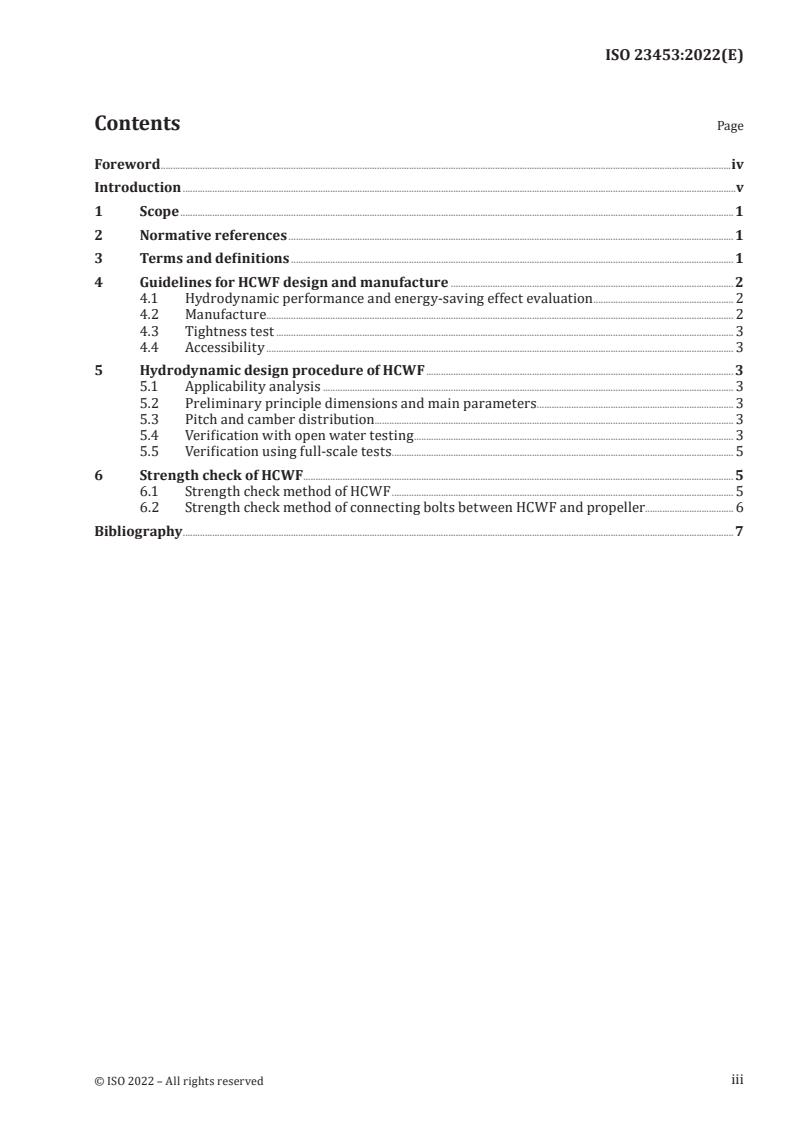
Contents Page
Foreword .iv
Introduction .v
1 Scope . 1
2 Normative references . 1
3 Terms and definitions . 1
4 Guidelines for HCWF design and manufacture . 2
4.1 Hydrodynamic performance and energy-saving effect evaluation . 2
4.2 Manufacture. 2
4.3 Tightness test . 3
4.4 Accessibility . 3
5 Hydrodynamic design procedure of HCWF . 3
5.1 Applicability analysis . 3
5.2 Preliminary principle dimensions and main parameters . 3
5.3 Pitch and camber distribution . . 3
5.4 V erification with open water testing . 3
5.5 V erification using full-scale tests . . 5
6 Strength check of HCWF . 5
6.1 Strength check method of HCWF . 5
6.2 Strength check method of connecting bolts between HCWF and propeller . . 6
Bibliography . 7
iii
Foreword
ISO (the International Organization for Standardization) is a worldwide federation of national standards
bodies (ISO member bodies). The work of preparing International Standards is normally carried out
through ISO technical committees. Each member body interested in a subject for which a technical
committee has been established has the right to be represented on that committee. International
organizations, governmental and non-governmental, in liaison with ISO, also take part in the work.
ISO collaborates closely with the International Electrotechnical Commission (IEC) on all matters of
electrotechnical standardization.
The procedures used to develop this document and those intended for its further maintenance are
described in the ISO/IEC Directives, Part 1. In particular, the different approval criteria needed for the
different types of ISO documents should be noted. This document was drafted in accordance with the
editorial rules of the ISO/IEC Directives, Part 2 (see www.iso.org/directives).
Attention is drawn to the possibility that some of the elements of this document may be the subject of
patent rights. ISO shall not be held responsible for identifying any or all such patent rights. Details of
any patent rights identified during the development of the document will be in the Introduction and/or
on the ISO list of patent declarations received (see www.iso.org/patents).
Any trade name used in this document is information given for the convenience of users and does not
constitute an endorsement.
For an explanation of the voluntary nature of standards, the meaning of ISO specific terms and
expressions related to conformity assessment, as well as information about ISO's adherence to
the World Trade Organization (WTO) principles in the Technical Barriers to Trade (TBT), see
www.iso.org/iso/foreword.html.
This document was prepared by Technical Committee ISO/TC 8, Ships and marine technology,
Subcommittee SC 8, Ship design.
Any feedback or questions on this document should be directed to the user’s national standards body. A
complete listing of these bodies can be found at www.iso.org/members.html.
iv
Introduction
A hub cap with fins is an energy-saving device installed behind a propeller instead of a propeller hub
cap. It rotates together with the propeller to increase the propulsion efficiency of the ship by decreasing
the energy losses caused by hub vortex. To save energy and reduce underwater noise, propeller hub
caps with fins are installed on a wide variety of ships.
v
INTERNATIONAL STANDARD ISO 23453:2022(E)
Ships and marine technology — Guidelines for the design
and manufacture of the hub cap with fins for a fixed-pitch
marine propeller
1 Scope
This document provides general guidelines for design and manufacture of a hub vortex energy-saving
device for a fixed-pitch marine propeller. This document can also apply to the design and manufacture
of hub vortex energy-saving device for other types of marine propellers.
According to the specific geometrical shape of the propeller and other specifications, it is suggested
that hub cap with fins is used in merchant ships.
2 Normative references
There are no normative references in this document.
3 Terms and definitions
For the purposes of this document, the following terms and definitions apply.
ISO and IEC maintain terminology databases for use in standardization at the following address
...