

ISO 4242:1980
(Main)Cinematography — Recording head gaps for two sound records on 16 mm magnetic film — Positions and width dimensions
General Information
- Abstract
This International Standard specifies the lateral positions and width dimensions of the recording heads for two magnetic Sound records and a control track on 16 mm Single perforated magnetic recording film. lt also specifies the reproducing velocity of the film travel.
- Status
- Published
- Publication Date
- 30-Jun-1980
- Technical Committee
- ISO/TC 36 - Cinematography
- Drafting Committee
- ISO/TC 36/WG 3 - Audio technology
- Current Stage
- 9093 - International Standard confirmed
- Start Date
- 10-Jul-2023
- Completion Date
- 29-Aug-2026
Buy Documents

ISO 4242:1980 - Cinematography — Recording head gaps for two sound records on 16 mm magnetic film — Positions and width dimensions Released:7/1/1980

ISO 4242:1980 - Cinématographie — Entrefers de tetes d'enregistrement pour enregistrement du son sur deux pistes sur film magnétique de 16 mm — Emplacement et largeur
Overview
ISO 4242:1980 is an international standard published by the International Organization for Standardization (ISO) that addresses cinematography sound recording on 16 mm magnetic film. Specifically, this standard defines the lateral positions and width dimensions of recording head gaps for two sound records and a control track on 16 mm single perforated magnetic film. Additionally, it specifies the film reproducing velocity to ensure consistency and interchangeability of sound recordings across different equipment and regions.
This standard is crucial for professionals working in film sound recording, post-production, and magnetic film manufacturing, ensuring that soundtracks adhere to precise physical and operational parameters for quality and compatibility.
Key Topics
Recording Head Gap Positions and Dimensions: ISO 4242:1980 defines exact lateral positions and width measurements of the magnetic recording heads, including the center and edge tracks, to guarantee sound fidelity and minimize interference on 16 mm film.
Film Travel Velocity: The standard specifies reproduction velocities of either 24 perforations per second (about 18.3 cm/s) or 25 perforations per second (approximately 19.05 cm/s). These speeds correspond to industry norms for 16 mm film playback and recording.
Track Usage Guidelines:
- The center track is preferably used for single monaural recordings.
- For stereo programs, the center track accommodates the left channel.
- For dual language soundtracks, the center track holds the primary language, while the edge track handles the secondary.
- The control track is designated for supplementary data such as control signals or address codes (analog or digital).
Head Gap Orientation: The magnetic head gaps must be physically aligned at an angle of 90° ± 5° to the film travel direction, ensuring optimal contact and recording quality.
Compatibility with ISO 1188: The recorded magnetic characteristics must conform to ISO 1188, which details recording parameters for magnetic sound on 16 mm motion-picture film, ensuring international interchangeability.
Applications
ISO 4242:1980 is essential in several practical contexts:
Cinematography Sound Recording: Enables film studios and sound technicians to position and size magnetic recording heads correctly during film production, preserving sound quality and facilitating multi-track recording.
Magnetic Film Manufacturing: Guides manufacturers of 16 mm magnetic motion picture film and film processing equipment in designing products that meet global standards for sound record quality and positioning.
Post-Production and Restoration: Assists professionals in film post-production and archival restoration to identify and maintain recording consistency, ensuring that historic or multi-language soundtracks are faithfully reproduced.
Equipment Standardization: Provides film projector and recorder engineers with standardized specifications to build or calibrate equipment supporting two sound tracks and control signals on 16 mm film.
Related Standards
ISO 1188: Defines the recording characteristics and technical specifications for magnetic sound recording on 16 mm motion picture film, supporting the acoustic quality requirements referenced by ISO 4242.
ISO 69: Specifies cutting and perforating dimensions for 16 mm raw motion-picture film stock, ensuring physical compatibility for magnetic coatings and sound recording.
ISO/TC 36: The ISO technical committee responsible for cinematography standards, under which ISO 4242 was developed and maintained, driving updates in motion picture film technologies.
Keywords: ISO 4242, 16 mm magnetic film, cinematography sound recording, recording head gaps, magnetic sound tracks, film reproducing velocity, film sound standards, magnetic recording specifications, two sound records, control track, ISO cinematography standards.
Buy Documents
ISO 4242:1980 - Cinematography — Recording head gaps for two sound records on 16 mm magnetic film — Positions and width dimensions Released:7/1/1980
ISO 4242:1980 - Cinématographie — Entrefers de tetes d'enregistrement pour enregistrement du son sur deux pistes sur film magnétique de 16 mm — Emplacement et largeur
Frequently Asked Questions
ISO 4242:1980 is a standard published by the International Organization for Standardization (ISO). Its full title is "Cinematography — Recording head gaps for two sound records on 16 mm magnetic film — Positions and width dimensions". This standard covers: This International Standard specifies the lateral positions and width dimensions of the recording heads for two magnetic Sound records and a control track on 16 mm Single perforated magnetic recording film. lt also specifies the reproducing velocity of the film travel.
This International Standard specifies the lateral positions and width dimensions of the recording heads for two magnetic Sound records and a control track on 16 mm Single perforated magnetic recording film. lt also specifies the reproducing velocity of the film travel.
ISO 4242:1980 is classified under the following ICS (International Classification for Standards) categories: 37.060.20 - Motion picture films. Cartridges. The ICS classification helps identify the subject area and facilitates finding related standards.
ISO 4242:1980 is available in PDF format for immediate download after purchase. The document can be added to your cart and obtained through the secure checkout process. Digital delivery ensures instant access to the complete standard document.
Standards Content (Sample)
International Standard
INTERNATIONAL ORGANIZATION FOR STANDARDIZATION.MEX~YHAPOAHAR OPrAHM3A~MR fl0 CTAHCJAPTkl3AL(MM*ORGANISATlON INTERNATIONALE DE NORMALISATION
Cinematography -
Recording head gaps for two Sound
records on 16 mm magnetic film - Positions and width
dimensions
Cinema tographie -
En trefers de t&es d’enregistrement pour enregistrement du son sur deux pistes sur film magnbtique de
16 mm - Emplacement et largeur
First edition - 1980-07-01
~~~
UDC 681.84.083.82 : 778.534.4 Ref. No. ISO 4242-1980 (E)
iii
-
A
Descriptors : cinematography, motion picture film 16 mm, magnetic recording, Sound recording, Sound track, magnetic heads, dimensions,
positioning, specifications.
Price based on 2 pages
Foreword
ISO (the International Organization for Standardization) is a worldwide federation of
national Standards institutes (ISO member bodies). The work of developing Inter-
national Standards is carried out through ISO technical committees. Every member
body interested in a subject for which a technical committee has been set up has the
right to be represented on that committee. International organizations, governmental
and non-governmental, in liaison with ISO, also take part in the work.
Draft International Standards adopted by the technical committees are circulated to
the member bodies for approval before their acceptance as International Standards by
the ISO Council.
International Standard ISO 4242 was developed by Technical Committee ISO/TC 36,
Cinematography, and was circulated to the member bodies in May 1979.
lt has been approved by the member bodies of the following countries :
Austria Italy Sweden
Belgium Japan United Kingdom
Canada Libyan Arab Jamahiriya USA
Czechoslovakia Mexico USSR
Denmark Poland Y ugoslavia
France South Africa, Rep. of
Germany, F. R. Spain
No member body expressed disapproval of the document.
This International Standard cancels and replaces ISO Recommendations R 890-1968
and R 891-1968, of which it constitutes a technical revision.
0 International Organkation for Standardkation, 1980
Printed in Switzerland
ISO 4242-1980 (E)
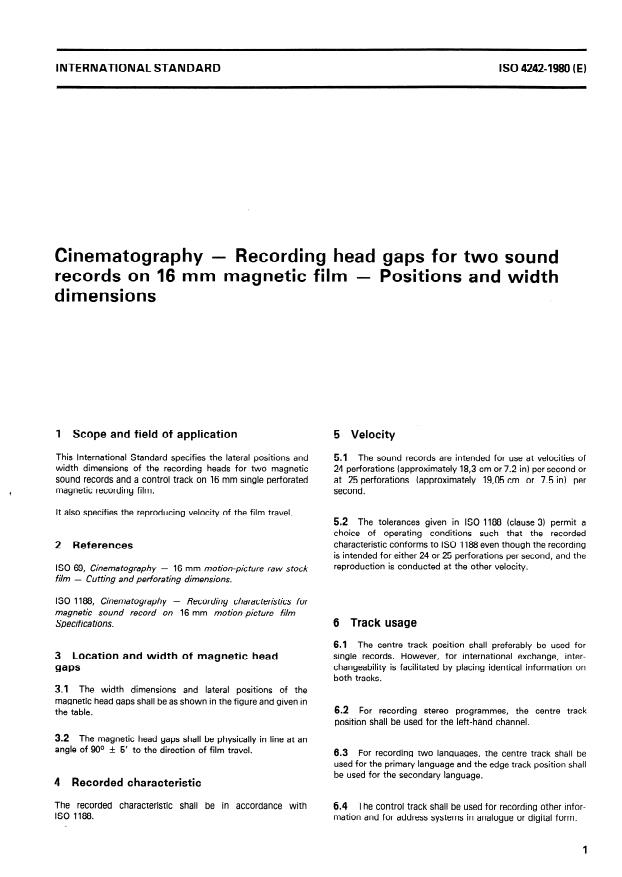
INTERNATIONAL STANDARD
Cinematography - Recording head gaps for two Sound
records on 16 mm magnetic film - Positions and width
dimensions
1 Scope and field of application 5 Vetocity
This International Standard specifies the lateral positions and 5.1 The Sound records are intended for use at velocities of
width dimensions of the recording heads for two magnetic 24 petforations (approximately 18,3 cm or 7.2 in) per second or
Sound records and a control track on 16 mm Single perforated
at 25 perforation
...
Norme internationale
INTERNATIONAL ORGANIZATION FOR STANDARDIZATION.ME~YHAPO,lJHAR OP!-AHM3ALWlR Il0 CTAHAAPTbl3Al@lM.ORGANISATlON INTERNATIONALE DE NORMALISATION
Cinématographie - Entrefers. de têtes d’enregistrement
pour enregistrement du son sur deux pistes sur film
magnétique de 16 mm - Emplacement et largeur
Cinematograph y - Recording head gaps for two sound records on 16 mm magnetic film - Positions and width dimensions
Première édition - 1980-07-01
CDU 681.84.083.82 : 778.534.4 Réf. no : ISO 4242-1984 (F)
Gi
Descripteurs : cinématographie, film cinématographique 16 mm, enregistrement magnétique, enregistrement du son, piste sonore, tête magnéti-
que, dimension, mise en position, spécification.
Prix basé sur 2 pages
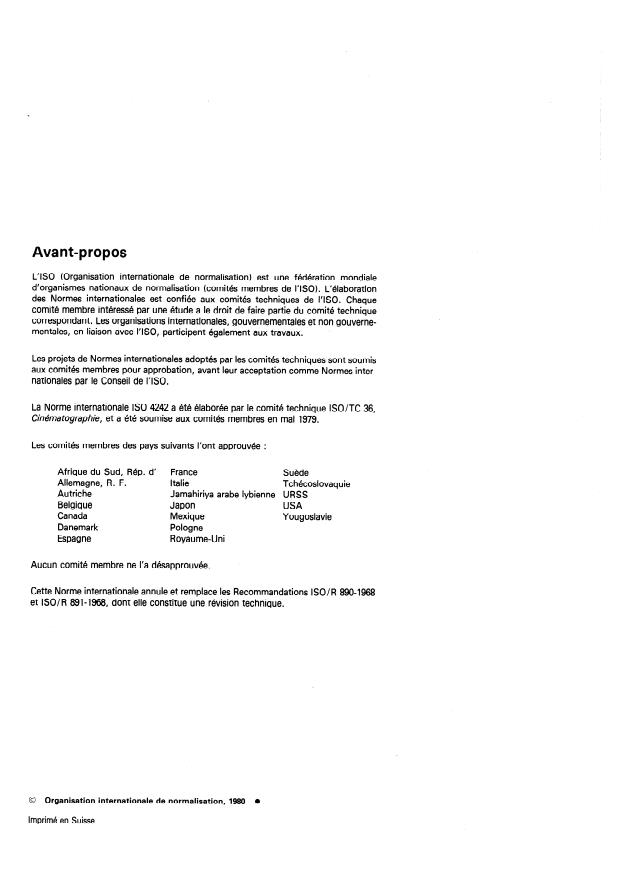
Avant-propos
L’ISO (Organisation internationale de normalisation) est une fédération mondiale
d’organismes nationaux de normalisation (comités membres de I’ISO). L’élaboration
des Normes internationales est confiée aux comités techniques de I’ISO. Chaque
comité membre intéressé par une étude a le droit de faire partie du comité technique
correspondant. Les organisations internationales, gouvernementales et non gouverne-
mentales, en liaison avec I’ISO, participent également aux travaux.
Les projets de Normes internationales adoptés par les comités techniques sont soumis
aux comités membres pour approbation, avant leur acceptation comme Normes inter-
nationales par le Conseil de I’ISO.
La Norme internationale ISO 4242 a été élaborée par le comité technique ISO/TC 36,
Cinématographie, et a été soumise aux comités membres en mai 1979.
Les comités membres des pays suivants l’ont approuvée :
Afrique du Sud, Rép. d’ France
Suede
Allemagne, R. F. Italie Tchécoslovaquie
Autriche
Jamahiriya arabe lybienne URSS
Belgique Japon
USA
Canada Mexique Yougoslavie
Danemark Pologne
Espagne Royaume-Uni
Aucun comité membre ne l’a désapprouvée.
Cette Norme internationale annule et remplace les Recommandations ISO/R 890-1968
et ISO/R 891-1968, dont elle constitue une révision technique.
0 Organisation internationale de normalisation, 1980
Imprimé en Suisse
60 4242-1980 (F)
NORME INTERNATIONALE
Entrefers de têtes d’enregistrement
Cinématographie -
pour enregistrement du son sur deux pistes sur film
magnétique de 16 mm - Emplacement et largeur
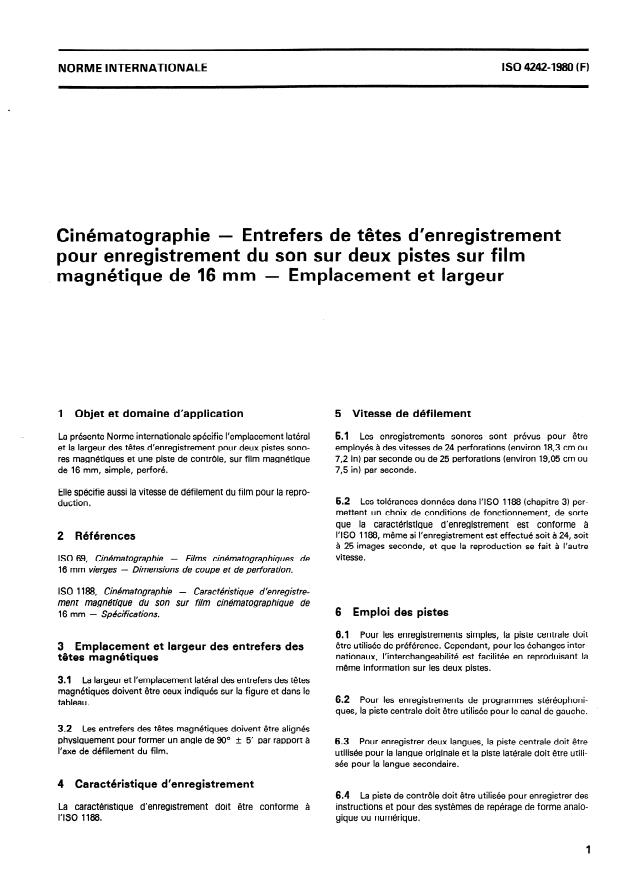
5 Vitesse de défilement
1 Objet et domaine d’application
La présente Norme internationale spécifie l’emplacement latéral 5.1 Les enregistrements sonores sont prévus pour être
et la largeur des têtes d’enregistrement pour deux pistes sono- employés à des vitesses de 24 perforations (environ 18’3 cm ou
res magnétiques et une piste de contrôle, sur film magnétique 7’2 in) par seconde ou de 25 perforations (environ 19’05 cm ou
de 16 mm, simple, perforé. 7’5 in) par seconde.
Elle spécifie aussi la vitesse de défilem
...