

ISO/IEC 14496-10:2022
(Main)Information technology — Coding of audio-visual objects — Part 10: Advanced video coding
General Information
- Abstract
This document specifies advanced video coding for coding of audio-visual objects.
- Status
- Withdrawn
- Publication Date
- 07-Nov-2022
- Current Stage
- 9599 - Withdrawal of International Standard
- Start Date
- 11-Jul-2025
- Completion Date
- 29-Aug-2026



Overview
ISO/IEC 14496-10:2022 - Advanced Video Coding (AVC) - specifies a widely used standard for coding of audio‑visual objects. Published as the tenth edition (2022) of Part 10 of the ISO/IEC 14496 series, this document captures the syntax, semantics, decoding and parsing processes required to implement interoperable AVC/H.264 systems. It is the formal joint standard with ITU‑T H.264 and includes updates such as new supplemental enhancement information (SEI) messages (annotated regions and shutter interval).
Keywords: ISO/IEC 14496-10:2022, Advanced Video Coding, AVC, H.264, video compression standard, MPEG-4 Part 10.
Key Topics
- Bitstream and NAL unit formats: definitions for Network Abstraction Layer (NAL) units and raw byte sequence payloads for interoperable transport and storage.
- Syntax and semantics: tabular specifications for slice headers, slice data, macroblock layers and associated semantic rules.
- Decoding processes: detailed procedures for NAL unit and slice decoding, picture order count, reference picture management, and picture construction.
- Prediction methods: comprehensive intra and inter prediction processes (including 4x4, 8x8, 16x16 luma modes and chroma prediction).
- Transform and quantization: transform coefficient decoding, inverse scanning, scaling and reconstruction processes for 4x4 and 8x8 blocks and Intra_16x16.
- Entropy coding: parsing and decoding for both CAVLC and CABAC entropy coding methods.
- Deblocking filter: loop filtering algorithms for reducing blocking artifacts in reconstructed pictures.
- Profiles, levels and annexes: normative Annex A (profiles and levels) and annexes for byte stream format, reference decoder, SEI, VUI, Scalable Video Coding (SVC), Multiview Video Coding (MVC), and multiview/depth extensions.
Keywords: NAL unit, macroblock, CAVLC, CABAC, deblocking, profiles and levels, SVC, MVC, SEI, VUI.
Applications
ISO/IEC 14496-10:2022 is essential for:
- Codec and decoder implementers (software and hardware acceleration)
- Streaming platforms and OTT services ensuring interoperable delivery
- Broadcast and IPTV systems using standardized compression and transport
- Video conferencing, surveillance, and telepresence products
- Multimedia application developers, transcoders and content preparation tools
- Conformance testing laboratories and interoperability test suites
Implementers use the standard to ensure bitstream compatibility, optimize coding efficiency, and meet profile/level constraints for target devices.
Related standards
- ITU‑T H.264 (joint specification with ISO/IEC 14496-10)
- Other parts of the ISO/IEC 14496 (MPEG-4) series for container formats, systems and audio/video object definitions
For implementation or procurement, consult the full ISO/IEC 14496-10:2022 text and national standards bodies for licensing or patent declarations.
Relations
- Effective Date
- 12-Aug-2023
- Effective Date
- 21-Aug-2021
Get Certified
Connect with accredited certification bodies for this standard

BSI Group
BSI (British Standards Institution) is the business standards company that helps organizations make excellence a habit.

NYCE
Mexican standards and certification body.
Sponsored listings
Frequently Asked Questions
ISO/IEC 14496-10:2022 is a standard published by the International Organization for Standardization (ISO). Its full title is "Information technology — Coding of audio-visual objects — Part 10: Advanced video coding". This standard covers: This document specifies advanced video coding for coding of audio-visual objects.
This document specifies advanced video coding for coding of audio-visual objects.
ISO/IEC 14496-10:2022 is classified under the following ICS (International Classification for Standards) categories: 35.040.40 - Coding of audio, video, multimedia and hypermedia information. The ICS classification helps identify the subject area and facilitates finding related standards.
ISO/IEC 14496-10:2022 has the following relationships with other standards: It is inter standard links to ISO/IEC 14496-10:2025, ISO/IEC 14496-10:2020. Understanding these relationships helps ensure you are using the most current and applicable version of the standard.
ISO/IEC 14496-10:2022 is available in PDF format for immediate download after purchase. The document can be added to your cart and obtained through the secure checkout process. Digital delivery ensures instant access to the complete standard document.
Standards Content (Sample)
INTERNATIONAL ISO/IEC
STANDARD 14496-10
Tenth edition
2022-11
Information technology — Coding of
audio-visual objects —
Part 10:
Advanced video coding
Technologies de l'information — Codage des objets audiovisuels —
Partie 10: Codage visuel avancé
Reference number
© ISO/IEC 2022
© ISO/IEC 2022
All rights reserved. Unless otherwise specified, or required in the context of its implementation, no part of this publication may
be reproduced or utilized otherwise in any form or by any means, electronic or mechanical, including photocopying, or posting on
the internet or an intranet, without prior written permission. Permission can be requested from either ISO at the address below
or ISO’s member body in the country of the requester.
ISO copyright office
CP 401 • Ch. de Blandonnet 8
CH-1214 Vernier, Geneva
Phone: +41 22 749 01 11
Email: copyright@iso.org
Website: www.iso.org
Published in Switzerland
ii
© ISO/IEC 2022 – All rights reserved
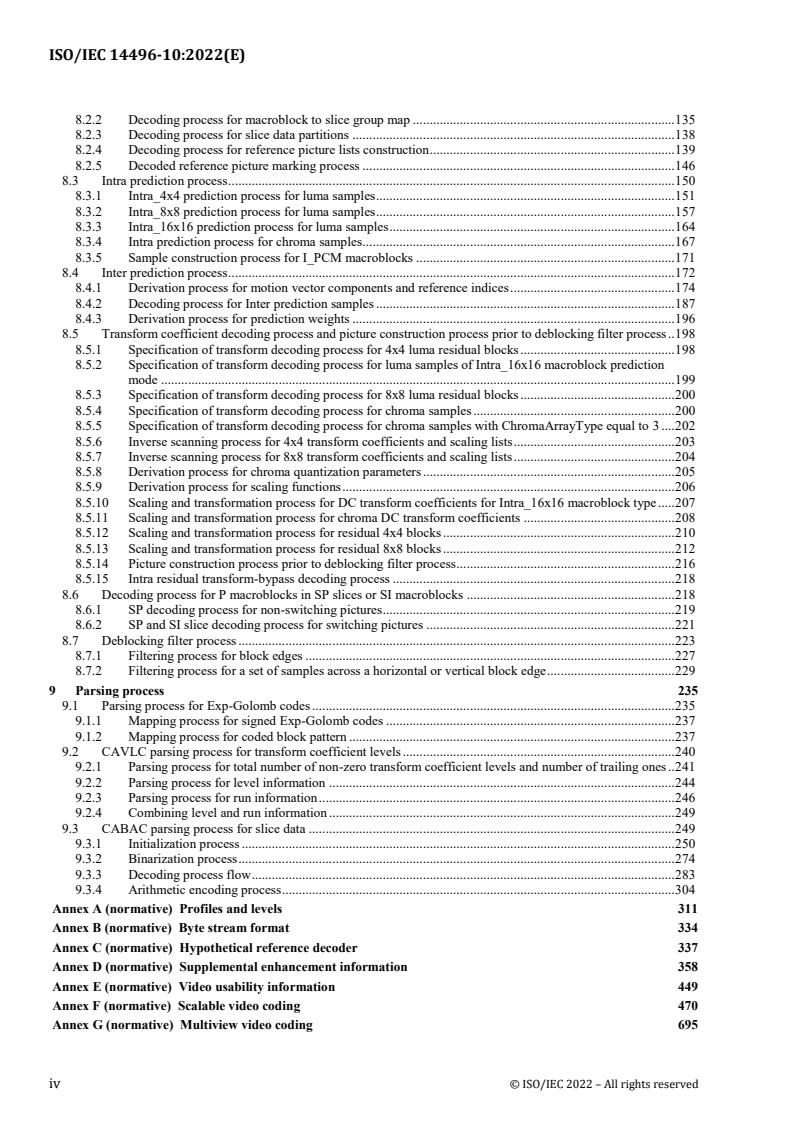
Contents
Foreword vi
0 Introduction vii
1 Scope 1
2 Normative references 1
3 Terms and definitions 1
4 Abbreviated terms 28
5 Conventions 29
5.1 Arithmetic operators . 29
5.2 Logical operators . 30
5.3 Relational operators . 30
5.4 Bit-wise operators . 30
5.5 Assignment operators . 31
5.6 Range notation. 31
5.7 Mathematical functions . 31
5.8 Order of operation precedence . 32
5.9 Variables, syntax elements, and tables . 33
5.10 Text description of logical operations . 34
5.11 Processes . 35
6 Source, coded, decoded and output data formats, scanning processes, and neighbouring relationships 35
6.1 Bitstream formats . 35
6.2 Source, decoded, and output picture formats . 35
6.3 Spatial subdivision of pictures and slices . 40
6.4 Inverse scanning processes and derivation processes for neighbours . 41
6.4.1 Inverse macroblock scanning process . 41
6.4.2 Inverse macroblock partition and sub-macroblock partition scanning process . 42
6.4.3 Inverse 4x4 luma block scanning process . 43
6.4.4 Inverse 4x4 Cb or Cr block scanning process for ChromaArrayType equal to 3 . 44
6.4.5 Inverse 8x8 luma block scanning process . 44
6.4.6 Inverse 8x8 Cb or Cr block scanning process for ChromaArrayType equal to 3 . 44
6.4.7 Inverse 4x4 chroma block scanning process . 44
6.4.8 Derivation process of the availability for macroblock addresses . 45
6.4.9 Derivation process for neighbouring macroblock addresses and their availability . 45
6.4.10 Derivation process for neighbouring macroblock addresses and their availability in MBAFF frames . 45
6.4.11 Derivation processes for neighbouring macroblocks, blocks, and partitions . 46
6.4.12 Derivation process for neighbouring locations . 51
6.4.13 Derivation processes for block and partition indices . 54
7 Syntax and semantics 55
7.1 Method of specifying syntax in tabular form . 55
7.2 Specification of syntax functions, categories, and descriptors . 56
7.3 Syntax in tabular form . 58
7.3.1 NAL unit syntax . 58
7.3.2 Raw byte sequence payloads and RBSP trailing bits syntax . 59
7.3.3 Slice header syntax . 67
7.3.4 Slice data syntax . 72
7.3.5 Macroblock layer syntax . 73
7.4 Semantics . 80
7.4.1 NAL unit semantics . 80
7.4.2 Raw byte sequence payloads and RBSP trailing bits semantics . 90
7.4.3 Slice header semantics . 104
7.4.4 Slice data semantics . 115
7.4.5 Macroblock layer semantics . 116
8 Decoding process 129
8.1 NAL unit decoding process . 130
8.2 Slice decoding process . 131
8.2.1 Decoding process for picture order count . 131
© ISO/IEC 2022 – All rights reserved iii
8.2.2 Decoding process for macroblock to slice group map . 135
8.2.3 Decoding process for slice data partitions . 138
8.2.4 Decoding process for reference picture lists construction . 139
8.2.5 Decoded reference picture marking process . 146
8.3 Intra prediction process . 150
8.3.1 Intra_4x4 prediction process for luma samples . 151
8.3.2 Intra_8x8 prediction process for luma samples . 157
8.3.3 Intra_16x16 prediction process for luma samples . 164
8.3.4 Intra prediction process for chroma samples. 167
8.3.5 Sample construction process for I_PCM macroblocks . 171
8.4 Inter prediction process . 172
8.4.1 Derivation process for motion vector components and reference indices . 174
8.4.2 Decoding process for Inter prediction samples . 187
8.4.3 Derivation process for prediction weights . 196
8.5 Transform coefficient decoding process and picture construction process prior to deblocking filter process . 198
8.5.1 Specification of transform decoding process for 4x4 luma residual blocks . 198
8.5.2 Specification of transform decoding process for luma samples of Intra_16x16 macroblock prediction
mode . 199
8.5.3 Specification of transform decoding process for 8x8 luma residual blocks . 200
8.5.4 Specification of transform decoding process for chroma samples . 200
8.5.5 Specification of transform decoding process for chroma samples with ChromaArrayType equal to 3 . 202
8.5.6 Inverse scanning process for 4x4 transform coefficients and scaling lists . 203
8.5.7 Inverse scanning process for 8x8 transform coefficients and scaling lists . 204
8.5.8 Derivation process for chroma quantization parameters . 205
8.5.9 Derivation process for scaling functions . 206
8.5.10 Scaling and transformation process for DC transform coefficients for Intra_16x16 macroblock type . 207
8.5.11 Scaling and transformation process for chroma DC transform coefficients . 208
8.5.12 Scaling and transformation process for residual 4x4 blocks . 210
8.5.13 Scaling and transformation process for residual 8x8 blocks . 212
8.5.14 Picture construction process prior to deblocking filter process . 216
8.5.15 Intra residual transform-bypass decoding process . 218
8.6 Decoding process for P macroblocks in SP slices or SI macroblocks . 218
8.6.1 SP decoding process for non-switching pictures . 219
8.6.2 SP and SI slice decoding process for switching pictures . 221
8.7 Deblocking filter process . 223
8.7.1 Filtering process for block edges . 227
8.7.2 Filtering process for a set of samples across a horizontal or vertical block edge . 229
9 Parsing process 235
9.1 Parsing process for Exp-Golomb codes . 235
9.1.1 Mapping process for signed Exp-Golomb codes . 237
9.1.2 Mapping process for coded block pattern . 237
9.2 CAVLC parsing process for transform coefficient levels . 240
9.2.1 Parsing process for total number of non-zero transform coefficient levels and number of trailing ones . 241
9.2.2 Parsing process for level information . 244
9.2.3 Parsing process for run information . 246
9.2.4 Combining level and run information . 249
9.3 CABAC parsing process for slice data . 249
9.3.1 Initialization process . 250
9.3.2 Binarization process . 274
9.3.3 Decoding process flow . 283
9.3.4 Arithmetic encoding process . 304
Annex A (normative) Profiles and levels 311
Annex B (normative) Byte stream format 334
Annex C (normative) Hypothetical reference decoder 337
Annex D (normative) Supplemental enhancement information 358
Annex E (normative) Video usability information 449
Annex F (normative) Scalable video coding 470
Annex G (normative) Multiview video coding 695
iv © ISO/IEC 2022 – All rights reserved
Annex H (normative) Multiview and depth video coding 762
Annex I (normative) Multiview and depth video with enhanced non-base view coding 811
Bibliography 867
© ISO/IEC 2022 – All rights reserved v
Foreword
ISO (the International Organization for Standardization) and IEC (the International Electrotechnical
Commission) form the specialized system for worldwide standardization. National bodies that are members of
ISO or IEC participate in the development of International Standards through technical committees
established by the respective organization to deal with particular fields of technical activity. ISO and IEC
technical committees collaborate in fields of mutual interest. Other international organizations, governmental
and non-governmental, in liaison with ISO and IEC, also take part in the work.
The procedures used to develop this document and those intended for its further maintenance are described in
the ISO/IEC Directives, Part 1. In particular, the different approval criteria needed for the different types of
document should be noted. This document was drafted in accordance with the editorial rules of the
ISO/IEC Directives, Part 2 (see www.iso.org/directives or www.iec.ch/members_experts/refdocs).
Attention is drawn to the possibility that some of the elements of this document may be the subject of patent
rights. ISO and IEC shall not be held responsible for identifying any or all such patent rights. Details of any
patent rights identified during the development of the document will be in the Introduction and/or on the ISO
list of patent declarations received (see www.iso.org/patents) or the IEC list of patent declarations received
(see http://patents.iec.ch).
Any trade name used in this document is information given for the convenience of users and does not
constitute an endorsement.
For an explanation of the voluntary nature of standards, the meaning of ISO specific terms and expressions
related to conformity assessment, as well as information about ISO's adherence to the World Trade
Organization (WTO) principles in the Technical Barriers to Trade (TBT), see www.iso.org/iso/foreword.html.
In the IEC, see www.iec.ch/understanding-standards.
This document was prepared by Joint Technical Committee ISO/IEC JTC 1, Information technology,
Subcommittee SC 29, Coding of audio, picture, multimedia and hypermedia information, in collaboration
with ITU-T (as ITU-T H.264).
This tenth edition cancels and replaces the ninth edition (ISO/IEC 14496-10:2020), which has been
technically revised.
The main changes are as follows:
— addition of annotated regions and shutter interval information supplemental enhancement information
messages.
A list of all parts in the ISO/IEC 14496 series can be found on the ISO and IEC websites.
Any feedback or questions on this document should be directed to the user’s national standards body. A
complete listing of these bodies can be found at www.iso.org/members.html and www.iec.ch/national-
committees.
vi © ISO/IEC 2022 – All rights reserved
0 Introduction
0.1 Prologue
As the costs for both processing power and memory have reduced, network support for coded video data has diversified,
and advances in video coding technology have progressed, the need has arisen for an industry standard for compressed
video representation with substantially increased coding efficiency and enhanced robustness to network environments.
Toward these ends the ITU-T Video Coding Experts Group (VCEG) and the ISO/IEC Moving Picture Experts Group
(MPEG) formed a Joint Video Team (JVT) in 2001 for development of a new Recommendation | International Standard.
The standard has since been maintained and enhanced jointly by VCEG and MPEG.
0.2 Purpose
This Recommendation | International Standard was developed in response to the growing need for higher compression of
moving pictures for various applications such as videoconferencing, digital storage media, television broadcasting,
internet streaming, and communication. It is also designed to enable the use of the coded video representation in a
flexible manner for a wide variety of network environments. The use of this Recommendation | International Standard
allows motion video to be manipulated as a form of computer data and to be stored on various storage media, transmitted
and received over existing and future networks and distributed on existing and future broadcasting channels.
0.3 Applications
This Recommendation | International Standard is designed to cover a broad range of applications for video content
including but not limited to the following:
⎯ CATV: cable TV on optical networks, copper, etc.
⎯ DBS: direct broadcast satellite video services.
⎯ DSL: digital subscriber line video services.
⎯ DTTB: digital terrestrial television broadcasting.
⎯ ISM: interactive storage media (optical disks, etc.).
⎯ MMM: multimedia mailing.
⎯ MSPN: multimedia services over packet networks.
⎯ RTC: real-time conversational services (videoconferencing, videophone, etc.).
⎯ RVS: remote video surveillance.
⎯ SSM: serial storage media (digital VTR, etc.).
0.4 Publication and versions of this document
ITU-T Rec. H.264 | ISO/IEC 14496-10 version 1 refers to the first approved version of this Recommendation |
International Standard.
ITU-T Rec. H.264 | ISO/IEC 14496-10 version 2 refers to the integrated text containing the corrections specified in the
first technical corrigendum.
ITU-T Rec. H.264 | ISO/IEC 14496-10 version 3 refers to the integrated text containing both the first technical
corrigendum (2004) and the first amendment, which is referred to as the "Fidelity range extensions".
ITU-T Rec. H.264 | ISO/IEC 14496-10 version 4 refers to the integrated text containing the first technical corrigendum
(2004), the first amendment (the "Fidelity range extensions"), and an additional technical corrigendum (2005).
ITU-T Rec. H.264 | ISO/IEC 14496-10 version 5 refers to the integrated version 4 text with its specification of the
High 4:4:4 profile removed.
ITU-T Rec. H.264 | ISO/IEC 14496-10 version 6 refers to the integrated version 5 text after its amendment to support
additional colour space indicators.
ITU-T Rec. H.264 | ISO/IEC 14496-10 version 7 refers to the integrated version 6 text after its amendment to define five
new profiles intended primarily for professional applications (the High 10 Intra, High 4:2:2 Intra, High 4:4:4 Intra,
© ISO/IEC 2022 – All rights reserved vii
CAVLC 4:4:4 Intra, and High 4:4:4 Predictive profiles) and two new types of supplemental enhancement information
(SEI) messages (the post-filter hint SEI message and the tone mapping information SEI message).
ITU-T Rec. H.264 | ISO/IEC 14496-10 version 8 refers to the integrated version 7 text after its amendment to specify
scalable video coding in three profiles (Scalable Baseline, Scalable High, and Scalable High Intra profiles).
ITU-T Rec. H.264 | ISO/IEC 14496-10 version 9 refers to the integrated version 8 text after applying the corrections
specified in a third technical corrigendum.
ITU-T Rec. H.264 | ISO/IEC 14496-10 version 10 refers to the integrated version 9 text after its amendment to specify a
profile for multiview video coding (the Multiview High profile) and to define additional SEI messages.
ITU-T Rec. H.264 | ISO/IEC 14496-10 version 11 refers to the integrated version 10 text after its amendment to define a
new profile (the Constrained Baseline profile) intended primarily to enable implementation of decoders supporting only
the common subset of capabilities supported in various previously-specified profiles.
ITU-T Rec. H.264 | ISO/IEC 14496-10 version 12 refers to the integrated version 11 text after its amendment to define a
new profile (the Stereo High profile) for two-view video coding with support of interlaced coding tools and to specify an
additional SEI message specified as the frame packing arrangement SEI message. The changes for versions 11 and 12
were processed as a single amendment in the ISO/IEC approval process.
ITU-T Rec. H.264 | ISO/IEC 14496-10 version 13 refers to the integrated version 12 text with various minor corrections
and clarifications as specified in a fourth technical corrigendum.
ITU-T Rec. H.264 | ISO/IEC 14496-10 version 14 refers to the integrated version 13 text after its amendment to define a
new level (Level 5.2) supporting higher processing rates in terms of maximum macroblocks per second and a new profile
(the Progressive High profile) to enable implementation of decoders supporting only the frame coding tools of the
previously-specified High profile.
ITU-T Rec. H.264 | ISO/IEC 14496-10 version 15 refers to the integrated version 14 text with miscellaneous corrections
and clarifications as specified in a fifth technical corrigendum.
ITU-T Rec. H.264 | ISO/IEC 14496-10 version 16 refers to the integrated version 15 text after its amendment to define
three new profiles intended primarily for communication applications (the Constrained High, Scalable Constrained
Baseline, and Scalable Constrained High profiles).
ITU-T Rec. H.264 | ISO/IEC 14496-10 version 17 refers to the integrated version 16 text after its amendment to define
additional supplemental enhancement information (SEI) message data, including the multiview view position SEI
message, the display orientation SEI message, and two additional frame packing arrangement type indication values for
the frame packing arrangement SEI message (the 2D content and tiled arrangement type indication values).
ITU-T Rec. H.264 | ISO/IEC 14496-10 version 18 refers to the integrated version 17 text after its amendment to specify
the coding of depth signals, including the specification of an additional profile, the Multiview Depth High profile.
ITU-T Rec. H.264 | ISO/IEC 14496-10 version 19 refers to the integrated version 18 text after incorporating a correction
to the sub-bitstream extraction process for multiview video coding.
ITU-T Rec. H.264 | ISO/IEC 14496-10 version 20 refers to the integrated version 19 text after its amendment to specify
the combined coding of video view and depth enhancement, including the specification of an additional profile, the
Enhanced Multiview Depth High profile.
ITU-T Rec. H.264 | ISO/IEC 14496-10 version 21 refers to the integrated version 20 text after its amendment to specify
additional colorimetry identifiers and an additional model type in the tone mapping information SEI message.
ITU-T Rec. H.264 | ISO/IEC 14496-10 version 22 refers to the integrated version 21 text after its amendment to specify
multi-resolution frame-compatible (MFC) enhancement for stereoscopic video coding, including the specification of an
additional profile, the MFC High profile.
ITU-T Rec. H.264 | ISO/IEC 14496-10 version 23 refers to the integrated version 22 text after its amendment to specify
multi-resolution frame-compatible (MFC) stereoscopic video with depth maps, including the specification of an
additional profile, the MFC Depth High profile, and the mastering display colour volume SEI message, additional colour-
related video usability information codepoint identifiers, and miscellaneous minor corrections and clarifications.
ITU-T Rec. H.264 | ISO/IEC 14496-10 version 24 refers to the integrated version 23 text after its amendment to specify
additional levels of decoder capability supporting larger picture sizes (Levels 6, 6.1, and 6.2), the green metadata SEI
message, the alternative depth information SEI message, additional colour-related video usability information codepoint
identifiers, and miscellaneous minor corrections and clarifications.
viii © ISO/IEC 2022 – All rights reserved
Rec. ITU-T H.264 | ISO/IEC 14496-10 version 25 refers to the integrated version 24 text after its amendment to specify
the Progressive High 10 profile; support for additional colour-related indicators, including the hybrid log-gamma transfer
characteristics indication, the alternative transfer characteristics SEI message, the IC C colour matrix transformation,
T P
chromaticity-derived constant luminance and non-constant luminance colour matrix coefficients, the colour remapping
information SEI message, and miscellaneous minor corrections and clarifications.
Rec. ITU-T H.264 | ISO/IEC 14496-10 version 26 refers to the integrated version 25 text after its amendment to
specify additional SEI messages for ambient viewing environment, content light level information, content colour
volume, equirectangular projection, cubemap projection, sphere rotation, region-wise packing, omnidirectional
viewport, SEI manifest, and SEI prefix indication, and miscellaneous minor corrections and clarifications.
Rec. ITU-T H.264 | ISO/IEC 14496-10 version 27 (the current document) refers to the integrated version 26 text
after its amendment to specify additional SEI messages for annotated regions (through referencing to Rec. ITU-T
H.274 | ISO/IEC 23002-7) and shutter interval information, and miscellaneous minor corrections and
clarifications.
This edition corresponds in technical content to the fourteenth edition in ITU-T (approved in August 2021).
0.5 Profiles and levels
This document is designed to be generic in the sense that it serves a wide range of applications, bit rates, resolutions,
qualities, and services. Applications should cover, among other things, digital storage media, television broadcasting and
real-time communications. In the course of creating this document, various requirements from typical applications have
been considered, necessary algorithmic elements have been developed, and these have been integrated into a single
syntax. Hence, this document will facilitate video data interchange among different applications.
Considering the practicality of implementing the full syntax of this document, however, a limited number of subsets of
the syntax are also stipulated by means of "profiles" and "levels". These and other related terms are formally defined in
Clause 3.
A "profile" is a subset of the entire bitstream syntax that is specified by this document. Within the bounds imposed by the
syntax of a given profile it is still possible to require a very large variation in the performance of encoders and decoders
depending upon the values taken by syntax elements in the bitstream such as the specified size of the decoded pictures. In
many applications, it is currently neither practical nor economic to implement a decoder capable of dealing with all
hypothetical uses of the syntax within a particular profile.
In order to deal with this problem, "levels" are specified within each profile. A level is a specified set of constraints
imposed on values of the syntax elements in the bitstream. These constraints may be simple limits on values.
Alternatively they may take the form of constraints on arithmetic combinations of values (e.g., picture width multiplied
by picture height multiplied by number of pictures decoded per second).
Coded video content conforming to this document uses a common syntax. In order to achieve a subset of the complete
syntax, flags, parameters, and other syntax elements are included in the bitstream that signal the presence or absence of
syntactic elements that occur later in the bitstream.
0.6 Overview of the design characteristics
0.6.1 General
The coded representation specified in the syntax is designed to enable a high compression capability for a desired image
quality. With the exception of the transform bypass mode of operation for lossless coding in the High 4:4:4 Intra,
CAVLC 4:4:4 Intra, and High 4:4:4 Predictive profiles, and the I_PCM mode of operation in all profiles, the algorithm is
typically not lossless, as the exact source sample values are typically not preserved through the encoding and decoding
processes. A number of techniques may be used to achieve highly efficient compression. Encoding algorithms (not
specified in this document) may select between inter and intra coding for block-shaped regions of each picture. Inter
coding uses motion vectors for block-based inter prediction to exploit temporal statistical dependencies between different
pictures. Intra coding uses various spatial prediction modes to exploit spatial statistical dependencies in the source signal
for a single picture. Motion vectors and intra prediction modes may be specified for a variety of block sizes in the picture.
The prediction residual is then further compressed using a transform to remove spatial correlation inside the transform
block before it is quantized, producing an irreversible process that typically discards less important visual information
while forming a close approximation to the source samples. Finally, the motion vectors or intra prediction modes are
© ISO/IEC 2022 – All rights reserved ix
combined with the quantized transform coefficient information and encoded using either variable length coding or
arithmetic coding.
Scalable video coding is specified in Annex F allowing the construction of bitstreams that contain sub-bitstreams that
conform to this document. For temporal bitstream scalability, i.e., the presence of a sub-bitstream with a smaller temporal
sampling rate than the bitstream, complete access units are removed from the bitstream when deriving the sub-bitstream.
In this case, high-level syntax and inter prediction reference pictures in the bitstream are constructed accordingly. For
spatial and quality bitstream scalability, i.e., the presence of a sub-bitstream with lower spatial resolution or quality than
the bitstream, NAL units are removed from the bitstream when deriving the sub-bitstream. In this case, inter-layer
prediction, i.e., the prediction of the higher spatial resolution or quality signal by data of the lower spatial resolution or
quality signal, is typically used for efficient coding. Otherwise, the coding algorithm as described in the previous
paragraph is used.
Multiview video coding is specified in Annex G allowing the construction of bitstreams that represent multiple views.
Similar to scalable video coding, bitstreams that represent multiple views may also contain sub-bitstreams that conform
to this document. For temporal bitstream scalability, i.e., the presence of a sub-bitstream with a smaller temporal
sampling rate than the bitstream, complete access units are removed from the bitstream when deriving the sub-bitstream.
In this case, high-level syntax and inter prediction reference pictures in the bitstream are constructed accordingly. For
view bitstream scalability, i.e., the presence of a sub-bitstream with fewer views than the bitstream, NAL units are
removed from the bitstream when deriving the sub-bitstream. In this case, inter-view prediction, i.e., the prediction of one
view signal by data of another view signal, is typically used for efficient coding. Otherwise, the coding algorithm as
described in the previous paragraph is used.
An extension of multiview video coding that additionally supports the inclusion of depth maps is specified in Annex H,
allowing the construction of bitstreams that represent multiple views with corresponding depth views. In a similar
manner as with the multiview video coding specified in Annex G, bitstreams encoded as specified in Annex H may also
contain sub-bitstreams that conform to this document.
A multiview video coding extension with depth information is specified in Annex I. Sub-bitstreams consisting of a
texture base view conform to this document, sub-bitstreams consisting of multiple texture views may also conform to
Annex G of this document, and sub-bitstreams consisting of one or more texture views and one or more depth views may
also conform to Annex H of this document. Enhanced texture view coding that utilizes the associated depth views and
decoding processes for depth views are specified for this extension.
Rec. ITU-T H.274 | ISO/IEC 23002-7 specifies the syntax and semantics of some video usability information (VUI)
parameters and supplemental enhancement information (SEI) messages that do not affect the conformance specifications
in Annex C and subclauses F.8, G.8, H.8, and I.8. Among these SEI messages, those for which the syntax and semantics
are not specified in this document may be used together with this document. SEI messages for which the syntax and
semantics are specified in this document may always be used together with this document. To enable being used together
with this document, the SEI payload type value of an SEI message specified in Rec. ITU-T H.274 | ISO/IEC 23002-7
needs to be specified in this document. For example, the SEI payload type value 202 (for the annotated regions SEI
message) is specified in subclause D.1.1, while the syntax and semantics of that SEI message are specified in Rec. ITU-T
H.274 | ISO/IEC 23002-7.
0.6.2 Predictive coding
Because of the conflicting requirements of random access and highly efficient compression, two main coding types are
specified. Intra coding is done without reference to other pictures. Intra coding may provide access points to the coded
sequence where decoding can begin and continue correctly, but typically also shows only moderate compression
efficiency. Inter coding (predictive or bi-predictive) is more efficient using inter prediction of each block of sample
values from some previously decoded picture selected by the encoder. In contrast to some other video coding standards,
pictures coded using bi-predictive inter prediction may also be used as references for inter coding of other pictures.
The application of the three coding types to pictures in a sequence is flexible, and the order of the decoding process is
generally not the same as the order of the source picture capture process in the encoder or the output order from the
decoder for display. The choice is left to the encoder and will depend on the requirements of the application. The
decoding order is specified such that the decoding of pictures that use inter-picture prediction follows later in decoding
order than other pictures that are referenced in the decoding process.
0.6.3 Coding of progressive and interlaced video
This document specifies a syntax and decoding process for video that originated in either progressive-scan or interlaced-
scan form, which may be mixed together in the same sequence. The two fields of an interlaced frame are separated in
capture time while the two fields of a progressive frame share the same capture time. Each field may be coded separately
or the two fields may be coded together as a frame. Progressive frames are typically coded as a frame. For interlaced
x © ISO/IEC 2022 – All rights reserved
video, the encoder can choose between frame coding and field coding. Frame coding or field coding can be adaptively
selected on a picture-by-picture basis and also on a more localized basis within a coded frame. Frame coding is typically
preferred when the video scene contains significant detail with limited motion. Field coding typically works better when
there is fast picture-to-picture motion.
0.6.4 Picture partitioning into macroblocks and smaller partitions
As in previous video coding Recommendations and International Standards, a macroblock, consisting of a 16x16 block
of luma samples and two corresponding blocks of chroma samples, is used as the basic processing unit of the video
decoding process.
A macroblock can be further partitioned for inter prediction. The selection of the size of inter prediction partitions is a
result of a trade-off between the coding gain provided by using motion compensation with smaller blocks and the
quantity of data needed to represent the data for motion compensation. In this document the inter prediction process can
form segmentations for motion representation as small as 4x4 luma samples in size, using motion vector accuracy of one-
quarter of the luma sample grid spacing displacement. The process for inter prediction of a sample block can also involve
the selection of the picture to be used as the reference picture from a number of stored previously-decoded pictures.
Motion vectors are encoded differentially with respect to predicted values formed from nearby encoded motion vectors.
Typically, the encoder calculates appropriate motion vectors and other data elements represented in the video data
stream. This motion estimation process in the encoder and the selection of whether to use inter prediction for the
representation of each region of the video content is not specified in this document.
0.6.5 Spatial redundancy reduction
Both source pictures and prediction residuals have high spatial redundancy. This document is based on the use of a
block-based transform method for spatial redundancy removal. After inter prediction from previously-decoded samples
in other pictures or spatial-based prediction from previously-decoded samples within the current picture, the resulting
prediction residual is split into 4x4 blocks. These are converted into the transform domain where they are quantized.
After quantization many of the transform coefficients are zero or have low amplitude and can thus be represented with a
small amount of encoded data. The processes of transformation and quantization in the encoder are not specified in this
document.
0.7 How to read this document
It is suggested that the reader starts with Clause 1 (Scope) and moves on to Clause 3 (Terms and Terms and definitions).
Clause 6 should be read for the geometrical relationship of the source, input, and output of the decoder. Clause 7 (Syntax
and semantics) specifies the order to parse syntax elements from the bitstream. See subclauses 7.1 to 7.3 for syntactical
order and see subclause 7.4 for semantics; i.e., the scope, restrictions, and conditions that are imposed on the syntax
elements. The actual parsing for most syntax elements is specified in Clause 9 (Parsing process). Finally, Clause 8
(Decoding process) specifies how the syntax elements are mapped into decoded samples. Throughout reading this
document, the reader should refer to Clauses 2 (Normative references), 4 (Abbreviated terms), and 5 (Conventions) as
needed. Annexes A through F also form an integral part of this document.
Annex A specifies fourteen profiles (Baseline, Constrained Baseline, Main, Extended, High, Progressive High,
Constrained High, High 10, High 4:2:2, High 4:4:4 Predictive, High 10 Intra, High 4:2:2 Intra, High 4:4:4 Intra, and
CAVLC 4:4:4 Intra), each being tailored to certain application domains, and defines the so-called levels of the profiles.
Annex B specifies syntax and semantics of a byte stream format for delivery of coded video as an ordered stream of
bytes. Annex C specifies the hypothetical reference decoder and its use to check bitstream and decoder conformance.
Annex D specifies syntax and semantics for supplemental enhancement information message payloads. Annex E
specifies syntax and semantics of the video usability information parameters of the sequence parameter set.
Annex F specifies scalable video coding (SVC). The reader is referred to Annex F for the entire decoding process for
SVC, which is specified there with references being made to Clauses 2 to 9 and Annexes A to E. Subclause F.10
specifies five profiles for SVC (Scalable Baseline, Scalable Constrained Baseline, Scalable High, Scalable Constrained
High, and Scalable High Intra).
Annex F specifies multiview video coding (MVC) and multi-resolution frame compatible stereo coding (MFC). The
reader is referred to Annex F for the entire decoding process for MVC and MFC, which is specified there with references
being made to Clauses 2 to 9 and Annexes A to E. Subclause G.10 specifies two profiles for MVC (Multiview High and
Stereo High) and one profile for MFC (MFC High).
© ISO/IEC 2022 – All rights reserved xi
Annex G specifies MVC extensions for inclusion of depth maps, referred to as multiview video coding with depth
(MVCD). The reader
...