


ISO 15634:2015
(Main)Iron ores — Determination of chromium content — Flame atomic absorption spectrometric method
General Information
- Abstract
ISO 15634:2015 specifies a flame atomic absorption spectrometric method for the determination of the chromium content of iron ores. This method is applicable to chromium contents between 0,001 6 % and 0,1 % (mass fractions) in natural iron ores, iron ore concentrates, and agglomerates including sinter products.
- Status
- Published
- Publication Date
- 27-Jul-2015
- Technical Committee
- ISO/TC 102/SC 2 - Chemical analysis
- Drafting Committee
- ISO/TC 102/SC 2 - Chemical analysis
- Current Stage
- 9093 - International Standard confirmed
- Start Date
- 01-Jul-2026
- Completion Date
- 11-Jul-2026
Buy Documents
ISO 15634:2015 - Iron ores -- Determination of chromium content -- Flame atomic absorption spectrometric method


ISO 15634:2015 - Iron ores — Determination of chromium content — Flame atomic absorption spectrometric method/28/2015
Overview
ISO 15634:2015 - "Iron ores - Determination of chromium content - Flame atomic absorption spectrometric method" specifies a validated laboratory procedure for measuring chromium content in iron ores, concentrates and agglomerates (including sinter). The method uses flame atomic absorption spectrometry (AAS) after chemical decomposition, iron removal and reconstitution of the sample solution. It applies to chromium mass fractions from 0.0016 % to 0.1 %.
Key topics and technical requirements
- Scope and applicability: Natural iron ores, iron ore concentrates and agglomerates; chromium content range 0.0016–0.1 % (mass fraction).
- Sample preparation: Use a laboratory sample prepared according to ISO 3082 and predried test samples as per ISO 7764. Typical particle size <100 µm (or <160 µm for ores with combined water/oxidizable compounds).
- Decomposition and matrix treatment:
- Acid decomposition with hydrochloric and nitric acids.
- Removal of the bulk iron by organic extraction using methylpentan-2-one (MIBK).
- Treatment of insoluble residue including HF/sulfuric acid evaporation and fusion with sodium carbonate/sodium tetraborate, then recombining with main solution.
- Analytical measurement:
- Aspirate prepared solution into a dinitrogen oxide–acetylene flame AAS burner.
- Compare sample absorbances against calibration solutions prepared from chromium standards.
- Instrument performance criteria:
- Minimum sensitivity: most concentrated calibration solution absorbance ≥ 0.3.
- Linearity: slope for top 20% of range ≥ 0.7 of slope for bottom 20%.
- Stability: standard deviation limits for calibration and zero solutions as specified.
- Quality control and reporting:
- At least duplicate determinations, with blank and certified reference material (CRM) analyses in each run.
- Procedures for calculation, repeatability, between-laboratory precision and check for trueness are provided.
- Safety: The standard warns about hazardous reagents and operations (HF, strong acids, N2O–acetylene flames); follow appropriate health and safety practices.
Applications and users
ISO 15634:2015 is used by:
- Analytical laboratories performing chemical characterization of iron ores and concentrates.
- Mining companies and ore processors monitoring trace chromium for quality control, product compliance and metallurgical planning.
- Quality assurance teams in steel and raw-material supply chains needing reproducible chromium data.
- Research groups comparing chromium concentrations across deposits or processing steps.
Benefits include reproducible, internationally recognized chromium determinations for material specification, regulatory compliance and process control.
Related standards
- ISO 3082 - Sampling and sample preparation procedures (iron ores)
- ISO 7764 - Preparation of predried test samples for chemical analysis
- ISO 3696 - Water for analytical laboratory use
- ISO 648 / ISO 1042 - Laboratory glassware (pipettes and volumetric flasks)
Keywords: ISO 15634:2015, chromium determination, flame atomic absorption spectrometry, AAS, iron ores, chromium content, MIBK extraction, sample preparation, analytical method.
Relations
- Effective Date
- 18-Oct-2014
Buy Documents
ISO 15634:2015 - Iron ores -- Determination of chromium content -- Flame atomic absorption spectrometric method
ISO 15634:2015 - Iron ores — Determination of chromium content — Flame atomic absorption spectrometric method/28/2015
Get Certified
Connect with accredited certification bodies for this standard

Bureau Veritas Chile
Bureau Veritas certification services in Chile.
Bureau Veritas Peru
Bureau Veritas certification services in Peru.
BVQI Peru
Bureau Veritas certification in Peru.
Sponsored listings
Frequently Asked Questions
ISO 15634:2015 is a standard published by the International Organization for Standardization (ISO). Its full title is "Iron ores — Determination of chromium content — Flame atomic absorption spectrometric method". This standard covers: ISO 15634:2015 specifies a flame atomic absorption spectrometric method for the determination of the chromium content of iron ores. This method is applicable to chromium contents between 0,001 6 % and 0,1 % (mass fractions) in natural iron ores, iron ore concentrates, and agglomerates including sinter products.
ISO 15634:2015 specifies a flame atomic absorption spectrometric method for the determination of the chromium content of iron ores. This method is applicable to chromium contents between 0,001 6 % and 0,1 % (mass fractions) in natural iron ores, iron ore concentrates, and agglomerates including sinter products.
ISO 15634:2015 is classified under the following ICS (International Classification for Standards) categories: 73.060.10 - Iron ores. The ICS classification helps identify the subject area and facilitates finding related standards.
ISO 15634:2015 has the following relationships with other standards: It is inter standard links to ISO 15634:2005. Understanding these relationships helps ensure you are using the most current and applicable version of the standard.
ISO 15634:2015 is available in PDF format for immediate download after purchase. The document can be added to your cart and obtained through the secure checkout process. Digital delivery ensures instant access to the complete standard document.
Standards Content (Sample)
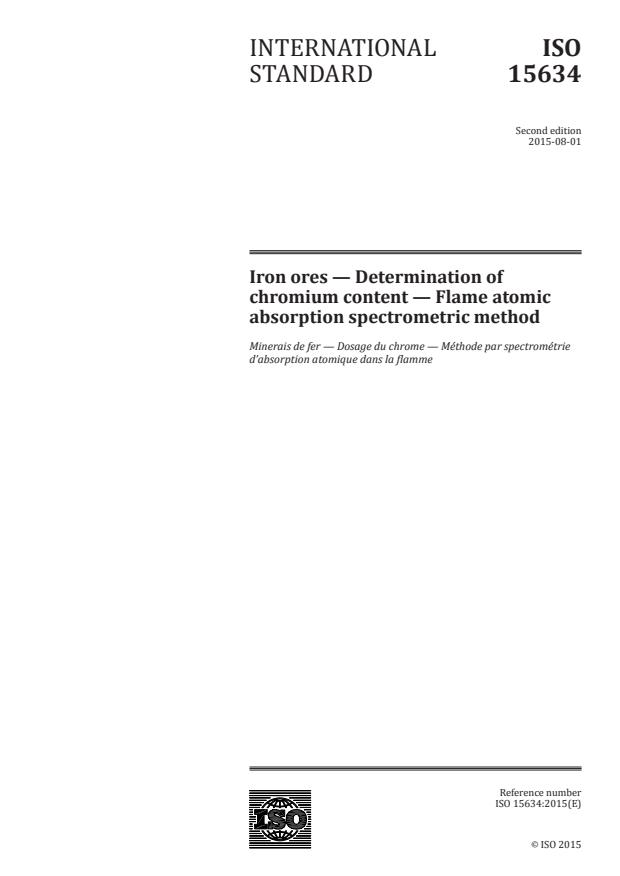
INTERNATIONAL ISO
STANDARD 15634
Second edition
2015-08-01
Iron ores — Determination of
chromium content — Flame atomic
absorption spectrometric method
Minerais de fer — Dosage du chrome — Méthode par spectrométrie
d’absorption atomique dans la flamme
Reference number
©
ISO 2015
© ISO 2015, Published in Switzerland
All rights reserved. Unless otherwise specified, no part of this publication may be reproduced or utilized otherwise in any form
or by any means, electronic or mechanical, including photocopying, or posting on the internet or an intranet, without prior
written permission. Permission can be requested from either ISO at the address below or ISO’s member body in the country of
the requester.
ISO copyright office
Ch. de Blandonnet 8 • CP 401
CH-1214 Vernier, Geneva, Switzerland
Tel. +41 22 749 01 11
Fax +41 22 749 09 47
copyright@iso.org
www.iso.org
ii © ISO 2015 – All rights reserved
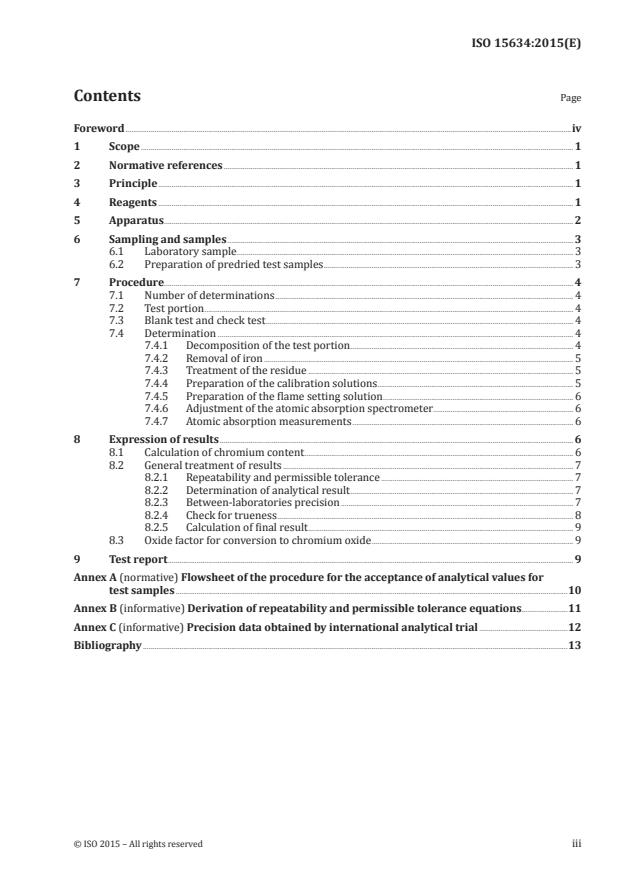
Contents Page
Foreword .iv
1 Scope . 1
2 Normative references . 1
3 Principle . 1
4 Reagents . 1
5 Apparatus . 2
6 Sampling and samples . 3
6.1 Laboratory sample . 3
6.2 Preparation of predried test samples . 3
7 Procedure. 4
7.1 Number of determinations . 4
7.2 Test portion . 4
7.3 Blank test and check test . 4
7.4 Determination . 4
7.4.1 Decomposition of the test portion . 4
7.4.2 Removal of iron . 5
7.4.3 Treatment of the residue . 5
7.4.4 Preparation of the calibration solutions . 5
7.4.5 Preparation of the flame setting solution . 6
7.4.6 Adjustment of the atomic absorption spectrometer. 6
7.4.7 Atomic absorption measurements . 6
8 Expression of results . 6
8.1 Calculation of chromium content . 6
8.2 General treatment of results . 7
8.2.1 Repeatability and permissible tolerance . 7
8.2.2 Determination of analytical result . 7
8.2.3 Between-laboratories precision . 7
8.2.4 Check for trueness . 8
8.2.5 Calculation of final result . 9
8.3 Oxide factor for conversion to chromium oxide . 9
9 Test report . 9
Annex A (normative) Flowsheet of the procedure for the acceptance of analytical values for
test samples .10
Annex B (informative) Derivation of repeatability and permissible tolerance equations .11
Annex C (informative) Precision data obtained by international analytical trial .12
Bibliography .13
Foreword
ISO (the International Organization for Standardization) is a worldwide federation of national standards
bodies (ISO member bodies). The work of preparing International Standards is normally carried out
through ISO technical committees. Each member body interested in a subject for which a technical
committee has been established has the right to be represented on that committee. International
organizations, governmental and non-governmental, in liaison with ISO, also take part in the work.
ISO collaborates closely with the International Electrotechnical Commission (IEC) on all matters of
electrotechnical standardization.
The procedures used to develop this document and those intended for its further maintenance are
described in the ISO/IEC Directives, Part 1. In particular the different approval criteria needed for the
different types of ISO documents should be noted. This document was drafted in accordance with the
editorial rules of the ISO/IEC Directives, Part 2 (see www.iso.org/directives).
Attention is drawn to the possibility that some of the elements of this document may be the subject of
patent rights. ISO shall not be held responsible for identifying any or all such patent rights. Details of
any patent rights identified during the development of the document will be in the Introduction and/or
on the ISO list of patent declarations received (see www.iso.org/patents).
Any trade name used in this document is information given for the convenience of users and does not
constitute an endorsement.
For an explanation on the meaning of ISO specific terms and expressions related to conformity
assessment, as well as information about ISO’s adherence to the WTO principles in the Technical
Barriers to Trade (TBT) see the following URL: Foreword - Supplementary Information
The committee responsible for this document is ISO/TC 102, Iron ore and direct reduced iron,
Subcommittee SC 2, Chemical analysis.
This second edition cancels and replaces the first edition (ISO 15634:2005), which has been
technically revised.
iv © ISO 2015 – All rights reserved
INTERNATIONAL STANDARD ISO 15634:2015(E)
Iron ores — Determination of chromium content — Flame
atomic absorption spectrometric method
WARNING — This International Standard may involve hazardous materials, operations, and
equipment. This International Standard does not purport to address all of the safety problems
associated with its use. It is the responsibility of the user of this International Standard to
establish appropriate health and safety practices and determine the applicability of regulatory
limitations prior to use.
1 Scope
This International Standard specifies a flame atomic absorption spectrometric method for the
determination of the chromium content of iron ores.
This method is applicable to chromium contents between 0,001 6 % and 0,1 % (mass fractions) in
natural iron ores, iron ore concentrates, and agglomerates including sinter products.
2 Normative references
The following documents, in whole or in part, are normatively referenced in this document and are
indispensable for its application. For dated references, only the edition cited applies. For undated
references, the latest edition of the referenced document (including any amendments) applies.
ISO 648, Laboratory glassware — Single-volume pipettes
ISO 1042, Laboratory glassware — One-mark volumetric flasks
ISO 3082, Iron ores — Sampling and sample preparation procedures
ISO 3696, Water for analytical laboratory use — Specification and test methods
ISO 7764, Iron ores — Preparation of predried test samples for chemical analysis
3 Principle
The test portion is decomposed by treatment with hydrochloric and nitric acids.
The major portion of iron in the filtrate is removed by extraction with 4-methylpentan-2-one.
The insoluble residue is ignited and the silicon dioxide is removed by evaporation with hydrofluoric
and sulfuric acids. The residue is fused with a mixture of sodium carbonate and sodium tetraborate,
and then dissolved with hydrochloric acid and combined with the main solution.
The solution is aspirated into the flame of an atomic absorption spectrometer using a nitrous oxide-
acetylene burner.
The absorbance values obtained are compared with those obtained from the calibration solutions.
4 Reagents
During the analysis, use only reagents of recognized analytical grade.
4.1 Water, complying with grade 2 as defined in ISO 3696.
4.2 Sodium carbonate, (Na CO ), anhydrous powder.
2 3
4.3 Sodium tetraborate, (Na B O ), anhydrous powder.
2 4 7
4.4 Lithium tetraborate, (Li B O ), anhydrous powder.
2 4 7
4.5 Hydrochloric acid, ρ 1,16 g/ml to 1,19 g/ml.
4.6 Hydrochloric acid, ρ 1,16 g/ml to 1,19 g/ml, diluted 2 + 1.
4.7 Hydrochloric acid, ρ 1,16 g/ml to 1,19 g/ml, diluted 1 + 1.
4.8 Hydrochloric acid, ρ 1,16 g/ml to 1,19 g/ml, diluted 2 + 100.
4.9 Nitric acid, ρ 1,4 g/ml.
4.10 Nitric acid, ρ 1,4 g/ml, diluted 1 + 1.
4.11 Hydrofluoric acid, ρ 1,13 g/ml, 40 % (mass fraction) or ρ 1,19 g/ml, 48 % (mass fraction).
4.12 Sulfuric acid, ρ 1,84 g/ml.
4.13 Sulfuric acid, ρ 1,84 g/ml, diluted 1 + 1.
4.14 Methylpentan-2-one, (methyl isobutyl ketone, MIBK).
4.15 Chromium standard solution A, 100 µg Cr/ml.
Dissolve 0,100 0 g of chromium metal [purity >99,9 % (mass fraction) (see Note of 4.16)] in 20 ml of
hydrochloric acid (4.7). After cooling, transfer to a 1 000 ml one-mark volumetric flask quantitatively,
dilute to volume with water (4.1), and mix.
4.16 Chromium standard solution B, 10 µg Cr/ml.
Transfer 100,0 ml of chromium standard solution A (4.15) to a 1 000 ml one-mark volumetric flask.
Dilute to volume with water and mix.
NOTE The purity of the metals stated on the certificates does not generally take into account the presence of
adsorbed gases like oxygen, carbon monoxide, etc.
5 Apparatus
Ordinary laboratory apparatus including one-mark pipettes and one-mark volumetric flasks complying
with the specifications of ISO 648 and ISO 1042, and the following.
5.1 Platinum crucible, of minimum capacity 25 ml.
5.2 Muffle furnace.
5.3 Atomic absorption spectrometer, equipped with a dinitrogen oxide-acetylene burner.
WARNING — Follow the manufacturer’s instructions for igniting and extinguishing the
dinitrogen oxide-acetylene flame to avoid possible explosion hazards. Wear tinted safety glasses
whenever the burner is in operation.
2 © ISO 2015 – All rights reserved
The atomic absorption spectrometer used in this method shall meet the following criteria:
a) Minimum sensitivity — The absorbance of the most concentrated calibration solution (see 7.4.4) is
at least 0,3;
b) Graph linearity — The slope of the calibration graph covering the top 20 % of the concentration
range (expressed as a change in absorbance) is not less than 0,7 of the value of the slope for the
bottom 20 % of the concentration range determined in the same way;
c) Minimum stability — The standard deviation of the absorbance of the most concentrated calibration
solution and that of the zero calibration solution each being calculated from a sufficient number
of repetitive measurements are less than 1,5 % and 0,5 %, respectively of the mean value of the
absorbance of the most concentrated solution.
The use of a strip-chart recorder and/or digital readout device is recommended to evaluate criteria a),
b), and c) and for all subsequent measurements.
NOTE Instrument parameters will vary with each instrument. The following parameters were successfully
used in several laboratories and they can be used as guidelines:
— hollow-cathode lamp 10 mA;
— wavelength 357,9 nm;
— dinitrogen oxide flow rate ≈10 l/min;
— acetylene flow rate 5 l/min.
A dinitrogen oxide-acetylene flame was used.
In systems where the values shown above for gas flow rates do not apply, the ratio of the gas flow rates
can still be a useful guideline.
6 Sampling and samples
6.1 Laboratory sample
For analysis, use a laboratory sample of particle size of less than 100 µm which has been taken and
prepared in accordance with ISO 3082. In the case of ores containing significant contents of combined
water or oxidizable compounds, use a particle size of less than 160 µm.
NOTE A guideline on significant contents of combined water and oxidizable compounds is incorporated in
ISO 7764.
Ensure that the sample has not been pulverized in a nickel/chromium pot.
6.2 Preparation of predried test samples
Thoroughly mix the laboratory sample and taking multiple increments, extract a test sample in such a
way that it is representative of the whole contents of the container. Dry the test sample at (105 ± 2) °C as
specified in ISO 7764 (this is the predried test sample).
7 Procedure
7.1 Number of determinations
Carry out the analysis at least in duplicate in accordance with Annex A, independently on one
predried test sample.
NOTE The expression “independently” means that the second and any subsequent result is not affected
by the previous result(s). For this particular analytical method, this condition implies that the repetition of the
procedure be carried out either by the same operator at a different time or by a different operator including, in
either case, appropriate recalibration.
7.2 Test portion
Taking several increments, weigh to the nearest 0,000 2 g, app
...
INTERNATIONAL ISO
STANDARD 15634
Second edition
2015-08-01
Iron ores — Determination of
chromium content — Flame atomic
absorption spectrometric method
Minerais de fer — Dosage du chrome — Méthode par spectrométrie
d’absorption atomique dans la flamme
Reference number
©
ISO 2015
© ISO 2015, Published in Switzerland
All rights reserved. Unless otherwise specified, no part of this publication may be reproduced or utilized otherwise in any form
or by any means, electronic or mechanical, including photocopying, or posting on the internet or an intranet, without prior
written permission. Permission can be requested from either ISO at the address below or ISO’s member body in the country of
the requester.
ISO copyright office
Ch. de Blandonnet 8 • CP 401
CH-1214 Vernier, Geneva, Switzerland
Tel. +41 22 749 01 11
Fax +41 22 749 09 47
copyright@iso.org
www.iso.org
ii © ISO 2015 – All rights reserved
Contents Page
Foreword .iv
1 Scope . 1
2 Normative references . 1
3 Principle . 1
4 Reagents . 1
5 Apparatus . 2
6 Sampling and samples . 3
6.1 Laboratory sample . 3
6.2 Preparation of predried test samples . 3
7 Procedure. 4
7.1 Number of determinations . 4
7.2 Test portion . 4
7.3 Blank test and check test . 4
7.4 Determination . 4
7.4.1 Decomposition of the test portion . 4
7.4.2 Removal of iron . 5
7.4.3 Treatment of the residue . 5
7.4.4 Preparation of the calibration solutions . 5
7.4.5 Preparation of the flame setting solution . 6
7.4.6 Adjustment of the atomic absorption spectrometer. 6
7.4.7 Atomic absorption measurements . 6
8 Expression of results . 6
8.1 Calculation of chromium content . 6
8.2 General treatment of results . 7
8.2.1 Repeatability and permissible tolerance . 7
8.2.2 Determination of analytical result . 7
8.2.3 Between-laboratories precision . 7
8.2.4 Check for trueness . 8
8.2.5 Calculation of final result . 9
8.3 Oxide factor for conversion to chromium oxide . 9
9 Test report . 9
Annex A (normative) Flowsheet of the procedure for the acceptance of analytical values for
test samples .10
Annex B (informative) Derivation of repeatability and permissible tolerance equations .11
Annex C (informative) Precision data obtained by international analytical trial .12
Bibliography .13
Foreword
ISO (the International Organization for Standardization) is a worldwide federation of national standards
bodies (ISO member bodies). The work of preparing International Standards is normally carried out
through ISO technical committees. Each member body interested in a subject for which a technical
committee has been established has the right to be represented on that committee. International
organizations, governmental and non-governmental, in liaison with ISO, also take part in the work.
ISO collaborates closely with the International Electrotechnical Commission (IEC) on all matters of
electrotechnical standardization.
The procedures used to develop this document and those intended for its further maintenance are
described in the ISO/IEC Directives, Part 1. In particular the different approval criteria needed for the
different types of ISO documents should be noted. This document was drafted in accordance with the
editorial rules of the ISO/IEC Directives, Part 2 (see www.iso.org/directives).
Attention is drawn to the possibility that some of the elements of this document may be the subject of
patent rights. ISO shall not be held responsible for identifying any or all such patent rights. Details of
any patent rights identified during the development of the document will be in the Introduction and/or
on the ISO list of patent declarations received (see www.iso.org/patents).
Any trade name used in this document is information given for the convenience of users and does not
constitute an endorsement.
For an explanation on the meaning of ISO specific terms and expressions related to conformity
assessment, as well as information about ISO’s adherence to the WTO principles in the Technical
Barriers to Trade (TBT) see the following URL: Foreword - Supplementary Information
The committee responsible for this document is ISO/TC 102, Iron ore and direct reduced iron,
Subcommittee SC 2, Chemical analysis.
This second edition cancels and replaces the first edition (ISO 15634:2005), which has been
technically revised.
iv © ISO 2015 – All rights reserved
INTERNATIONAL STANDARD ISO 15634:2015(E)
Iron ores — Determination of chromium content — Flame
atomic absorption spectrometric method
WARNING — This International Standard may involve hazardous materials, operations, and
equipment. This International Standard does not purport to address all of the safety problems
associated with its use. It is the responsibility of the user of this International Standard to
establish appropriate health and safety practices and determine the applicability of regulatory
limitations prior to use.
1 Scope
This International Standard specifies a flame atomic absorption spectrometric method for the
determination of the chromium content of iron ores.
This method is applicable to chromium contents between 0,001 6 % and 0,1 % (mass fractions) in
natural iron ores, iron ore concentrates, and agglomerates including sinter products.
2 Normative references
The following documents, in whole or in part, are normatively referenced in this document and are
indispensable for its application. For dated references, only the edition cited applies. For undated
references, the latest edition of the referenced document (including any amendments) applies.
ISO 648, Laboratory glassware — Single-volume pipettes
ISO 1042, Laboratory glassware — One-mark volumetric flasks
ISO 3082, Iron ores — Sampling and sample preparation procedures
ISO 3696, Water for analytical laboratory use — Specification and test methods
ISO 7764, Iron ores — Preparation of predried test samples for chemical analysis
3 Principle
The test portion is decomposed by treatment with hydrochloric and nitric acids.
The major portion of iron in the filtrate is removed by extraction with 4-methylpentan-2-one.
The insoluble residue is ignited and the silicon dioxide is removed by evaporation with hydrofluoric
and sulfuric acids. The residue is fused with a mixture of sodium carbonate and sodium tetraborate,
and then dissolved with hydrochloric acid and combined with the main solution.
The solution is aspirated into the flame of an atomic absorption spectrometer using a nitrous oxide-
acetylene burner.
The absorbance values obtained are compared with those obtained from the calibration solutions.
4 Reagents
During the analysis, use only reagents of recognized analytical grade.
4.1 Water, complying with grade 2 as defined in ISO 3696.
4.2 Sodium carbonate, (Na CO ), anhydrous powder.
2 3
4.3 Sodium tetraborate, (Na B O ), anhydrous powder.
2 4 7
4.4 Lithium tetraborate, (Li B O ), anhydrous powder.
2 4 7
4.5 Hydrochloric acid, ρ 1,16 g/ml to 1,19 g/ml.
4.6 Hydrochloric acid, ρ 1,16 g/ml to 1,19 g/ml, diluted 2 + 1.
4.7 Hydrochloric acid, ρ 1,16 g/ml to 1,19 g/ml, diluted 1 + 1.
4.8 Hydrochloric acid, ρ 1,16 g/ml to 1,19 g/ml, diluted 2 + 100.
4.9 Nitric acid, ρ 1,4 g/ml.
4.10 Nitric acid, ρ 1,4 g/ml, diluted 1 + 1.
4.11 Hydrofluoric acid, ρ 1,13 g/ml, 40 % (mass fraction) or ρ 1,19 g/ml, 48 % (mass fraction).
4.12 Sulfuric acid, ρ 1,84 g/ml.
4.13 Sulfuric acid, ρ 1,84 g/ml, diluted 1 + 1.
4.14 Methylpentan-2-one, (methyl isobutyl ketone, MIBK).
4.15 Chromium standard solution A, 100 µg Cr/ml.
Dissolve 0,100 0 g of chromium metal [purity >99,9 % (mass fraction) (see Note of 4.16)] in 20 ml of
hydrochloric acid (4.7). After cooling, transfer to a 1 000 ml one-mark volumetric flask quantitatively,
dilute to volume with water (4.1), and mix.
4.16 Chromium standard solution B, 10 µg Cr/ml.
Transfer 100,0 ml of chromium standard solution A (4.15) to a 1 000 ml one-mark volumetric flask.
Dilute to volume with water and mix.
NOTE The purity of the metals stated on the certificates does not generally take into account the presence of
adsorbed gases like oxygen, carbon monoxide, etc.
5 Apparatus
Ordinary laboratory apparatus including one-mark pipettes and one-mark volumetric flasks complying
with the specifications of ISO 648 and ISO 1042, and the following.
5.1 Platinum crucible, of minimum capacity 25 ml.
5.2 Muffle furnace.
5.3 Atomic absorption spectrometer, equipped with a dinitrogen oxide-acetylene burner.
WARNING — Follow the manufacturer’s instructions for igniting and extinguishing the
dinitrogen oxide-acetylene flame to avoid possible explosion hazards. Wear tinted safety glasses
whenever the burner is in operation.
2 © ISO 2015 – All rights reserved
The atomic absorption spectrometer used in this method shall meet the following criteria:
a) Minimum sensitivity — The absorbance of the most concentrated calibration solution (see 7.4.4) is
at least 0,3;
b) Graph linearity — The slope of the calibration graph covering the top 20 % of the concentration
range (expressed as a change in absorbance) is not less than 0,7 of the value of the slope for the
bottom 20 % of the concentration range determined in the same way;
c) Minimum stability — The standard deviation of the absorbance of the most concentrated calibration
solution and that of the zero calibration solution each being calculated from a sufficient number
of repetitive measurements are less than 1,5 % and 0,5 %, respectively of the mean value of the
absorbance of the most concentrated solution.
The use of a strip-chart recorder and/or digital readout device is recommended to evaluate criteria a),
b), and c) and for all subsequent measurements.
NOTE Instrument parameters will vary with each instrument. The following parameters were successfully
used in several laboratories and they can be used as guidelines:
— hollow-cathode lamp 10 mA;
— wavelength 357,9 nm;
— dinitrogen oxide flow rate ≈10 l/min;
— acetylene flow rate 5 l/min.
A dinitrogen oxide-acetylene flame was used.
In systems where the values shown above for gas flow rates do not apply, the ratio of the gas flow rates
can still be a useful guideline.
6 Sampling and samples
6.1 Laboratory sample
For analysis, use a laboratory sample of particle size of less than 100 µm which has been taken and
prepared in accordance with ISO 3082. In the case of ores containing significant contents of combined
water or oxidizable compounds, use a particle size of less than 160 µm.
NOTE A guideline on significant contents of combined water and oxidizable compounds is incorporated in
ISO 7764.
Ensure that the sample has not been pulverized in a nickel/chromium pot.
6.2 Preparation of predried test samples
Thoroughly mix the laboratory sample and taking multiple increments, extract a test sample in such a
way that it is representative of the whole contents of the container. Dry the test sample at (105 ± 2) °C as
specified in ISO 7764 (this is the predried test sample).
7 Procedure
7.1 Number of determinations
Carry out the analysis at least in duplicate in accordance with Annex A, independently on one
predried test sample.
NOTE The expression “independently” means that the second and any subsequent result is not affected
by the previous result(s). For this particular analytical method, this condition implies that the repetition of the
procedure be carried out either by the same operator at a different time or by a different operator including, in
either case, appropriate recalibration.
7.2 Test portion
Taking several increments, weigh to the nearest 0,000 2 g, app
...