


ISO/TS 9516-2:2024
(Main)Iron ores — Determination of various elements by X-ray fluorescence spectrometry — Part 2: Single element calibration procedure
Iron ores — Determination of various elements by X-ray fluorescence spectrometry — Part 2: Single element calibration procedure
This document sets out a wavelength dispersive X-ray fluorescence procedure for the determination of various elements in iron ores. The method is applicable to iron ores regardless of mineralogical type.
Titre manque — Partie 2: Titre manque
General Information
- Status
- Published
- Publication Date
- 05-May-2024
- Technical Committee
- ISO/TC 102/SC 2 - Chemical analysis
- Current Stage
- 9092 - International Standard to be revised
- Start Date
- 18-Jun-2025
- Completion Date
- 12-Feb-2026
Overview
ISO/TS 9516-2:2024 - Iron ores: Determination of various elements by X‑ray fluorescence spectrometry - Part 2: Single element calibration procedure defines a wavelength dispersive X‑ray fluorescence (WDXRF) procedure for determining multiple elements in iron ores. The method is stated to be applicable to iron ores regardless of mineralogical type. This Technical Specification focuses on the single‑element calibration workflow used to generate reliable quantitative XRF results for routine and laboratory determinations.
Key topics and technical requirements
- Scope & principle: WDXRF method for elemental analysis of iron ores; single element calibration approach.
- Sampling and sample preparation: Requirements for laboratory samples and sample preparation routes, referencing ISO 2596 and ISO 7764 for preparation methods.
- Fused‑disc preparation: Detailed steps for weighing, mixing, fusion, casting, visual inspection, storage and cleaning of platinum ware and discs.
- Instrument settings and measurement: Guidance on analytical lines, XRF generator settings, crystals, collimators, pulse‑height discrimination, counting time and measurement sequence.
- Drift correction & monitor discs: Procedures for preparing and using drift correction monitor discs to maintain measurement stability.
- Calibration & calculations: Instructions to calculate calibration coefficients, the alpha correction coefficient, mass‑ratio corrections (flux/sample and oxidizer/sample), conversion from oxide to element concentrations, and background equivalent concentration (BEC).
- Validation & quality control: Spectrometer precision tests, check analyses, blank tests and flowchart for acceptance of results.
- Normative and informative annexes: Includes flux preparation procedures, specimen preparation variability, theoretical derivations, FP (fundamental parameter) and least‑squares methods for corrections, counting time calculations, and an air‑cooling block for fused discs.
Applications and users
This standard is intended for:
- Analytical and metallurgical laboratories performing elemental analysis of iron ores.
- Mining companies, iron‑ore processors and quality control teams establishing or auditing WDXRF calibration.
- Instrument manufacturers and service providers implementing single‑element calibration routines or software.
- Laboratories involved in trade, specification compliance, or product certification where reproducible elemental results are required.
Practical uses include routine quality control, contract sampling verification, development of calibration sets for WDXRF instruments, and method validation for regulatory or commercial reporting.
Related standards and notes
- References and sample‑prep cross‑references: ISO 2596, ISO 7764 (sample preparation methods cited in the document).
- Annexes cover FP and least‑square methods as alternative/calculation aids.
- Warning: the document notes potential hazards from materials and operations; users must apply appropriate safety controls.
Keywords: ISO/TS 9516-2:2024, iron ores, XRF, WDXRF, single element calibration, fused discs, calibration coefficients, drift correction, sample preparation, laboratory quality control.

Get Certified
Connect with accredited certification bodies for this standard

Bureau Veritas Chile
Bureau Veritas certification services in Chile.
Bureau Veritas Peru
Bureau Veritas certification services in Peru.
BVQI Peru
Bureau Veritas certification in Peru.
Sponsored listings
Frequently Asked Questions
ISO/TS 9516-2:2024 is a technical specification published by the International Organization for Standardization (ISO). Its full title is "Iron ores — Determination of various elements by X-ray fluorescence spectrometry — Part 2: Single element calibration procedure". This standard covers: This document sets out a wavelength dispersive X-ray fluorescence procedure for the determination of various elements in iron ores. The method is applicable to iron ores regardless of mineralogical type.
This document sets out a wavelength dispersive X-ray fluorescence procedure for the determination of various elements in iron ores. The method is applicable to iron ores regardless of mineralogical type.
ISO/TS 9516-2:2024 is classified under the following ICS (International Classification for Standards) categories: 73.060.10 - Iron ores. The ICS classification helps identify the subject area and facilitates finding related standards.
ISO/TS 9516-2:2024 is available in PDF format for immediate download after purchase. The document can be added to your cart and obtained through the secure checkout process. Digital delivery ensures instant access to the complete standard document.
Standards Content (Sample)
Technical
Specification
ISO/TS 9516-2
First edition
Iron ores — Determination
2024-05
of various elements by X-ray
fluorescence spectrometry —
Part 2:
Single element calibration
procedure
Reference number
© ISO 2024
All rights reserved. Unless otherwise specified, or required in the context of its implementation, no part of this publication may
be reproduced or utilized otherwise in any form or by any means, electronic or mechanical, including photocopying, or posting on
the internet or an intranet, without prior written permission. Permission can be requested from either ISO at the address below
or ISO’s member body in the country of the requester.
ISO copyright office
CP 401 • Ch. de Blandonnet 8
CH-1214 Vernier, Geneva
Phone: +41 22 749 01 11
Email: copyright@iso.org
Website: www.iso.org
Published in Switzerland
ii
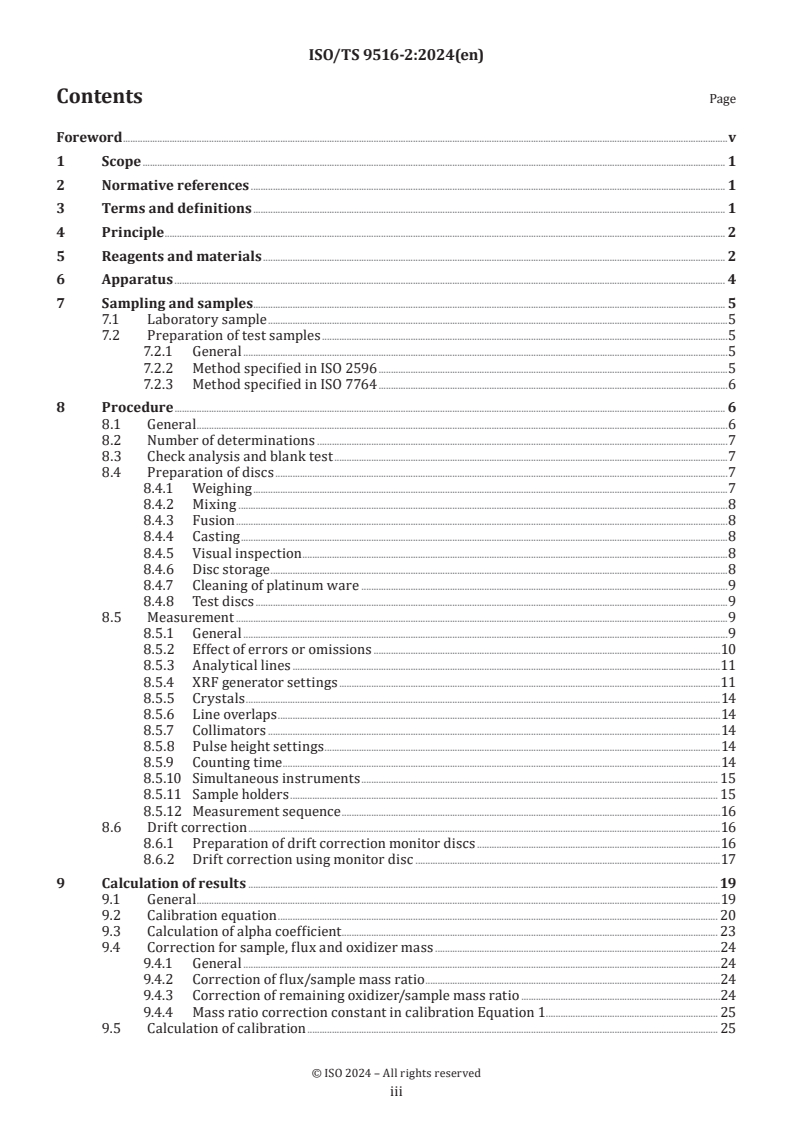
Contents Page
Foreword .v
1 Scope . 1
2 Normative references . 1
3 Terms and definitions . 1
4 Principle . 2
5 Reagents and materials . 2
6 Apparatus . 4
7 Sampling and samples . . 5
7.1 Laboratory sample .5
7.2 Preparation of test samples .5
7.2.1 General .5
7.2.2 Method specified in ISO 2596 .5
7.2.3 Method specified in ISO 7764 .6
8 Procedure . 6
8.1 General .6
8.2 Number of determinations .7
8.3 Check analysis and blank test .7
8.4 Preparation of discs .7
8.4.1 Weighing .7
8.4.2 Mixing .8
8.4.3 Fusion .8
8.4.4 Casting .8
8.4.5 Visual inspection .8
8.4.6 Disc storage .8
8.4.7 Cleaning of platinum ware .9
8.4.8 Test discs .9
8.5 Measurement .9
8.5.1 General .9
8.5.2 Effect of errors or omissions .10
8.5.3 Analytical lines .11
8.5.4 XRF generator settings .11
8.5.5 Crystals .14
8.5.6 Line overlaps .14
8.5.7 Collimators .14
8.5.8 Pulse height settings .14
8.5.9 Counting time .14
8.5.10 Simultaneous instruments . 15
8.5.11 Sample holders . 15
8.5.12 Measurement sequence .16
8.6 Drift correction .16
8.6.1 Preparation of drift correction monitor discs .16
8.6.2 Drift correction using monitor disc .17
9 Calculation of results . 19
9.1 General .19
9.2 Calibration equation . 20
9.3 Calculation of alpha coefficient . 23
9.4 Correction for sample, flux and oxidizer mass .24
9.4.1 General .24
9.4.2 Correction of flux/sample mass ratio .24
9.4.3 Correction of remaining oxidizer/sample mass ratio .24
9.4.4 Mass ratio correction constant in calibration Equation 1 . 25
9.5 Calculation of calibration . 25
iii
9.5.1 Preparation of calibration discs . 25
9.5.2 Calculation of concentrations of calibration discs . 28
9.5.3 Measurement of calibration discs . 29
9.5.4 Calculation of calibration coefficients . 29
9.6 Calculation of concentrations . . 33
9.6.1 Calculation of flux/sample and remaining oxidizer/sample mass ratios . 33
9.6.2 Calculation of initial concentration . 34
9.6.3 Calculation of concentrations . 34
9.6.4 Conversion from oxide to element concentrations . 35
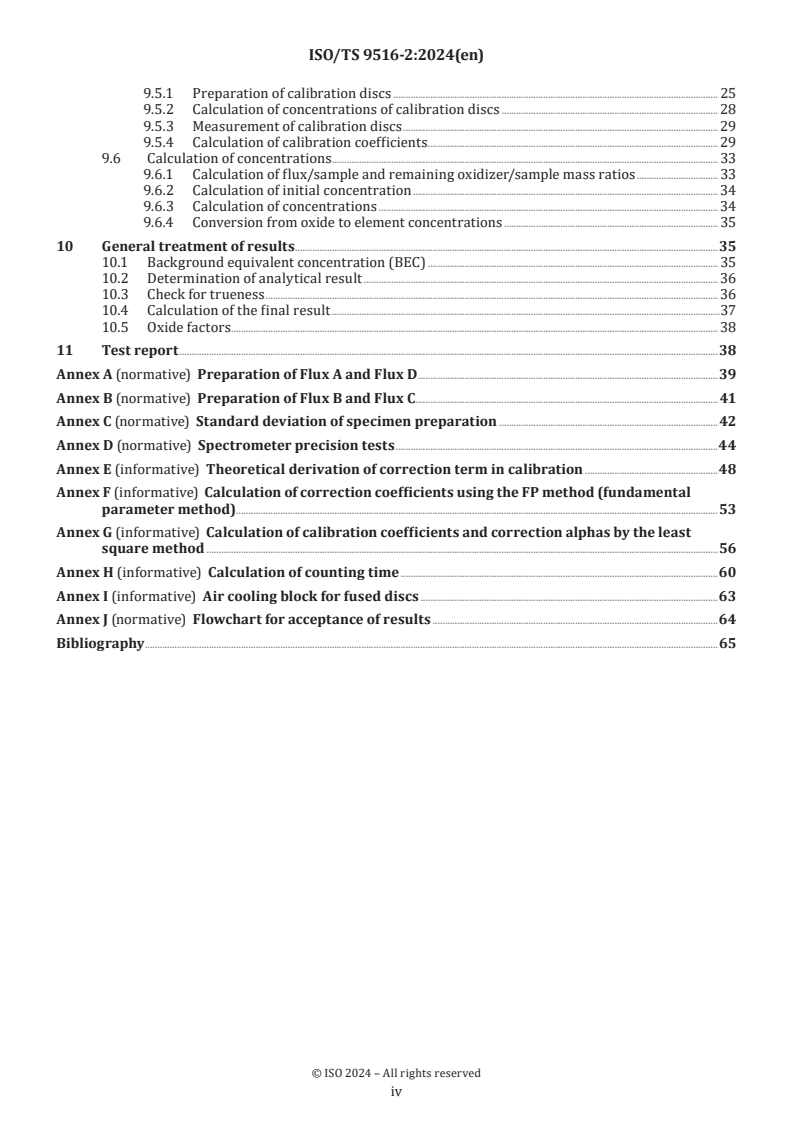
10 General treatment of results .35
10.1 Background equivalent concentration (BEC) . 35
10.2 Determination of analytical result . 36
10.3 Check for trueness . 36
10.4 Calculation of the final result .37
10.5 Oxide factors . . 38
11 Test report .38
Annex A (normative) Preparation of Flux A and Flux D .39
Annex B (normative) Preparation of Flux B and Flux C . 41
Annex C (normative) Standard deviation of specimen preparation .42
Annex D (normative) Spectrometer precision tests .44
Annex E (informative) Theoretical derivation of correction term in calibration .48
Annex F (informative) Calculation of correction coefficients using the FP method (fundamental
parameter method).53
Annex G (informative) Calculation of calibration coefficients and correction alphas by the least
square method .56
Annex H (informative) Calculation of counting time .60
Annex I (informative) Air cooling block for fused discs .63
Annex J (normative) Flowchart for acceptance of results .64
Bibliography .65
iv
Foreword
ISO (the International Organization for Standardization) is a worldwide federation of national standards
bodies (ISO member bodies). The work of preparing International Standards is normally carried out through
ISO technical committees. Each member body interested in a subject for which a technical committee
has been established has the right to be represented on that committee. International organizations,
governmental and non-governmental, in liaison with ISO, also take part in the work. ISO collaborates closely
with the International Electrotechnical Commission (IEC) on all matters of electrotechnical standardization.
The procedures used to develop this document and those intended for its further maintenance are described
in the ISO/IEC Directives, Part 1. In particular, the different approval criteria needed for the different types
of ISO document should be noted. This document was drafted in accordance with the editorial rules of the
ISO/IEC Directives, Part 2 (see www.iso.org/directives).
ISO draws attention to the possibility that the implementation of this document may involve the use of (a)
patent(s). ISO takes no position concerning the evidence, validity or applicability of any claimed patent
rights in respect thereof. As of the date of publication of this document, ISO had not received notice of (a)
patent(s) which may be required to implement this document. However, implementers are cautioned that
this may not represent the latest information, which may be obtained from the patent database available at
www.iso.org/patents. ISO shall not be held responsible for identifying any or all such patent rights.
Any trade name used in this document is information given for the convenience of users and does not
constitute an endorsement.
For an explanation of the voluntary nature of standards, the meaning of ISO specific terms and expressions
related to conformity assessment, as well as information about ISO's adherence to the World Trade
Organization (WTO) principles in the Technical Barriers to Trade (TBT), see www.iso.org/iso/foreword.html.
This document was prepared by Technical Committee ISO/TC 102, Iron ore and direct reduced iron,
Subcommittee SC 2, Chemical analysis.
A list of all parts in the ISO 9516 series can be found on the ISO website.
Any feedback or questions on this document should be directed to the user’s national standards body. A
complete listing of these bodies can be found at www.iso.org/members.html.
v
Technical Specification ISO/TS 9516-2:2024(en)
Iron ores — Determination of various elements by X-ray
fluorescence spectrometry —
Part 2:
Single element calibration procedure
WARNING — This document can involve hazardous materials, operations and equipment. This
document does not purport to address all of the safety problems associated with its use. It is the
responsibility of the user of this document to establish appropriate health and safety practices and
determine the applicability of regulatory limitations prior to use.
1 Scope
This document sets out a wavelength dispersive X-ray fluorescence procedure for the determination of
various elements in iron ores. The method is applicable to iron ores regardless of mineralogical type.
2 Normative references
The following documents are referred to in the text in such a way that some of all of their content constitutes
requirements of this document. For dated reference, only the edition cited applies. For undated references,
the latest edition of the referenced document (including any amendments) applies.
ISO 648, Laboratory glassware — Single-volume pipettes
ISO 1042, Laboratory glassware — One-mark volumetric flasks
ISO 2596, Iron ores — Determination of hygroscopic moisture in analytical samples — Gravimetric, Karl Fischer
and mass-loss methods
ISO 3082, Iron ores — Sampling and sample preparation procedures
ISO 3696, Water for analytical laboratory use — Specification and test methods
ISO 7764, Iron ores — Preparation of predried test samples for chemical analysis
ISO 8655-2, Piston-operated volumetric apparatus — Part 2: Pipettes
ISO 11323, Iron ore and direct reduced iron — Vocabulary
3 Terms and definitions
For the purposes of this document, the terms and definitions given in ISO 11323 apply.
ISO and IEC maintain terminology databases for use in standardization at the following addresses.
— ISO Online browsing platform: available at https:// www .iso .org/ obp
— IEC Electropedia: available at https:// www .electropedia .org/
4 Principle
The glass discs for X-ray fluorescence measurement are prepared by incorporating the test portion of the
iron ore sample, via fusion, into a borate glass disc using a casting procedure. By using a fused glass disc,
particle size effects are eliminated. Sodium nitrate may be added to the flux to ensure complete oxidation
of all components, particularly iron and sulfur. Any of four methods for glass disc preparation may be used:
three use lithium borate as flux; the other uses sodium borate.
X-ray fluorescence measurements are based on the “line only” principle. If desired, backgrounds can be
measured to obtain net line intensities. This method is applicable to data from simultaneous and sequential
X-ray fluorescence spectrometers.
This method relies on measuring all components of the sample, other than volatiles. If some components are
not measured, errors will result in the measured components (see 8.5.2).
Results are obtained after matrix corrections for inter-element effects.
5 Reagents and materials
During analysis, only reagents of recognized high purity, and only grade 2 water as specified in ISO 3696
shall be used.
Where reagents have been ignited, they shall be stored during cooling in a desiccator and weighed as soon
as possible.
5.1 Silicon dioxide, (SiO ), nominally 99,999 % SiO .
2 2
The silicon dioxide shall contain less than 3 μg/g of each of the other elements listed in Table 1. It shall be
heated to 1 000 °C in a platinum crucible for a minimum of 2 h and cooled in a desiccator.
5.2 Aluminium oxide, (Al O ), analytical reagent grade, α form.
2 3
If the α form is used, it shall be heated to 1 000 °C in a platinum crucible for a minimum of 2 h. If the
aluminium oxide is not the α form, it shall be converted to the α form by heating to 1 250 °C in a platinum
crucible for a minimum of 2 h. It shall be cooled in a desiccator and weighed as soon as it is cooled.
5.3 Iron(III) oxide, (Fe O ), purity of 99,995 % or more Fe O .
2 3 2 3
The iron(III) oxide shall contain less than 3 μg/g of each of the other elements listed in Table 1. It shall be
heated at 1 000 °C in a platinum crucible for a minimum of 1 h and cooled in a desiccator.
5.4 Titanium dioxide, (TiO ).
Analytical grade titanium dioxide shall be heated at 1 000 °C in a platinum crucible for a minimum of 1 h and
cooled in a desiccator.
Phosphorus is a common impurity in TiO and a reagent low in phosphorus shall be selected. The selected
reagent shall be checked, as even nominally high-purity reagents can be significantly contaminated, e.g. a
supposed 99,99 % TiO grade reagent has been found to contain about 0,5 % P O .
2 2 5
5.5 Potassium dihydrogen orthophosphate solution, (KH PO ).
2 4
Potassium dihydrogen orthophosphate KH PO of purity 99,0 % or more shall be dried at 105 °C for 1 h
2 4
and cooled in a desiccator. 3,481 g of the dried potassium dihydrogen orthophosphate shall be dissolved
in 100 ml water in a volumetric flask. One ml of this solution contains 7,92 mg phosphorous and 10,0 mg
potassium.
5.6 Calcium carbonate, (CaCO ).
Analytical grade calcium carbonate shall be dried at 105 °C for 1 h and cooled in a desiccator.
5.7 Manganese (II) sulfate hydrate solution, (MnSO ·5H O).
4 2
8,777 (= 5,497 + 5 × 0,656) g of manganese sulfate hydrate MnSO ·5H O of purity 99 % or more shall be
4 2
dissolved in 100 ml water in a volumetric flask. Manganese sulfate monohydrate (MnSO ·H O) may be
4 2
used as an alternative reagent of purity 99 % or more and 6,153 (= 5,497 + 0,656) g of the reagent shall be
dissolved in 100 ml water in a volumetric flask. One millilitre of the solution contains manganese 20,0 mg
and sulfur 11,67 mg.
5.8 Magnesium nitrate hexahydrate, [Mg(NO ) ·6H O], purity of 99,0 % or more.
3 2 2
5.9 1 000 mg/l element standards for V, Cr, Co, Ni, Cu, Zn, As, Pb and Ba.
Single element standard water solutions with 1 000 mg/l concentration and 0,5 to 6 % of nitric acid shall be
used. It is recommended to use commercially available standards. When standard solutions are prepared in
the laboratory, 1,000 g of pure metal (99,99 % or more) shall be dissolved in diluted nitric acid. Water shall
be added to this solution such that the prepared standard solution is 1 000 ml.
For the standard water solution for Cr, a solution of potassium dichromate solution (K Cr O ) with nitric
2 2 7
acid may be used.
5.10 Sodium nitrate, (NaNO ).
Analytical grade sodium nitrate shall be dried at 105 °C for 1 h and cooled in a desiccator.
5.11 Ammonium iodide, (NH I).
Laboratory reagent grade ammonium iodide does not need to be dried but shall be stored in a desiccator.
5.12 Desiccant.
The desiccant shall be freshly regenerated self-indicating silica gel.
5.13 Flux.
5.13.1 General
One of fluxes from Flux A, Flux B, Flux C or Flux D, as described in 5.13.2, 5.13.3 and 5.13.4, shall be used. The
levels of contamination in the flux shall be checked (see 10.1). Because levels of contamination can vary from
batch to batch, the same batch of flux shall be used for all discs (iron ore, blank and calibration) involved in
the batch of determinations.
5.13.2 Flux A and Flux D
Flux A and Flux D shall be prepared by fusion of a mixture of anhydrous lithium tetraborate (Li B O ) and
2 4 7
anhydrous lithium metaborate (LiBO ) using the procedure specified in Annex A. Flux shall be dried at
500 °C for a minimum of 4 h and stored in a desiccator.
5.13.3 Flux B
Flux B shall be prepared using sodium tetraborate using the procedure specified in Annex B. Flux shall be
dried at 500 °C for a minimum of 4 h and stored in a desiccator.
5.13.4 Flux C
Flux C shall be prepared using lithium tetraborate using the procedure specified in Annex B. Flux shall be
dried at 500 °C for a minimum of 4 h and stored in a desiccator.
NOTE If this flux is used, sulfur will not be reported.
6 Apparatus
The sample may be fused with the flux in a crucible and then poured into a separate mould or, if an
appropriately shaped crucible is used, the fusion may be carried out and the glass allowed to cool in the
same crucible. Both methods will produce glass discs of the same quality.
A conventional electric furnace, high-frequency furnace, or a gas burner may be used for heating. There are
disc-making machines commercially available, and these may be used to fuse and cast the discs.
A platinum lid may be used to cover the crucible if fusing in a furnace, but not if fusing over a flame, as this
enhances sulfur loss.
Where a high-frequency furnace or a gas burner is used for heating, a check shall be made to determine if
sulfur is lost during disc preparation. A mixture that contains 90 % Fe O and 10 % CaSO shall be prepared
2 3 4
and used to prepare replicate discs using normal fusion times and times of twice and thrice normal. The
intensity of SKα from the discs should not vary by more than 2 % relative.
Single-volume pipettes, one-mark volumetric flasks and piston pipettes to be used shall comply with
specifications of ISO 648, ISO 1042 and ISO 8655-2, respectively.
6.1 Analytical balance, capable of weighing to the nearest 0,1 mg.
6.2 Crucible and mould.
The crucible and mould shall be made from a non-wetting platinum alloy. Either platinum/gold or platinum/
gold/rhodium alloys are suitable.
If more than one crucible or more than one mould is used for casting, these crucibles or moulds shall all be
used in the specimen preparation test in Annex C. It is essential to use all of the crucibles or moulds in the
test described in Annex C, as casting vessels can become distorted with use, giving the analytical surface a
curvature that will result in error.
Sometimes, even undistorted crucibles or moulds give curvatures unique to the particular crucible or mould.
6.2.1 Crucible
Where the crucible is used for fusion only, it shall have sufficient capacity to hold the flux and sample
required for fusion. Where the crucible is used as a mould as well as for fusion, it shall have a flat bottom, to
enable production discs with minimum curvature.
6.2.2 Mould
Because the bottom of the disc is the analytical surface, the inside bottom surface of the mould shall be
flat and shall be polished regularly with approximately 3 μm diamond paste to ensure that the glass disc
releases easily from the mould. To prevent deformation through repeated heating and cooling, the base shall
be greater than 2 mm thick. The mould shall have a flat bottom, to enable production of discs with minimum
curvature.
6.3 Electric furnace, capable of maintaining a temperature of at least 1 050 °C.
The furnace shall be capable of maintaining higher temperatures where it is to be used for converting Al O
2 3
to the α form (1 250 °C), or for preparing Flux A (1 100 °C).
The furnace may be of a conventional type with heating elements, or may be a high-frequency furnace. The
furnace shall be cleaned regularly to prevent contamination of the samples.
6.4 Gas-oxygen burner.
Where fusions are made over a gas-oxygen flame, provision shall be made for oxygen enhancement of
the flame to minimize sulfur loss and crucible contamination. The temperature of the melt shall be in the
range 1 000 °C to 1 050 °C. The temperature shall be checked using an optical pyrometer while the crucible
contains several grams of flux. Alternatively, if an optical pyrometer is not available, about 3 g of potassium
sulfate (m.p. 1 069 °C) shall be put in an empty crucible and the flame adjusted so that it all just melts in the
open crucible. A gas burner may be used for heating the mould, and it shall be adjusted so that the mould is a
bright red heat (approximately 950 °C). A Meker burner shall not be used, as loss of sulfur and the uptake of
iron from the glass into the platinum ware can result.
6.5 Desiccator.
6.6 Spatulas, non-magnetic, for weighing of the test portion and for mixing.
6.7 X-ray fluorescence spectrometer, of any wavelength dispersive, vacuum (or helium) path,
simultaneous or sequential type, X-ray fluorescence spectrometer, provided that the instrument has been
checked.
Performance checks shall be carried out in accordance with the precision tests set out in Annex D,
accumulating at least 2 × 10 counts for each measurement.
6.8 Ultrasonic bath, optional. It may be used to aid cleaning of the platinum ware.
6.9 Cooling device.
It is recommended that the mould and glass be cooled using an air jet. Commercial disc-making machines
use this method. A drawing of a suitable device is given in Annex I.
Whatever the method of cooling, it is vital that samples be treated identically, as the curvature of the
analytical surface of the disc depends on the rate of cooling.
7 Sampling and samples
7.1 Laboratory sample
For analysis, laboratory samples of −100 μm particle size which has been taken and prepared in accordance
with ISO 3082 shall be used. In the case of ores having significant contents of combined water or oxidizable
compounds, samples of particle size of −160 μm shall be used.
7.2 Preparation of test samples
7.2.1 General
Depending on the ore type, air-equilibrate test samples shall be prepared in accordance with either ISO 2596
in 7.2.2 or ISO 7764 in 7.2.3.
7.2.2 Method specified in ISO 2596
The method is applicable to all types of ores.
The laboratory samples shall be thoroughly mixed, and in multiple increments, a test sample shall be
extracted in such a manner that it is representative of the entire content in the container. The test sample
shall be brought into equilibrium with the laboratory atmosphere in accordance with ISO 2596.
7.2.3 Method specified in ISO 7764
The method is not applicable to the following types of ores:
a) processed ores containing metallic iron;
b) natural or processed ores in which the sulfur content is higher than 0,2 %;
c) natural or processed ores in which the content of combined water is higher than 2,5 %.
The laboratory samples shall be thoroughly mixed and, multiple increments shall be taken, a test sample
shall be extracted in such a manner that it is representative of the whole contents of the container.
8 Procedure
8.1 General
The concentration range covered for each of the component elements is given in Table 1.
Table 1 — Range of application of the method
Concentration range for referee pur-
Concentration range for analysis
Component element poses
%
%
Fe 31 to 72 31 to 72
Si 0,16 to 11,8 0,16 to 11,8
Ca 0,011 to 13,7 0,011 to 13,7
Mn 0,016 to 2,0 0,016 to 2,0
Al 0,036 to 4,2 0,036 to 4,2
Ti 0,013 to 4,5 0,013 to 4,5
Mg 0,012 to 1,7 0,012 to 1,7
P 0,001 3 to 0,6 0,001 3 to 0,6
S 0,011 to 0,76 0,011 to 0,76
K 0,008 to 0,46 0,008 to 0,46
V 0,002 to 0,32 0,002 to 0,32
Cr — 0,006 to 0,067
Co — 0,006 to 0,023
Ni 0,008 to 0,038 0,008 to 0,038
Cu 0,007 to 0,17 0,007 to 0,17
Zn 0,005 to 0,36 0,005 to 0,36
As — 0,003 to 0,11
Pb — 0,001 to 0,23
Ba — 0,011 to 0,74
When the influence of absorption or spectral overlap by trace heavy elements to reporting elements is small
enough and can be ignored, those trace heavy elements can be omitted from measuring elements.
The applicable ranges for referee and non-referee methods are also to be determined based on results of
international trials.
The operator shall have demonstrated the ability to consistently make discs with high precision. This ability
shall be verified by carrying out the procedure given in Annex C.
The operator shall periodically test all moulds according to Annex C, because their shape can become
distorted with repeated use.
In preparing discs, great care shall be taken to avoid contamination and, in particular, the crucible in which
the fusion is carried out shall be thoroughly cleaned prior to use (see 8.4.7).
8.2 Number of determinations
Carry out two analyses independently for duplicate fused discs prepared on different days in accordance
with Annex J for each test sample (see 7.2).
8.3 Check analysis and blank test
In each run, one analysis of a certified reference material of the same type of ore shall be carried out in
parallel with the analysis of the ore sample(s) under the same conditions. A test sample of the certified
reference material shall be prepared in the manner appropriate to the type of ore involved.
When analysis is carried out on several samples of the same ore type at the same time, the analytical result
of one certified reference material may be used.
When a new reagent as for flux from a different bottle is used, it is recommended to measure a blank sample
to check the impurities and contamination due to sample preparation, before the analysis is carried out on
ore sample(s). The blank disc shall be prepared with 100 % Fe O .
2 3
8.4 Preparation of discs
8.4.1 Weighing
Table 2 shows the components used in making the glass discs. Provided that the proportions are kept
approximate to those given in Table 2, the masses can be varied to suit mould diameter. If a disc diameter
used differs from those given in Table 2, masses should be adjusted to be approximately proportional to the
area of the glass disc.
Table 2 — Masses of specimen components
Component Typical masses Mass
g g
Disc diameter
32 mm 40 mm
Flux 6,80 3,52 to 6,40 5,50 to 10,00
NaNO 0,40 or 0 0,21 to 0,37 or 0 0,33 to 0,58 or 0
Sample 0,66 0,35 to 0,60 0,55 to 0,94
The specified masses may be weighed as “catch” weights, recording the mass weighed to the nearest 0,001 g
for the flux and sodium nitrate portions, and to the nearest 0,000 1 g for the test and calibration portions. If
masses used are higher than recommended, crystallization and segregation with consequent cracking are
likely to occur as the glass cools.
If desired, ammonium iodide (5.11) can be used as a releasing agent. If added at this stage, no more than
0,01 g shall be added. Alternatively, a smaller amount may be added prior to casting (see 8.4.4). Exceeding
the recommended amount of releasing agent of ammonium iodide can introduce error in the titanium result
due to the overlap. ILβ interferes with TiKα.
Because the components are hygroscopic, they shall be weighed as soon as possible after reaching room
temperature following heating and without any undue delay between each weighing. Weighing may be made
directly into the crucible to be used in the fusion, or into a clean glass vial. Because of static effects, glass
vials are preferable to plastic. If a vial is used, care shall be taken to ensure complete transfer of the contents
into the fusion crucible.
8.4.2 Mixing
Thoroughly mix the components in the crucible using a spatula or similar implement, taking care that no
material is lost. The mixing implement used should be free of sharp or pointed edges, in order to ensure that
the interior of the crucible is not damaged by scratching. Brush any fine material adhering to the mixing
implement back into the crucible. Gently tap the bottom of the crucible on the bench top to ensure that any
material adhering to the crucible wall, above the general level of the mixed components, is reincorporated
into the bulk of the mix.
It is imperative that the crucible be tapped gently on the bench top, as too severe an impact will result in
the loss of some of the finer material and possible deformation of the crucible. Care shall be taken to mix the
components thoroughly to aid reproducibility of disc preparation.
8.4.3 Fusion
For samples containing sulfur as sulfide, the fusion mixture is to be preoxidised by heating to 700 °C for
10 min prior to fusion. Place the crucible in the electric furnace (6.3) or on the gas-oxygen burner (6.4) at
a temperature of 1 000 °C to 1 050 °C and maintain this temperature for 10 min. At least once during this
period, after the sample is dissolved, briefly swirl the mixture. While swirling, incorporate into the melt any
material that can be adhering to the sides of the crucible.
If a furnace is used for heating, it can be necessary to remove the crucible from the furnace for the purpose
of swirling. When the furnace is opened, the temperature can drop. The specified temperature shall be
regained before the time period starts.
8.4.4 Casting
If ammonium iodide was not added as a release agent earlier, it may be added to the melt just prior to casting.
In this case, no more than 0,002 g shall be added. Casting is then carried out by one of the following methods.
a) Casting in the crucible.
If the glass is to be cast in the crucible, remove the crucible from the furnace, place on a suitable cooling
device (6.9) and allow the glass to solidify.
b) Casting in a separate mould.
If the glass is to be cast in a separate mould, the mould shall be pre-heated over a gas flame to red heat
(900 °C to 1 050 °C). While the mould is still hot, pour the melt into the mould from the crucible. Remove
the mould from the heat source and place it on the cooling device (6.9) and allow the glass to solidify.
NOTE Failure to ensure that the mould is scrupulously clean prior to casting will result in discs sticking to the
mould and possibly cracking.
8.4.5 Visual inspection
Prior to storage, discs shall be inspected visually, paying particular attention to the analytical surface. The
discs shall not contain undissolved material, and shall be whole and free from crystallization, cracks and
bubbles. Defective discs shall be re-fused in the crucible, or discarded and substitute discs prepared.
8.4.6 Disc storage
As soon as possible (while the glass is still warm), transfer the discs to a desiccator so that absorption of
moisture and the possibility of contamination are minimized. When not being measured, discs shall be
stored in a clean desiccator.
To avoid contamination of the analytical surface, the specimen shall be handled by its edges and the surface
shall not be touched by hand or treated in any way. Specifically, it shall not be washed with water or other
solvents, ground or polished.
If paper labels are used on the backs of discs, great care should be taken to ensure that the labels do not
contact the analytical surfaces of other discs. Paper labels are clay coated and readily cause contamination
by silicon and aluminium. For the same reason, paper envelopes should not be used to store the discs.
8.4.7 Cleaning of platinum ware
Although the crucible and mould are fabricated from an alloy that is not wetted by the glass, in order to
ensure absolute precision, they shall be cleaned between each fusion. Immersion in hot hydrochloric, citric
or acetic acid (approximately 2 M), for about 1 h is usually sufficient, but they should be inspected to ensure
that all residual glass has been removed.
A rapid method of cleaning is to put the crucible or mould into a beaker containing the acid. Place the beaker
in a small ultrasonic bath for about 1 min or until all residual glass is removed, then rinse the mould in
distilled water and dry before using.
An alternative method of cleaning is to fuse several grams of flux in the crucible, moving the melt around to
clean the entire inner surface. The molten flux is then poured from the crucible. If a droplet adheres to the
crucible, this can easily be flaked off when the crucible is cold.
If new platinum ware is used without pre-conditioning by the cleaning described above, then the Fe results
will be unreliable until conditioning occurs. New platinum ware can also release contaminants without
conditioning.
8.4.8 Test discs
One disc from each test sample shall be prepared. At least one certified reference material, of the same type
as the ore used in the test discs, shall be prepared. Prior to fusing test discs, crucibles should be thoroughly
clean, particularly if the same crucibles were used to prepare the calibration discs, some of which are high
in trace elements.
8.5 Measurement
8.5.1 General
The analytical lines to be used and suggested operating conditions are given in Table 3. Other instrument
parameters (collimators and detectors) shall be selected according to the particular element.
Table 3 — Suggested analytical lines, crystals and operating conditions
a
Component ele- Line Voltage Crystal Specific line
ment (see 8.5.3) (see 8.5.4) (see 8.5.5) overlaps
kV (see 8.5.6)
Fe Kα 40 to 80 LiF(200) or LiF(220) —
Kβ 40 to 80 LiF(200) or LiF(220) —
Si Kα 25 to 50 PE —
Ca Kα 25 to 50 LiF(200) or PE or Ge(111) —
Mn Kα 50 to 80 LiF(200) CrKβ
...
Questions, Comments and Discussion
Ask us and Technical Secretary will try to provide an answer. You can facilitate discussion about the standard in here.
Loading comments...