

ISO 11999-9:2016
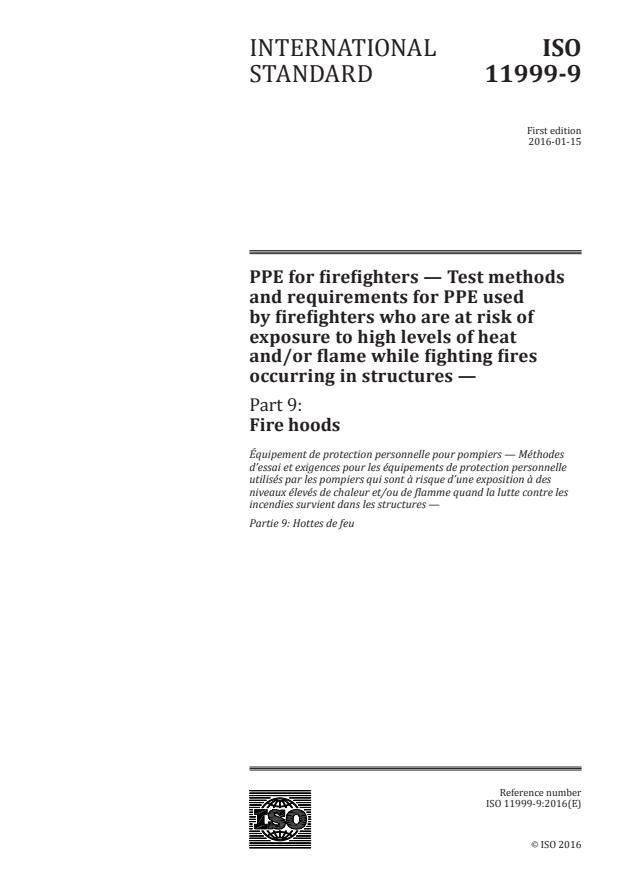
(Main)PPE for firefighters — Test methods and requirements for PPE used by firefighters who are at risk of exposure to high levels of heat and/or flame while fighting fires occurring in structures — Part 9: Fire hoods
General Information
- Abstract
ISO 11999-9:2016 specifies the minimum design and performance requirements for a fire hood as part of personal protective equipment (PPE) to be used by firefighters, primarily but not solely to protect against exposure to flame and high thermal loads.
- Status
- Withdrawn
- Publication Date
- 07-Jan-2016
- Technical Committee
- ISO/TC 94/SC 14 - Firefighters' personal equipment
- Drafting Committee
- ISO/TC 94/SC 14 - Firefighters' personal equipment
- Current Stage
- 9599 - Withdrawal of International Standard
- Start Date
- 25-Apr-2025
- Completion Date
- 29-Aug-2026
Buy Documents

ISO 11999-9:2016 - PPE for firefighters — Test methods and requirements for PPE used by firefighters who are at risk of exposure to high levels of heat and/or flame while fighting fires occurring in structures — Part 9: Fire hoods Released:1/8/2016
Overview - ISO 11999-9:2016 (Fire hoods)
ISO 11999-9 specifies minimum design and performance requirements and test methods for fire hoods as part of personal protective equipment (PPE) for firefighters exposed to high heat and/or flame in structural firefighting. The standard defines hood classification (Class 2 and Class 3), sizing, interfaces with breathing apparatus and turnout garments, sampling/pretreatment (laundering or dry-cleaning), and required laboratory performance tests.
Key topics and technical requirements
- Classification: Fire hoods are classified as Class 2 or Class 3, with progressively stricter performance limits for Class 3.
- Design basics: Close-fitting hood with facial opening to interface with facemask, a yoke interface to the protective garment, flexible fit, and robust seam construction.
- Sampling & pretreatment: Test specimens are subject to conditioning and, where specified, five cleaning cycles (wash: ISO 6330 procedure 2A at 60 ± 3 °C; tumble dry) or dry-cleaning (ISO 3175-1).
- Flame resistance: Tested per ISO 15025 - Class 2 uses surface ignition tests (Procedure A), Class 3 uses bottom-edge ignition (Procedure B) with limits on after-flame time (mean ≤ 2 s), char length, and absence of molten debris.
- Heat resistance: Exposed per ISO 17493 at specified temperatures: Class 2: 180 °C, Class 3: 260 °C; limits on shrinkage (≤5% / ≤10%) and no melting/dripping/ignition.
- Heat transfer performance:
- Flame exposure (ISO 9151): HTI minimums (Class 2 ≥ 8 s; Class 3 ≥ 11 s) and secondary HTI24–HTI12 requirements.
- Radiant exposure (ISO 6942): RHTI minimums (Class 2 ≥ 11 s; Class 3 ≥ 14 s).
- Combined flame + radiant alternative: ISO 17492 using TTI (Class 2 ≥ 700 J/m²; Class 3 ≥ 900 J/m²).
- Mechanical integrity: Residual burst strength after radiant exposure (ISO 13938-2) - Class 2 ≥ 300 kPa at 10 kW/m²; Class 3 ≥ 450 kPa at 20 kW/m². Seam burst strength ≥ 450 kPa.
- Dimensional controls: Hood opening size retention - change ≤ ±20% and not exceed 145 mm after don/doff cycling; dimensional change after laundering ≤ 5%.
- Thread resistance: Threads must not ignite, melt, or char when tested at 260 °C (ISO 3146).
Applications - who uses ISO 11999-9
- PPE manufacturers designing and certifying fire hoods
- Independent test laboratories conducting performance verification
- Fire service procurement and safety officers specifying compliant hoods
- Regulatory bodies, standards committees, and conformity assessment organizations
Related standards
- ISO 11999 (other parts: Part 1 General; Part 2 Compatibility; Parts 3–10 covering clothing, gloves, helmets, footwear, face/eye, hearing, respiratory protection)
- ISO 15025, ISO 9151, ISO 6942, ISO 17492, ISO 13938-2, ISO 3146, ISO 6330, ISO 5077, EN 960
Keywords: ISO 11999-9, fire hood standard, PPE for firefighters, firefighter PPE testing, flame resistance, heat transfer, HTI, RHTI, TTI, seam burst strength, hood opening retention.
Relations
- Effective Date
- 24-Sep-2022
Buy Documents
ISO 11999-9:2016 - PPE for firefighters — Test methods and requirements for PPE used by firefighters who are at risk of exposure to high levels of heat and/or flame while fighting fires occurring in structures — Part 9: Fire hoods Released:1/8/2016
Get Certified
Connect with accredited certification bodies for this standard

CIS Institut d.o.o.
Personal Protective Equipment (PPE) certification body. Notified Body NB-2890 for EU Regulation 2016/425 PPE.

Kiwa BDA Testing
Building and construction product certification.
Kmetijski inštitut Slovenije
Agricultural Institute of Slovenia. Soil testing, plant health, agricultural product analysis.
Sponsored listings
Frequently Asked Questions
ISO 11999-9:2016 is a standard published by the International Organization for Standardization (ISO). Its full title is "PPE for firefighters — Test methods and requirements for PPE used by firefighters who are at risk of exposure to high levels of heat and/or flame while fighting fires occurring in structures — Part 9: Fire hoods". This standard covers: ISO 11999-9:2016 specifies the minimum design and performance requirements for a fire hood as part of personal protective equipment (PPE) to be used by firefighters, primarily but not solely to protect against exposure to flame and high thermal loads.
ISO 11999-9:2016 specifies the minimum design and performance requirements for a fire hood as part of personal protective equipment (PPE) to be used by firefighters, primarily but not solely to protect against exposure to flame and high thermal loads.
ISO 11999-9:2016 is classified under the following ICS (International Classification for Standards) categories: 13.340.10 - Protective clothing. The ICS classification helps identify the subject area and facilitates finding related standards.
ISO 11999-9:2016 has the following relationships with other standards: It is inter standard links to ISO 11999-9:2025. Understanding these relationships helps ensure you are using the most current and applicable version of the standard.
ISO 11999-9:2016 is available in PDF format for immediate download after purchase. The document can be added to your cart and obtained through the secure checkout process. Digital delivery ensures instant access to the complete standard document.
Standards Content (Sample)
INTERNATIONAL ISO
STANDARD 11999-9
First edition
2016-01-15
PPE for firefighters — Test methods
and requirements for PPE used
by firefighters who are at risk of
exposure to high levels of heat
and/or flame while fighting fires
occurring in structures —
Part 9:
Fire hoods
Équipement de protection personnelle pour pompiers — Méthodes
d’essai et exigences pour les équipements de protection personnelle
utilisés par les pompiers qui sont à risque d’une exposition à des
niveaux élevés de chaleur et/ou de flamme quand la lutte contre les
incendies survient dans les structures —
Partie 9: Hottes de feu
Reference number
©
ISO 2016
© ISO 2016, Published in Switzerland
All rights reserved. Unless otherwise specified, no part of this publication may be reproduced or utilized otherwise in any form
or by any means, electronic or mechanical, including photocopying, or posting on the internet or an intranet, without prior
written permission. Permission can be requested from either ISO at the address below or ISO’s member body in the country of
the requester.
ISO copyright office
Ch. de Blandonnet 8 • CP 401
CH-1214 Vernier, Geneva, Switzerland
Tel. +41 22 749 01 11
Fax +41 22 749 09 47
copyright@iso.org
www.iso.org
ii © ISO 2016 – All rights reserved
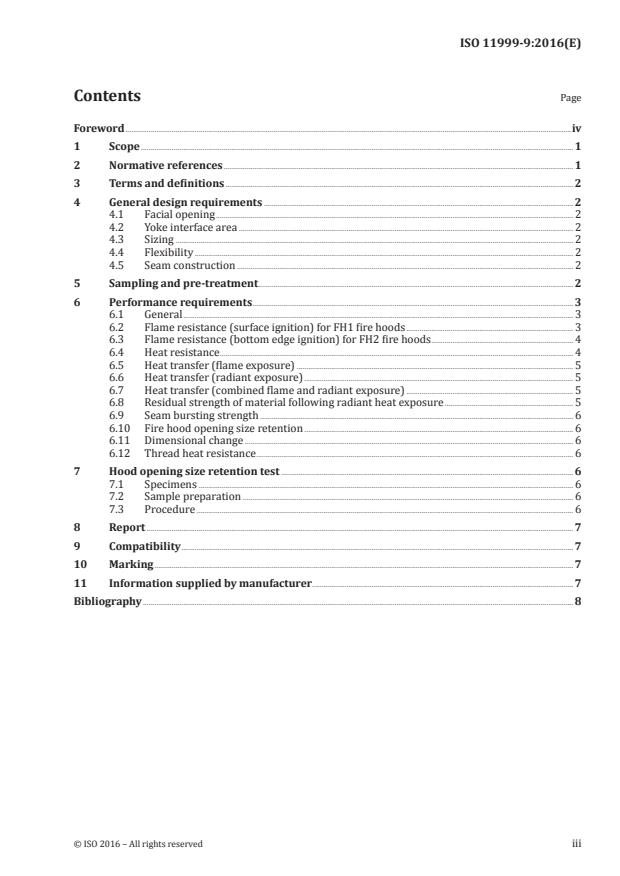
Contents Page
Foreword .iv
1 Scope . 1
2 Normative references . 1
3 Terms and definitions . 2
4 General design requirements . 2
4.1 Facial opening . 2
4.2 Yoke interface area . 2
4.3 Sizing . 2
4.4 Flexibility . 2
4.5 Seam construction . 2
5 Sampling and pre-treatment . 2
6 Performance requirements . 3
6.1 General . 3
6.2 Flame resistance (surface ignition) for FH1 fire hoods . 3
6.3 Flame resistance (bottom edge ignition) for FH2 fire hoods . 4
6.4 Heat resistance . 4
6.5 Heat transfer (flame exposure) . 5
6.6 Heat transfer (radiant exposure) . 5
6.7 Heat transfer (combined flame and radiant exposure) . 5
6.8 Residual strength of material following radiant heat exposure . 5
6.9 Seam bursting strength . 6
6.10 Fire hood opening size retention . 6
6.11 Dimensional change . 6
6.12 Thread heat resistance . 6
7 Hood opening size retention test . 6
7.1 Specimens . 6
7.2 Sample preparation . 6
7.3 Procedure . 6
8 Report . 7
9 Compatibility . 7
10 Marking . 7
11 Information supplied by manufacturer . 7
Bibliography . 8
Foreword
ISO (the International Organization for Standardization) is a worldwide federation of national standards
bodies (ISO member bodies). The work of preparing International Standards is normally carried out
through ISO technical committees. Each member body interested in a subject for which a technical
committee has been established has the right to be represented on that committee. International
organizations, governmental and non-governmental, in liaison with ISO, also take part in the work.
ISO collaborates closely with the International Electrotechnical Commission (IEC) on all matters of
electrotechnical standardization.
The procedures used to develop this document and those intended for its further maintenance are
described in the ISO/IEC Directives, Part 1. In particular the different approval criteria needed for the
different types of ISO documents should be noted. This document was drafted in accordance with the
editorial rules of the ISO/IEC Directives, Part 2 (see www.iso.org/directives).
Attention is drawn to the possibility that some of the elements of this document may be the subject of
patent rights. ISO shall not be held responsible for identifying any or all such patent rights. Details of
any patent rights identified during the development of the document will be in the Introduction and/or
on the ISO list of patent declarations received (see www.iso.org/patents).
Any trade name used in this document is information given for the convenience of users and does not
constitute an endorsement.
For an explanation on the meaning of ISO specific terms and expressions related to conformity
assessment, as well as information about ISO’s adherence to the WTO principles in the Technical
Barriers to Trade (TBT) see the following URL: Foreword - Supplementary information.
The committee responsible for this document is ISO/TC 94, Personal safety — Protective clothing and
equipment, Subcommittee SC 14, Fire-fighters’ personal equipment.
ISO 11999 consists of the following parts, under the general title PPE for Firefighters — Test methods
and requirements for PPE used by firefighters who are at risk of exposure to high levels of heat and/or flame
while fighting fires occurring in structures:
— Part 1: General
— Part 2: Compatibility [Technical Specification]
— Part 3: Clothing
— Part 4: Gloves
— Part 5: Helmets
— Part 6: Footwear
— Part 9: Fire hoods
NOTE The number of this draft has been changed from ISO 11613-9 to ISO 11999-9. The committee agreed
a new number for this project was appropriate given the scope publication of the ISO 11999 series was to cover
ensemble standards. It was further agreed that ISO 11613:1999 would remain current.
iv © ISO 2016 – All rights reserved
INTERNATIONAL STANDARD ISO 11999-9:2016(E)
PPE for firefighters — Test methods and requirements
for PPE used by firefighters who are at risk of exposure
to high levels of heat and/or flame while fighting fires
occurring in structures —
Part 9:
Fire hoods
1 Scope
This part of ISO 11999 specifies the minimum design and performance requirements for a fire hood
as part of personal protective equipment (PPE) to be used by firefighters, primarily but not solely to
protect against exposure to flame and high thermal loads.
2 Normative references
The following documents, in whole or in part, are normatively referenced in this document and are
indispensable for its application. For dated references, only the edition cited applies. For undated
references, the latest edition of the referenced document (including any amendments) applies.
ISO 3146, Plastics — Determination of melting behaviour (melting temperature or melting range) of semi-
crystalline polymers by capillary tube and polarizing-microscope methods
ISO 3175–1, Textiles — Professional care, drycleaning and wetcleaning of fabrics and garments — Part 1:
Assessment of performance after cleaning and finishing
ISO 5077, Textiles — Determination of dimensional change in washing and drying
ISO 6942, Protective clothing — Protection against heat and fire — Method of test: Evaluation of materials
and material assemblies when exposed to a source of radiant heat
ISO 9151, Protective clothing against heat and flame — Determination of heat transmission on
exposure to flame
ISO 11999–1, PPE for firefighters — Test methods and requirements for PPE used by firefighters who
are at risk of exposure to high levels of heat and/or flame while fighting fires occurring in structures —
Part 1: General
ISO/TS 11999–2, PPE for firefighters — Test methods and requirements for PPE used by firefighters who
are at risk of exposure to high levels of heat and/or flame while fighting fires occurring in structures —
Part 2: Compatibility
ISO 13688, Protective clothing — General requirements
ISO 13938-1, Textiles — Bursting properties of fabrics — Part 1: Hydraulic method for determination of
bursting strength and bursting distension
ISO 13938-2, Textiles — Bursting properties of fabrics — Part 2: Pneumatic method for determination of
bursting strength and bursting distension
ISO 15025:2000, Protective clothing — Protection against heat and flame — Method of test for limited
flame spread
...