

ISO 22646:2005/Amd 1:2015
(Amendment)Space data and information transfer systems — Space packet protocol — Amendment 1
General Information
- Abstract
- Status
- Published
- Publication Date
- 08-Jul-2015
- Technical Committee
- ISO/TC 20/SC 13 - Space data and information transfer systems
- Drafting Committee
- ISO/TC 20/SC 13 - Space data and information transfer systems
- Current Stage
- 6060 - International Standard published
- Start Date
- 09-Jul-2015
- Due Date
- 17-Mar-2017
- Completion Date
- 17-Mar-2017

Overview
ISO 22646:2005/Amd 1:2015 is an amendment to the international standard governing space data and information transfer systems through the space packet protocol. Developed by the Consultative Committee for Space Data Systems (CCSDS) and maintained by ISO/TC 20/SC 13, this amendment updates the original 2005 standard with refinements to technical terminology, references, and protocol specifications. The document ensures consistency and interoperability for space packet communications essential for satellite missions, spacecraft operations, and interplanetary data exchanges.
This standard aligns with international collaboration efforts in space communications and supports reliable, standardized packet transfer methods to facilitate robust data handling in challenging space environments.
Key Topics
Space Packet Protocol Updates
The amendment introduces clarifications and adjustments to the Application Process Identifier (APID) usage-highlighting the transition from original definitions to incorporating the concept of APID qualifiers and Path IDs for better addressing of onboard processes.Revised References
Key references, such as those related to Space Link Identifiers, have been updated to current registry sources like the Space Assigned Number Authority (SANA) to maintain accurate and authoritative numbering schemes.Protocol Specification Enhancements
Additional explanatory paragraphs and renumbering of clauses improve the document's clarity, specifying the unique identification capability of APIDs for individual onboard application processes, which is critical for multiplexing data streams in spacecraft communication systems.Collaborative Development Framework
The standard reflects the cooperative work between ISO and CCSDS, with involvement from national and international experts, ensuring the document reflects consensus-based, globally accepted spacecraft communication practices.
Applications
ISO 22646:2005/Amd 1:2015 is vital for organizations and entities involved in:
Satellite Communication Operations
Enabling standardized packet data handling to ensure reliable transmission, reception, and processing of telemetry, telecommand, and onboard data management in satellites.Space Mission Control Systems
Assisting ground stations and mission control centers by providing clear protocols for managing space data packets, facilitating efficient spacecraft monitoring and control.Spacecraft Data Systems Design
Guiding engineers and system architects in implementing interoperable onboard communication protocols that comply with internationally recognized standards.Interplanetary Data Transfer
Supporting missions involving deep-space probes where robust, well-defined data packet standards are essential for long-distance, delay-tolerant communication.
By adhering to this amendment, space agencies and contractors can enhance mission success rates through improved data integrity, interoperability, and operational efficiency.
Related Standards
CCSDS 133.0-B-1 Space Packet Protocol
The base document which ISO 22646 amends, defining the original space packet structure and usage for space data transfer.CCSDS 135.0-B-1 Space Link Identifiers
A complementary standard detailing the identification codes used in space data systems, updated by this amendment to refer to SANA registries.ISO/IEC Directives, Part 2
Governs the drafting and publication processes for international standards, ensuring consistency and quality in technical documentation like ISO 22646.Space Data Link Protocol Specifications
Earlier standards referenced in this amendment which clarify the evolution of protocol concepts relevant to space packet management.
Adoption of ISO 22646:2005/Amd 1:2015 ensures that space data communication systems maintain compliance with current best practices and technological advancements in space packet protocols, promoting interoperability across international space missions and technology providers.
Relations
- Effective Date
- 28-Aug-2021
Get Certified
Connect with accredited certification bodies for this standard

BUREAU VERITAS Certification Germany
Bureau Veritas certification in Germany.

Element Materials Technology
Materials testing and product certification.

AQMS Ltd.
AQMS provides ISO certification to SMEs across the UK.
Sponsored listings
Frequently Asked Questions
ISO 22646:2005/Amd 1:2015 is a standard published by the International Organization for Standardization (ISO). Its full title is "Space data and information transfer systems — Space packet protocol — Amendment 1". This standard covers: Space data and information transfer systems — Space packet protocol — Amendment 1
Space data and information transfer systems — Space packet protocol — Amendment 1
ISO 22646:2005/Amd 1:2015 is classified under the following ICS (International Classification for Standards) categories: 49.140 - Space systems and operations. The ICS classification helps identify the subject area and facilitates finding related standards.
ISO 22646:2005/Amd 1:2015 has the following relationships with other standards: It is inter standard links to ISO 22646:2005. Understanding these relationships helps ensure you are using the most current and applicable version of the standard.
ISO 22646:2005/Amd 1:2015 is available in PDF format for immediate download after purchase. The document can be added to your cart and obtained through the secure checkout process. Digital delivery ensures instant access to the complete standard document.
Standards Content (Sample)
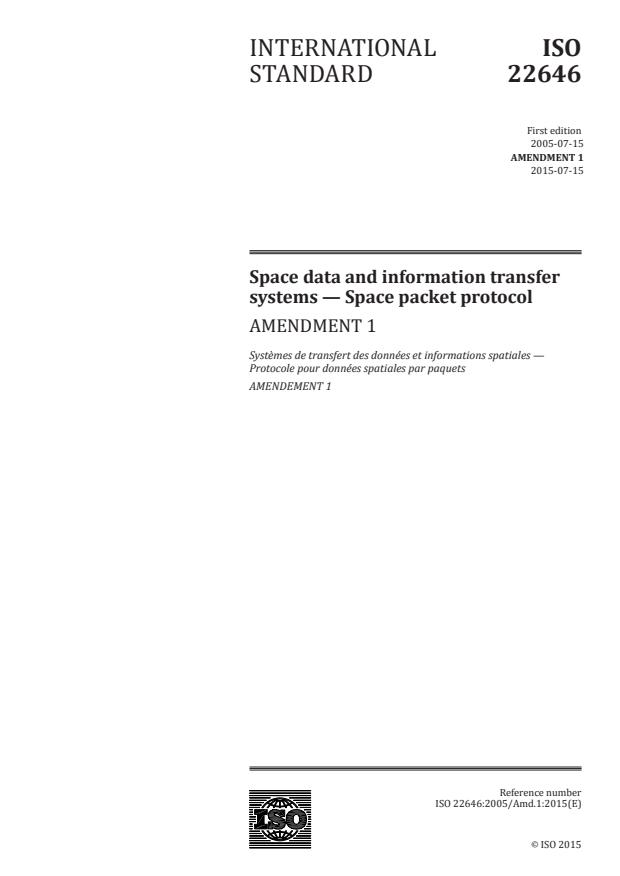
INTERNATIONAL ISO
STANDARD 22646
First edition
2005-07-15
AMENDMENT 1
2015-07-15
Space data and information transfer
systems — Space packet protocol
AMENDMENT 1
Systèmes de transfert des données et informations spatiales —
Protocole pour données spatiales par paquets
AMENDEMENT 1
Reference number
ISO 22646:2005/Amd.1:2015(E)
©
ISO 2015
ISO 22646:2005/Amd.1:2015(E)
© ISO 2015, Published in Switzerland
All rights reserved. Unless otherwise specified, no part of this publication may be reproduced or utilized otherwise in any form
or by any means, electronic or mechanical, including photocopying, or posting on the internet or an intranet, without prior
written permission. Permission can be requested from either ISO at the address below or ISO’s member body in the country of
the requester.
ISO copyright office
Ch. de Blandonnet 8 • CP 401
CH-1214 Vernier, Geneva, Switzerland
Tel. +41 22 749 01 11
Fax +41 22 749 09 47
copyright@iso.org
www.iso.org
ii © ISO 2015 – All rights reserved
ISO 22646:2005/Amd.1:2015(E)
Foreword
ISO (the International Organization for Standardization) is a worldwide federation of national standards bodies
(ISO member bodies). The work of preparing International Standards is normally carried out through ISO
technical committees. Each member body interested in a subject for which a technical committee has been
established has the right to be represented on that committee. International organizations, governmental and
non-governmental, in liaison with ISO, also take part in the work. ISO collaborates closely with the
International Electrotechnical Commission (IEC) on all matters of electrotechnical standardization.
International Standards are drafted in accordance with the rules given in the ISO/IEC Directives, Part 2.
The main task of technical committees is to prepare International Standards. Draft International Standards
adopted by the technical committees are circulated to the member bodies for voting. Publication as an
International Standard requires approval by at least 75 % of the member bodies casting a vote.
Attention is drawn to the possibility that some of the elements of this document may be the subject of patent
rights. ISO shall not be held responsible for identifying any or all such patent rights.
ISO 22646 was prepared by the Consultative Committee for Space Data Systems (CCSDS) (as CCSDS
133.0-B-1, September 2012) and was adopted (without modifications except those
...