

ISO 23507:2025
(Main)Space data and information transfer systems — Information preparation to enable long term use
General Information
- Abstract
This document deals with the aspects of a project, in particular the terminology used. Many of these terms are already used with various definitions within the target communities for this practice, for example, space, science, life sciences, libraries, records management, and archival communities. It is expected that other communities can easily map this terminology to the terminology used within those communities. The Reference Model for an Open Archival Information System (OAIS) provided a starting point and inputs from a variety of other sources were used to arrive at the terms used within this standard. This document accomplishes the following: – identifies the Additional Information to be collected or improved at various points; – forms a basis for the specification of Data Management Plans (DMPs); – forms a basis for the identification and/or development of additional standards and implementation guides, including those that address particular concerns in more detail.
- Status
- Published
- Publication Date
- 04-Mar-2025
- Technical Committee
- ISO/TC 20/SC 13 - Space data and information transfer systems
- Drafting Committee
- ISO/TC 20/SC 13 - Space data and information transfer systems
- Current Stage
- 6060 - International Standard published
- Start Date
- 05-Mar-2025
- Due Date
- 14-Jul-2025
- Completion Date
- 05-Mar-2025

Overview
ISO 23507:2025 - "Space data and information transfer systems - Information preparation to enable long term use" provides guidance on the Additional Information (broadly, metadata and preservation-related documentation) that projects must capture and maintain so their digital outputs remain understandable, usable and trustworthy over the short, medium and long term. Originating from the space community and aligned with OAIS concepts, the standard defines terminology, collection points (Collection Groups), and a framework to inform Data Management Plans (DMPs) and downstream archival actions.
Key topics and technical requirements
- Additional Information (metadata): Identifies what contextual, technical and provenance information must be collected or improved at specific project points to enable long-term reuse.
- Collection Groups and project handovers: Specifies typical activity groups within project phases where information capture is critical (e.g., design, calibration, validation, transfer).
- Representation and Preservation Description Information (PDI): Emphasizes capturing Representation Information and PDI so archived data remain independently understandable.
- Provenance capture: Requires documenting the history of data creation and transformations to support authenticity and reproducibility.
- Data Management Plans (DMPs): Provides a basis for scoping, specifying and evolving DMPs throughout a project life cycle.
- Framework activities: Recommends when and how to collect or update Additional Information during project workflows rather than only at project end.
- Interoperability with packaging and representation formats: Maps to practical mechanisms for representation and packaging (e.g., PVL, EAST, DEDSL, XFDU) without prescribing a single implementation.
- Terminology harmonization: Aligns definitions across space, science, library, records management and archival communities to ease mapping and reuse.
Practical applications and target users
ISO 23507 is practical for organizations and roles responsible for digital preservation and data reuse:
- Space mission teams (science and engineering) - to ensure mission data remain interpretable across decades.
- Research projects and funders - to structure and monitor DMPs that evolve with project phases.
- Data managers, archivists and repository engineers - to specify what to request from producers and to validate incoming submissions.
- Libraries, records managers and life-science communities - to adapt the guidance for domain-specific long-term use.
- System integrators and standards developers - to derive implementation guides and interface specifications for producer-archive workflows.
Benefits include improved data discoverability, usability, authenticity and reduced risk of data loss or misinterpretation over time.
Related standards and references
- OAIS (Open Archival Information System)
- PAIMAS (Producer-Archive Interface Methodology Abstract Standard)
- PAIS (Producer-Archive Interface Specification)
- Audit and Certification of Trustworthy Digital Repositories
- Representation/packaging standards: PVL, EAST, DEDSL, XFDU
- Contextual guidance: PMBOK, DMBOK
Keywords: ISO 23507, long-term preservation, space data, metadata, data management plan, OAIS, provenance, digital preservation.
Get Certified
Connect with accredited certification bodies for this standard

BUREAU VERITAS Certification Germany
Bureau Veritas certification in Germany.

Element Materials Technology
Materials testing and product certification.

AQMS Ltd.
AQMS provides ISO certification to SMEs across the UK.
Sponsored listings
Frequently Asked Questions
ISO 23507:2025 is a standard published by the International Organization for Standardization (ISO). Its full title is "Space data and information transfer systems — Information preparation to enable long term use". This standard covers: This document deals with the aspects of a project, in particular the terminology used. Many of these terms are already used with various definitions within the target communities for this practice, for example, space, science, life sciences, libraries, records management, and archival communities. It is expected that other communities can easily map this terminology to the terminology used within those communities. The Reference Model for an Open Archival Information System (OAIS) provided a starting point and inputs from a variety of other sources were used to arrive at the terms used within this standard. This document accomplishes the following: – identifies the Additional Information to be collected or improved at various points; – forms a basis for the specification of Data Management Plans (DMPs); – forms a basis for the identification and/or development of additional standards and implementation guides, including those that address particular concerns in more detail.
This document deals with the aspects of a project, in particular the terminology used. Many of these terms are already used with various definitions within the target communities for this practice, for example, space, science, life sciences, libraries, records management, and archival communities. It is expected that other communities can easily map this terminology to the terminology used within those communities. The Reference Model for an Open Archival Information System (OAIS) provided a starting point and inputs from a variety of other sources were used to arrive at the terms used within this standard. This document accomplishes the following: – identifies the Additional Information to be collected or improved at various points; – forms a basis for the specification of Data Management Plans (DMPs); – forms a basis for the identification and/or development of additional standards and implementation guides, including those that address particular concerns in more detail.
ISO 23507:2025 is classified under the following ICS (International Classification for Standards) categories: 49.140 - Space systems and operations. The ICS classification helps identify the subject area and facilitates finding related standards.
ISO 23507:2025 is available in PDF format for immediate download after purchase. The document can be added to your cart and obtained through the secure checkout process. Digital delivery ensures instant access to the complete standard document.
Standards Content (Sample)
International
Standard
ISO 23507
First edition
Space data and information transfer
2025-03
systems — Information preparation
to enable long term use
Systèmes de transfert de données et d'informations spatiales —
Préparation des informations pour permettre une utilisation à
long terme
Reference number
© ISO 2025
All rights reserved. Unless otherwise specified, or required in the context of its implementation, no part of this publication may
be reproduced or utilized otherwise in any form or by any means, electronic or mechanical, including photocopying, or posting on
the internet or an intranet, without prior written permission. Permission can be requested from either ISO at the address below
or ISO’s member body in the country of the requester.
ISO copyright office
CP 401 • Ch. de Blandonnet 8
CH-1214 Vernier, Geneva
Phone: +41 22 749 01 11
Email: copyright@iso.org
Website: www.iso.org
Published in Switzerland
ii
Foreword
ISO (the International Organization for Standardization) is a worldwide federation of national standards
bodies (ISO member bodies). The work of preparing International Standards is normally carried out through
ISO technical committees. Each member body interested in a subject for which a technical committee has been
established has the right to be represented on that committee. International organizations, governmental and
non-governmental, in liaison with ISO, also take part in the work. ISO collaborates closely with the
International Electrotechnical Commission (IEC) on all matters of electrotechnical standardization.
The procedures used to develop this document and those intended for its further maintenance are described
in the ISO/IEC Directives, Part 1. In particular, the different approval criteria needed for the different types of
ISO document should be noted (see www.iso.org/directives).
ISO draws attention to the possibility that the implementation of this document may involve the use of (a)
patent(s). ISO takes no position concerning the evidence, validity or applicability of any claimed patent rights
in respect thereof. As of the date of publication of this document, ISO had not received notice of (a) patent(s)
which may be required to implement this document. However, implementers are cautioned that this may not
represent the latest information, which may be obtained from the patent database available at
www.iso.org/patents. ISO shall not be held responsible for identifying any or all such patent rights.
Any trade name used in this document is information given for the convenience of users and does not
constitute an endorsement.
For an explanation of the voluntary nature of standards, the meaning of ISO specific terms and expressions
related to conformity assessment, as well as information about ISO’s adherence to the World Trade
Organization (WTO) principles in the Technical Barriers to Trade (TBT), see www.iso.org/iso/foreword.html.
This document was prepared by the Consultative Committee for Space Data Systems (CCSDS) (as CCSDS 653.0-
M-1, December 2024) and drafted in accordance with its editorial rules. It was assigned to Technical
Committee ISO/TC 20, Aircraft and space vehicles, Subcommittee SC 13, Space data and information transfer
systems and adopted under the “fast-track procedure”.
Any feedback or questions on this document should be directed to the user’s national standards body. A
complete listing of these bodies can be found at www.iso.org/members.html.
iii
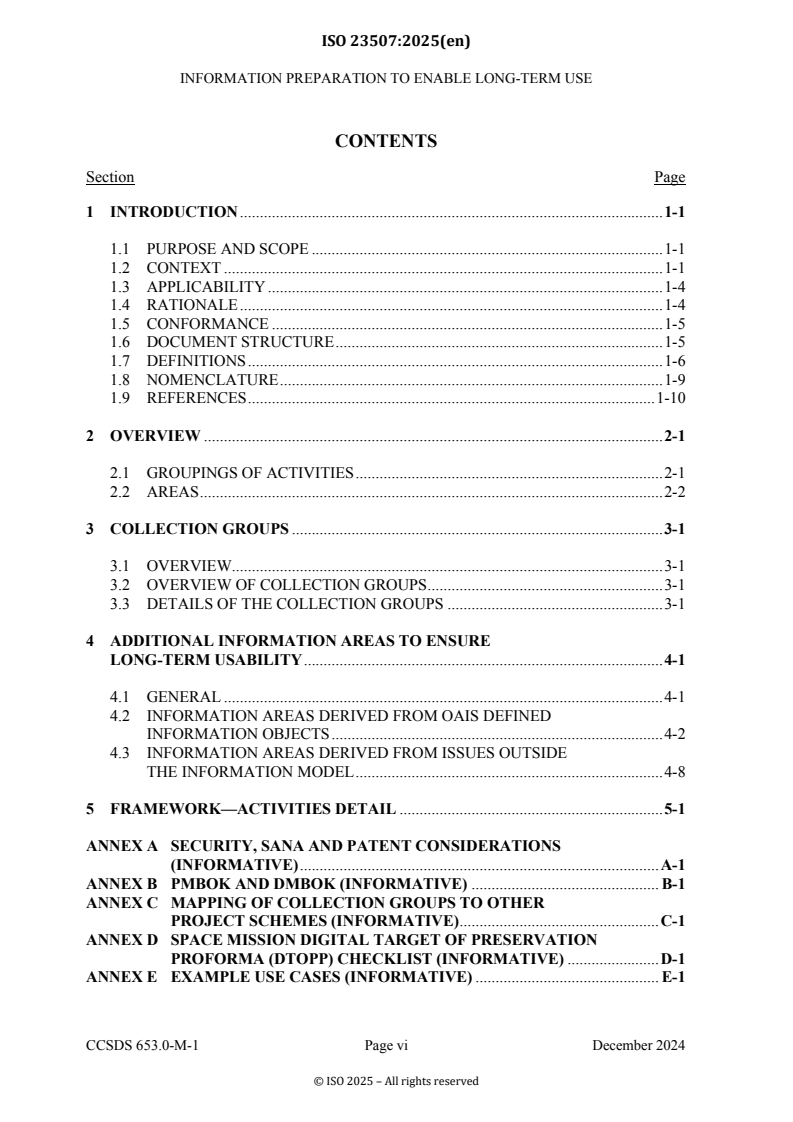
INFORMATION PREPARATION TO ENABLE LONG-TERM USE
CONTENTS
Section Page
1 INTRODUCTION . 1-1
1.1 PURPOSE AND SCOPE . 1-1
1.2 CONTEXT . 1-1
1.3 APPLICABILITY . 1-4
1.4 RATIONALE . 1-4
1.5 CONFORMANCE . 1-5
1.6 DOCUMENT STRUCTURE . 1-5
1.7 DEFINITIONS . 1-6
1.8 NOMENCLATURE . 1-9
1.9 REFERENCES . 1-10
2 OVERVIEW . 2-1
2.1 GROUPINGS OF ACTIVITIES . 2-1
2.2 AREAS . 2-2
3 COLLECTION GROUPS . 3-1
3.1 OVERVIEW . 3-1
3.2 OVERVIEW OF COLLECTION GROUPS . 3-1
3.3 DETAILS OF THE COLLECTION GROUPS . 3-1
4 ADDITIONAL INFORMATION AREAS TO ENSURE
LONG-TERM USABILITY . 4-1
4.1 GENERAL . 4-1
4.2 INFORMATION AREAS DERIVED FROM OAIS DEFINED
INFORMATION OBJECTS . 4-2
4.3 INFORMATION AREAS DERIVED FROM ISSUES OUTSIDE
THE INFORMATION MODEL . 4-8
5 FRAMEWORK—ACTIVITIES DETAIL . 5-1
ANNEX A SECURITY, SANA AND PATENT CONSIDERATIONS
(INFORMATIVE) . A-1
ANNEX B PMBOK AND DMBOK (INFORMATIVE) . B-1
ANNEX C MAPPING OF COLLECTION GROUPS TO OTHER
PROJECT SCHEMES (INFORMATIVE) . C-1
ANNEX D SPACE MISSION DIGITAL TARGET OF PRESERVATION
PROFORMA (DTOPP) CHECKLIST (INFORMATIVE) . D-1
ANNEX E EXAMPLE USE CASES (INFORMATIVE) . E-1
CCSDS 653.0-M-1 Page vi December 2024
INFORMATION PREPARATION TO ENABLE LONG-TERM USE
CONTENTS (continued)
Figure Page
1-1 Relationship between CCSDS Standards . 1-3
3-1 Example Collection Groups within a Project with Three Phases . 3-1
4-1 Archival Information Package (Detailed View) . 4-1
C-1 Mapping Collection Groups to Commonly Used Phases . C-2
Table
5-1 Status of Information Capture for Additional Information in Collection Groups . 5-2
CCSDS 653.0-M-1 Page vii December 2024
INFORMATION PREPARATION TO ENABLE LONG-TERM USE
1 INTRODUCTION
1.1 PURPOSE AND SCOPE
There is a well-recognized need to capture digital information associated with a great variety
of endeavours in virtually all areas of society. However, it is widely recognized that many
such endeavours are not able, for one reason or another, to leave a sufficient legacy of
information so others can reuse and fully leverage the effort that has gone into the endeavour.
Such reasons include the focus on hardware by those involved in earlier stages of a project,
which means that they may not always think about collecting and saving information about
design decisions and calibrations needed for analysis of the data the hardware will collect or
create; lack of understanding that there must be a budget allocation to fund the collection of
such information; uncertainty about what information to collect at various stages, which
often means that very little is collected; and limits on data collection such that information
may not be collected if it is not needed for the primary use of the data collected, which means
that alternative uses are limited.
The purpose of this Recommended Practice is to provide guidance for projects about the
metadata (the term Additional Information is used below because the term ‘metadata’ is too
unspecific and its use can cause confusion) that needs to be captured and/or generated and
retained in order to ensure that the information created by the project, either as part of its
main objectives or as a by-product of achieving those objectives, can be exploited over the
short, medium, and long term.
This Recommended Practice deals with the aspects of a project, in particular the terminology
used. Many of these terms are already used with various definitions within the target
communities for this practice, for example, space, science, life sciences, libraries, records
management, and archival communities. It is expected that other communities can easily map
this terminology to the terminology used within those communities. The Reference Model for
an Open Archival Information System (OAIS) provided a starting point and inputs from a
variety of other sources were used to arrive at the terms used within this standard.
This Recommended Practice accomplishes the following:
– identifies the Additional Information to be collected or improved at various points;
– forms a basis for the specification of Data Management Plans (DMPs);
– forms a basis for the identification and/or development of additional standards and
implementation guides, including those that address particular concerns in more detail.
1.2 CONTEXT
This Recommended Practice was inspired by the approach taken by the widely used Project
Management Book of Knowledge (PMBOK) Guide (reference [1]) and the related Data
Management Body of Knowledge (DMBOK) (references [2] and [3]).
CCSDS 653.0-M-1 Page 1-1 December 2024
INFORMATION PREPARATION TO ENABLE LONG-TERM USE
The PMBOK defines a project as an endeavour which is temporary, that is, having a
beginning and an end, undertaken to create a unique product, service, or result, and focusses
on the information and techniques required to manage the project so that it achieves its
objectives. The DMBOK focuses on all aspects of data management within such an activity,
while noting that ‘Data, and information created from data, are now widely recognised as
enterprise assets’, and furthermore, ‘Data has value only when it is actually used, or can be
useful in the future’.
This document is focussed on the Additional Information that needs to be captured and/or
generated and retained in order to ensure that the information created by the project, either as
part of its main objectives or as a by-product of achieving those objectives, can be exploited
over the short, medium, and long term. It is expected that, by ensuring this Additional
Information is collected as fully as possible, projects can significantly improve their
information legacy to the benefit of the wider community.
At various times in the project, and for various reasons, data is captured or created. There is
Additional Information associated with this data that also needs to be captured. The types of
Additional Information are informed by the Reference Model for an Open Archival
Information System (OAIS) (reference [4]) that provides a conceptual view of long-term
information preservation in an archive.
This Recommended Practice fits into the overall context defined by a number of other
standards. Some relationships between the documents are illustrated in figure 1-1.
The Additional Information required for the information to be preserved will be
collected/created by individuals and teams not necessarily involved with the archive which
will undertake the preservation. Therefore, this document is needed as a guide for those
individuals and teams so that adequate information is available for those that do use the
Producer-Archive Interface Methodology Abstract Standard (PAIMAS), the Producer-
Archive Interface Specification (PAIS), OAIS, and Audit and Certification. If insufficient
Additional Information is created/collected, then this will limit the ability of any archive to
undertake long-term preservation of the information.
CCSDS 653.0-M-1 Page 1-2 December 2024
INFORMATION PREPARATION TO ENABLE LONG-TERM USE
Guides the Defines a mechanism to Defines how the Defines how to check
collection/creation of transfer Data and the information should be that the information is
the Additional appropriate Additional preserved being preserved
Information required Information to the
archive
AUDIT &
IPELTU PAIMAS PAIS OAIS
CERTIFICATION
EAST DEDSL PVL XFDU
CCSDS/ISO Standards for Representation CCSDS/ISO Standard
Information for Packaging
Figure 1-1: Relationship between CCSDS Standards
OAIS is one of the most widely recognized and applied archival standards available today. An
OAIS is an archive, consisting of an organization of people and systems, that has accepted the
responsibility to preserve information and make it available for a Designated Community.
PAIMAS (reference [5]) defines a methodology for transferring data from an Information
Producer to an Archive based on the four following phases: Preliminary, Formal Definition,
Transfer, and Validation. Required activities during each phase are identified.
PAIS (reference [6]) provides the abstract syntax and an XML implementation of
descriptions of data to be sent to an archive. These descriptions are negotiated agreements
between the data Producer and the Archive and facilitate production of agreed-upon data by
the Producer and validation of received data by the Archive. The negotiation is required in
order to ensure that the correct level of detail of description is produced. The Recommended
Standard includes an abstract syntax and one possible concrete implementation for the
packages.
The Audit and Certification of Trustworthy Digital Repositories Recommended Practice
(reference [7]) provides metrics for use in assessing the trustworthiness of digital repositories
or archives.
In addition, there are other CCSDS/ISO standards that may be used to create Representation
Information (the Parameter Value Language (PVL), reference [8]; the Data Description
Language EAST Specification, reference [9]; and the Data Entity Dictionary Specification
Language (DEDSL), reference [10]; and also to package information the XML Formatted
Data Unit (XFDU), reference [11]). There are many other techniques for creating Additional
Information, but these are outside the scope of this document.
CCSDS 653.0-M-1 Page 1-3 December 2024
INFORMATION PREPARATION TO ENABLE LONG-TERM USE
1.3 APPLICABILITY
While this Recommended Practice originates in the space community, it is being designed in
a generic way and should be applicable to any science domain, such as life sciences, and to
the wider library, records management, and archival communities. It is applicable to
information created by an individual, in an individual project, or by an organisation as a
whole. It is applicable to projects in which the data already exists as well as projects in which
data is to be created in the future. It is also applicable to projects in which the associated data
is not the main focus of the project.
This document should be of use to funders and information creators, a role which may be
played by multiple actors such as researchers or manufacturers, archive managers and end-
users. It will be of use by helping to increase the effectiveness of preservation activities and
the exploitation of information, and by informing the practices and standards these users
define in their communities.
This guidance can form the basis on which plans, including DMPs, can be constructed,
updated, and monitored, to achieve the objectives noted above.
1.4 RATIONALE
Data that is collected or created must have Additional Information associated with it if it is to
be independently understandable, usable, and trusted as being authentic. The amount and
content of the Additional Information change over time, as hardware, software, the general
environment, and users’ tacit knowledge change. OAIS uses the terms Representation
Information and Preservation Description Information (PDI) for the associated information
which is important for preservation. But other types of Additional Information which may
help future long-term exploitation are needed. All these must be accumulated over the life of
the project. For example, Provenance Information (part of PDI) should originate at data
creation and will accumulate over time, recording the things that have happened to the data.
In the case of information created by individual projects, funders are increasingly asking that
DMPs accompany any request for project funding. However, these tend not to evolve with
the project and are difficult to monitor. This standard encourages the active management of
these plans to continue to address the communities’ needs and uses for the data. These DMPs
can also be captured as part of the Additional Information.
Many project models have been proposed. However, they do not focus on the activities
needed at each stage that will help to ensure that the data can be optimally exploited over the
long term.
There are a small number of generally applicable groups of activities, within larger project
phases in a project where Additional Information should be collected (Collection Groups).
These are typically where the responsibility is handed on from one individual or team to
another. Each of those individuals or teams has specific knowledge about the information
which subsequent individuals or teams may not possess. There is a need to specify the
CCSDS 653.0-M-1 Page 1-4 December 2024
INFORMATION PREPARATION TO ENABLE LONG-TERM USE
information to be captured within and at the interfaces between each of those Project Phases.
Improvements or changes to the Additional Information must be considered as the work
proceeds. Therefore, there is a need for guidance as to what Additional Information should be
captured or improved through the various Project Phases.
This document should help to enable:
– the Producer to capture and record the relevant information in a timely manner;
– the Archive to be assured that it will receive adequate information to enable it to
perform preservation activities and support exploitation (e.g., reuse or secondary use)
of the information;
– the user to reuse information more easily;
– the funder/sponsor to be assured that the resources that they contribute to the creation
of the information will have suitable pay-back.
1.5 CONFORMANCE
Conformance to this recommended practice requires that Additional Information is collected
as described in sections 4 and 5.
1.6 DOCUMENT STRUCTURE
Section 2 gives an overview of the document concepts and the way in which activities in
projects can be grouped. These are expanded in the following sections. The overlapping
activities that occur throughout a project or phases in projects are described in more detail in
Section 3. Section 4 defines the areas about which information should be collected and
identifies the major pieces of information related to eventual reuse and exploitation which
need to be collected. Section 5 shows a Framework for the way in which that minimum
useful information that should be captured may evolve through the project.
The annexes provide supporting information. Annex B provides more details from PMBOK
and DMBOK, from which a number of concepts are drawn. A brief comparison of other
ways to break down projects is in annex C. Checklists specific for space projects are given in
annex D. Examples of Frameworks, in less detail, are provided for a broader set of domains
in annex E. Security considerations are discussed in annex A.
CCSDS 653.0-M-1 Page 1-5 December 2024
INFORMATION PREPARATION TO ENABLE LONG-TERM USE
1.7 DEFINITIONS
1.7.1 ACRONYMS AND ABBREVIATIONS
AIP Archival Information Package
CCSDS Consultative Committee for Space Data Systems
CRC Cyclic(al) Redundancy Check
CRIS Current Research Information System
CRO contract research organization
DAMA Data Management Association International
DEDSL Data Entity Dictionary Specification Language
DMBOK Data Management Body of Knowledge
DMP Data Management Plan
DOI Digital Object Identifier
EO Earth Observation
ESDIS Earth Science Data and Information System
Flexible Image Transport System
FITS
GDPR General Data Protection Regulation
good practice
GxP
IIIF International Image Interoperability Framework
International Standard Archival Authority Record
ISAAR
ISAD international standard archival description
Long-Term Data Preservation
LTDP
MDR Medical Devices Regulation
Open Archival Information System
OAIS
OPAC Online Public Access Catalogue
PAIMAS Producer-Archive Ingest Methodology Abstract Standard
PAIS Producer-Archive Ingest Specification
PDI Preservation Description Information
PMBOK Project Management Book of Knowledge
PVL Parameter Value Language
RIN Representation Information Network
SDLC Systems Development Lifecycle
SDO Standards Development Organization
SIP Submission Information Package
XFDU XML Formatted Data Unit
XML Extensible Markup Language
CCSDS 653.0-M-1 Page 1-6 December 2024
INFORMATION PREPARATION TO ENABLE LONG-TERM USE
1.7.2 TERMINOLOGY
There are many terms used in this document which need to have well-defined meanings.
These terms are defined in this subsection. When first used in the text, they are shown in bold
and are capitalized. Subsequent use employs capitalization only. They should eventually be
available online at http://www.sanaregistry.org/r/terms/terms.html.
Apart from the extra terms below, the definitions provided by the Reference Model for an
Open Archival Information System (OAIS) (reference [4]) and the other standards described
in 1.2 are used; these terms are normally capitalized, following the OAIS convention. It is
assumed that the reader has some familiarity with OAIS.
NOTE – For convenience, a number of selected definitions from OAIS are included here:
Activity: A distinct, scheduled portion of work performed during the course of a project
(from PMBOK).
Additional Information Area: A complete set of concepts, terms, and activities that make
up the Additional Information that is needed to support long-term exploitation of data.
Additional Information: The information which should accompany Data to ensure that it
can be preserved and exploited. This will include Representation Information and PDI, as
defined by OAIS.
Collection Groups: types of Activities in which Additional Information may be collected.
The Collection Groups are:
– Initiating—justification for creating the data and initial definition of the data project.
– Planning—planning for the data creation and encoding.
– Executing—creating/collecting/encoding the data. At each point, there may be
deviations from the planned results, including instrument effects and unexpected
influences.
– Closing—completing the data creation/collection/encoding to satisfy the
requirements of the project, phase or contractual obligations, and, at the end of the
project, turning the information over to the long-term preservation organization.
– Control—track, review, and orchestrate the progress and performance of the activities.
Content Information: A set of information that is the original target of preservation or that
includes part or all of that information. It is an Information Object composed of its Content
Data Object and its Representation Information.
Data: A reinterpretable representation of information in a formalized manner suitable for
communication, interpretation, or processing.
CCSDS 653.0-M-1 Page 1-7 December 2024
INFORMATION PREPARATION TO ENABLE LONG-TERM USE
Data Management Plan, DMP: A document that describes how Data will be handled
throughout the project and what will happen to it when the project ends. There may be
several different Data Management Plans, of various scope and timescale, throughout the
project.
Data Object: Either a Physical Object or a Digital Object.
Deliverable: Any unique and verifiable product, result, or capability to perform a service that
is required to be produced to complete a process, phase, or project (from PMBOK).
Designated Community: An identified group of potential Consumers who should be able to
understand a particular set of information in ways exemplified by the Preservation
Objectives. The Designated Community may be composed of multiple user communities. A
Designated Community is defined by the Archive, and this definition may change over time.
Digital Object: An object composed of a set of bit sequences.
Information Object: A Data Object together with its Representation Information.
Information Package: A logical container composed of optional Information Object(s).
Associated with this Information Package is Packaging Information used to delimit and
identify the Information Object and optional Package Description information used to
facilitate searches for the Information Object.
Information: Any type of knowledge that can be exchanged. In an exchange, it is
represented by data.
Long Term: A period of time long enough for there to be concern about the impacts of
changing technologies, including support for new media and data formats, and of a changing
Designated Community or changes to the Designated Community’s Knowledge Base, on the
information being held in an OAIS. This period extends into the indefinite future.
Physical Object: An object (such as a moon rock, bio-specimen, or microscope slide) with
physically observable properties that represent information that is considered suitable for
being adequately documented for preservation, distribution, and independent usage.
Preservation Description Information, PDI: The information, which, along with
Representation Information, is necessary for adequate preservation of the Content Data
Object and which can be categorized as Provenance Information, Context Information,
Reference Information, Fixity Information, and Access Rights Information.
Preservation Objective: A specific achievable aim which can be carried out using the
Information Object.
Project Phase: A collection of logically related project activities that culminates in the
completion of one or more outputs (from PMBOK).
CCSDS 653.0-M-1 Page 1-8 December 2024
INFORMATION PREPARATION TO ENABLE LONG-TERM USE
Project: A temporary endeavour undertaken to create a unique product, service, or result
(from PMBOK).
Representation Information: The information that maps a Data Object into more
meaningful concepts so that the Data Object may be understood in ways exemplified by
Preservation Objectives. It is a type of Information Object.
1.8 NOMENCLATURE
1.8.1 NORMATIVE TEXT
The following conventions apply for the normative specifications in this Recommended
Practice:
a) the words ‘shall’ and ‘must’ imply a binding and verifiable specification;
b) the word ‘should’ implies an optional, but desirable, specification;
c) the word ‘may’ implies an optional specification;
d) the words ‘is’, ‘are’, and ‘will’ imply statements of fact.
NOTE – These conventions do not imply constraints on diction in text that is clearly
informative in nature.
1.8.2 INFORMATIVE TEXT
In the normative sections of this document, informative text is set off from the normative
specifications either in notes or under one of the following subsection headings:
– Overview;
– Background;
– Rationale;
– Discussion.
CCSDS 653.0-M-1 Page 1-9 December 2024
INFORMATION PREPARATION TO ENABLE LONG-TERM USE
1.9 REFERENCES
The following publications contain provisions which, through reference in this text,
constitute provisions of this document. At the time of publication, the editions indicated were
valid. All publications are subject to revision, and users of this document are encouraged to
investigate the possibility of applying the most recent editions of the publications indicated
below. The CCSDS Secretariat maintains a register of currently valid CCSDS publications.
[1] A Guide to the Project Management Body of Knowledge (PMBOK® Guide). 5th ed.
Newtown Square, Pennsylvania: PMI, 2013.
[2] The DAMA Guide to the Data Management Body of Knowledge (DAMA-DMBOK
Guide). 1st ed. Bradley Beach, New Jersey: Technics Publications, 2009.
[3] DAMA-DMBOK: The DAMA Guide to the Data Management Body of Knowledge.
2nd ed. Bradley Beach, New Jersey: Technics Publications, 2017.
[4] Reference Model for an Open Archival Information System (OAIS). Issue 3.
Recommendation for Space Data System Practices (Magenta Book), CCSDS 650.0-M-
3. Washington, D.C.: CCSDS, December 2024. [Equivalent to ISO 14721.]
[5] Producer-Archive Interface Methodology Abstract Standard. Issue 1. Recommendation
for Space Data System Practices (Magenta Book), CCSDS 651.0-M-1. Washington,
D.C.: CCSDS, May 2004. [Equivalent to ISO 20652:2006.]
[6] Producer-Archive Interface Specification (PAIS). Issue 1. Recommendation for Space
Data System Standards (Blue Book), CCSDS 651.1-B-1. Washington, D.C.: CCSDS,
February 2014. [Equivalent to ISO 20104:2015]
[7] Audit and Certification of Trustworthy Digital Repositories. Issue 2. Recommendation
for Space Data System Practices (Magenta Book), CCSDS 652.0-M-2. Washington,
D.C.: CCSDS, December 2024. [Equivalent to ISO 16363.]
[8] Parameter Value Language Specification (CCSD0006 and CCSD0008). Issue 2-S.
Recommendation for Space Data System Standards (Historical), CCSDS 641.0-B-2-S.
Washington, D.C.: CCSDS, (June 2000) June 2000. [Equivalent to ISO 21962:2003.]
[9] The Data Description Language EAST Specification (CCSD0010). Issue 3.
Recommendation for Space Data System Standards (Blue Book), CCSDS 644.0-B-3.
Washington, D.C.: CCSDS, June 2010. [Equivalent to ISO 15889:2011.]
[10] Data Entity Dictionary Specification Language (DEDSL)—XML/DTD Syntax (CCSD0013).
Issue 1. Recommendation for Space Data System Standards (Blue Book), CCSDS 647.3-B-
1. Washington, D.C.: CCSDS, January 2002. [Equivalent to ISO 15889:2011.]
[11] XML Formatted Data Unit (XFDU) Structure and Construction Rules. Issue 1.
Recommendation for Space Data System Standards (Blue Book), CCSDS 661.0-B-1.
Washington, D.C.: CCSDS, September 2008. [Equivalent to ISO 13527:2010.]
CCSDS 653.0-M-1 Page 1-10 December 2024
INFORMATION PREPARATION TO ENABLE LONG-TERM USE
2 OVERVIEW
Following the terminology discussed in annex B, a Project may be divided into any number
of Project Phases (see, for example, annex C to annex E). A Project Phase is a collection of
logically related project Activities that culminates in the completion of one or more
Deliverables. The Project Phases may be sequential or overlapping.
There are many system lifecycle descriptions which describe the stages or phases of systems.
Those in annex B use a more flexible approach of describing groups of activities which
appear repeatedly in these various stages or phases.
The basic method descibed here and eloborated in this document is to identify a framework
in the form of a matrix of groupings of activities/processes for a number of areas (this
document uses the term Additional Information Areas). In this document, the Areas are about
collections of activities for which information is needed in order to support long-term
exploitation of data.
The aim is to fill in the cells in the table below to show that for a given area there should be
some specific Activity. This will act as a checklist to help to ensure that data is useable over
the long term.
Activities→ Activity 1 Activity 2 Activity n
Areas↓
Area 1 Expected … … … …
activity of type
‘Activity 1’ in
‘Area 1’
Area 2 … … … … …
Area … … … … … …
Area m … … --- --- Expected
activity of type
‘Activity n’ in
‘Area m’
Subsection 2.1 describes the groupings of activities while 2.2 describes the areas.
2.1 GROUPINGS OF ACTIVITIES
2.1.1 GENERAL
PMBOK and DMBOK described in annex B use slightly different groupings and terminology;
the former uses the term Process Groups, described in B1, while the latter uses the term
Activity Groups, described in B2. This document uses the term Collection Groups, which best
fits the requirements of this document and is described in 2.1.2.
Each data management activity fits into one or more data management activity groups.
CCSDS 653.0-M-1 Page 2-1 December 2024
INFORMATION PREPARATION TO ENABLE LONG-TERM USE
2.1.2 COLLECTION GROUPS
This document uses the term Collection Groups because the concern is to collect Additional
Information about the data being created. The Collection Groups identify types of Activities
in which Additional Information may be collected and is a specialization of the PMBOK
terminology described in annex B, in particular including ‘Closing’ because when the process
to create data closes, steps must be taken to ensure its usability after the end of that process.
The Collection Groups are:
– Initiating—justification for creating the data and initial definition of the data project.
– Planning—planning for the data creation and encoding.
– Executing—creating/collecting/encoding the data. At each point there may be
deviations from the planned results, including instrument effects and unexpected
influences.
– Closing—completing the data creation/collection/encoding to satisfy the
requirements of the project, phase, or contractual obligations, and, at the end of the
project, turning the information over to the long-term preservation organization.
– Control—track, review, and orchestrate the progress and performance of the
activities.
These will be discussed in detail in section 3.
2.2 AREAS
2.2.1 GENERAL
The areas identify general headings which are or should be used in most projects most of the
time. Annex B provides lists of these areas in general terms. PMBOK uses the term Knowledge
Areas, described in B3 while DMBOK currently uses the term Functions, described in B4.
This document uses the term Additional Information Areas, described in 2.2.2.
2.2.2 ADDITIONAL INFORMATION AREAS
The Additional Information Areas have a strong relationship to the PMBOK and DMBOK
Knowledge Areas/Functions. PMBOK and DMBOK deal with all aspects of a project, but
this document is concerned only with those aspects which ensure long-term usability of the
data.
The Metadata Management function (see B4) clearly is of particular significance, but for the
purpose of this document, it is important to provide finer granularity by using the concepts
provided by the OAIS Information Model. OAIS defines the information required for Long-
Term Preservation. All or part of the Information required by these Information Objects must
therefore be created/collected through the project. These are largely the areas of information
CCSDS 653.0-M-1 Page 2-2 December 2024
INFORMATION PREPARATION TO ENABLE LONG-TERM USE
which are required to create an Archival Information Package, supplemented by a number of
other areas which are not covered by OAIS.
The Additional Information Areas are
– Content Information:
• Content Data Object,
• Representation Information;
– PDI:
• Reference Information,
• Provenance Information,
• Context Information,
• Fixity Information,
• Access Rights Information;
– Package Description;
– Packaging Information;
– Issues Outside OAIS Information Model:
• Publications,
• Related Data Set,
• Potential uses of the data,
• Potential Designated Community/Knowledge Base,
• Potential Transformational Information Properties.
These are discussed in more detail in section 4.
CCSDS 653.0-M-1 Page 2-3 December 2024
INFORMATION PREPARATION TO ENABLE LONG-TERM USE
3 COLLECTION GROUPS
3.1 OVERVIEW
Subsection 3.2 outlines the Collection Groups. Subsection 3.3 provides a brief description of
each of the Collection Groups.
3.2 OVERVIEW OF COLLECTION GROUPS
The Collection Groups, following in the style of PMBOK’s Knowledge Areas, are illustrated
as follows. The groups are linked by the outputs they produce; they are overlapping activities
that occur throughout a project or phases of a project. They are not expected to be either one
time or discrete events.
Figure 3-1 illustrates these Collection Groups in a project with three phases.
Project Phase 1 Project Phase 2 Project Phase 3
Figure 3-1: Example Collection Groups within a Project with Three Phases
3.3 DETAILS OF THE COLLECTION GROUPS
3.3.1 OVERVIEW
In the following subsections, the focus is on the Information created by the project, including
the project management information, which may need to be retained and preserved as
Additional Information so that the data (created or collected by the project) will remain
understandable and usable. Important types of information are identified in section 4, and a
number of checklists are provided in annex D and annex E; these objects should be
considered for Long Term Preservation. But the variety of potential projects and their
documents means that only general guidelines can be given.
3.3.2 THE INITIATING COLLECTION GROUP
The Initiating Collection Group consists of processes performed to justify the data collection
and to define a new project, or new phase of an existing project, by obtaining authorization to
start the project or phase.
CCSDS 653.0-M-1 Page 3-1 December 2024
INFORMATION PREPARATION TO ENABLE LONG-TERM USE
This could include proposing the project/phase, perhaps responding to solicitations, and
funding information available. It would be reasonable to expect the following types of
information to be created:
– the aims of the project, stated clearly enough to justify the data collection and its
resources;
– the way in which data would be collected and the kind of data to be collected, stated
in general terms;
– an outline of the initial exploitation of the data.
These are likely to be important pieces of Additional Information that should be preserved as
documentation of the project. The participants in this group of processes will almost certainly
include sponsors and proposers and may also include data managers and archivists. Examples
of documents to begin managing during project initiation include the list of project
participants and organizations represented, the criteria for data collection, privacy and data
protection, the criteria for repositories where the project data and documentation will be
preserved, agreements among participants regarding authorship/ownership of intellectual
property produced by the project, as well as relevant policies of participating organizations
regarding such rights.
3.3.3 THE PLANNING COLLECTION GROUP
The Planning Collection Group consists of those processes performed to establish the total
scope of the effort, define and refine the objectives, and develop the course of action required
to attain those objectives.
In the Planning Collection Group, the preparations are made to collect or create data. This
could include:
– the design and assembly of the components of the information system;
– the development or update of hardware and/or software systems;
– the development of the associated procedures for data collection, privacy, and
protection;
– the establishment of a data dictionary.
These are likely to be important pieces of Additional Information that should be preserved as
documentation of the project. Examples of documents to be managed during project planning
include the project mission statement, the project management plan, the communication plan,
the risk management plan, assignments for roles and responsibilities of team members, the
list of project deliverables, and the list of candidate repositories and how they meet the
established criteria for managing data and documents produced by the project.
CCSDS 653.0-M-1 Page 3-2 December 2024
INFORMATION PREPARATION TO ENABLE LONG-TERM USE
3.3.4 THE EXECUTING COLLECTION GROUP
The Executing Collection Group consists of those processes performed to complete the work
defined in the project/phase plan to satisfy the specifications.
Activities are carried out which:
– create or collect the data;
– process and analyse data.
These processes will produce data that needs to be preserved for the long term either as a
product or by-product. Examples of documents to be managed during project execution
include signed contracts and approvals received from stakeholders or other authorities, data
access policies and processes such as processing algorithms, validation and qualification
plans, qualification matrixes, testing results, and project logs.
3.3.5 THE CLOSING COLLECTION GROUP
The Closing Collection Group consists of those processes performed to conclude all activities
across all Collection Groups to formally complete the project phase, or the entire project.
The data which may be part of the legacy of the project and which can be exploited in
various ways includes:
– publication of research findings;
– generation of income;
– exchange of social information;
– predictions;
– scientific and social advancements.
There may also be ideas for exploitation in the future.
The Closing Collection Group is performed by the project/phase team to use/reuse and
exploit the information and, if appropriate, prepare it for handing over for long-term
preservation, reuse, and exploitation. Examples of documents to be managed during project
closing include signed acceptances, procurement documents, associated data, and related
publication.
3.3.6 THE CONTROL COLLECTION GROUP
The Control Collection Group consists of those processes performed to ensure the project is
on track or to identify areas which need attention. Thi
...