

ISO 16363:2025
(Main)Space data and information transfer systems — Audit and certification of trustworthy digital repositories
General Information
- Abstract
This document defines a CCSDS Recommended Practice on which to base an audit and certification process for assessing the trustworthiness of digital repositories. The scope of application of this document is the entire range of digital repositories.
- Status
- Published
- Publication Date
- 04-Mar-2025
- Technical Committee
- ISO/TC 20/SC 13 - Space data and information transfer systems
- Drafting Committee
- ISO/TC 20/SC 13 - Space data and information transfer systems
- Current Stage
- 6060 - International Standard published
- Start Date
- 05-Mar-2025
- Due Date
- 14-Jul-2025
- Completion Date
- 05-Mar-2025

Overview
ISO 16363:2025 - "Space data and information transfer systems - Audit and certification of trustworthy digital repositories" - defines a CCSDS Recommended Practice for auditing and certifying the trustworthiness of digital repositories. Published as the second edition in 2025, it updates and replaces ISO 16363:2012 and aligns the audit criteria with the OAIS Reference Model (ISO 14721). The standard’s scope covers the entire range of digital repositories and provides auditable, evidence-based metrics to evaluate long‑term digital preservation capabilities.
Key topics and technical requirements
ISO 16363:2025 structures its normative metrics into three main domains and introduces clarifying updates such as mention of Preservation Objectives and refined terminology (e.g., “documented” rather than “written”, “information” rather than “metadata”):
Organizational infrastructure
- Governance, mission and preservation policy framework
- Organizational structure, staffing and financial sustainability
- Contracts, liability and procedural accountability
Digital object management
- Ingest processes and creation of Archival Information Packages (AIP)
- Preservation planning and AIP preservation actions
- Information management and access controls (SIP/DIP concepts)
Infrastructure and security risk management
- Technical infrastructure risk assessment and mitigation
- Security policies, operational controls, and continuity planning
Other critical elements:
- Use of metrics and evidence to justify trustworthiness claims (logs, documented procedures, policies).
- Emphasis on OAIS concepts (Designated Community, AIP/SIP/DIP) to ensure consistent terminology and expectations.
- Guidance designed to support an ISO audit and certification process for repositories.
Practical applications - who uses this standard
ISO 16363 is intended for:
- Auditors and certification bodies conducting formal repository assessments.
- Repository managers and digital preservation teams seeking objective measures of trustworthiness and gaps to remediate.
- Archivists, libraries, and space data centres aligning preservation activities with ISO/CCSDS practices.
- IT, security, and governance stakeholders implementing risk management, access policies, and sustainability planning.
- Organizations designing or redesigning digital repository systems who want auditable requirements and metrics.
Practical benefits include clearer evidence requirements for certification, a transparent audit framework, and a common vocabulary for long‑term preservation planning.
Related standards
- ISO 14721 (OAIS) - Open Archival Information System (reference model)
- TRAC and earlier Trusted Digital Repositories frameworks (historical bases)
- ISO 16363:2012 - previous edition (superseded)
Keywords: ISO 16363, trustworthy digital repositories, digital preservation, audit and certification, OAIS, Archival Information Package, AIP, repository audit, CCSDS, risk management.
Relations
- Effective Date
- 15-Jul-2023
Get Certified
Connect with accredited certification bodies for this standard

BUREAU VERITAS Certification Germany
Bureau Veritas certification in Germany.

Element Materials Technology
Materials testing and product certification.

AQMS Ltd.
AQMS provides ISO certification to SMEs across the UK.
Sponsored listings
Frequently Asked Questions
ISO 16363:2025 is a standard published by the International Organization for Standardization (ISO). Its full title is "Space data and information transfer systems — Audit and certification of trustworthy digital repositories". This standard covers: This document defines a CCSDS Recommended Practice on which to base an audit and certification process for assessing the trustworthiness of digital repositories. The scope of application of this document is the entire range of digital repositories.
This document defines a CCSDS Recommended Practice on which to base an audit and certification process for assessing the trustworthiness of digital repositories. The scope of application of this document is the entire range of digital repositories.
ISO 16363:2025 is classified under the following ICS (International Classification for Standards) categories: 49.140 - Space systems and operations. The ICS classification helps identify the subject area and facilitates finding related standards.
ISO 16363:2025 has the following relationships with other standards: It is inter standard links to ISO 16363:2012. Understanding these relationships helps ensure you are using the most current and applicable version of the standard.
ISO 16363:2025 is available in PDF format for immediate download after purchase. The document can be added to your cart and obtained through the secure checkout process. Digital delivery ensures instant access to the complete standard document.
Standards Content (Sample)
International
Standard
ISO 16363
Second edition
Space data and information transfer
2025-03
systems — Audit and certification of
trustworthy digital repositories
Systèmes de transfert des informations et données spatiales —
Audit et certification des référentiels numériques de confiance
Reference number
© ISO 2025
All rights reserved. Unless otherwise specified, or required in the context of its implementation, no part of this publication may
be reproduced or utilized otherwise in any form or by any means, electronic or mechanical, including photocopying, or posting on
the internet or an intranet, without prior written permission. Permission can be requested from either ISO at the address below
or ISO’s member body in the country of the requester.
ISO copyright office
CP 401 • Ch. de Blandonnet 8
CH-1214 Vernier, Geneva
Phone: +41 22 749 01 11
Email: copyright@iso.org
Website: www.iso.org
Published in Switzerland
ii
Foreword
ISO (the International Organization for Standardization) is a worldwide federation of national standards
bodies (ISO member bodies). The work of preparing International Standards is normally carried out through
ISO technical committees. Each member body interested in a subject for which a technical committee has been
established has the right to be represented on that committee. International organizations, governmental and
non-governmental, in liaison with ISO, also take part in the work. ISO collaborates closely with the
International Electrotechnical Commission (IEC) on all matters of electrotechnical standardization.
The procedures used to develop this document and those intended for its further maintenance are described
in the ISO/IEC Directives, Part 1. In particular, the different approval criteria needed for the different types of
ISO document should be noted (see www.iso.org/directives).
ISO draws attention to the possibility that the implementation of this document may involve the use of (a)
patent(s). ISO takes no position concerning the evidence, validity or applicability of any claimed patent rights
in respect thereof. As of the date of publication of this document, ISO had not received notice of (a) patent(s)
which may be required to implement this document. However, implementers are cautioned that this may not
represent the latest information, which may be obtained from the patent database available at
www.iso.org/patents. ISO shall not be held responsible for identifying any or all such patent rights.
Any trade name used in this document is information given for the convenience of users and does not
constitute an endorsement.
For an explanation of the voluntary nature of standards, the meaning of ISO specific terms and expressions
related to conformity assessment, as well as information about ISO’s adherence to the World Trade
Organization (WTO) principles in the Technical Barriers to Trade (TBT), see www.iso.org/iso/foreword.html.
This document was prepared by the Consultative Committee for Space Data Systems (CCSDS) (as CCSDS 652.0-
P-1.1, November 2021) and drafted in accordance with its editorial rules. It was assigned to Technical
Committee ISO/TC 20, Aircraft and space vehicles, Subcommittee SC 13, Space data and information transfer
systems and adopted under the “fast-track procedure”.
This second edition cancels and replaces the first edition (ISO 16363:2012), which has been technically
revised.
The main changes are as follows:
— updates to ensure consistency with updated ISO 14721, e.g. add mentions of "Preservation Objectives" in
section 4.1.1.4 and 4.1.1.5, and added new 4.3.5;
— clarifications added to "Discussions" in several sections;
— added section 3.3.3 for better consistency with ISO 14721;
— changed "written" to "documented" in many metrics;
— changed "metadata" to "information" in many metrics;
— clarify Risk Management in section 5.1.1.
Any feedback or questions on this document should be directed to the user’s national standards body. A
complete listing of these bodies can be found at www.iso.org/members.html.
iii
AUDIT AND CERTIFICATION OF TRUSTWORTHY DIGITAL REPOSITORIES
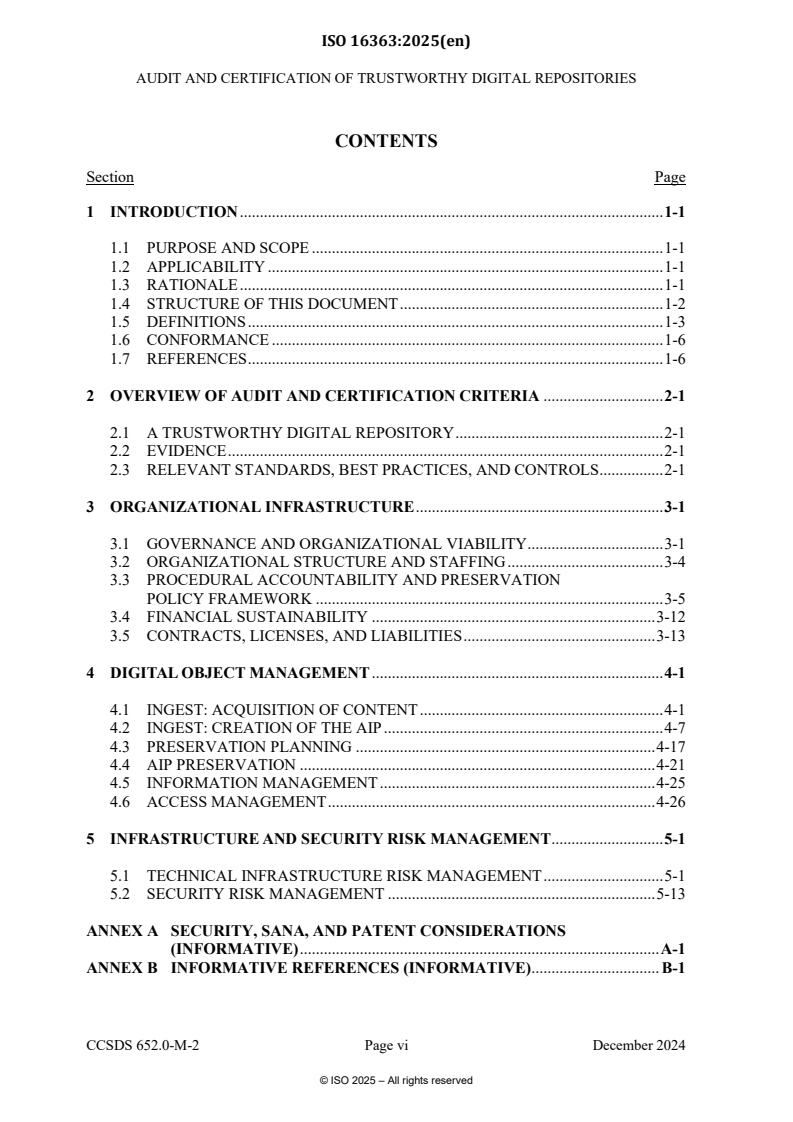
CONTENTS
Section Page
1 INTRODUCTION . 1-1
1.1 PURPOSE AND SCOPE . 1-1
1.2 APPLICABILITY . 1-1
1.3 RATIONALE . 1-1
1.4 STRUCTURE OF THIS DOCUMENT . 1-2
1.5 DEFINITIONS . 1-3
1.6 CONFORMANCE . 1-6
1.7 REFERENCES . 1-6
2 OVERVIEW OF AUDIT AND CERTIFICATION CRITERIA . 2-1
2.1 A TRUSTWORTHY DIGITAL REPOSITORY . 2-1
2.2 EVIDENCE . 2-1
2.3 RELEVANT STANDARDS, BEST PRACTICES, AND CONTROLS . 2-1
3 ORGANIZATIONAL INFRASTRUCTURE . 3-1
3.1 GOVERNANCE AND ORGANIZATIONAL VIABILITY . 3-1
3.2 ORGANIZATIONAL STRUCTURE AND STAFFING . 3-4
3.3 PROCEDURAL ACCOUNTABILITY AND PRESERVATION
POLICY FRAMEWORK . 3-5
3.4 FINANCIAL SUSTAINABILITY . 3-12
3.5 CONTRACTS, LICENSES, AND LIABILITIES . 3-13
4 DIGITAL OBJECT MANAGEMENT . 4-1
4.1 INGEST: ACQUISITION OF CONTENT . 4-1
4.2 INGEST: CREATION OF THE AIP . 4-7
4.3 PRESERVATION PLANNING . 4-17
4.4 AIP PRESERVATION . 4-21
4.5 INFORMATION MANAGEMENT . 4-25
4.6 ACCESS MANAGEMENT . 4-26
5 INFRASTRUCTURE AND SECURITY RISK MANAGEMENT . 5-1
5.1 TECHNICAL INFRASTRUCTURE RISK MANAGEMENT . 5-1
5.2 SECURITY RISK MANAGEMENT . 5-13
ANNEX A SECURITY, SANA, AND PATENT CONSIDERATIONS
(INFORMATIVE) . A-1
ANNEX B INFORMATIVE REFERENCES (INFORMATIVE) . B-1
CCSDS 652.0-M-2 Page vi December 2024
AUDIT AND CERTIFICATION OF TRUSTWORTHY DIGITAL REPOSITORIES
1 INTRODUCTION
1.1 PURPOSE AND SCOPE
The main purpose of this document is to define a CCSDS Recommended Practice on which
to base an audit and certification process for assessing the trustworthiness of digital
repositories. The scope of application of this document is the entire range of digital
repositories.
1.2 APPLICABILITY
This document is meant primarily for those responsible for auditing digital repositories and
also for those who work in or are responsible for digital repositories seeking objective
measurement of the trustworthiness of their repository. Some institutions may also choose to
use these metrics during a design or redesign process for their digital repository.
1.3 RATIONALE
In 1996 the Task Force on Archiving of Digital Information (reference [B1]) declared, ‘a
critical component of digital archiving infrastructure is the existence of a sufficient number
of trusted organizations capable of storing, migrating, and providing access to digital
collections’. The task force saw that ‘trusted’ or trustworthy organizations could not simply
identify themselves. To the contrary, the task force declared, ‘a process of certification for
digital archives is needed to create an overall climate of trust about the prospects of
preserving digital information’.
Work in articulating responsible digital archiving infrastructure was furthered by the
development of the Open Archival Information System (OAIS) Reference Model
(reference [1]). Designed to create a consensus on ‘what is required for an archive to provide
permanent or indefinite long-term preservation of digital information’, the OAIS addressed
fundamental questions regarding the long-term preservation of digital materials that cut
across domain-specific implementations. The reference model (ISO 14721) provides a
common conceptual framework describing the environment, functional components, and
information objects within a system responsible for the long-term preservation of digital
materials. Long before it became an approved standard in 2002, many in the cultural heritage
community had adopted OAIS as a model to better understand what would be needed from
digital preservation systems.
Institutions began to declare themselves ‘OAIS-compliant’ to underscore the trustworthiness
of their digital repositories. However, there was no established understanding of ‘OAIS-
compliance’ beyond being able to apply OAIS terminology to describe their archive, despite
there being a compliance section in OAIS which specifies the need to support the model of
information and fulfilling the mandatory responsibilities.
CCSDS 652.0-M-2 Page 1-1 December 2024
AUDIT AND CERTIFICATION OF TRUSTWORTHY DIGITAL REPOSITORIES
Claims of trustworthiness are easy to make but are thus far difficult to justify or objectively
prove. Establishing more clear criteria detailing what a trustworthy repository is and is not
has become vital.
In 2002, Research Libraries Group (RLG) and Online Computer Library Center (OCLC)
jointly published Trusted Digital Repositories: Attributes and Responsibilities
(reference [B2]), which further articulated a framework of attributes and responsibilities for
trusted, reliable, sustainable digital repositories capable of handling the range of materials
held by large and small cultural heritage and research institutions. The framework was broad
enough to accommodate different situations, technical architectures, and institutional
responsibilities while providing a basis for the expectations of a trusted repository. The
document has proven to be useful for institutions grappling with the long-term preservation
of cultural heritage resources and has been used in combination with the OAIS as a digital
preservation planning tool. As a framework, this document concentrated on high-level
organizational and technical attributes and discussed potential models for digital repository
certification. It refrained from being prescriptive about the specific nature of rapidly
emerging digital repositories and archives and instead reiterated the call for certification of
digital repositories, recommending the development of certification program and articulation
of auditable criteria.
OAIS included a Roadmap for follow-on standards which included ‘standard(s) for
accreditation of archives’. It was agreed that RLG and National Archives and Records
Administration (NARA) would take this particular topic forward and the later published the
TRAC (reference [B3]) document which combined ideas from OAIS (reference [1]) and
Trusted Digital Repositories: Attributes and Responsibilities (TDR—reference [B2]).
The current document follows on from, extends and clarifies TRAC in order to produce an
ISO standard which can be used in an ISO audit and certification process.
1.4 STRUCTURE OF THIS DOCUMENT
This document is divided into informative and normative sections and annexes.
Sections 1-2 of this document are informative and give a high-level view of the rationale, the
conceptual environment, some of the important design issues, and an introduction to the
terminology and concepts.
– Section 1 gives purpose and scope, rationale, a view of the overall document
structure, and the acronym list, glossary, and reference list for this document.
– Section 2 provides an overview of audit and certification criteria, ideas about
evidence to support claims, and a discussion of related standards.
Metrics are empirically derived and consistent measures of effectiveness. When
evaluated together, metrics can be used to judge the overall suitability of a repository
to be trusted to provide a preservation environment that is consistent with the goals of
CCSDS 652.0-M-2 Page 1-2 December 2024
AUDIT AND CERTIFICATION OF TRUSTWORTHY DIGITAL REPOSITORIES
the OAIS. Separately, individual metrics or measures can be used to identify possible
weaknesses or pending declines in repository functionality.
– Sections 3 to 5 provide the normative metrics against which a digital repository may
be judged. These sections provide metrics grouped as follows:
• section 3 covers Organizational Infrastructure;
• section 4 covers Digital Object Management;
• section 5 covers Infrastructure and Security Risk Management.
Each section groups metrics into one or more subsections.
– Security considerations are discussed in annex A.
– Annex B provides Informative References.
1.5 DEFINITIONS
1.5.1 ACRONYMS AND ABBREVIATIONS
AIP Archival Information Package
CCSDS Consultative Committee for Space Data Systems
DEDSL Data Entity Specification Language
DIP Dissemination Information Package
FITS Flexible Image Transport System
GIS Geographic Information System
ISO International Organization for Standardization
OAIS Open Archival Information System
PDI Preservation Description Information
SIP Submission Information Package
TEI Text Encoding Initiative
UML Unified Modeling Language
XML Extensible Markup Language
1.5.2 TERMINOLOGY
Digital preservation interests a range of different communities, each with a distinct
vocabulary and local definitions for key terms. A glossary is included in this document, but it
is important to draw attention to the usage of several key terms.
In general, key terms in this document have been adopted from the OAIS Reference Model.
One of the great strengths of the OAIS Reference Model has been to provide a common
terminology made up of terms ‘not already overloaded with meaning so as to reduce
conveying unintended meanings’ (reference [1]). Because the OAIS has become a
foundational document for digital preservation, the common terms are well understood and
are therefore used within this document.
CCSDS 652.0-M-2 Page 1-3 December 2024
AUDIT AND CERTIFICATION OF TRUSTWORTHY DIGITAL REPOSITORIES
The OAIS Reference Model uses ‘digital archive’ to mean the organization responsible for
digital preservation. In this document, the term ‘repository’ or phrase ‘digital repository’ is
used to convey the same concept in all instances except when quoting from the OAIS. It is
important to understand that in all instances in this document, ‘repository’ and ‘digital
repository’ are used to convey digital repositories and archives that have, or contribute to,
long-term preservation responsibilities and functionality. This document uses the OAIS
concept of the ‘Designated Community’. A repository may have a single, generalized
‘Designated Community’ (e.g., every citizen of a country), while other repositories may have
several, distinct user communities with highly specialized needs, each requiring different
functionality or support from the repository; this document uses the term Designated
Community to cover this second case also.
Finally, this document names criteria that, combined, evaluate the trustworthiness of digital
repositories and archives.
NOTE – The relationship between the terms below is motivated as follows. A repository
is assumed to have an overall Repository Mission Statement, part of which will
be concerned with preservation. The Preservation Strategic Plan states how the
mission will be achieved, in general terms with goals and objectives. The
Preservation Policy then declares the range of approaches that the repository will
employ to ensure preservation (that is, to implement the Preservation Strategic
Plan), and finally the Preservation Implementation Plan translates those into
services that the repository must carry out. This is an abstract documentary
model that, in reality, can result in different documents, a different distribution of
subjects between documents, different document names, etc.
1.5.2.1 Glossary
Unless otherwise indicated, other definitions are taken from the OAIS Reference Model
(reference [1]).
Access Policy: Documented statement, authorized by the repository management, that
describes the approach to be taken by the repository for providing access to objects
accessioned into the repository. The Access Policy may distinguish between different types
of access rights, for example between system administrators, members of the Designated
Community, and general users.
Practice: Actions conducted to execute procedures. Practices are measured by logs or other
evidence that record actions completed.
Preservation Implementation Plan: A documented statement, authorized by the
management of the repository, that describes the services to be offered by the repository for
preserving objects accessioned into the repository in accordance with the Preservation Policy.
CCSDS 652.0-M-2 Page 1-4 December 2024
AUDIT AND CERTIFICATION OF TRUSTWORTHY DIGITAL REPOSITORIES
Preservation Policy: Documented statement, authorized by the repository management, that
describes the approach to be taken by the repository for the preservation of objects
accessioned into the repository. The Preservation Policy is consistent with the Preservation
Strategic Plan.
Preservation Strategic Plan: A documented statement, authorized by the management of
the repository, that states the goals and objectives for achieving that part of the mission of the
repository concerned with preservation. Preservation Strategic Plans may include long-term
and short-term plans.
Procedure: A documented statement that specifies actions required to complete a service or
to achieve a specific state or condition. Procedures specify how various aspects of the
relevant Preservation Implementation Plans are to be fulfilled.
Provider (or Submitter): A person or system that submits a digital object to the repository.
The Provider can be the Producer.
Repository Mission Statement: A documented statement, authorized by the management of
the repository, that, among other things, describes the commitment of the organization for the
stewardship of digital objects in its custody.
1.5.3 NOMENCLATURE
The following conventions apply for the normative specifications in this Recommended
Practice:
a) the words ‘shall’ and ‘must’ imply a binding and verifiable specification;
b) the word ‘should’ implies an optional, but desirable, specification;
c) the word ‘may’ implies an optional specification;
d) the words ‘is’, ‘are’, and ‘will’ imply statements of fact.
NOTE – These conventions do not imply constraints on diction in text that is clearly
informative in nature.
1.5.4 CONVENTIONS
The following conventions apply:
– The term Designated Community may include multiple user communities. A
repository may have a different Designated Community for different collections of
information and so a repository may be said to have multiple Designated
Communities.
– The term ‘written statement’ or ‘documented statement’ is meant to make it clear that
verbal statements are not adequate.
CCSDS 652.0-M-2 Page 1-5 December 2024
AUDIT AND CERTIFICATION OF TRUSTWORTHY DIGITAL REPOSITORIES
– Sub-metrics for any section are intended to help clarify and elucidate their superior
item. Satisfaction of the sub-metrics provides evidence supporting a claim of
compliance with the hierarchically superior items.
– Each metric has one or more of the following informative pieces of text associated
with it:
• Supporting Text: giving an explanation of why the metric is important.
• Examples of Ways the Repository Can Demonstrate It Is Meeting This
Requirement: providing examples of the evidence which might be examined to
test whether the repository satisfies the metric.
NOTE – It is assumed that a formal system development life cycle was used in the
development of the repository system and that a set of well-defined
documents exist that could be used as evidence. The names of documents
that might be used in ‘Examples of Ways the Repository Can
Demonstrate It Is Meeting This Requirement’ text are intended to be
easily mappable to whatever documentation nomenclature that the
repository uses.
• Discussion: clarifications about the intent of the metric.
1.6 CONFORMANCE
An archive that conforms to this Recommended Practice shall have documented its design
and requirements, and shall have satisfied an auditor on each of the Requirements, which are
referred to as metrics below. Because the requirements cannot specify every possible detail,
the judgement of the auditor will come into play. The supporting organization and practice of
auditing will lead to the creation of auditors’ guidelines, as described in the Requirements for
Bodies Conducting Audit and Certification of Candidate Trustworthy Digital Repositories
(reference [2]).
As described in the referenced ISO documents, the aim of the audit process is to create a
process of continuous improvement. Thus, the outcome of the audit will not be a simple
yes/no but rather a judgment about areas that need improvement.
1.7 REFERENCES
The following documents contain provisions which, through reference in this text, constitute
provisions of this Recommended Practice. At the time of publication, the editions indicated
were valid. All documents are subject to revision, and users of this Recommended Practice
are encouraged to investigate the possibility of applying the most recent editions of the
documents indicated below. The CCSDS Secretariat maintains a register of currently valid
CCSDS documents.
CCSDS 652.0-M-2 Page 1-6 December 2024
AUDIT AND CERTIFICATION OF TRUSTWORTHY DIGITAL REPOSITORIES
[1] Reference Model for an Open Archival Information System (OAIS). Issue 3.
Recommendation for Space Data System Practices (Magenta Book), CCSDS 650.0-M-
3. Washington, D.C.: CCSDS, December 2024 [to be published as ISO 14721:2025 ] or
later version.
[2] Requirements for Bodies Providing Audit and Certification of Candidate Trustworthy
Digital Repositories. Issue 3. Recommendation for Space Data System Practices
(Magenta Book), CCSDS 652.1-M-3. Washington, D.C.: CCSDS, December 2024 [to
be published as ISO 16919:2025 ] or later version.
NOTE – Informative references are listed in annex B.
Issue year is surmized.
CCSDS 652.0-M-2 Page 1-7 December 2024
AUDIT AND CERTIFICATION OF TRUSTWORTHY DIGITAL REPOSITORIES
2 OVERVIEW OF AUDIT AND CERTIFICATION CRITERIA
This section provides an overview of some of the key concepts that are incorporated in the
design of the metrics in this Recommended Practice.
2.1 A TRUSTWORTHY DIGITAL REPOSITORY
At the very basic level, the definition of a trustworthy digital repository must start with ‘a
mission to provide reliable, long-term access to managed digital resources to its Designated
Community, now and into the future’ (reference [B2]). Expanding the definition has caused
great discussion both within and across various groups, from the broad digital preservation
community to the data archives or institutional repository communities.
A trustworthy digital repository will understand threats to and risks within its systems.
Constant monitoring, planning, and maintenance, as well as conscious actions and strategy
implementation will be required of repositories to carry out their mission of digital
preservation. All of these present an expensive, complex undertaking that depositors,
stakeholders, funders, the Designated Community, and other digital repositories will need to
rely on in the greater collaborative digital preservation environment that is required to
preserve the vast amounts of digital information generated now and into the future.
Communicating audit results to the public (where allowed)—that is, transparency—will
engender more trust, and additional objective audits, potentially leading towards certification,
will promote further trust in the repository and the system that supports it. Finally, attaining
trustworthy status is not a one-time accomplishment, achieved and forgotten. To retain
trustworthy status, a repository will need to undertake a regular cycle of audit and/or
certification.
2.2 EVIDENCE
As noted in 1.5.4 each metric has associated with it informative text under the heading
Examples of Ways the Repository Can Demonstrate It Is Meeting This Requirement:
providing examples of the evidence which might be examined to test whether the repository
satisfies the metric. These examples are illustrative rather than prescriptive, and the lists of
possible evidence are not exhaustive.
2.3 RELEVANT STANDARDS, BEST PRACTICES, AND CONTROLS
Numerous documents and standards include pieces that are applicable or related to this work.
These standards are important to acknowledge and embrace as complementary audit tools. A
few examples:
– The ISO 9000 family of standards (e.g., Quality Management Systems—
Fundamentals and Vocabulary—reference [B9]) addresses quality assurance
components within an organization and system management that, while valuable,
CCSDS 652.0-M-2 Page 2-1 December 2024
AUDIT AND CERTIFICATION OF TRUSTWORTHY DIGITAL REPOSITORIES
were not specifically developed to gauge the trustworthiness of organizations
operating digital repositories.
– Similarly, ISO 17799:2005, Information Technology—Security Techniques—Code of
Practice for Information Security Management (reference [B10]), was developed
specifically to address data security and information management systems. Like ISO
9000, it has some very valuable components to it, but it was not designed to address
the trustworthiness of digital repositories. Its requirements for information security
seek data security compliance to a very granular level, but do not address
organizational, procedural, and preservation planning components necessary for the
long-term management of digital resources.
– ISO 15489-1:2001, Information and Documentation—Records Management—Part 1:
General (reference [B11]), and ISO 15489-2:2001, Information and Documentation—
Records Management—Part 2: Guidelines (reference [B12]), define a systematic and
process-driven approach that governs the practice of records managers and any person
who creates or uses records during their business activities, treats information
contained in records as a valuable resource and business asset, and protects/preserves
records as evidence of actions. Conformance to ISO 15489 requires an organization to
establish, document, maintain, and promulgate policies, procedures, and practices for
records management, but, by design, addresses records management specifically
rather than applying to all types of repositories and archives.
– Finally, the Open Archival Information System Reference Model (reference [1]),
provides a high-level reference model or framework identifying the participants in
digital preservation, their roles and responsibilities, and the kinds of information to be
exchanged during the course of deposit and ingest into and dissemination from a
digital repository.
It is important to acknowledge that there is real value in knowing whether an institution is
certified to related standards or meets other controls that would be relevant to an audit.
Certainly, an institution that has undertaken any kind of certification process—even if none of
the evaluated components overlap with a digital repository audit—will be better prepared for
digital repository certification. And those that have achieved certification in related standards
will be able to use those certifications as evidence during the digital repository audit.
CCSDS 652.0-M-2 Page 2-2 December 2024
AUDIT AND CERTIFICATION OF TRUSTWORTHY DIGITAL REPOSITORIES
3 ORGANIZATIONAL INFRASTRUCTURE
3.1 GOVERNANCE AND ORGANIZATIONAL VIABILITY
3.1.1 The repository shall have a mission statement that reflects a commitment to the
preservation of, long term retention of, management of, and access to digital
information.
Supporting Text
This is necessary in order to ensure commitment to preservation, retention, management and
access at the repository’s highest administrative level.
Examples of Ways the Repository Can Demonstrate It Is Meeting This Requirement
Mission statement or charter of the repository or its parent organization that specifically
addresses or implicitly calls for the preservation of information and/or other resources under
its purview; a legal, statutory, or government regulatory mandate applicable to the repository
that specifically addresses or implicitly requires the preservation, retention, management and
access to information and/or other resources under its purview.
Discussion
The repository’s or its parent organization’s mission statement should explicitly address
preservation. If preservation is not among the primary purposes of an organization that
houses a digital repository then preservation may not be essential to the organization’s
mission. In some instances, a repository pursues its preservation mission as an outgrowth of
the larger goals of an organization in which it is housed, such as a university or a government
agency, and its narrower mission may be formalized through policies explicitly adopted and
approved by the larger organization. Government agencies and other organizations may have
legal mandates that require they preserve materials, in which case these mandates can be
substituted for mission statements, as they define the purpose of the organization. Mission
statements should be kept up to date and continue to reflect the common goals and practices
for preservation.
3.1.2 The repository shall have a Preservation Strategic Plan that defines the
approach the repository will take in the long-term support of its mission.
Supporting Text
This is necessary in order to help the repository make administrative decisions, shape
policies, and allocate resources in order to successfully preserve its holdings.
Examples of Ways the Repository Can Demonstrate It Is Meeting This Requirement
Preservation Strategic Plan; meeting minutes; documentation of administrative decisions
which have been made.
CCSDS 652.0-M-2 Page 3-1 December 2024
AUDIT AND CERTIFICATION OF TRUSTWORTHY DIGITAL REPOSITORIES
Discussion
The strategic plan should be based on the organization’s established mission, and on its
defined values, vision and goals. Strategic plans typically cover a particular finite time
period, normally in the 3–5-year range.
3.1.2.1 The repository shall have an appropriate succession plan, contingency plans,
and/or escrow arrangements in place in case the repository ceases to operate or the
governing or funding institution substantially changes its scope or the repository can no
longer commit to the long-term preservation of the specific digital objects.
Supporting Text
This is necessary in order to preserve the information content entrusted to the repository by
handing it on to another custodian in the case that the repository ceases to operate.
Examples of Ways the Repository Can Demonstrate It Is Meeting This Requirement
Written and credible succession and contingency plan(s); explicit and specific statement
documenting the intent to ensure continuity of the repository, and the steps taken and to be
taken to ensure continuity; escrow of critical code, software, and information sufficient to
enable reconstitution of the repository and its content in the event of repository failure;
escrow and/or reserve funds set aside for contingencies; explicit agreements with successor
organizations documenting the measures to be taken to ensure the complete and formal
transfer of responsibility for the repository’s digital content and related assets, and granting
the requisite rights necessary to ensure continuity of the content and repository services.
Discussion
A repository’s failure threatens the long-term sustainability of a repository’s information
content. It is not sufficient for the repository to have an informal plan or policy regarding
where its data goes should a failure occur. A formal plan with identified procedures needs to
be in place. The length of time of future guaranteed funding will be a factor in determining
the risk to be mitigated.
3.1.2.2 The repository shall monitor its organizational environment to determine
when to execute its succession plan, contingency plans, and/or escrow arrangements.
Supporting Text
This is necessary in order to ensure that the repository can recognize when it is necessary to
execute those plans.
CCSDS 652.0-M-2 Page 3-2 December 2024
AUDIT AND CERTIFICATION OF TRUSTWORTHY DIGITAL REPOSITORIES
Examples of Ways the Repository Can Demonstrate It Is Meeting This Requirement
Administrative policies, procedures, protocols, requirements; budgets and financial analysis
documents; fiscal calendars; business plan(s); any evidence of active monitoring and
preparedness.
Discussion
The management of a repository should have formal procedures in place to periodically
check on the viability of the repository. This periodic check should be used to determine if, or
when, to execute the repository’s formal succession plan, contingency plans, and/or escrow
arrangements. The checks could involve comparing the time it would take to hand over
holdings to a successor with the time to the end of the current funding cycle and any potential
gaps with the next funding cycle.
In order to reduce the time it would take to hand over holdings it might be practical, for
example, to have copies of all AIPs and Access Aids in a system independent format (i.e., not
have to rely on export functions of existing systems) so that the information could be
transferred to a successor repository on very short notice.
3.1.3 The repository shall have a Collection Policy or other document that specifies the
type of information it will preserve, retain, manage, and provide access to.
Supporting Text
This is necessary in order that the repository has guidance on acquisition of digital content it
will preserve, retain, manage and provide access to.
Examples of Ways the Repository Can Demonstrate It Is Meeting This Requirement
Collection policy and supporting documents; Preservation Policy, mission, goals and vision
of the repository.
Discussion
The collection policy can be used to understand what the repository holds, what it does not
hold, and why. The collection policy supports the broader mission of the repository. Without
such a policy the repository is likely to collect in a haphazard manner, or store large amounts
of low-value digital content. The collection policy helps the organization to identify what
digital content it will and will not accept for ingestion. In an organization with a broader
mission than preservation of digital content the collection policy helps to define the role of
the repository within the larger organizational context.
CCSDS 652.0-M-2 Page 3-3 December 2024
AUDIT AND CERTIFICATION OF TRUSTWORTHY DIGITAL REPOSITORIES
3.2 ORGANIZATIONAL STRUCTURE AND STAFFING
3.2.1 The repository shall have identified and established the duties that it needs to
perform and shall have appointed staff with adequate skills and experience to fulfill
these duties.
Discussion
Staffing of the repository should be by personnel with the required training and skills to carry
out the activities of the repository. The repository should be able to document through
development plans, organizational charts, job descriptions, and related policies and
procedures that the repository is defining and maintaining the skills and roles that are
required for the sustained operation of the repository.
3.2.1.1 The repository shall have identified and established the duties that it needs to
perform.
Supporting Text
This is necessary in order to ensure that the repository can complete all tasks associated with
the long-term preservation and management of the data objects.
Examples of Ways the Repository Can Demonstrate It Is Meeting This Requirement
A staffing plan; competency definitions; job descriptions; staff professional development
plans; certificates of training and accreditation; plus evidence that the repository reviews and
maintains these documents as requirements evolve.
Discussion
Preservation depends upon a range of activities from maintaining hardware and software to
migrating content and storage media to negotiating intellectual property rights agreements. In
order to ensure long-term sustainability, a repository must be aware of all required activities
and demonstrate that it can successfully complete them. The repository can achieve these
aims by, for example, identifying the competencies and skill sets required to carry out its
activities over time—for example, archival training, technical skills, and legal expertise.
3.2.1.2 The repository shall have the appropriate number of staff to support all
functions and services.
Supporting Text
This is necessary in order to ensure repository staffing levels are adequate for preserving the
digital content and providing a secure, quality repository.
CCSDS 652.0-M-2 Page 3-4 December 2024
AUDIT AND CERTIFICATION OF TRUSTWORTHY DIGITAL REPOSITORIES
Examples of Ways the Repository Can Demonstrate It Is Meeting This Requirement
Organizational charts; definitions of roles and responsibilities; comparison of staffing levels
to industry benchmarks and standards.
Discussion
The repository should determine the appropriate number and level of staff that corresponds to
requirements and commitments. The repository should also demonstrate how it evaluates
staff effectiveness and suitability to support its functions and services.
3.2.1.3 The repository shall have in place an active professional development program
that provides staff with skills and expertise development opportunities.
Supporting Text
This is necessary to ensure that staff skill sets evolve as the repository technology and
preservation procedures change.
Examples of Ways the Repository Can Demonstrate It Is Meeting This Requirement
Professional development plans and reports; training requirements and training budgets,
documentation of training expenditures (amount per staff); performance goals and
documentation of staff assignments and achievements, copies of certificates awarded,
individual training plans (with evidence of periodic review and any updates), and training logs.
Discussion
Technology and general practices for digital preservation will continue to change, as will the
requirements of its Designated Community, so the repository must ensure that its staff’s skill
sets evolve. Ideally the repository will meet this requirement through a lifelong learning
approach to developing and retaining staff.
3.3 PROCEDURAL ACCOUNTABILITY AND PRESERVATION POLICY
FRAMEWORK
Documentation assures stakeholders (consumers, producers, and contributors of digital
content) that the repository is meeting its requirements and fully performing its role as a
trustworthy digital repository. A repository must create documentation that reflects its
Mission Statement and Strategic Plan and captures its normal activities. This entails
documenting all repository processes, decision-making, and goal setting. Documentation is
provided so that the activities of the repository will be understood by stakeholders and
management. It ensures that repository policies and procedures are carried out in approved,
consistent ways, resulting in long-term preservation and access to digital content in its care.
Certification, the clearest indicator of a repository’s sound and standards-based practice, is
facilitated by procedural accountability and documentation.
CCSDS 652.0-M-2 Page 3-5 December 2024
AUDIT AND CERTIFICATION OF TRUSTWORTHY DIGITAL REPOSITORIES
3.3.1 The repository shall have defined its Designated Community and associated
knowledge base(s) and shall have these definitions appropriately accessible.
Supporting Text
This is necessary in order that it is possible to test that the repository meets the needs of its
Designated Community.
Examples of Ways the Repository Can Demonstrate It Is Meeting This Requirement
A written definition of the Designated Community.
Discussion
The Designated Community is defined as ‘an identified group of potential Consumers who
should be able to understand a particular set of information in ways exemplified by the
Preservation Objectives. The Designated Community (reference [1]) may be composed of
multiple user communities. A Designated Community is defined by the archive and this
definition may change/evolve over time’ (OAIS Glossary, reference [1]). In addition to and
associated with a definition of the Designated Community for each AIP (or class of AIPs),
Preservation Objectives will be defined for each AIP (or class of AIPs).
General Public versus Designated Community
The OAIS Reference Model, and this standard, do not require repositories to limit their
Consumers to members of their Designated Communities. However, many repositories have
as part of their mission/mandate to serve the general public. In other words, the repository
must disseminate any information that the Consumer is allowed to access without violating
any restrictions on the release of the requested information. Some repositories have raised
concerns about the tension between their requirements to serve the gene
...