

ISO 17712:2013
(Main)Freight containers — Mechanical seals
General Information
- Abstract
ISO 17712:2013 establishes uniform procedures for the classification, acceptance, and withdrawal of mechanical freight container seals. It provides a single source of information on mechanical seals which are acceptable for securing freight containers in international commerce.
- Status
- Published
- Publication Date
- 12-May-2013
- Technical Committee
- ISO/TC 104 - Freight containers
- Drafting Committee
- ISO/TC 104 - Freight containers
- Current Stage
- 9093 - International Standard confirmed
- Start Date
- 13-Dec-2023
- Completion Date
- 29-Aug-2026
Buy Documents
ISO 17712:2013 - Freight containers -- Mechanical seals
ISO 17712:2013 - Freight containers — Mechanical seals/13/2013
Overview
ISO 17712:2013 - "Freight containers - Mechanical seals" defines uniform procedures for the classification, acceptance, and withdrawal of mechanical freight container seals used in international commerce. The standard provides a single-source reference for mechanical seals that are acceptable for securing freight containers and for evidencing tampering or unauthorized entry. It stresses that seals are one element of a wider security system and that proper selection, handling, application, and inspection are essential for effectiveness.
Key topics and technical requirements
- Seal classification: Three classes are defined - Indicative (I), Security (S), and High-security (H) - based on construction and resistance to intrusion.
- Types of mechanical seals covered: wire, padlock, strap, cable, bolt, cinch (pull‑up), twist, scored, label, and barrier seals.
- Marking and identification: All seals must carry unique identifiers (numbers, manufacturer name/logo) and be marked by classification (I, S, H); markings must be permanent and legible.
- Bolt seal diameter requirement: Metal components of bolt seals must meet the 18 mm minimum diameter qualification to prevent simple removal through worn hasps.
- Durability and environmental fitness: Seals must resist marine/transport conditions (salt spray, sand, vibration, shock); ISO 18185-3 is referenced for environmental characteristics.
- Testing for classification (Clause 5): Includes standardized mechanical tests - tensile, shear, bending, and impact - plus documented classification test reports.
- Evidence of tampering (Clause 6): Defines test apparatus, tools, methods, and criteria to evaluate tamper evidence and indicativeness.
- Manufacturers’ practices and transition provisions: Normative annexes cover security-related manufacturer practices and transition timeframes for amended requirements.
Practical applications
- Use ISO 17712:2013 to select and specify mechanical seals for:
- International shipping containers and intermodal freight
- Bulk railcars and truck trailers in cross-border and domestic transport
- Port operators, freight forwarders, customs, and logistics providers seeking recognized tamper-evident sealing
- Applicable for procurement specifications, customs/security regulations, acceptance testing, and quality control of seal suppliers.
Who should use this standard
- Shipping lines, container operators, and terminal/port authorities
- Customs agencies and security regulators enforcing seal requirements
- Seal manufacturers, testing laboratories, and conformity assessment bodies
- Logistics managers and cargo owners requiring tamper-evident security
Related standards
- ISO/IEC 15417 (Code 128 bar code symbology) - for bar-coded identification
- ISO/IEC 17020 and ISO/IEC 17025 - for inspection and testing body competence
- ISO 18185-3 - environmental characteristics for container seals
Keywords: ISO 17712:2013, freight container seals, mechanical seals, high-security seal, bolt seal, tamper evidence, seal classification, seal testing, security seal.
Relations
- Effective Date
- 06-Jul-2012
Buy Documents
ISO 17712:2013 - Freight containers -- Mechanical seals
ISO 17712:2013 - Freight containers — Mechanical seals/13/2013
Get Certified
Connect with accredited certification bodies for this standard

BRCGS (Brand Reputation Compliance Global Standards)
Global food safety and quality standards owner.
Sponsored listings
Frequently Asked Questions
ISO 17712:2013 is a standard published by the International Organization for Standardization (ISO). Its full title is "Freight containers — Mechanical seals". This standard covers: ISO 17712:2013 establishes uniform procedures for the classification, acceptance, and withdrawal of mechanical freight container seals. It provides a single source of information on mechanical seals which are acceptable for securing freight containers in international commerce.
ISO 17712:2013 establishes uniform procedures for the classification, acceptance, and withdrawal of mechanical freight container seals. It provides a single source of information on mechanical seals which are acceptable for securing freight containers in international commerce.
ISO 17712:2013 is classified under the following ICS (International Classification for Standards) categories: 55.180.10 - General purpose containers. The ICS classification helps identify the subject area and facilitates finding related standards.
ISO 17712:2013 has the following relationships with other standards: It is inter standard links to ISO 17712:2010. Understanding these relationships helps ensure you are using the most current and applicable version of the standard.
ISO 17712:2013 is available in PDF format for immediate download after purchase. The document can be added to your cart and obtained through the secure checkout process. Digital delivery ensures instant access to the complete standard document.
Standards Content (Sample)
INTERNATIONAL ISO
STANDARD 17712
Second edition
2013-05-15
Freight containers — Mechanical seals
Conteneurs pour le transport de marchandises — Scellés mécaniques
Reference number
©
ISO 2013
© ISO 2013
All rights reserved. Unless otherwise specified, no part of this publication may be reproduced or utilized otherwise in any form
or by any means, electronic or mechanical, including photocopying, or posting on the internet or an intranet, without prior
written permission. Permission can be requested from either ISO at the address below or ISO’s member body in the country of
the requester.
ISO copyright office
Case postale 56 • CH-1211 Geneva 20
Tel. + 41 22 749 01 11
Fax + 41 22 749 09 47
E-mail copyright@iso.org
Web www.iso.org
Published in Switzerland
ii © ISO 2013 – All rights reserved
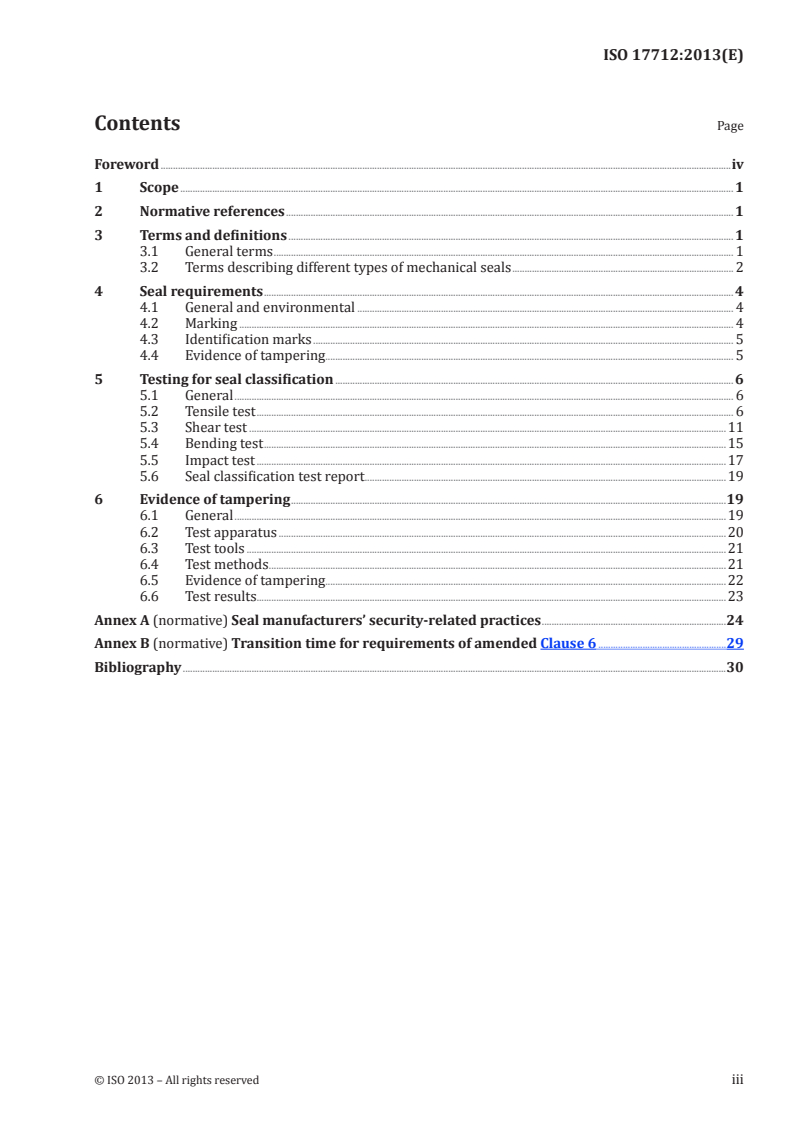
Contents Page
Foreword .iv
1 Scope . 1
2 Normative references . 1
3 Terms and definitions . 1
3.1 General terms . 1
3.2 Terms describing different types of mechanical seals . 2
4 Seal requirements . 4
4.1 General and environmental . 4
4.2 Marking . 4
4.3 Identification marks . 5
4.4 Evidence of tampering . . 5
5 Testing for seal classification . 6
5.1 General . 6
5.2 Tensile test . 6
5.3 Shear test .11
5.4 Bending test .15
5.5 Impact test .17
5.6 Seal classification test report .19
6 Evidence of tampering .19
6.1 General .19
6.2 Test apparatus .20
6.3 Test tools .21
6.4 Test methods .21
6.5 Evidence of tampering . .22
6.6 Test results.23
Annex A (normative) Seal manufacturers’ security-related practices .24
Annex B (normative) Transition time for requirements of amended Clause 6 .29
Bibliography .30
Foreword
ISO (the International Organization for Standardization) is a worldwide federation of national standards
bodies (ISO member bodies). The work of preparing International Standards is normally carried out
through ISO technical committees. Each member body interested in a subject for which a technical
committee has been established has the right to be represented on that committee. International
organizations, governmental and non-governmental, in liaison with ISO, also take part in the work.
ISO collaborates closely with the International Electrotechnical Commission (IEC) on all matters of
electrotechnical standardization.
International Standards are drafted in accordance with the rules given in the ISO/IEC Directives, Part 2.
The main task of technical committees is to prepare International Standards. Draft International
Standards adopted by the technical committees are circulated to the member bodies for voting.
Publication as an International Standard requires approval by at least 75 % of the member bodies
casting a vote.
Attention is drawn to the possibility that some of the elements of this document may be the subject of
patent rights. ISO shall not be held responsible for identifying any or all such patent rights.
ISO 17712 was prepared by Technical Committee ISO/TC 104, Freight containers.
This second edition cancels and replaces the first edition (ISO 17712:2010), which has been
technically revised.
iv © ISO 2013 – All rights reserved
INTERNATIONAL STANDARD ISO 17712:2013(E)
Freight containers — Mechanical seals
1 Scope
This International Standard establishes uniform procedures for the classification, acceptance, and
withdrawal of mechanical freight container seals. It provides a single source of information on mechanical
seals which are acceptable for securing freight containers in international commerce.
NOTE The purpose of mechanical seals is, as part of a security system, to determine whether a freight
container has been tampered with, i.e. whether there has been unauthorized entry into the container through its
doors. Seals can be effective only if seal users properly select, store, account for, apply, document, and attend to
seals prior to use and in use; while these issues are not addressed in this International Standard, they are relevant
to successful use of the seals covered by this International Standard.
Seals that conform to this International Standard are suitable for other applications, such as bulk railcars
or truck trailers used in cross-border and domestic operations. Users and regulatory agencies can apply
this International Standard to other applications as they deem appropriate.
2 Normative references
The following documents, in whole or in part, are normatively referenced in this document and are
indispensable for its application. For dated references, only the edition cited applies. For undated
references, the latest edition of the referenced document (including any amendments) applies.
ISO/IEC 15417, Information technology — Automatic identification and data capture techniques — Code
128 bar code symbology specification
ISO/IEC 17020, Conformity assessment — Requirements for the operation of various types of bodies
performing inspection
ISO/IEC 17025, General requirements for the competence of testing and calibration laboratories
3 Terms and definitions
For the purposes of this document, the following terms and definitions apply.
3.1 General terms
3.1.1
seal
mechanical device marked with a unique identifier and usually designed for a single use, which is
externally affixed to the container doors and designed to evidence tampering or intrusion through the
doors of a container and to secure closed doors of a container
Note 1 to entry: Depending on its design and construction, the seal provides varying degrees of resistance to an
intentional or unintentional attempt to open it or to enter the freight container through the container doors.
Note 2 to entry: Seals need to be designed and constructed so that tamper attempts create and leave evidence of
that tampering.
Note 3 to entry: All grades and types of seals require inspection to indicate whether tampering has occurred or
entry has been attempted.
3.1.2
high-security seal
seal that is constructed and manufactured of material such as metal or metal cable with the intent to
delay intrusion
Note 1 to entry: High-security seals can generally be removed with substantial bolt cutters or cable cutters.
3.1.3
security seal
seal that is constructed and manufactured of material that provides limited resistance to intrusion and
requires lightweight tools for removal
3.1.4
indicative seal
seal that is constructed and manufactured of material that can easily be broken by hand or by using a
simple snipping tool or shear
3.1.5
manufacturer
company or entity that either owns the seal-producing factory or contracts to buy made-to-order seals
for resale from a third-party factory
3.1.6
bar code
automatic identification technology that encodes information into an array of parallel bars and spaces
of varying widths
3.1.7
defeated seal
seal which has been opened or removed and replaced or reconstructed without detectable evidence of
tampering
3.1.8
tampering
attempt to open or remove and then replace or reconstruct a seal without leaving detectable evidence
of the attempt
3.1.9
tamper evidence
tell-tale indication that an attempt has been made to open or remove and then replace or reconstruct
without detectable evidence of that attempt
Note 1 to entry: Examples of tamper evidence include a change in the colour of the material, in surface texture,
cracks, indentations, or abrasions. Tamper evident indicators are recognizable by normal examination under the
usual circumstances prevailing in practice without technical aids (such as a magnifying glass or microscope).
3.1.10
indicativeness
ability to reveal evidence after attempts have been made to tamper with the seal
3.2 Terms describing different types of mechanical seals
3.2.1
wire seal
length of wire secured in a loop by some type of seizing device
EXAMPLE Wire seals include: crimp wire, fold wire, and cup wire seals.
Note 1 to entry: The seizing device can be plastic or metal and its deformation is one indication of tampering.
2 © ISO 2013 – All rights reserved
3.2.2
padlock seal
locking body with a bail attached
EXAMPLE Padlock seals include: wire shackle padlock (metal or plastic body), plastic padlock, and keyless
padlock seals.
Note 1 to entry: The padlock itself is not an integral part of the freight container.
3.2.3
strap seal
metal or plastic strap secured in a loop by inserting one end into or through a protected (covered)
locking mechanism on the other end
Note 1 to entry: The seizing device can be plastic or metal and its deformation is one indication of tampering.
3.2.4
cable seal
cable and a locking mechanism
EXAMPLE On a one-piece seal, the locking or seizing mechanism is permanently attached to one end of the
cable. A two-piece cable seal has a separate locking mechanism which slips onto the cable or prefabricated cable end.
3.2.5
bolt seal
metal rod, threaded or unthreaded, flexible or rigid, with a formed head, secured with a separate
locking mechanism
3.2.6
cinch seal
pull-up seal
indicative seal consisting of a thin strip of material, serrated or non-serrated, with a locking mechanism
attached to one end
Note 1 to entry: The free end is pulled through a hole in the locking mechanism and drawn up to the necessary
tightness. Cinch or pull-up type seals can have multiple lock positions. These seals are generally made of synthetic
materials such as nylon or plastic. They can resemble, but are significantly different from, simple electrical ties.
3.2.7
twist seal
steel rod or heavy-gauge wire of various diameters, which is inserted through the locking fixture and
twisted around itself by use of a special tool
3.2.8
scored seal
metal strip which is scored perpendicular to the length of the strip
Note 1 to entry: The strip is passed through the locking fixture and bent at the score mark. Removal of the seal
requires bending at the score mark, which results in breakage of the seal.
3.2.9
label seal
frangible seal consisting of a paper or plastic backing with adhesive
Note 1 to entry: The combination of backing and adhesive is chosen to cause the seal to tear when removal is attempted.
3.2.10
barrier seal
designed to provide a significant barrier to container entry
Note 1 to entry: A barrier seal can enclose a portion of the inner locking rods on a container.
Note 2 to entry: Barrier seals can be designed to be reusable.
4 Seal requirements
4.1 General and environmental
4.1.1 The choice of seal for a specific requirement will depend on many factors. It should be selected after full
consideration of the user’s performance requirements. The first decision is the appropriate seal classification
(indicative, security, or high security), followed by a decision on a particular type, make, and model.
NOTE Selection of a seal presumes the user has already considered the condition of the item to be sealed;
some items, such as open rack containers, are not suitable for any seal on the container itself. A seal is only one
element in a security system; any seal will only be as good as the system into which it is introduced.
In general terms, a low-strength indicative seal should be used where only indication of entry is desired.
Where a physical barrier is a definitive requirement, either a security or high-security seal should be used.
All seals should be easy to fit correctly on the item to be sealed and, once in situ, be easy to check for
positive engagement of the locking mechanism(s). Correct handling and fitting of seals is at least equal
if not greater in importance than selection of the correct seal. A poorly chosen but correctly fitted seal
may provide security; however, a well-chosen but incorrectly fitted seal will provide no security.
4.1.2 Security and high-security seals shall be sufficiently durable, strong, and reliable so as to prevent
accidental breakage and early deterioration (due to weather conditions, chemical action, vibration, shock,
etc.) in normal use.
4.1.3 To preclude the simple removal or loss of a bolt seal by pulling the pin head or locking body
through a worn container hasp, the minimum diameter (or minimum widest cross-dimension) for the
metal components of a bolt seal shall be 18 mm. This shall be referred to as the “Bolt Seal Diameter
Qualification” and it is pass/fail. ISO 17712-compliant bolt seals must pass.
NOTE The seal users who participated in the Working Group for this International Standard were from the
international liner shipping industry. They indicated that field personnel experienced recurring problems with
17 mm seals which could be removed intact by pulling the pin head or locking body through worn container hasps.
Those members of the Working Group requested that ISO 17712 require an 18 mm minimum diameter for metal
parts of bolt seals.
4.1.4 All classes of seals shall be capable of being affixed easily and quickly.
4.1.5 Container seals are typically subjected to the harsh environments of the marine, rail, and road
transportation industries. Sand and dust, salt spray, grease, snow, ice, and grime can be expected to coat
the seal. Physical shock and vibration are commonly encountered as a result of handling and transport
operations. ISO 18185-3, Freight containers — Electronic seals — Part 3: Environmental characteristics,
provides an excellent description of the harsh environment that applies to mechanical seals as well as
electronic seals. ISO 18185-3 also provides useful guidelines that are generally applicable to mechanical
seals. Mechanical seals shall be constructed to be fit for their intended purposes.
4.1.6 Indicative, security, and high-security seals shall be fit for use in the environmental conditions to
which maritime containers may be exposed.
4.2 Marking
4.2.1 Seals shall be identified by unique marks (such as a logotype) and unique numbers that are readily
legible; markings intended for unique identification of the seal shall be considered permanent. All seals
shall be uniquely numbered and identified. The identity of the manufacturer or private label holder shall
be evident on every seal, either name or logo.
4 © ISO 2013 – All rights reserved
4.2.2 Seals meeting the relevant criteria shall be marked or stamped in a readily legible way to identify
their classification as indicative (“I”), security (“S”), or high-security (“H”) seals. Any modification of markings
shall require obvious irreversible physical, chemical, heat, or other damage to or destruction of the seal.
4.2.3 Manufacturers or distributors shall not affix such classification marks unless the conditions in
4.2.3.a and 4.2.3.b are met.
a) The seal shall meet the appropriate physical parameters in this International Standard, as certified
by an accredited testing facility [A.3.3 a)].
b) The firm that manufactures the seal complies with the security-related practices described in
Annex A, as certified by an accredited process review organization (A.3.2).
c) Furthermore, for a seal to be affixed the “H” mark, it shall be designed and constructed with tamper
evidence features that generate tell-tale evidence of tampering, as documented in a compliance
certification letter and the audit report by an accredited process review organization.
4.2.4 In the case of reusable devices, the seal number should be carried on the portion designed to be
cut off so as to preclude its reuse.
4.2.5 Seals shall be marked and constructed in such a manner that manufacturers shall be able to
identify their own products.
4.2.6 Manufacturers may add a machine-readable bar code to their seals. The bar code shall represent
the unique identification numbers as reflected in 4.2.1. Bar codes, if used, shall comply with customer
specifications; or, in the absence of a contrary customer specification, the manufacturer shall comply with
ISO/IEC 15417, which addresses Code 128 bar code symbology specification.
4.3 Identification marks
Regulatory authorities and private customers may require identifiers that go beyond the requirements
of this International Standard, such as in the following cases.
a) Seals intended for use on freight containers moving under customs laws shall be approved or accepted
and individually marked as determined by the relevant customs organization or competent authority.
b) If the seal is to be purchased and used by customs, the seal or fastening, as appropriate, shall be
marked to show that it is a customs seal by application of unique words or markings designated by
the customs organization in question and a unique identification number.
c) If the seal is to be used by private industry (i.e. a shipper, manufacturer, or carrier), it shall be clearly
and legibly marked and uniquely numbered and identified. It may also be marked with a company
name or logo.
4.4 Evidence of tampering
4.4.1 Seals shall be designed and constructed so that tamper attempts create and leave evidence of
that tampering. More specifically, seals shall be designed and manufactured to prevent removal of or
undoing the seal without breaking, or tampering without leaving clear visible evidence, or undetectable
re-application of seals designed for single use. Compliant high-security “H” seals shall demonstrate their
ability to resist such tamper attempts as documented in a certification letter and audit report regarding
the seal manufacturer by an accredited process review organization in accordance with Clause 6
and Normative Annex A. Such documentation shall, upon request, be made available to competent
governmental agencies or authorities and to bona fide private seal users.
4.4.2 Seals constructed with plastic coating over metal components shall have sufficiently thick metal
components so as to preclude removal of the plastic coating, opening of the seal, and re-closing of the seal
without leaving visual evidence of tampering.
4.4.3 Different seal types evidence tampering in different ways. It is recommended that users receive
training in seal inspection and detection of tampering.
NOTE 1 A useful field and training guide for inspecting seals and detecting tampering is ASTM F1158 “Standard
guide for inspection and evaluation of tampering of security seals.”
NOTE 2 Table 5 provides useful examples of tampering evidence.
5 Testing for seal classification
5.1 General
5.1.1 There are four physical test procedures: tensile, shear, bending, and impact. The impact procedure
is performed twice at different temperatures. Five samples shall be evaluated for each of the five tests. A
total of 25 samples are needed to complete the testing necessary to classify a seal as indicative, security,
or high security.
The lowest classification for any sample on any test shall define the classification for the seal being
evaluated. To achieve a given classification, all samples must meet the requirements for that classification
in all five tests.
NOTE The terms indicative, security, and high security refer to the barrier capabilities of the seal (respectively,
minimal, medium, and meaningful barrier strength). [Since indicative seals, by definition, ‘can easily be broken
by hand’ (3.1.4), indicative seals do not need to be subjected to the strength tests in Clause 5.] The classification
names do not imply any differences in security against tampering.
5.1.2 Testing is to be done once every two years as set forth in A.3.3 a) unless more frequent testing
is required by the competent authority or there is a meaningful modification in the design or material
specifications of the seal.
Seals shall be tested as sold. Test samples shall be selected at random from inventory available for sale.
The general type of seal and its configuration shall be used to determine the appropriate attachment to
the test fixture.
Manufacturers shall submit all relevant products to an accredited independent testing laboratory
to ensure that the product complies with Clause 5. The testing lab shall be accredited according to
ISO/IEC 17025 with an explicit scope that includes this International Standard.
5.2 Tensile test
A pull test shall be conducted to determine the strength of a seal’s locking mechanism. The test fixture
shall apply a uniform load to the seal in a manner that simulates reversal of the motion used to lock the
seal. The load shall be slowly applied until the seal forcibly opens or is otherwise broken. For all seals,
pulling speed must be (50,8 ± 25,4) mm/min.
The seal shall be classified according to the criteria in Table 1 based on the tensile force recorded at the
time of seal failure.
Figures 1 to 5 illustrate the apparatuses for conducting tensile tests; Figures 1 to 4 are required while
Figure 5 is suggested.
All tests should be carried out at a temperature of (18 ± 3) °C.
6 © ISO 2013 – All rights reserved
Key
1 shackle fixture: steel, case hardening depth 0,7 mm
2 seal support bolt and nut: steel, Class 10.9, see Notes 2, 3, and 4
3 seal location
F applied tensile force
NOTE 1 The same seal support fixture is used for the tensile test and the impact test. This seal support fixture
(and the bolt seal support fixture in Figure 2) fits into the complete apparatus shown in Figure 11.
NOTE 2 Seal support bolt diameter 6,35 mm (0,25 inches) for seals with smallest cross-sectional dimension
less than or equal to 3,18 mm (0,125 inches).
NOTE 3 Seal support bolt diameter 12,7 mm (0,5 inches) for seals with smallest cross-sectional area greater
than 3,18 mm (0,125 inches).
NOTE 4 Tolerance ± 0,254 mm (0,010 inches).
Figure 1 — Tensile test apparatus — Wire seal, strap seal, cable seal, cinch seal
Dimensions in millimetres
Key
1 bolt seal support: steel, case hardening depth 0,7 mm
2 shackle fixture: steel, case hardening depth 0,7 mm
3 bolt seal location
4 2 × bolt seal support washer: steel, case hardening depth 0,7 mm
5 4 × thread M8 × 1 mm, 20 mm deep
6 4 × counterbore for M8 × 1 mm
7 1 × thread M16 × 1,5 mm thru
F applied tensile force
a
The bolt seal support washer (4) thickness may be increased to allow seal clearance but shall not be less than
5 mm.
b
Cross-section dimension
c
5 % to 10 % larger than the largest cross-section of the bolt seal shaft
8 © ISO 2013 – All rights reserved
NOTE 1 All fasteners used shall be Class 12.9 socket cap-type screws with the specified thread pitch. English
substitute fasteners must be Grade 8 and have diameter equal or greater than the specified fastener.
NOTE 2 The same bolt seal support fixture is used for the tensile test and the impact test. The complete
apparatus is shown in Figure 11.
Figure 2 — Tensile test apparatus — Bolt seals
Key
1 twist seal
2 pin, see Notes 1, 2, and 3
F applied tensile force
a
Cross-sectional diameter
NOTE 1 Seal support bolt diameter 6,35 mm (0,25 inches) for seals with smallest cross-sectional dimension
less than or equal to 3,18 mm (0,125 inches).
NOTE 2 Seal support bolt diameter 12,7 mm (0,5 inches) for seals with smallest cross-sectional dimension
greater than 3,18 mm (0,125 inches).
NOTE 3 Tolerance ± 0,254 mm (0,010 inches).
Figure 3 — Tensile test apparatus — Twist seal
Key
1 padlock seal
2 pin, see Notes 1, 2, and 3
F applied tensile force
a
Cross-sectional diameter
NOTE 1 Seal support bolt diameter 6,35 mm (0,25 inches) for seals with smallest cross-sectional dimension
less than or equal to 3,18 mm (0,125 inches).
NOTE 2 Seal support bolt diameter 12,7 mm (0,5 inches) for seals with smallest cross-sectional dimension
greater than 3,18 mm (0,125 inches).
NOTE 3 Tolerance ± 0,254 mm (0,010 inches).
Figure 4 — Tensile test apparatus — Padlock seal
10 © ISO 2013 – All rights reserved
Key
1 seal support bolt
2 pin
F applied tensile force
Figure 5 — Suggested tensile test apparatuses — Other seals
Table 1 — Tensile test seal classification requirements
Load to failure
Seal classification
a
kN
10,0 “H” (high-security seal)
2,27 “S” (security seal)
< 2,27 “I” (indicative seal)
a
1 kN = 225 lbf.
5.3 Shear test
5.3.1 A shear test shall be conducted to test the ability of a seal to withstand cutting with shearing
blades, as might be implemented with bolt cutters. The cutting blades used in the test fixture shall be
sufficiently well aligned that seals are cut and not merely deformed as might occur with a thin, flexible
seal and misaligned blades. The compressive load shall be applied until the seal is severed; however, the
maximum load shall be limited in accordance with Note 2.
Travel rate for shear test: 12,5 mm ± 6,35 mm/min.
5.3.2 The seal shall be classified according to the criteria in Table 2 based on the compressive load
recorded at the time of seal failure and in accordance with Note 3.
Figures 6 and 7 illustrate alternative required apparatus for conducting tensile tests. The apparatus in
Figure 7, the shear test bypass apparatus, shall be used for strap, wire, and small diameter cable seals.
The apparatus in Figure 6 shall be used for all other seals.
When performing the shear test, apply shear force at the weakest section of the seal.
Fixtures shall be designed such that applied stress is within the elastic limit of the fixture material.
Tests shall be carried out at a temperature of 18 °C ± 3 °C.
CAUTION — Do not exceed a shear force of 8 900 N (2 001 lbf). If the specimen has not failed at
that force, halt the test and unload the test equipment. Record a shear force of 8 896 N (2 000 lbf).
Sudden and violent rupture of the test specimen can endanger personnel, equipment, and property.
Table 2 — Shear test seal classification requirements
Load to failure
Seal classification
a
kN
3,336 “H” (high-security seal)
2,224 “S” (security seal)
< 2,224 “I” (indicative seal)
a
1 kN = 225 lbf.
12 © ISO 2013 – All rights reserved
Dimensions in millimetres
Key
1 cutting blades, machined from cutter jaws 60, Rockwell “C” scale
2 cutting test fixture (appropriate dimensions depend on final ground size of cutting blades)
F applied shear force
a
15,9 mm (5/8 inches) shear gap for seal location during test
b
0,1 mm larger than the final ground length/width of the blade
NOTE 1 The cutting test fixture (specimen holder) may be made in two pieces and assembled by bolt or weld
construction.
NOTE 2 The opening in the cutting test fixture (specimen holder) may be shimmed to achieve the intended fit.
Cutting blades shall be in alignment within 0,1 mm.
Figure 6 — Shear test apparatus
Dimensions in millimetres
Key
1 special specimen
2 cutting jaw: steel, 60 to 62 Rockwell “C” scale
3 specimen holder: steel, case hardened to 0,7 mm
F applied force
a
0,1 mm larger than the final ground length/width of the blade
b
Cross-section dimension
c
Minimum 5 × smallest cross-section dimension
NOTE 1 This fixture shall be used for cable seals less than 2 mm in diameter and other types of seals too small
in cross-section to be effectively sheared by the fixture in Figure 6.
NOTE 2 The specimen holder may be made in two pieces and assembled by bolt or weld construction.
NOTE 3 The opening of the specimen holder may be shimmed to achieve the intended fit.
Figure 7 — Shear test bypass apparatus — Small diameter cable, wire and strap seals
14 © ISO 2013 – All rights reserved
5.4 Bending test
5.4.1 The bending test is conducted to determine the resistance of a seal to failure under bending loads.
How the test is run shall be based on the subclassification of the seal as either flexible or rigid. Flexible
seals shall be tested for their ability to resist repeated bending cycles without failure. Rigid seals shall be
tested to determine their resistance to deformation by bending.
5.4.2 For flexible seals, fix the locking end and flex the material adjacent to this fixed end repeatedly
through an arc of 180° until failure or 501 cycles, whichever occurs first. Record the number of cycles
through this 180° arc and base classification of the seal on the number of cycles, as shown in Table 3. The
bending time (speed) for each cycle of 180° (i.e. duration of bend from −90° to +90°) is (3 ± 1) s.
Tests should be carried out at a temperature of (18 ± 3) °C.
5.4.3 For single-shaft rigid seals, fix the locking end and then fit a tube (300 ± 5) mm long over ≤ 20 mm
of the remaining seal and apply a load. The bending time (speed) for each cycle of 90° is (3 ± 1) s. Record
the load required to bend the seal and the distance above the fixed end of the seal (the moment arm) that
the load is applied. Base the classification of the seal on the maximum bending moment recorded and in
accordance with the values given in Table 3.
5.4.4 For rigid seals with two shafts such as in a padlock seal, fix the locking end and then fit a bar or
other suitable lever over ≤ 20 mm of the remaining seal and apply a load. Rotate the rod or bar until it
is in contact with both shafts. Continue to rotate the bar in the same direction an additional 90°. Record
the torsional force needed to achieve the 90° rotation or to cause failure of the locking mechanism if that
occurs prior to achieving the 90° rotation. Base the classification of the seal on the maximum bending
moment recorded and in accordance with the values given in Table 3. The duration of bending to 90°
(speed) is (3 ± 1) s.
Figures 8 to 10 illustrate the required apparatus for conducting bending tests.
Tests should be carried out at a temperature of (18 ± 3) °C.
Key
1 bolt seal
2 movable bolt seal holder
3 holding device (vice or similar object)
4 point of applied load
a
90° movement
b
Moment arm
Figure 8 — Bending test apparatus — Bolt seal
Key
1 seal (padlock type)
2 vice or similar fixture to fix the seal shackle
3 seal fixture for torque wrench (size and shape of fixture depend on seal shape)
4 torque wrench
a
Apply torsional load about centreline of seal
b
Centreline of seal and torque wrench
Figure 9 — Bending test apparatus — Padlock seal
Key
1 bar for load application (shown in rest position)
2 vice or similar fixture to fix seal body
3 shackle of flexible seal
a
90° motion (first step) return to rest position (second step)
b
Top view of seal
Figure 10 — Bending test apparatus — Padlock seal (top view)
16 © ISO 2013 – All rights reserved
Table 3 — Bending test seal classification requirements
Bending moment to failure
Cycles to failure
(rigid seals) Seal classification
(flexible seals)
a
Nm
501 50 “H” (high-security seal)
251 22 “S” (security seal)
< 251 < 22 “I” (indicative seal)
a
1 Nm = 0,737 562 1 ft-lbf.
5.5 Impact test
5.5.1 The impact test shall be conducted to determine the resistance of the seal to an impact load at
(18 ± 3) °C and at (−27 ± 3) °C. For the cold test, the test specimen and the test apparatus shall reside in
a cold chamber and be chilled completely to the specified temperature. The test shall be conducted in the
cold chamber.
The impact load shall be applied five times at a load equivalent to 13,56 J. Subsequent impact test
sequences shall be run at a load that is 13,56 J higher than the previous five impact loads. Impacts shall
be run until the seal fails or successfully withstands five impacts at 40,68 J. A second set of five seals
shall be tested at the second temperature.
The test fixture shall be devised so the impact load is applied at the locking mechanism of the seal in the
direction opposite the direction used in locking the seal. The impact test apparatus uses the same bolt
seal support fixture as does the tensile test (Figure 2), but it adds a provision for applying impact loads.
Figure 11 illustrates the required apparatus for conducting impact tests.
The impact test apparatus shall be placed directly on a solid concrete floor.
CAUTION — Use safety glasses during the test. During impact, test parts can become detached,
which presents an injury risk.
Figure 11 — Impact test apparatus
Key
1 base plate: aluminium 9 M16 locking nut
2 support tube: “11/2 in” galvanized pipe 10 shackle fixture: steel, case hardening depth 0,7 mm
3 shaft cross support: aluminium 11 bolt seal support: steel, case hardening depth 0,7 mm
4 fixture support: steel 12 bolt seal support washer: steel, case hardening depth 0,7 mm
5 weight guide shaft: steel 13 bolt seal location
6 anvil collar: steel 14 M20 locking nut
7 dead blow weight: steel, (4 ± 0,01) kg 15 2 × counterbore for M8
8 adjustable stop collar: steel
a
Dead blow drop height
NOTE All fasteners used shall be Class 12.9 with the specified thread pitch. English substitute fasteners shall
be Grade 8 and have a diameter equal or greater than the specified fastener.
Figure 11 — Impact test apparatus (continued)
18 © ISO 2013 – All rights reserved
5.5.2 The seal shall be classified according to the criteria in Table 4 based on the lowest impact load
recorded at the time of seal failure. (In order to be classified as high security, all 10 test samples must
survive five impacts of 40,68 J at high and low temperatures.)
Table 4 — Impact test seal classification requirements
Low temperature impact High temperature Dead blow mass drop Seal classification
load, J impact load, J height (see Figure 10)
40,68 40,68 1,037 m “H” (high-security seal)
27,12 27,12 0,691 m “S” (security seal)
< 27,12 < 27,12 0,346 m “I” (indicative seal)
5.6 Seal classification test report
The test report shall contain as a minimum the following information:
a) identification/description of the test specimen;
b) reference to this International Standard (i.e. ISO 17712);
c) results of the test: (a)., (b)., as specified in the individual tests;
d) conditioning, pre-treatment, etc.;
e) temperature and the relative humidity in the test room throughout the test;
f) details of the supply and monitoring equipment and the response criteria;
g) details of any deviation from this International Standard or from the international standards to
which reference is made, and details of any operations regarded as optional.
6 Evidence of tampering
6.1 General
This clause requires that seals be designed and constructed with tamper evidence features that generate
tell-tale evidence of tampering. The fundamental function of any seal is “indicativeness”, the ability to reveal
evidence after attempts have been made to tamper with the seal. In practical field applications, this calls
for evidence available to visual or other inspection of a seal in situ by a commercial or regulatory person.
This clause also requires that, for high-security seals desired to be Clause 6-compliant, a manufacturer
can demonstrate the tamper-evident properties and related documentation to the auditors of an
accredited process review organization; this shall occur as part of the seal manufacturer’s ISO 9001,
Quality Operational Procedures (QOP) in accordance with Normative Annex A. The report of the
independent and accredited auditing agency shall address compliance of the manufacturer’s tamper
evidence program, including testing. For ease of use in its customer and regulatory relationships,
manufacturers may request a summary letter from the auditing agency that certifies such compliance.
NOTE 1 “An accredited process review organization” is a third-party organization accredited according to
ISO/IEC 17020.
NOTE 2 Tamper-evident capabilities can result from engineering and design features, methods of construction,
or a combination of factors.
NOTE 3 Resistance to tampering is another important factor in seal design and manufacture. Since any given
security product can be tampered with given sufficient time, motivation, and resources, lab-based attempts to
measure a seal’s time-to-resist tampering have shown little practical value in a standards context.
NOTE 4 Seals are much more vulnerable to successful tampering when they can be manipulated prior to
application and closing. Seal designers and manufacturers shall strive to minimize the possibility of easy
pre-closure manipulation — that is, before seals are put in place and closed. Pre-application tampering (pre-
tampering) generally requires collusion by someone within the supply chain, usually at the shipment’s point of
origin, before a container is stuffed, closed, and sealed. Experience indicates that careful attention to security-
related seal procedures is the most effective method to mitigate vulnerability to pre-tampering. It is critical how
seals are received by the seal purchaser from the seal manufacturer, how the received seals are stored before they
are affixed, and who affixes the seals. These user policy, training, and system discipline issues may be addressed
by customs administrations and other regulatory bodies as part of the authorization of trading entities to use
their own seals in place of customs seals.
6.1.1 Appropriate internal testing should be done per the type of seal used on shipping containers under
the conditions the seal would encounter in a typical shipping environment. As part of its security-related
practices and as a condition for its certification in conformance with Normative Annex A (A.3.2), the seal
manufacturer shall arrange for, and undertake, appropriate testing of the tamper evidence features in
each of its various high-security seal products that it desires to be compliant with this standard. Such
testing shall be done once every two years as specified in A.3.3 a) or earlier if there is a meaningful
modification in the design or material specifications of the seal. The testing shall be done on samples of
seals manufactured for sale. Testing of seals that are not intended for sale is not permissible.
The manufacturer shall make available the relevant seal products, with the appropriately documented
internal test processes, procedures, and results to the auditors of the accredited process review
organization that undertakes the ISO 9001 (or equivalent) quality system certification and auditing
of the seal manufacturer. This documentation shall, upon request, be made available to competent
governmental agencies or authorities and to bona fide private seal users.
NOTE Normative Annex A requires ISO 9001 certification by properly
...
INTERNATIONAL ISO
STANDARD 17712
Second edition
2013-05-15
Freight containers — Mechanical seals
Conteneurs pour le transport de marchandises — Scellés mécaniques
Reference number
©
ISO 2013
© ISO 2013
All rights reserved. Unless otherwise specified, no part of this publication may be reproduced or utilized otherwise in any form
or by any means, electronic or mechanical, including photocopying, or posting on the internet or an intranet, without prior
written permission. Permission can be requested from either ISO at the address below or ISO’s member body in the country of
the requester.
ISO copyright office
Case postale 56 • CH-1211 Geneva 20
Tel. + 41 22 749 01 11
Fax + 41 22 749 09 47
E-mail copyright@iso.org
Web www.iso.org
Published in Switzerland
ii © ISO 2013 – All rights reserved
Contents Page
Foreword .iv
1 Scope . 1
2 Normative references . 1
3 Terms and definitions . 1
3.1 General terms . 1
3.2 Terms describing different types of mechanical seals . 2
4 Seal requirements . 4
4.1 General and environmental . 4
4.2 Marking . 4
4.3 Identification marks . 5
4.4 Evidence of tampering . . 5
5 Testing for seal classification . 6
5.1 General . 6
5.2 Tensile test . 6
5.3 Shear test .11
5.4 Bending test .15
5.5 Impact test .17
5.6 Seal classification test report .19
6 Evidence of tampering .19
6.1 General .19
6.2 Test apparatus .20
6.3 Test tools .21
6.4 Test methods .21
6.5 Evidence of tampering . .22
6.6 Test results.23
Annex A (normative) Seal manufacturers’ security-related practices .24
Annex B (normative) Transition time for requirements of amended Clause 6 .29
Bibliography .30
Foreword
ISO (the International Organization for Standardization) is a worldwide federation of national standards
bodies (ISO member bodies). The work of preparing International Standards is normally carried out
through ISO technical committees. Each member body interested in a subject for which a technical
committee has been established has the right to be represented on that committee. International
organizations, governmental and non-governmental, in liaison with ISO, also take part in the work.
ISO collaborates closely with the International Electrotechnical Commission (IEC) on all matters of
electrotechnical standardization.
International Standards are drafted in accordance with the rules given in the ISO/IEC Directives, Part 2.
The main task of technical committees is to prepare International Standards. Draft International
Standards adopted by the technical committees are circulated to the member bodies for voting.
Publication as an International Standard requires approval by at least 75 % of the member bodies
casting a vote.
Attention is drawn to the possibility that some of the elements of this document may be the subject of
patent rights. ISO shall not be held responsible for identifying any or all such patent rights.
ISO 17712 was prepared by Technical Committee ISO/TC 104, Freight containers.
This second edition cancels and replaces the first edition (ISO 17712:2010), which has been
technically revised.
iv © ISO 2013 – All rights reserved
INTERNATIONAL STANDARD ISO 17712:2013(E)
Freight containers — Mechanical seals
1 Scope
This International Standard establishes uniform procedures for the classification, acceptance, and
withdrawal of mechanical freight container seals. It provides a single source of information on mechanical
seals which are acceptable for securing freight containers in international commerce.
NOTE The purpose of mechanical seals is, as part of a security system, to determine whether a freight
container has been tampered with, i.e. whether there has been unauthorized entry into the container through its
doors. Seals can be effective only if seal users properly select, store, account for, apply, document, and attend to
seals prior to use and in use; while these issues are not addressed in this International Standard, they are relevant
to successful use of the seals covered by this International Standard.
Seals that conform to this International Standard are suitable for other applications, such as bulk railcars
or truck trailers used in cross-border and domestic operations. Users and regulatory agencies can apply
this International Standard to other applications as they deem appropriate.
2 Normative references
The following documents, in whole or in part, are normatively referenced in this document and are
indispensable for its application. For dated references, only the edition cited applies. For undated
references, the latest edition of the referenced document (including any amendments) applies.
ISO/IEC 15417, Information technology — Automatic identification and data capture techniques — Code
128 bar code symbology specification
ISO/IEC 17020, Conformity assessment — Requirements for the operation of various types of bodies
performing inspection
ISO/IEC 17025, General requirements for the competence of testing and calibration laboratories
3 Terms and definitions
For the purposes of this document, the following terms and definitions apply.
3.1 General terms
3.1.1
seal
mechanical device marked with a unique identifier and usually designed for a single use, which is
externally affixed to the container doors and designed to evidence tampering or intrusion through the
doors of a container and to secure closed doors of a container
Note 1 to entry: Depending on its design and construction, the seal provides varying degrees of resistance to an
intentional or unintentional attempt to open it or to enter the freight container through the container doors.
Note 2 to entry: Seals need to be designed and constructed so that tamper attempts create and leave evidence of
that tampering.
Note 3 to entry: All grades and types of seals require inspection to indicate whether tampering has occurred or
entry has been attempted.
3.1.2
high-security seal
seal that is constructed and manufactured of material such as metal or metal cable with the intent to
delay intrusion
Note 1 to entry: High-security seals can generally be removed with substantial bolt cutters or cable cutters.
3.1.3
security seal
seal that is constructed and manufactured of material that provides limited resistance to intrusion and
requires lightweight tools for removal
3.1.4
indicative seal
seal that is constructed and manufactured of material that can easily be broken by hand or by using a
simple snipping tool or shear
3.1.5
manufacturer
company or entity that either owns the seal-producing factory or contracts to buy made-to-order seals
for resale from a third-party factory
3.1.6
bar code
automatic identification technology that encodes information into an array of parallel bars and spaces
of varying widths
3.1.7
defeated seal
seal which has been opened or removed and replaced or reconstructed without detectable evidence of
tampering
3.1.8
tampering
attempt to open or remove and then replace or reconstruct a seal without leaving detectable evidence
of the attempt
3.1.9
tamper evidence
tell-tale indication that an attempt has been made to open or remove and then replace or reconstruct
without detectable evidence of that attempt
Note 1 to entry: Examples of tamper evidence include a change in the colour of the material, in surface texture,
cracks, indentations, or abrasions. Tamper evident indicators are recognizable by normal examination under the
usual circumstances prevailing in practice without technical aids (such as a magnifying glass or microscope).
3.1.10
indicativeness
ability to reveal evidence after attempts have been made to tamper with the seal
3.2 Terms describing different types of mechanical seals
3.2.1
wire seal
length of wire secured in a loop by some type of seizing device
EXAMPLE Wire seals include: crimp wire, fold wire, and cup wire seals.
Note 1 to entry: The seizing device can be plastic or metal and its deformation is one indication of tampering.
2 © ISO 2013 – All rights reserved
3.2.2
padlock seal
locking body with a bail attached
EXAMPLE Padlock seals include: wire shackle padlock (metal or plastic body), plastic padlock, and keyless
padlock seals.
Note 1 to entry: The padlock itself is not an integral part of the freight container.
3.2.3
strap seal
metal or plastic strap secured in a loop by inserting one end into or through a protected (covered)
locking mechanism on the other end
Note 1 to entry: The seizing device can be plastic or metal and its deformation is one indication of tampering.
3.2.4
cable seal
cable and a locking mechanism
EXAMPLE On a one-piece seal, the locking or seizing mechanism is permanently attached to one end of the
cable. A two-piece cable seal has a separate locking mechanism which slips onto the cable or prefabricated cable end.
3.2.5
bolt seal
metal rod, threaded or unthreaded, flexible or rigid, with a formed head, secured with a separate
locking mechanism
3.2.6
cinch seal
pull-up seal
indicative seal consisting of a thin strip of material, serrated or non-serrated, with a locking mechanism
attached to one end
Note 1 to entry: The free end is pulled through a hole in the locking mechanism and drawn up to the necessary
tightness. Cinch or pull-up type seals can have multiple lock positions. These seals are generally made of synthetic
materials such as nylon or plastic. They can resemble, but are significantly different from, simple electrical ties.
3.2.7
twist seal
steel rod or heavy-gauge wire of various diameters, which is inserted through the locking fixture and
twisted around itself by use of a special tool
3.2.8
scored seal
metal strip which is scored perpendicular to the length of the strip
Note 1 to entry: The strip is passed through the locking fixture and bent at the score mark. Removal of the seal
requires bending at the score mark, which results in breakage of the seal.
3.2.9
label seal
frangible seal consisting of a paper or plastic backing with adhesive
Note 1 to entry: The combination of backing and adhesive is chosen to cause the seal to tear when removal is attempted.
3.2.10
barrier seal
designed to provide a significant barrier to container entry
Note 1 to entry: A barrier seal can enclose a portion of the inner locking rods on a container.
Note 2 to entry: Barrier seals can be designed to be reusable.
4 Seal requirements
4.1 General and environmental
4.1.1 The choice of seal for a specific requirement will depend on many factors. It should be selected after full
consideration of the user’s performance requirements. The first decision is the appropriate seal classification
(indicative, security, or high security), followed by a decision on a particular type, make, and model.
NOTE Selection of a seal presumes the user has already considered the condition of the item to be sealed;
some items, such as open rack containers, are not suitable for any seal on the container itself. A seal is only one
element in a security system; any seal will only be as good as the system into which it is introduced.
In general terms, a low-strength indicative seal should be used where only indication of entry is desired.
Where a physical barrier is a definitive requirement, either a security or high-security seal should be used.
All seals should be easy to fit correctly on the item to be sealed and, once in situ, be easy to check for
positive engagement of the locking mechanism(s). Correct handling and fitting of seals is at least equal
if not greater in importance than selection of the correct seal. A poorly chosen but correctly fitted seal
may provide security; however, a well-chosen but incorrectly fitted seal will provide no security.
4.1.2 Security and high-security seals shall be sufficiently durable, strong, and reliable so as to prevent
accidental breakage and early deterioration (due to weather conditions, chemical action, vibration, shock,
etc.) in normal use.
4.1.3 To preclude the simple removal or loss of a bolt seal by pulling the pin head or locking body
through a worn container hasp, the minimum diameter (or minimum widest cross-dimension) for the
metal components of a bolt seal shall be 18 mm. This shall be referred to as the “Bolt Seal Diameter
Qualification” and it is pass/fail. ISO 17712-compliant bolt seals must pass.
NOTE The seal users who participated in the Working Group for this International Standard were from the
international liner shipping industry. They indicated that field personnel experienced recurring problems with
17 mm seals which could be removed intact by pulling the pin head or locking body through worn container hasps.
Those members of the Working Group requested that ISO 17712 require an 18 mm minimum diameter for metal
parts of bolt seals.
4.1.4 All classes of seals shall be capable of being affixed easily and quickly.
4.1.5 Container seals are typically subjected to the harsh environments of the marine, rail, and road
transportation industries. Sand and dust, salt spray, grease, snow, ice, and grime can be expected to coat
the seal. Physical shock and vibration are commonly encountered as a result of handling and transport
operations. ISO 18185-3, Freight containers — Electronic seals — Part 3: Environmental characteristics,
provides an excellent description of the harsh environment that applies to mechanical seals as well as
electronic seals. ISO 18185-3 also provides useful guidelines that are generally applicable to mechanical
seals. Mechanical seals shall be constructed to be fit for their intended purposes.
4.1.6 Indicative, security, and high-security seals shall be fit for use in the environmental conditions to
which maritime containers may be exposed.
4.2 Marking
4.2.1 Seals shall be identified by unique marks (such as a logotype) and unique numbers that are readily
legible; markings intended for unique identification of the seal shall be considered permanent. All seals
shall be uniquely numbered and identified. The identity of the manufacturer or private label holder shall
be evident on every seal, either name or logo.
4 © ISO 2013 – All rights reserved
4.2.2 Seals meeting the relevant criteria shall be marked or stamped in a readily legible way to identify
their classification as indicative (“I”), security (“S”), or high-security (“H”) seals. Any modification of markings
shall require obvious irreversible physical, chemical, heat, or other damage to or destruction of the seal.
4.2.3 Manufacturers or distributors shall not affix such classification marks unless the conditions in
4.2.3.a and 4.2.3.b are met.
a) The seal shall meet the appropriate physical parameters in this International Standard, as certified
by an accredited testing facility [A.3.3 a)].
b) The firm that manufactures the seal complies with the security-related practices described in
Annex A, as certified by an accredited process review organization (A.3.2).
c) Furthermore, for a seal to be affixed the “H” mark, it shall be designed and constructed with tamper
evidence features that generate tell-tale evidence of tampering, as documented in a compliance
certification letter and the audit report by an accredited process review organization.
4.2.4 In the case of reusable devices, the seal number should be carried on the portion designed to be
cut off so as to preclude its reuse.
4.2.5 Seals shall be marked and constructed in such a manner that manufacturers shall be able to
identify their own products.
4.2.6 Manufacturers may add a machine-readable bar code to their seals. The bar code shall represent
the unique identification numbers as reflected in 4.2.1. Bar codes, if used, shall comply with customer
specifications; or, in the absence of a contrary customer specification, the manufacturer shall comply with
ISO/IEC 15417, which addresses Code 128 bar code symbology specification.
4.3 Identification marks
Regulatory authorities and private customers may require identifiers that go beyond the requirements
of this International Standard, such as in the following cases.
a) Seals intended for use on freight containers moving under customs laws shall be approved or accepted
and individually marked as determined by the relevant customs organization or competent authority.
b) If the seal is to be purchased and used by customs, the seal or fastening, as appropriate, shall be
marked to show that it is a customs seal by application of unique words or markings designated by
the customs organization in question and a unique identification number.
c) If the seal is to be used by private industry (i.e. a shipper, manufacturer, or carrier), it shall be clearly
and legibly marked and uniquely numbered and identified. It may also be marked with a company
name or logo.
4.4 Evidence of tampering
4.4.1 Seals shall be designed and constructed so that tamper attempts create and leave evidence of
that tampering. More specifically, seals shall be designed and manufactured to prevent removal of or
undoing the seal without breaking, or tampering without leaving clear visible evidence, or undetectable
re-application of seals designed for single use. Compliant high-security “H” seals shall demonstrate their
ability to resist such tamper attempts as documented in a certification letter and audit report regarding
the seal manufacturer by an accredited process review organization in accordance with Clause 6
and Normative Annex A. Such documentation shall, upon request, be made available to competent
governmental agencies or authorities and to bona fide private seal users.
4.4.2 Seals constructed with plastic coating over metal components shall have sufficiently thick metal
components so as to preclude removal of the plastic coating, opening of the seal, and re-closing of the seal
without leaving visual evidence of tampering.
4.4.3 Different seal types evidence tampering in different ways. It is recommended that users receive
training in seal inspection and detection of tampering.
NOTE 1 A useful field and training guide for inspecting seals and detecting tampering is ASTM F1158 “Standard
guide for inspection and evaluation of tampering of security seals.”
NOTE 2 Table 5 provides useful examples of tampering evidence.
5 Testing for seal classification
5.1 General
5.1.1 There are four physical test procedures: tensile, shear, bending, and impact. The impact procedure
is performed twice at different temperatures. Five samples shall be evaluated for each of the five tests. A
total of 25 samples are needed to complete the testing necessary to classify a seal as indicative, security,
or high security.
The lowest classification for any sample on any test shall define the classification for the seal being
evaluated. To achieve a given classification, all samples must meet the requirements for that classification
in all five tests.
NOTE The terms indicative, security, and high security refer to the barrier capabilities of the seal (respectively,
minimal, medium, and meaningful barrier strength). [Since indicative seals, by definition, ‘can easily be broken
by hand’ (3.1.4), indicative seals do not need to be subjected to the strength tests in Clause 5.] The classification
names do not imply any differences in security against tampering.
5.1.2 Testing is to be done once every two years as set forth in A.3.3 a) unless more frequent testing
is required by the competent authority or there is a meaningful modification in the design or material
specifications of the seal.
Seals shall be tested as sold. Test samples shall be selected at random from inventory available for sale.
The general type of seal and its configuration shall be used to determine the appropriate attachment to
the test fixture.
Manufacturers shall submit all relevant products to an accredited independent testing laboratory
to ensure that the product complies with Clause 5. The testing lab shall be accredited according to
ISO/IEC 17025 with an explicit scope that includes this International Standard.
5.2 Tensile test
A pull test shall be conducted to determine the strength of a seal’s locking mechanism. The test fixture
shall apply a uniform load to the seal in a manner that simulates reversal of the motion used to lock the
seal. The load shall be slowly applied until the seal forcibly opens or is otherwise broken. For all seals,
pulling speed must be (50,8 ± 25,4) mm/min.
The seal shall be classified according to the criteria in Table 1 based on the tensile force recorded at the
time of seal failure.
Figures 1 to 5 illustrate the apparatuses for conducting tensile tests; Figures 1 to 4 are required while
Figure 5 is suggested.
All tests should be carried out at a temperature of (18 ± 3) °C.
6 © ISO 2013 – All rights reserved
Key
1 shackle fixture: steel, case hardening depth 0,7 mm
2 seal support bolt and nut: steel, Class 10.9, see Notes 2, 3, and 4
3 seal location
F applied tensile force
NOTE 1 The same seal support fixture is used for the tensile test and the impact test. This seal support fixture
(and the bolt seal support fixture in Figure 2) fits into the complete apparatus shown in Figure 11.
NOTE 2 Seal support bolt diameter 6,35 mm (0,25 inches) for seals with smallest cross-sectional dimension
less than or equal to 3,18 mm (0,125 inches).
NOTE 3 Seal support bolt diameter 12,7 mm (0,5 inches) for seals with smallest cross-sectional area greater
than 3,18 mm (0,125 inches).
NOTE 4 Tolerance ± 0,254 mm (0,010 inches).
Figure 1 — Tensile test apparatus — Wire seal, strap seal, cable seal, cinch seal
Dimensions in millimetres
Key
1 bolt seal support: steel, case hardening depth 0,7 mm
2 shackle fixture: steel, case hardening depth 0,7 mm
3 bolt seal location
4 2 × bolt seal support washer: steel, case hardening depth 0,7 mm
5 4 × thread M8 × 1 mm, 20 mm deep
6 4 × counterbore for M8 × 1 mm
7 1 × thread M16 × 1,5 mm thru
F applied tensile force
a
The bolt seal support washer (4) thickness may be increased to allow seal clearance but shall not be less than
5 mm.
b
Cross-section dimension
c
5 % to 10 % larger than the largest cross-section of the bolt seal shaft
8 © ISO 2013 – All rights reserved
NOTE 1 All fasteners used shall be Class 12.9 socket cap-type screws with the specified thread pitch. English
substitute fasteners must be Grade 8 and have diameter equal or greater than the specified fastener.
NOTE 2 The same bolt seal support fixture is used for the tensile test and the impact test. The complete
apparatus is shown in Figure 11.
Figure 2 — Tensile test apparatus — Bolt seals
Key
1 twist seal
2 pin, see Notes 1, 2, and 3
F applied tensile force
a
Cross-sectional diameter
NOTE 1 Seal support bolt diameter 6,35 mm (0,25 inches) for seals with smallest cross-sectional dimension
less than or equal to 3,18 mm (0,125 inches).
NOTE 2 Seal support bolt diameter 12,7 mm (0,5 inches) for seals with smallest cross-sectional dimension
greater than 3,18 mm (0,125 inches).
NOTE 3 Tolerance ± 0,254 mm (0,010 inches).
Figure 3 — Tensile test apparatus — Twist seal
Key
1 padlock seal
2 pin, see Notes 1, 2, and 3
F applied tensile force
a
Cross-sectional diameter
NOTE 1 Seal support bolt diameter 6,35 mm (0,25 inches) for seals with smallest cross-sectional dimension
less than or equal to 3,18 mm (0,125 inches).
NOTE 2 Seal support bolt diameter 12,7 mm (0,5 inches) for seals with smallest cross-sectional dimension
greater than 3,18 mm (0,125 inches).
NOTE 3 Tolerance ± 0,254 mm (0,010 inches).
Figure 4 — Tensile test apparatus — Padlock seal
10 © ISO 2013 – All rights reserved
Key
1 seal support bolt
2 pin
F applied tensile force
Figure 5 — Suggested tensile test apparatuses — Other seals
Table 1 — Tensile test seal classification requirements
Load to failure
Seal classification
a
kN
10,0 “H” (high-security seal)
2,27 “S” (security seal)
< 2,27 “I” (indicative seal)
a
1 kN = 225 lbf.
5.3 Shear test
5.3.1 A shear test shall be conducted to test the ability of a seal to withstand cutting with shearing
blades, as might be implemented with bolt cutters. The cutting blades used in the test fixture shall be
sufficiently well aligned that seals are cut and not merely deformed as might occur with a thin, flexible
seal and misaligned blades. The compressive load shall be applied until the seal is severed; however, the
maximum load shall be limited in accordance with Note 2.
Travel rate for shear test: 12,5 mm ± 6,35 mm/min.
5.3.2 The seal shall be classified according to the criteria in Table 2 based on the compressive load
recorded at the time of seal failure and in accordance with Note 3.
Figures 6 and 7 illustrate alternative required apparatus for conducting tensile tests. The apparatus in
Figure 7, the shear test bypass apparatus, shall be used for strap, wire, and small diameter cable seals.
The apparatus in Figure 6 shall be used for all other seals.
When performing the shear test, apply shear force at the weakest section of the seal.
Fixtures shall be designed such that applied stress is within the elastic limit of the fixture material.
Tests shall be carried out at a temperature of 18 °C ± 3 °C.
CAUTION — Do not exceed a shear force of 8 900 N (2 001 lbf). If the specimen has not failed at
that force, halt the test and unload the test equipment. Record a shear force of 8 896 N (2 000 lbf).
Sudden and violent rupture of the test specimen can endanger personnel, equipment, and property.
Table 2 — Shear test seal classification requirements
Load to failure
Seal classification
a
kN
3,336 “H” (high-security seal)
2,224 “S” (security seal)
< 2,224 “I” (indicative seal)
a
1 kN = 225 lbf.
12 © ISO 2013 – All rights reserved
Dimensions in millimetres
Key
1 cutting blades, machined from cutter jaws 60, Rockwell “C” scale
2 cutting test fixture (appropriate dimensions depend on final ground size of cutting blades)
F applied shear force
a
15,9 mm (5/8 inches) shear gap for seal location during test
b
0,1 mm larger than the final ground length/width of the blade
NOTE 1 The cutting test fixture (specimen holder) may be made in two pieces and assembled by bolt or weld
construction.
NOTE 2 The opening in the cutting test fixture (specimen holder) may be shimmed to achieve the intended fit.
Cutting blades shall be in alignment within 0,1 mm.
Figure 6 — Shear test apparatus
Dimensions in millimetres
Key
1 special specimen
2 cutting jaw: steel, 60 to 62 Rockwell “C” scale
3 specimen holder: steel, case hardened to 0,7 mm
F applied force
a
0,1 mm larger than the final ground length/width of the blade
b
Cross-section dimension
c
Minimum 5 × smallest cross-section dimension
NOTE 1 This fixture shall be used for cable seals less than 2 mm in diameter and other types of seals too small
in cross-section to be effectively sheared by the fixture in Figure 6.
NOTE 2 The specimen holder may be made in two pieces and assembled by bolt or weld construction.
NOTE 3 The opening of the specimen holder may be shimmed to achieve the intended fit.
Figure 7 — Shear test bypass apparatus — Small diameter cable, wire and strap seals
14 © ISO 2013 – All rights reserved
5.4 Bending test
5.4.1 The bending test is conducted to determine the resistance of a seal to failure under bending loads.
How the test is run shall be based on the subclassification of the seal as either flexible or rigid. Flexible
seals shall be tested for their ability to resist repeated bending cycles without failure. Rigid seals shall be
tested to determine their resistance to deformation by bending.
5.4.2 For flexible seals, fix the locking end and flex the material adjacent to this fixed end repeatedly
through an arc of 180° until failure or 501 cycles, whichever occurs first. Record the number of cycles
through this 180° arc and base classification of the seal on the number of cycles, as shown in Table 3. The
bending time (speed) for each cycle of 180° (i.e. duration of bend from −90° to +90°) is (3 ± 1) s.
Tests should be carried out at a temperature of (18 ± 3) °C.
5.4.3 For single-shaft rigid seals, fix the locking end and then fit a tube (300 ± 5) mm long over ≤ 20 mm
of the remaining seal and apply a load. The bending time (speed) for each cycle of 90° is (3 ± 1) s. Record
the load required to bend the seal and the distance above the fixed end of the seal (the moment arm) that
the load is applied. Base the classification of the seal on the maximum bending moment recorded and in
accordance with the values given in Table 3.
5.4.4 For rigid seals with two shafts such as in a padlock seal, fix the locking end and then fit a bar or
other suitable lever over ≤ 20 mm of the remaining seal and apply a load. Rotate the rod or bar until it
is in contact with both shafts. Continue to rotate the bar in the same direction an additional 90°. Record
the torsional force needed to achieve the 90° rotation or to cause failure of the locking mechanism if that
occurs prior to achieving the 90° rotation. Base the classification of the seal on the maximum bending
moment recorded and in accordance with the values given in Table 3. The duration of bending to 90°
(speed) is (3 ± 1) s.
Figures 8 to 10 illustrate the required apparatus for conducting bending tests.
Tests should be carried out at a temperature of (18 ± 3) °C.
Key
1 bolt seal
2 movable bolt seal holder
3 holding device (vice or similar object)
4 point of applied load
a
90° movement
b
Moment arm
Figure 8 — Bending test apparatus — Bolt seal
Key
1 seal (padlock type)
2 vice or similar fixture to fix the seal shackle
3 seal fixture for torque wrench (size and shape of fixture depend on seal shape)
4 torque wrench
a
Apply torsional load about centreline of seal
b
Centreline of seal and torque wrench
Figure 9 — Bending test apparatus — Padlock seal
Key
1 bar for load application (shown in rest position)
2 vice or similar fixture to fix seal body
3 shackle of flexible seal
a
90° motion (first step) return to rest position (second step)
b
Top view of seal
Figure 10 — Bending test apparatus — Padlock seal (top view)
16 © ISO 2013 – All rights reserved
Table 3 — Bending test seal classification requirements
Bending moment to failure
Cycles to failure
(rigid seals) Seal classification
(flexible seals)
a
Nm
501 50 “H” (high-security seal)
251 22 “S” (security seal)
< 251 < 22 “I” (indicative seal)
a
1 Nm = 0,737 562 1 ft-lbf.
5.5 Impact test
5.5.1 The impact test shall be conducted to determine the resistance of the seal to an impact load at
(18 ± 3) °C and at (−27 ± 3) °C. For the cold test, the test specimen and the test apparatus shall reside in
a cold chamber and be chilled completely to the specified temperature. The test shall be conducted in the
cold chamber.
The impact load shall be applied five times at a load equivalent to 13,56 J. Subsequent impact test
sequences shall be run at a load that is 13,56 J higher than the previous five impact loads. Impacts shall
be run until the seal fails or successfully withstands five impacts at 40,68 J. A second set of five seals
shall be tested at the second temperature.
The test fixture shall be devised so the impact load is applied at the locking mechanism of the seal in the
direction opposite the direction used in locking the seal. The impact test apparatus uses the same bolt
seal support fixture as does the tensile test (Figure 2), but it adds a provision for applying impact loads.
Figure 11 illustrates the required apparatus for conducting impact tests.
The impact test apparatus shall be placed directly on a solid concrete floor.
CAUTION — Use safety glasses during the test. During impact, test parts can become detached,
which presents an injury risk.
Figure 11 — Impact test apparatus
Key
1 base plate: aluminium 9 M16 locking nut
2 support tube: “11/2 in” galvanized pipe 10 shackle fixture: steel, case hardening depth 0,7 mm
3 shaft cross support: aluminium 11 bolt seal support: steel, case hardening depth 0,7 mm
4 fixture support: steel 12 bolt seal support washer: steel, case hardening depth 0,7 mm
5 weight guide shaft: steel 13 bolt seal location
6 anvil collar: steel 14 M20 locking nut
7 dead blow weight: steel, (4 ± 0,01) kg 15 2 × counterbore for M8
8 adjustable stop collar: steel
a
Dead blow drop height
NOTE All fasteners used shall be Class 12.9 with the specified thread pitch. English substitute fasteners shall
be Grade 8 and have a diameter equal or greater than the specified fastener.
Figure 11 — Impact test apparatus (continued)
18 © ISO 2013 – All rights reserved
5.5.2 The seal shall be classified according to the criteria in Table 4 based on the lowest impact load
recorded at the time of seal failure. (In order to be classified as high security, all 10 test samples must
survive five impacts of 40,68 J at high and low temperatures.)
Table 4 — Impact test seal classification requirements
Low temperature impact High temperature Dead blow mass drop Seal classification
load, J impact load, J height (see Figure 10)
40,68 40,68 1,037 m “H” (high-security seal)
27,12 27,12 0,691 m “S” (security seal)
< 27,12 < 27,12 0,346 m “I” (indicative seal)
5.6 Seal classification test report
The test report shall contain as a minimum the following information:
a) identification/description of the test specimen;
b) reference to this International Standard (i.e. ISO 17712);
c) results of the test: (a)., (b)., as specified in the individual tests;
d) conditioning, pre-treatment, etc.;
e) temperature and the relative humidity in the test room throughout the test;
f) details of the supply and monitoring equipment and the response criteria;
g) details of any deviation from this International Standard or from the international standards to
which reference is made, and details of any operations regarded as optional.
6 Evidence of tampering
6.1 General
This clause requires that seals be designed and constructed with tamper evidence features that generate
tell-tale evidence of tampering. The fundamental function of any seal is “indicativeness”, the ability to reveal
evidence after attempts have been made to tamper with the seal. In practical field applications, this calls
for evidence available to visual or other inspection of a seal in situ by a commercial or regulatory person.
This clause also requires that, for high-security seals desired to be Clause 6-compliant, a manufacturer
can demonstrate the tamper-evident properties and related documentation to the auditors of an
accredited process review organization; this shall occur as part of the seal manufacturer’s ISO 9001,
Quality Operational Procedures (QOP) in accordance with Normative Annex A. The report of the
independent and accredited auditing agency shall address compliance of the manufacturer’s tamper
evidence program, including testing. For ease of use in its customer and regulatory relationships,
manufacturers may request a summary letter from the auditing agency that certifies such compliance.
NOTE 1 “An accredited process review organization” is a third-party organization accredited according to
ISO/IEC 17020.
NOTE 2 Tamper-evident capabilities can result from engineering and design features, methods of construction,
or a combination of factors.
NOTE 3 Resistance to tampering is another important factor in seal design and manufacture. Since any given
security product can be tampered with given sufficient time, motivation, and resources, lab-based attempts to
measure a seal’s time-to-resist tampering have shown little practical value in a standards context.
NOTE 4 Seals are much more vulnerable to successful tampering when they can be manipulated prior to
application and closing. Seal designers and manufacturers shall strive to minimize the possibility of easy
pre-closure manipulation — that is, before seals are put in place and closed. Pre-application tampering (pre-
tampering) generally requires collusion by someone within the supply chain, usually at the shipment’s point of
origin, before a container is stuffed, closed, and sealed. Experience indicates that careful attention to security-
related seal procedures is the most effective method to mitigate vulnerability to pre-tampering. It is critical how
seals are received by the seal purchaser from the seal manufacturer, how the received seals are stored before they
are affixed, and who affixes the seals. These user policy, training, and system discipline issues may be addressed
by customs administrations and other regulatory bodies as part of the authorization of trading entities to use
their own seals in place of customs seals.
6.1.1 Appropriate internal testing should be done per the type of seal used on shipping containers under
the conditions the seal would encounter in a typical shipping environment. As part of its security-related
practices and as a condition for its certification in conformance with Normative Annex A (A.3.2), the seal
manufacturer shall arrange for, and undertake, appropriate testing of the tamper evidence features in
each of its various high-security seal products that it desires to be compliant with this standard. Such
testing shall be done once every two years as specified in A.3.3 a) or earlier if there is a meaningful
modification in the design or material specifications of the seal. The testing shall be done on samples of
seals manufactured for sale. Testing of seals that are not intended for sale is not permissible.
The manufacturer shall make available the relevant seal products, with the appropriately documented
internal test processes, procedures, and results to the auditors of the accredited process review
organization that undertakes the ISO 9001 (or equivalent) quality system certification and auditing
of the seal manufacturer. This documentation shall, upon request, be made available to competent
governmental agencies or authorities and to bona fide private seal users.
NOTE Normative Annex A requires ISO 9001 certification by properly
...