

ISO 2572:1982
(Main)Textile machinery and accessories — Card gauges
General Information
- Abstract
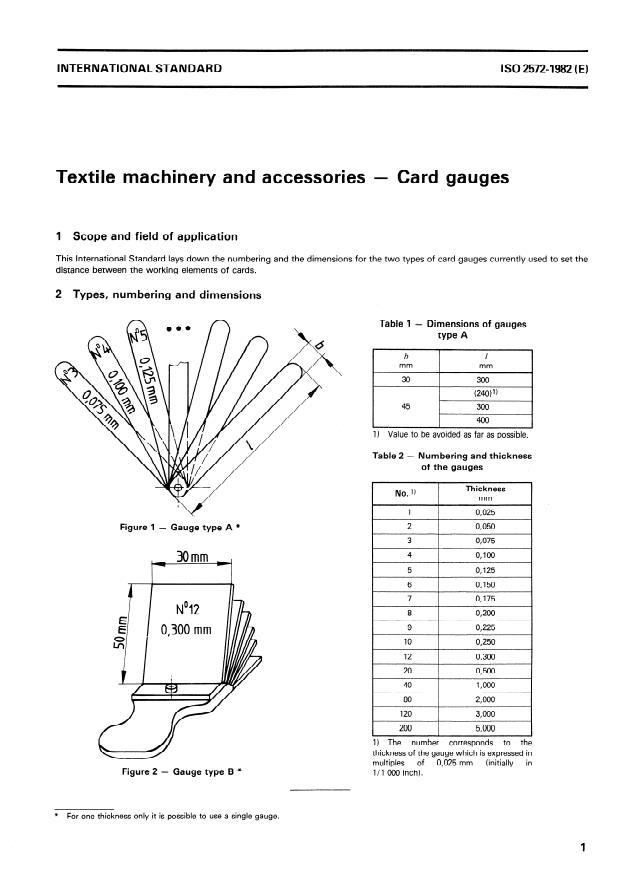
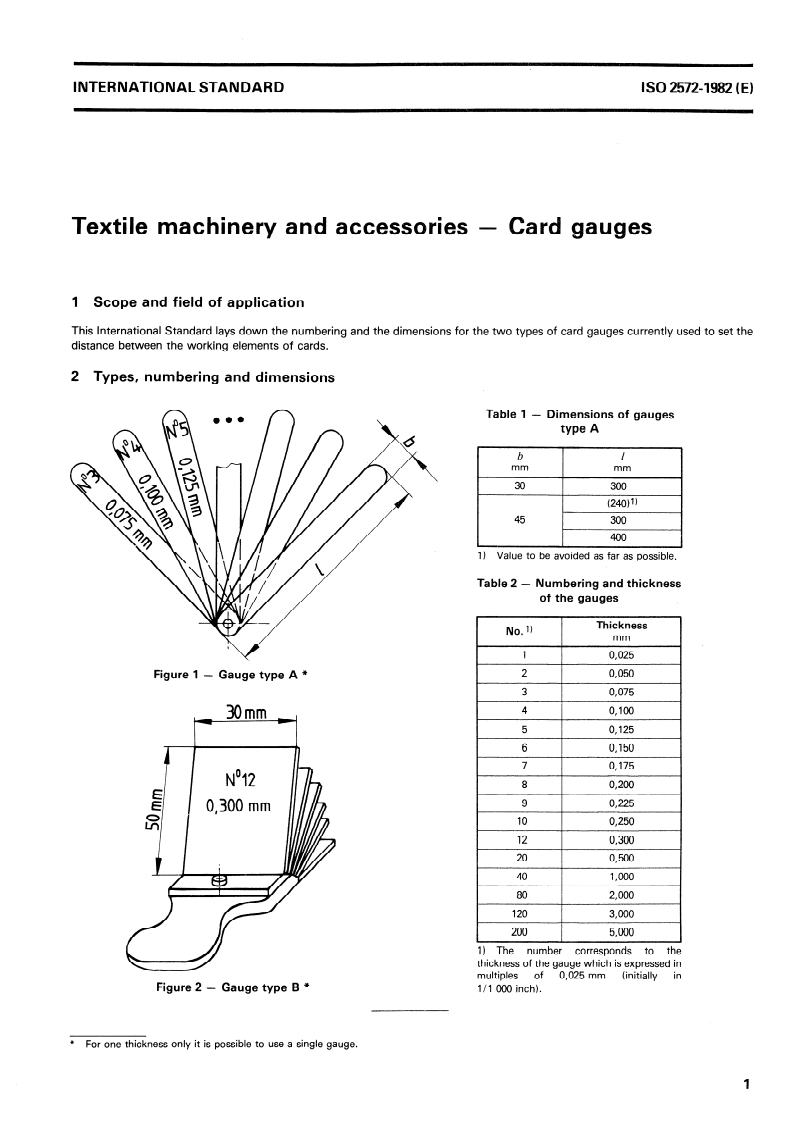
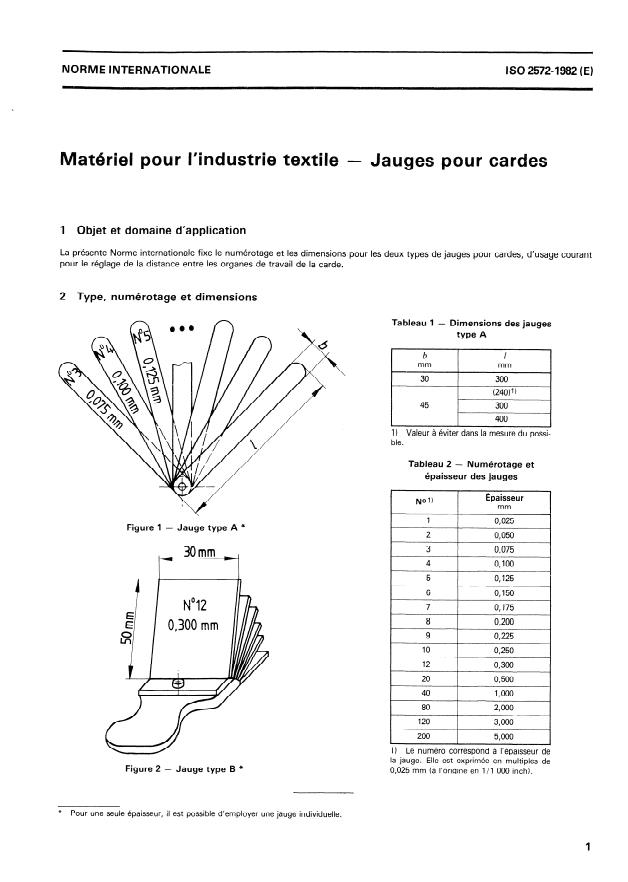
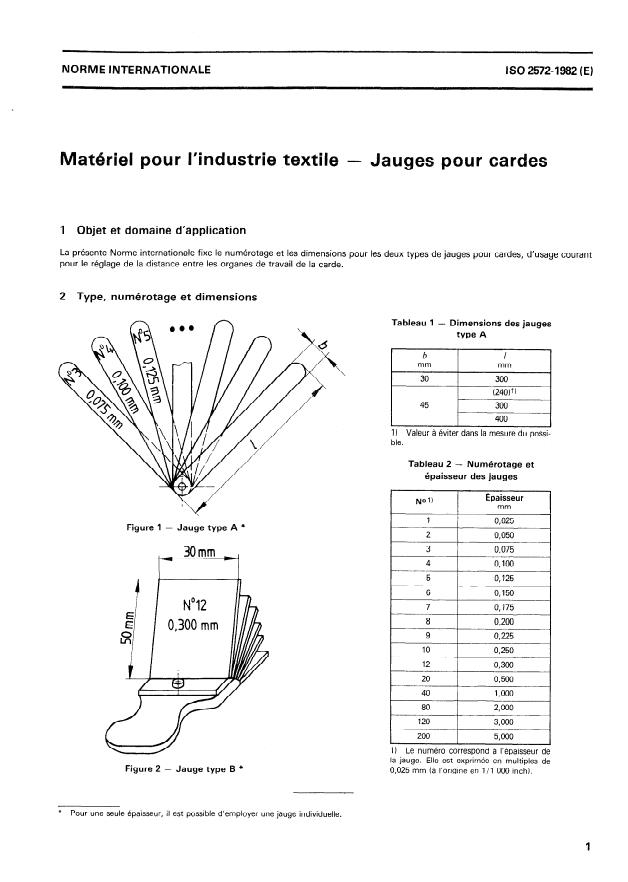
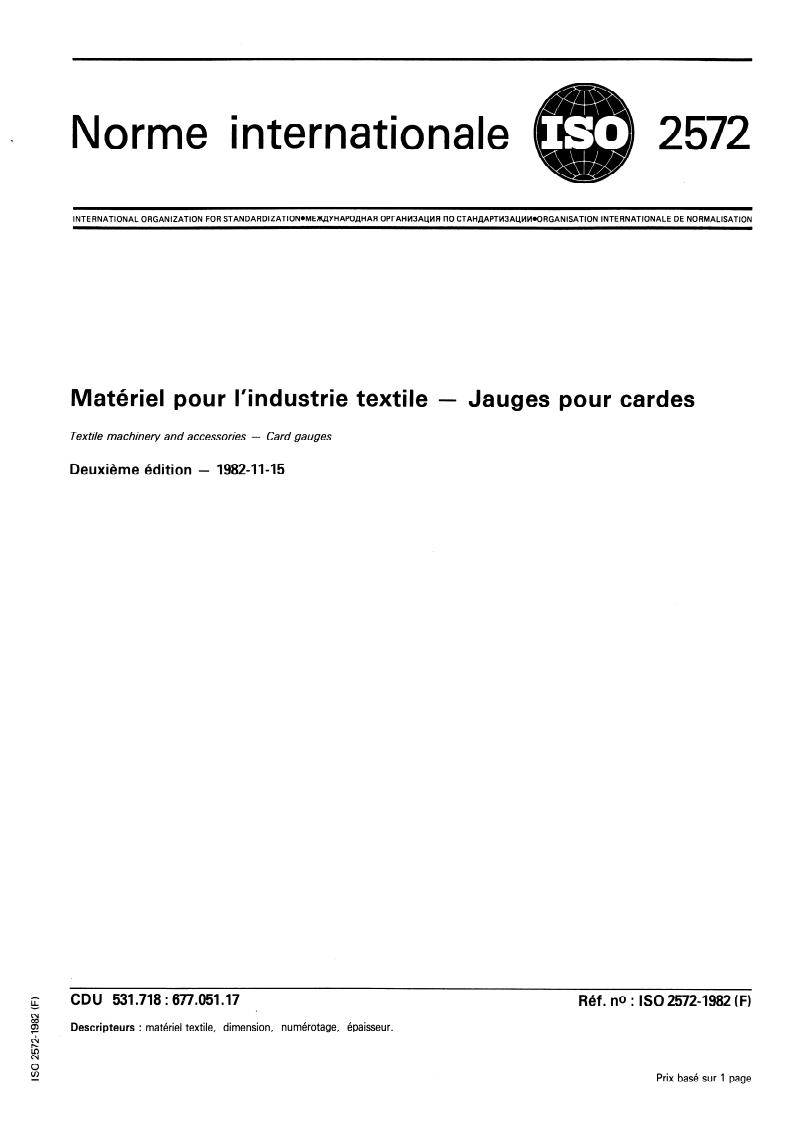
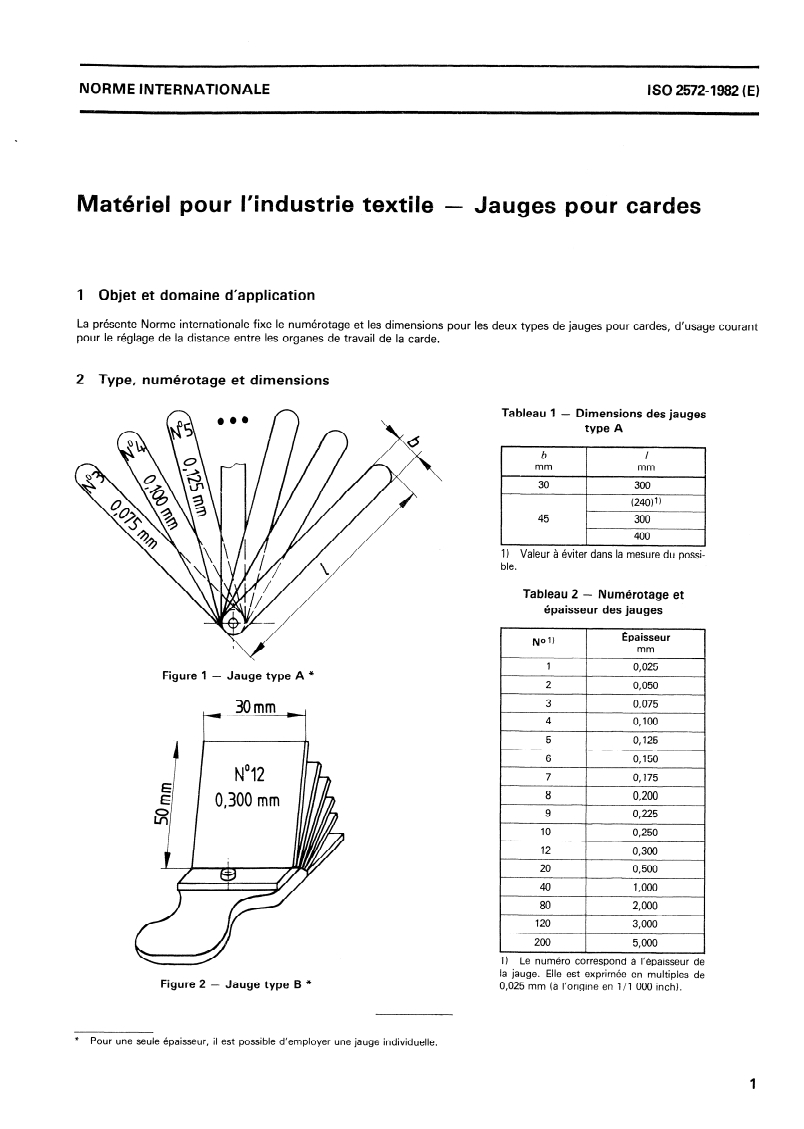
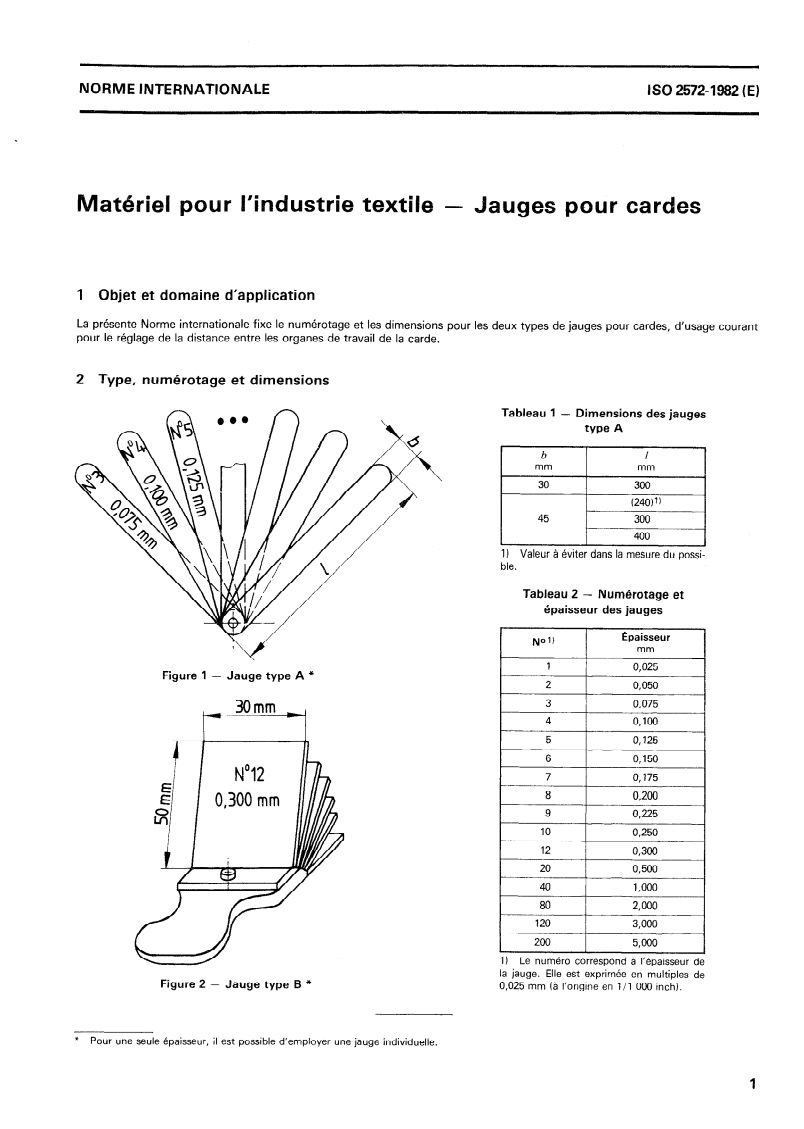
Specifies the numbering and the dimensions for the two types of card gauges currently used to set the distance between the working elements of cards. Dimensions of gauges, typ A are shown in table 1, numbering and thickness of the gauges are contained in table 2. - Replaces the first edition (ISO 2572-1974)
- Status
- Published
- Publication Date
- 31-Oct-1982
- Current Stage
- 9093 - International Standard confirmed
- Start Date
- 13-Dec-2023
- Completion Date
- 29-Aug-2026
Buy Documents

ISO 2572:1982 - Textile machinery and accessories -- Card gauges

ISO 2572:1982 - Textile machinery and accessories — Card gauges/1/1982

ISO 2572:1982 - Matériel pour l'industrie textile -- Jauges pour cardes

ISO 2572:1982 - Matériel pour l'industrie textile -- Jauges pour cardes
ISO 2572:1982 - Matériel pour l'industrie textile — Jauges pour cardes/1/1982
ISO 2572:1982 - Matériel pour l'industrie textile — Jauges pour cardes/1/1982
Overview
ISO 2572:1982 is an international standard developed by the International Organization for Standardization (ISO) that specifies the numbering and dimensions of card gauges used in textile machinery. These gauges are essential accessories for setting the distance between the working elements of carding machines. The standard covers two types of card gauges and defines precise measurements to ensure uniformity and accuracy in the textile industry.
This second edition of ISO 2572, published in 1982, replaces the original 1974 edition. It serves as a key reference for manufacturers, engineers, and quality control professionals involved in the production and maintenance of carding equipment, promoting consistent measurement practices worldwide.
Key Topics
- Card Gauges Types: The standard distinguishes between two main types of card gauges, each with specified physical dimensions critical for accurate adjustment of carding machines.
- Numbering System: ISO 2572 defines a clear numbering protocol for gauges based on their thickness, facilitating easy identification and selection during machine setup.
- Thickness Measurement: Gauge thicknesses are expressed in multiples of 0.025 mm, a system originally derived from imperial units but now standardized in metric, enabling precise control over the spacing between carding machine components.
- Dimensions: Detailed dimensional data for Type A gauges are given, including length and width parameters to ensure compatibility and interchangeability for standard carding machinery.
Applications
ISO 2572:1982 is primarily applied in the textile manufacturing industry where carding machines-used for cleaning, aligning, and preparing fibers-require precise spacing adjustment between their working elements. Accurate use of standardized card gauges helps in:
- Machine Setup: Ensuring the carding machine is set correctly for optimal fiber processing efficiency.
- Quality Control: Maintaining consistent production quality by standardizing the space between carding elements across different machines and sites.
- Maintenance: Facilitating easy replacement and adjustment of card gauges, reducing downtime and improving machine reliability.
- Interoperability: Allowing manufacturers of textile machinery and accessories to produce compatible parts that conform to international standards.
By following ISO 2572, textile equipment producers and operators achieve better process control and product uniformity, minimizing variations that can affect fabric quality.
Related Standards
For professionals working with textile machinery and accessories, other relevant ISO standards may include:
- ISO 139: Textile machinery - Terminology - establishing common terms for machinery components and operations.
- ISO 195: Textile machinery - Methods for measuring elongation of textile yarns - relevant for complementary quality assessments.
- ISO 160: Textile fibre specifications - helps in understanding the raw material characteristics affected by carding processes.
- ISO 837: Textile machinery - Wire clothing for cards - focusing on another key carding machine component related to quality and performance.
These related standards, alongside ISO 2572, offer a comprehensive framework to standardize equipment, processes, and quality assurance in textile production.
Keywords: ISO 2572, textile machinery, card gauges, carding machine accessories, gauge dimensions, gauge numbering, carding machine setup, textile industry standards, fiber processing, machine maintenance, quality control, international textile standards
Buy Documents
ISO 2572:1982 - Textile machinery and accessories -- Card gauges
ISO 2572:1982 - Textile machinery and accessories — Card gauges/1/1982
ISO 2572:1982 - Matériel pour l'industrie textile -- Jauges pour cardes
ISO 2572:1982 - Matériel pour l'industrie textile -- Jauges pour cardes
ISO 2572:1982 - Matériel pour l'industrie textile — Jauges pour cardes/1/1982
ISO 2572:1982 - Matériel pour l'industrie textile — Jauges pour cardes/1/1982
Get Certified
Connect with accredited certification bodies for this standard

Control Union Certifications
Global certification for agriculture and sustainability.

Hohenstein Institut
Textile testing and certification.

Bureau Veritas Bangladesh
Bureau Veritas certification services in Bangladesh.
Sponsored listings
Frequently Asked Questions
ISO 2572:1982 is a standard published by the International Organization for Standardization (ISO). Its full title is "Textile machinery and accessories — Card gauges". This standard covers: Specifies the numbering and the dimensions for the two types of card gauges currently used to set the distance between the working elements of cards. Dimensions of gauges, typ A are shown in table 1, numbering and thickness of the gauges are contained in table 2. - Replaces the first edition (ISO 2572-1974)
Specifies the numbering and the dimensions for the two types of card gauges currently used to set the distance between the working elements of cards. Dimensions of gauges, typ A are shown in table 1, numbering and thickness of the gauges are contained in table 2. - Replaces the first edition (ISO 2572-1974)
ISO 2572:1982 is classified under the following ICS (International Classification for Standards) categories: 59.120.10 - Spinning, twisting and texturing machines. The ICS classification helps identify the subject area and facilitates finding related standards.
ISO 2572:1982 is available in PDF format for immediate download after purchase. The document can be added to your cart and obtained through the secure checkout process. Digital delivery ensures instant access to the complete standard document.
Standards Content (Sample)
International Standard
INTERNATIONAL ORGANIZATION FOR STANDARDIZATIONWlE~YHAPO~HAfl OPrAHM3Al.&lR fl0 CTAH~APTbl3AL(MWORGANISATION INTERNATIONALE DE NORMALISATION
Textile machinery and accessories - Card gauges
Mat&iel pour l’hdustrie textile - Jauges pour cardes
Second edition - 1982-11-15
UDC 531.718 : 677.051.17 Ref. No. ISO 25724982 (E)
Descriptors : textile machinery, gauges, dimensions, numbering, thickness.
Price based on 1 page
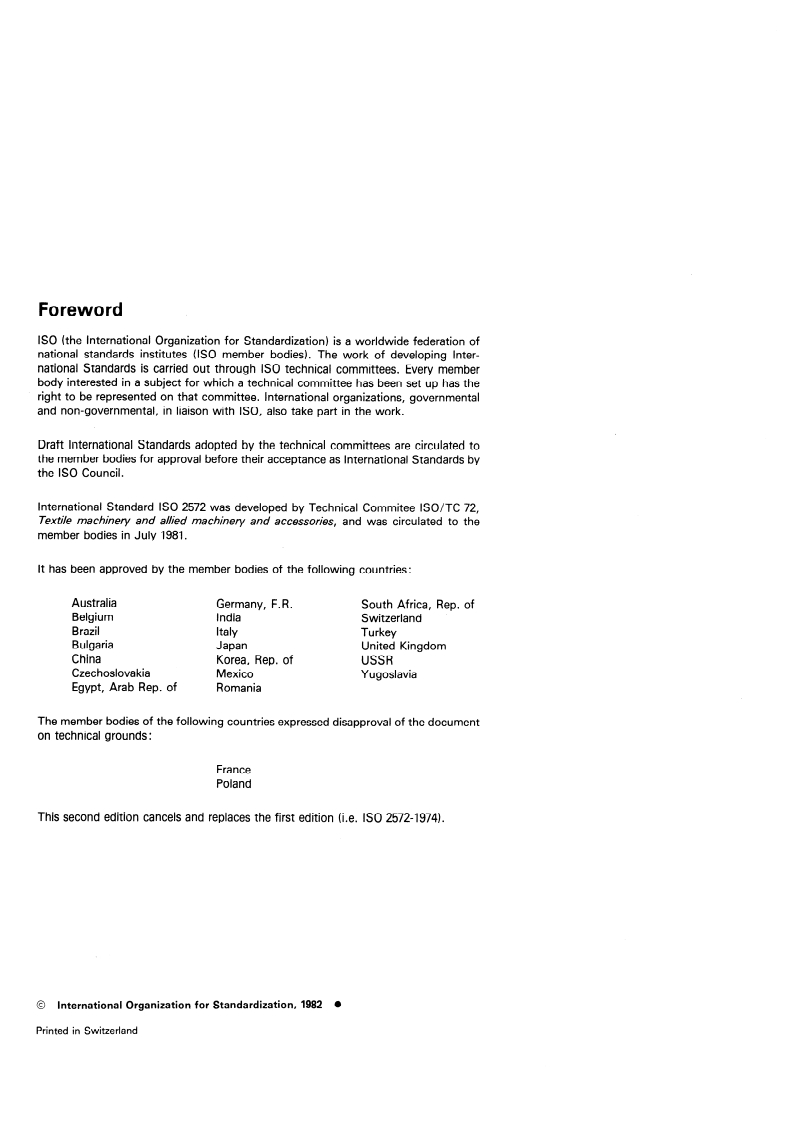
Foreword
ISO (the International Organization for Standardization) is a worldwide federation of
national Standards institutes (ISO member bodies). The work of developing Inter-
national Standards is carried out through ISO technical committees. Every member
body interested in a subject for which a technical committee has been set up has the
right to be represented on that committee. International organizations, governmental
and non-governmental, in liaison with ISO, also take part in the werk.
Draft International Standards adopted by the technical committees are circulated to
the member bodies for approval before their acceptance as International Standards by
the ISO Council.
International Standard ISO 2572 was developed by Technical Commitee ISO/TC 72,
Textile machinery and allied machinery and accessories, and was circulated to the
member bodies in July 1981.
lt has been approved by the member bodies of the following countries:
Australia
Germany, F. R. South Africa, Rep. of
Belgium
India Switzer
...
International Standard
INTERNATIONAL ORGANIZATION FOR STANDARDIZATIONWlE~YHAPO~HAfl OPrAHM3Al.&lR fl0 CTAH~APTbl3AL(MWORGANISATION INTERNATIONALE DE NORMALISATION
Textile machinery and accessories - Card gauges
Mat&iel pour l’hdustrie textile - Jauges pour cardes
Second edition - 1982-11-15
UDC 531.718 : 677.051.17 Ref. No. ISO 25724982 (E)
Descriptors : textile machinery, gauges, dimensions, numbering, thickness.
Price based on 1 page
Foreword
ISO (the International Organization for Standardization) is a worldwide federation of
national Standards institutes (ISO member bodies). The work of developing Inter-
national Standards is carried out through ISO technical committees. Every member
body interested in a subject for which a technical committee has been set up has the
right to be represented on that committee. International organizations, governmental
and non-governmental, in liaison with ISO, also take part in the werk.
Draft International Standards adopted by the technical committees are circulated to
the member bodies for approval before their acceptance as International Standards by
the ISO Council.
International Standard ISO 2572 was developed by Technical Commitee ISO/TC 72,
Textile machinery and allied machinery and accessories, and was circulated to the
member bodies in July 1981.
lt has been approved by the member bodies of the following countries:
Australia
Germany, F. R. South Africa, Rep. of
Belgium
India Switzer
...
Norme internationale
INTERNATIONAL ORGANIZATION FOR STANDARDIZATIONWEXW’HAPO~HAR OPrAHM3A~MR Il0 CTAH~APTbl3A~MM.ORGANISATION INTERNATIONALE DE NORMALISATION
Matériel pour l’industrie textile - Jauges pour cardes
Textile machinery and accessories - Gard gauges
Deuxième édition - 1982-11-15
CDU 531.718 : 677.051.17 Réf. no : ISO 25724982 (F)
r
Y
Descripteurs : matériel textile, dimension, numérotage, épaisseur.
m
Prix basé sur 1 page
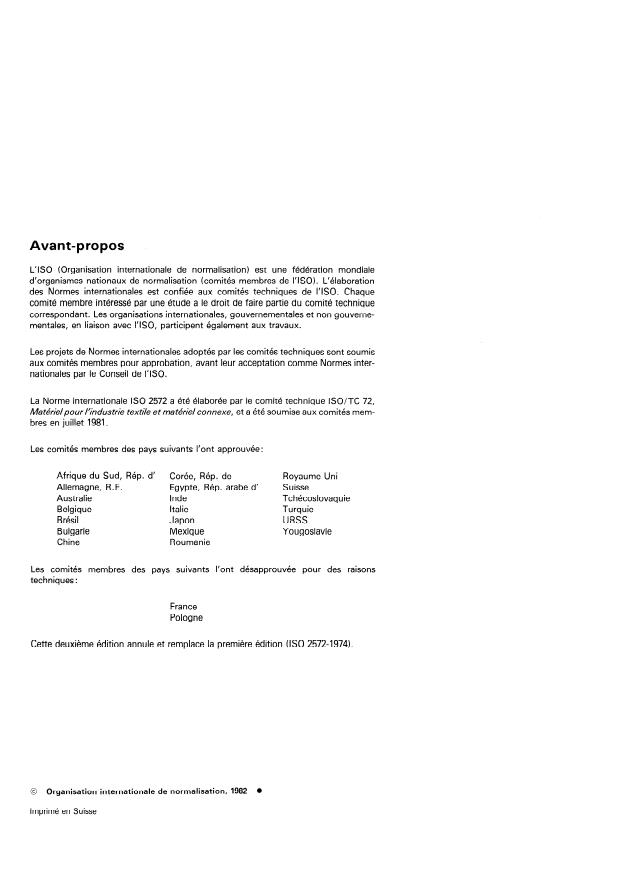
Avant-propos
L’ISO (Organisation internationale de normalisation) est une fédération mondiale
d’organismes nationaux de normalisation (comités membres de I’ISO). L’élaboration
des Normes internationales est confiée aux comités techniques de I’ISO. Chaque
comité membre intéressé par une étude a le droit de faire partie du comité technique
correspondant. Les organisations internationales, gouvernementales et non gouverne-
mentales, en liaison avec I’ISO, participent également aux travaux.
Les projets de Normes internationales adoptés par les comités techniques sont soumis
aux comités membres pour approbation, avant leur acceptation comme Normes inter-
nationales par le Conseil de I’ISO.
La Norme internationale ISO 2572 a été élaborée par le comité technique ISOITC 72,
Matérielpour l’industrie textile et matériel connexe, et a été soumise aux comités mem-
bres en juillet 1981.
Les comités membres des pays suivants l’ont approuvée:
Afrique du Sud, Rép. d’
Corée, Rép. de Royaume-Uni
Allemagne, R. F. Egypte, Rép. arabe d’
Suisse
Aus
...
Norme internationale
INTERNATIONAL ORGANIZATION FOR STANDARDIZATIONWEXW’HAPO~HAR OPrAHM3A~MR Il0 CTAH~APTbl3A~MM.ORGANISATION INTERNATIONALE DE NORMALISATION
Matériel pour l’industrie textile - Jauges pour cardes
Textile machinery and accessories - Gard gauges
Deuxième édition - 1982-11-15
CDU 531.718 : 677.051.17 Réf. no : ISO 25724982 (F)
r
Y
Descripteurs : matériel textile, dimension, numérotage, épaisseur.
m
Prix basé sur 1 page
Avant-propos
L’ISO (Organisation internationale de normalisation) est une fédération mondiale
d’organismes nationaux de normalisation (comités membres de I’ISO). L’élaboration
des Normes internationales est confiée aux comités techniques de I’ISO. Chaque
comité membre intéressé par une étude a le droit de faire partie du comité technique
correspondant. Les organisations internationales, gouvernementales et non gouverne-
mentales, en liaison avec I’ISO, participent également aux travaux.
Les projets de Normes internationales adoptés par les comités techniques sont soumis
aux comités membres pour approbation, avant leur acceptation comme Normes inter-
nationales par le Conseil de I’ISO.
La Norme internationale ISO 2572 a été élaborée par le comité technique ISOITC 72,
Matérielpour l’industrie textile et matériel connexe, et a été soumise aux comités mem-
bres en juillet 1981.
Les comités membres des pays suivants l’ont approuvée:
Afrique du Sud, Rép. d’
Corée, Rép. de Royaume-Uni
Allemagne, R. F. Egypte, Rép. arabe d’
Suisse
Aus
...
Norme internationale
INTERNATIONAL ORGANIZATION FOR STANDARDIZATIONWEXW’HAPO~HAR OPrAHM3A~MR Il0 CTAH~APTbl3A~MM.ORGANISATION INTERNATIONALE DE NORMALISATION
Matériel pour l’industrie textile - Jauges pour cardes
Textile machinery and accessories - Gard gauges
Deuxième édition - 1982-11-15
CDU 531.718 : 677.051.17 Réf. no : ISO 25724982 (F)
r
Y
Descripteurs : matériel textile, dimension, numérotage, épaisseur.
m
Prix basé sur 1 page
Avant-propos
L’ISO (Organisation internationale de normalisation) est une fédération mondiale
d’organismes nationaux de normalisation (comités membres de I’ISO). L’élaboration
des Normes internationales est confiée aux comités techniques de I’ISO. Chaque
comité membre intéressé par une étude a le droit de faire partie du comité technique
correspondant. Les organisations internationales, gouvernementales et non gouverne-
mentales, en liaison avec I’ISO, participent également aux travaux.
Les projets de Normes internationales adoptés par les comités techniques sont soumis
aux comités membres pour approbation, avant leur acceptation comme Normes inter-
nationales par le Conseil de I’ISO.
La Norme internationale ISO 2572 a été élaborée par le comité technique ISOITC 72,
Matérielpour l’industrie textile et matériel connexe, et a été soumise aux comités mem-
bres en juillet 1981.
Les comités membres des pays suivants l’ont approuvée:
Afrique du Sud, Rép. d’
Corée, Rép. de Royaume-Uni
Allemagne, R. F. Egypte, Rép. arabe d’
Suisse
Aus
...
Norme internationale
INTERNATIONAL ORGANIZATION FOR STANDARDIZATIONWEXW’HAPO~HAR OPrAHM3A~MR Il0 CTAH~APTbl3A~MM.ORGANISATION INTERNATIONALE DE NORMALISATION
Matériel pour l’industrie textile - Jauges pour cardes
Textile machinery and accessories - Gard gauges
Deuxième édition - 1982-11-15
CDU 531.718 : 677.051.17 Réf. no : ISO 25724982 (F)
r
Y
Descripteurs : matériel textile, dimension, numérotage, épaisseur.
m
Prix basé sur 1 page
Avant-propos
L’ISO (Organisation internationale de normalisation) est une fédération mondiale
d’organismes nationaux de normalisation (comités membres de I’ISO). L’élaboration
des Normes internationales est confiée aux comités techniques de I’ISO. Chaque
comité membre intéressé par une étude a le droit de faire partie du comité technique
correspondant. Les organisations internationales, gouvernementales et non gouverne-
mentales, en liaison avec I’ISO, participent également aux travaux.
Les projets de Normes internationales adoptés par les comités techniques sont soumis
aux comités membres pour approbation, avant leur acceptation comme Normes inter-
nationales par le Conseil de I’ISO.
La Norme internationale ISO 2572 a été élaborée par le comité technique ISOITC 72,
Matérielpour l’industrie textile et matériel connexe, et a été soumise aux comités mem-
bres en juillet 1981.
Les comités membres des pays suivants l’ont approuvée:
Afrique du Sud, Rép. d’
Corée, Rép. de Royaume-Uni
Allemagne, R. F. Egypte, Rép. arabe d’
Suisse
Aus
...