

ISO 93-1:2006/Amd 1:2015
(Amendment)Textile machinery and accessories — Cylindrical sliver cans — Part 1: Main dimensions — Amendment 1
General Information
- Abstract
- Status
- Published
- Publication Date
- 04-Feb-2015
- Current Stage
- 6060 - International Standard published
- Start Date
- 05-Feb-2015
- Due Date
- 17-Jun-2016
- Completion Date
- 17-Jun-2016

Overview
ISO 93-1:2006/Amd 1:2015 is an important amendment to the international standard for textile machinery and accessories, specifically focusing on cylindrical sliver cans. This part addresses the main dimensions of sliver cans, incorporating updated specifications to ensure improved compatibility and uniformity within the textile industry. By standardizing sliver can dimensions and tolerances (both with and without castors), the amendment supports efficiency, safety, and interchangeability across manufacturing processes and international markets.
Key Topics
- Standardization of Main Dimensions: This amendment clearly defines acceptable ranges for the main measurements of cylindrical sliver cans, ensuring uniformity and compatibility across machine components.
- Increments for Larger Sizes:
- For cans without castors: Inside diameters above 700 mm and heights above 1200 mm must follow specific incremental steps.
- For cans with castors: Inside diameters above 1,000 mm must increase in set increments; the same applies to heights above 1,200 mm.
- Comprehensive Dimension Tables: Revised tables provide detailed guidance on diameter and height combinations, as well as corresponding tolerances, facilitating clear communication between textile machinery manufacturers and suppliers.
- Metric Units: All dimensions are provided in millimetres, supporting global harmonization and integration into both new and existing textile systems.
Applications
The specifications set out in ISO 93-1:2006/Amd 1:2015 are vital in a range of practical scenarios within the textile industry:
- Manufacturing and Sourcing: Textile machinery manufacturers, sliver can producers, and sourcing specialists rely on these dimension standards to ensure consistent quality and compatibility, reducing the likelihood of production delays or operational issues.
- Process Efficiency: Standardized sizes facilitate the smooth movement of sliver cans between different machinery and production lines, promoting automation and operational efficiency in spinning, twisting, and winding operations.
- Global Trade: With harmonized specifications, international buyers and suppliers can transact confidently, knowing that products meet widely recognized dimension standards.
- Safety and Maintenance: Adherence to standardized dimensions helps prevent operational hazards related to mismatched parts and contributes to easier maintenance and equipment replacement.
Related Standards
For organizations seeking a comprehensive approach to textile machinery standardization, the following related ISO standards may provide additional guidance and technical value:
- ISO 93-1:2006: The parent document which covers the main body of requirements for cylindrical sliver cans.
- ISO/TC 72 Series: Family of standards covering spinning preparatory machinery, spinning, twisting, winding equipment, and their accessories.
- ISO 9001: While not specific to textile machinery, this standard for quality management systems helps ensure consistent application of product and process standards across an organization.
- ISO 18652: Focuses on textile machinery safety requirements.
Conclusion
ISO 93-1:2006/Amd 1:2015 offers essential guidance for anyone involved in the design, production, or use of cylindrical sliver cans in the textile sector. Its clearly defined dimension standards support safer, more efficient, and globally compatible textile manufacturing environments. Adhering to this standard not only facilitates smoother operations but also fosters international collaboration and trade within the textile machinery supply chain.
Relations
- Effective Date
- 06-Jun-2022
- Effective Date
- 13-Oct-2020
Get Certified
Connect with accredited certification bodies for this standard

Control Union Certifications
Global certification for agriculture and sustainability.

Hohenstein Institut
Textile testing and certification.

Bureau Veritas Bangladesh
Bureau Veritas certification services in Bangladesh.
Sponsored listings
Frequently Asked Questions
ISO 93-1:2006/Amd 1:2015 is a standard published by the International Organization for Standardization (ISO). Its full title is "Textile machinery and accessories — Cylindrical sliver cans — Part 1: Main dimensions — Amendment 1". This standard covers: Textile machinery and accessories — Cylindrical sliver cans — Part 1: Main dimensions — Amendment 1
Textile machinery and accessories — Cylindrical sliver cans — Part 1: Main dimensions — Amendment 1
ISO 93-1:2006/Amd 1:2015 is classified under the following ICS (International Classification for Standards) categories: 59.120.10 - Spinning, twisting and texturing machines. The ICS classification helps identify the subject area and facilitates finding related standards.
ISO 93-1:2006/Amd 1:2015 has the following relationships with other standards: It is inter standard links to ISO 11348-3:2007/Amd 1:2018, ISO 93-1:2006. Understanding these relationships helps ensure you are using the most current and applicable version of the standard.
ISO 93-1:2006/Amd 1:2015 is available in PDF format for immediate download after purchase. The document can be added to your cart and obtained through the secure checkout process. Digital delivery ensures instant access to the complete standard document.
Standards Content (Sample)
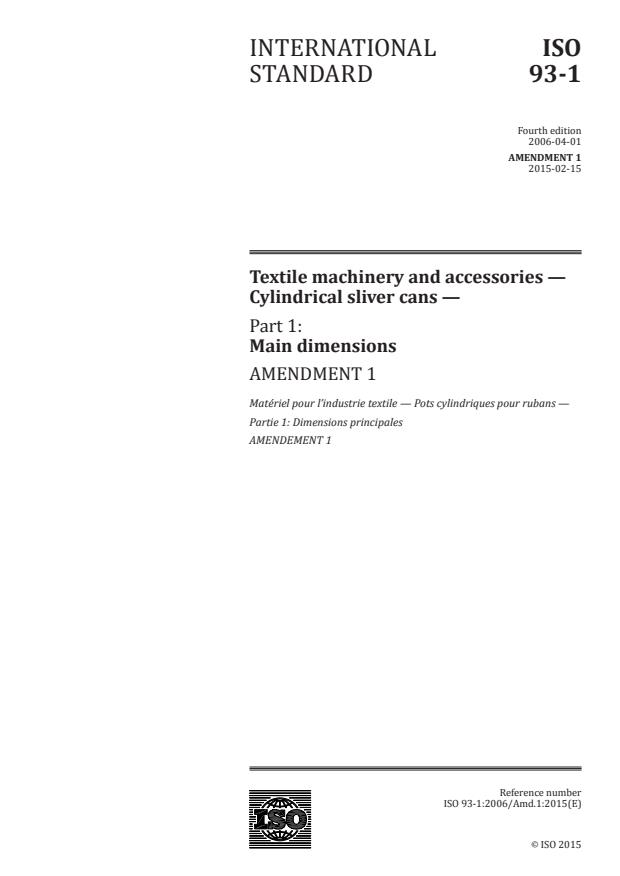
INTERNATIONAL ISO
STANDARD 93-1
Fourth edition
2006-04-01
AMENDMENT 1
2015-02-15
Textile machinery and accessories —
Cylindrical sliver cans —
Part 1:
Main dimensions
AMENDMENT 1
Matériel pour l’industrie textile — Pots cylindriques pour rubans —
Partie 1: Dimensions principales
AMENDEMENT 1
Reference number
ISO 93-1:2006/Amd.1:2015(E)
©
ISO 2015
ISO 93-1:2006/Amd.1:2015(E)
© ISO 2015
All rights reserved. Unless otherwise specified, no part of this publication may be reproduced or utilized otherwise in any form
or by any means, electronic or mechanical, including photocopying, or posting on the internet or an intranet, without prior
written permission. Permission can be requested from either ISO at the address below or ISO’s member body in the country of
the requester.
ISO copyright office
Case postale 56 • CH-1211 Geneva 20
Tel. + 41 22 749 01 11
Fax + 41 22 749 09 47
E-mail copyright@iso.org
Web www.iso.org
Published in Switzerland
ii © ISO 2015 – All rights reserved
ISO 93-1:2006/Amd.1:2015(E)
Foreword
ISO (the International Organization for Standardization) is a worldwide federation of national standards
bodies (ISO member bodies). The work of preparing International Standards is normally carried out
through ISO technical committees. Each member body interested in a subject for which a technical
committee has been established has the right to be represented on that committee. International
organizations, governmental and non-governmental, in liaison with ISO, also take part in the work.
ISO collaborates closely with the International Electrotechnical Commission (IEC) on all matters of
electrotechnical standardization.
The procedures used to develop this document and those intended for its further maintenance are
described in the ISO/IEC Directives, Part 1. In particular the different approval criteria needed for the
different types of ISO documents should be noted. This document was drafted in accordance with the
editorial rules of the ISO/IEC Directives, Part 2 (see www.iso.org/directives).
Attention is drawn to the possibility that some of the elements of this document may be the subject of
patent rights. ISO shall not be held responsible for identifying any or all such patent rights. Details of any
patent rights identified during the development of the document will be in the Introduction and/or on
the ISO list of patent declarations received (see www.iso.org/patents).
Any trade name used in this document is information given for the convenience of users and does not
constitute an endor
...