

ISO/TS 37008:2023
(Main)Internal investigations of organizations — Guidance
General Information
- Abstract
This document gives guidance on internal investigations within organizations, including: — the principles; — support for investigations; — establishment of the policy, procedures, processes and standards for carrying out and reporting on an investigation; — the reporting of investigation results; — the application of remedial measures. This document is applicable to all organizations regardless of type, size, location, structure or purpose. NOTE See Annex A for guidance on the use of this document.
- Status
- Published
- Publication Date
- 27-Jul-2023
- Technical Committee
- ISO/TC 309 - Governance of organizations
- Drafting Committee
- ISO/TC 309 - Governance of organizations
- Current Stage
- 9093 - International Standard confirmed
- Start Date
- 25-Aug-2026
- Completion Date
- 29-Aug-2026
Buy Documents


ISO/TS 37008:2023 - Internal investigations of organizations — Guidance Released:28. 07. 2023


ISO/TS 37008:2023 - Internal investigations of organizations — Guidance/15/2024
Overview
ISO/TS 37008:2023, "Internal investigations of organizations - Guidance", provides practical guidance for planning, conducting and reporting internal investigations. Applicable to all organizations regardless of type, size, location or purpose, the technical specification frames internal investigations as a professional fact‑finding process to address alleged or suspected wrongdoing, misconduct or non‑compliance (e.g., bribery, fraud, harassment). The document emphasizes five core principles: independent, confidential, competent and professional, objective and impartial, and legal and lawful.
Key topics
The standard covers the full investigative lifecycle and associated controls, including:
- Governance and support
- Establishment of investigation policy, procedures and standards
- Leadership commitment, resources and reporting lines
- Principles and protections
- Confidential investigations, anti‑retaliation and safeguarding of people involved
- Preservation and secure handling of evidence
- Investigative process (detailed)
- Formation and appointment of an investigation team and reporting line
- Preliminary assessment, scoping and planning of investigations
- Document and electronic data collection, preservation and analysis
- Interview preparation, conduct and record‑keeping
- Finalization and preparation of an investigation report
- Remedial measures and follow‑up
- Proposal, interim and final remedial measures, proportionality, monitoring and enforcement
- Stakeholder interaction and communication
- Internal/external communication, regulatory engagement and guidance on self‑disclosure
- Related operational elements
- Liability cautions, evidence safeguarding, disciplinary actions and Annex A guidance on use
These topics align with the standard’s role in strengthening compliance, ethics and risk‑management frameworks.
Applications and users
ISO/TS 37008:2023 is practical for organizations that need consistent, legally sound processes for internal probes. Typical users include:
- Compliance officers and compliance management systems
- Legal and HR teams conducting misconduct or disciplinary investigations
- Internal audit, risk and governance functions
- Security and data teams handling digital evidence preservation
- Small and medium enterprises up to multinational corporations preparing or improving investigation policies
Common applications:
- Designing or updating an internal investigation policy and SOPs
- Preserving electronic evidence and conducting lawful interviews
- Assessing root causes, recommending remedial actions and monitoring corrective measures
- Coordinating self‑disclosure to regulators and protecting whistleblowers
Related standards
- ISO 37001 - Anti‑bribery management systems
- ISO 37002 - Whistleblowing management systems
- ISO 37301 - Compliance management systems
ISO/TS 37008:2023 complements these standards by providing focused guidance on the conduct, reporting and remediation of internal investigations to support robust compliance and governance.
Buy Documents
ISO/TS 37008:2023 - Internal investigations of organizations — Guidance Released:28. 07. 2023
ISO/TS 37008:2023 - Internal investigations of organizations — Guidance/15/2024
Get Certified
Connect with accredited certification bodies for this standard

BSI Group
BSI (British Standards Institution) is the business standards company that helps organizations make excellence a habit.

Bureau Veritas
Bureau Veritas is a world leader in laboratory testing, inspection and certification services.

DNV
DNV is an independent assurance and risk management provider.
Sponsored listings
Frequently Asked Questions
ISO/TS 37008:2023 is a technical specification published by the International Organization for Standardization (ISO). Its full title is "Internal investigations of organizations — Guidance". This standard covers: This document gives guidance on internal investigations within organizations, including: — the principles; — support for investigations; — establishment of the policy, procedures, processes and standards for carrying out and reporting on an investigation; — the reporting of investigation results; — the application of remedial measures. This document is applicable to all organizations regardless of type, size, location, structure or purpose. NOTE See Annex A for guidance on the use of this document.
This document gives guidance on internal investigations within organizations, including: — the principles; — support for investigations; — establishment of the policy, procedures, processes and standards for carrying out and reporting on an investigation; — the reporting of investigation results; — the application of remedial measures. This document is applicable to all organizations regardless of type, size, location, structure or purpose. NOTE See Annex A for guidance on the use of this document.
ISO/TS 37008:2023 is classified under the following ICS (International Classification for Standards) categories: 03.100.02 - Governance and ethics. The ICS classification helps identify the subject area and facilitates finding related standards.
ISO/TS 37008:2023 is available in PDF format for immediate download after purchase. The document can be added to your cart and obtained through the secure checkout process. Digital delivery ensures instant access to the complete standard document.
Standards Content (Sample)
TECHNICAL ISO/TS
SPECIFICATION 37008
First edition
2023-07
Internal investigations of
organizations — Guidance
Enquêtes internes des organisations — Recommandations
Reference number
© ISO 2023
All rights reserved. Unless otherwise specified, or required in the context of its implementation, no part of this publication may
be reproduced or utilized otherwise in any form or by any means, electronic or mechanical, including photocopying, or posting on
the internet or an intranet, without prior written permission. Permission can be requested from either ISO at the address below
or ISO’s member body in the country of the requester.
ISO copyright office
CP 401 • Ch. de Blandonnet 8
CH-1214 Vernier, Geneva
Phone: +41 22 749 01 11
Email: copyright@iso.org
Website: www.iso.org
Published in Switzerland
ii
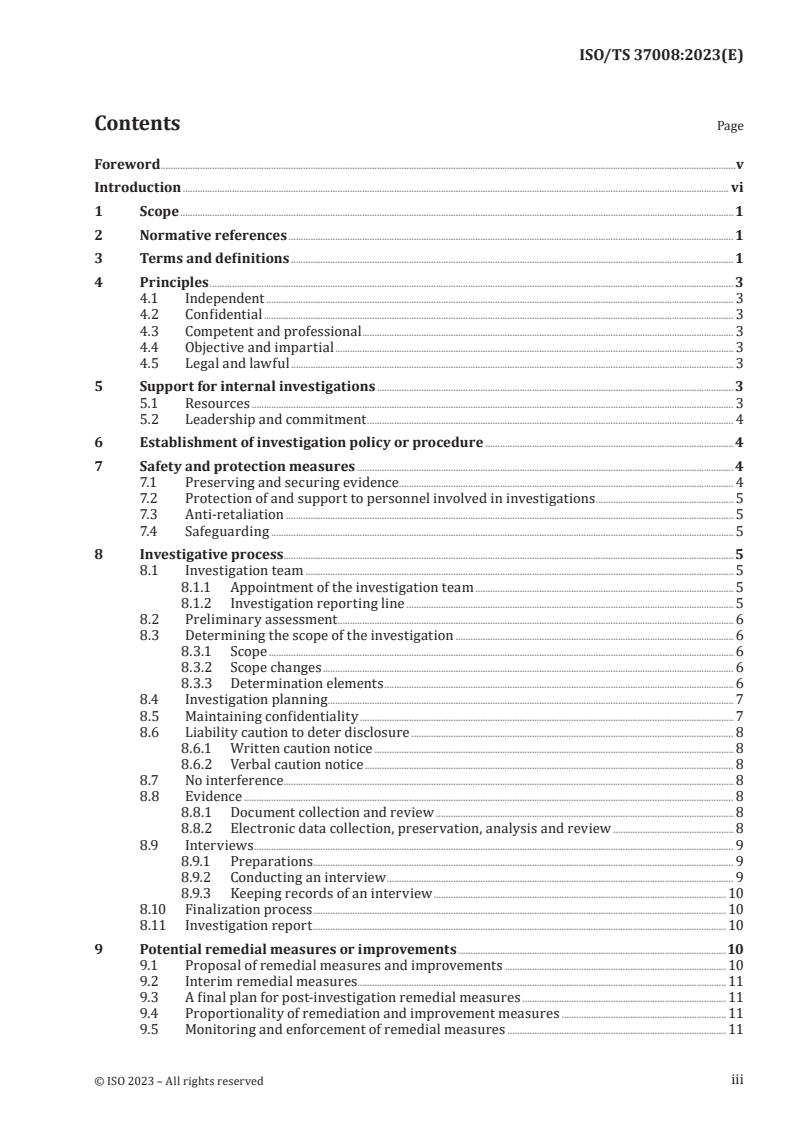
Contents Page
Foreword .v
Introduction . vi
1 Scope . 1
2 Normative references . 1
3 Terms and definitions . 1
4 Principles . 3
4.1 Independent . 3
4.2 Confidential . 3
4.3 Competent and professional . 3
4.4 Objective and impartial . 3
4.5 Legal and lawful . 3
5 Support for internal investigations . 3
5.1 Resources . 3
5.2 Leadership and commitment . 4
6 Establishment of investigation policy or procedure . 4
7 Safety and protection measures . 4
7.1 Preserving and securing evidence . 4
7.2 Protection of and support to personnel involved in investigations . 5
7.3 Anti-retaliation . 5
7.4 Safeguarding . 5
8 Investigative process.5
8.1 Investigation team . 5
8.1.1 Appointment of the investigation team . 5
8.1.2 Investigation reporting line . 5
8.2 Preliminary assessment . 6
8.3 Determining the scope of the investigation . 6
8.3.1 Scope . 6
8.3.2 Scope changes . 6
8.3.3 Determination elements . 6
8.4 Investigation planning . 7
8.5 Maintaining confidentiality . 7
8.6 Liability caution to deter disclosure . 8
8.6.1 Written caution notice . 8
8.6.2 Verbal caution notice . 8
8.7 No interference . . 8
8.8 Evidence . 8
8.8.1 Document collection and review . 8
8.8.2 Electronic data collection, preservation, analysis and review . 8
8.9 Interviews . 9
8.9.1 Preparations . 9
8.9.2 Conducting an interview . 9
8.9.3 Keeping records of an interview . 10
8.10 Finalization process . 10
8.11 Investigation report . 10
9 Potential remedial measures or improvements .10
9.1 Proposal of remedial measures and improvements . 10
9.2 Interim remedial measures. 11
9.3 A final plan for post-investigation remedial measures . 11
9.4 Proportionality of remediation and improvement measures . 11
9.5 Monitoring and enforcement of remedial measures . 11
iii
10 Interaction with stakeholders .11
10.1 General . 11
10.2 Planning . 11
10.3 Measures for the communication process .12
10.4 Effective communication channels .12
10.5 Government and regulator communication .12
10.6 Self-disclosure to the authorities .12
11 Disciplinary actions .12
Annex A (informative) Guidance on the use of this document .13
Bibliography .24
iv
Foreword
ISO (the International Organization for Standardization) is a worldwide federation of national standards
bodies (ISO member bodies). The work of preparing International Standards is normally carried out
through ISO technical committees. Each member body interested in a subject for which a technical
committee has been established has the right to be represented on that committee. International
organizations, governmental and non-governmental, in liaison with ISO, also take part in the work.
ISO collaborates closely with the International Electrotechnical Commission (IEC) on all matters of
electrotechnical standardization.
The procedures used to develop this document and those intended for its further maintenance are
described in the ISO/IEC Directives, Part 1. In particular, the different approval criteria needed for the
different types of ISO documents should be noted. This document was drafted in accordance with the
editorial rules of the ISO/IEC Directives, Part 2 (see www.iso.org/directives).
Attention is drawn to the possibility that some of the elements of this document may be the subject of
patent rights. ISO shall not be held responsible for identifying any or all such patent rights. Details of
any patent rights identified during the development of the document will be in the Introduction and/or
on the ISO list of patent declarations received (see www.iso.org/patents).
Any trade name used in this document is information given for the convenience of users and does not
constitute an endorsement.
For an explanation of the voluntary nature of standards, the meaning of ISO specific terms and
expressions related to conformity assessment, as well as information about ISO’s adherence to
the World Trade Organization (WTO) principles in the Technical Barriers to Trade (TBT), see
www.iso.org/iso/foreword.html.
This document was prepared by Technical Committee ISO/TC 309, Governance of organizations.
Any feedback or questions on this document should be directed to the user’s national standards body. A
complete listing of these bodies can be found at www.iso.org/members.html.
v
Introduction
Internal investigation is an integral part of organizational management. Internal investigation is a
professional fact-finding process, initiated by or for an organization, to establish facts in relation to
alleged or suspected wrongdoing, misconduct or noncompliance (such as bribery, fraudulent activities,
harassment, violence or discrimination). Internal investigations enable an organization to:
— make informed decisions if laws, regulations, industry codes, internal policies, procedures,
processes, corporate compliance policy and/or the organization’s values and ethics have been
breached;
— understand the cause(s) that lead to the above-mentioned breaches;
— determine if an allegation or concern is substantiated or unsubstantiated;
— assess the financial loss of an organization;
— mitigate liability of the organization and/or its management;
— put in place and implement the necessary mitigation measures to prevent similar conduct from
occurring;
— strengthen the organization’s compliance and ethics culture;
— make external reporting to relevant authorities (law enforcement, judicial bodies, regulators or
other bodies prescribed by law or regulation) or relevant interested parties when necessary;
— make decisions on sanctions of management and/or employees and debarment of working with
third parties involved in unethical conduct.
Civil actions, whistleblower reports and external investigations by regulators can be reasons for
internal investigation as well so that the concerned organizations can find out what triggered the
actions, reports and external investigations, then take appropriate measures.
Internal investigation is part of a compliance management system. This document can be used to help
with the implementation of other standards such as ISO 37301, ISO 37001 and ISO 37002. It can also
be a useful tool for an organization to identify risks. With risk clearly identified, an organization can
analyse the root causes of noncompliance and design measures to control the risks.
Not having the capabilities to conduct internal investigations and/or failing to conduct internal
investigations can have adverse effects on an organization such as compromising the effectiveness of
the compliance management system, failing to protect its reputation, and failing to detect and counter
wrongdoing.
This document provides guidance for organizations to implement internal investigations based on the
following principles: independent, confidential, competent and professional, objective and impartial,
and legal and lawful.
Figure 1 is a conceptual overview of the investigative process showing the whole picture of internal
investigation and the possible post-investigation actions.
vi
Figure 1 — Overview of the investigative process
vii
TECHNICAL SPECIFICATION ISO/TS 37008:2023(E)
Internal investigations of organizations — Guidance
1 Scope
This document gives guidance on internal investigations within organizations, including:
— the principles;
— support for investigations;
— establishment of the policy, procedures, processes and standards for carrying out and reporting on
an investigation;
— the reporting of investigation results;
— the application of remedial measures.
This document is applicable to all organizations regardless of type, size, location, structure or purpose.
NOTE See Annex A for guidance on the use of this document.
2 Normative references
The following documents are referred to in the text in such a way that some or all of their content
constitutes requirements of this document. For dated references, only the edition cited applies. For
undated references, the latest edition of the referenced document (including any amendments) applies.
ISO 37001, Anti-bribery management systems — Requirements with guidance for use
ISO 37002, Whistleblowing management systems — Guidelines
ISO 37301, Compliance management systems — Requirements with guidance for use
3 Terms and definitions
For the purposes of this document, the terms and definitions given in ISO 37001, ISO 37002, ISO 37301
and the following apply.
ISO and IEC maintain terminology databases for use in standardization at the following addresses:
— ISO Online browsing platform: available at https:// www .iso .org/ obp
— IEC Electropedia: available at https:// www .electropedia .org/
3.1
internal investigation
professional fact-finding process, initiated by or for an organization (3.3), to establish facts in relation
to alleged or suspected wrongdoing, misconduct or noncompliance
3.2
risk
effect of uncertainty on objectives
[SOURCE: ISO 31000:2018, 3.1, modified — Notes to entry deleted.]
3.3
organization
person or group of people that has its own functions with responsibilities, authorities and relationships
to achieve its objectives
Note 1 to entry: The concept of organization includes, but is not limited to, sole-trader, company, corporation, firm,
enterprise, authority, partnership, charity or institution, or part or combination thereof, whether incorporated
or not, public or private.
[SOURCE: ISO 37301:2021, 3.1, modified — Note 2 to entry deleted.]
3.4
need to know
legitimate requirement to know or have access to a minimum amount of sensitive information
[SOURCE: ISO 19650-5:2020, 3.4, modified — “of a prospective recipient of information” deleted, “or
have access to” replaced “to access, or to possess”, and “a minimum amount of” added to the definition.]
3.5
investigator
person(s) appointed to manage or carry out an investigation
3.6
lead investigator
person leading an investigation
3.7
stakeholder
person or organization (3.3) that can affect, be affected by, or perceive itself to be affected by a decision
or activity
[SOURCE: ISO 37301:2021, 3.2, modified — “interested party” deleted as the preferred term.]
3.8
internal investigation function
person(s) with the organizational responsibility for investigations
3.9
compliance function
person or group of persons with responsibility and authority for the operation of the compliance
management system
[SOURCE: ISO 37301:2021, 3.23, modified — Note 1 to entry deleted.]
3.10
governing body
person or group of persons that has the ultimate responsibility and authority for an organization’s
(3.3) activities, governance and policies and to which top management (3.11) reports and by which top
management is held accountable
[SOURCE: ISO 37301:2021, 3.21, modified — Notes to entry deleted.]
3.11
top management
person or group of people who directs and controls an organization (3.3) at the highest level
[SOURCE: ISO 37301:2021, 3.3, modified — Notes to entry deleted.]
4 Principles
4.1 Independent
An internal investigation should not be influenced or controlled by other people, events or incentives in
relation to the subject matter that is being investigated.
NOTE See A.3.1 for guidance.
4.2 Confidential
All documents and information gathered in the context of an investigation, including records, evidence
and reports, should be treated in a confidential and sensitive manner. The documents and information
should only be revealed on a “need to know” basis and investigators should be aware of applicable
statutory laws and regulatory requirements.
4.3 Competent and professional
An internal investigation should be conducted by investigators who have professional skills, knowledge,
experience, attitude and capacity to ensure the quality of their work.
An internal investigation should be conducted with integrity, fairness, truthfulness, tenacity, trust,
emotional intelligence, good judgement and diligence, and completed in a timely manner.
NOTE See A.3.2 for guidance.
4.4 Objective and impartial
An internal investigation should be free from conflict of interest, conducted objectively and based on
factual evidence. The investigation should not be influenced by personal feelings, interpretations or
prejudice.
NOTE See A.3.3 for guidance.
4.5 Legal and lawful
Those establishing or conducting an internal investigation should identify the regulations and applicable
statutes and legislation in all applicable jurisdictions to ensure the legality of the investigation.
NOTE See A.3.4 for guidance.
5 Support for internal investigations
5.1 Resources
The governing body should support the establishment, implementation, maintenance and continual
improvement of internal investigations, for which top management of the organization should provide
adequate resources.
Resources can include but are not limited to personnel, financial, technical and organizational
infrastructure. These resources can be provided internally or externally.
NOTE See A.4.1 for more information.
5.2 Leadership and commitment
The governing body, top management and others in the appropriate positions should demonstrate
leadership and commitment to an independent, objective, impartial and confidential internal
investigation.
The governing body, top management and others in the appropriate positions should be reasonably
informed, according to the agreed communication plan, the internal guidelines and policies preset, or
as investigators deem necessary.
NOTE See A.4.2 for guidance.
6 Establishment of investigation policy or procedure
The organization should establish and implement an investigation policy or procedures that:
— define the investigation scope, process, responsibilities and capabilities of internal investigators;
— make a clear link to the organization’s “whistleblower” or “speak up” procedures;
— require timely and appropriate action every time when a concern is raised;
— ensure the investigation is carried out with respect to the rights of the persons involved;
— empower and enable investigators to carry out investigation work;
— require cooperation in the investigation by all personnel;
— ensure the investigation is carried out by, and reported to, the personnel who are independent of the
investigation;
— require the output of the investigation, including any limitation, challenge or any other concern of
the investigation, to be appropriately documented, reviewed and reported;
— require that investigation is carried out confidentially and information is only shared with people
who need to know;
— require that the organization should have policies or processes in place to stop unlawful actions
immediately, also during an ongoing investigation;
— require that lessons learned or recommendations arising from investigations are used to prevent
the recurrence of wrongdoing;
— require that the policies and procedures are regularly updated with learning from internal
investigations.
NOTE See Clause A.5 for guidance.
7 Safety and protection measures
7.1 Preserving and securing evidence
From the beginning of the process, investigators should start to identify where relevant evidence can
be stored.
An investigator should work with the relevant functions in the organization to establish whether
any key witness or investigated personnel are already in the process of leaving the organization, for
whatever reason.
The organization should have policies or processes to prevent anyone from tampering with witnesses
and from intentionally or unintentionally deleting, destroying, altering, transferring or concealing
any form of information, data or records, which can be used as evidence, and subject the person to
disciplinary measures as a breach of code of conduct.
The organization should also set protective measures to prevent information acquired in the course of
the investigation from being given to persons without a need to know.
NOTE See A.6.1 for guidance.
7.2 Protection of and support to personnel involved in investigations
The organization should take measures to ensure that:
— all investigation activities, including interviews, are carried out in the absence of any form of threat,
promise, inducement or oppression;
— inquiries and interviews are conducted in a discreet manner and reasonable level of privacy;
— the evidence given by the witnesses is kept confidential.
NOTE See A.6.2 for guidance.
7.3 Anti-retaliation
The organization should adopt measures to ensure that witnesses, whistleblowers, investigators,
interviewees, subjects of investigation, and the personnel taking decisions on remedial measures and
disciplinary actions have protection from any form of pressure, intimidation, threat, harassment and
any other harmful conducts.
NOTE See A.6.3 for guidance.
7.4 Safeguarding
The organization should protect the physical and psychological well-being of anyone participating in
the investigation.
8 Investigative process
8.1 Investigation team
8.1.1 Appointment of the investigation team
Top management or the governing body should appoint or authorize a person or team to conduct an
investigation unless an existing investigation charter pre-sets the process of the appointment. In case
the current management has a conflict of interest, the management of the next level should make such
an appointment or authorization. An investigation can be assigned to external investigators.
NOTE See A.7.1 for more information.
8.1.2 Investigation reporting line
The governing body, top management or other people in the appropriate position according to the
organization’s internal policies should appoint an investigation reporting line who will be responsible
for applying sanctions and recommending further follow up actions to the investigation.
The investigation team should keep the investigation reporting line including roles, responsibilities and
authorities updated regularly or at defined intervals, and submit the investigation report for review.
The responsibilities of the investigation reporting line include but are not limited to:
— assessment of the nature of the allegation(s);
— checking any possible conflict of interest;
— reviewing the possibility of future interactions with authorities and other stakeholders regarding
the investigation results;
— consideration of the severity or the seriousness of the issue;
— assessment of the potential financial, reputational or regulatory risk to the organization.
8.2 Preliminary assessment
The investigation team should conduct a preliminary assessment of the allegation.
The investigation team should consider the seriousness and credibility of the allegation presented and
whether the allegations are sufficiently specific to start an investigation.
Where possible, the investigation team should consider reaching out to the whistleblower and ask
for additional details in relation to the allegations, then evaluate whether a full-scale investigation is
needed and use the assessment results to plan the investigation.
The results from the preliminary assessment should be documented clearly. In cases where further
investigations are required, it should be reflected by a documented decision.
NOTE See A.7.2 for more information.
8.3 Determining the scope of the investigation
8.3.1 Scope
The investigation team should consider the outputs of the preliminary assessment, if any, to determine
the scope of the investigation so that the investigation can be conducted effectively and adequately.
Before determining the scope of the investigation, it is important to establish the intended objective(s)
of the investigation, such as:
— whether the investigator is required to simply discover the facts of a particular incident;
— whether the investigator is required to make a determination regarding whether there is any breach
of organizational policy or a potential violation of law;
— whether the investigator has to make a recommendation regarding what action should be taken in
case a breach is identified.
8.3.2 Scope changes
If as part of the investigation, the investigation team becomes aware of additional violations of
law, organizational policies or criminal activities, then the investigation scope should be adapted
accordingly. The change in scope should be documented.
8.3.3 Determination elements
When determining the scope of the investigation, the investigation team should consider critical
elements, which include but are not limited to:
— substance: the specific allegation(s);
— interval: the period of time that the investigation should examine;
— geography: which region(s) or country(s) will be covered by the investigation;
— location: where any specific alleged incident(s) took place;
— persons: who allegedly conducted a breach.
8.4 Investigation planning
The investigation team should set out an investigation plan. The plan should outline the following
factors:
— the background information, scope, timeline, purpose and objective of the investigation;
— the personnel required to be interviewed or to provide information to assist the investigation;
— internal or external resources required and available to achieve the objective and whether expert
resources are needed, such as forensic accountants, external counsels, external investigators,
industry experts or digital forensics experts;
— an evaluation of whether any employee’s or custodian’s labour contract must be suspended for the
duration of the investigations and physical access to offices or IT systems revoked;
— potential sources of evidence and how to deal with evidence preservation, collection and review;
— how to conduct interviews, including the interview and notification schedule;
— whether any person subject to the investigation needs or requires legal representation, if permissible,
and/or a support person to accompany during the interview;
— whether there is any significant legal issue;
— the risks and/or challenges the subject matter of the investigation can cause to the investigation
and to the organization, and what strategies are to be used to mitigate or eliminate them;
— how the investigation should be recorded and which stakeholders should be reported to, when and
in what level of detail;
— whether the organization is required to make a self-disclosure to the concerned government
authority in line with the reporting requirements.
The investigation plan should be treated as a live document and should be updated as the situation
changes to ensure an investigation meets the scope, objective and fundamental principles. Changes to
the investigation plan should be documented.
NOTE See A.7.3 for guidance.
8.5 Maintaining confidentiality
The flow of information should be controlled on a need to know basis and kept confidential during the
whole investigation process.
When necessary, the lead investigator may brief the relevant stakeholders identified in the investigation
plan.
NOTE See A.7.4 for more information.
8.6 Liability caution to deter disclosure
8.6.1 Written caution notice
A written caution notice is recommended to be issued to the stakeholders to highlight the significance
of the requirement to maintain confidentiality, the negative impacts of disclosure (accidental or
otherwise) and the possible liabilities for disclosure.
Negative impacts of the disclosure include but are not limited to tampering with or deleting evidence,
causing harm to persons involved in the investigation or causing damages to the organization. A breach
of confidentiality may lead to sanctions and liability for the individuals who cause the breach.
NOTE See A.7.5 for guidance.
8.6.2 Verbal caution notice
Under certain circumstances, a verbal caution notice can be more appropriate than a written caution
notice to the stakeholders. It should be decided by the lead investigator when and how it should be
communicated. A verbal caution notice should include the main aspects as stated in the written caution
notice. The lead investigator should keep a record of any verbal cautions issued, and may inform the
stakeholders of this record.
The caution should include advising the person not to do anything that can interfere with the
investigation process or impede the fact gathering.
8.7 No interference
The organization should take measures to avoid or stop interference in the investigation. This can include
interference from external parties, other organizations and inside parties such as certain management
or other departments. The lead investigator should report any relevant attempt to interfere in the
investigation to the investigation reporting line or to the management of the organization according to
the investigation policy or procedure, or in the way that the lead investigator deems appropriate.
8.8 Evidence
8.8.1 Document collection and review
The investigation team should take all the control measures to safely obtain, secure, organize and
review all necessary documents collected from internal or external parties.
Investigative activity should consider the examination of all applicable evidence.
The main purpose of reviewing these records is to spot critical documents essential to the investigation.
As for reviewing on a large scale, using technological or digital tools or engaging outside service
providers or counsels can be considered.
NOTE See A.7.6.1 for guidance.
8.8.2 Electronic data collection, preservation, analysis and review
The investigation team should work with the information technology department or a third-party
service provider when the analysis of any electronic evidence is required in order to identify, preserve
and analyse electronic data. There are technology platforms and search/e-Discovery tools which can
aid the review of digital data and manage digital data review workflow. Investigators should consider
the use of technology and subject matter experts to aid the retrieval and review of electronic data.
The investigation team and the information technology department or third-party service provider
should implement proper measures to secure all captured electronic data.
Personnel conducting electronic data collection, analysis and review should have the generic
competence described in ISO/IEC 27037:2012.
NOTE See A.7.6.2 for guidance.
8.9 Interviews
8.9.1 Preparations
Before conducting the interview(s), an investigation team should do the following:
— Draft an initial list of the individuals to be interviewed.
— Prepare an interview plan including an outline of topic areas, questions if deemed necessary, and
documents, emails or other materials to be used during the interview, and also decide a schedule
for the timing and sequencing of interviews. Interviews should be scheduled in a manner to prevent
interviewees from tampering with interviewing questions and answers. The interview plan should
consider the roles of interviewers and the potential responses from the interviewee.
— Adopt appropriate interview techniques.
— Conduct interviews using appropriate techniques in which the interviewers should have sufficient
competence.
— Assess the local culture and ecosystem prior to determining the team composition for an interview.
NOTE 1 In certain geographies, it can be recommended that if the discussion is with a female, it would be
appropriate for the investigation team to include a female in the room for discussion.
— Review and compile relevant documents, as applicable.
— Take measures to conduct the interviews in an environment that is free of outside interference and
disturbance and which can ensure confidentiality.
NOTE 2 See A.7.7.1 for guidance.
8.9.2 Conducting an interview
Steps should be taken to ensure that an interview, particularly with a subject of an investigation, is
witnessed where appropriate. This can involve having two interviewers or an interviewer and a note-
taker, or otherwise recording the interview, where appropriate and permissible. Care should be taken
to ensure that there is a proportionate number of interviewers present to avoid being oppressive. The
interviewers should consider the language in which the interview will be conducted. Arrangement
should be made for translation if the interviewers do not speak the language understood by the
interviewee.
The interviewer should, as a method for fact-finding, clarify with the interviewee any incoherent or
conflicting information.
Upon conclusion of the interview, the interviewer should seek acknowledgement from the interviewee
that the statement documented is true and accurate to the best of their knowledge and ask if they have
anything further to add or clarify.
An accurate record of the interview should be taken. Interviewers should follow policies and procedures
for recording interviews and take local law into consideration. Interviewees may sign a record of
interview where this is appropriate and permitted.
While conducting the interview, the interviewer(s) should:
— pay attention to the interactions with the interviewee;
— be professional and respectful to the interviewee;
— exercise good listening skills;
— provide accurate and correct information.
NOTE See A.7.7.2 for guidance.
8.9.3 Keeping records of an interview
An interview should be adequately and appropriately documented, and the outputs should be securely
stored and maintained confidential. Each documented interview may be communicated in written form
to the interviewee(s). Interview records should be retained in line with the organization’s data/records
retention policy.
NOTE See A.7.7.3 for guidance.
8.10 Finalization process
An investigation should not be considered substantially complete unless it achieves the following:
— the investigation team is ready to make evidence-supported findings, and these findings are enough
for the governing body and/or management to make a decision regarding the noncompliance
incident;
— the investigation team is able to fully account for its work product to their constituencies;
— the investigation result provides a sufficient basis to initiate remedial and corrective actions.
NOTE See A.7.8 for guidance.
8.11 Investigation report
The investigation results should be recorded in writing. For investigations where litigation is
contemplated and/or whether disclosure is needed to regulators (e.g. regulated sector), legal
advice should be obtained on the (confidential) treatment of investigation reports and documents.
Investigation records (which include records of interviews) and final investigation reports should be
factually and accurately communicated.
The investigation team should gather and record the working papers to support the report.
The investigation report should be made in accordance with the documentary, audio, visual and oral
evidence.
The investigation report should contain a full explanation of the relevant facts, limitations and
constraints encountered and be limited to the scope of the investigation.
The investigation team should be aware of all applicable laws and follow the organization’s retention
policy in relation to preservation of all records and results. The investigation team should ensure the
security of the data so that it is not misused for other purposes and it is adequately protected (e.g. from
loss of confidentiality, improper use or loss of integrity).
NOTE See A.7.9 for guidance.
9 Potential remedial measures or improvements
9.1 Proposal of remedial measures and improvements
The investigation team may, subject to the organization’s requirements, propose appropriate remedial
measures to be implemented based on the results of the investigation to minimize the impact of
violations and improve internal controls of the organization’s compliance programme. Root cause
analysis methods should be used to arrive at the most appropriate remedial measures and improvements
to ensure that the root causes are being appropriately, sufficiently and effectively addressed.
9.2 Interim remedial measures
As the investigation progresses, the investigation team may highlight compliance gaps, violations of
law and make recommendations to the governing body, top management or the compliance function to
take urgent remedial measures.
The investigation team should report to the compliance function if requested, to assist in developing
a provisional plan on interim measures. The plan should state clearly the compliance gaps or
vulnerabilities and the goal(s) these measures intend to reach.
9.3 A final plan for post-investigation remedial measures
The organization’s function assigned according to the correspondent policies or procedures should
design a final remediation plan based on the investigation report.
The post-investigation remedial measures should be broken down to specific steps with corresponding
tasks assigned to a responsible person for adequate and timely implementation.
A thorough assessment of the plan should be carried out by the compliance function to ensure
effectiveness and practicality.
9.4 Proportionality of remediation and improvement measures
In formulating the final remediation plan, the organization’s function assigned according to the
correspondent policies or procedures should con
...
ESPECIFICACIÓN ISO/TS
TÉCNICA 37008
Traducción oficial
Primera edición
2023-07
Official translation
Traduction officielle
Investigaciones internas de las
organizaciones — Orientación
Internal investigations of organizations — Guidance
Enquêtes internes des organisations — Recommandations
Publicado por la Secretaría Central de ISO en Ginebra, Suiza,
como traducción oficial en español avalada por el Translation
Management Group, que ha certificado la conformidad en relación
con las versiones inglesa y francesa.
Número de referencia
DOCUMENTO PROTEGIDO POR COPYRIGHT
© ISO 2023
Reservados los derechos de reproducción. Salvo prescripción diferente, no podrá reproducirse ni utilizarse ninguna parte de
esta publicación bajo ninguna forma y por ningún medio, electrónico o mecánico, incluidos el fotocopiado, o la publicación en
Internet o una Intranet, sin la autorización previa por escrito. La autorización puede solicitarse a ISO en la siguiente dirección o al
organismo miembro de ISO en el país solicitante.
ISO copyright office
CP 401 • Ch. de Blandonnet 8
CH-1214 Vernier, Geneva
Phone: +41 22 749 01 11
Email: copyright@iso.org
Website: www.iso.org
Publicado en Suiza
Version espanola publicada en 2024
Traducción oficial/Official translation/Traduction officielle
ii
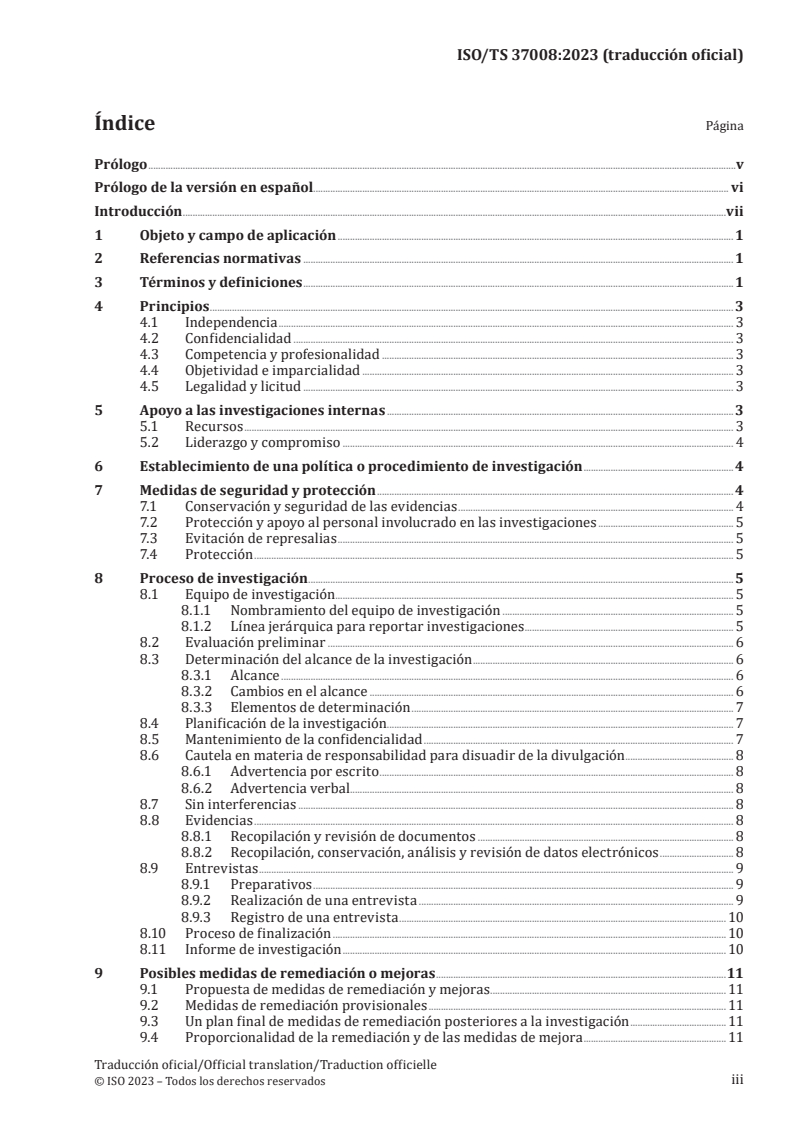
Índice Página
Prólogo .v
Prólogo de la versión en español. vi
Introducción .vii
1 Objeto y campo de aplicación . 1
2 Referencias normativas . 1
3 Términos y definiciones .1
4 Principios . 3
4.1 Independencia . 3
4.2 Confidencialidad . 3
4.3 Competencia y profesionalidad . 3
4.4 Objetividad e imparcialidad . 3
4.5 Legalidad y licitud . 3
5 Apoyo a las investigaciones internas .3
5.1 Recursos . 3
5.2 Liderazgo y compromiso . 4
6 Establecimiento de una política o procedimiento de investigación .4
7 Medidas de seguridad y protección . 4
7.1 Conservación y seguridad de las evidencias . 4
7.2 Protección y apoyo al personal involucrado en las investigaciones . 5
7.3 Evitación de represalias . 5
7.4 Protección . 5
8 Proceso de investigación .5
8.1 Equipo de investigación. 5
8.1.1 Nombramiento del equipo de investigación . 5
8.1.2 Línea jerárquica para reportar investigaciones . 5
8.2 Evaluación preliminar . 6
8.3 Determinación del alcance de la investigación . 6
8.3.1 Alcance . 6
8.3.2 Cambios en el alcance . 6
8.3.3 Elementos de determinación . 7
8.4 Planificación de la investigación . 7
8.5 Mantenimiento de la confidencialidad . 7
8.6 Cautela en materia de responsabilidad para disuadir de la divulgación . 8
8.6.1 Advertencia por escrito . 8
8.6.2 Advertencia verbal. 8
8.7 Sin interferencias . 8
8.8 Evidencias . 8
8.8.1 Recopilación y revisión de documentos . 8
8.8.2 Recopilación, conservación, análisis y revisión de datos electrónicos . 8
8.9 Entrevistas . 9
8.9.1 Preparativos . 9
8.9.2 Realización de una entrevista . 9
8.9.3 Registro de una entrevista . 10
8.10 Proceso de finalización . 10
8.11 Informe de investigación . 10
9 Posibles medidas de remediación o mejoras .11
9.1 Propuesta de medidas de remediación y mejoras . 11
9.2 Medidas de remediación provisionales . 11
9.3 Un plan final de medidas de remediación posteriores a la investigación . 11
9.4 Proporcionalidad de la remediación y de las medidas de mejora . 11
Traducción oficial/Official translation/Traduction officielle
iii
9.5 Hacer seguimiento y hacer cumplir las medidas de remediación . 11
10 Interacción con las partes interesadas .12
10.1 Generalidades .12
10.2 Planificación .12
10.3 Medidas para el proceso de comunicación .12
10.4 Canales de comunicación eficaces .12
10.5 Comunicación con el gobierno y las autoridades reglamentarias .12
10.6 Autodenuncia ante las autoridades . 13
11 Medidas disciplinarias .13
Anexo A (informativo) Orientaciones para la utilización de este documento .14
Bibliografía.26
Traducción oficial/Official translation/Traduction officielle
iv
Prólogo
ISO (Organización Internacional de Normalización) es una federación mundial de organismos
nacionales de normalización (organismos miembros de ISO). El trabajo de elaboración de las Normas
Internacionales se lleva a cabo normalmente a través de los comités técnicos de ISO. Cada organismo
miembro interesado en una materia para la cual se haya establecido un comité técnico, tiene el derecho
de estar representado en dicho comité. Las organizaciones internacionales, gubernamentales y no
gubernamentales, vinculadas con ISO, también participan en el trabajo. ISO colabora estrechamente
con la Comisión Electrotécnica Internacional (IEC) en todos los temas de normalización electrotécnica.
En la Parte 1 de las Directivas ISO/IEC se describen los procedimientos utilizados para desarrollar este
documento y aquellos previstos para su mantenimiento posterior. En particular debería tomarse nota
de los diferentes criterios de aprobación necesarios para los distintos tipos de documentos ISO. Este
documento ha sido redactado de acuerdo con las reglas editoriales de la Parte 2 de las Directivas ISO/
IEC (véase www.iso.org/directives).
Se llama la atención sobre la posibilidad de que algunos de los elementos de este documento puedan
estar sujetos a derechos de patente. ISO no asume la responsabilidad por la identificación de alguno
o todos los derechos de patente. Los detalles sobre cualquier derecho de patente identificado durante
el desarrollo de este documento se indicarán en la Introducción y/o en la lista ISO de declaraciones de
patente recibidas (véase www.iso.org/patents).
Cualquier nombre comercial utilizado en este documento es información que se proporciona para
comodidad del usuario y no constituye una recomendación.
Para una explicación de la naturaleza voluntaria de las normas, el significado de los términos específicos
de ISO y las expresiones relacionadas con la evaluación de la conformidad, así como la información
acerca de la adhesión de ISO a los principios de la Organización Mundial del Comercio (OMC) respecto a
los Obstáculos Técnicos al Comercio (OTC), véase www.iso.org/iso/foreword.html.
Este documento ha sido elaborado por el Comité Técnico ISO/TC 309, Gobernanza de las organizaciones.
Cualquier comentario o pregunta sobre este documento deberían dirigirse al organismo nacional de
normalización del usuario. En www.iso.org/members.html se puede encontrar un listado completo de
estos organismos.
Traducción oficial/Official translation/Traduction officielle
v
Prólogo de la versión en español
Este documento ha sido traducido por el Grupo de Trabajo Spanish Translation Task Force (STTF) del
Comité Técnico ISO/TC 309, Gobernanza de las organizaciones, en el que participan representantes de
los organismos nacionales de normalización y otras partes interesadas, para lograr la unificación de la
terminología en lengua española en el ámbito de la gobernanza de las organizaciones.
Este documento ha sido validado por el ISO/TMBG/Spanish Translation Management Group (STMG)
conformado por los siguientes países: Argentina, Bolivia, Chile, Colombia, Costa Rica, Cuba, Ecuador,
El Salvador, España, Guatemala, Honduras, República Dominicana, México, Panamá, Paraguay, Perú y
Uruguay.
Traducción oficial/Official translation/Traduction officielle
vi
Introducción
La investigación interna es parte integrante de la gestión organizacional. La investigación interna
es un proceso profesional de determinación de hechos, iniciado por o para una organización, con el
fin de establecer los hechos en relación con una supuesta o presunta irregularidad, mala conducta o
incumplimiento (como soborno, actividades fraudulentas, acoso, violencia o discriminación). Las
investigaciones internas permiten a una organización:
— tomar decisiones informadas si se han infringido leyes, reglamentaciones, códigos del sector,
políticas internas, procedimientos, procesos, la política de compliance corporativa y/o los valores y
la ética de la organización;
— comprender las causas que provocaron los incumplimientos mencionados;
— determinar si una acusación o preocupación está fundamentada o no;
— evaluar las pérdidas financieras de una organización;
— mitigar la responsabilidad de la organización y/o de sus directivos;
— establecer e implementar las medidas paliativas necesarias para evitar que se produzcan conductas
similares;
— reforzar la cultura de compliance y ética de la organización;
— realizar informes externos a las autoridades pertinentes (fuerzas y cuerpos de seguridad, órganos
judiciales, autoridades reglamentarias u otros órganos prescritos por la ley o reglamentaciones) o a
las partes interesadas pertinentes cuando sea necesario;
— tomar decisiones sobre sanciones a directivos y/o empleados e inhabilitación para trabajar con
terceros involucrados en conductas poco éticas.
Las acciones civiles, los informes de los denunciantes y las investigaciones externas de las autoridades
reglamentarias también pueden ser motivos de investigación interna, de modo que las organizaciones
afectadas puedan averiguar qué desencadenó las acciones, los informes y las investigaciones externas y,
seguidamente, tomar las medidas oportunas.
La investigación interna forma parte de un sistema de gestión del compliance. Este documento puede
utilizarse como ayuda para la aplicación de otras normas como ISO 37301, ISO 37001 e ISO 37002.
También puede ser una herramienta útil para que una organización identifique los riesgos. Con los
riesgos claramente identificados, una organización puede analizar las causas fundamentales del
incumplimiento y diseñar medidas para controlar los riesgos.
No tener la capacidad de realizar investigaciones internas y/o no realizarlas puede tener efectos
adversos en una organización, como comprometer la eficacia del sistema de gestión del compliance, no
proteger su reputación y no detectar ni contrarrestar las irregularidades.
Este documento ofrece orientación para que las organizaciones lleven a cabo investigaciones internas
basadas en los siguientes principios: independencia, confidencialidad, competencia y profesionalidad,
objetividad e imparcialidad, legalidad y licitud.
La Figura 1 es un resumen conceptual del proceso de investigación que muestra el panorama completo
de la investigación interna y las posibles acciones posteriores a la investigación.
Traducción oficial/Official translation/Traduction officielle
vii
Figura 1 — Descripción general del proceso de investigación
Traducción oficial/Official translation/Traduction officielle
viii
ESPECIFICACIÓN TÉCNICA ISO/TS 37008:2023 (traducción oficial)
Investigaciones internas de las organizaciones —
Orientación
1 Objeto y campo de aplicación
Este documento proporciona orientación sobre investigaciones internas en las organizaciones, que
incluyen:
— los principios;
— apoyo a las investigaciones;
— establecimiento de la política, los procedimientos, los procesos y las normas para llevar a cabo una
investigación e informar sobre ella;
— la comunicación de los resultados de las investigaciones;
— la aplicación de medidas de remediación.
Este documento es aplicable a todas las organizaciones, independientemente de su tipo, tamaño,
ubicación, estructura o finalidad.
NOTA Véase el Anexo A para orientaciones sobre el uso de este documento.
2 Referencias normativas
En el texto se hace referencia a los siguientes documentos de manera que parte o la totalidad de su
contenido constituyen requisitos de este documento. Para las referencias con fecha, solo se aplica la
edición citada. Para las referencias sin fecha se aplica la última edición (incluida cualquier modificación
de esta).
ISO 37001, Sistemas de gestión antisoborno — Requisitos con orientación para su uso
ISO 37002, Sistemas de gestión de la denuncia de irregularidades — Directrices
ISO 37301, Sistemas de gestión del compliance — Requisitos con orientación para su uso
3 Términos y definiciones
Para los fines de este documento, se aplican los términos y definiciones incluidos en las Normas
ISO 37001, ISO 37002, ISO 37301 además de los siguientes:
ISO e IEC mantienen bases de datos terminológicas para su utilización en normalización en las siguientes
direcciones:
— Plataforma de búsqueda en línea de ISO: disponible en https:// www .iso .org/ obp
— Electropedia de IEC: disponible en https:// www .electropedia .org/
3.1
investigación interna
proceso profesional de determinación de hechos, iniciado por o para una organización (3.3),
para establecer los hechos en relación con una supuesta o presunta infracción, mala conducta o
incumplimiento
Traducción oficial/Official translation/Traduction officielle
3.2
riesgo
efecto de la incertidumbre en los objetivos[FUENTE: ISO 31000:2018, 3.1, modificado — Notas a la
entrada eliminadas].
3.3
organización
persona o grupo de personas que tienen sus propias funciones con responsabilidades, autoridades y
relaciones para el logro de sus objetivos
Nota 1 a la entrada: El concepto de organización incluye, entre otros, un trabajador independiente, compañía,
corporación, firma, empresa, autoridad, sociedad, organización benéfica o institución, o una parte o combinación
de estas, ya estén constituidas o no, públicas o privadas.
[FUENTE: ISO 37301:2021, 3.1, modificado — Nota 2 a la entrada eliminada].
3.4
necesidad de saber
necesidad legítima de conocer o tener acceso a un mínimo de información sensible[FUENTE:
ISO 19650-5:2020, 3.4, modificado — "de un posible receptor de información" eliminado, "o tener acceso
a" sustituido por "acceder, o poseer", y "una cantidad mínima de" añadido a la definición].
3.5
investigador
personas designadas para gestionar o llevar a cabo una investigación
3.6
investigador principal
persona que dirige una investigación
3.7
partes interesadas
persona u organización (3.3) que puede afectar, verse afectada o percibirse como afectada por una
decisión o actividad[FUENTE: ISO 37301:2021, 3.2, modificado — "interested party" eliminado como
término preferido].
3.8
función de investigación interna
personas con la responsabilidad organizativa de las investigaciones
3.9
función de compliance
persona o grupo de personas con responsabilidad y autoridad para la operación del sistema de gestión
del compliance[FUENTE: ISO 37301:2021, 3.23, modificado — Nota 1 a la entrada eliminada].
3.10
órgano de gobierno
persona o grupo de personas que tienen la última responsabilidad y autoridad en las actividades,
gobierno y políticas de una organización (3.3) ante quienes la alta dirección (3.11) informa y rinde
cuentas[FUENTE: ISO 37301:2021, 3.21, modificado — Notas a la entrada eliminadas].
3.11
alta dirección
persona o grupo de personas que dirigen y controlan una organización (3.3) al más alto nivel[FUENTE:
ISO 37301:2021, 3.3, modificado — Notas a la entrada eliminadas].
Traducción oficial/Official translation/Traduction officielle
4 Principios
4.1 Independencia
Una investigación interna no debería verse influenciada o controlada por otras personas,
acontecimientos o incentivos en relación con el asunto que se está investigando.
NOTA Véase el apartado A.3.1 para orientación.
4.2 Confidencialidad
Todos los documentos e información recogidos en el contexto de una investigación, incluidos los
registros, las evidencias y los informes, deberían tratarse de forma confidencial y sensible. Los
documentos y la información solo deberían revelarse en función de la “necesidad de saber” y los
investigadores deberían conocer las leyes ordinarias y los requisitos reglamentarios aplicables.
4.3 Competencia y profesionalidad
Una investigación interna debería ser llevada a cabo por investigadores que tengan habilidades
profesionales, conocimientos, experiencia, actitud y capacidad para asegurar la calidad de su trabajo.
Una investigación interna debería llevarse a cabo con integridad, imparcialidad, veracidad, tenacidad,
confianza, inteligencia emocional, buen juicio y diligencia, y completarse a su debido tiempo.
NOTA Véase el apartado A.3.2 para orientación.
4.4 Objetividad e imparcialidad
Una investigación interna debería estar libre de conflictos de interés, realizarse de manera objetiva y
basarse en evidencia real. La investigación no debería verse influenciada por sentimientos personales,
interpretaciones o prejuicios.
NOTA Véase el apartado A.3.3 para orientación.
4.5 Legalidad y licitud
Quienes establezcan o lleven a cabo una investigación interna deberían identificar las reglamentaciones,
las leyes y los estatutos aplicables en todas las jurisdicciones pertinentes para asegurar la legalidad de
la investigación.
NOTA Véase el apartado A.3.4 para orientación.
5 Apoyo a las investigaciones internas
5.1 Recursos
El órgano de gobierno debería apoyar el establecimiento, la aplicación, el mantenimiento y la mejora
continua de las investigaciones internas, para lo cual la alta dirección de la organización debería
proporcionar los recursos adecuados.
Los recursos pueden incluir, entre otros, personal, infraestructura financiera, técnica y organizacional.
Estos recursos pueden proporcionarse interna o externamente.
NOTA Véase el apartado A.4.1 para más información.
Traducción oficial/Official translation/Traduction officielle
5.2 Liderazgo y compromiso
El órgano de gobierno, la alta dirección y otros responsables deberían demostrar su liderazgo y
compromiso con una investigación interna independiente, objetiva, imparcial y confidencial.
Se debería informar razonablemente al órgano de gobierno, a la alta dirección y a otras personas
que ocupen los cargos adecuados, de acuerdo con el plan de comunicación acordado, las directrices y
políticas internas preestablecidas, o según lo que los investigadores consideren necesario.
NOTA Véase el apartado A.4.2 para orientación.
6 Establecimiento de una política o procedimiento de investigación
La organización debería establecer y aplicar una política o procedimientos de investigación que:
— definan el alcance de la investigación, el proceso, las responsabilidades y las capacidades de los
investigadores internos;
— establezcan un vínculo claro con los procedimientos de "denuncia de irregularidades" o "hablar de
irregularidades" (speak up) de la organización;
— exijan una actuación oportuna y adecuada cada vez que se plantee un problema;
— aseguren que la investigación se lleva a cabo respetando los derechos de las personas involucradas;
— faculten y capaciten a los investigadores para llevar a cabo el trabajo de investigación;
— exijan la cooperación de todo el personal en la investigación;
— aseguren que la investigación sea llevada a cabo por personal independiente de la investigación y
que se informe al respecto;
— exijan que el resultado de la investigación, incluida cualquier limitación, impugnación o cualquier
otro aspecto de la investigación, se documente, revise y comunique adecuadamente;
— exijan que la investigación se lleve a cabo de forma confidencial y que la información sólo se comparta
con las personas que necesitan conocerla;
— exijan que la organización deba disponer de políticas o procesos para detener inmediatamente los
actos ilícitos, también durante una investigación en curso;
— exijan que las lecciones aprendidas o las recomendaciones derivadas de las investigaciones se
utilicen para evitar que se repitan las irregularidades;
— exijan que las políticas y procedimientos se actualicen periódicamente con lo aprendido de las
investigaciones internas.
NOTA Véase el Capítulo A.5 para orientación.
7 Medidas de seguridad y protección
7.1 Conservación y seguridad de las evidencias
Desde el principio del proceso, los investigadores deberían comenzar a identificar dónde pueden
almacenarse las evidencias pertinentes.
El investigador debería trabajar con las funciones pertinentes de la organización para determinar si
algún testigo clave o personal investigado está ya en proceso de abandonar la organización, por el
motivo que sea.
Traducción oficial/Official translation/Traduction officielle
La organización debería contar con políticas o procesos para evitar que alguien manipule testigos y
borre, destruya, altere, transfiera u oculte, intencionadamente o no, cualquier forma de información,
datos o registros, que puedan utilizarse como evidencia, y someter a la persona a medidas disciplinarias
como incumplimiento del código de conducta.
La organización también debería establecer medidas de protección para evitar que la información
obtenida en el curso de la investigación se facilite a personas sin necesidad de conocerla.
NOTA Véase el apartado A.6.1 para orientación.
7.2 Protección y apoyo al personal involucrado en las investigaciones
La organización debería tomar medidas para asegurar:
— que todas las actividades de investigación, incluidas las entrevistas, se lleven a cabo en ausencia de
cualquier forma de amenaza, promesa, inducción u opresión;
— que las investigaciones y entrevistas se lleven a cabo de forma discreta y con un nivel razonable de
privacidad;
— que las evidencias aportadas por los testigos se mantengan confidenciales.
NOTA Véase el apartado A.6.2 para orientación.
7.3 Evitación de represalias
La organización debería adoptar medidas para asegurar que los testigos, denunciantes, investigadores,
entrevistados, sujetos de investigación y el personal que toma decisiones sobre medidas de remediación
y acciones disciplinarias tengan protección contra cualquier forma de presión, intimidación, amenaza,
acoso y cualquier otra conducta perjudicial.
NOTA Véase el apartado A.6.3 para orientación.
7.4 Protección
La organización debería proteger el bienestar físico y psicológico de cualquier persona que participe en
la investigación.
8 Proceso de investigación
8.1 Equipo de investigación
8.1.1 Nombramiento del equipo de investigación
La alta dirección o el órgano de gobierno debería nombrar o autorizar a una persona o a un equipo
para llevar a cabo una investigación, a menos que una carta de investigación existente preestablezca
el proceso del nombramiento. En el caso de que la dirección actual tenga un conflicto de interés, la
dirección del siguiente nivel debería realizar dicho nombramiento o autorización. Una investigación
puede asignarse a investigadores externos.
NOTA Véase el apartado A.7.1 para más información.
8.1.2 Línea jerárquica para reportar investigaciones
El órgano de gobierno, la alta dirección u otras personas que ocupen el cargo adecuado según las políticas
internas de la organización deberían designar una línea jerárquica para reportar investigaciones que se
encargue de aplicar las sanciones y recomendar otras medidas de seguimiento de la investigación.
Traducción oficial/Official translation/Traduction officielle
El equipo de investigación debería mantener actualizada periódicamente o a intervalos definidos la
línea jerárquica para reportar investigaciones, incluidas las funciones, responsabilidades y autoridades,
y presentar el informe de investigaciones para su revisión.
Las responsabilidades de la línea jerárquica para reportar investigaciones incluyen, entre otras, las
siguientes:
— evaluar la naturaleza de las acusaciones;
— comprobar cualquier posible conflicto de interés;
— examinar la posibilidad de futuras interacciones con las autoridades y otras partes interesadas en
relación con los resultados de la investigación;
— considerar la gravedad o la seriedad del asunto;
— evaluar el posible riesgo financiero, de reputación o reglamentario para la organización.
8.2 Evaluación preliminar
El equipo de investigación debería realizar una evaluación preliminar de la acusación.
El equipo de investigación debería considerar la gravedad y credibilidad de la acusación presentada y si
las acusaciones son lo suficientemente específicas como para iniciar una investigación.
Cuando sea posible, el equipo de investigación debería considerar la posibilidad de ponerse en contacto
con el denunciante y pedirle detalles adicionales en relación con las acusaciones, evaluar seguidamente
si es necesaria una investigación a gran escala y utilizar los resultados de la evaluación para planificar
la investigación.
Los resultados de la evaluación preliminar deberían documentarse claramente. En los casos en que se
requieran nuevas investigaciones, esto debería reflejarse mediante una decisión documentada.
NOTA Véase el apartado A.7.2 para más información.
8.3 Determinación del alcance de la investigación
8.3.1 Alcance
El equipo de investigación debería considerar los resultados de la evaluación preliminar, si los hubiere,
para determinar el alcance de la investigación de modo que esta pueda llevarse a cabo de forma eficaz
y adecuada.
Antes de determinar el alcance de la investigación, es importante establecer los objetivos previstos de
la investigación, tales como:
— si se requiere que el investigador simplemente descubra los hechos de un incidente en particular;
— si se requiere que el investigador tome una determinación con respecto a si existe algún
incumplimiento de la política de la organización o una posible violación de la ley;
— si el investigador tiene que hacer una recomendación con respecto a qué acción se debería tomar en
caso de que se identifique un incumplimiento.
8.3.2 Cambios en el alcance
Si, en el marco de la investigación, el equipo de investigación tiene conocimiento de otras infracciones
de la ley, de las políticas de la organización o de actividades delictivas, el alcance de la investigación
debería adaptarse en consecuencia. El cambio de alcance debería documentarse.
Traducción oficial/Official translation/Traduction officielle
8.3.3 Elementos de determinación
A la hora de determinar el alcance de la investigación, el equipo de investigación debería tener en cuenta
los elementos críticos, entre los que se incluyen:
— sustancia: las acusaciones específicas;
— intervalo: periodo de tiempo que debería examinar la investigación;
— geografía: qué regiones o países abarcará la investigación;
— lugar: donde se produjeron los supuestos incidentes;
— personas: quienes presuntamente llevaron a cabo una infracción.
8.4 Planificación de la investigación
El equipo de investigación debería establecer un plan de investigación. En el plan deberían esbozarse
los siguientes factores:
— los antecedentes, el alcance, los plazos, la finalidad y el objetivo de la investigación;
— el personal requerido para ser entrevistado o para facilitar información que ayude a la investigación;
— los recursos internos o externos necesarios y disponibles para lograr el objetivo y si se necesitan
recursos expertos, como contables forenses, asesores externos, investigadores externos, expertos
del sector o expertos en análisis forense digital;
— una evaluación sobre si es necesario suspender el contrato laboral de algún empleado o custodio
mientras duren las investigaciones y revocar el acceso físico a las oficinas o sistemas informáticos;
— las posibles fuentes de evidencias y cómo tratar la conservación, recopilación y revisión de las
evidencias;
— cómo realizar las entrevistas, incluyendo el cronograma de entrevistas y de notificaciones;
— si alguna persona sujeta a la investigación necesita o requiere representación legal, si está permitido,
y/o una persona de apoyo que la acompañe durante la entrevista;
— si existe alguna cuestión legal importante;
— los riesgos y/o retos que el objeto de la investigación puede causar a la investigación y a la
organización, y qué estrategias se van a utilizar para mitigarlos o eliminarlos;
— cómo debería registrarse la investigación y a qué partes interesadas debería informarse, cuándo y
con qué nivel de detalle;
— si la organización está obligada a hacer una autodenuncia a la autoridad gubernamental
correspondiente de acuerdo con los requisitos de información.
El plan de investigación debería tratarse como un documento vivo y debería actualizarse a medida que
cambie la situación para asegurar que la investigación cumple el alcance, el objetivo y los principios
fundamentales. Las modificaciones del plan de investigación deberían documentarse.
NOTA Véase el apartado A.7.3 para orientación.
8.5 Mantenimiento de la confidencialidad
El flujo de información debería controlarse en función de la necesidad de conocer y mantenerse
confidencial durante todo el proceso de investigación.
Traducción oficial/Official translation/Traduction officielle
Cuando sea necesario, el investigador principal podrá informar a las partes interesadas pertinentes
identificadas en el plan de investigación.
NOTA Véase el apartado A.7.4 para más información.
8.6 Cautela en materia de responsabilidad para disuadir de la divulgación
8.6.1 Advertencia por escrito
Se recomienda enviar una advertencia por escrito a las partes interesadas para destacar la importancia
del requisito de mantener la confidencialidad, los impactos negativos de la divulgación (accidental o no)
y las posibles responsabilidades por la divulgación.
Los impactos negativos de la divulgación incluyen, entre otros, la manipulación o eliminación de
evidencias, o causar daños a personas involucradas en la investigación o causar daños a la organización.
El incumplimiento de la confidencialidad puede llevar a sanciones y responsabilidades para las personas
causantes del incumplimiento.
NOTA Véase el apartado A.7.5 para orientación.
8.6.2 Advertencia verbal
En determinadas circunstancias, una advertencia verbal puede ser más apropiada que una advertencia
por escrito a las partes interesadas. El investigador principal debería decidir cuándo y cómo
comunicarla. La advertencia verbal debería incluir los principales aspectos indicados en la advertencia
escrita. El investigador principal debería llevar un registro de todas las advertencias verbales emitidas,
y puede informar a las partes interesadas de este registro.
La advertencia debería incluir el aviso a la persona de que no haga nada que pueda interferir en el
proceso de investigación o impedir la recopilación de hechos.
8.7 Sin interferencias
La organización debería tomar medidas para evitar o detener las interferencias en la investigación.
Esto puede incluir interferencias de partes externas, otras organizaciones y partes internas, como
determinados directivos u otros departamentos. El investigador principal debería informar de cualquier
intento relevante de interferir en la investigación a la línea jerárquica para reportar investigaciones o
a la dirección de la organización de acuerdo con la política o el procedimiento de investigación, o de la
forma que el investigador principal considere adecuada.
8.8 Evidencias
8.8.1 Recopilación y revisión de documentos
El equipo de investigación debería tomar todas las medidas de control para obtener, asegurar, organizar
y revisar con seguridad todos los documentos necesarios recopilados de partes internas o externas.
La actividad investigadora debería considerar el examen de todas las evidencias aplicables.
El objetivo principal de la revisión de estos registros es detectar documentos críticos esenciales para la
investigación. En cuanto a la revisión a gran escala, puede considerarse la utilización de herramientas
tecnológicas o digitales o la contratación de proveedores de servicios o asesores externos.
NOTA Véase el apartado A.7.6.1 para orientación.
8.8.2 Recopilación, conservación, análisis y revisión de datos electrónicos
El equipo de investigación debería trabajar con el departamento de tecnología de la información o con
un proveedor de servicios externo cuando se requiera el análisis de cualquier evidencia electrónica
Traducción oficial/Official translation/Traduction officielle
con el fin de identificar, preservar y analizar los datos electrónicos. Existen plataformas tecnológicas
y herramientas de búsqueda/descubrimiento electrónico que pueden facilitar la revisión de datos
digitales y gestionar el flujo de trabajo de revisión de datos digitales. Los investigadores deberían
considerar el uso de la tecnología y de expertos en la materia para ayudar a la recuperación y revisión
de los datos electrónicos.
El equipo de investigación y el departamento de tecnología de la información o el proveedor de servicios
externo deberían aplicar medidas adecuadas para proteger todos los datos electrónicos capturados.
El personal encargado de la recopilación, el análisis y la revisión de datos electrónicos debería tener la
competencia genérica descrita en la Norma ISO/IEC 27037:2012.
NOTA Véase el apartado A.7.6.2 para orientación.
8.9 Entrevistas
8.9.1 Preparativos
Antes de realizar la entrevista o entrevistas, el equipo de investigación debería hacer lo siguiente:
— Elaborar una lista inicial de las personas a entrevistar.
— Preparar un plan de entrevista que incluya un esquema de las áreas temáticas, las preguntas si se
considera necesario, y los documentos, correos electrónicos u otros materiales que se utilizarán
durante la entrevista, y decida también un calendario para el momento y la secuencia de las
entrevistas. Las entrevistas deberían programarse de manera que se impida a los entrevistados
manipular las preguntas y respuestas de la entrevista. El plan de la entrevista debería tener en
cuenta las funciones de los entrevistadores y las posibles respuestas del entrevistado.
— Adoptar técnicas de entrevista adecuadas.
— Realizar entrevistas utilizando técnicas adecuadas en las que los entrevistadores deberían tener
suficiente competencia.
— Evaluar la cultura y el ecosistema locales antes de determinar la conformación del equipo para una
entrevista.
NOTA 1 En determinadas geografías, puede recomendarse que, si la discusión es con una mujer, sea
conveniente que el equipo de investigación incluya a una mujer en la sala de discusión.
— Revisar y recopilar los documentos pertinentes, según proceda.
— Tomar medidas para realizar las entrevistas en un entorno libre de interferencias y perturbaciones
externas y que pueda asegurar la confidencialidad.
NOTA 2 Véase el apartado A.7.7.1 para orientación.
8.9.2 Realización de una entrevista
Deberían tomarse medidas para asegurar que una entrevista, en particular con un sujeto de una
investigación, sea presenciada cuando sea apropiado. Esto puede involucrar la presencia de dos
entrevistadores o de un entrevistador y un testigo o en su lugar, grabar la entrevista, cuan
...