

ISO 4610:2001
(Main)Plastics — Vinyl chloride homopolymer and copolymer resins — Sieve analysis using air-jet sieve apparatus
General Information
- Abstract
ISO 4610:2001 specifies a method for the determination of the sieve retention and particle size distribution of preferably free-flowing vinyl chloride homopolymer and copolymer resins prepared by the 'suspension', 'bulk' and 'emulsion' polymerization processes. Control of these characteristics can help to ensure consistency of supply and predictable processing behaviour.
- Status
- Published
- Publication Date
- 31-Oct-2001
- Technical Committee
- ISO/TC 61/SC 9 - Thermoplastic materials
- Drafting Committee
- ISO/TC 61/SC 9/WG 20 - Poly(vinyl chloride)
- Current Stage
- 9060 - Close of review
- Completion Date
- 02-Dec-2031
Buy Documents
ISO 4610:2001 - Plastics — Vinyl chloride homopolymer and copolymer resins — Sieve analysis using air-jet sieve apparatus Released:1/25/2007
ISO 4610:2001 - Plastiques — Résines d'homopolymeres et copolymeres de chlorure de vinyle — Analyse granulométrique sur tamiseuse a dépression d'air Released:1/25/2007
Overview
ISO 4610:2001 is an international standard published by the International Organization for Standardization (ISO) that defines a method for sieve analysis of vinyl chloride homopolymer and copolymer resins. Specifically, it describes the use of an air-jet sieve apparatus to determine particle size distribution and sieve retention of these plastic resins. This method applies to free-flowing resins produced by suspension, bulk, and emulsion polymerization processes. Accurate control of particle size distribution ensures consistency in supply and predictable processing behavior, which are critical for manufacturers and users in the plastics industry.
Key Topics
Scope and Applicability
ISO 4610:2001 covers sieve analysis specifically for vinyl chloride homopolymer and copolymer resins, including homopolymers synthesized via emulsion polymerization. It targets free-flowing powders suitable for air-jet sieving.Sample Preparation and Handling
Samples should be taken as supplied, ideally analyzed immediately or stored in sealed containers to maintain integrity. An anti-static agent (e.g., 0.5% γ-alumina by mass) is recommended to prevent electrostatic issues during sieving.Air-Jet Sieve Apparatus
The apparatus consists of circular metal sieves (diameter 200 mm) with mesh sizes compliant with ISO 565, housed in a unit with air inflow and suction to suspend particles. A rotating air jet continuously sweeps the sieve surface ensuring accurate particle separation.Test Procedure
- Weigh the sample (typically 25 g or 10 g for fine powders).
- Mount the sample on the sieve and seal the apparatus.
- Apply a partial vacuum of 2.5 kPa and operate the air-jet shaker for 4 minutes ± 15 seconds, extending up to 15 minutes if low residue is expected.
- Collect and weigh the residue retained on the sieve to calculate percentage retention.
Results Expression
Sieve retention is expressed as the percentage of the original sample mass retained on the sieve, reported to one decimal place for precision.Precision and Reproducibility
Interlaboratory tests demonstrate repeatability and reproducibility for standard suspension PVC resins, supporting the method’s reliability. Specific standard deviations for different mesh sizes are available under the standard’s detailed tables.Reporting Requirements
Test reports must include full details such as sample identification, sample mass, sieve mesh size(s), test duration, vacuum applied, anti-static agent usage, and the date of analysis.
Applications
ISO 4610:2001 is essential for manufacturers, quality control laboratories, and processors of vinyl chloride plastics who require standardized methods to characterize resin particle size distribution. Typical applications include:
- Quality Control: Ensuring batch-to-batch consistency of PVC and copolymer resin powders by monitoring particle size and sieve retention.
- Process Optimization: Tailoring polymerization processes or downstream processing parameters based on uniform particle size distributions for predictable flow and melting behavior.
- Product Specification: Providing a reproducible measurement technique for resin suppliers to certify product conformance to customer requirements.
- Research and Development: Supporting formulation and process innovation by enabling precise particle size characterization of new plastic resin variants.
Related Standards
- ISO 565: Defines nominal opening sizes of metal test sieves used in sieve analysis, crucial for selecting sieve mesh sizes compliant with ISO 4610.
- Other ISO standards on plastics testing and particle characterization complement ISO 4610 by providing alternative or complementary methods for resin analysis.
By adhering to ISO 4610:2001, stakeholders in the plastics industry benefit from a robust, internationally recognized procedure to analyze vinyl chloride resin powders, contributing to enhanced product quality and operational efficiency.
Keywords: ISO 4610, sieve analysis, vinyl chloride resin, homopolymer, copolymer, air-jet sieve, particle size distribution, PVC resin testing, suspension polymerization, bulk polymerization, emulsion polymerization, plastics quality control, resin particle size, anti-static agent, sieve retention, polymer resin analysis.
Relations
- Effective Date
- 25-Aug-2026
- Effective Date
- 12-Feb-2026
- Consolidates
ISO 6107-2:1981 - Water quality — Vocabulary - Effective Date
- 06-Jun-2022
- Effective Date
- 12-May-2008
- Effective Date
- 15-Apr-2008
Buy Documents
ISO 4610:2001 - Plastics — Vinyl chloride homopolymer and copolymer resins — Sieve analysis using air-jet sieve apparatus Released:1/25/2007
ISO 4610:2001 - Plastiques — Résines d'homopolymeres et copolymeres de chlorure de vinyle — Analyse granulométrique sur tamiseuse a dépression d'air Released:1/25/2007
Get Certified
Connect with accredited certification bodies for this standard

DIN CERTCO
DIN Group product certification.

Smithers Quality Assessments
US management systems and product certification.
Sponsored listings
Frequently Asked Questions
ISO 4610:2001 is a standard published by the International Organization for Standardization (ISO). Its full title is "Plastics — Vinyl chloride homopolymer and copolymer resins — Sieve analysis using air-jet sieve apparatus". This standard covers: ISO 4610:2001 specifies a method for the determination of the sieve retention and particle size distribution of preferably free-flowing vinyl chloride homopolymer and copolymer resins prepared by the 'suspension', 'bulk' and 'emulsion' polymerization processes. Control of these characteristics can help to ensure consistency of supply and predictable processing behaviour.
ISO 4610:2001 specifies a method for the determination of the sieve retention and particle size distribution of preferably free-flowing vinyl chloride homopolymer and copolymer resins prepared by the 'suspension', 'bulk' and 'emulsion' polymerization processes. Control of these characteristics can help to ensure consistency of supply and predictable processing behaviour.
ISO 4610:2001 is classified under the following ICS (International Classification for Standards) categories: 83.080.20 - Thermoplastic materials. The ICS classification helps identify the subject area and facilitates finding related standards.
ISO 4610:2001 has the following relationships with other standards: It is inter standard links to EN ISO 24024-2:2021, EN ISO 4610:2001, ISO 6107-2:1981, SIST ISO 4610:1996, ISO 4610:1977. Understanding these relationships helps ensure you are using the most current and applicable version of the standard.
ISO 4610:2001 is available in PDF format for immediate download after purchase. The document can be added to your cart and obtained through the secure checkout process. Digital delivery ensures instant access to the complete standard document.
Standards Content (Sample)
INTERNATIONAL ISO
STANDARD 4610
Second edition
2001-10-15
Corrected version
2007-02-01
Plastics — Vinyl chloride homopolymer and
copolymer resins — Sieve analysis using
air-jet sieve apparatus
Plastiques — Résines d'homopolymères et copolymères de chlorure de
vinyle — Analyse granulométrique sur tamiseuse à dépression d'air
Reference number
PDF disclaimer
This PDF file may contain embedded typefaces. In accordance with Adobe's licensing policy, this file may be printed or viewed but shall not be
edited unless the typefaces which are embedded are licensed to and installed on the computer performing the editing. In downloading this file,
parties accept therein the responsibility of not infringing Adobe's licensing policy. The ISO Central Secretariat accepts no liability in this area.
Adobe is a trademark of Adobe Systems Incorporated.
Details of the software products used to create this PDF file can be found in the General Info relative to the file; the PDF-creation parameters
were optimized for printing. Every care has been taken to ensure that the file is suitable for use by ISO member bodies. In the unlikely event
that a problem relating to it is found, please inform the Central Secretariat at the address given below.
All rights reserved. Unless otherwise specified, no part of this publication may be reproduced or utilized in any form or by any means, elec-
tronic or mechanical, including photocopying and microfilm, without permission in writing from either ISO at the address below or ISO's mem-
ber body in the country of the requester.
ISO copyright office
Case postale 56 CH-1211 Geneva 20
Tel. + 41 22 749 01 11
Fax + 41 22 749 09 47
E-mail copyright@iso.ch
Web www.iso.ch
Printed in Switzerland
©
ii ISO 2001 – All rights reserved
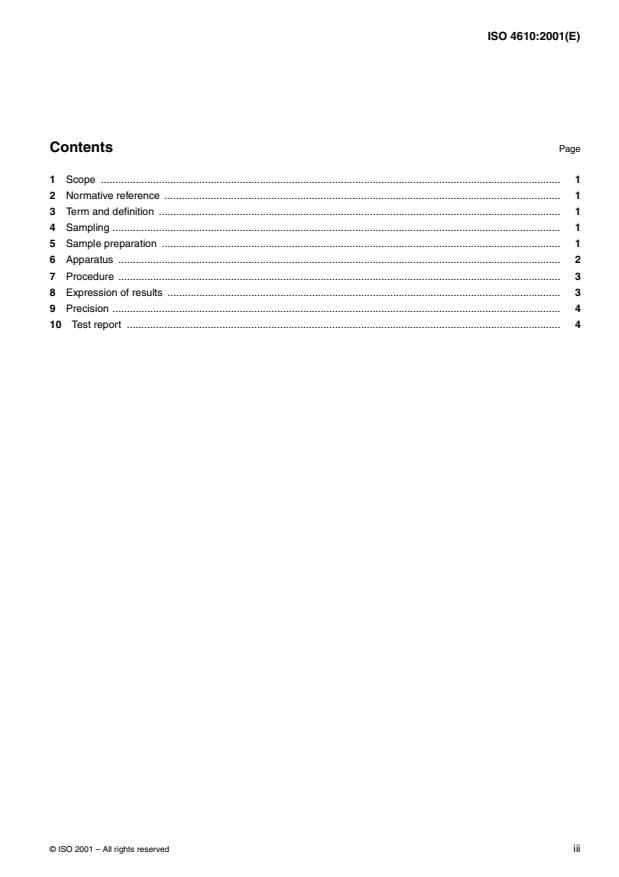
Contents Page
1 Scope . 1
2 Normative reference . 1
3 Term and definition . 1
4 Sampling . 1
5 Sample preparation . 1
6 Apparatus . 2
7 Procedure . 3
8 Expression of results . 3
9 Precision . 4
10 Test report . 4
©
ISO 2001 – All rights reserved iii
Foreword
ISO (the International Organization for Standardization) is a worldwide federation of national standards bodies (ISO
member bodies). The work of preparing International Standards is normally carried out through ISO technical com-
mittees. Each member body interested in a subject for which a technical committee has been established has the
right to be represented on that committee. International organizations, governmental and non-governmental, in liai-
son with ISO, also take part in the work. ISO collaborates closely with the International Electrotechnical Commission
(IEC) on all matters of electrotechnical standardization.
International Standards are drafted in accordance with the rules given in the ISO/IEC Directives, Part 3.
Draft International Standards adopted by the technical committees are circulated to the member bodies for voting.
Publication as an International Standard requires approval by at least 75 % of the member bodies casting a vote.
Attention is drawn to the possibility that some of the elements of this International Standard may be the subject of
patent rights. ISO shall not be held responsible for identifying any or all such patent rights.
International Standard ISO 4610 was prepared by Technical Committee ISO/TC 61, Plastics, Subcommittee SC 9,
Thermoplastic materials.
This second edition cancels and replaces the first edition (ISO 4610:1977), which has been modified as follows:
— emulsion-polymerized PVC has been included in the scope;
— a second obligatory measurement has been included;
— a precision statement, based on current test data, has been included.
In this corrected version of ISO 4610:2001, the URL in Clause 9 has been replaced by a more user-friendly one.
©
iv ISO 2001 – All rights reserved
INTERNATIONAL STANDARD ISO 4610:2001(E)
Plastics — Vinyl chloride homopolymer and copolymer resins —
Sieve analysis using air-jet sieve apparatus
1 Scope
This International Standard specifies a method for the determination of the sieve retention and particle size distribu-
tion of preferably free-flowing vinyl chloride homopolymer and copolymer resins prepared by the “suspension”, “bulk”
and “emulsion” polymerization processes. Control of these characteristics can help to ensure consistency of supply
and predictable processing behaviour.
2 Normative reference
The following normative document contains provisions which, through reference in this text, constitute provisions of
this International Standard. For dated references, subs
...
NORME ISO
INTERNATIONALE 4610
Deuxième édition
2001-10-15
Version corrigée
2007-02-01
Plastiques — Résines d'homopolymères et
copolymères de chlorure de vinyle —
Analyse granulométrique sur tamiseuse à
dépression d'air
Plastics — Vinyl chloride homopolymer and copolymer resins — Sieve
analysis using air-jet sieve apparatus
Numéro de référence
PDF — Exonération de responsabilité
Le présent fichier PDF peut contenir des polices de caractères intégrées. Conformément aux conditions de licence d'Adobe, ce fichier peut
être imprimé ou visualisé, mais ne doit pas être modifié à moins que l'ordinateur employé à cet effet ne bénéficie d'une licence autorisant l'uti-
lisation de ces polices et que celles-ci y soient installées. Lors du téléchargement de ce fichier, les parties concernées acceptent de fait la res-
ponsabilité de ne pas enfreindre les conditions de licence d'Adobe. Le Secrétariat central de l'ISO décline toute responsabilité en la matière.
Adobe est une marque déposée d'Adobe Systems Incorporated.
Les détails relatifs aux produits logiciels utilisés pour la création du présent fichier PDF sont disponibles dans la rubrique General Info du fi-
chier; les paramètres de création PDF ont été optimisés pour l'impression. Toutes les mesures ont été prises pour garantir l'exploitation de ce
fichier par les comités membres de l'ISO. Dans le cas peu probable où surviendrait un problème d'utilisation, veuillez en informer le Secréta-
riat central à l'adresse donnée ci-dessous.
Droits de reproduction réservés. Sauf prescription différente, aucune partie de cette publication ne peut être reproduite ni utilisée sous quel-
que forme que ce soit et par aucun procédé, électronique ou mécanique, y compris la photocopie et les microfilms, sans l'accord écrit de l'ISO
à l'adresse ci-après ou au comité membre de l'ISO dans le pays du demandeur.
ISO copyright office
Case postale 56 CH-1211 Geneva 20
Tel. + 41 22 749 01 11
Fax + 41 22 749 09 47
E-mail copyright@iso.ch
Web www.iso.ch
Imprimé en Suisse
©
ii ISO 2001 – Tous droits réservés
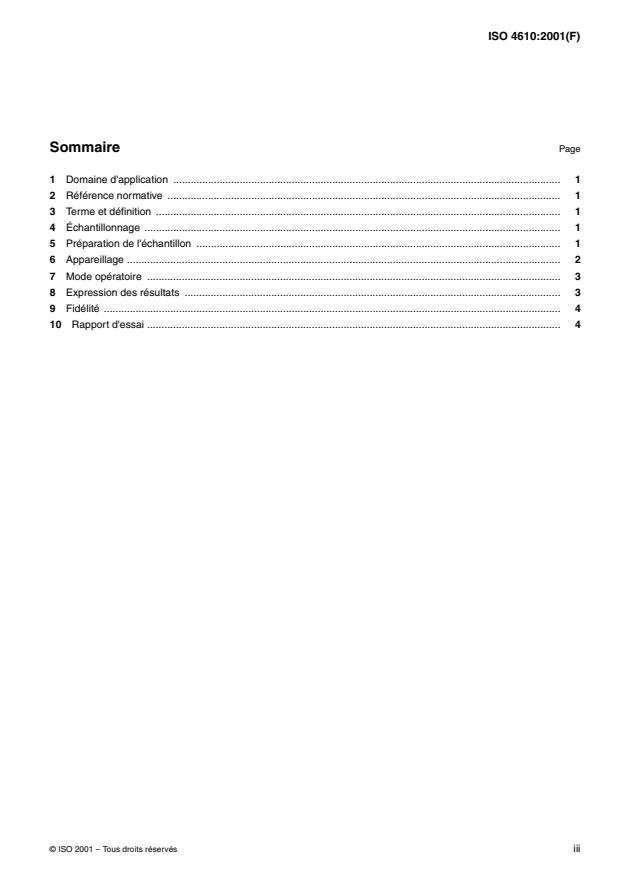
Sommaire Page
1 Domaine d'application . 1
2 Référence normative . 1
3 Terme et définition . 1
4 Échantillonnage . 1
5 Préparation de l'échantillon . 1
6 Appareillage . 2
7 Mode opératoire . 3
8 Expression des résultats . 3
9 Fidélité . 4
10 Rapport d'essai . 4
©
ISO 2001 – Tous droits réservés iii
Avant-propos
L'ISO (Organisation internationale de normalisation) est une fédération mondiale d'organismes nationaux de
normalisation (comités membres de l'ISO). L'élaboration des Normes internationales est en général confiée aux
comités techniques de l'ISO. Chaque comité membre intéressé par une étude a le droit de faire partie du comité
technique créé à cet effet. Les organisations internationales, gouvernementales et non gouvernementales, en liaison
avec l'ISO participent également aux travaux. L'ISO collabore étroitement avec la Commission électrotechnique
internationale (CEI) en ce qui concerne la normalisation électrotechnique.
Les Normes internationales sont rédigées conformément aux règles données dans les Directives ISO/CEI, Partie 3.
Les projets de Normes internationales adoptés par les comités techniques sont soumis aux comités membres pour
vote. Leur publication comme Normes internationales requiert l'approbation de 75 % au moins des comités membres
votants.
L'attention est appelée sur le fait que certains des éléments de la présente Norme internationale peuvent faire l'objet
de droits de propriété intellectuelle ou de droits analogues. L'ISO ne saurait être tenue pour responsable de ne pas
avoir identifié de tels droits de propriété et averti de leur existence.
La Norme internationale ISO 4610 a été élaborée par le comité technique ISO/TC 61, Plastiques, sous-comité SC 9,
Matériaux thermoplastiques.
Cette deuxième édition annule et remplace la première édition (ISO 4610:1977), qui a été modifiée comme suit:
— ajout dans le domaine d’application du PVC «polymérisé en émulsion»;
— ajout d’un second mesurage obligatoire;
— ajout d’une disposition relative à la fidélité, fondée sur les résultats d’essai actuels.
Dans cette version corrigée de l’ISO 4610:2001, l’URL dans l’Article 9 a été remplacée par une version plus
conviviale.
©
iv ISO 2001 – Tous droits réservés
NORME INTERNATIONALE ISO 4610:2001(F)
Plastiques — Résines d'homopolymères et copolymères de
chlorure de vinyle — Analyse granulométrique sur tamiseuse à
dépression d'air
1 Domaine d'application
La présente Norme internationale spécifie une méthode de détermination des refus sur tamis et de la répartition
granulométrique des résines d'homopolymères et de copolymères du chlorure de vinyle, de préférence susceptibles
de s'écouler librement, préparées selon les procédés de polymérisation «en suspension», «en masse» et «en
émulsion». La maîtrise de ces caractéristiques peut contribuer à garantir l'uniformité de la fourniture et un
comportement prévisible à la mise en œuvre.
2 Référence normative
Le document normatif suivant contient des dispositions qui, par suite de la référence qui y est faite, constituent des
dispositions valables pour la présente Norme internationale. Pour les références datées, les amendements ultérieurs
ou les révisions d
...