


ISO/TR 20432:2007
(Main)Guidelines for the determination of the long-term strength of geosynthetics for soil reinforcement
Guidelines for the determination of the long-term strength of geosynthetics for soil reinforcement
ISO/TR 20432:2007 provides guidelines for the determination of the long-term strength of geosynthetics for soil reinforcement. ISO/TR 20432:2007 describes a method of deriving reduction factors for geosynthetic soil reinforcement materials to account for creep and creep rupture, installation damage and weathering, and chemical and biological degradation. It is intended to provide a link between the test data and the codes for construction with reinforced soil.
Lignes directrices pour la détermination de la résistance à long terme des géosynthétiques pour le renforcement du sol
General Information
- Status
- Withdrawn
- Publication Date
- 20-Nov-2007
- Technical Committee
- ISO/TC 221 - Geosynthetics
- Drafting Committee
- ISO/TC 221/WG 5 - Durability
- Current Stage
- 9599 - Withdrawal of International Standard
- Start Date
- 19-Dec-2022
- Completion Date
- 12-Feb-2026
Relations
- Effective Date
- 23-Apr-2020
Get Certified
Connect with accredited certification bodies for this standard

Control Union Certifications
Global certification for agriculture and sustainability.

Bureau Veritas Bangladesh
Bureau Veritas certification services in Bangladesh.

ECOCERT France
Leader in organic and sustainability certification worldwide.
Sponsored listings
Frequently Asked Questions
ISO/TR 20432:2007 is a technical report published by the International Organization for Standardization (ISO). Its full title is "Guidelines for the determination of the long-term strength of geosynthetics for soil reinforcement". This standard covers: ISO/TR 20432:2007 provides guidelines for the determination of the long-term strength of geosynthetics for soil reinforcement. ISO/TR 20432:2007 describes a method of deriving reduction factors for geosynthetic soil reinforcement materials to account for creep and creep rupture, installation damage and weathering, and chemical and biological degradation. It is intended to provide a link between the test data and the codes for construction with reinforced soil.
ISO/TR 20432:2007 provides guidelines for the determination of the long-term strength of geosynthetics for soil reinforcement. ISO/TR 20432:2007 describes a method of deriving reduction factors for geosynthetic soil reinforcement materials to account for creep and creep rupture, installation damage and weathering, and chemical and biological degradation. It is intended to provide a link between the test data and the codes for construction with reinforced soil.
ISO/TR 20432:2007 is classified under the following ICS (International Classification for Standards) categories: 59.080.70 - Geotextiles. The ICS classification helps identify the subject area and facilitates finding related standards.
ISO/TR 20432:2007 has the following relationships with other standards: It is inter standard links to ISO/TS 20432:2022. Understanding these relationships helps ensure you are using the most current and applicable version of the standard.
ISO/TR 20432:2007 is available in PDF format for immediate download after purchase. The document can be added to your cart and obtained through the secure checkout process. Digital delivery ensures instant access to the complete standard document.
Standards Content (Sample)
TECHNICAL ISO/TR
REPORT 20432
First edition
2007-12-01
Guidelines for the determination of the
long-term strength of geosynthetics for
soil reinforcement
Lignes directrices pour la détermination de la résistance à long terme
des géosynthétiques pour le renforcement du sol
Reference number
©
ISO 2007
PDF disclaimer
This PDF file may contain embedded typefaces. In accordance with Adobe's licensing policy, this file may be printed or viewed but
shall not be edited unless the typefaces which are embedded are licensed to and installed on the computer performing the editing. In
downloading this file, parties accept therein the responsibility of not infringing Adobe's licensing policy. The ISO Central Secretariat
accepts no liability in this area.
Adobe is a trademark of Adobe Systems Incorporated.
Details of the software products used to create this PDF file can be found in the General Info relative to the file; the PDF-creation
parameters were optimized for printing. Every care has been taken to ensure that the file is suitable for use by ISO member bodies. In
the unlikely event that a problem relating to it is found, please inform the Central Secretariat at the address given below.
© ISO 2007
All rights reserved. Unless otherwise specified, no part of this publication may be reproduced or utilized in any form or by any means,
electronic or mechanical, including photocopying and microfilm, without permission in writing from either ISO at the address below or
ISO's member body in the country of the requester.
ISO copyright office
Case postale 56 • CH-1211 Geneva 20
Tel. + 41 22 749 01 11
Fax + 41 22 749 09 47
E-mail copyright@iso.org
Web www.iso.org
Published in Switzerland
ii © ISO 2007 – All rights reserved
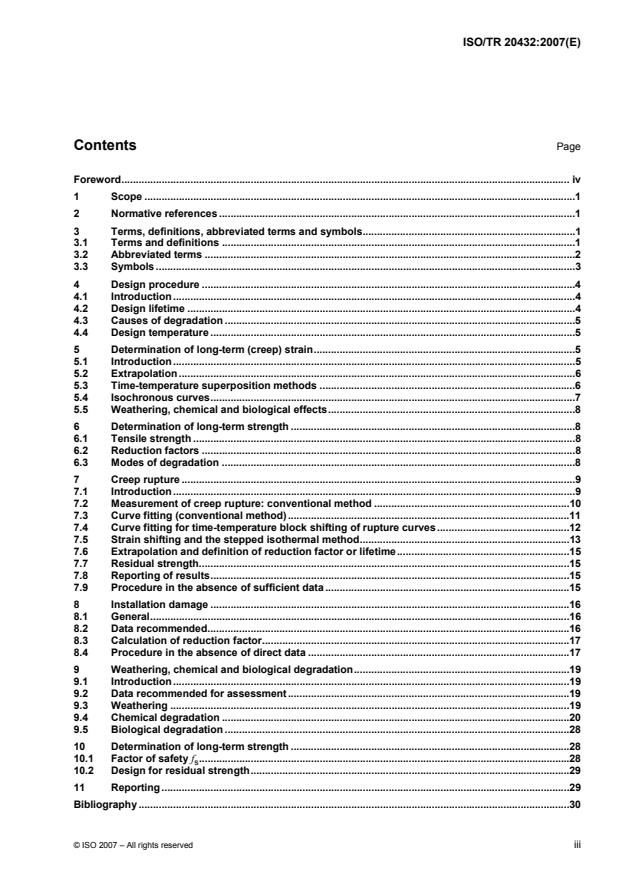
Contents Page
Foreword. iv
1 Scope.1
2 Normative references.1
3 Terms, definitions, abbreviated terms and symbols.1
3.1 Terms and definitions .1
3.2 Abbreviated terms.2
3.3 Symbols.3
4 Design procedure .4
4.1 Introduction.4
4.2 Design lifetime .4
4.3 Causes of degradation .5
4.4 Design temperature .5
5 Determination of long-term (creep) strain.5
5.1 Introduction.5
5.2 Extrapolation.6
5.3 Time-temperature superposition methods .6
5.4 Isochronous curves.7
5.5 Weathering, chemical and biological effects.8
6 Determination of long-term strength .8
6.1 Tensile strength.8
6.2 Reduction factors .8
6.3 Modes of degradation .8
7 Creep rupture.9
7.1 Introduction.9
7.2 Measurement of creep rupture: conventional method .10
7.3 Curve fitting (conventional method).11
7.4 Curve fitting for time-temperature block shifting of rupture curves .12
7.5 Strain shifting and the stepped isothermal method.13
7.6 Extrapolation and definition of reduction factor or lifetime.15
7.7 Residual strength.15
7.8 Reporting of results.15
7.9 Procedure in the absence of sufficient data .15
8 Installation damage .16
8.1 General.16
8.2 Data recommended.16
8.3 Calculation of reduction factor.17
8.4 Procedure in the absence of direct data .17
9 Weathering, chemical and biological degradation.19
9.1 Introduction.19
9.2 Data recommended for assessment.19
9.3 Weathering.19
9.4 Chemical degradation .20
9.5 Biological degradation.28
10 Determination of long-term strength .28
10.1 Factor of safety f .28
s
10.2 Design for residual strength.29
11 Reporting.29
Bibliography .30
Foreword
ISO (the International Organization for Standardization) is a worldwide federation of national standards bodies
(ISO member bodies). The work of preparing International Standards is normally carried out through ISO
technical committees. Each member body interested in a subject for which a technical committee has been
established has the right to be represented on that committee. International organizations, governmental and
non-governmental, in liaison with ISO, also take part in the work. ISO collaborates closely with the
International Electrotechnical Commission (IEC) on all matters of electrotechnical standardization.
International Standards are drafted in accordance with the rules given in the ISO/IEC Directives, Part 2.
The main task of technical committees is to prepare International Standards. Draft International Standards
adopted by the technical committees are circulated to the member bodies for voting. Publication as an
International Standard requires approval by at least 75 % of the member bodies casting a vote.
In exceptional circumstances, when a technical committee has collected data of a different kind from that
which is normally published as an International Standard (“state of the art”, for example), it may decide by a
simple majority vote of its participating members to publish a Technical Report. A Technical Report is entirely
informative in nature and does not have to be reviewed until the data it provides are considered to be no
longer valid or useful.
Attention is drawn to the possibility that some of the elements of this document may be the subject of patent
rights. ISO shall not be held responsible for identifying any or all such patent rights.
ISO/TR 20432 was prepared by Technical Committee ISO/TC 221, Geosynthetics.
iv © ISO 2007 – All rights reserved
TECHNICAL REPORT ISO/TR 20432:2007(E)
Guidelines for the determination of the long-term strength of
geosynthetics for soil reinforcement
1 Scope
This Technical Report provides guidelines for the determination of the long-term strength of geosynthetics for
soil reinforcement.
This Technical Report describes a method of deriving reduction factors for geosynthetic soil-reinforcement
materials to account for creep and creep rupture, installation damage and weathering, and chemical and
biological degradation. It is intended to provide a link between the test data and the codes for construction
with reinforced soil.
The geosynthetics covered in this Technical Report include those whose primary purpose is reinforcement,
such as geogrids, woven geotextiles and strips, where the reinforcing component is made from polyester
(polyethylene terephthalate), polypropylene, high density polyethylene, polyvinyl alcohol, aramids and
polyamides 6 and 6,6. This Technical Report does not cover the strength of joints or welds between
geosynthetics, nor whether these might be more or less durable than the basic material. Nor does it apply to
geomembranes, for example, in landfills. It does not cover the effects of dynamic loading. It does not consider
any change in mechanical properties due to soil temperatures below 0 °C, nor the effect of frozen soil. The
Technical Report does not cover uncertainty in the design of the reinforced soil structure, nor the human or
economic consequences of failure.
Any prediction is not a complete assurance of durability.
2 Normative references
The following referenced documents are indispensable for the application of this document. For dated
references, only the edition cited applies. For undated references, the latest edition of the referenced
document (including any amendments) applies.
ISO 10318, Geosynthetics — Terms and definitions
3 Terms, definitions, abbreviated terms and symbols
3.1 Terms and definitions
For the purposes of this document, the terms and definitions given in ISO 10318 and the following apply.
3.1.1
long-term strength
load which, if applied continuously to the geosynthetic during the service lifetime, is predicted to lead to
rupture at the end of that lifetime
3.1.2
long-term strain
total strain predicted in the geosynthetic during the service lifetime as a result of the applied load
3.1.3
reduction factor
factor (W 1) by which the tensile strength is divided to take into account particular service conditions in order to
derive the long-term strength
NOTE In Europe, the term 'partial factor' is used.
3.1.4
characteristic strength
95 % (two-sided) lower confidence limit for the tensile strength of the geosynthetic, approximately equal to the
mean strength less two standard deviations
NOTE This should be assured by the manufacturer’s own quality assurance scheme or by independent assessment.
3.1.5
block shifting
procedure by which a set of data relating applied load to the logarithm of time to rupture, all measured at a
single temperature, are shifted along the log time axis by a single factor to coincide with a second set
measured at a second temperature
3.1.6
product line
series of products manufactured using the same polymer, in which the polymer for all products in the line
comes from the same source, the manufacturing process is the same for all products in the line, and the only
difference is in the product mass per area or number of fibres contained in each reinforcement element
3.2 Abbreviated terms
CEG carboxyl end group
DSC differential scanning calorimetry
HALS hindered amine light stabilizers
HDPE high density polyethylene
HPOIT high pressure oxidation induction time
LCL lower confidence limit
MARV minimum average roll value
OIT oxidation induction time
PA polyamide
PET polyethylene terephthalate
PP polypropylene
PTFE polytetrafluorethylene
PVA polyvinyl alcohol
RF reduction factor to allow for chemical and biological effects
CH
RF reduction factor to allow for the effect of sustained static load
CR
RF reduction factor to allow for the effect of mechanical damage
ID
RF reduction factor to allow for weathering
W
SIM stepped isothermal method
TTS time-temperature shifting
2 © ISO 2007 – All rights reserved
3.3 Symbols
A time-temperature shift factor
i
b gradient of Arrhenius graph
a
d mean granular size of fill
d granular size of fill for 90 % pass (10 % retention)
f factor of safety
s
G, H parameters used in the validation of temperature shift linearity (see 7.4)
m gradient of line fitted to creep rupture points (log time against load); inverse of gradient of
conventional plot of load against log time.
M number averaged molecular weight
n
n number of creep rupture or Arrhenius points
P applied load
R ratio representing the uncertainty due to extrapolation
R ratio representing the uncertainty in strength derived from Arrhenius testing
S sum of squares of difference of log (time to rupture) and straight line fit
sq
S , S , S sums of squares as defined in derivation of regression lines in 9.4.3
xx xy yy
σ standard deviation used in calculation of LCL
t time, expressed in hours
t time to 90 % retained strength
t design life
D
t degradation time during oxidation
deg
t induction time during oxidation
ind
t LCL of time to a defined retained strength at the service temperature
LCL
t longest observed time to creep rupture, expressed in hours
max
t Student’s t for n − 2 degrees of freedom and a stated probability
n−2
t time to rupture, expressed in hours
R
t time to a defined retained strength at the service temperature
s
T load per width
T batch tensile strength (per width)
B
T characteristic strength (per width) (see 6.1)
char
T unfactored long-term strength (see 9.4.3)
x
T long-term strength per width (including factor of safety)
D
T residual strength
DR
θ temperature of accelerated creep test
j
θ temperature
K
T LCL of T due to chemical degradation
LCL char
θ service temperature
s
x abscissa: on a creep rupture graph the logarithm of time, in hours
x mean value of x
x abscissa of an individual creep rupture point
i
x predicted time to rupture
p
y ordinate: on a creep rupture graph, applied load expressed as a percentage of tensile strength,
or a function of applied load
y value of y at 1 h (log t = 0)
y mean value of y
y ordinate of an individual creep rupture point
i
y value of y at time 0, derived from the line fitted to creep rupture points
4 Design procedure
4.1 Introduction
The design of reinforced soil structures generally requires consideration of the following two issues:
a) the maximum strain in the reinforcement during the design lifetime;
b) the minimum strength of the reinforcement that could lead to rupture during the design lifetime.
In civil engineering design, these two issues are referred to as the serviceability and ultimate limit state
respectively. Both factors depend on time and can be degraded by the environment to which the
reinforcement is exposed.
4.2 Design lifetime
A design lifetime, t , is defined for the reinforced soil structure. For civil engineering structures this is typically
D
50 to 100 years. These durations are too long for direct measurements to be made in advance of construction.
Reduction factors have therefore to be determined by extrapolation of short-term data aided, where
necessary, by tests at elevated temperatures to accelerate the processes of creep or degradation.
4 © ISO 2007 – All rights reserved
4.3 Causes of degradation
Strain and strength may be changed due to the effects of the following:
⎯ mechanical damage caused during installation;
⎯ sustained static (or dynamic) load;
⎯ elevated temperature;
⎯ weathering while the material is exposed to light;
⎯ chemical effects of natural or contaminated soil.
4.4 Design temperature
The design temperature should have been defined for the application in hand. In the absence of a defined
temperature or of site specific in-soil temperature data, the design temperature should be taken as the
temperature which is halfway between the average yearly air temperature and the normal daily air
temperature for the hottest month at the site. If this information is not available, 20 °C should be used as the
default value.
Many geosynthetic tests are performed at a standard temperature of (20 ± 2) °C. If the design temperature
differs, appropriate adjustments should be made to the measured properties.
This Technical Report does not cover the effects of temperatures below 0 °C (see Clause 1).
5 Determination of long-term (creep) strain
5.1 Introduction
The design specification may set a limit on the total strain over the lifetime of the geosynthetic, or on the strain
generated between the end of construction and the service lifetime. In the second case, the time at “end of
construction” should be defined, as shown in Figure 1. When plotted against log t, even a one-year
construction period should have negligible influence on the creep strain curve beyond 10 years.
Levels of creep strain encountered in the primary creep regime (creep rate decreasing with time) are thought
not to adversely affect strength properties of geosynthetic reinforcement materials.
Key
1 Laboratory creep test 5 New time = 0 for post construction creep
2 Load ramp period on wall 6 Wall construction time
3 Load ramp period in creep test X Time
4 Loading and creep of reinforcement in wall Y Strain
Figure 1 — Conceptual illustration for comparing the creep measured in walls
to laboratory creep data
5.2 Extrapolation
Creep strain should be measured according to ISO 13431 and plotted as strain against the log t. It may then
be extrapolated to the design lifetime. Extrapolation may be by graphical or curve-fitting procedures, in which
the formulae applied should be as simple as is necessary to provide a reasonable fit to the data, for example,
power laws. The use of polynomial functions is discouraged since they can lead to unrealistic values when
extrapolated.
5.3 Time-temperature superposition methods
Time-temperature superposition methods may be used to assist with extending the creep curves. Creep
curves are measured under the same load at different temperatures, with intervals generally not exceeding
10 °C, and plotted on the same diagram as strain against log t. The lowest temperature is taken as the
reference temperature. The creep curves at the higher temperatures are then shifted along the time axis until
they form one continuous “master” curve, i.e. the predicted long-term creep curve for the reference
temperature. The shift factors, i.e. the amounts (in units equivalent to log t) by which each curve is shifted,
should be plotted against temperature where they should form a straight line or smooth curve. The cautions
given in 7.6 should be noted.
Experience has shown the strains on loading are variable. Since the increase in strain with time is small, this
variability can lead to wide variability in time-temperature shifting (TTS). The stepped isothermal method (SIM)
described in 7.5 avoids this problem by using a single specimen, increasing the temperature in steps, and
then shifting the sections of creep curve measured at the various temperatures to form one continuous master
curve.
6 © ISO 2007 – All rights reserved
If a more accurate measure of initial strain is required, five replicates are recommended at each load. Some of
these can be of short duration, e.g. 1 000 s. At a series of loads, fewer replicates at each load will suffice if the
data are pooled using regression techniques. One approach is to use regression analysis to develop an
isochronous load versus strain curve at 0,1 h. The creep curve should then be shifted vertically to pass
through the mean strain measured after 0,1 h.
If the lowest test temperature is below the design temperature, the shift factor corresponding to the design
temperature should be read off the plot of shift factor against temperature. The time-scale of the master curve
should then be adjusted by this factor.
5.4 Isochronous curves
From the creep curve corresponding to each load, read off the strains for specified durations, typically 1 h,
10 h, 100 h, etc., and including the design lifetime. Set up a diagram of load against strain. For each duration,
plot the points of load against strain for the corresponding durations (see Figure 2). These are called
isochronous curves. Where a maximum strain is permitted over the design lifetime, or between the end of
construction (e.g. 100 h) and the design lifetime, it is possible to read off the corresponding loads from these
curves. Where the strain is measured from zero, note that in geosynthetics strains are measured from a set
preload (defined in ISO 10319 and ISO 13431 as 1 % of the tensile strength) and that some woven and
particularly non-woven materials may exhibit considerable irreversible strains below this initial loading. See [2]
in the Bibliography for additional details on creep strain characterization.
Key
X Strain
Y Load
Figure 2 — Isochronous diagram
5.5 Weathering, chemical and biological effects
Creep strain is generally insensitive to limited weathering, chemical and biological effects. In addition, creep
strains are in general not affected by installation damage, unless the damage is severe, or unless the load
level applied is very near the creep limit of the undamaged material. In most cases, the load level applied is
well below the creep limit of the material. See [3] in the Bibliography for additional details on this issue. Thus,
no further adjustment is generally required beyond the effect of temperature.
Note, however, that artificially contaminated soils may contain chemicals, such as organic fuels and solvents,
which can affect the creep of geosynthetics. If necessary, perform a short-term creep test according to
ISO 13431 on a sample of geosynthetic that is immersed in the chemical or has just been removed from it. If
the creep strain is significantly different, do not use this geosynthetic in this soil.
6 Determination of long-term strength
6.1 Tensile strength
The characteristic strength, T , is taken as the basis for the long-term strength. T is typically a statistical
char char
value generated from the mean strength of production material less two standard deviations sometimes
referred to as the minimum average roll value (MARV), unless otherwise defined.
6.2 Reduction factors
T can then be divided by the following four reduction factors, each of which represents a loss of strength
char
determined in accordance with this Technical Report, to arrive at the long-term strength T :
D
⎯ RF is a reduction factor to allow for the effect of sustained static load at the service temperature;
CR
NOTE The effect of dynamic loads is not included.
⎯ RF is a reduction factor to allow for the effect of mechanical damage;
ID
⎯ RF is a reduction factor to allow for weathering during exposure prior to installation or of permanently
W
exposed material;
⎯ RF is a reduction factor to allow for reductions in strength due to chemical and biological effects at the
CH
design temperature (see 4.4).
In addition to the reduction factors, a factor of safety, f , takes into account the statistical variation in the
s
reduction factors calculated (see 6.1). It does not consider the uncertainties related to the soil structure and
the calculation of loads.
6.3 Modes of degradation
Degradation of strength can be divided into three Modes according to the manner in which they take place
with time:
⎯ Mode 1: Immediate reduction in strength, insignificant further reduction with time;
⎯ Mode 2: Gradual, though not necessarily constant, reduction in strength;
⎯ Mode 3: No reduction in strength for a long period; after a certain period, onset of rapid degradation.
For Mode 1, of which installation damage is an example, it is appropriate to reduce the tensile strength by an
appropriate time-independent reduction factor. For Mode 2, where there is a progressive reduction in strength,
the tensile strength will be reduced by a time-dependent reduction factor. For Mode 3, it is not appropriate to
apply a reduction factor to the tensile strength but rather to restrict the service lifetime.
8 © ISO 2007 – All rights reserved
These Modes are depicted schematically in Figure 3.
Key
1 Mode 1
2 Mode 2
3 Mode 3
X Time
Y Retained strength
Figure 3 — Retained strength plotted against time for the three Modes of degradation
7 Creep rupture
7.1 Introduction
Creep rupture, or lifetime under sustained load, is determined by measuring times to rupture of up to at least
10 000 h. The results are extrapolated to predict longer lifetimes at lower loads and thereby the reduction
factor RF .
CR
This procedure may be supported by measurements at higher temperatures. Conventional TTS of results
obtained on multiple specimens at elevated temperatures provides an improved prediction of the long-term
behaviour at ambient temperature. In the SIM, the temperature of a single specimen is increased in steps. The
sections of creep strain curve measured at each temperature step are then combined to predict the long-term
creep strain and rupture lifetime.
It should be noted that a creep rupture diagram depicts applied load plotted against time to rupture and is not
a statement of the loss of strength under continuous load. It has been predicted on the basis of accelerated
tests that many geosynthetics exposed to sustained load do not in fact significantly diminish in strength until
close to the end of their predicted life. When the strength equals the applied load, the material ruptures (see
Figure 4). Sustained load is therefore a Mode 3 form of degradation.
Key
1 Creep rupture
2 Residual strength
3 Applied load
4 Lifetime
X Time
Y Applied load, residual strength
Figure 4 — Creep rupture and residual strength as a function of time
The creep rupture curve shows the predicted lifetime corresponding to a particular applied load. During that
lifetime, the strength of the geosynthetic follows the residual strength curve, falling to equal the applied load at
the moment of rupture.
7.2 Measurement of creep rupture: conventional method
For limit state design, the creep rupture behaviour of the product should be measured according to ISO 13431
with a minimum of 12 measurements. As a guide, at least four of the test results should have rupture times
between 100 h and 1 000 h, and at least four of the test results should have rupture times of 1 000 h to
10 000 h, with at least one additional test result having a rupture time of approximately 10 000 h (1,14 years)
or more.
Specimens should be tested in the direction in which the load will be applied in use. The tensile strength of the
same batch, T , of the material in the same direction should be determined according to ISO 10319 using
B
grips similar to those used for creep rupture testing. Loads applied during the creep rupture tests should be
expressed as a percentage of T . The nature of the failure should be observed and recorded.
B
It is recommended that creep strain is measured as well as time to rupture, since this can assist with
conventional time-temperature strain shifting and in identifying any change in behaviour that could invalidate
extrapolation of the results. This practice will also permit laboratory creep data collected at moderate
differences (plus or minus 10 °C) in test temperature to be corrected to the desired reference temperature.
Similar moderate changes in reference temperature will be facilitated under this practice as well.
10 © ISO 2007 – All rights reserved
The temperature should be as stated in ISO 13431 and ISO 10319; if a different temperature, for example, the
design temperature, is used then it should be the same for both tensile and creep rupture measurements.
Further tests at elevated temperature may be used for the purposes of TTS.
The creep rupture data for the product should be tabulated as:
⎯ load per width T, as percentage of the batch tensile strength, T ;
B
⎯ time to rupture, t , in h;
R
⎯ log t to rupture;
⎯ observations on the failure, including the strain at failure or the strain at the point where the rate of creep
starts to increase (tertiary creep) and, where visible, the nature of the fracture surface, e.g. ductile, semi-
brittle or brittle and smooth;
⎯ creep strain data, if available, particularly if conventional time-temperature strain shifting is applied;
⎯ whether the test was conventional (20 °C), time-temperature accelerated, SIM or was performed on a
similar material as supporting data.
Incomplete tests may be included, with the test duration replacing the time to rupture, but should be listed as
such. The procedure for handling incomplete tests is described in 7.3.
7.3 Curve fitting (conventional method)
The data, including any relevant supporting data, should be plotted as y = T (expressed as a percentage of T )
B
against x = log t , which should yield a linear plot (see Figure 5). This is referred to as a semi-logarithmic plot
R
and has been shown to apply to polyester reinforcements. If the plot is not linear, it may be necessary to plot
the ordinate (y) as a function of applied load to achieve a linear plot. The use of the function y = log T,
resulting in a double logarithmic plot, has been shown to apply to polyethylene and polypropylene
reinforcements. Where a function of T is used, it should preferably be based on a known physical model.
Key
X Time (h)
Y Load per width T, as % tensile strength
Figure 5 — Creep rupture diagram with straight line fit
Fit a straight line using statistical regression analysis. In the following, x equals log t and y equals T or a
R
function of P. The creep rupture points, total number n, are denoted as (x , y). Note that in contrast to most
i i
scientific plots, the independent variable is plotted on the y axis and the dependent variable is plotted on the x
axis. The formulae that follow therefore differ from those conventionally found by having x and y interchanged.
The straight line fit (regression line) is given by the formula:
xx=+ ()my−y
where
x y
∑ i ∑ i
x = and y=
n n
summed over all points (x , y ).
i i
m is given by the formula:
xx−−y y
( )( )
ii
∑
m=
yy−
()
∑ i
Because of the interchange of x and y, the gradient of the graph is equal to 1/m. For a semi-logarithmic
diagram, this should be expressed as percentage tensile strength per decade of time. The gradient should be
a negative value.
The intercept y on the line x = 0 (i.e. at log t = 0; t = 1 h) is given by:
yy=−x /m
The accepted practice for incomplete tests is as follows. The regression should first be performed with the
incomplete tests excluded. The time to failure for an incomplete test should then be determined for the
corresponding value of T. If the predicted time to failure is less than the duration of the incomplete test, the
point may be added and the regression recalculated. If the predicted time to failure is greater than the duration
of the incomplete test, the point should continue to be excluded. In Figure 5 the incomplete test shown by an
open triangle is included since it lies to the right of the regression line.
Extend the regression line to the design lifetime, for example in Figure 5 where for a design lifetime of
1 000 000 h, T = 52 % of tensile strength. RF = 1/52% = 100/52 = 1,92
CR
Record the duration of the longest test that has ended in rupture, or the duration of the longest incomplete test
whose duration has been included in the regression calculation: this duration is denoted as t .
max
7.4 Curve fitting for time-temperature block shifting of rupture curves
If data obtained at higher temperatures θ are to be included for the purposes of acceleration, tabulate the
i
values of y and t as in 7.3 together with the temperatures θ . For each temperature θ , assign a nominal shift
i R j i
factor A . Assign nominal values to the constants y and m. Include the test points derived at 20 °C for which
j 0
A = 0. Then proceed as follows.
i
For each measured value of t , calculate the shifted log time x = log t + A .
R i R j
For each value of y , calculate the logarithm of the predicted time to rupture x = (y − y )m.
i p i 0
For each pair of values, calculate the square of the difference (x − x ) .
i p
Derive the sum of squares S = Σ (x − x ) .
sq i i p
Using a spreadsheet optimization programme, minimize S as a function of all A , y and m.
sq j 0
Plot y against x and add the straight line fit as in 7.3.
i i
Plot A against θ . Check that the line passes through the point (20 °C, 0) and is then straight or lightly curved,
i i
such that if the curve is approximated by the quadratic equation
A = G (θ − 20) + H (θ − 20)
j i i
12 © ISO 2007 – All rights reserved
then −0,003 < G/H < 0,003. If not, the validity of the tests should be reviewed.
For example in Figure 6, the regression creep rupture lines for 20 °C, 40 °C and 60 °C are assumed to be
parallel. The 40 °C and 60 °C lines and associated points have been shifted to the right until they coincide
with the 20 °C line to which they form an extension. Temperature steps u 10 °C are recommended for PE and
PP.
This procedure assumes that the creep rupture curves at all temperatures are linear and parallel, which has
been found empirically to apply to polyester (semi-log plots) and polypropylene (log/log plots). It should be
pointed out that the theory of Zhurkov [4] in the Bibliography, which assumes that the fracture process is
activated thermally with the additional effect of applied stress, predicts that the creep rupture characteristics
should be straight when plotted on a semi-logarithmic diagram, and that their gradients should be stress-
dependent. This theory has not provided a better fit to experimental creep rupture data than the empirical
method used here, but experience has shown that the shift factors can be stress-dependent and block shifting
ignores this.
7.5 Strain shifting and the stepped isothermal method
Long-term rupture data can be obtained through the use of the classical TTS of creep strain data. Strain
shifting as described in 5.2 can be applied to creep curves terminated in rupture. For example, a creep strain
versus log t curve obtained under a given load at 60 °C and which terminates in rupture can be shifted to
longer times. Needed to accomplish this are creep strain curves at, say, 20 °C and 40 °C under the same
load. The lower temperature curves can be terminated before rupture provided that sufficient data are
available to effect the TTS procedure properly. Because of the scatter in initial strains mentioned previously,
the strain tests should be replicated.
In the SIM, which is a special case of TTS, the temperature of the creep test is raised in a series of steps. The
sections of creep curve at the individual temperatures are then combined to form a continuous determination
of the creep strain at the starting temperature. The time to rupture can also be determined.
ASTM D 6992:2003 is recommended.
SIM can be considered for use in generating and extrapolating geosynthetic creep rupture data, provided that
the predictions are consistent with those based on conventional testing or time-temperature block or strain
shifting as described above. To this end, it is recommended that a minimum of 12 data points, time-shifted to
the reference temperature, be obtained from accelerated (TTS and SIM) and conventional testing, with a
minimum of
⎯ three time-shifted durations between 1 000 and 100 000 h, and
⎯ three time-shifted durations between 100 000 and 10 000 000 h.
In addition, a limited programme of conventional creep rupture tests obtained at the reference temperature
and therefore un-shifted (except as corrected per 7.2), should be performed in accordance with 7.2. It is
recommended that there should be four conventional creep rupture data points between 100 h and 10 000 h
and one data point at 10 000 h or more. (The last data point may be an incomplete test). This conventional
creep rupture data envelope should then be compared to the envelope determined from the accelerated data.
Linear regression analysis should be performed separately for the conventional and accelerated data in
accordance with 7.3 and 7.4. The value of RF determined from the accelerated data at 2 000 h at the
CR
reference temperature should differ from the value of RF determined from conventional data at 2 000 h at
CR
the reference temperature by no more than 0,15. Also the value of RF determined from the accelerated
CR
data at 10 000 h at the reference temperature should differ from the value of RF determined from
CR
conventional data at 10 000 h at the reference temperature by no more than 0,15. If both the conditions are
fulfilled, the SIM data may be combined with the conventional data and used to determine RF . If not, RF
CR CR
should be determined from data from conventional testing alone (additional conventional data will be needed
in this case).
The validity of SIM is supported by various publications [5-9] in the Bibliography.
60 ruptures
40 ruptures
20 ruptures
regression 20
regression 40
regression 60
60 ruptures
40 ruptures
20 ruptures
regression 20
Key
X Time (h)
Y Percentage tensile strength
Figure 6 — Block shifting
14 © ISO 2007 – All rights reserved
7.6 Extrapolation and definition of reduction factor or lifetime
Extrapolate the straight line fit to log t . Read off the corresponding percentage y from the formula
D
y = y − (log t )/m (if y is a different function of load, derive the percentage accordingly).
o D
Calculate RF = 100/y. RF should be greater than unity.
CR CR
A condition of the extrapolation is that there is no evidence or reason to believe that the rupture behaviour will
change over this duration. It should be checked that at long durations, and at elevated temperatures, if used:
⎯ there is no abrupt change in the gradient of the creep rupture curve;
⎯ there is no abrupt change in the strain to failure;
⎯ there is no significant change in the appearance of the fracture surface.
Any evidence of such changes, particularly in accelerated tests, should invalidate the extrapolation unless it
can be taken into account as described in the following example. Particular attention is drawn to the behaviour
of unoriented thermoplastics under sustained load, where a transition in behaviour is observed in long-term
creep rupture testing. The effect of this transition is that the gradient of the creep rupture curve steepens at
the so-called “knee” such that long-term failures occur at much shorter lifetimes than would otherwise be
predicted. The strain at failure is greatly reduced and the appearance of the fracture surface changes from
ductile to semi-brittle. If this is observed, any extrapolation should assume that the “knee” will occur. For the
method of extrapolation, reference should be made to ISO 9080:2003.
7.7 Residual strength
Creep rupture is Mode 3 degradation, resulting in little reduction in strength until the duration approaches the
design life (see Figure 4). If the applied load is expected to be lower than T /RF , it can be more
char CR
appropriate to calculate the time to failure corresponding to the applied load and to check that this
substantially exceeds t . On the basis of current measurements, it may then be assumed that the strength
D
remains close to T over the design life. This is particularly relevant to seismic design and to other cases
char
where a certain reserve strength has to be assured.
7.8 Reporting of results
The results should be reported as a graph of applied load (or a function of applied load) plotted against time to
rupture in the manner of Figure 5.
The following should be stated:
⎯ material;
⎯ design lifetime;
⎯ design temperature;
⎯ T ;
char
⎯ equation of the regression line y = y − x/m;
⎯ RF .
CR
7.9 Procedure in the absence of sufficient data
Long-term creep data obtained from tests performed on older product lines, or other products within the same
product line, may be a
...
Questions, Comments and Discussion
Ask us and Technical Secretary will try to provide an answer. You can facilitate discussion about the standard in here.
Loading comments...