


ISO/TR 18228-6:2023
(Main)Design using geosynthetics — Part 6: Protection
Design using geosynthetics — Part 6: Protection
This document provides general considerations to support design guidance for the evaluation of geosynthetics to fulfil a protective function to any surface or material placed in contact with the protective element.
Conception utilisant des géosynthétiques — Partie 6: Protection
General Information
- Status
- Published
- Publication Date
- 04-Dec-2023
- Technical Committee
- ISO/TC 221 - Geosynthetics
- Drafting Committee
- ISO/TC 221/WG 6 - Design using geosynthetics
- Current Stage
- 6060 - International Standard published
- Start Date
- 05-Dec-2023
- Completion Date
- 05-Dec-2023
Overview
ISO/TR 18228-6:2023 - Design using geosynthetics - Part 6: Protection is a technical report that provides guidance for evaluating geosynthetics used as protective layers in contact with barriers, liners and other surfaces. It explains the fundamental principles for protection geosynthetics, design approaches, laboratory and field testing methods, and practical considerations for handling and installation. The document is part of the ISO/TR 18228 series and is intended to support designers, specifiers and constructors of containment and below‑ground systems.
Key topics and requirements
- Purpose and principles: Defines the objective of protection geosynthetics - to limit stresses and strains on underlying barriers during construction and operation so as to minimize puncture and stress‑crack risk.
- Design approaches:
- Strain minimization - reduce localized deformation of the barrier to a permissible strain limit.
- Puncture resistance - select protection layers to resist localized puncture and yield under imposed loads.
- Protection levels: Describes commonly used protection levels (for example, Level I for hazardous‑waste containment with a limiting local strain of 0.25 % and an intermediate Level II), and discusses the basis for selecting the appropriate level.
- Testing and performance evaluation:
- Index tests: CBR burst strength and elongation (ISO 12236), tear strength (ISO 9073‑4), mass (ISO 9864) and thickness (ISO 9863‑1) are used as indicators of protective capacity.
- Performance‑index and field tests: Cylinder tests and site test pads (with actual drainage aggregate and placement equipment) are recommended to assess real‑world performance and minimum cover thickness during aggregate placement.
- Considerations: Interaction with drainage aggregate, construction trafficking, settlement, UV exposure, thermal and chemical effects, and biological factors.
- Practical guidance: Handling, installation and identification requirements to ensure the protective element performs as intended.
Applications and who uses it
ISO/TR 18228-6 is relevant to:
- Geotechnical and civil engineers designing landfill liners, containment systems, and subgrade protection
- Environmental and waste‑management specialists specifying barrier protection
- Geosynthetic manufacturers and product developers assessing material performance
- Contractors and site supervisors performing installation and validation test pads Practical use cases include protection of HDPE geomembranes, geosynthetic clay liners, and other barrier materials from puncture by drainage aggregates and construction loads.
Related standards
- ISO/TR 18228 series (general design guidance)
- ISO 10318‑1 (terms and definitions) and ISO 10318‑2 (symbols and pictograms)
- Test standards referenced: ISO 12236, ISO 9073‑4, ISO 9864, ISO 9863‑1
Keywords: geosynthetics protection, protection geotextile, barrier protection, puncture resistance, strain minimization, ISO/TR 18228-6:2023, laboratory testing, field testing, landfill liner protection.


Get Certified
Connect with accredited certification bodies for this standard

Control Union Certifications
Global certification for agriculture and sustainability.

Bureau Veritas Bangladesh
Bureau Veritas certification services in Bangladesh.

ECOCERT France
Leader in organic and sustainability certification worldwide.
Sponsored listings
Frequently Asked Questions
ISO/TR 18228-6:2023 is a technical report published by the International Organization for Standardization (ISO). Its full title is "Design using geosynthetics — Part 6: Protection". This standard covers: This document provides general considerations to support design guidance for the evaluation of geosynthetics to fulfil a protective function to any surface or material placed in contact with the protective element.
This document provides general considerations to support design guidance for the evaluation of geosynthetics to fulfil a protective function to any surface or material placed in contact with the protective element.
ISO/TR 18228-6:2023 is classified under the following ICS (International Classification for Standards) categories: 59.080.70 - Geotextiles. The ICS classification helps identify the subject area and facilitates finding related standards.
ISO/TR 18228-6:2023 is available in PDF format for immediate download after purchase. The document can be added to your cart and obtained through the secure checkout process. Digital delivery ensures instant access to the complete standard document.
Standards Content (Sample)
TECHNICAL ISO/TR
REPORT 18228-6
First edition
2023-12
Design using geosynthetics —
Part 6:
Protection
Conception utilisant des géosynthétiques —
Partie 6: Protection
Reference number
© ISO 2023
All rights reserved. Unless otherwise specified, or required in the context of its implementation, no part of this publication may
be reproduced or utilized otherwise in any form or by any means, electronic or mechanical, including photocopying, or posting on
the internet or an intranet, without prior written permission. Permission can be requested from either ISO at the address below
or ISO’s member body in the country of the requester.
ISO copyright office
CP 401 • Ch. de Blandonnet 8
CH-1214 Vernier, Geneva
Phone: +41 22 749 01 11
Email: copyright@iso.org
Website: www.iso.org
Published in Switzerland
ii
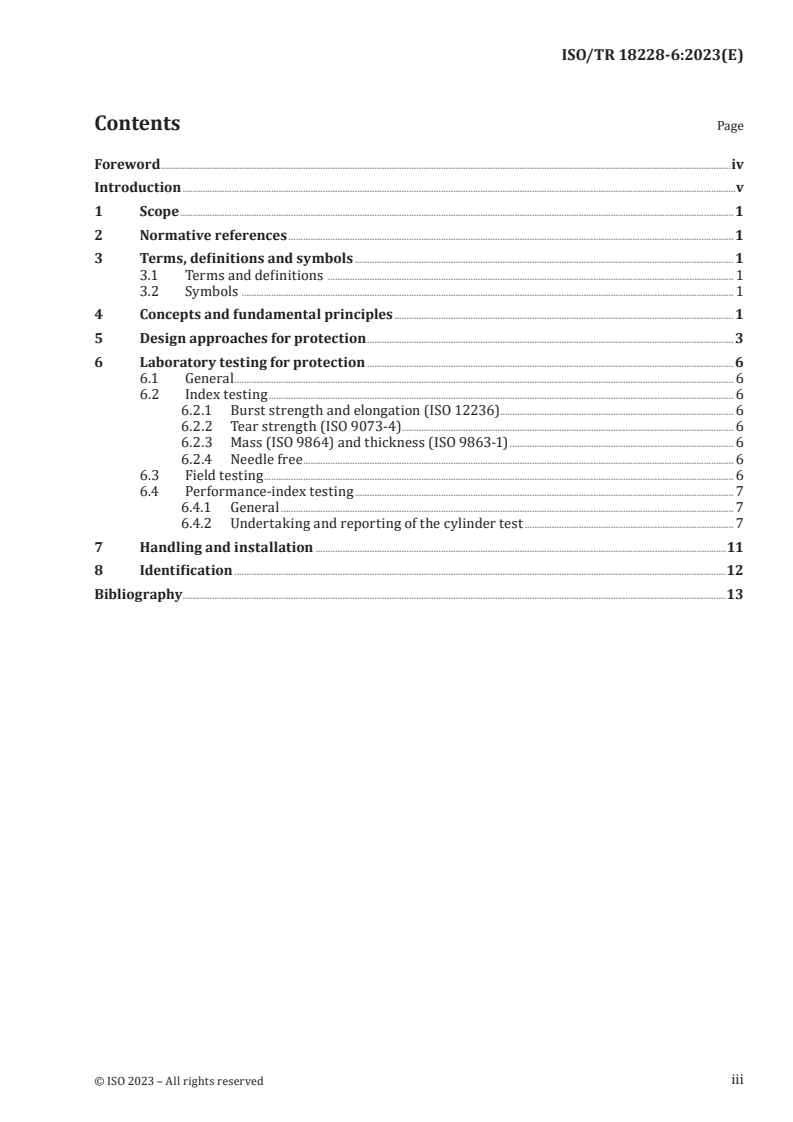
Contents Page
Foreword .iv
Introduction .v
1 Scope . 1
2 Normative references . 1
3 Terms, definitions and symbols . 1
3.1 Terms and definitions . 1
3.2 Symbols . . 1
4 Concepts and fundamental principles . 1
5 Design approaches for protection . 3
6 Laboratory testing for protection . 6
6.1 General . 6
6.2 Index testing . 6
6.2.1 Burst strength and elongation (ISO 12236). 6
6.2.2 Tear strength (ISO 9073-4) . 6
6.2.3 Mass (ISO 9864) and thickness (ISO 9863-1) . 6
6.2.4 Needle free . 6
6.3 Field testing . 6
6.4 Performance-index testing . 7
6.4.1 General . 7
6.4.2 Undertaking and reporting of the cylinder test . 7
7 Handling and installation .11
8 Identification .12
Bibliography .13
iii
Foreword
ISO (the International Organization for Standardization) is a worldwide federation of national standards
bodies (ISO member bodies). The work of preparing International Standards is normally carried out
through ISO technical committees. Each member body interested in a subject for which a technical
committee has been established has the right to be represented on that committee. International
organizations, governmental and non-governmental, in liaison with ISO, also take part in the work.
ISO collaborates closely with the International Electrotechnical Commission (IEC) on all matters of
electrotechnical standardization.
The procedures used to develop this document and those intended for its further maintenance are
described in the ISO/IEC Directives, Part 1. In particular, the different approval criteria needed for the
different types of ISO document should be noted. This document was drafted in accordance with the
editorial rules of the ISO/IEC Directives, Part 2 (see www.iso.org/directives).
ISO draws attention to the possibility that the implementation of this document may involve the use
of (a) patent(s). ISO takes no position concerning the evidence, validity or applicability of any claimed
patent rights in respect thereof. As of the date of publication of this document, ISO had not received
notice of (a) patent(s) which may be required to implement this document. However, implementers are
cautioned that this may not represent the latest information, which may be obtained from the patent
database available at www.iso.org/patents. ISO shall not be held responsible for identifying any or all
such patent rights.
Any trade name used in this document is information given for the convenience of users and does not
constitute an endorsement.
For an explanation of the voluntary nature of standards, the meaning of ISO specific terms and
expressions related to conformity assessment, as well as information about ISO's adherence to
the World Trade Organization (WTO) principles in the Technical Barriers to Trade (TBT), see
www.iso.org/iso/foreword.html.
This document was prepared by Technical Committee ISO/TC 221, Geosynthetics, Working group WG 6,
Design using geosynthetics.
A list of all parts in the ISO/TR 18228 series can be found on the ISO website.
Any feedback or questions on this document should be directed to the user’s national standards body. A
complete listing of these bodies can be found at www.iso.org/members.html.
iv
Introduction
The ISO/TR 18228 series provides guidance for designs using geosynthetics for soils and below ground
structures in contact with natural soils, fills and asphalt. The series contains 10 parts which cover
designs using geosynthetics, including guidance for characterisation of the materials to be used and
other factors affecting the design and performance of the systems which are particular to each part,
with ISO/TR 18228-1 providing general guidance relevant to the subsequent parts of the series.
The series is generally written in a limit state format and guidelines are provided in terms of partial
material factors and load factors for various applications and design lives, where appropriate.
This document includes information relating to the use of geosynthetics in a protective function.
v
TECHNICAL REPORT ISO/TR 18228-6:2023(E)
Design using geosynthetics —
Part 6:
Protection
1 Scope
This document provides general considerations to support design guidance for the evaluation of
geosynthetics to fulfil a protective function to any surface or material placed in contact with the
protective element.
2 Normative references
The following documents are referred to in the text in such a way that some or all of their content
constitutes requirements of this document. For dated references, only the edition cited applies. For
undated references, the latest edition of the referenced document (including any amendments) applies.
ISO 10318-1, Geosynthetics — Part 1: Terms and definitions
ISO 10318-2, Geosynthetics — Part 2: Symbols and pictograms
3 Terms, definitions and symbols
3.1 Terms and definitions
For the purposes of this document, the terms and definitions given in ISO 10318-1 apply.
ISO and IEC maintain terminology databases for use in standardization at the following addresses:
— ISO Online browsing platform: available at https:// www .iso .org/ obp
— IEC Electropedia: available at https:// www .electropedia .org/
3.2 Symbols
For the purposes of this document, the symbols in ISO 10318-2 apply.
4 Concepts and fundamental principles
Geosynthetics for protection (protectors) are frequently incorporated with other geosynthetics and soil
components in barrier systems. The objective of any barrier protector is to ensure that the stresses and
strains encountered during the construction phase and operational life of a site pose no significant risk
of damage to the barrier. The aim of the geosynthetic protection layer is to limit damage to the barrier
caused by the drainage aggregate placed above the barrier (see Figure 1 and Figure 2). Designers would
normally assess the potential for stresses and strains in the protector. This document covers the use of
geosynthetics as a protection layer for barriers.
Figure 1 — Drainage aggregate in contact with protection geotextile
Figure 2 — Placement of drainage aggregate
The purpose of the protective layer is to:
— minimize the risk of barrier damage or puncture during construction i.e. placement of the aggregate
drainage layer (dynamic loads) (static loads). The test methods described in Clause 4 don’t cover this
aspect of the design. Test pads using the actual geotextile grade, drainage aggregate and placement
equipment are normally performed in order to assess the minimum aggregate placement thickness.
Figure 3 shows barrier damage from a rounded river gravel due to trafficking with <150 mm cover;
and
— minimize the localized strains in the barrier during the subsequent operation and life of the
containment facility. Hence reducing the risk for future mechanical damage forming due to, for
example, environmental stress cracking.
Figure 3 — Barrier damage due to construction traffic
Figure 4 — Deformation without protection layer
Figure 5 — Deformation with protection layer
A geosynthetic can provide some stress reduction (Figures 4 and 5) however, this layer alone would not
normally be relied upon to reduce all stresses from the barrier. While strain minimization is desirable,
designers would normally be aware that zero strain is unlikely to be achieved.
5 Design approaches for protection
Table 1 outlines some of the common issues designers normally consider in selecting the most effective
geosynthetic for protection.
Table 1 — Issues considered by designers
Environment Issue
— The likely stresses and strains imposed during the
construction period.
— The likely stresses and strains imposed by
settlement and movement.
— The likely stresses and strains imposed by the
materials placed in contact with the geosynthetic,
particularly any drainage stone.
Physical
— The duration of exposure to ultraviolet light.
— The likely temperatures expected adjacent to the
geosynthetic and whether these are likely to have
a damaging effect upon the material properties in
any way.
— The interface friction angles between the materials
around the geosynthetics and the geosynthetics
themselves, particularly on slopes.
— The likely interaction between the geosynthetic
and the material around the geosynthetic. It is
usual for there to be little or no interaction.
— The polymeric structure of the geosynthetic itself
and whether it will be prone to degradation which
Chemical would affect its ability to protect the barrier. The
polymeric structure would normally be such as
to cover the predicted life of the geosynthetic and
barrier.
— The effects of mineral precipitation on the
geosynthetics performance.
— The effects of microbial growth on the polymer of
the geosynthetic.
Biological
— The effects of microbial growth on the
characteristics of the geosynthetic.
Currently there are two main approaches regarding the design of protective geosynthetics: strain
minimization and resistance to puncture.
Strain minimization considers whether the protective effect of a protection layer is sufficient if the load
distribution is dispersed to such an extent that only slight indentations arise in the barrier. By limiting
the strain of a barrier to within a strain limit, damage can usually be prevented in the microstructure
of the material that would otherwise develop when strains exceed this limit. Excessive strain can
sometimes develop into macroscopic stress cracks. Conversely, stress crack formation is impossible
when deformations stay below this limiting strain, regardless of the stresses imposed.
[1]
A limiting value for the permissible deformation can be derived another way. Koch et al. suggested
that tensile stresses be considered. These arise from different deformation events, taking stress
relaxation in the barrier into account. The stresses are then compared with the stress level that the
HDPE material can tolerate over the long-term without stress crack formation (long-term pipe pressure
tests).
[2]
Narejo defined levels of protection against puncture for barriers under typical loading conditions as
follows:
— Level I: typically applied to barrier systems for hazardous waste facilities. This level requires that
the barrier system be designed such that less than 0,25 % localized strain (average strain over the
length of the indentation measured in 3 mm increments) occurs in the barrier from the imposed
loading.
— Level II: (intermediate protection level) for non-hazardous waste facilities. The “intermediate
protection level” lies between level I protection and the yield of an GBRP. The yield of GBRPs in the
puncture mode is considered as a failure of level II protection. In other words, the liner system is
allowed to have barrier strains greater than 0,25 %, but not if it results in yielding of an GBRP.
[3] [4] [5] [6]
Wilson-Fahmy et al., Narejo et al., Koerner et al. and, more recently, Koerner et al. provide a
basis for protection layer design consistent with this philosophy.
The maximum of 0,25 % local strain (Ԑ ) was proposed by the German “Quo Vadi
...
Questions, Comments and Discussion
Ask us and Technical Secretary will try to provide an answer. You can facilitate discussion about the standard in here.
Loading comments...