

ISO/IEC 30108-1:2015
(Main)Information technology — Biometric Identity Assurance Services — Part 1: BIAS services
General Information
- Abstract
ISO/IEC 30108-1:2015 defines the architecture, operations, data elements, and basic requirements for biometric identity assurance services ? a framework for the implementation of generic, biometric-based identity services within a services-oriented environment. An identity in the context of BIAS comprises a subject, biographic data, and biometric data. Other parts are intended to define specific BIAS implementations (or bindings) within specific environments, for example, SOAP web services. BIAS services are generic in nature, being modality neutral, and not targeted at any particular business application. These services include those related to identity data management, transformation, and biometric comparison. Services are invoked by a BIAS requester and implemented by a BIAS service provider (responder). It does not prescribe the architecture or business logic of either the requester or service provider. Two categories of identity services are defined ? primitive and aggregate. Primitive services are more atomic and well-defined, whereas the aggregate services tend to be higher level and enable more flexibility on the part of the BIAS service provider. Two identity models are also defined ? person-centric and encounter-based. Person-centric systems maintain a single up-to-date record (set of data) for a given subject, whereas an encounter-based system retains data related to each interaction the subject has with the system. ISO/IEC 30108-1:2015 represents a version of BIAS subsequent to that previously standardized by INCITS and OASIS, therefore, it is denoted as version 2.0.
- Status
- Withdrawn
- Publication Date
- 02-Nov-2015
- Technical Committee
- ISO/IEC JTC 1/SC 37 - Biometrics
- Drafting Committee
- ISO/IEC JTC 1/SC 37 - Biometrics
- Current Stage
- 9599 - Withdrawal of International Standard
- Start Date
- 12-Jan-2026
- Completion Date
- 29-Aug-2026
Buy Documents

ISO/IEC 30108-1:2015 - Information technology — Biometric Identity Assurance Services — Part 1: BIAS services/7/2016


ISO/IEC 30108-1:2015 - Information technology -- Biometric Identity Assurance Services
Overview
ISO/IEC 30108-1:2015 - Information technology - Biometric Identity Assurance Services (BIAS) - Part 1: BIAS services - defines a framework for implementing generic, biometric-based identity services in a service-oriented environment. Published in 2015 (corrected 2016), this standard describes architecture, operations, data elements and baseline requirements for BIAS. It is modality-neutral, application-agnostic, and represents BIAS version 2.0 (successor to earlier INCITS/OASIS work).
Key topics and requirements
- Service-oriented architecture (SOA): Defines how BIAS services fit into SOA environments and interactions between a BIAS requester and a BIAS service provider.
- Service categories: Two types of services are specified:
- Primitive services - atomic, well-defined operations (e.g., Create Subject, Add Subject To Gallery, Verify Subject, Transform Biometric Data).
- Aggregate services - higher-level operations that sequence primitives (e.g., Enrol, Identify, Verify, Update, Delete).
- Identity models:
- Person-centric - maintains a single up-to-date record per subject.
- Encounter-based - retains data per interaction or event.
- Data model and XML schema: Standardizes data elements and types for biographic data, biometric data (CBEFF/BIR referenced), document data, candidate lists, capabilities and fusion information; includes an interface XML schema for service payloads.
- Operational considerations: Error handling, notification codes, conformance rules, and security baseline elements are included.
- Implementation guidance: Informative annexes with sample data formats, example usage and encounter scenarios help implementers.
Applications and who uses it
ISO/IEC 30108-1 is designed for organizations implementing biometric identity services and can apply across sectors:
- System architects & integrators building biometric SOA or API-based identity platforms
- Biometrics and identity vendors developing modality-neutral service components
- Government agencies for national identity, border control, law enforcement and civil registration systems
- Enterprise security teams deploying centralized identity assurance, access control, or onboarding services
- Cloud service providers offering biometric verification or identity-as-a-service (IDaaS)
- Standards bodies and certification labs assessing conformance and interoperability
Related standards
- References to CBEFF (Common Biometric Exchange Formats Framework) appear in the data model.
- Other parts of the ISO/IEC 30108 series (not included here) specify specific bindings and environment implementations (for example, SOAP or REST bindings).
- Historical alignment: this edition follows BIAS definitions previously standardized by INCITS and OASIS.
Keywords: ISO/IEC 30108-1, Biometric Identity Assurance Services, BIAS, biometric services, identity management, service-oriented architecture, person-centric, encounter-based, CBEFF, XML schema.
Relations
- Effective Date
- 17-Sep-2022
Buy Documents
ISO/IEC 30108-1:2015 - Information technology — Biometric Identity Assurance Services — Part 1: BIAS services/7/2016
ISO/IEC 30108-1:2015 - Information technology -- Biometric Identity Assurance Services
Get Certified
Connect with accredited certification bodies for this standard

BSI Group
BSI (British Standards Institution) is the business standards company that helps organizations make excellence a habit.

NYCE
Mexican standards and certification body.
Sponsored listings
Frequently Asked Questions
ISO/IEC 30108-1:2015 is a standard published by the International Organization for Standardization (ISO). Its full title is "Information technology — Biometric Identity Assurance Services — Part 1: BIAS services". This standard covers: ISO/IEC 30108-1:2015 defines the architecture, operations, data elements, and basic requirements for biometric identity assurance services ? a framework for the implementation of generic, biometric-based identity services within a services-oriented environment. An identity in the context of BIAS comprises a subject, biographic data, and biometric data. Other parts are intended to define specific BIAS implementations (or bindings) within specific environments, for example, SOAP web services. BIAS services are generic in nature, being modality neutral, and not targeted at any particular business application. These services include those related to identity data management, transformation, and biometric comparison. Services are invoked by a BIAS requester and implemented by a BIAS service provider (responder). It does not prescribe the architecture or business logic of either the requester or service provider. Two categories of identity services are defined ? primitive and aggregate. Primitive services are more atomic and well-defined, whereas the aggregate services tend to be higher level and enable more flexibility on the part of the BIAS service provider. Two identity models are also defined ? person-centric and encounter-based. Person-centric systems maintain a single up-to-date record (set of data) for a given subject, whereas an encounter-based system retains data related to each interaction the subject has with the system. ISO/IEC 30108-1:2015 represents a version of BIAS subsequent to that previously standardized by INCITS and OASIS, therefore, it is denoted as version 2.0.
ISO/IEC 30108-1:2015 defines the architecture, operations, data elements, and basic requirements for biometric identity assurance services ? a framework for the implementation of generic, biometric-based identity services within a services-oriented environment. An identity in the context of BIAS comprises a subject, biographic data, and biometric data. Other parts are intended to define specific BIAS implementations (or bindings) within specific environments, for example, SOAP web services. BIAS services are generic in nature, being modality neutral, and not targeted at any particular business application. These services include those related to identity data management, transformation, and biometric comparison. Services are invoked by a BIAS requester and implemented by a BIAS service provider (responder). It does not prescribe the architecture or business logic of either the requester or service provider. Two categories of identity services are defined ? primitive and aggregate. Primitive services are more atomic and well-defined, whereas the aggregate services tend to be higher level and enable more flexibility on the part of the BIAS service provider. Two identity models are also defined ? person-centric and encounter-based. Person-centric systems maintain a single up-to-date record (set of data) for a given subject, whereas an encounter-based system retains data related to each interaction the subject has with the system. ISO/IEC 30108-1:2015 represents a version of BIAS subsequent to that previously standardized by INCITS and OASIS, therefore, it is denoted as version 2.0.
ISO/IEC 30108-1:2015 is classified under the following ICS (International Classification for Standards) categories: 35.040 - Information coding; 35.240.15 - Identification cards. Chip cards. Biometrics. The ICS classification helps identify the subject area and facilitates finding related standards.
ISO/IEC 30108-1:2015 has the following relationships with other standards: It is inter standard links to ISO/IEC 30108-1:2026. Understanding these relationships helps ensure you are using the most current and applicable version of the standard.
ISO/IEC 30108-1:2015 is available in PDF format for immediate download after purchase. The document can be added to your cart and obtained through the secure checkout process. Digital delivery ensures instant access to the complete standard document.
Standards Content (Sample)
INTERNATIONAL ISO/IEC
STANDARD 30108-1
First edition
2015-11-01
Corrected version
2016-04-15
Information technology — Biometric
Identity Assurance Services —
Part 1:
BIAS services
Technologies de l’information — Service d’assurance de l’identité
biométrique (BIAS) —
Partie 1: Services BIAS
Reference number
©
ISO/IEC 2015
© ISO/IEC 2015, Published in Switzerland
All rights reserved. Unless otherwise specified, no part of this publication may be reproduced or utilized otherwise in any form
or by any means, electronic or mechanical, including photocopying, or posting on the internet or an intranet, without prior
written permission. Permission can be requested from either ISO at the address below or ISO’s member body in the country of
the requester.
ISO copyright office
Ch. de Blandonnet 8 • CP 401
CH-1214 Vernier, Geneva, Switzerland
Tel. +41 22 749 01 11
Fax +41 22 749 09 47
copyright@iso.org
www.iso.org
ii © ISO/IEC 2015 – All rights reserved
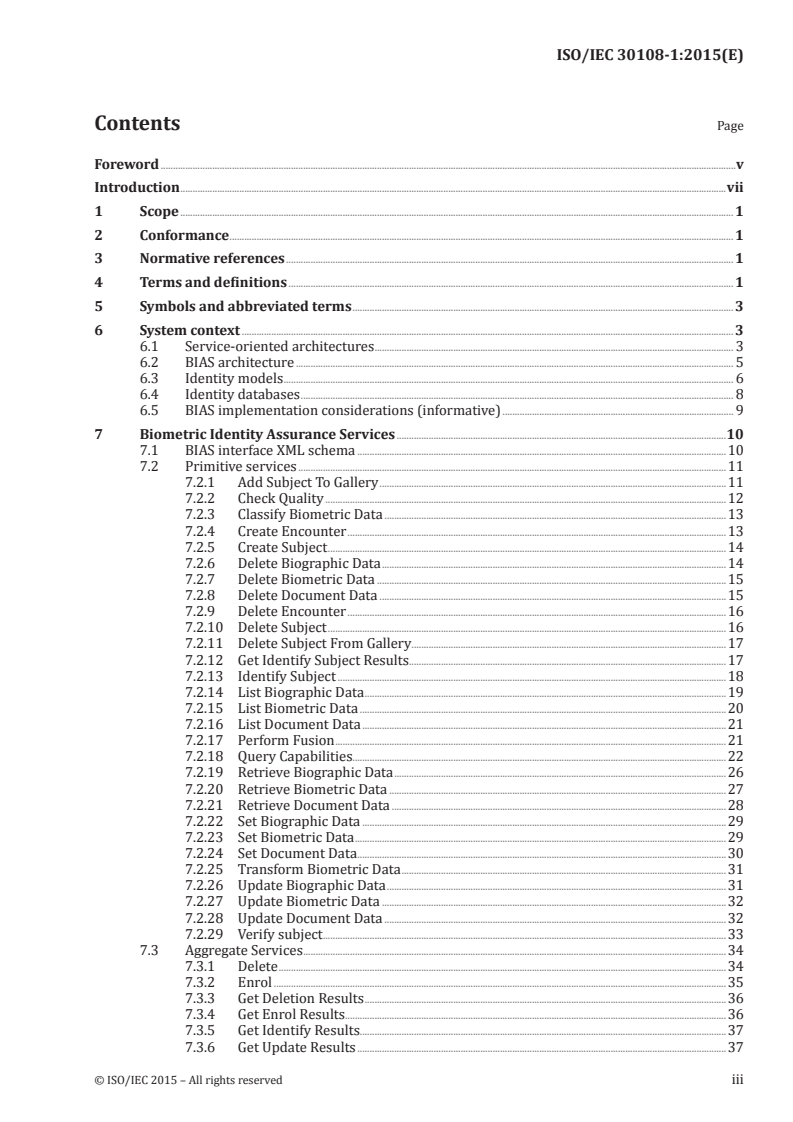
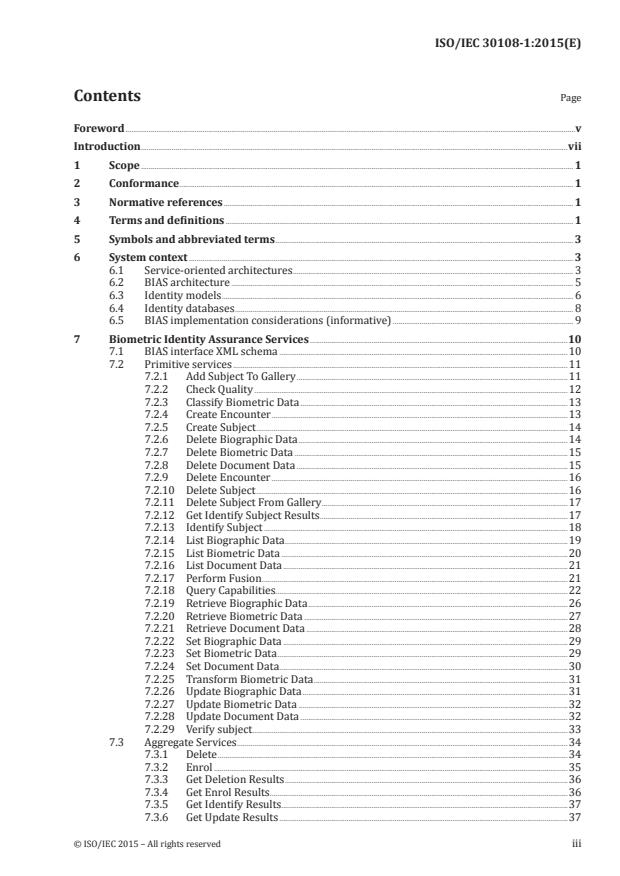
Contents Page
Foreword .v
Introduction .vii
1 Scope . 1
2 Conformance . 1
3 Normative references . 1
4 Terms and definitions . 1
5 Symbols and abbreviated terms . 3
6 System context . 3
6.1 Service-oriented architectures . 3
6.2 BIAS architecture . 5
6.3 Identity models . 6
6.4 Identity databases . 8
6.5 BIAS implementation considerations (informative) . 9
7 Biometric Identity Assurance Services .10
7.1 BIAS interface XML schema .10
7.2 Primitive services .11
7.2.1 Add Subject To Gallery .11
7.2.2 Check Quality .12
7.2.3 Classify Biometric Data .13
7.2.4 Create Encounter .13
7.2.5 Create Subject .14
7.2.6 Delete Biographic Data .14
7.2.7 Delete Biometric Data .15
7.2.8 Delete Document Data .15
7.2.9 Delete Encounter .16
7.2.10 Delete Subject .16
7.2.11 Delete Subject From Gallery .17
7.2.12 Get Identify Subject Results.17
7.2.13 Identify Subject .18
7.2.14 List Biographic Data .19
7.2.15 List Biometric Data .20
7.2.16 List Document Data .21
7.2.17 Perform Fusion .21
7.2.18 Query Capabilities.22
7.2.19 Retrieve Biographic Data .26
7.2.20 Retrieve Biometric Data .27
7.2.21 Retrieve Document Data .28
7.2.22 Set Biographic Data .29
7.2.23 Set Biometric Data .29
7.2.24 Set Document Data .30
7.2.25 Transform Biometric Data .31
7.2.26 Update Biographic Data .31
7.2.27 Update Biometric Data .32
7.2.28 Update Document Data .32
7.2.29 Verify subject .33
7.3 Aggregate Services .34
7.3.1 Delete .34
7.3.2 Enrol .35
7.3.3 Get Deletion Results .36
7.3.4 Get Enrol Results.36
7.3.5 Get Identify Results.37
7.3.6 Get Update Results .37
© ISO/IEC 2015 – All rights reserved iii
7.3.7 Get Verify Results .38
7.3.8 Identify .38
7.3.9 Retrieve Data .40
7.3.10 Update .40
7.3.11 Verify .41
8 Data elements and data types .42
8.1 Biographic data .42
8.1.1 Biographic Data Type . .42
8.1.2 Biographic Data Item Type.43
8.1.3 Biographic Data Set Type .43
8.1.4 Biographic Data List Type .44
8.2 Biometric Data.44
8.2.1 CBEFF BIR Type .44
8.2.2 CBEFF BIR List Type .45
8.2.3 Biometric Data Element Type .46
8.2.4 Biometric Data List Type .46
8.3 Document Data .46
8.3.1 Document Data Type .46
8.3.2 Document Data List Type .47
8.4 Candidate Lists .48
8.4.1 Candidate Type .48
8.4.2 Candidate List Type .48
8.5 Capabilities .49
8.5.1 Capability Type . .49
8.5.2 Capability List Type .49
8.6 Fusion Information .50
8.6.1 Fusion Information Type .50
8.6.2 Fusion Information List Type .50
8.6.3 Fusion Identity List Type .51
8.7 Other Data Types.51
8.7.1 Encounter Category Type .51
8.7.2 Encounter List Type .51
8.7.3 Information Type .52
8.7.4 List Filter Type .52
8.7.5 Option Type .52
8.7.6 Processing Options Type.53
8.7.7 Token Type .53
9 Error handling and notification .54
9.1 Successful service calls .54
9.2 Error condition codes .54
10 Security.56
Annex A (normative) Conformance requirements .57
Annex B (informative) Sample biographic data format references .66
Annex C (informative) Example usage scenarios .67
Annex D (informative) Example encounter scenarios .74
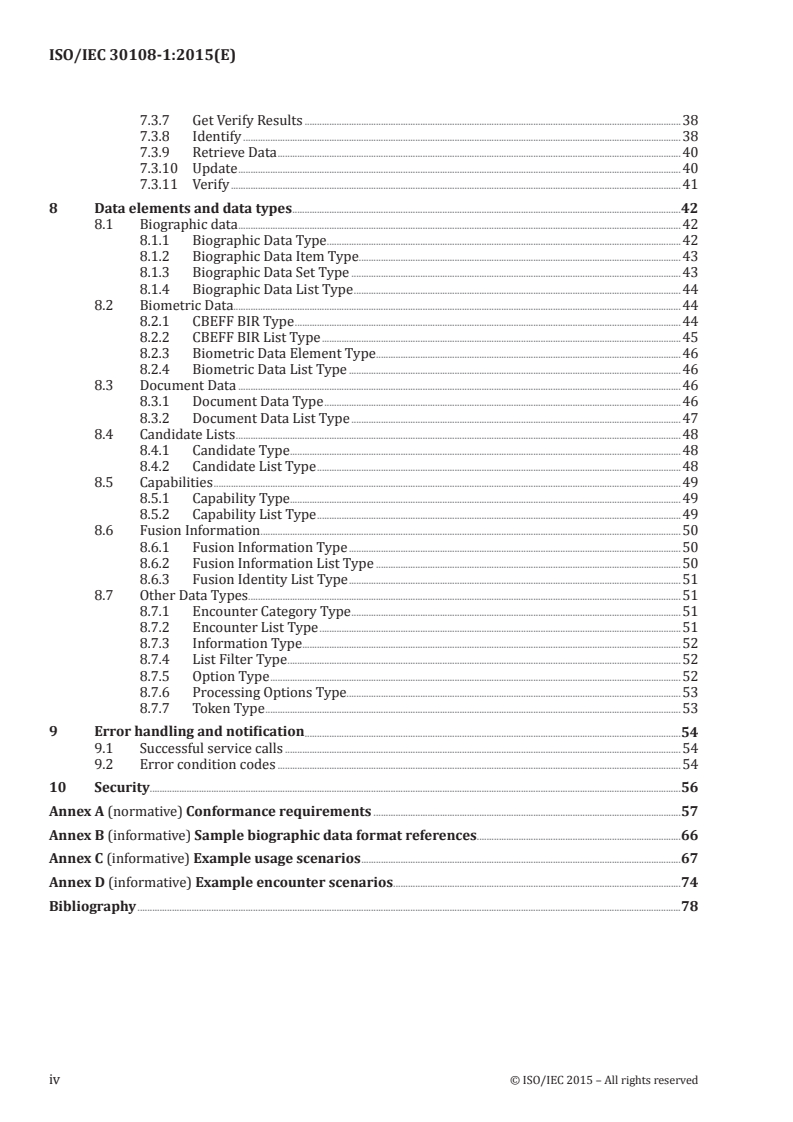
Bibliography .78
iv © ISO/IEC 2015 – All rights reserved
Foreword
ISO (the International Organization for Standardization) and IEC (the International Electrotechnical
Commission) form the specialized system for worldwide standardization. National bodies that are
members of ISO or IEC participate in the development of International Standards through technical
committees established by the respective organization to deal with particular fields of technical
activity. ISO and IEC technical committees collaborate in fields of mutual interest. Other international
organizations, governmental and non-governmental, in liaison with ISO and IEC, also take part in the
work. In the field of information technology, ISO and IEC have established a joint technical committee,
ISO/IEC JTC 1.
The procedures used to develop this document and those intended for its further maintenance are
described in the ISO/IEC Directives, Part 1. In particular the different approval criteria needed for
the different types of document should be noted. This document was drafted in accordance with the
editorial rules of the ISO/IEC Directives, Part 2 (see www.iso.org/directives).
Attention is drawn to the possibility that some of the elements of this document may be the subject
of patent rights. ISO and IEC shall not be held responsible for identifying any or all such patent
rights. Details of any patent rights identified during the development of the document will be in the
Introduction and/or on the ISO list of patent declarations received (see www.iso.org/patents).
Any trade name used in this document is information given for the convenience of users and does not
constitute an endorsement.
For an explanation on the meaning of ISO specific terms and expressions related to conformity
assessment, as well as information about ISO’s adherence to the WTO principles in the Technical
Barriers to Trade (TBT) see the following URL: Foreword - Supplementary information
The committee responsible for this document is ISO/IEC JTC 1, Information technology, Subcommittee
SC 37, Biometrics.
ISO/IEC 30108 consists of the following parts, under the general title Information technology —
Biometric Identity Assurance Services:
— Part 1: BIAS Services
This corrected version of ISO/IEC 30108-1:2015 incorporates the following corrections plus other
minor editorial modifications.
Table A.1: The following rows were missing and have been added to the end of the table:
Get Verify Results C* C* C*
Identify X X
Retrieve Data X X
Update X X X
Verify X X X
Capability Information Items
AggregateInputDataOptional X X X
AggregateInputDataRequired X X X
AggregateProcessingOption X X X
AggregateReturnData X X X
AggregateServiceDescription X X X
BiographicDataSet X X X X X
CBEFFPatronFormat X X X X X X X
© ISO/IEC 2015 – All rights reserved v
ClassificationAlgorithmType X
ConformanceClass X X X X X X X
Gallery X X X
IdentityModel X X X X X
ComparisonAlgorithm X X X X X X X
ComparisonScore X X X X X X X
QualityAlgorithm X
SupportedBiometric X X X X X X X
TransformOperation X
vi © ISO/IEC 2015 – All rights reserved
Introduction
This part of ISO/IEC 30108 defines the architecture, operations, data elements, and basic requirements
for biometric identity assurance services – a framework for the implementation of generic, biometric-
based identity services within a services-oriented environment. An identity in the context of BIAS
comprises a subject, biographic data, and biometric data. Other parts are intended to define specific
BIAS implementations (or bindings) within specific environments, for example, SOAP web services.
BIAS services are generic in nature, being modality neutral, and not targeted at any particular business
application. These services include those related to identity data management, transformation, and
biometric comparison. Services are invoked by a BIAS requester and implemented by a BIAS service
provider (responder). It does not prescribe the architecture or business logic of either the requester or
service provider.
Two categories of identity services are defined – primitive and aggregate. Primitive services are more
atomic and well-defined, whereas the aggregate services tend to be higher level and enable more
flexibility on the part of the BIAS service provider.
Two identity models are also defined – person-centric and encounter-based. Person-centric systems
maintain a single up-to-date record (set of data) for a given subject, whereas an encounter-based system
retains data related to each interaction the subject has with the system.
This part of ISO/IEC 30108 represents a version of BIAS subsequent to that previously standardized by
INCITS and OASIS, therefore, it is denoted as version 2.0.
© ISO/IEC 2015 – All rights reserved vii
INTERNATIONAL STANDARD ISO/IEC 30108-1:2015(E)
Information technology — Biometric Identity Assurance
Services —
Part 1:
BIAS services
1 Scope
This part of ISO/IEC 30108 defines biometric services used for identity assurance that are invoked over
a services-based framework. It provides a generic set of biometric and identity-related functions and
associated data definitions to allow remote access to biometric services.
The binding of these services to specific frameworks is not included in this part of ISO/IEC 30108, but
will be the subject of subsequent parts.
Although focused on biometrics, this part of ISO/IEC 30108 will necessarily include support for other
related identity assurance mechanisms such as biographic and document capabilities. BIAS is intended
to be compatible with and used in conjunction with other biometric standards as described in Clause 3.
Specification of biometric functionality is limited to remote (backend) services. Services between
a client-side application and biometric capture devices are not within the scope of this part of
ISO/IEC 30108.
Integration of biometric services as part of an authentication service or protocol is not within the scope
of this part of ISO/IEC 30108.
2 Conformance
Annex A specifies the conformance requirements for systems/components claiming conformance to
this part of ISO/IEC 30108.
3 Normative references
The following documents, in whole or in part, are normatively referenced in this document and are
indispensable for its application. For dated references, only the edition cited applies. For undated
references, the latest edition of the referenced document (including any amendments) applies.
ISO/IEC 19785-1, Information technology — Common Biometric Exchange Formats Framework — Part 1:
Data element specification
ISO/IEC 19785-3, Information technology — Common Biometric Exchange Formats Framework — Part 3:
Patron format specifications
4 Terms and definitions
For the purposes of this document, the following terms and definitions apply.
4.1
biometric sample
analogue or digital representation of biometric characteristics prior to biometric feature extraction
Note 1 to entry: As an example, a record containing the image of a finger is a biometric sample.
© ISO/IEC 2015 – All rights reserved 1
4.2
claim to identity
biometric claim
assertion that an individual is or is not the bodily source of a specified or unspecified biometric
reference in an identity assurance system
4.3
encounter
event in which the BIAS requester interacts with a subject (4.11) resulting in data being collected during
or about the encounter
Note 1 to entry: The event may involve collection of biographic, biometric, document, and/or contextual data
during an enrolment or recognition interaction.
4.4
encounter-centric system
system that supports encounter processing maintaining a one-to-many relationship between subjects
(4.11) and encounters (4.3) and which does not necessarily contain a single, unique set of information
for each subject
4.5
gallery
group of subjects (4.11) related by a common purpose, designation, or status
EXAMPLE A watch list or a set of subjects entitled to a certain benefit.
4.6
identification
biometric identification
process of searching against a biometric enrolment database to find and return the biometric reference
identifier(s) attributable to a single individual
4.7
identity assurance
process of establishing, determining, and/or confirming a subject identity
4.8
merge
combination of biometric data during the process of updating an enrolment record
Note 1 to entry: The “merge” operation is implementation specific, however, it may include either adding a new
sample to a multi-sample record or performing some level of biometric fusion, for example, sample or feature
level fusion.
4.9
merge
combination of two or more subject records into a single subject record
4.10
person-centric model
identity model in which a single master record is maintained on a subject (4.11) which is updated over
time when additional, newer, or better biographic, biometric, and/or document information becomes
available and which does not maintain separate historical data records for each system encounter with
the subject
4.11
subject
person who is known to an identity assurance system
Note 1 to entry: The person may also be a biometric capture subject or biometric data subject, but this is not the
case in all situations.
2 © ISO/IEC 2015 – All rights reserved
4.12
verification
biometric verification
process of confirming a biometric claim (4.2) through biometric comparison
Note 1 to entry: Verification is usually performed through a one-to-one comparison in which a biometric sample
(4.1) from one individual (probe) is compared to a biometric reference(s) from one individual to produce a
comparison decision (match/no-match) and optionally, a comparison score.
5 Symbols and abbreviated terms
AFIS Automated Fingerprint Identification System
BIAS Biometric Identity Assurance Services
BIR Biometric Information Record
CBEFF Common Biometric Exchange Formats Framework
ESB Enterprise Service Bus
ID Identity/Identification/Identifier
OASIS Organization for the Advancement of Structured Information Standards
SOA Service-Oriented Architecture
SOAP Simple Object Access Protocol
6 System context
This clause provides an overview of Service-Oriented Architectures, the BIAS architecture, and BIAS
implementation considerations.
6.1 Service-oriented architectures
Service-Oriented Architectures are software architectures in which reusable services are deployed
onto application servers and then consumed by clients in different applications or business processes.
They are intended to decouple the implementation of a software service from the interface that
calls that service. This allows clients of a service to rely on a consistent interface regardless of the
implementation technology of the service [JDJ] (see Annex C).
Biometric services are one of the types of services that can be provided over such a remote interface
in a distributed information system across a collection of networks. This can occur in a 2-tier, 3-tier, or
N-tier environment. A diagram of a simple N-tier architecture is shown in Figure 1.
© ISO/IEC 2015 – All rights reserved 3
Figure 1 — Simple N-Tier architecture
In this diagram, BIAS services are defined between the application logic layer and the resource
management layer.
Examples of biometric resources that are of interest may include one or more of the following:
— A fingerprint verification server;
— A 1:N iris search engine;
— A facial biometric watch list;
— A criminal or civil automated fingerprint identification system (AFIS);
— A name-based biographic identity database;
— An archive of biometric identifiers;
— A population of subjects.
It is desired that a generic set of services be defined that allows clients to remotely access and manage
these capabilities. To the extent possible, domain specific implementations are to be avoided.
NOTE This part of ISO/IEC 30108 is intended to support a wide variety of application domains which may
include government (e.g. background checking, border management, and criminal justice), enterprise (e.g. logical
access control), and commercial biometric identity management implementations (e.g. employee databases).
Services are well defined, self-contained modules that provide standard business functionality and
are independent of the state or context of other services. Services can be easily assembled to form a
collection of autonomous and loosely-coupled business processes.
It is not the intention that specific business logic be instantiated within the service definitions – this
logic is more appropriate within the application logic layer – either in the higher level system initiating
the series of requests, or within the middleware [e.g. an enterprise service bus (ESB), workflow
manager, or biometric middleware] as appropriate. To do so would of necessity make the interface less
generic, modular, and flexible and require that the interface be updated each time the logic changed,
defeating one of the primary purposes of the services architecture.
The services to be defined are not targeted at a particular SOA implementation or framework.
Instead, they are defined in such a manner as to be able to be utilised within any such architecture.
This is accomplished by separately defining (in another standard) the bindings to that
4 © ISO/IEC 2015 – All rights reserved
architecture/implementation. For example, Web services bindings are defined in the OASIS BIAS
Messaging Protocol.
6.2 BIAS architecture
The BIAS architecture consists of the following components:
— BIAS services (interface definition);
— BIAS data (schema definition);
— BIAS bindings (defined outside this standard).
The BIAS services expose a common set of operations to external requesters of these operations.
These requesters may be an external system, a Web application, or an intermediary. The BIAS services
themselves are platform and language independent. The BIAS services may be implemented with
differing technologies on multiple platforms. For example, OASIS is defining Web services bindings for
the BIAS services.
Figure 2 depicts the BIAS services within an application environment. BIAS services provide basic
biometric functionality as modular and independent operations which can be assembled in many
different ways to perform and/or support a variety of business processes. BIAS services can be publicly
exposed directly and/or utilised indirectly in support of a service-provider’s own public services.
© ISO/IEC 2015 – All rights reserved 5
Figure 2 — BIAS application environment
6.3 Identity models
Some identity systems are person-centric and others are encounter-centric. That is, some base
transactions on a unique identifier associated with an individual human being while others track
6 © ISO/IEC 2015 – All rights reserved
“biometric encounters” which may or may not be linked through such an identifier. Figure 3 provides
context to further explain these concepts.
Figure 3 — Person-centric and encounter-centric views
In a person-centric model, as new data is received for a given subject, it is either added (if it does not
already exist) or replaces previous data (if it already exists). For example, referring to Figure 3, if the
initial enrolment contains biographic data and a set of fingerprints these are stored. If subsequently,
a photo is received, it is added to the person-centric record. If later new biographic data is received
(e.g. new address), it replaces the originally stored data. In this way, the “master” subject record
is continuously updated to contain the most accurate, current information with (in general, but not
exclusively) no need to retain historical data. This model is used, for example, in access control type
systems.
An encounter-centric model, in comparison, retains all data received for every interaction with
the subject. Initially, the subject record is created and populated with enrolment data (for example,
fingerprint, facial photo, and biographic data as shown in Figure 3). Subsequently, if new fingerprint
data is captured for that subject (during an interaction event, or encounter), a new encounter is created
containing all data obtained during that encounter. The system now has two encounters for that subject.
Later, in a third encounter, fingerprint and biographic data is captured and stored, in addition to the
data previously stored in encounters one and two. Encounter IDs, unique to a subject, are assigned to
each encounter. This model is used, for example, in case management type systems.
EXAMPLE In a border management system, a person is enroled in the system the first time they enter the
country. A subject is created and biometric and biographic data are set, following any required identification
operation(s). This represents the first encounter. Subsequently, when the person crosses the border in the future,
their passport number is used as a claim of identity, a verification of that identity is performed, as well as any
identification operations. Biometric and biographic data collected during this interaction is retained as another
separately identified encounter (see Annex D for additional use cases).
Encounters can be classified as either enrolment or recognition encounters. Figure 4 depicts an example
in which both biographic and biometric data are submitted during different types of encounters.
Diagrams for additional scenarios are found in Annex D.
© ISO/IEC 2015 – All rights reserved 7
Figure 4 — Example of encounter types
NOTE Encounter type may be set using the Create Encounter operation. In addition, the Purpose field
within the CBEFF header may be set to indicate this (see 8.2 for more information on biometric data).
6.4 Identity databases
Biometric systems frequently include both a master database as well as a comparison engine database.
The former is used to store all identity information (including encounter information). The latter,
however, usually contains a single set of biometric reference data, even within an encounter-based
system and minimal, if any, biographic data. Systems use various schemes to determine which data to
include within the biometric engines and when that data is updated. Figure 5 provides an example of
how these databases may exist within a BIAS implementation. This is not always the case; however, as
in some systems the master and comparison engine databases may be one and the same.
Within this part of ISO/IEC 30108, all services (with the exception of comparison services, such as
IdentifySubject) operate upon the master database unless otherwise stated, with any associated
updates to the comparison engine databases (when separate) left to the policies of the BIAS service
provider.
8 © ISO/IEC 2015 – All rights reserved
Figure 5 — Example master/engine database implementation
EXAMPLE In the previous border management example, fingerprint, face, and iris biometric data is collected
on the first encounter. All information is stored in the master database. Additionally, selected fingerprint and iris
data are processed into templates and stored within the appropriate comparison engine database. During the
second encounter, only the data required for verification and identification is collected, and this data is stored
in the master database. Templates are generated and used to perform the comparison operations. Based on
service provider policy, following successful verification, it is found that the left index and ring fingerprints are
of better quality than those collected during the first encounter and the engine database is updated with these
fingerprints (replacing the original templates).
6.5 BIAS implementation considerations (informative)
Biometric services and the applications which use them, particularly in an identity assurance context,
have unique characteristics which are summarised below:
— Some services can be performed very quickly while others (such as a 1:N identification within a
large population) can take considerable time (on the order of hours) to complete. Therefore, the
interface should support both synchronous and asynchronous operations;
— Biometric operations may be singular or multi-biometric.
Biometric data is in nearly all cases considered personal information and thus privacy protection is
always a consideration.
— Before a biometric, biographic and/or document data transaction occurs between two different
entities, the terms and conditions of the use of the data should be negotiated and made transparent.
The following questions may be addressed:
— Who will be the recipient of the data to be shared?
— For what purpose(s) can the recipient use this data?
— Who/what authorises this data to be shared with the recipient for this purpose?
— How long may the recipient retain the data?
— How must data be destroyed at the end of a retention period?
© ISO/IEC 2015 – All rights reserved 9
— May the recipient share this data with other entities? If so, with whom? For what purpose(s)?
How long may the third party retain the data?
— A recipient would later have to understand what they are accepting and the terms and conditions of
the agreement.
NOTE Implementers may consider implementation of a Biometric Policy (BP) and/or Biometric Practice
Statement (BPS0 as defined in ISO 19092. A BP is a set of rules that specify the applicability of biometric
information for use by a class of applications or community that share common security and privacy requirements.
A BP may be used to control access to biometric information by an entity acting in some role or for some purpose
(e.g. information sharing). A BPS describes the security and privacy practices that an organization follows
during the biometric information life cycle, including business, legal, regulatory, and technical considerations for
information sharing and exchange.
Security is important for any kind of SOA. As in the case of privacy protection, before a biometric,
biographic and/or document data transaction occurs between two different entities, the security
characteristics provided by the BIAS implementation should be known.
For the purposes of data integrity and quality assurance, a capability for creation of a chain of custody
should be created to track events, changes, and transfers of data. For example, the deletion of data
should be tracked and logged.
NOTE Organization management should require that formal mechanisms be used to document and
report biometric system events, including system malfunctions and other security incidents, and additions,
modifications, deletions, and transfers of data. Incident management results and metrics gathered from
biometric systems event journals should be used in a periodic review process that causes security controls to be
re-evaluated over time. An on-going, systematic approach to reviews should inform the continuous improvement
of the biometric information management system over time.
Methods for service level monitoring and compliance with agreed-upon service level agreements may
be critical to requesters and implementers. Terms and conditions for these capabilities may need to be
negotiated.
7 Biometric Identity Assurance Services
This clause defines two categories of BIAS services, primitive and aggregate. Primitive services are
lower-level operations that are used to request a specific capability. Aggregate services operate at a
higher-level, performing a sequence of primitive operations in a single request. (An example of such
a sequence would be a negative search where a 1:N identification which results in no matches being
found is immediately followed by the addition of the biometric sample into that search population.)
Implementers are not restricted to one or the other but may provide (and requesters use) a mixture of
both primitive and aggregate types.
Aggregate services do not have to utilize primitive services.
7.1 BIAS interface XML schema
A goal for this BIAS Standard is to be as language and protocol independent as possible. To that end, the
services are specified using a simple XML schema as defined below.
minOccurs="0" maxOccurs="unbounded" />
...
INTERNATIONAL ISO/IEC
STANDARD 30108-1
First edition
2015-11-01
Corrected version
2016-04-15
Information technology — Biometric
Identity Assurance Services —
Part 1:
BIAS services
Technologies de l’information — Service d’assurance de l’identité
biométrique (BIAS) —
Partie 1: Services BIAS
Reference number
©
ISO/IEC 2015
© ISO/IEC 2015, Published in Switzerland
All rights reserved. Unless otherwise specified, no part of this publication may be reproduced or utilized otherwise in any form
or by any means, electronic or mechanical, including photocopying, or posting on the internet or an intranet, without prior
written permission. Permission can be requested from either ISO at the address below or ISO’s member body in the country of
the requester.
ISO copyright office
Ch. de Blandonnet 8 • CP 401
CH-1214 Vernier, Geneva, Switzerland
Tel. +41 22 749 01 11
Fax +41 22 749 09 47
copyright@iso.org
www.iso.org
ii © ISO/IEC 2015 – All rights reserved
Contents Page
Foreword .v
Introduction .vii
1 Scope . 1
2 Conformance . 1
3 Normative references . 1
4 Terms and definitions . 1
5 Symbols and abbreviated terms . 3
6 System context . 3
6.1 Service-oriented architectures . 3
6.2 BIAS architecture . 5
6.3 Identity models . 6
6.4 Identity databases . 8
6.5 BIAS implementation considerations (informative) . 9
7 Biometric Identity Assurance Services .10
7.1 BIAS interface XML schema .10
7.2 Primitive services .11
7.2.1 Add Subject To Gallery .11
7.2.2 Check Quality .12
7.2.3 Classify Biometric Data .13
7.2.4 Create Encounter .13
7.2.5 Create Subject .14
7.2.6 Delete Biographic Data .14
7.2.7 Delete Biometric Data .15
7.2.8 Delete Document Data .15
7.2.9 Delete Encounter .16
7.2.10 Delete Subject .16
7.2.11 Delete Subject From Gallery .17
7.2.12 Get Identify Subject Results.17
7.2.13 Identify Subject .18
7.2.14 List Biographic Data .19
7.2.15 List Biometric Data .20
7.2.16 List Document Data .21
7.2.17 Perform Fusion .21
7.2.18 Query Capabilities.22
7.2.19 Retrieve Biographic Data .26
7.2.20 Retrieve Biometric Data .27
7.2.21 Retrieve Document Data .28
7.2.22 Set Biographic Data .29
7.2.23 Set Biometric Data .29
7.2.24 Set Document Data .30
7.2.25 Transform Biometric Data .31
7.2.26 Update Biographic Data .31
7.2.27 Update Biometric Data .32
7.2.28 Update Document Data .32
7.2.29 Verify subject .33
7.3 Aggregate Services .34
7.3.1 Delete .34
7.3.2 Enrol .35
7.3.3 Get Deletion Results .36
7.3.4 Get Enrol Results.36
7.3.5 Get Identify Results.37
7.3.6 Get Update Results .37
© ISO/IEC 2015 – All rights reserved iii
7.3.7 Get Verify Results .38
7.3.8 Identify .38
7.3.9 Retrieve Data .40
7.3.10 Update .40
7.3.11 Verify .41
8 Data elements and data types .42
8.1 Biographic data .42
8.1.1 Biographic Data Type . .42
8.1.2 Biographic Data Item Type.43
8.1.3 Biographic Data Set Type .43
8.1.4 Biographic Data List Type .44
8.2 Biometric Data.44
8.2.1 CBEFF BIR Type .44
8.2.2 CBEFF BIR List Type .45
8.2.3 Biometric Data Element Type .46
8.2.4 Biometric Data List Type .46
8.3 Document Data .46
8.3.1 Document Data Type .46
8.3.2 Document Data List Type .47
8.4 Candidate Lists .48
8.4.1 Candidate Type .48
8.4.2 Candidate List Type .48
8.5 Capabilities .49
8.5.1 Capability Type . .49
8.5.2 Capability List Type .49
8.6 Fusion Information .50
8.6.1 Fusion Information Type .50
8.6.2 Fusion Information List Type .50
8.6.3 Fusion Identity List Type .51
8.7 Other Data Types.51
8.7.1 Encounter Category Type .51
8.7.2 Encounter List Type .51
8.7.3 Information Type .52
8.7.4 List Filter Type .52
8.7.5 Option Type .52
8.7.6 Processing Options Type.53
8.7.7 Token Type .53
9 Error handling and notification .54
9.1 Successful service calls .54
9.2 Error condition codes .54
10 Security.56
Annex A (normative) Conformance requirements .57
Annex B (informative) Sample biographic data format references .66
Annex C (informative) Example usage scenarios .67
Annex D (informative) Example encounter scenarios .74
Bibliography .78
iv © ISO/IEC 2015 – All rights reserved
Foreword
ISO (the International Organization for Standardization) and IEC (the International Electrotechnical
Commission) form the specialized system for worldwide standardization. National bodies that are
members of ISO or IEC participate in the development of International Standards through technical
committees established by the respective organization to deal with particular fields of technical
activity. ISO and IEC technical committees collaborate in fields of mutual interest. Other international
organizations, governmental and non-governmental, in liaison with ISO and IEC, also take part in the
work. In the field of information technology, ISO and IEC have established a joint technical committee,
ISO/IEC JTC 1.
The procedures used to develop this document and those intended for its further maintenance are
described in the ISO/IEC Directives, Part 1. In particular the different approval criteria needed for
the different types of document should be noted. This document was drafted in accordance with the
editorial rules of the ISO/IEC Directives, Part 2 (see www.iso.org/directives).
Attention is drawn to the possibility that some of the elements of this document may be the subject
of patent rights. ISO and IEC shall not be held responsible for identifying any or all such patent
rights. Details of any patent rights identified during the development of the document will be in the
Introduction and/or on the ISO list of patent declarations received (see www.iso.org/patents).
Any trade name used in this document is information given for the convenience of users and does not
constitute an endorsement.
For an explanation on the meaning of ISO specific terms and expressions related to conformity
assessment, as well as information about ISO’s adherence to the WTO principles in the Technical
Barriers to Trade (TBT) see the following URL: Foreword - Supplementary information
The committee responsible for this document is ISO/IEC JTC 1, Information technology, Subcommittee
SC 37, Biometrics.
ISO/IEC 30108 consists of the following parts, under the general title Information technology —
Biometric Identity Assurance Services:
— Part 1: BIAS Services
This corrected version of ISO/IEC 30108-1:2015 incorporates the following corrections plus other
minor editorial modifications.
Table A.1: The following rows were missing and have been added to the end of the table:
Get Verify Results C* C* C*
Identify X X
Retrieve Data X X
Update X X X
Verify X X X
Capability Information Items
AggregateInputDataOptional X X X
AggregateInputDataRequired X X X
AggregateProcessingOption X X X
AggregateReturnData X X X
AggregateServiceDescription X X X
BiographicDataSet X X X X X
CBEFFPatronFormat X X X X X X X
© ISO/IEC 2015 – All rights reserved v
ClassificationAlgorithmType X
ConformanceClass X X X X X X X
Gallery X X X
IdentityModel X X X X X
ComparisonAlgorithm X X X X X X X
ComparisonScore X X X X X X X
QualityAlgorithm X
SupportedBiometric X X X X X X X
TransformOperation X
vi © ISO/IEC 2015 – All rights reserved
Introduction
This part of ISO/IEC 30108 defines the architecture, operations, data elements, and basic requirements
for biometric identity assurance services – a framework for the implementation of generic, biometric-
based identity services within a services-oriented environment. An identity in the context of BIAS
comprises a subject, biographic data, and biometric data. Other parts are intended to define specific
BIAS implementations (or bindings) within specific environments, for example, SOAP web services.
BIAS services are generic in nature, being modality neutral, and not targeted at any particular business
application. These services include those related to identity data management, transformation, and
biometric comparison. Services are invoked by a BIAS requester and implemented by a BIAS service
provider (responder). It does not prescribe the architecture or business logic of either the requester or
service provider.
Two categories of identity services are defined – primitive and aggregate. Primitive services are more
atomic and well-defined, whereas the aggregate services tend to be higher level and enable more
flexibility on the part of the BIAS service provider.
Two identity models are also defined – person-centric and encounter-based. Person-centric systems
maintain a single up-to-date record (set of data) for a given subject, whereas an encounter-based system
retains data related to each interaction the subject has with the system.
This part of ISO/IEC 30108 represents a version of BIAS subsequent to that previously standardized by
INCITS and OASIS, therefore, it is denoted as version 2.0.
© ISO/IEC 2015 – All rights reserved vii
INTERNATIONAL STANDARD ISO/IEC 30108-1:2015(E)
Information technology — Biometric Identity Assurance
Services —
Part 1:
BIAS services
1 Scope
This part of ISO/IEC 30108 defines biometric services used for identity assurance that are invoked over
a services-based framework. It provides a generic set of biometric and identity-related functions and
associated data definitions to allow remote access to biometric services.
The binding of these services to specific frameworks is not included in this part of ISO/IEC 30108, but
will be the subject of subsequent parts.
Although focused on biometrics, this part of ISO/IEC 30108 will necessarily include support for other
related identity assurance mechanisms such as biographic and document capabilities. BIAS is intended
to be compatible with and used in conjunction with other biometric standards as described in Clause 3.
Specification of biometric functionality is limited to remote (backend) services. Services between
a client-side application and biometric capture devices are not within the scope of this part of
ISO/IEC 30108.
Integration of biometric services as part of an authentication service or protocol is not within the scope
of this part of ISO/IEC 30108.
2 Conformance
Annex A specifies the conformance requirements for systems/components claiming conformance to
this part of ISO/IEC 30108.
3 Normative references
The following documents, in whole or in part, are normatively referenced in this document and are
indispensable for its application. For dated references, only the edition cited applies. For undated
references, the latest edition of the referenced document (including any amendments) applies.
ISO/IEC 19785-1, Information technology — Common Biometric Exchange Formats Framework — Part 1:
Data element specification
ISO/IEC 19785-3, Information technology — Common Biometric Exchange Formats Framework — Part 3:
Patron format specifications
4 Terms and definitions
For the purposes of this document, the following terms and definitions apply.
4.1
biometric sample
analogue or digital representation of biometric characteristics prior to biometric feature extraction
Note 1 to entry: As an example, a record containing the image of a finger is a biometric sample.
© ISO/IEC 2015 – All rights reserved 1
4.2
claim to identity
biometric claim
assertion that an individual is or is not the bodily source of a specified or unspecified biometric
reference in an identity assurance system
4.3
encounter
event in which the BIAS requester interacts with a subject (4.11) resulting in data being collected during
or about the encounter
Note 1 to entry: The event may involve collection of biographic, biometric, document, and/or contextual data
during an enrolment or recognition interaction.
4.4
encounter-centric system
system that supports encounter processing maintaining a one-to-many relationship between subjects
(4.11) and encounters (4.3) and which does not necessarily contain a single, unique set of information
for each subject
4.5
gallery
group of subjects (4.11) related by a common purpose, designation, or status
EXAMPLE A watch list or a set of subjects entitled to a certain benefit.
4.6
identification
biometric identification
process of searching against a biometric enrolment database to find and return the biometric reference
identifier(s) attributable to a single individual
4.7
identity assurance
process of establishing, determining, and/or confirming a subject identity
4.8
merge
combination of biometric data during the process of updating an enrolment record
Note 1 to entry: The “merge” operation is implementation specific, however, it may include either adding a new
sample to a multi-sample record or performing some level of biometric fusion, for example, sample or feature
level fusion.
4.9
merge
combination of two or more subject records into a single subject record
4.10
person-centric model
identity model in which a single master record is maintained on a subject (4.11) which is updated over
time when additional, newer, or better biographic, biometric, and/or document information becomes
available and which does not maintain separate historical data records for each system encounter with
the subject
4.11
subject
person who is known to an identity assurance system
Note 1 to entry: The person may also be a biometric capture subject or biometric data subject, but this is not the
case in all situations.
2 © ISO/IEC 2015 – All rights reserved
4.12
verification
biometric verification
process of confirming a biometric claim (4.2) through biometric comparison
Note 1 to entry: Verification is usually performed through a one-to-one comparison in which a biometric sample
(4.1) from one individual (probe) is compared to a biometric reference(s) from one individual to produce a
comparison decision (match/no-match) and optionally, a comparison score.
5 Symbols and abbreviated terms
AFIS Automated Fingerprint Identification System
BIAS Biometric Identity Assurance Services
BIR Biometric Information Record
CBEFF Common Biometric Exchange Formats Framework
ESB Enterprise Service Bus
ID Identity/Identification/Identifier
OASIS Organization for the Advancement of Structured Information Standards
SOA Service-Oriented Architecture
SOAP Simple Object Access Protocol
6 System context
This clause provides an overview of Service-Oriented Architectures, the BIAS architecture, and BIAS
implementation considerations.
6.1 Service-oriented architectures
Service-Oriented Architectures are software architectures in which reusable services are deployed
onto application servers and then consumed by clients in different applications or business processes.
They are intended to decouple the implementation of a software service from the interface that
calls that service. This allows clients of a service to rely on a consistent interface regardless of the
implementation technology of the service [JDJ] (see Annex C).
Biometric services are one of the types of services that can be provided over such a remote interface
in a distributed information system across a collection of networks. This can occur in a 2-tier, 3-tier, or
N-tier environment. A diagram of a simple N-tier architecture is shown in Figure 1.
© ISO/IEC 2015 – All rights reserved 3
Figure 1 — Simple N-Tier architecture
In this diagram, BIAS services are defined between the application logic layer and the resource
management layer.
Examples of biometric resources that are of interest may include one or more of the following:
— A fingerprint verification server;
— A 1:N iris search engine;
— A facial biometric watch list;
— A criminal or civil automated fingerprint identification system (AFIS);
— A name-based biographic identity database;
— An archive of biometric identifiers;
— A population of subjects.
It is desired that a generic set of services be defined that allows clients to remotely access and manage
these capabilities. To the extent possible, domain specific implementations are to be avoided.
NOTE This part of ISO/IEC 30108 is intended to support a wide variety of application domains which may
include government (e.g. background checking, border management, and criminal justice), enterprise (e.g. logical
access control), and commercial biometric identity management implementations (e.g. employee databases).
Services are well defined, self-contained modules that provide standard business functionality and
are independent of the state or context of other services. Services can be easily assembled to form a
collection of autonomous and loosely-coupled business processes.
It is not the intention that specific business logic be instantiated within the service definitions – this
logic is more appropriate within the application logic layer – either in the higher level system initiating
the series of requests, or within the middleware [e.g. an enterprise service bus (ESB), workflow
manager, or biometric middleware] as appropriate. To do so would of necessity make the interface less
generic, modular, and flexible and require that the interface be updated each time the logic changed,
defeating one of the primary purposes of the services architecture.
The services to be defined are not targeted at a particular SOA implementation or framework.
Instead, they are defined in such a manner as to be able to be utilised within any such architecture.
This is accomplished by separately defining (in another standard) the bindings to that
4 © ISO/IEC 2015 – All rights reserved
architecture/implementation. For example, Web services bindings are defined in the OASIS BIAS
Messaging Protocol.
6.2 BIAS architecture
The BIAS architecture consists of the following components:
— BIAS services (interface definition);
— BIAS data (schema definition);
— BIAS bindings (defined outside this standard).
The BIAS services expose a common set of operations to external requesters of these operations.
These requesters may be an external system, a Web application, or an intermediary. The BIAS services
themselves are platform and language independent. The BIAS services may be implemented with
differing technologies on multiple platforms. For example, OASIS is defining Web services bindings for
the BIAS services.
Figure 2 depicts the BIAS services within an application environment. BIAS services provide basic
biometric functionality as modular and independent operations which can be assembled in many
different ways to perform and/or support a variety of business processes. BIAS services can be publicly
exposed directly and/or utilised indirectly in support of a service-provider’s own public services.
© ISO/IEC 2015 – All rights reserved 5
Figure 2 — BIAS application environment
6.3 Identity models
Some identity systems are person-centric and others are encounter-centric. That is, some base
transactions on a unique identifier associated with an individual human being while others track
6 © ISO/IEC 2015 – All rights reserved
“biometric encounters” which may or may not be linked through such an identifier. Figure 3 provides
context to further explain these concepts.
Figure 3 — Person-centric and encounter-centric views
In a person-centric model, as new data is received for a given subject, it is either added (if it does not
already exist) or replaces previous data (if it already exists). For example, referring to Figure 3, if the
initial enrolment contains biographic data and a set of fingerprints these are stored. If subsequently,
a photo is received, it is added to the person-centric record. If later new biographic data is received
(e.g. new address), it replaces the originally stored data. In this way, the “master” subject record
is continuously updated to contain the most accurate, current information with (in general, but not
exclusively) no need to retain historical data. This model is used, for example, in access control type
systems.
An encounter-centric model, in comparison, retains all data received for every interaction with
the subject. Initially, the subject record is created and populated with enrolment data (for example,
fingerprint, facial photo, and biographic data as shown in Figure 3). Subsequently, if new fingerprint
data is captured for that subject (during an interaction event, or encounter), a new encounter is created
containing all data obtained during that encounter. The system now has two encounters for that subject.
Later, in a third encounter, fingerprint and biographic data is captured and stored, in addition to the
data previously stored in encounters one and two. Encounter IDs, unique to a subject, are assigned to
each encounter. This model is used, for example, in case management type systems.
EXAMPLE In a border management system, a person is enroled in the system the first time they enter the
country. A subject is created and biometric and biographic data are set, following any required identification
operation(s). This represents the first encounter. Subsequently, when the person crosses the border in the future,
their passport number is used as a claim of identity, a verification of that identity is performed, as well as any
identification operations. Biometric and biographic data collected during this interaction is retained as another
separately identified encounter (see Annex D for additional use cases).
Encounters can be classified as either enrolment or recognition encounters. Figure 4 depicts an example
in which both biographic and biometric data are submitted during different types of encounters.
Diagrams for additional scenarios are found in Annex D.
© ISO/IEC 2015 – All rights reserved 7
Figure 4 — Example of encounter types
NOTE Encounter type may be set using the Create Encounter operation. In addition, the Purpose field
within the CBEFF header may be set to indicate this (see 8.2 for more information on biometric data).
6.4 Identity databases
Biometric systems frequently include both a master database as well as a comparison engine database.
The former is used to store all identity information (including encounter information). The latter,
however, usually contains a single set of biometric reference data, even within an encounter-based
system and minimal, if any, biographic data. Systems use various schemes to determine which data to
include within the biometric engines and when that data is updated. Figure 5 provides an example of
how these databases may exist within a BIAS implementation. This is not always the case; however, as
in some systems the master and comparison engine databases may be one and the same.
Within this part of ISO/IEC 30108, all services (with the exception of comparison services, such as
IdentifySubject) operate upon the master database unless otherwise stated, with any associated
updates to the comparison engine databases (when separate) left to the policies of the BIAS service
provider.
8 © ISO/IEC 2015 – All rights reserved
Figure 5 — Example master/engine database implementation
EXAMPLE In the previous border management example, fingerprint, face, and iris biometric data is collected
on the first encounter. All information is stored in the master database. Additionally, selected fingerprint and iris
data are processed into templates and stored within the appropriate comparison engine database. During the
second encounter, only the data required for verification and identification is collected, and this data is stored
in the master database. Templates are generated and used to perform the comparison operations. Based on
service provider policy, following successful verification, it is found that the left index and ring fingerprints are
of better quality than those collected during the first encounter and the engine database is updated with these
fingerprints (replacing the original templates).
6.5 BIAS implementation considerations (informative)
Biometric services and the applications which use them, particularly in an identity assurance context,
have unique characteristics which are summarised below:
— Some services can be performed very quickly while others (such as a 1:N identification within a
large population) can take considerable time (on the order of hours) to complete. Therefore, the
interface should support both synchronous and asynchronous operations;
— Biometric operations may be singular or multi-biometric.
Biometric data is in nearly all cases considered personal information and thus privacy protection is
always a consideration.
— Before a biometric, biographic and/or document data transaction occurs between two different
entities, the terms and conditions of the use of the data should be negotiated and made transparent.
The following questions may be addressed:
— Who will be the recipient of the data to be shared?
— For what purpose(s) can the recipient use this data?
— Who/what authorises this data to be shared with the recipient for this purpose?
— How long may the recipient retain the data?
— How must data be destroyed at the end of a retention period?
© ISO/IEC 2015 – All rights reserved 9
— May the recipient share this data with other entities? If so, with whom? For what purpose(s)?
How long may the third party retain the data?
— A recipient would later have to understand what they are accepting and the terms and conditions of
the agreement.
NOTE Implementers may consider implementation of a Biometric Policy (BP) and/or Biometric Practice
Statement (BPS0 as defined in ISO 19092. A BP is a set of rules that specify the applicability of biometric
information for use by a class of applications or community that share common security and privacy requirements.
A BP may be used to control access to biometric information by an entity acting in some role or for some purpose
(e.g. information sharing). A BPS describes the security and privacy practices that an organization follows
during the biometric information life cycle, including business, legal, regulatory, and technical considerations for
information sharing and exchange.
Security is important for any kind of SOA. As in the case of privacy protection, before a biometric,
biographic and/or document data transaction occurs between two different entities, the security
characteristics provided by the BIAS implementation should be known.
For the purposes of data integrity and quality assurance, a capability for creation of a chain of custody
should be created to track events, changes, and transfers of data. For example, the deletion of data
should be tracked and logged.
NOTE Organization management should require that formal mechanisms be used to document and
report biometric system events, including system malfunctions and other security incidents, and additions,
modifications, deletions, and transfers of data. Incident management results and metrics gathered from
biometric systems event journals should be used in a periodic review process that causes security controls to be
re-evaluated over time. An on-going, systematic approach to reviews should inform the continuous improvement
of the biometric information management system over time.
Methods for service level monitoring and compliance with agreed-upon service level agreements may
be critical to requesters and implementers. Terms and conditions for these capabilities may need to be
negotiated.
7 Biometric Identity Assurance Services
This clause defines two categories of BIAS services, primitive and aggregate. Primitive services are
lower-level operations that are used to request a specific capability. Aggregate services operate at a
higher-level, performing a sequence of primitive operations in a single request. (An example of such
a sequence would be a negative search where a 1:N identification which results in no matches being
found is immediately followed by the addition of the biometric sample into that search population.)
Implementers are not restricted to one or the other but may provide (and requesters use) a mixture of
both primitive and aggregate types.
Aggregate services do not have to utilize primitive services.
7.1 BIAS interface XML schema
A goal for this BIAS Standard is to be as language and protocol independent as possible. To that end, the
services are specified using a simple XML schema as defined below.
minOccurs="0" maxOccurs="unbounded" />
...