

ISO 5768:1998
(Main)Cinematography — Image produced by camera aperture Type W on 16 mm motion-picture film — Position and dimensions
General Information
- Abstract
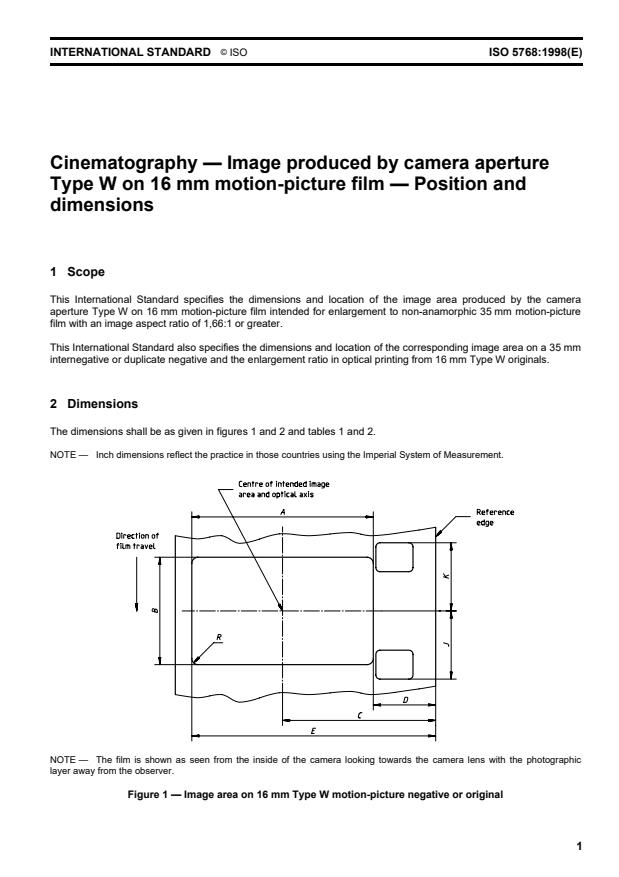
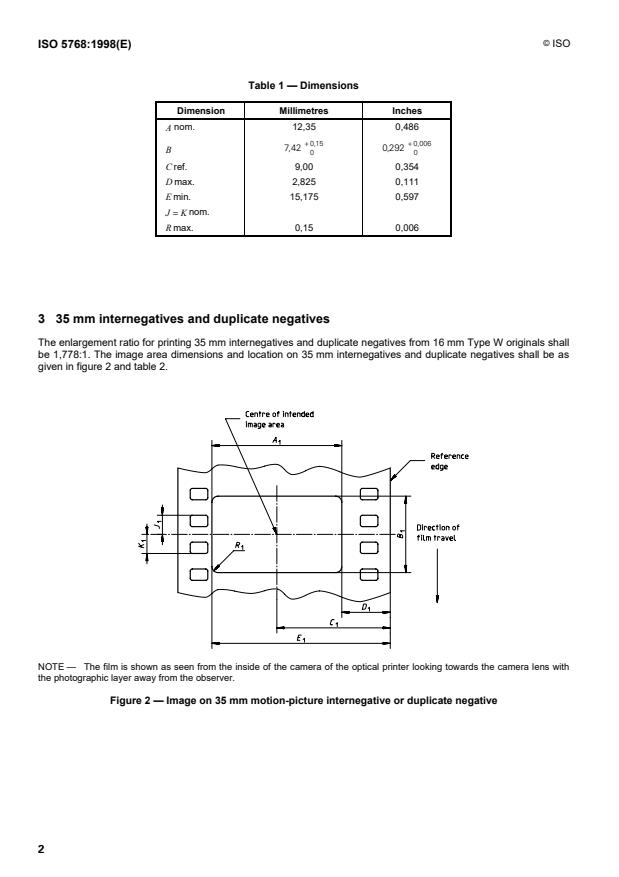
This International Standard specifies the dimensions and location of the image area produced by the camera aperture Type W on 16 mm motion-picture film intended for enlargement to non-anamorphic 35 mm motion-picture film with an image aspect ratio of 1,66:1 or greater. This International Standard also specifies the dimensions and location of the corresponding image area on a 35 mm internegative or duplicate negative and the enlargement ratio in optical printing from 16 mm Type W originals.
- Status
- Published
- Publication Date
- 02-Dec-1998
- Technical Committee
- ISO/TC 36 - Cinematography
- Drafting Committee
- ISO/TC 36 - Cinematography
- Current Stage
- 9060 - Close of review
- Completion Date
- 04-Mar-2029
Buy Documents
ISO 5768:1998 - Cinematography — Image produced by camera aperture Type W on 16 mm motion-picture film — Position and dimensions Released:12/3/1998
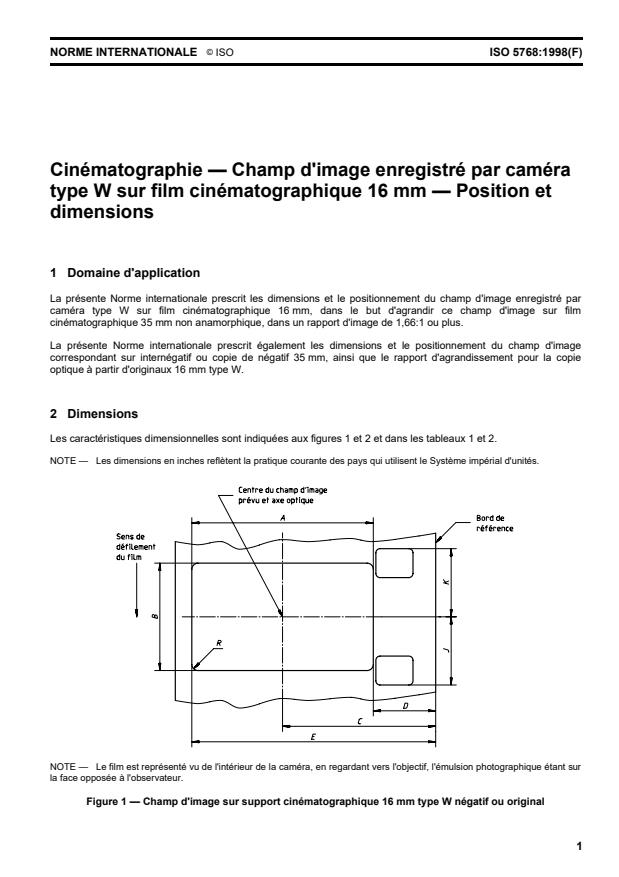
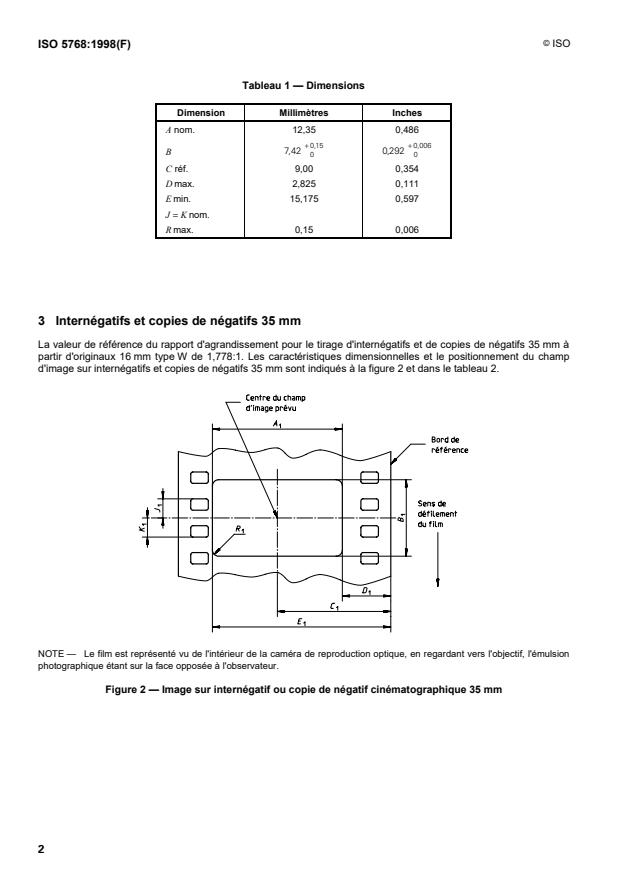
ISO 5768:1998 - Cinématographie — Champ d'image enregistré par caméra type W sur film cinématographique 16 mm — Position et dimensions Released:12/3/1998
Overview
ISO 5768:1998 establishes the precise dimensions and position of the image area created by a Type W camera aperture on 16 mm motion-picture film. This standard supports the effective enlargement of 16 mm film to non-anamorphic 35 mm film formats, particularly those with an aspect ratio of 1.66:1 or greater. ISO 5768:1998 also addresses the corresponding image area and location on 35 mm internegatives or duplicate negatives, and details the necessary enlargement ratio for optical printing processes. Developed by ISO Technical Committee ISO/TC 36 (Cinematography), this standard is essential for professionals involved in film production, post-production, and archival processes where image consistency and interoperability are critical.
Key Topics
- Image Area Dimensions: Defines the exact width and height of the image area exposed by Type W camera apertures on 16 mm film for optimal transfer to 35 mm film.
- Image Position: Specifies the location of the image area relative to the physical edges of both 16 mm and 35 mm films, ensuring alignment during enlargement and printing.
- Enlargement Ratio: Standardizes the optical printing ratio (1.778:1) to accurately scale 16 mm originals to 35 mm internegatives or duplicate negatives.
- Equivalent Projectable Areas: Provides information for determining the projectable image area equivalent on 16 mm film when preparing for various 35 mm release formats (notably 1.66:1 and 1.85:1 aspect ratios).
- International Measurement Units: Accommodates both metric and imperial units to support global usage.
Applications
ISO 5768:1998 is indispensable in the following practical contexts:
- Film Production and Post-Production: Ensures that cinematographers, camera manufacturers, and laboratories can produce and handle 16 mm footage intended for blow-up to 35 mm film, maintaining image integrity and framing.
- Optical Printing: Guides film laboratories in setting accurate enlargement ratios and positioning for transferring original camera negatives to internegatives or duplicates, supporting high-fidelity results in the final print.
- Editing and Viewing: Assists editors and screening facilities in determining equivalent viewing areas on 16 mm prints, reflecting the portion of the image that will ultimately appear on 35 mm releases.
- Film Archiving and Restoration: Facilitates standardized archival practices by maintaining consistent image area specifications across different film stocks and generations, aiding in long-term preservation and restoration projects.
Related Standards
Compliance with ISO 5768:1998 is enhanced by familiarity with these related international standards:
- ISO 25:1994 - Cinematography - Camera usage of 16 mm motion-picture film - Specifications.
- ISO 69:1998 - Cinematography - 16 mm motion-picture and magnetic film - Cutting and perforating dimensions.
- ISO 466:1976 - Cinematography - Image produced by 16 mm motion-picture camera aperture - Position and dimensions.
- ISO 2907:1984 - Cinematography - Maximum projectable image area on 35 mm motion-picture film - Position and dimensions.
- ISO 2939:1986 - Cinematography - Picture image area and photographic sound record on 35 mm motion-picture release prints - Position and dimensions.
These standards collectively ensure precision, compatibility, and professional quality in cinematic imaging across both 16 mm and 35 mm film formats, supporting the entire lifecycle from camera to final projection.
Keywords: ISO 5768, Type W aperture, 16 mm film, 35 mm film, cinematography standards, image dimensions, image position, optical printing, enlargement ratio, film production, internegative, duplicate negative, film archiving, non-anamorphic film, aspect ratio 1.66:1.
Relations
- Effective Date
- 15-Apr-2008
Buy Documents
ISO 5768:1998 - Cinematography — Image produced by camera aperture Type W on 16 mm motion-picture film — Position and dimensions Released:12/3/1998
ISO 5768:1998 - Cinématographie — Champ d'image enregistré par caméra type W sur film cinématographique 16 mm — Position et dimensions Released:12/3/1998
Frequently Asked Questions
ISO 5768:1998 is a standard published by the International Organization for Standardization (ISO). Its full title is "Cinematography — Image produced by camera aperture Type W on 16 mm motion-picture film — Position and dimensions". This standard covers: This International Standard specifies the dimensions and location of the image area produced by the camera aperture Type W on 16 mm motion-picture film intended for enlargement to non-anamorphic 35 mm motion-picture film with an image aspect ratio of 1,66:1 or greater. This International Standard also specifies the dimensions and location of the corresponding image area on a 35 mm internegative or duplicate negative and the enlargement ratio in optical printing from 16 mm Type W originals.
This International Standard specifies the dimensions and location of the image area produced by the camera aperture Type W on 16 mm motion-picture film intended for enlargement to non-anamorphic 35 mm motion-picture film with an image aspect ratio of 1,66:1 or greater. This International Standard also specifies the dimensions and location of the corresponding image area on a 35 mm internegative or duplicate negative and the enlargement ratio in optical printing from 16 mm Type W originals.
ISO 5768:1998 is classified under the following ICS (International Classification for Standards) categories: 37.060.20 - Motion picture films. Cartridges. The ICS classification helps identify the subject area and facilitates finding related standards.
ISO 5768:1998 has the following relationships with other standards: It is inter standard links to ISO 5768:1996. Understanding these relationships helps ensure you are using the most current and applicable version of the standard.
ISO 5768:1998 is available in PDF format for immediate download after purchase. The document can be added to your cart and obtained through the secure checkout process. Digital delivery ensures instant access to the complete standard document.
Standards Content (Sample)
INTERNATIONAL ISO
STANDARD 5768
Third edition
1998-12-01
Cinematography — Image produced by
camera aperture Type W on 16 mm
motion-picture film — Position and
dimensions
Cinématographie — Champ d’image enregistré par caméra type W sur film
cinématographique 16 mm — Position et dimensions
A
Reference number
Foreword
ISO (the International Organization for Standardization) is a worldwide
federation of national standards bodies (ISO member bodies). The work of
preparing International Standards is normally carried out through ISO
technical committees. Each member body interested in a subject for which
a technical committee has been established has the right to be represented
on that committee. International organizations, governmental and non-
governmental, in liaison with ISO, also take part in the work. ISO
collaborates closely with the International Electrotechnical Commission
(IEC) on all matters of electrotechnical standardization.
Draft International Standards adopted by the technical committees are
circulated to the member bodies for voting. Publication as an International
Standard requires approval by at least 75 % of the member bodies casting
a vote.
International Standard ISO 5768 was prepared by Technical Committee
ISO/TC 36, Cinematography.
This third edition cancels and replaces the second edition (ISO 5768:1996),
of which it constitutes a minor revision. In table 1, the tolerances have been
removed from reference dimension C.
Annex A of this International Standard is for information only.
© ISO 1998
All rights reserved. Unless otherwise specified, no part of this publication may be reproduced
or utilized in any form or by any means, electronic or mechanical, including photocopying and
microfilm, without permission in writing from the publisher.
International Organization for Standardization
Case postale 56 • CH-1211 Genève 20 • Switzerland
Internet iso@iso.ch
Printed in Switzerland
ii
©
INTERNATIONAL STANDARD ISO ISO 5768:1998(E)
Cinematography — Image produced by camera aperture
Type W on 16 mm motion-picture film — Position and
dimensions
1 Scope
This International Standard specifies the dimensions and location of the image area produced by the camera
aperture Type W on 16 mm motion-picture film intended for enlargement to non-anamorphic 35 mm motion-picture
film with an image aspect ratio of 1,66:1 or greater.
This International Standard also specifies the dimensions and location of the corresponding image area on a 35 mm
internegative or duplicate negative and the enlargement ratio in optical printing from 16 mm Type W originals.
2 Dimensions
The dimensions shall be as given in figures 1 and 2 and tables 1 and 2.
NOTE — Inch dimensions reflect the practice in those countries using the Imperial System of Measurement.
NOTE — The film is shown as seen from the inside of the camera looking towards the camera lens with the photo
...
NORME ISO
INTERNATIONALE 5768
Troisième édition
1998-12-01
Cinématographie — Champ d’image
enregistré par caméra type W sur film
cinématographique 16 mm — Position et
dimensions
Cinematography — Image produced by camera aperture Type W on 16 mm
motion-picture film — Position and dimensions
A
Numéro de référence
Avant-propos
L'ISO (Organisation internationale de normalisation) est une fédération
mondiale d'organismes nationaux de normalisation (comités membres de
l'ISO). L'élaboration des Normes internationales est en général confiée aux
comités techniques de l'ISO. Chaque comité membre intéressé par une
étude a le droit de faire partie du comité technique créé à cet effet. Les
organisations internationales, gouvernementales et non gouvernementales,
en liaison avec l'ISO participent également aux travaux. L'ISO collabore
étroitement avec la Commission électrotechnique internationale (CEI) en
ce qui concerne la normalisation électrotechnique.
Les projets de Normes internationales adoptés par les comités techniques
sont soumis aux comités membres pour vote. Leur publication comme
Normes internationales requiert l'approbation de 75 % au moins des co-
mités membres votants.
La Norme internationale ISO 5768 a été élaborée par le comité technique
ISO/TC 36, Cinématographie.
Cette troisième édition annule et remplace la deuxième édition
(ISO 5768:1996), dont elle constitue une révision mineure. Dans le
tableau 1, les tolérances ont été retirées de la dimension C de référence.
L’annexe A de la présente Norme internationale est donnée uniquement à
titre d'information.
© ISO 1998
Droits de reproduction réservés. Sauf prescription différente, aucune partie de cette publi-
cation ne peut être reproduite ni utilisée sous quelque forme que ce soit et par aucun pro-
cédé, électronique ou mécanique, y compris la photocopie et les microfilms, sans l'accord
écrit de l'éditeur.
Organisation internationale de normalisation
Case postale 56 • CH-1211 Genève 20 • Suisse
Internet iso@iso.ch
Imprimé en Suisse
ii
©
NORME INTERNATIONALE ISO ISO 5768:1998(F)
Cinématographie — Champ d'image enregistré par caméra
type W sur film cinématographique 16 mm — Position et
dimensions
1 Domaine d'application
La présente Norme internationale prescrit les dimensions et le positionnement du champ d'image enregistré par
caméra type W sur film cinématographique 16 mm, dans le but d'agrandir ce champ d'image sur film
cinématographique 35 mm non anamorphique, dans un rapport d'image de 1,66:1 ou plus.
La présente Norme internationale prescrit également les dimensions et le positionnement du champ d'image
correspondant sur internégatif ou copie de négatif 35 mm, ainsi que le rapport d'agrandissement pour la copie
optique à partir d'originaux 16 mm type W.
2 Dimensions
Les caractéristiques dimensionnelles sont indiquées aux figures 1 et 2 et dans les tableaux 1 et 2.
NOTE — Les dimensions en inches reflètent la pratique courante des pays qui utilisent le Système impérial d'unités.
NOTE — Le film est représenté vu de l'intérieur de la caméra, en regardant vers l'objectif, l'émulsion photographique étant sur
la
...