

ISO 6025:2000
(Main)Cinematography — Analogue photographic sound test films, 35 mm and 16 mm — Specifications
General Information
- Abstract
1.1 This International Standard specifies basic technical characteristics for the international exchange of analogue photographic sound test films intended for checking, adjusting and measuring motion-picture projector sound systems and sound reproducing channels of motion-picture installations for monophonic or stereophonic reproduction. 1.2 This International Standard specifies types and technical characteristics of test films made on 35 mm and 16 mm motion-picture films. 1.3 This International Standard includes test films intended for the checking, adjusting and measuring of a) focusing and azimuth of the scanning beam, b) scanning beam width and its position relative to the reference edge of the film, c) uniformity of the scanning beam illumination, d) level output balance of several motion-picture projectors, e) frequency response of the sound reproduction channel, and f) non-uniformity of film travel.
- Status
- Published
- Publication Date
- 01-Nov-2000
- Technical Committee
- ISO/TC 36 - Cinematography
- Drafting Committee
- ISO/TC 36/WG 3 - Audio technology
- Current Stage
- 9093 - International Standard confirmed
- Start Date
- 10-Jul-2023
- Completion Date
- 29-Aug-2026
Overview
ISO 6025:2000 - Cinematography - Analogue photographic sound test films, 35 mm and 16 mm - Specifications - defines the technical characteristics and test types for analogue photographic sound test films used to check, adjust and measure motion‑picture projector sound systems and sound‑reproducing channels. The standard covers both 35 mm and 16 mm formats and supports monophonic and stereophonic reproduction, providing consistent test signals and dimensional references for international exchange of test films.
Key topics and technical requirements
- Test film types: Films for focus/azimuth, lateral position (buzz track), scanning‑beam uniformity (snake track), level/output balance (variable‑area modulation), frequency response and film‑velocity non‑uniformity (flutter).
- Format specifics: Uses standard 35 mm and 16 mm cutting/perforation and track dimensions (conforming to referenced ISO film dimension standards). Polyester or low‑shrinkage triacetate bases are preferred.
- Representative signal parameters:
- Focus/azimuth tones: 9 kHz (35 mm) and 7.1 kHz (16 mm) with tight tolerances and long duration (100 s).
- Buzz track: square waves at 300 Hz (picture side) and 1 000 Hz (opposite side).
- Snake track: 1 000 Hz sweep for illumination uniformity.
- Level test (variable area): 1 000 Hz (35 mm) and 400 Hz (16 mm) with photoelectric output factor (POF) guidance (example POF ≈ 0.344 for a nominal 50% 35 mm stereophonic track).
- Frequency response: multi‑frequency series (from tens of Hz to >10 kHz) with defined tolerances and durations.
- Flutter: 3 150 Hz test tone and wow/flutter limits measured per IEC 60386.
- Quality controls: Splice restrictions, azimuth tolerance guidance (informative annex recommends tighter than ±5’ and ideally within ±2’ of arc), modulation and distortion limits, and duration requirements.
Applications
ISO 6025 test films are practical tools for:
- Commissioning and routine maintenance of cinema projector sound systems
- Calibration of film scanners, optical sound reproducers and audio playback chains
- Measuring frequency response, channel balance, scanning‑beam alignment and flutter/wow
- Film laboratories and post‑production quality control, archival playback verification, and equipment manufacturers for product testing
Who uses this standard
- Projectionists and theatre engineers
- Audio/visual installers and service technicians
- Film laboratory technicians and restoration specialists
- Equipment manufacturers and quality engineers
- Standards bodies and test labs working on analogue optical sound systems
Related standards
Key normative references include ISO 491 (35 mm), ISO 69 (16 mm), ISO 7343, ISO 4243, IEC 60386, and related documents such as ISO 7739 and ISO 7832 for track dimensions and photoelectric output factor measurement.
Keywords: ISO 6025, cinematography standard, analogue photographic sound test films, 35 mm, 16 mm, azimuth, buzz track, snake track, photoelectric output factor (POF), frequency response, flutter.
Relations
- Effective Date
- 15-Apr-2008
- Revises
ISO 6025:1993 - Cinematography — Photographic sound test films, 35 mm and 16 mm — Specifications - Effective Date
- 15-Apr-2008
Frequently Asked Questions
ISO 6025:2000 is a standard published by the International Organization for Standardization (ISO). Its full title is "Cinematography — Analogue photographic sound test films, 35 mm and 16 mm — Specifications". This standard covers: 1.1 This International Standard specifies basic technical characteristics for the international exchange of analogue photographic sound test films intended for checking, adjusting and measuring motion-picture projector sound systems and sound reproducing channels of motion-picture installations for monophonic or stereophonic reproduction. 1.2 This International Standard specifies types and technical characteristics of test films made on 35 mm and 16 mm motion-picture films. 1.3 This International Standard includes test films intended for the checking, adjusting and measuring of a) focusing and azimuth of the scanning beam, b) scanning beam width and its position relative to the reference edge of the film, c) uniformity of the scanning beam illumination, d) level output balance of several motion-picture projectors, e) frequency response of the sound reproduction channel, and f) non-uniformity of film travel.
1.1 This International Standard specifies basic technical characteristics for the international exchange of analogue photographic sound test films intended for checking, adjusting and measuring motion-picture projector sound systems and sound reproducing channels of motion-picture installations for monophonic or stereophonic reproduction. 1.2 This International Standard specifies types and technical characteristics of test films made on 35 mm and 16 mm motion-picture films. 1.3 This International Standard includes test films intended for the checking, adjusting and measuring of a) focusing and azimuth of the scanning beam, b) scanning beam width and its position relative to the reference edge of the film, c) uniformity of the scanning beam illumination, d) level output balance of several motion-picture projectors, e) frequency response of the sound reproduction channel, and f) non-uniformity of film travel.
ISO 6025:2000 is classified under the following ICS (International Classification for Standards) categories: 37.060.20 - Motion picture films. Cartridges. The ICS classification helps identify the subject area and facilitates finding related standards.
ISO 6025:2000 has the following relationships with other standards: It is inter standard links to ISO 6025:1993/Cor 1:1997, ISO 6025:1993. Understanding these relationships helps ensure you are using the most current and applicable version of the standard.
ISO 6025:2000 is available in PDF format for immediate download after purchase. The document can be added to your cart and obtained through the secure checkout process. Digital delivery ensures instant access to the complete standard document.
Standards Content (Sample)
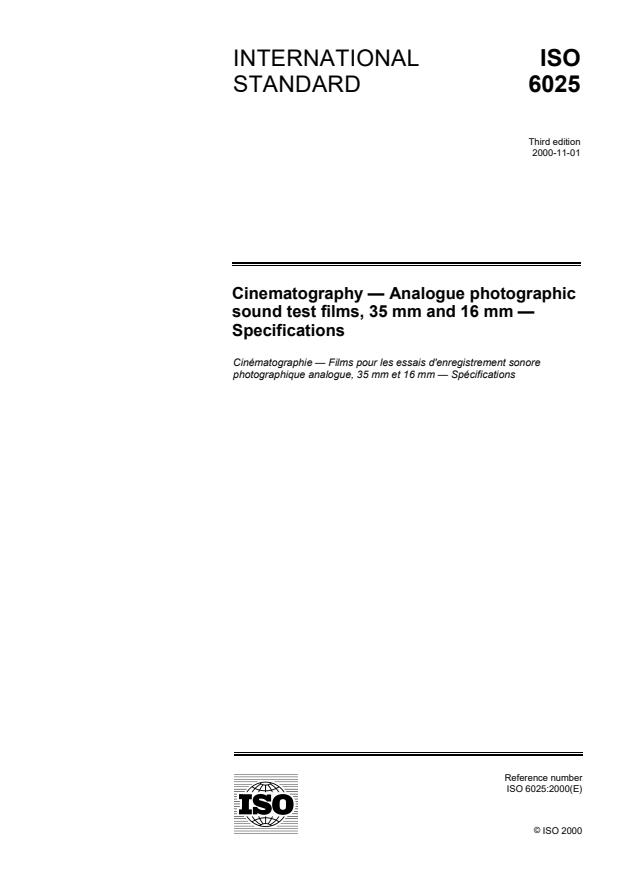
INTERNATIONAL ISO
STANDARD 6025
Third edition
2000-11-01
Cinematography — Analogue photographic
sound test films, 35 mm and 16 mm —
Specifications
Cinématographie — Films pour les essais d'enregistrement sonore
photographique analogue, 35 mm et 16 mm — Spécifications
Reference number
©
ISO 2000
PDF disclaimer
This PDF file may contain embedded typefaces. In accordance with Adobe's licensing policy, this file may be printed or viewed but shall not
be edited unless the typefaces which are embedded are licensed to and installed on the computer performing the editing. In downloading this
file, parties accept therein the responsibility of not infringing Adobe's licensing policy. The ISO Central Secretariat accepts no liability in this
area.
Adobe is a trademark of Adobe Systems Incorporated.
Details of the software products used to create this PDF file can be found in the General Info relative to the file; the PDF-creation parameters
were optimized for printing. Every care has been taken to ensure that the file is suitable for use by ISO member bodies. In the unlikely event
that a problem relating to it is found, please inform the Central Secretariat at the address given below.
All rights reserved. Unless otherwise specified, no part of this publication may be reproduced or utilized in any form or by any means, electronic
or mechanical, including photocopying and microfilm, without permission in writing from either ISO at the address below or ISO's member body
in the country of the requester.
ISO copyright office
Case postale 56 � CH-1211 Geneva 20
Tel. + 41 22 749 01 11
Fax + 41 22 749 09 47
E-mail copyright@iso.ch
Web www.iso.ch
Printed in Switzerland
ii © ISO 2000 – All rights reserved
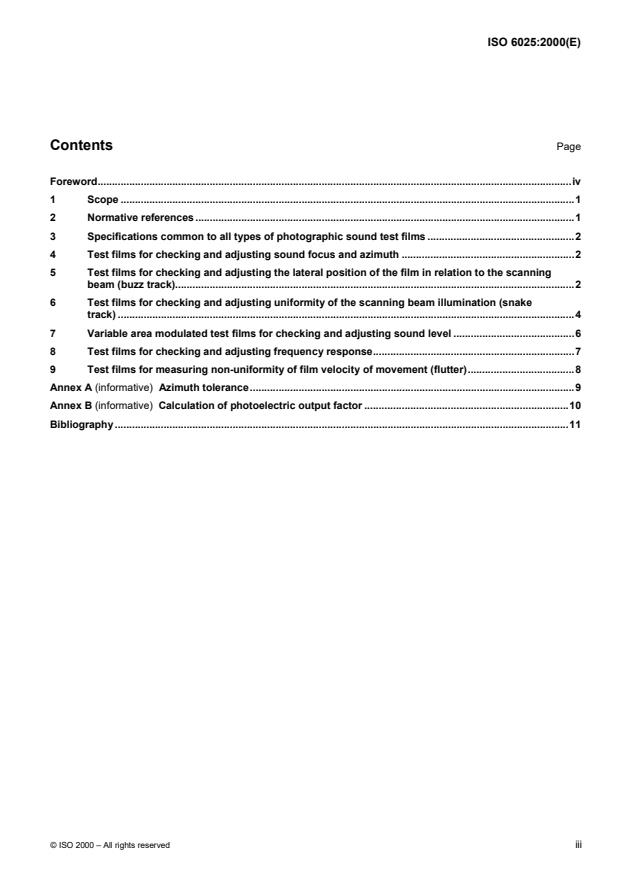
Contents Page
Foreword.iv
1 Scope .1
2 Normative references .1
3 Specifications common to all types of photographic sound test films .2
4 Test films for checking and adjusting sound focus and azimuth .2
5 Test films for checking and adjusting the lateral position of the film in relation to the scanning
beam (buzz track).2
6 Test films for checking and adjusting uniformity of the scanning beam illumination (snake
track) .4
7 Variable area modulated test films for checking and adjusting sound level .6
8 Test films for checking and adjusting frequency response.7
9 Test films for measuring non-uniformity of film velocity of movement (flutter).8
Annex A (informative) Azimuth tolerance.9
Annex B (informative) Calculation of photoelectric output factor .10
Bibliography.11
Foreword
ISO (the International Organization for Standardization) is a worldwide federation of national standards bodies (ISO
member bodies). The work of preparing International Standards is normally carried out through ISO technical
committees. Each member body interested in a subject for which a technical committee has been established has
the right to be represented on that committee. International organizations, governmental and non-governmental, in
liaison with ISO, also take part in the work. ISO collaborates closely with the International Electrotechnical
Commission (IEC) on all matters of electrotechnical standardization.
International Standards are drafted in accordance with the rules given in the ISO/IEC Directives, Part 3.
Draft International Standards adopted by the technical committees are circulated to the member bodies for voting.
Publication as an International Standard requires approval by at least 75 % of the member bodies casting a vote.
Attention is drawn to the possibility that some of the elements of this International Standard may be the subject of
patent rights. ISO shall not be held responsible for identifying any or all such patent rights.
International Standard ISO 6025 was prepared by Technical Committee ISO/TC 36, Cinematography.
This third edition cancels and replaces the second edition (ISO 6025:1993), clause 1 and Table 7 of which have
been revised. Clause 2 has also been revised and a bibliography has been added.
Annexes A and B of this International Standard are for information only.
iv © ISO 2000 – All rights reserved
INTERNATIONAL STANDARD ISO 6025:2000(E)
Cinematography — Analogue photographic sound test films,
35 mm and 16 mm — Specifications
1 Scope
1.1 This International Standard specifies basic technical characteristics for the international exchange of
analogue photographic sound test films intended for checking, adjusting and measuring motion-picture projector
sound systems and sound reproducing channels of motion-picture installations for monophonic or stereophonic
reproduction.
1.2 This International Standard specifies types and technical characteristics of test films made on 35 mm and
16 mm motion-picture films.
1.3 This International Standard includes test films intended for the checking, adjusting and measuring of
a) focusing and azimuth of the scanning beam,
b) scanning beam width and its position relative to the reference edge of the film,
c) uniformity of the scanning beam illumination,
d) level output balance of several motion-picture projectors,
e) frequency response of the sound reproduction channel, and
f) non-uniformity of film travel.
2 Normative references
The following normative documents contain provisions which, through reference in this text, constitute provisions of
this International Standard. For dated references, subsequent amendments to, or revisions of, any of these
publications do not apply. However, parties to agreements based on this International Standard are encouraged to
investigate the possibility of applying the most recent editions of the normative documents indicated below. For
undated references, the latest edition of the normative document referred to applies. Members of ISO and IEC
maintain registers of currently valid International Standards.
ISO 69:1998, Cinematography — 16 mm motion-picture and magnetic film — Cutting and perforating dimensions.
ISO 491:1995, Cinematography — 35 mm motion-picture film and magnetic film — Cutting and perforating dimensions.
ISO 4243:1979, Cinematography — Picture image area and photographic sound record on 16 mm motion-picture
release prints — Positions and dimensions.
ISO 7343:1993, Cinematography — Two-track photographic sound records on 35 mm motion-picture prints —
Positions and width dimensions.
IEC 60386:1972, Method of measurement of speed fluctuations in sound recording and reproducing equipment.
3 Specifications common to all types of photographic sound test films
3.1 Test films shall be made on motion-picture raw stock films, the cutting and perforating dimensions of which
shall be in accordance with ISO 491 for 35 mm film and ISO 69 for 16 mm film.
3.2 The film stock should preferably be polyester base or low-shrinkage triacetate base.
3.3 The location and width dimensions of sound records shall be in accordance with ISO 7343 for 35 mm film
and ISO 4243 for 16 mm film.
3.4 Test films shall be splice-free, except where joins are an essential part of the test film.
3.5 Each film shall be intended primarily for use at 24 frames per second. All frequencies and velocity tolerances
given in this International Standard refer to that velocity. A speed of 25 frames per second may be used. Other test
films may be developed for use at other speeds, if the speeds are so stated.
4 Test films for checking and adjusting sound focus and azimuth
The characteristics of the test signal for checking and adjusting sound focus and azimuth shall be as given in
Table 1.
Table 1
Test signal characteristic 35
...