

ISO 11377:1997
(Main)Textile floor coverings — Floor soiling — Test site set-up and soiling evaluation
General Information
- Abstract
- Status
- Published
- Publication Date
- 24-Dec-1997
- Technical Committee
- ISO/TC 219 - Floor coverings
- Drafting Committee
- ISO/TC 219/WG 1 - Textile floor coverings
- Current Stage
- 9093 - International Standard confirmed
- Start Date
- 16-Jun-2025
- Completion Date
- 29-Aug-2026
Buy Documents

ISO 11377:1997 - Textile floor coverings — Floor soiling — Test site set-up and soiling evaluation Released:12/25/1997
ISO 11377:1997 - Revetements de sol textiles — Encrassement — Établissement d'un emplacement d'essai et évaluation Released:12/25/1997
Overview
ISO 11377:1997 specifies a repeatable procedure for setting up a test site and evaluating floor soiling of textile floor coverings by measuring colour change. The standard defines how to prepare, install and traffic carpet specimens in a controlled corridor environment, and how to evaluate soiling using instrumental or visual methods. It is intended to provide consistent, comparable results for product development, quality control and comparative testing.
Key topics and requirements
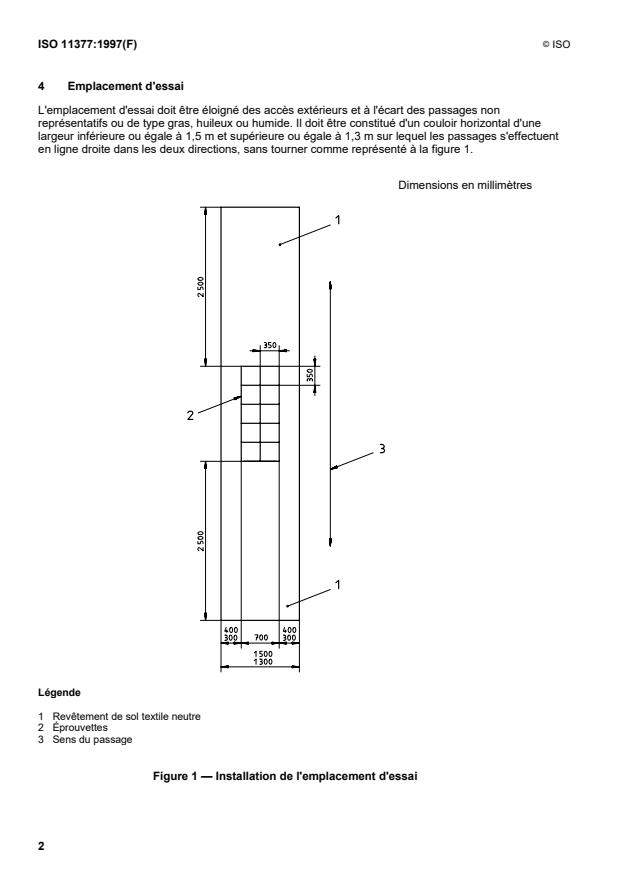
- Test site layout: corridor with straight, non-turning traffic, width between 1.3 m and 1.5 m; buffer strips of at least 2.5 m at each end; avoid entrances and areas where people congregate. A photoelectric traffic counter may be used.
- Specimen preparation: specimens sampled per ISO 1957 and cut square to (350 ± 10) mm sides; at least two replicates per sample; specimens placed in two parallel lines with buffer side strips.
- Installation and safety: secure specimens (e.g., pressure-sensitive tape or mounted on rigid substrates); edge trim or edging to prevent tripping; safety signage may conform to ISO 3864.
- Specimen layout and rotation: initial alternating layouts (examples: AB/BA, AB/CA/BC). Rotate specimens every two days or after a set number of trafficks: rotate 90° clockwise, move two places down the corridor and switch lines to ensure even soiling.
- Maintenance during test: suction-clean specimens after rotation using a defined vacuuming technique-two double strokes (twice backwards and twice forwards) with 50% overlap and initial positioning half on buffer and half on test area.
- End-point and evaluation: traffic until a predetermined soiling level (e.g., grey scale level) or fixed traffick/time is reached. Evaluation methods include:
- Instrumental colour measurement (ISO 105-J01)
- Grey scale assessment (ISO 105-A02)
- Visual comparative ranking
Note: pile flattening and specimen positioning can affect colour-measurement results.
- Test report requirements: identification of specimens, reference to ISO 11377, purpose, site layout at start/end, rotation and maintenance procedures, predetermined soiling level and trafficks/time, evaluation methods, results, environmental conditions, and date.
Applications
- Product development and comparative performance testing of carpets and textile floor coverings
- Quality assurance and batch verification for manufacturers
- Research on soiling mechanisms, cleaning effectiveness and wear simulation
- Specification and procurement guidance for facilities managers and flooring consultants
Who uses this standard
- Flooring and textile manufacturers
- Independent test laboratories and certification bodies
- R&D teams and product engineers
- Building managers, specifiers and procurement professionals
Related standards
- ISO 1957 - Sampling and cutting specimens for textile floor coverings
- ISO 105-A02 - Grey scale for assessing change in colour
- ISO 105-J01 - Measurement of surface colour
- ISO 3864 - Safety colours and signs
Keywords: ISO 11377:1997, textile floor coverings, floor soiling, test site set-up, soiling evaluation, colour change measurement, grey scale, flooring testing standards.
Buy Documents
ISO 11377:1997 - Textile floor coverings — Floor soiling — Test site set-up and soiling evaluation Released:12/25/1997
ISO 11377:1997 - Revetements de sol textiles — Encrassement — Établissement d'un emplacement d'essai et évaluation Released:12/25/1997
Get Certified
Connect with accredited certification bodies for this standard

Control Union Certifications
Global certification for agriculture and sustainability.

Hohenstein Institut
Textile testing and certification.

Bureau Veritas Bangladesh
Bureau Veritas certification services in Bangladesh.
Sponsored listings
Frequently Asked Questions
ISO 11377:1997 is a standard published by the International Organization for Standardization (ISO). Its full title is "Textile floor coverings — Floor soiling — Test site set-up and soiling evaluation". This standard covers: Textile floor coverings — Floor soiling — Test site set-up and soiling evaluation
Textile floor coverings — Floor soiling — Test site set-up and soiling evaluation
ISO 11377:1997 is classified under the following ICS (International Classification for Standards) categories: 59.080.60 - Textile floor coverings; 97.150 - Floor coverings. The ICS classification helps identify the subject area and facilitates finding related standards.
ISO 11377:1997 is available in PDF format for immediate download after purchase. The document can be added to your cart and obtained through the secure checkout process. Digital delivery ensures instant access to the complete standard document.
Standards Content (Sample)
INTERNATIONAL ISO
STANDARD 11377
First edition
1997-12-15
Textile floor coverings — Floor soiling —
Test site set-up and soiling evaluation
Revêtements de sol textiles — Encrassement — Établissement
d'un emplacement d'essai et évaluation
A
Reference number
Foreword
ISO (the International Organization for Standardization) is a worldwide
federation of national standards bodies (ISO member bodies). The work of
preparing International Standards is normally carried out through ISO technical
committees. Each member body interested in a subject for which a technical
committee has been established has the right to be represented on that committee.
International organizations, governmental and non-governmental, in liaison with
ISO, also take part in the work. ISO collaborates closely with the International
Electrotechnical Commission (IEC) on all matters of electrotechnical
standardization.
Draft International Standards adopted by the technical committees are circulated
to the member bodies for voting. Publication as an International Standard requires
approval by at least 75 % of the member bodies casting a vote.
International Standard ISO 11377 was prepared by Technical Committee
ISO/TC 38, Textiles, Subcommittee SC 12, Textile floor coverings.
Annex A of this International Standard is for information only.
© ISO 1997
All rights reserved. Unless otherwise specified, no part of this publication may be reproduced
or utilized in any form or by any means, electronic or mechanical, including photocopying and
microfilm, without permission in writing from the publisher.
International Organization for Standardization
Case postale 56 • CH-1211 Genève 20 • Switzerland
Internet central@iso.ch
X.400 c=ch; a=400net; p=iso; o=isocs; s=central
Printed in Switzerland
ii
©
INTERNATIONAL STANDARD ISO ISO 11377:1997(E)
Textile floor coverings — Floor soiling — Test
site set-up and soiling evaluation
1 Scope
This International Standard specifies the procedure for setting up a test site for
textile floor coverings and the procedure for evaluation of levels of soiling as
measured by colour change.
2 Normative references
The following standards contain provisions which, through reference in this text
constitute provisions of this International Standard. At the time of publication,
the editions indicated were valid. All standards are subject to revision, and
parties to agreements based on this International Standard are encouraged to
investigate the possibility of applying the most recent editions of the standards
indicated below. Members of IEC and ISO maintain registers of currently valid
International Standards
ISO 105-A02:1993, Textiles — Tests for colour fastness — Part A02: Grey scale for
assessing change in colour.
1)
ISO 105-J01:— , Textiles — Tests for colour fastness — Part J01: General
principles for the measurement of surface colour.
ISO 1957:1986, Machine-made textile floor coverings — Sampling and cutting
specimens for physical tests.
3 Principle
Samples of textile floor covering are exposed to foot traffic at a controlled test
site and are evaluated for change in colour after a given level of soiling is
reached. The textile floor coverings can be evaluated for soiling in-situ for
intermediate assessments and, after removal from the test site, for final
assessment.
____________
1) To be published. (Revision of ISO 105-J01:1989)
©
ISO
4 Test site
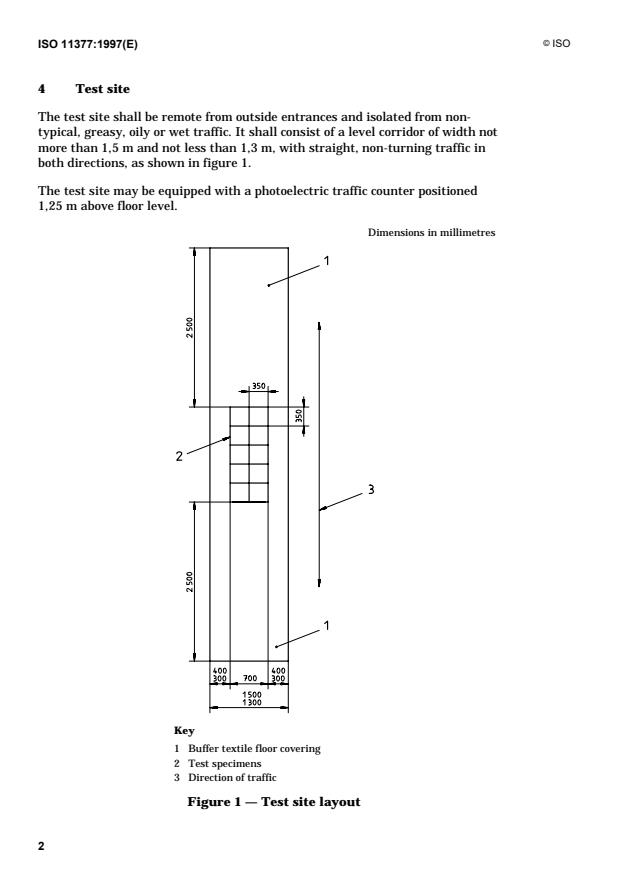
The test site shall be remote from outside entrances and isolated from non-
typical, greasy, oily or wet traffic. It shall consist of a level corridor of width not
more than 1,5 m and not less than 1,3 m, with straight, non-turning traffic in
both directions, as shown in figure 1.
The test site may be equipped with a photoelectric traffic counter positioned
1,25 m above floor level.
Dimensions in millimetres
Key
1 Buffer textile floor covering
2 Test specimens
3 Direction of traffic
Figure 1 — Test site layout
©
ISO
The test site shall not be in areas where people gather, such as those containing
bulletin boards or vending machines. The floor shall be level and free from
irregularities. At least 2,5 m of buffer textile floor covering, free from
contaminants and exhibiting minimum fibre shedding, shall be placed at each
end of the test textile floor covering.
5 Test specimen preparation
Textile floor coverings under test shall be sampled in accordance with ISO 1957
and square test specimens shall be prepared having sides measuring
(350 ± 10) mm. They shall be placed in two lines along the length of the corridor
(see figure 1). Buffer textile floor covering between 300 mm and 400 mm in
width shall be attached to the sides of the test area, so as to fill the width of the
corridor. For each sample of floor covering there shall be at least two replicate
specimens.
6 Textile floor covering installation
Textile floor coverings shall be installed in such a way that they ensure safe
traffic. This is easily ac
...
NORME ISO
INTERNATIONALE 11377
Première édition
1997-12-15
Revêtements de sol textiles —
Encrassement — Établissement d'un
emplacement d'essai et évaluation
Textile floor coverings — Floor soiling — Test site set-up and soiling
evaluation
A
Numéro de référence
Avant-propos
L'ISO (Organisation internationale de normalisation) est une fédération
mondiale d'organismes nationaux de normalisation (comités membres de
l'ISO). L'élaboration des Normes internationales est en général confiée aux
comités techniques de l'ISO. Chaque comité membre intéressé par une
étude a le droit de faire partie du comité technique créé à cet effet. Les
organisations internationales, gouvernementales et non gouvernementales,
en liaison avec l'ISO participent également aux travaux. L'ISO collabore
étroitement avec la Commission électrotechnique internationale (CEI) en
ce qui concerne la normalisation électrotechnique.
Les projets de Normes internationales adoptés par les comités techniques
sont soumis aux comités membres pour vote. Leur publication comme
Normes internationales requiert l'approbation de 75 % au moins des
comités membres votants.
La Norme internationale ISO 11377 a été élaborée par le comité technique
ISO/TC 38, Textiles, sous-comité SC 12, Revêtements de sol textiles.
L’annexe A de la présente Norme internationale est donnée uniquement à
titre d’information.
© ISO 1997
Droits de reproduction réservés. Sauf prescription différente, aucune partie de cette publi-
cation ne peut être reproduite ni utilisée sous quelque forme que ce soit et par aucun pro-
cédé, électronique ou mécanique, y compris la photocopie et les microfilms, sans l'accord
écrit de l'éditeur.
Organisation internationale de normalisation
Case postale 56 • CH-1211 Genève 20 • Suisse
Internet central@iso.ch
X.400 c=ch; a=400net; p=iso; o=isocs; s=central
Imprimé en Suisse
ii
©
NORME INTERNATIONALE ISO ISO 11377:1997(F)
Revêtements de sol textiles — Encrassement — Établissement
d'un emplacement d'essai et évaluation
1 Domaine d'application
La présente Norme internationale spécifie le mode opératoire pour l'installation d'un emplacement
d'essai de revêtements de sol ainsi que la méthode d'évaluation des niveaux d'encrassement en
fonction de la modification de couleur.
2 Références normatives
Les normes suivantes contiennent des dispositions qui, par suite de la référence qui en est faite,
constituent des dispositions valables pour la présente Norme internationale. Au moment de la
publication, les éditions indiquées étaient en vigueur. Toute norme est sujette à révision et les parties
prenantes des accords fondés sur la présente Norme internationale sont invitées à rechercher la
possibilité d'appliquer les éditions les plus récentes des normes indiquées ci-après. Les membres de la
CEI et de l'ISO possèdent le registre des Normes internationales en vigueur à un moment donné.
Textiles — Essais de solidité des teintures — Partie A02: Échelle
ISO 105-A02:1993,
de gris pour l'évaluation des dégradations.
1)
Textiles — Essais de solidité des teintures — Partie J01: Principes
ISO 105-J01:— ,
généraux du mesurage de la couleur de surface.
Textiles — Revêtements de sol textiles fabriqués à la machine —
ISO 1957:1986,
Échantillonnage et prélèvement des éprouvettes en vue des
essais physiques.
3 Principe
Des échantillons de revêtements de sol textiles sont soumis aux passages de piétons sur un
emplacement contrôlé puis, après obtention d'un niveau donné d'encrassement, la modification de
couleur est évaluée. L'encrassement des revêtements de sol textiles peut être déterminé sur place pour
les évaluations intermédiaires et, après enlèvement de l'emplacement, pour l'évaluation finale.
1) À publier. (Révision de l'ISO 105-J01:1989)
©
4 Emplacement d'essai
L'emplacement d'essai doit être éloigné des accès extérieurs et à l'écart des passages non
représentatifs ou de type gras, huileux ou humide. Il doit être constitué d'un couloir horizontal d'une
largeur inférieure ou égale à 1,5 m et supérieure ou égale à 1,3 m sur lequel les passages s'effectuent
en ligne droite dans les deux directions, sans tourner comme représenté à la figure 1.
Dimensions en millimètres
Légende
1 Revêtement de sol textile neutre
2 Éprouvettes
3 Sens du passage
Figure 1 — Installation de l'emplacement d'essai
©
ISO
L’emplacement d’essai peut être équipé d'un compteur photoélectrique placé à 1,25 m au-dessus du
niveau du sol.
L'emplacement d'essai ne doit pas être un lieu fréquenté se trouvant, par exemple, près d'un tableau
d'affichage ou d'un distributeur automatique. Le sol doit être plan et exempt d'irrégularités. Des
longueurs d'au moins 2,5 m de revêtement de sol textile neutre, exempt de contaminants et présentant
un minimum de débourrage doivent être disposées à chaque extrémité du revêtement de sol textile
soumis à essai.
5 Préparation des éprouvettes
Prélever des échantillons de revêtements de sol textiles conformément à l'ISO 1957. Les éprouvettes
doivent être de forme carrée, de (350 ± 10) mm de côté. Disposer les éprouvettes sur deux rangées
dans le sens de la longueur du couloir (voir figure 1). Fixer le revêtement de sol textile neutre d'une
largeur comprise entre 300 mm et 400 mm de chaque côté de la zone d'essai de façon à couvrir la
largeur du couloir. Prélever au moins deux éprouvettes (une éprouvette et son double) dans chaque
échantillon de revêtement de sol textile.
6 Installation du revêtement de sol textile
Installer le revêtement de sol textile de façon
...