

ISO 21626-2:2020
(Main)Bamboo charcoal — Part 2: Fuel applications
General Information
- Abstract
This document specifies the requirements and test methods of the raw and moulded bamboo charcoal for fuel applications.
- Status
- Published
- Publication Date
- 03-Dec-2020
- Technical Committee
- ISO/TC 296 - Bamboo and rattan
- Drafting Committee
- ISO/TC 296/WG 3 - Bamboo Charcoal
- Current Stage
- 9093 - International Standard confirmed
- Start Date
- 01-Sep-2026
- Completion Date
- 05-Sep-2026


Overview
ISO 21626-2:2020 is an international standard published by the International Organization for Standardization (ISO) that specifies the requirements and test methods for bamboo charcoal used in fuel applications. This standard addresses both raw and moulded bamboo charcoal products intended for industrial and domestic energy use. Bamboo charcoal is recognized for its environmental benefits, offering a cleaner-burning alternative to traditional coal fuels due to its low sulfur and nitrogen content. ISO 21626-2:2020 supports the sustainable development of bamboo charcoal as a renewable fuel source and promotes harmonized quality benchmarks for international trade.
Key Topics
Scope and Definitions: The standard covers raw and briquetted bamboo charcoal designed for fuel use. Key terms include moisture content, ash content, fixed carbon, and calorific value, which define fuel quality metrics.
Quality Requirements: The standard sets specific physical and chemical criteria for bamboo charcoal based on grading levels:
- Moisture content: Maximum levels range between 9% and 12%.
- Ash content: Limits vary from 4.5% up to 10.5%.
- Fixed carbon: Minimum content from 65% to 85%.
- Calorific value: Minimum energy output ranges from 17 MJ/kg to 29 MJ/kg.
Test Methods: Analytical procedures conform to established ISO methods for:
- Visual inspection
- Moisture determination (ISO 18134-3)
- Ash content measurement (ISO 18122)
- Volatile matter and fixed carbon calculation (ISO 18123)
- Calorific value assessment (ISO 18125)
Sampling and Inspection: The document describes random sampling techniques and sensory evaluations to ensure consistency in product quality.
Packaging and Labelling: Guidelines mandate clear marking of manufacturer information, production batch, net mass, product grade, and usage instructions to inform consumers and facilitate traceability.
Storage and Transport: Proper handling conditions are outlined to maintain fuel integrity, emphasizing protection from moisture, sunlight, and physical damage.
Applications
ISO 21626-2:2020 facilitates the production and supply of high-quality bamboo charcoal for fuel across multiple sectors, including:
Domestic Heating and Cooking: Bamboo charcoal briquettes are widely used in residential energy solutions, offering a cleaner, renewable fuel option.
Industrial Energy Use: Industries relying on charcoal fuels can adopt standardized bamboo charcoal, benefiting from predictable combustion efficiency and environmental compliance.
Sustainable Energy Production: Bamboo charcoal serves as a substitute for traditional charcoal and fossil fuels, supporting forest conservation and reduced emissions.
International Trade: Compliance with ISO 21626-2 ensures that bamboo charcoal products meet global quality standards, encouraging market expansion and consumer confidence.
Related Standards
ISO 21626-2:2020 references several related ISO standards that complement its framework for solid biofuels:
- ISO 18122: Determination of ash content in solid biofuels.
- ISO 18123: Determination of volatile matter in solid biofuels.
- ISO 18134-3: Moisture content determination methods.
- ISO 18125: Test methods for calorific value of solid biofuels.
- ISO 18135: Sampling methods for solid biofuels.
- ISO 16559: Terminology and definitions related to solid biofuels.
These interconnected standards establish a comprehensive system for evaluating fuel properties vital to bamboo charcoal applications.
Keywords: ISO 21626-2, bamboo charcoal standard, bamboo charcoal fuel, bamboo charcoal briquettes, fuel quality requirements, charcoal testing methods, renewable biofuel, sustainable energy, moisture content, ash content, fixed carbon, calorific value, bamboo charcoal packaging, solid biofuels standards.
Get Certified
Connect with accredited certification bodies for this standard

DNV
DNV is an independent assurance and risk management provider.

Lloyd's Register
Lloyd's Register is a global professional services organisation specialising in engineering and technology.
DNV Energy Systems
Energy and renewable energy certification.
Sponsored listings
Frequently Asked Questions
ISO 21626-2:2020 is a standard published by the International Organization for Standardization (ISO). Its full title is "Bamboo charcoal — Part 2: Fuel applications". This standard covers: This document specifies the requirements and test methods of the raw and moulded bamboo charcoal for fuel applications.
This document specifies the requirements and test methods of the raw and moulded bamboo charcoal for fuel applications.
ISO 21626-2:2020 is classified under the following ICS (International Classification for Standards) categories: 27.190 - Biological sources and alternative sources of energy; 75.160.40 - Biofuels. The ICS classification helps identify the subject area and facilitates finding related standards.
ISO 21626-2:2020 is available in PDF format for immediate download after purchase. The document can be added to your cart and obtained through the secure checkout process. Digital delivery ensures instant access to the complete standard document.
Standards Content (Sample)
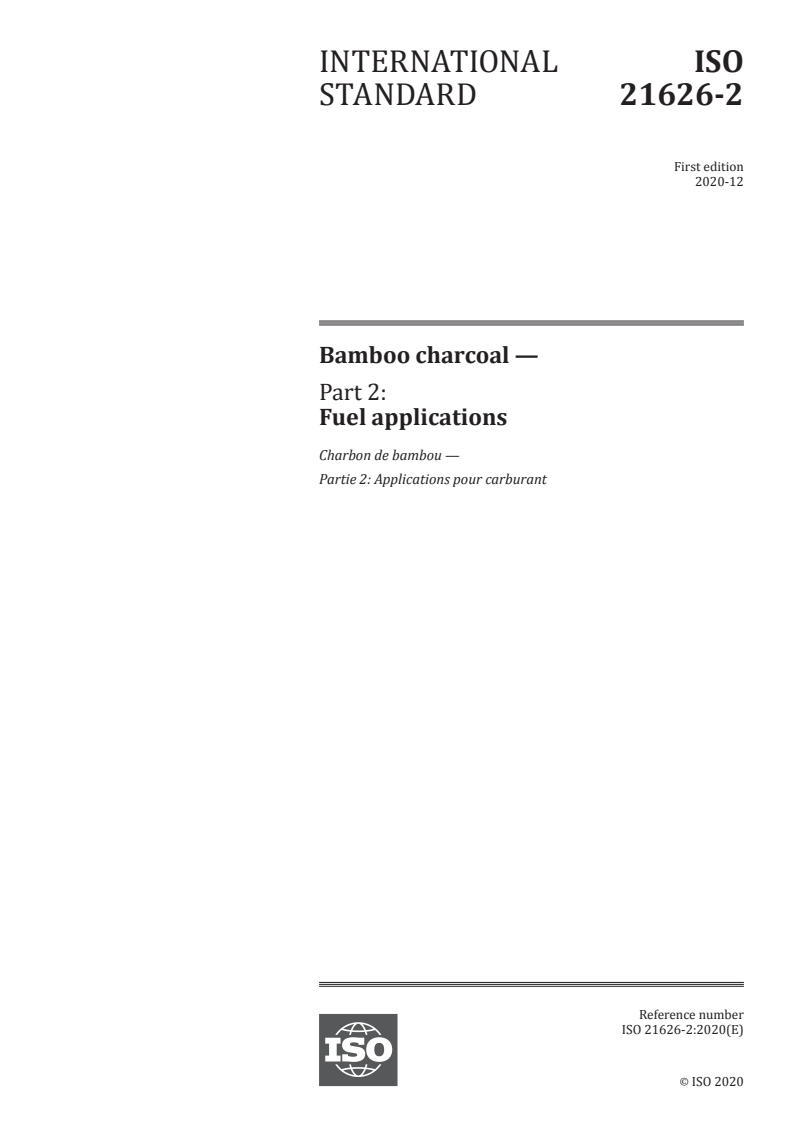
INTERNATIONAL ISO
STANDARD 21626-2
First edition
2020-12
Bamboo charcoal —
Part 2:
Fuel applications
Charbon de bambou —
Partie 2: Applications pour carburant
Reference number
©
ISO 2020
© ISO 2020
All rights reserved. Unless otherwise specified, or required in the context of its implementation, no part of this publication may
be reproduced or utilized otherwise in any form or by any means, electronic or mechanical, including photocopying, or posting
on the internet or an intranet, without prior written permission. Permission can be requested from either ISO at the address
below or ISO’s member body in the country of the requester.
ISO copyright office
CP 401 • Ch. de Blandonnet 8
CH-1214 Vernier, Geneva
Phone: +41 22 749 01 11
Email: copyright@iso.org
Website: www.iso.org
Published in Switzerland
ii © ISO 2020 – All rights reserved
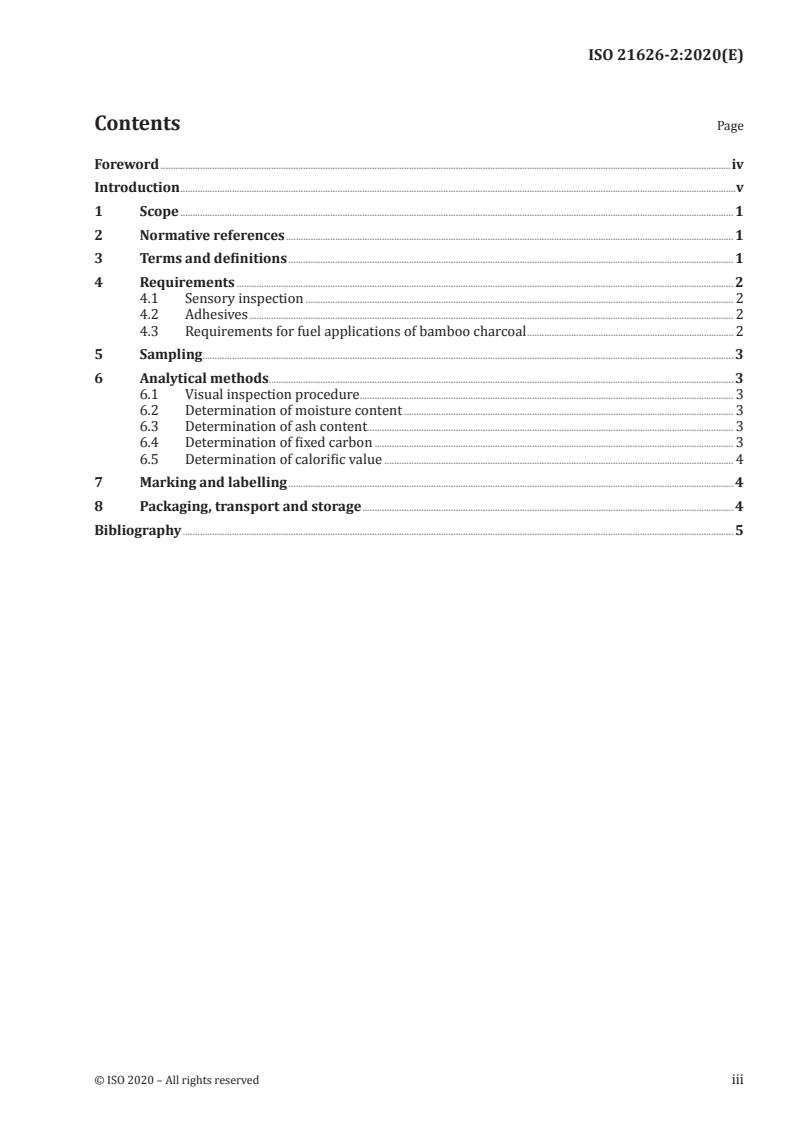
Contents Page
Foreword .iv
Introduction .v
1 Scope . 1
2 Normative references . 1
3 Terms and definitions . 1
4 Requirements . 2
4.1 Sensory inspection . 2
4.2 Adhesives . 2
4.3 Requirements for fuel applications of bamboo charcoal . 2
5 Sampling . 3
6 Analytical methods. 3
6.1 Visual inspection procedure . 3
6.2 Determination of moisture content . 3
6.3 Determination of ash content. 3
6.4 Determination of fixed carbon . 3
6.5 Determination of calorific value . 4
7 Marking and labelling . 4
8 Packaging, transport and storage . 4
Bibliography . 5
Foreword
ISO (the International Organization for Standardization) is a worldwide federation of national standards
bodies (ISO member bodies). The work of preparing International Standards is normally carried out
through ISO technical committees. Each member body interested in a subject for which a technical
committee has been established has the right to be represented on that committee. International
organizations, governmental and non-governmental, in liaison with ISO, also take part in the work.
ISO collaborates closely with the International Electrotechnical Commission (IEC) on all matters of
electrotechnical standardization.
The procedures used to develop this document and those intended for its further maintenance are
described in the ISO/IEC Directives, Part 1. In particular, the different approval criteria needed for the
different types of ISO documents should be noted. This document was drafted in accordance with the
editorial rules of the ISO/IEC Directives, Part 2. www .iso .org/ directives
Attention is drawn to the possibility that some of the elements of this document may be the subject of
patent rights. ISO shall not be held responsible for identifying any or all such patent rights. Details of
any patent rights identified during the development of the document will be in the Introduction and/or
on the ISO list of patent declarations received. www .iso .org/ patents
Any trade name used in this document is information given for the convenience of users and does not
constitute an endorsement.
For an explanation on the meaning of ISO specific terms and expressions related to conformity
assessment, as well as information about ISO's adherence to the WTO principles in the Technical
Barriers to Trade (TBT) see the following URL: Foreword - Supplementary information
This document is prepared by Technical Committee ISO/TC 296, Bamboo and Rattan.
Any feedback or questions on this document should be directed to the user’s national standards body. A
complete listing of these bodies can be found at www .iso .org/ members .html.
iv © ISO 2020 – All rights reserved
Introduction
Bamboo charcoal, which is a kind of fuel charcoal with a broad market prospect, is an excellent fuel
for industrial and domestic use. Bamboo charcoal has a potential to be cleaner and more environment
friendly than coal because of its extremely low content of sulphur and nitrogen. Using bamboo charcoal
as the substitute of traditional charcoal is a feasible way to protect timber resources. The reliability
...
INTERNATIONAL ISO
STANDARD 21626-2
First edition
2020-12
Bamboo charcoal —
Part 2:
Fuel applications
Charbon de bambou —
Partie 2: Applications pour carburant
Reference number
©
ISO 2020
© ISO 2020
All rights reserved. Unless otherwise specified, or required in the context of its implementation, no part of this publication may
be reproduced or utilized otherwise in any form or by any means, electronic or mechanical, including photocopying, or posting
on the internet or an intranet, without prior written permission. Permission can be requested from either ISO at the address
below or ISO’s member body in the country of the requester.
ISO copyright office
CP 401 • Ch. de Blandonnet 8
CH-1214 Vernier, Geneva
Phone: +41 22 749 01 11
Email: copyright@iso.org
Website: www.iso.org
Published in Switzerland
ii © ISO 2020 – All rights reserved
Contents Page
Foreword .iv
Introduction .v
1 Scope . 1
2 Normative references . 1
3 Terms and definitions . 1
4 Requirements . 2
4.1 Sensory inspection . 2
4.2 Adhesives . 2
4.3 Requirements for fuel applications of bamboo charcoal . 2
5 Sampling . 3
6 Analytical methods. 3
6.1 Visual inspection procedure . 3
6.2 Determination of moisture content . 3
6.3 Determination of ash content. 3
6.4 Determination of fixed carbon . 3
6.5 Determination of calorific value . 4
7 Marking and labelling . 4
8 Packaging, transport and storage . 4
Bibliography . 5
Foreword
ISO (the International Organization for Standardization) is a worldwide federation of national standards
bodies (ISO member bodies). The work of preparing International Standards is normally carried out
through ISO technical committees. Each member body interested in a subject for which a technical
committee has been established has the right to be represented on that committee. International
organizations, governmental and non-governmental, in liaison with ISO, also take part in the work.
ISO collaborates closely with the International Electrotechnical Commission (IEC) on all matters of
electrotechnical standardization.
The procedures used to develop this document and those intended for its further maintenance are
described in the ISO/IEC Directives, Part 1. In particular, the different approval criteria needed for the
different types of ISO documents should be noted. This document was drafted in accordance with the
editorial rules of the ISO/IEC Directives, Part 2. www .iso .org/ directives
Attention is drawn to the possibility that some of the elements of this document may be the subject of
patent rights. ISO shall not be held responsible for identifying any or all such patent rights. Details of
any patent rights identified during the development of the document will be in the Introduction and/or
on the ISO list of patent declarations received. www .iso .org/ patents
Any trade name used in this document is information given for the convenience of users and does not
constitute an endorsement.
For an explanation on the meaning of ISO specific terms and expressions related to conformity
assessment, as well as information about ISO's adherence to the WTO principles in the Technical
Barriers to Trade (TBT) see the following URL: Foreword - Supplementary information
This document is prepared by Technical Committee ISO/TC 296, Bamboo and Rattan.
Any feedback or questions on this document should be directed to the user’s national standards body. A
complete listing of these bodies can be found at www .iso .org/ members .html.
iv © ISO 2020 – All rights reserved
Introduction
Bamboo charcoal, which is a kind of fuel charcoal with a broad market prospect, is an excellent fuel
for industrial and domestic use. Bamboo charcoal has a potential to be cleaner and more environment
friendly than coal because of its extremely low content of sulphur and nitrogen. Using bamboo charcoal
as the substitute of traditional charcoal is a feasible way to protect timber resources. The reliability
...