

ISO/IEC 9541-1:2012
(Main)Information technology — Font information interchange — Part 1: Architecture
General Information
- Abstract
ISO/IEC 9541 defines a method of naming glyphs and glyph collections, independent of any document encoding technique; it assumes that one or more methods of associating document encoding techniques with glyph identifiers used in font resources will be provided by text processing systems. ISO/IEC 9541-1:2012 specifies the architecture of a font resource, i.e. the font description, font metrics, glyph description and glyph metrics properties required for font references and the interchange of font resources.
- Status
- Published
- Publication Date
- 12-Aug-2012
- Technical Committee
- ISO/IEC JTC 1/SC 34 - Document description and processing languages
- Drafting Committee
- ISO/IEC JTC 1/SC 34 - Document description and processing languages
- Current Stage
- 9093 - International Standard confirmed
- Start Date
- 10-Mar-2023
- Completion Date
- 29-Aug-2026
Overview
ISO/IEC 9541-1:2012 - Information technology - Font information interchange - Part 1: Architecture - defines the architectural framework for exchanging font resources. The standard specifies the structure and required properties of a font resource, including font description, font metrics, glyph description and glyph metrics, and establishes a method of naming glyphs and glyph collections that is independent of document encoding. The 2012 second edition modernized the syntax to XML (DSDL, ISO/IEC 19757-2) and consolidates several earlier amendments and corrigenda.
Key topics and requirements
- Glyph naming independent of document encoding
- A method for naming individual glyphs and glyph collections so fonts can be referenced and interchanged regardless of the document character encoding used.
- Font resource architecture
- Defines the conceptual components a font resource must expose: font description, glyph descriptions, font and glyph metrics, and related properties needed for consistent rendering and interchange.
- Metrics and descriptive properties
- Specifies required metric information (e.g., baseline, advance, bounding metrics) and descriptive properties to support layout, rendering, and font substitution decisions.
- Interchange syntax update
- Editorial conversion from older SGML/DTD and ASN.1 representations to XML using DSDL (ISO/IEC 19757-2) to support modern toolchains and parsing.
- Assumptions for mapping encodings
- The standard assumes text processing systems will provide one or more methods to associate document encodings with the glyph identifiers defined in the font resource.
Applications
- Font vendors and foundries: produce font files and metadata that comply with a consistent interchange architecture.
- Software developers: implement font handling, rendering engines, and layout systems that map document encodings to glyph identifiers and use standardized metrics for accurate text layout.
- Digital publishing and typesetting: ensure predictable font substitution, embedding and cross-platform appearance when exchanging documents and font resources.
- Archiving and font repositories: catalog and preserve font metadata and glyph collections in a standardized, encoding-independent way.
Who should use this standard
- Font format designers and implementers
- Text rendering and layout engine developers
- Digital publishers, typesetters, and desktop publishing vendors
- Archivists and repositories managing font assets
Related standards
- ISO/IEC 9541 (other parts in the font information interchange family)
- ISO/IEC 19757-2 (DSDL - the XML schema technology referenced for syntax)
- Historical formats referenced: SGML/DTD and ASN.1 (superseded by XML in this edition)
Keywords: ISO/IEC 9541-1, font information interchange, font architecture, glyph naming, font metrics, XML DSDL, font resource, glyph collections.
Relations
- Effective Date
- 25-Apr-2020
- Effective Date
- 11-Jul-2009
- Effective Date
- 11-Jul-2009
- Effective Date
- 11-Jul-2009
- Effective Date
- 11-Jul-2009
- Revises
ISO/IEC 9541-1:1991 - Information technology — Font information interchange — Part 1: Architecture - Effective Date
- 11-Jul-2009
Get Certified
Connect with accredited certification bodies for this standard

BSI Group
BSI (British Standards Institution) is the business standards company that helps organizations make excellence a habit.

NYCE
Mexican standards and certification body.
Sponsored listings
Frequently Asked Questions
ISO/IEC 9541-1:2012 is a standard published by the International Organization for Standardization (ISO). Its full title is "Information technology — Font information interchange — Part 1: Architecture". This standard covers: ISO/IEC 9541 defines a method of naming glyphs and glyph collections, independent of any document encoding technique; it assumes that one or more methods of associating document encoding techniques with glyph identifiers used in font resources will be provided by text processing systems. ISO/IEC 9541-1:2012 specifies the architecture of a font resource, i.e. the font description, font metrics, glyph description and glyph metrics properties required for font references and the interchange of font resources.
ISO/IEC 9541 defines a method of naming glyphs and glyph collections, independent of any document encoding technique; it assumes that one or more methods of associating document encoding techniques with glyph identifiers used in font resources will be provided by text processing systems. ISO/IEC 9541-1:2012 specifies the architecture of a font resource, i.e. the font description, font metrics, glyph description and glyph metrics properties required for font references and the interchange of font resources.
ISO/IEC 9541-1:2012 is classified under the following ICS (International Classification for Standards) categories: 35.240.30 - IT applications in information, documentation and publishing. The ICS classification helps identify the subject area and facilitates finding related standards.
ISO/IEC 9541-1:2012 has the following relationships with other standards: It is inter standard links to ISO/IEC 9541-1:2012/Amd 1:2016, ISO/IEC 9541-1:1991/Amd 1:2001, ISO/IEC 9541-1:1991/Amd 3:2000, ISO/IEC 9541-1:1991/Amd 4:2009, ISO/IEC 9541-1:1991/Amd 2:1998, ISO/IEC 9541-1:1991. Understanding these relationships helps ensure you are using the most current and applicable version of the standard.
ISO/IEC 9541-1:2012 is available in PDF format for immediate download after purchase. The document can be added to your cart and obtained through the secure checkout process. Digital delivery ensures instant access to the complete standard document.
Standards Content (Sample)
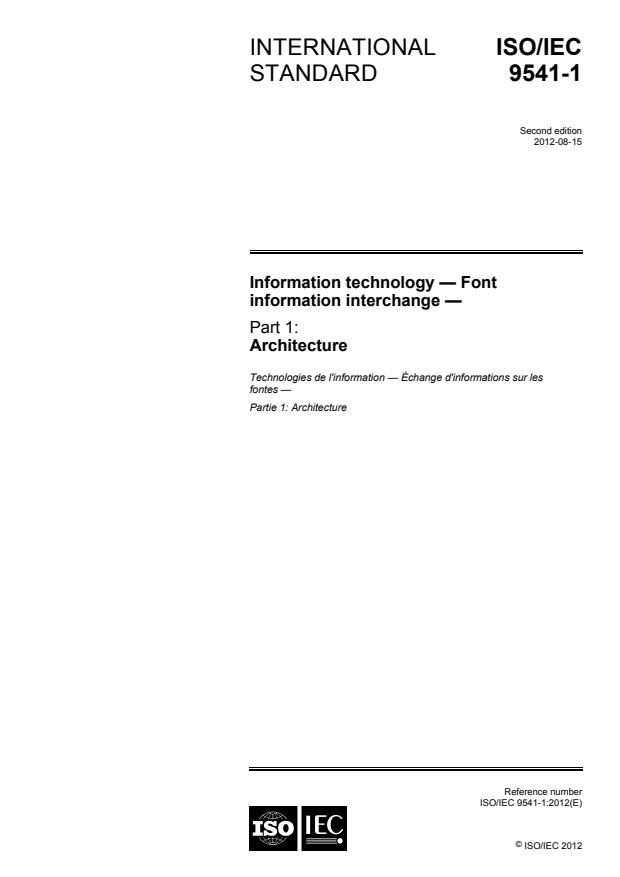
INTERNATIONAL ISO/IEC
STANDARD 9541-1
Second edition
2012-08-15
Information technology — Font
information interchange —
Part 1:
Architecture
Technologies de l'information — Échange d'informations sur les
fontes —
Partie 1: Architecture
Reference number
©
ISO/IEC 2012
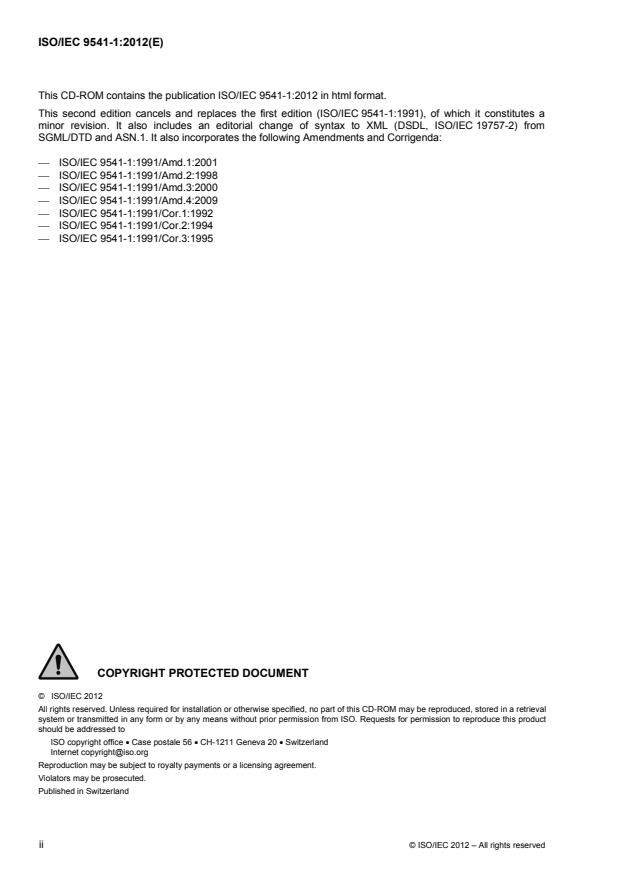
This CD-ROM contains the publication ISO/IEC 9541-1:2012 in html format.
This second edition cancels and replaces the first edition (ISO/IEC 9541-1:1991), of which it constitutes a
minor revision. It also includes an editorial change of syntax to XML (DSDL, ISO/IEC 19757-2) from
SGML/DTD and ASN.1. It also incorporates the following Amendments and Corrigenda:
ISO/IEC 9541-1:1991/Amd.1:2001
ISO/IEC 9541-1:1991/Amd.2:1998
ISO/IEC 9541-1:1991/Amd.3:2000
ISO/IEC 9541-1:1991/Amd.4:2009
ISO/IEC 9541-1:1991/Cor.1:1992
ISO/IEC 9541-1:1991/Cor.2:1994
ISO/IEC 9541-1:1991/Cor.3:1995
© ISO/IEC 2012
All rights reserved. Unless required for installation or otherwise specified, no part of this CD-ROM may be reproduced, stored in a retrieval
system or transmitted in any form or by any means without prior permission from ISO. Requests for permission to reproduce this product
should be addressed to
ISO copyright office Case postale 56 CH-1211 Geneva 20 Switzerland
Internet copyright@iso.org
Reproduction may be subject to royalty payments or a licensing agreement.
Violators may be prosecuted.
Published in Switzerland
ii © ISO/IEC 2012 – All rights reserved
Installation
If t
...