


ISO/IEC 9541-1:1991
(Main)Information technology — Font information interchange — Part 1: Architecture
Information technology — Font information interchange — Part 1: Architecture
Defines a method of naming glyphs and glyph collections, independent of any document encoding technique. Includes an alphabetical index. Annex A forms an integral part of this standard. Annex B is for information only.
Technologies de l'information — Échange d'informations sur les fontes — Partie 1: Architecture
General Information
- Status
- Withdrawn
- Publication Date
- 25-Sep-1991
- Withdrawal Date
- 25-Sep-1991
- Technical Committee
- ISO/IEC JTC 1/SC 34 - Document description and processing languages
- Drafting Committee
- ISO/IEC JTC 1/SC 34 - Document description and processing languages
- Current Stage
- 9599 - Withdrawal of International Standard
- Start Date
- 13-Aug-2012
- Completion Date
- 14-Feb-2026
Relations
- Effective Date
- 06-Jun-2022
- Effective Date
- 06-Jun-2022
- Effective Date
- 06-Jun-2022
- Effective Date
- 06-Jun-2022
- Revised
ISO/IEC 9541-1:2012 - Information technology — Font information interchange — Part 1: Architecture - Effective Date
- 11-Jul-2009
- Effective Date
- 15-Apr-2008
- Effective Date
- 15-Apr-2008
- Effective Date
- 15-Apr-2008
- Effective Date
- 15-Apr-2008
Get Certified
Connect with accredited certification bodies for this standard

BSI Group
BSI (British Standards Institution) is the business standards company that helps organizations make excellence a habit.

NYCE
Mexican standards and certification body.
Sponsored listings
Frequently Asked Questions
ISO/IEC 9541-1:1991 is a standard published by the International Organization for Standardization (ISO). Its full title is "Information technology — Font information interchange — Part 1: Architecture". This standard covers: Defines a method of naming glyphs and glyph collections, independent of any document encoding technique. Includes an alphabetical index. Annex A forms an integral part of this standard. Annex B is for information only.
Defines a method of naming glyphs and glyph collections, independent of any document encoding technique. Includes an alphabetical index. Annex A forms an integral part of this standard. Annex B is for information only.
ISO/IEC 9541-1:1991 is classified under the following ICS (International Classification for Standards) categories: 35.240.30 - IT applications in information, documentation and publishing. The ICS classification helps identify the subject area and facilitates finding related standards.
ISO/IEC 9541-1:1991 has the following relationships with other standards: It is inter standard links to ISO/IEC 9541-1:1991/Amd 2:1998, ISO/IEC 9541-1:1991/Amd 3:2000, ISO/IEC 9541-1:1991/Amd 4:2009, ISO/IEC 9541-1:1991/Amd 1:2001, ISO/IEC 9541-1:2012; is excused to ISO/IEC 9541-1:1991/Amd 2:1998, ISO/IEC 9541-1:1991/Amd 4:2009, ISO/IEC 9541-1:1991/Amd 3:2000, ISO/IEC 9541-1:1991/Amd 1:2001. Understanding these relationships helps ensure you are using the most current and applicable version of the standard.
ISO/IEC 9541-1:1991 is available in PDF format for immediate download after purchase. The document can be added to your cart and obtained through the secure checkout process. Digital delivery ensures instant access to the complete standard document.
Standards Content (Sample)
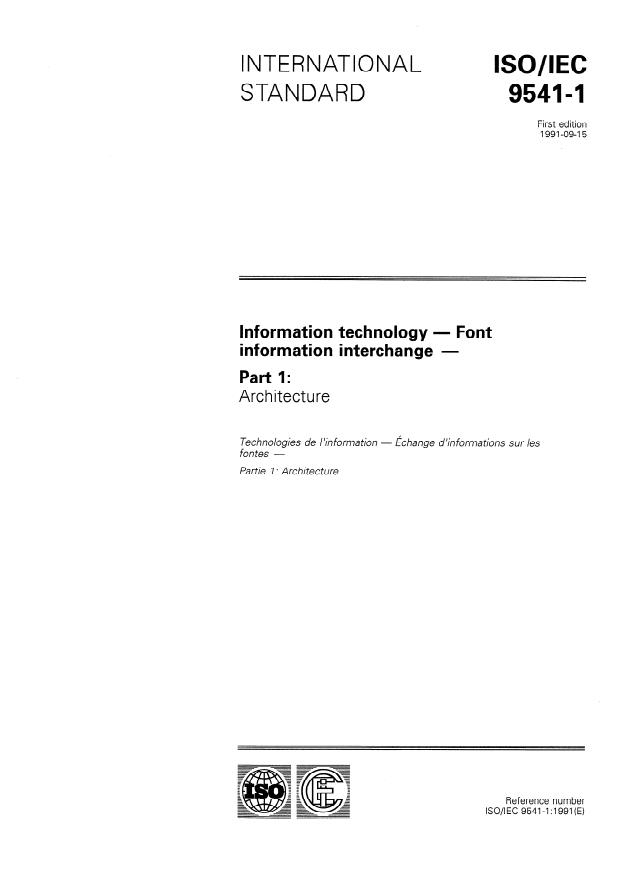
ISO/IEC
INTERNATIONAL
9541-1
STANDARD
First edition
1991-09-15
Information technology - Font
information interchange -
Part 1:
Architecture
- fkhange d’informations sur /es
Technologies de I’information
fontes -
Partie 1: Architecture
Reference number
ISO/1 EC 9541-1: 1991 (E)
--
P -- Y
lSO/lEC 9541=1:1991(E)
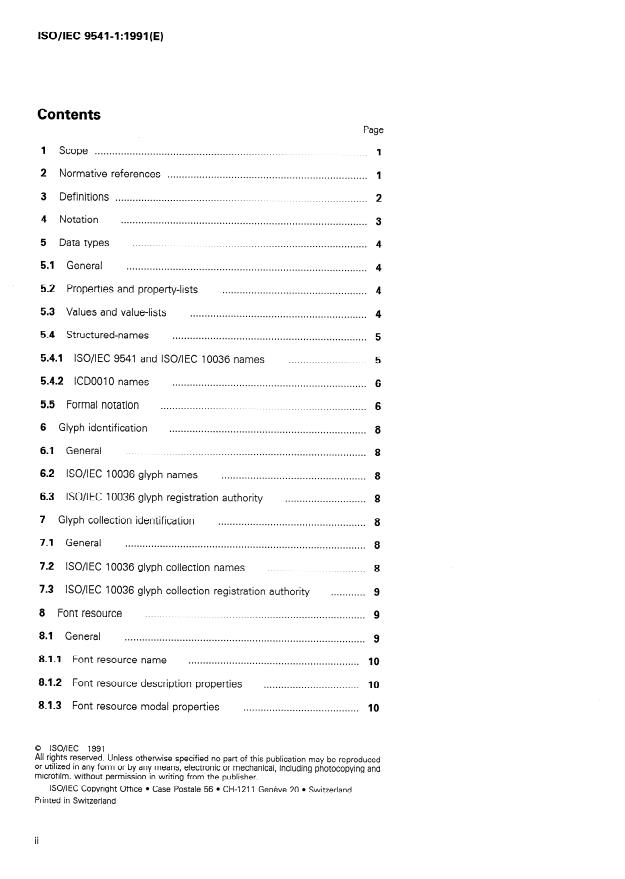
Contents
Page
1 Scope . 1
2 Normative references . 1
3 Definitions . 2
4 Notation . 3
5 Data types . 4
5.1 General . 4
5.2 Properties and property-lists
.................................................. 4
5.3 Values and value-lists
............................................................. 4
5.4 Structured-names . 5
5.4.1 ISO/IEC 9541 and lSO/IEC 10036 names . 5
5.4.2 ICDOOI 0 names .
5.5 Formal notation
....................................................................... 6
6 Glyph identification . 8
6.1 General . . . . . . . . . . . . . . . . . . . . . . . . . . . . . . . . . . . . . . . . . . . . . . . . . . . . . . . . . . . . . . . . . . . . . . . . . . . . . . . . . . . 8
6.2 ISO/IEC 10036 glyph names . . . . . . . . . . . . . . . . . . . . . . . . . . . . . . . . . . . . . . . . . . . . . . . . . . 8
6.3 ISO/1 EC 10036 glyph registration authority . 8
7 Glyph collection identification .
7.1 General
. . . . . . . . . . . . . . . . . . . . . . . . . . . . . . . . . . . . . . . . . . . . . . . . . . . . . . . . . . . . . . . . . . . . . . . . . . . . . . . . . . . 8
7.2 lSO/IEC 10036 glyph col ection names . . . . . . . . . . . . . . . . . . . . . . . . . . . . . . . . . . 8
7.3 lSO/IEC 10036 glyph col
ection registration authority . . . . . . . . . . . . 9
8 Font resource
. . . . . . . . . . . . . . . . . . . . . . . . . . . . . . . . . . . . . . . . . . . . . . . . . . . . . . . . . . . . . . . . . . . . . . . . . . . 9
Q
8.1 General . . . . . . . . . . . . . . . . . . . . . . . . . . . . . . . . . . . . . . . . . . . . . . . . . . . . . . . . . . . . . . . . . . . . . . . . . . . . . . . . . . . u
8.1.1 Font resource name . . . . . . . . . . . . . . . . . . . . . . . . . . . . . . . . . . . . . . . . . . . . . . . . . . . . . . . . . . .
8.1.2 Font resource description properties
. . . . . . . . . . . . . . . . . . . . . . . . . . . . . . . . . 10
8.1.3 Font resource modal properties . . . . . . . . . . . . . . . . . . . . . . . . . . . . . . . . . . . . . . . . 10
0 ISO/IEC 1991
All rights reserved. Unless otherwise specified no part of this publication may be reproduced
or utilized in any form or by any means, electronie or mechanical, including photocopying and
microfilm, without Permission in writing from the publisher.
ISO/1 EC Copyright Office l Case Postale 56 l CH-l 211 Geneve 20 l Switzerland
Printed in Switzerland
ii
ISO/IEC 9541=1:1991(E)
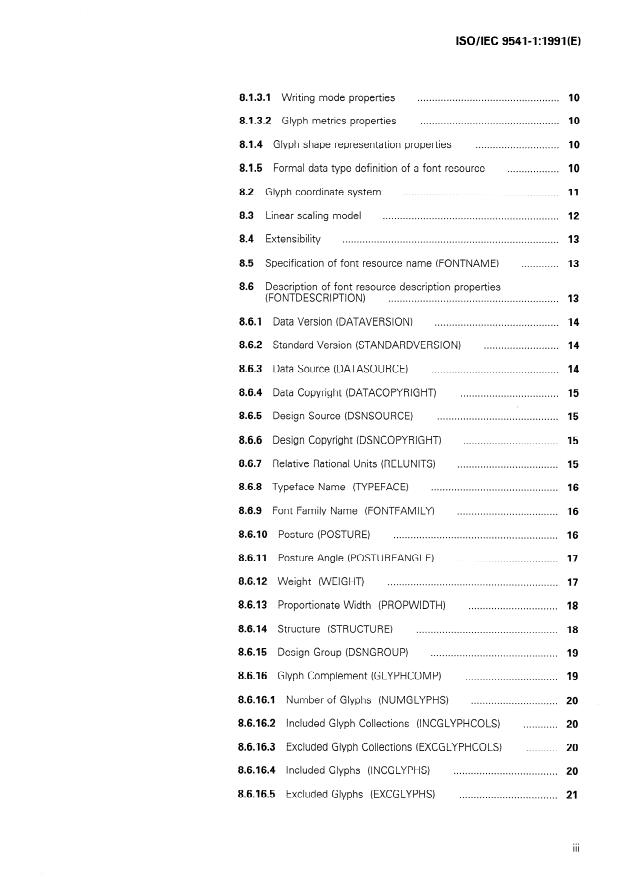
................................................. 10
8.1.3.1 Writing mode properties
8.1.3.2 Glyph metrics properties . 10
............................. 10
8.1.4 Glyph shape representation properties
Formal data type definition of a font resource . 10
8.1.5
82 . Glyph coordinate System . 11
Linear scaling model . 12
8.3
84 . Extensibility . 13
............. 13
85 . Specification of font resource name (FONTNAME)
.
86 Description of font resource description properties
........................................................... 13
(FONTDESCRIPTION)
8.6.1 Data Version (DATAVERSION) . .
.......................... 14
8.6.2 Standard Version (STANDARDVERSION)
8.6.3 Data Source (DATASOURCE) . 14
. . . . . . . . . . . . . . . . . . . . . . . . . . . . . . . . . . 15
8.6.4 Data Copyright (DATACOPYRIGHT)
8.6.5 Design Source (DSNSOURCE) . . . . . . . . 15
................................. 15
8.6.6 Design Copyright (DSNCOPYRIGHT)
8.6.7 Relative Rational Units (RELUNITS) . 15
8.6.8 Typeface Name (TYPEFACE) . . . . . . . . . . . 16
. . . . . . . . . . . . . . . . . . . . . . . . . . . . . . . . . . . 16
8.6.9 Font Family Name (FONTFAMILY)
8.6.10 Posture (POSTURE) . . . . . . . . . . . . . . . . . . . . . . . . . . . . . . . . . . . . . . . . . . . . . . . . . . . . . . . . . . 16
8.6.11 Posture Angle (POSTUREANGLE) . 17
8.6.12 Weight (WEIGHT) . . . . . . . . . . . . . . . . . . . . . I B. . 17
...............................
8.6.13 Proportionate Width (PROPWIDTH) 18
8.6.14 Structure (STRUCTURE) . . . . . . . . . . . . . . . . 18
Design Group (DSNGROUP) . . . . . . . . . 19
8.6.15
8.6.16 Glyph Complement (GLYPHCOMP) . 19
. . . . . . . . . . . . . . . . . . . . . . . . . . . . . .
8.6.16.1 Number of Glyphs (NUMGLYPHS) 20
8.6.16.2 Included Glyph Collections (INCGLYPHCOLS) . 20
........... 20
8.6.16.3 Excluded Glyph Collections (EXCGLYPHCOLS)
8.6.16.4 Included Glyphs (INCGLYPHS) .
8.6.16.5 Excluded Glyphs (EXCGLYPHS) . 21
ISO/IEC 9541=1:1991(E)
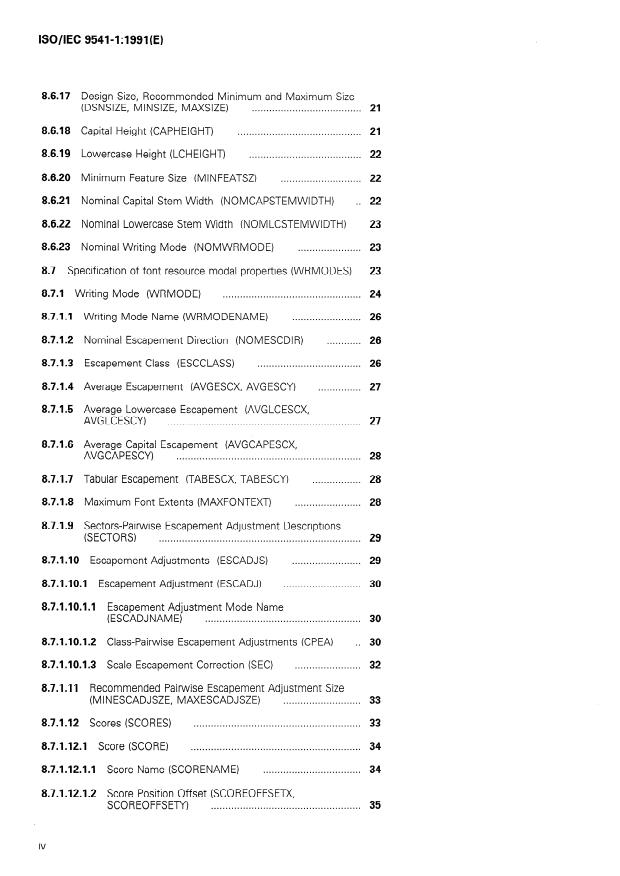
8.6.17 Design Size, Recommended Minimum and Maximum Size
(DSNSIZE, MINSIZE, MAXSIZE) . . . . . . . . . . . . . . . . . . . . . . . . . . . . . . . . . . . . . . 21
8.6.18 Capital Height (CAPHEIGHT) . . . . . . . . . . . . . . . . . . . . . . . . . . . . . . . . . . . . . . . . . . . 21
8.6.19 Lowercase Height (LCHEIGHT) . . . . . . . . . . . . . . . . . . . . . . . . . . . . . . . . . . . . . . . 22
8.6.20 Minimum Feature Size (MINFEATSZ) . . . . . . . . . . . . . . . . . . . . . . . . . . . . 22
. . 22
8.6.21 Nominal Capital Stern Width (NOMCAPSTEMWIDTH)
8.6.22 Nominal Lowercase Stern Width (NOMLCSTEMWIDTH) 23
8.6.23 Nominal Writing Mode (NOMWRMODE) . . . . . . . . . . . . . . . . . . . . . . 23
8.7 Specification of font resource modal properties (WRMODES) 23
8.7.1 Writing Mode (WRMODE) 24
. . . . . . . . . . . . . . . . . . . . . . . . . . . . . . . . . . . . . . . . . . . . . . . .
8.7.1 .l Writing Mode Name (WRMODENAME) . 26
8.7.1.2 Nominal Escapement Direction (NOM ESCDI R) . 26
8.7.1.3 Escapement Class (ESCCLASS) . . 26
8.7.1.4 Average Escapement (AVG ESCX, AVG ESCY) . 27
8.7.1.5
Average Lowercase Escapement (AVG LCESCX,
AVGLCESCY) . 27
8.7.1.6 Average Capital Escapement (AVGCAPESCX,
................................................................ 28
AVGCAPESCY)
8.7.1.7 (TAB ESCX, TAB ESCY) 28
Ta bular Escapement .
8.7.1.8 Maximum Font Extents (MAXFONTEXT) .
8.7.1.9 Seetors-Pairwise Escapement Adjustment Descriptions
(SECTORS) . 29
8.7.1.10 Escapement Adjustments (ESCADJS) . . . . . . . . . . . . . . . . . . . . . . . . 29
8.7.1.10.1 Escapement Adjustment (ESCADJ) . . . . . . . . . . . . . . . . . . . . . . . . . . . 30
8.7.1 .lO.l.l Escapement Adjustment Mode Name
(ESCADJNAME) . . . . . . . . . . . . . . . . . . . . . . . . . . . . . . . . . . . . . . . . . . . . . . . . . . . . . . 30
8.7.1.10.1.2 Class-Pairwise Escapement Adjustments (CPEA) . . 30
8.7.1 .10.1.3 Scale Escapement Correction (SEC) . . . . . . . . . . . . . . . . . . . . . . . 32
8.7.1 .ll Recommended Pairwise Escapement Adjustment Size
(MINESCADJSZE, MAXESCADJSZE) . . . . . . . . . . . . . . . . . . . . . . . . . . . 33
8.7.1.12 Scores (SCORES) . . . . . . . . . . . . . . . . . . . . . . . . . . . . . . . . . . . . . . . . . . . . . . . . . . . . . . . . . . 33
. . . . . . . . . . . . . . . . . . . . . . . . . . . . . . . . . . . . . . . . . . . . . . . . . . . . . . . . . . . 34
8.7.1 A2.1 Score (SCORE)
8.7.1.12.1.1 Score Name (SCORENAME) . . . . . . . . . . . . . . . . . . . . . . . . . . . . . . . . . . 34
8.7.1.12.1.2 Score Position Offset (SCOREOFFSETX,
SCOREOFFSETY) . . . . . . . . . . . . . . . . . . . . . . . . . . . . . . . . . . . . . . . . . . . . . . . . . . . .
iv
ISO/IEC 9541=1:1991(E)
8.7.1.12.1.3 Score Thickness (SCORETHICK) . . . . . . . . . . . . . . . . . . . . . . . . . . . . 35
8.7.1.13 Variant Scripts (VSCRIPTS) . . . . . . . . . . . . . . . . . . . . . . . . . . . . . . . . . . . . . . . . . . 35
. . . . . . . . . . . . . . . . . . . . . . . . . . . . . . . . . . . . . . . . . . . . 35
8.7.1.13.1 Variant Script (VSCRIPT)
. . . . . . . . . . . . . . . . . . . . . . . . . . . . . . 36
8.7.1.13.1.1 Variant Script Name (VSNAME)
8.7.1.13.1.2 Variant Script Position Offset (VSOFFSETX,
VSOFFSETY) . . . . . . . . . . . .*. 36
8.7.1.13.1.3 Variant Script Anamorphic Scale Factors (VSSCALEX,
VSSCALEY) . . . . . . . . . . . . . . . . . . . . . . . . . . . . . . . . . . . . . . . . . . . . . . . . . . . . . . . . . . . . . 37
8.7.1.14 Recommended Minimum Alignment Line-to-Line Spacing
Distance (MINLINESP) . . . . . . . . . . . . . . . . . . . . . . . . . . . . . . . . . . . . . . . . . . . . . . . . . . 37
8.7.1.15 Recommended Minimum and Maximum Anamorphic Scale
. . . . . . . . . . . . . . . . . 37
Factors (M I NANASCALE, MAXANASCALE)
. . . . . . . . . . . . . . . . . . . . . . 38
8.7.1.16 Nominal Alignment Mode (NOMALIGN)
8.7.1.17 Alignment Modes (ALIGNMODES) . . . . . . . . . . . . . . . . . . . . . . . . . . . . . 38
. . . . . . . . . . . . . . . . . . . . . . . . . . . . . . . . . . . . . . . . . . 39
8.7.1.17.1 Alignment Mode (ALIGN)
. . . . . . . . . . . . . . . . . . 39
8.7.1.17.1.1 Alignment Mode Name (ALIGNNAME)
8.7.1.17.1.2 Alignment Line Position Offset (ALIGNOFFSETX,
ALIGNOFFSETY) . . . . . . . . . . . . . . . . . . . . . . . . . . . . . . . . . . . . . . . . . . . . . . . . . . . . .
8.7.1.17.1.3 Alignment Mode Anamorphic Scale Factors
(ALIGNSCALEX, ALIGNSCALEY) . . . . . . . . . . . . . . . . . . . . . . . . . . . . 40
. . . . . . . . . . . . . . . . . . . . . . . . . . . . . . . . 41
8.7.1.18 Copy Fit Techniques (COPYFITS)
8.7.1.18.1 Copy Fit Technique (COPYFIT) . . . . . . . . . . . . . . . . . . . . . . . . . . . . . . . . . . 41
. . . . . . . . . . 42
8.7.1.18.1.1 Copy Fit Technique Name (COPYFITNAME)
. . . . . . . . . . . . . . . . 42
8.7.1.18.1.2 Copy Fit Measure (COPYFITMEASURE)
8.7.1.19 Design, Recommended Minimum and Maximum Wordspace
Adjustments (DSNWORDADD, DSNWORDAMPL,
MINWORDADD, MINWORDAMPL, MAXWORDADD,
MAXWORDAMPL) . . . . . . . . . . . . . . . . . . . . . . . . . . . . . . . . . . . . . . . . . . . . . . . . . . . . . . . . 42
8.7.1.20 Design, Recommended Minimum and Maximum Letterspace
Adjustments (DSNLETTERADD, DSNLETTERAMPL,
MINLETTERADD, MINLETTERAMPL, MAXLETTERADD,
. . . . . . . . . . . . . . . . . . . . . . . . . . . . . . . . . . . . . . . . . . . . . . . . . . . . . . 43
MAXLETTERAMPL)
8.8 Specification of font resource glyph metrics properties
(GLYPHMETRICS) . . . . . . . . . . . . . . . . . . . . . . . . . . . . . . . . . . . . . . . . . . . . . . . . . . . . . . . . . . . . . . . . . 44
8.8.1 Glyph Metric (GMETRIC) . . . . . . . . . . . . . . . . . . . . . . . . . . . . . . . . . . . . . . . . . . . . . . . . . . . 45
8.8.1.1 Glyph Name (GNAME) . . . . . . . . . . . . . . . . . . . . . . . . . . . . . . . . . . . . . . . . . . . . . . . . . . . . 45
8.8.1.2 Glyph Position and Escapement Points (PX, PY, EX, EY) 45
ISO/IEC 954%l:lSSl(E)
8.8.1.3 Glyph Extents (EXT) . . . . . . . . . . . . . . . . . . . . . . . . . . . . . . . . . . . . . . . . . . . . . . . . . . . . . . . .
8.8.1.4 Glyph Ligature Relationships (LGS) . . . . . . . . . . . . . . . . . . . . . . . . . . . . . . . . 47
8.8.1.4.1 Ligature (LG) . . . . . . . . . . . . . . . . . . . . . . . . . . . . . . . . . . . . . . . . . . . . . . . . . . . . . . . . . . . . . . . . 48
8.8.1.4.1.1 Ligature Name (LGN) . . . . . . . . . . . . . . .m. 48
8.8.1.4.1.2 Ligature Successor Names (LGSN) . . . . . . . . . . . . . . . . . . . . . . . . . . 49
8.8.1.5 Glyph Pairwise Escapement Adjustments (PEAS) . . . . . . . . . 49
8.8.1.5.1 Pairwise Escapement Adjustment (PEA) . . . . . . . . . . . . . . . . . . . . . 49
. . . . 50
8.8.1.5.1.1 Pairwise Escapement Adjustment Name (PEAN)
8.8.1.5.1.2 Pairwise Escapement Adjustment (PEAX, PEAY) . . . . 50
8.8.1.5.1.3 Seetor-Pairwise Escapement Adjustment Extents
(SPEAFORWDX, SPEAFORWDY, SPEABACKWDX,
. . . . . . . . . . . . . . . . . . . . . . . . . . . . . . . . . . . . . . . . .“. 51
SPEABACKWDY)
8.8.1.6 Class-Pairwise Escapement Adjustment Class Indicator
(CPEAI) . . . . . .*. 52
8.8.1.7 Escapement Adjustment Indicator (EAI) . . . . . . . . . . . . . . . . . . . . . . . . . 53
8.8.1.8 Minimum and Maximum Adjusted Escapement MINEX,
MINEY, MAXEX, MAXEY) . . . . . . . . . . . . . . . . . . . . . . . . . . . . . . . . . . . . . . . . . . . . . . 53
Annexes
A Typeface design grouping . . . . . . . . . . . . . . . . . . . . . . . . . . . . . . . . . . . . . . . . . . . . . . . . . . . . .
a
n F
D t-onr concepts . . . . . . . . . . . . . . . . . . . . . . . . . . . . . . . . . . . . . . . . . . . . . . . . . . . . . . . . . . . . . . . . . . . . . . . . 75
B.l General . . . . . . . . . . . . . . . . . . . . . . . . . . . . . . . . . . . . . . . . . . . . . . . . . . . . . . . . . . . . . . . . . . . . . . . . . . . . . . . . .
B.2 Font resource environment . 76
B.2.1 Font production . 76
B.2.2 Font resource installation, storage and access . 76
B.3 Application environment . 77
8.3.1 Text processing Systems . . . . . . . . . . . . . . . . . . . . . . . . . . . . . . . . . . . . . . . . . . . . . . . . . . 77
. . . . . . . . . . . . . . . . . . . . . . . . . . . . . . . . . . . . . . . . . . . . . . . . . . . . . . . 77
B.3.2 Document processing
B.3.2.1 Document editing . . . . . . . . . . . . . . . . . . . . . . . . . . . . . . . . . . . . . . . . . . . . . . . . . . . . . . . . . . . 77
B.3.2.2 Document formatting . . . . . . . . . . . . . . . . . . . . . . . . . . . . . . . . . . . . . . . . . . . . . . . . . . . . . 77
B.3.2.3 Document presentation . . . . . . . . . . . . . . . . . . . . . . . . . . . . . . . . . . . . . . . . . . . . . . . . . . 78
.................................................... ............ 78
B.3.3 Font referencing
B.3.4 Glyph referencing . . . . . . . . . . . . . . . . . . . . . . . . . . . . . . . . . . . . . . . . . . . . . . . . . . . . . . . . . . . . . . 78
B.3.5 Glyph positioning . . . . . . . . . . . . . . . . . . . . . . . . . . . . . . . . . . . . . . . . . . . . . . . . . . . . . . . . . . . . . . .
vi
ISO/IEC 9541=1:1991(E)
8.3.6 Glyph shape presentation .
Alphabetical index .
VII
ISO/IEC 9541=1:1991(E)
Foreword
ISO (the International Organization for Standardization) and IEC (the Inter-
national Electrotechnical Commission) form the specialized System for
worldwide standardization. National bodies that are members of ISO or
IEC participate in the development of International Standards through
technical committees established by the respective organization to deal
with particular fields of technical activity. ISO and IEC technical commit-
tees collaborate in fields of mutual interest. Other international organiza-
tions, governmental and non-governmental, in liaison with ISO and IEC,
also take patt in the work.
In the field of information technology, ISO and IEC have established a joint
technical committee, lSO/IEC JTC 1. Draft International Standards adopted
by the joint technical committee are circulated to national bodies for vot-
ing. Publication as an International Standard requires approval by at least
75 % of the national bodies casting a vote.
International Standard lSO/IEC 9541-1 was prepared by Joint Technical
Committee ISO/1 EC JTC 1, Information technology.
lSO/IEC 9541 consists of the following Parts, under the general title In-
forma tion technology - Fon t in forma tion in terchange:
- Part 1: Architecture
- Part 2: In terchange Format
tion
- Part 3: Glyph shape represen ta
- Part 4: Applica tion-specific requiremen ts
Part 1 of lSO/IEC 9541 specifies the architecture of a font resource, i.e.,
the font description, font metrics, glyph description and glyph metrics
properties required for font references and the interchange of font re-
sources.
Part 2 of lSO/IEC 9541 specifies the interchange formats for font infor-
mation, and the minimum subsets of that information required for inter-
Change.
Part 3 of lSO/IEC 9541 specifies the architecture and interchange formats
for glyph shape representations.
Part 4 of lSO/IEC 9541 specifies the architecture and interchange format
extensions for application specific (e.g. typesetting of mathematics) re-
quirements.
Annex A forms an integral part of this part of lSO/IEC 9541. Annex B is for
information only.
. . .
VIII
ISO/IEC 954%1:1991(E)
Introduction
The use of open networks for the interchange of documents in both Office
and publishing environments has shown the need for a mechanism ena-
bling the interchange of font information.
It is foreseen that publishing and Office technologies will merge and that
this development will be facilitated by definition of a Standard font re-
Source architecture and a limited number of Standard font resource inter-
Change formats.
ISO/IEC 95417l:lSSl(E)
.X
ISO/IEC 9541=1:1991(E)
INTERNATIONAL STANDARD
Font information
Information technology -
interchange -
Part 1:
Architecture
1 Scope
lSO/IEC 9541 defines a method of naming glyphs and glyph collections, independent of any document encoding
technique; it assumes that one or more methods of associating document encoding techniques with glyph iden-
tifiers used in font resources will be provided by text processing Systems.
This patt of lSO/IEC 9541 specifies the architecture of a font resource, i.e., the font description, font metrics, glyph
description and glyph metrics properties required for font references and the interchange of font resources.
2 Normative references
The following Standards contain provisions which, through reference in this text, constitute provisions of this part
of ISO/IEC 9541. At the time of publication, the editions indicated were valid. All Standards are subject to revision,
and Parties to agreements based on this part of ISO/IEC 9541 are encouraged to investigate the possibility of ap-
plying the most recent editions of the Standards indicated below. Members of IEC and ISO maintain registers of
currently valid International Standards.
ISO 646: 1983, Information processing - ISO 7-bit coded Character set for information interchange.
ISO 3166:1988, Codes for the representation of names of countries.
ISO 6523: 1984, Data interchange - Structures for the iden tification of organizations.
ISO 8824: 1990, Information technology - Open Systems Interconnection - Specification of Abstract Syntax
Notation One (ASN. 1).
Registration procedures for public text
ISO/IEC 9070:1991, Information technology - SGML support facilities -
o wner iden tifiers.
Fon t information interchange - Part 2: Interchange Format.
ISO/1 EC 9541-2: 1991, Information technology -
-.l) , Information technology - Procedure for registration of glyph and glyph collection identifiers.
lSO/IEC 10036:
1) To be published.
ISO/IEC 9541=1:1991(E)
3 Definitions
For the purposes of this patt of lSO/IEC 9541, the following definitions apply.
31 . alignment line: Imaginary line to which most glyph images of a font seem to align.
32 . current Position: A Point on the presentation surface at which the next glyph representation is to be imaged.
3.3 design size: Absolute size at which a font is designed to be used.
3.4 escapement: Movement of the current Position on the presentation surface after a glyph representation is
imaged.
3.5 escapement Point: A glyph metric; a Point in the glyph coordinate System, to which the current Position on
the presentation surface is usually translated, after the glyph representation is imaged.
3.6 font: A collection of glyph images having the same basic design, e.g., Courier Bold Oblique.
3.7 font family: A collection of fonts of common design, e.g., Courier, Courier Bald, Courier Bald Oblique.
3.8 font metrics: The set
of dimensions and positioning information in a font resource common to all glyph
representations contained in that font resource.
3.9 font reference: The information about a font resource in an electronie document representation, and possible
procedures and Operation s on that information, w ,hich identify or describe the desired font.
3.10 font resource: A collection of glyph representations together with descriptive and font metric information
which are relevant to the collection of glyph representations as a whole.
3.11 font size: A scalar reference size relative metrics, glyph shapes and glyph metrics are
to which most font
specif ied.
3.12 glyph: A recognizable abstract graphic Symbol which is independent of any specific design.
3.13 glyph collection: An identified set of glyphs.
3.14 glyph coordinate System: A two-dimensional Cartesian coordinate System within which glyph shapes,
glyph metrics, and font metrics are defined.
3.15 glyph image: An image of a glyph, as obtained from a glyph representation displayed on a presentation
surface.
3.16 glyph metrics: The set of information in a glyph representation used for defining the dimensions and pos-
itioning of the glyph shape.
3.17 glyph representation: The glyph shape and glyph metrics associated with a specific glyph in a font re-
Source.
3.18 glyph shape: The set of information in a glyph representation used for defining the shape which represents
the glyph.
3.19 kern: The extension of a glyph shape beyond its Position Point or escapement Point.
3.20 Position Point: A glyph metric; a Point in the glyph coordinate System, usually translated to the current
Position on the presentation surface before the glyph shape is imaged.
3.21 posture: The extent to which the shape of a glyph or set of glyphs appear to incline, including any conse-
quent design or form Change.
graphics display, etc.),
3.22 presentation surface: A virtual rep resentati on of a presentation medium (Page,
be imaged.
maintained by the presentation process, on which a lh shapes are to
11 glYP
ISO/IEC 9541=1:1991(E)
3.23 proportionate width: The ratio of a glyph’s or set of glyphs’ escapement to font height.
3.24 Stern: The major stroke of a glyph shape.
3.25 weight: The ratio of a glyph’s or set of glyphs’ stem width to font height.
3.26 writing mode: An identified mode for setting of text in a writing System, usually corresponding to a nominal
escapement direction of the glyphs in that mode, i.e., left-to-right, right-to-left or top-to-bottom.
4 Notation
An extended Version of Backus-Naur Form (BNF) notation is used to formally define the data types used through-
out this patt of lSO/IEC 9541 in a manner independent of the actual abstract data Syntax used in the font inter-
Change formats. By convention, basic data types are shown in uppercase.
The components of the extended BNF are:
aaa rule syntactic element
---
..- rule definition
element choice (or)
I
element separator
{ .:. ) optional element(s)
( -*- 1 group of elements
( . . . )” 0 to n repeat of element(s) in group
( . . . )+ 1 to n repeat of element(s) in group
II
II
. . . Iiteral element
-
. . . comment
EXAM PLES:
::= b, c: Element a is defined as/composed of the sequence of element b followed by element c (ordered list);
a) a
b) a ::= b 1 c: Element a is defined as either of the elements b or c;
c) a ::= (b 1 c), [d]: Element a is defined as the sequence of containing either of the elements b or c, optionally
followed by the element d;
::= (b 1 c)*: Elem en t a is defined as a sequence of 0 or more instances of either of the elements b or c;
d) a
e) a ::= (b, c, “foo”)+: Element a is defined as a sequence of 1 or more instances of the sequence of the ele-
ments b, c and the literal “foo”.
The formal data type definitions given in clause 8 identify the set of information that must be represented by all
font information interchange formats that conform to this patt of lSO/IEC 9541. There is no requirement that an
interchange format follow the exact organization of data or structures represented in clause 8 , as long as the
general architectural principles of extensibility, backward and forward compatibility are not compromised. Esch
conforming interchange format is free to adopt the most efficient encoding mechanism available in its abstract
Syntax.
In particular, the actual names of properties and property-lists defined in lSO/IEC 9541 do not have to be encoded
directly as data in an interchange format as long as the association between the names and values is maintained.
The fully qualified name of a property or property-list is given by the BNF definition of the structured property name
for each property defined in clause 8 . lt is up to the parsing processes to expand the encoding-specific names into
these fully qualified names for use by encoding-independent interfaces.
ISO/IEC 9541=1:1991(E)
5 Data types
5.1 General
An elemental data type defines the basic unit of information represented in a font resource for which there is no
further part 1 subdivision. A complex data type is a grouping of elemental data types which are used as basic
building blocks.
This clause defines the elemental and complex data types used throughout this patt of ISO/IEC 9541. The formal
Syntax and method of encoding these data types are defined in the font information interchange format specified
in lSO/IEC 9541-2.
5.2 Properties and property-lists
The principal data type used to represent font resource information is a property. Conceptually, a property is de-
fined to be a name type value tuple, where: name is the unambiguous property name; type is the data type of the
property value; and value is the value of the property, the meaning and interpretation of which is specified by the
property name and the context in which the property is used.
The font resource properties specified in clause 8 of lSO/IEC 9541 include precise definitions of data type. As a
result, the property name is also a specification of the data type and meaning of the corresponding property value.
The data type of non-ISO properties, however, shall be explicitly defined using the elemental and complex data
types defined in this clause.
For example, a property for identifying the font family name used in a font resource might have a property name
FONTFAMILY, whose value is defined to be of data type name, where a particular property value instance might
be Courier.
Proper-ties may be grouped together according to the class of Object they are associated with into property-lists.
A property-list is a set of zero or more properties of an Object, all with property names of the same class. Often
a class of property names is created specifically for the purpose of naming the objects in a particular type of
property-list. For example, the property names WEIGHT and POSTURE might belong to the class of font resource
property names created specifically to name descriptive font resource properties.
The value of a property may be itself a property-list (i.e., the data type is property-list) so that one property-Iist is
effectively nested inside another. In general, this nesting may be repeated indefinitely, so as to permit creation
of arbitrarily complex hierarchical data structures. In practice, however, the depth of nesting is usually restricted
according to the context in which a particular property is defined.
Property-lists, ordered or unordered as appropriate, allow for the definition and general extensibility of both ISO
and non-ISO font resource data. A non-ISO property is any font resource property not defined by lSO/IEC 9541.
5.3 Values and value-lists
Esch property has an associated value. A value may be terminal, i.e., it represents a simple data type such as in-
teger, it may be a Iist of values of such simple data types (a value-list), or it may be itself a property-list.
As opposed to property-lists, value-lists are used wherever the content of a property tan be prescribed; ordered
value-lists are used whenever the exact Order of the property values tan be prescribed.
The data types of each property value defined in a conforming font resource shall be specified to be one of the
following:
5.3.1 property: A name type value tuple data structure;
5.3.2 property-list: A list of zero or more related properties, possibly the value of some other higher-leve
I prop-
erty, which may be specified to be ordered in a particular sequence;
5.3.3 value-list: A list of zero or more property type value pairs, each usually of the same data type, whic :h may
be specified to be ordered in a particular sequence;
5.3.4 proprietary-data: A data structure containing binar-y information that is not representable by data types
defined in this patt of lSO/IEC 9541. Such information is usually proprietary in nature, and is often protected by
ISO/IEC 9541=1:1991(E)
legal contract. lt may be exchanged but will not be necessarily understood by all users of the font resource. Pro-
prietary data contains:
- optional message (usually giving a data Copyright notice);
- optional encryption key;
- n bytes of arbitrary binar-y data, optionally encrypted according to the encryption key.
5.3.5 match-string: An ordered sequence of graphic Character and possible Character set control Codes, of an
identified Character string universal class, as specified by ISO 8824, such string intended for matthing;
5.3.6 message: An ordered sequence of graphic Character and possible Character set control Codes, of an iden-
tified Character string universal class, as specified by ISO 8824, which constitute a human understandable mes-
sage suitable for presentation to a User;
5.3.7 octet-string: An ordered sequence of octets;
5.3.8 octet: An 8-bit byte;
5.3.9 integer: A signed integer number within the range -231 to 231 - 1 inclusive;
5.3.10 cardinal: An unsigned integer number within the range 0 to 232 - 1 inclusive;
5.3.11 Code: A cardinal within the range 0 to 28 - 1 inclusive;
as the ratio of two integers, i.e., a
5.3.12 rational: A signed rational number expressed
numerator/denominator. The denominator is within the range 1 to 231 - 1 inclusive;
5.3.13 rel-rational: A rational number expressed relative to the glyph coordinate System unit divisor;
5.3.14 angle: A rational number in degrees, within the range 0 inclusive to - +360 exclusive, rotated counter-
clockwise around the origin of the the glyph coordinate System, as measured from the positive x axis;
5.3.15 structured-name: A structured-name, see 5.4;
boolean: A boolean value, one of TRUE or FALSE.
5.3.16
5.4 Structured-names
The main vehicle for naming used in lSO/IEC 9541 is a structured-name, as defined in lSO/IEC 9541-2, Annex B.
A structured-name is an unambiguous identifier for some Object suitable for representing that Object within a de-
centralized, distributed Computer System, invariant over space and time.
The remainder of this clause defines the application of lSO/IEC 9541-2, Annex B, to structured-names as used in
lSO/IEC 9541. For notational convenience in lSO/IEC 9541, a structured-name is notated in the canonical form
defined in ISO/IEC 9070:1991.
5.4.1 ISO/IEC 9541 and ISO/IEC 10036 names
ISO/IEC 9541 names are those structured-names with naming authority in the canonical form of “ISO/IEC
9541-1 IJ . All lSO/IEC 9541 names are reserved for definition by this part of lSO/IEC 9541. Examples include the
font resource properties defined in clause 8 of this part. Portions of the structured-name may be omitted from
lSO/IEC 9541 names where context establishes the fully qualified name, thereby leaving only the property name
to be interchanged.
NOTE 1 The ASN.1 form of this naming authority is (1 0 9541 1).
ISO/IEC 10036 names are those structured-names with naming authority in canonical form “ISO/IEC 10036/RA”
. All lSO/IEC 10036 names are reserved for definition by registries specifically authorized by lSO/IEC 10036. Ex-
amples include the glyph names and registry thereof defined in clause 6 of this patt of lSO/lEC 9541. Pottions of
ISO/IEC 954%1:1991(E)
the structured-name may be omitted from structured ISO/ ‘IEC 10036 names where context estab lishes the fully
qualified name, thereby leaving only the glyph or glyph collection name(s) to be interchanged.
NOTE 2 The ASN.1 form of this naming authority is (1 1 10036).
The textual content of lSO/IEC 9541 names and lSO/IEC 10036 names contained in conforming font resources
shall be encoded according to the ISO 646 IRV coded Character set.
NOTES
3 The Character repertoire of ISO/IEC 9541 names and ISO/IEC 10036 names is defined in lSO/IEC 9541-2, Annex B.
4 lSO/IEC 9541 names and lSO/IEC 10036 names are so reserved as to provide a set of structured-names which are most
widely recognized and supported, while still allowing a distributed naming capability to those who wish to use it. Particular
classes of font-related objects and names are defined in the appropriate clauses of this part of lSO/IEC 9541 and in accordance
with ISO registration procedures.
5 While structured property names, structured glyph collection names and structured glyph names other than those registered
as lSO/IEC 9541 or lSO/IEC 10036 names, respectively, are generally supported by the architecture defined here, their meaning
is not defined by lSO/IEC 9541.
5.4.2 ICDOOI 0 names
ICDOOIO names are those structured-names created by organizations registered with naming authority
“ICDOO 10 ” , whose organizational Codes shall consist solely of numbers. All ICDOOIO names are reserved for
definition by registries specifically authorized by a type industry professional organization naming authority oper-
ating under ISO 6523 and having ICD value 0010 in its SIO.
NOTE 6 The ASN.l form of this naming authority is (1 3 IO).
lt is recommended, although not required, that the ICDOOIO naming authority be used to register organizations
wishing to create registries of font resource information for the purposes of font information interchange. For ex-
ample, for organization XYZ to create the font resource name
*‘/CD00 lO/I234~FontAlames::Garamond-Bold-ltalic-Condensed’f , the Object name naming authority 1234 must be
issued by naming authority ICDOOIO to organization XYZ.
5.5 Formal notation
The formal definition for ISO/IEC 9541 data types is given by the following BNF notation:
property ::= property-name,
[property-type,] property-value
property-name ::= STRUCTURED-NAME
property-type ::= -- coded ISO/IEC 9541 data type identifier, one of:
property-list,
ordered-property-list,
value-list, ordered-value-list, BOOLEAN,
STRUCTURED-NAME, MATCH-STRING, MESSAGE,
OCTET-STRING, OCTET, INTEGER, CARDINAL,. CODE,
RATIONAL, REL-RATIONAL, ANGLE, PROPRIETARY-DATA
property-value ::= value 1 complex-value
complex-value ::= value-list 1 ordered-value-list 1
property-list 1 ordered-property-list
value-list ::= (value)* -- unordered
ordered-value-list ::= (value)* -- ordered
-- unordered
property-list ::= (property)*
ISO/IEC 954%1:199l(E)
ordered-property-list ::= (property)* -- ordered
::= BOOLEAN 1 STRUCTURED-NAME 1
value
MATCH-STRING 1 MESSAGE 1 OCTET-STRING 1
OCTET 1 INTEGER 1 CARDINAL 1 CODE 1 RATIONAL 1
REL-RATIONAL 1 ANGLE 1 PROPRIETARY-DATA
BOOLEAN ::= -- a boolean value, one of TRUE or FALSE
STRUCTURED-NAME ::= -- see 5.4
MATCH-STRING ::= -- An ordered sequence of graphic Character and
possible Character set control Codes, of an identified
Character string universal class, as specified by
ISO 8824, intended for matthing
MESSAGE ::= -- An ordered sequence of graphic Character and
possible Character set control Codes, of an identified
Character string universal class, as specified by
ISO 8824, intended for presentation to a User
OCTET-STRING ::= (OCTET)*
OCTET ::= -- 8-bit byte
INTEGER ::= -- a signed integer number, -231 to 231 - 1 inclusive
CARDINAL ::= -- an unsigned integer number, 0 to 232 - 1 inclusive
CODE ::= -- a coded, unsigned integer number, 0 to 28 - 1 inclusive
RATIONAL ::= numerator, [denominator] -- denominator defaults to 1
REL-RATIONAL ::= numerator, [denominator] -- denominator defaults to value of glyF
coordinate System unit divisor or 1 if that divisor is not defin
ANGLE ::= numerator, [denominator] -- an angle, in degrees,
0 to +360 exclusive, rotated counter-clockwise around
-
the origin of the the glyph coordinate System, as measured
from the positive x axis
PROPRIETARY-DATA ::= [proprietary-data-message,]
[proprietary-data-key,]
proprietary-data-blackbox
numerator ::= -- a signed integer number, -231 to 231 - 1 inclusive
denominator ::= -- a signed integer number, 1 to 231 - 1 inclusive
proprietary-data-message ::= MESSAGE
proprietary-data-key ::= OCTET-STRING
proprietary-data-blackbox ::= OCTET-STRING
ISO/IEC 954%1:1991(E)
6 Glyph identification
6.1 General
Glyphs are distinguished by their design-independent shape and their description (e.g., “11” - double bracket, open,
piece extender; ” 11” - Center box bar, double vertical). In the general case, glyphs are identified by a structured
glyph name, according to the definition of structured-names in clause 5. For example, **/CD0010/1234~A** or
**/CD00~0/1234/$‘789** might be a name for the capital Latin “A” glyph, at the discretion of naming authority XYZ.
This method of naming is not intended to establish any particular encoding for strings of glyph names, pat-ticularly
not an encoding where the complete structured glyph name including the registered naming authority Object
identifier must be encoded for every glyph.
When referencing glyphs with intersecting descriptions, users are generally advised to use the the most specific
appropriate glyph available in Order to maintain unique glyph identification. For example, use hyphen rather than
hyphen-minus if hyphen is intended.
6.2 ISO/IEC 10036 glyph names
lSO/IEC 10036 glyphs are those glyphs named by structured-names for which the owner name identifies the
registration authority authorized by lSO/IEC 10036. ISO/IEC 10036 glyph identification has the objective of gener-
ating a unique, unambiguous glyph identifier for each glyph defined and used in the world. These glyph identifiers
are to be distinct for each combination of glyph shape and description, but will not be different for each design
Variation. This establishes a structure and registry for identification of ISO/IEC 10036 glyphs.
lSO/IEC 10036 glyphs are identified by structured-names for which the equivalent canonical Character string form
is **ISO/IEC 10036/RA//Glyphs.=.*nnnn ** ; where “nnnn” is a sequence of decimal digits beginning with a non-Zero
digit, which represents an integer in the range of 1 to 232 - 1.
6.3 ISO/IEC 10036 glyph registration authority
For the purposes of lSO/IEC 9541 and according to the rules for the designation and Operation of registration au-
thorities in the ISO/IEC JTCI Directives, the ISO and IEC Councils shall designate an organization to act as the
lSO/IEC 10036 glyph registration authority. The name and address of the registration authority and the registration
procedures are to be found in lSO/IEC 10036.
7 Glyph collection identification
7.1 General
A glyph collection is an identified set of glyphs, defined by enumeration of the structured-names of the glyphs in
the collection. In the general case, glyph collections are identified by a structured glyph collection name, according
to the definition of structured-names in 5.4 . For example, ‘*/CD00 1 O/I 234/VVestern European ** or
“/CDOOiO/l234~6789** might be a name for the Western European glyph collection, at the discretion of naming
authority XYZ.
Some or all of the glyphs of a collection might or might not be lSO/IEC 10036 glyphs. However, wherever practical,
users are advised to use lSO/lEC 10036 glyphs in defining collections. Further, the structured glyph collection
name might or might not be an ISO-registered name. However, wherever practical, users are advised to use
lSO/IEC 10036 glyph collections, and composite collections based on lSO/IEC 10036 glyph collections and ISO/IEC
10036 glyphs.
7.2 ISO/IEC 10036 glyph collection names
lSO/IEC 10036 glyph collections are those glyph collections named by structured-names for which the owner name
identifies the registration authority authorized by lSO/IEC 10036. lSO/IEC 10036 glyph collections shall consist
solely of lSO/IEC 10036 glyphs. Definition of lSO/IEC 10036 glyph collections has the objective of establishing a
ISO/IEC 9541=1:1991(E)
relatively few widely recognized collections w ,hich serve as the basi s for efficient generation and use of fonts. The
remainde r of this clause establis hes a structu re and regi stry for ide ntification of I SO/I EC 10036 glyph collections.
ISO/IEC 10036 glyph collections are identified by structured-names for which the equivalent canonical Character
string form is “ISO/IEC ?0036/RA//Collections::nnnn ” ; where “nnnn” is a squence of decimal digits, beginning
with a non-Zero digit, which represents an integer in the range 1 to 232 - 1.
7.3 ISO/IEC 10036 glyph collection registration authority
For the purposes of lSO/IEC 9541 and according to the rules for the designation and Operation of registration au-
thorities in the lSO/IEC JTCI Directives, the ISO and IEC Councils shall designate an organization to act as the
lSO/IEC 10036 glyph collection registration authority. The name and address of the registration authority and the
registration procedures are to be found in lSO/IEC 10036.
8 Font resource
8.1 General
A font resource is composed of an arbitrary number of ISO and non-ISO font properties and is unambiguously
identified by its device-independent font resource name. The properties of a font resource are defined by a
property-list whose property names are str
...
Questions, Comments and Discussion
Ask us and Technical Secretary will try to provide an answer. You can facilitate discussion about the standard in here.
Loading comments...