

ISO/IEC 23078-2:2024
(Main)Information technology — Specification of digital rights management (DRM) technology for digital publications — Part 2: User key-based protection
General Information
- Abstract
This document defines a technical solution for encrypting resources in digital publications (especially EPUB) and for securely delivering decryption keys to reading systems, included in licenses tailored to specific users. It also defines a simple passphrase-based authentication method for reading systems to verify the license and access the encrypted resources of such digital publications.
- Status
- Published
- Publication Date
- 06-Jun-2024
- Technical Committee
- ISO/IEC JTC 1/SC 34 - Document description and processing languages
- Drafting Committee
- ISO/IEC JTC 1/SC 34 - Document description and processing languages
- Current Stage
- 6060 - International Standard published
- Start Date
- 07-Jun-2024
- Due Date
- 09-Jun-2025
- Completion Date
- 07-Jun-2024

Overview
ISO/IEC 23078-2:2024 specifies a user key–based DRM solution for protecting digital publications (especially EPUB). It defines how resources in a publication are encrypted and how decryption keys are securely delivered to reading systems via user-tailored licenses. The document also describes a simple passphrase-based authentication method that reading systems can use to verify licenses and unlock encrypted content, improving interoperability and long‑term access.
Key topics and requirements
- Encryption of resources: Defines an encryption profile and requirements for encrypting publication assets and packaging encrypted resources in EPUB containers (use of META-INF/encryption.xml is specified).
- License document: Specifies the structure and mandatory fields of license files used to transmit decryption keys, links, rights, user identity, and signatures.
- User key and passphrase: Describes how a user key is calculated from user credentials, requirements for passphrase strength, and optional hints to assist user authentication.
- License status document: Covers status checking, events, timestamps, and workflows such as registering devices, returning publications, and renewing licenses.
- Signature and PKI: Requires signed license documents and defines certificate handling, canonicalization, signature generation and validation to ensure integrity and non‑repudiation.
- Reading system behavior: Provides rules for detecting protected publications, validating licenses, processing user keys, handling errors, and enforcing rights and restrictions.
- Encryption profiles and interoperability: Includes a baseline Basic Encryption Profile 1.0 and guidance for interoperability between issuers and reading systems.
- Examples and extensions: Informative annexes illustrate use cases (including library lending models) and an extension for PDF.
Practical applications and who uses it
- Publishers and aggregators: to protect EPUBs and other digital publications while preserving interoperability and portability.
- Library systems and consortia: to implement lending workflows, status checks, returns, and renewals in a standards-based DRM model.
- Reading system and device developers: to implement license parsing, passphrase-based user authentication, signature validation, and license-status interactions.
- Platform integrators and accessibility teams: to ensure protected publications remain accessible across compliant readers and to reduce vendor lock‑in risk.
- Standards bodies and archivists: to reference an interoperable DRM standard for long‑term access and preservation planning.
Related standards
- ISO/IEC 23078 series (DRM for digital publications)
- EPUB packaging conventions (integration guidance)
- XML Signature 1.1 and XML Encryption 1.1 (normative references)
- RFC 6901, RFC 6570 (referenced for data addressing and URI templates)
- LCP-related registries and ecosystem specifications (referenced within the document)
Keywords: DRM, digital publications, EPUB, user key, license document, encryption, passphrase authentication, reading system, interoperability, library lending.
Relations
- Effective Date
- 06-Jun-2022
Get Certified
Connect with accredited certification bodies for this standard

BSI Group
BSI (British Standards Institution) is the business standards company that helps organizations make excellence a habit.

NYCE
Mexican standards and certification body.
Sponsored listings
Frequently Asked Questions
ISO/IEC 23078-2:2024 is a standard published by the International Organization for Standardization (ISO). Its full title is "Information technology — Specification of digital rights management (DRM) technology for digital publications — Part 2: User key-based protection". This standard covers: This document defines a technical solution for encrypting resources in digital publications (especially EPUB) and for securely delivering decryption keys to reading systems, included in licenses tailored to specific users. It also defines a simple passphrase-based authentication method for reading systems to verify the license and access the encrypted resources of such digital publications.
This document defines a technical solution for encrypting resources in digital publications (especially EPUB) and for securely delivering decryption keys to reading systems, included in licenses tailored to specific users. It also defines a simple passphrase-based authentication method for reading systems to verify the license and access the encrypted resources of such digital publications.
ISO/IEC 23078-2:2024 is classified under the following ICS (International Classification for Standards) categories: 35.240.30 - IT applications in information, documentation and publishing. The ICS classification helps identify the subject area and facilitates finding related standards.
ISO/IEC 23078-2:2024 has the following relationships with other standards: It is inter standard links to ISO/IEC TS 23078-2:2020. Understanding these relationships helps ensure you are using the most current and applicable version of the standard.
ISO/IEC 23078-2:2024 is available in PDF format for immediate download after purchase. The document can be added to your cart and obtained through the secure checkout process. Digital delivery ensures instant access to the complete standard document.
Standards Content (Sample)
International
Standard
ISO/IEC 23078-2
First edition
Information technology —
2024-06
Specification of digital rights
management (DRM) technology for
digital publications —
Part 2:
User key-based protection
Reference number
© ISO/IEC 2024
All rights reserved. Unless otherwise specified, or required in the context of its implementation, no part of this publication may
be reproduced or utilized otherwise in any form or by any means, electronic or mechanical, including photocopying, or posting on
the internet or an intranet, without prior written permission. Permission can be requested from either ISO at the address below
or ISO’s member body in the country of the requester.
ISO copyright office
CP 401 • Ch. de Blandonnet 8
CH-1214 Vernier, Geneva
Phone: +41 22 749 01 11
Email: copyright@iso.org
Website: www.iso.org
Published in Switzerland
© ISO/IEC 2024 – All rights reserved
ii
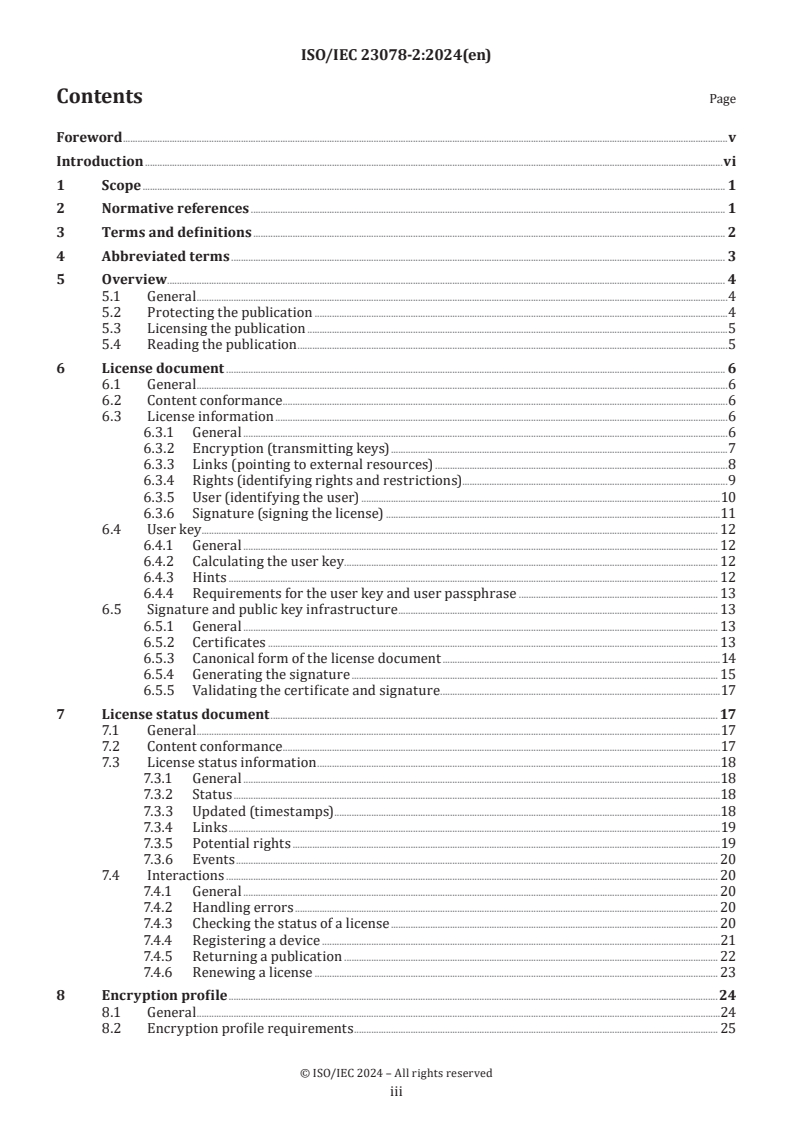
Contents Page
Foreword .v
Introduction .vi
1 Scope . 1
2 Normative references . 1
3 Terms and definitions . 2
4 Abbreviated terms . 3
5 Overview . 4
5.1 General .4
5.2 Protecting the publication .4
5.3 Licensing the publication .5
5.4 Reading the publication .5
6 License document . 6
6.1 General .6
6.2 Content conformance . .6
6.3 License information .6
6.3.1 General .6
6.3.2 Encryption (transmitting keys) .7
6.3.3 Links (pointing to external resources) .8
6.3.4 Rights (identifying rights and restrictions).9
6.3.5 User (identifying the user) .10
6.3.6 Signature (signing the license) .11
6.4 User key . 12
6.4.1 General . 12
6.4.2 Calculating the user key . . 12
6.4.3 Hints . 12
6.4.4 Requirements for the user key and user passphrase . 13
6.5 Signature and public key infrastructure . 13
6.5.1 General . 13
6.5.2 Certificates . 13
6.5.3 Canonical form of the license document .14
6.5.4 Generating the signature . 15
6.5.5 Validating the certificate and signature . .17
7 License status document . 17
7.1 General .17
7.2 Content conformance . .17
7.3 License status information .18
7.3.1 General .18
7.3.2 Status .18
7.3.3 Updated (timestamps) .18
7.3.4 Links .19
7.3.5 Potential rights .19
7.3.6 Events . 20
7.4 Interactions . 20
7.4.1 General . 20
7.4.2 Handling errors . 20
7.4.3 Checking the status of a license . 20
7.4.4 Registering a device .21
7.4.5 Returning a publication . 22
7.4.6 Renewing a license . 23
8 Encryption profile .24
8.1 General .24
8.2 Encryption profile requirements . 25
© ISO/IEC 2024 – All rights reserved
iii
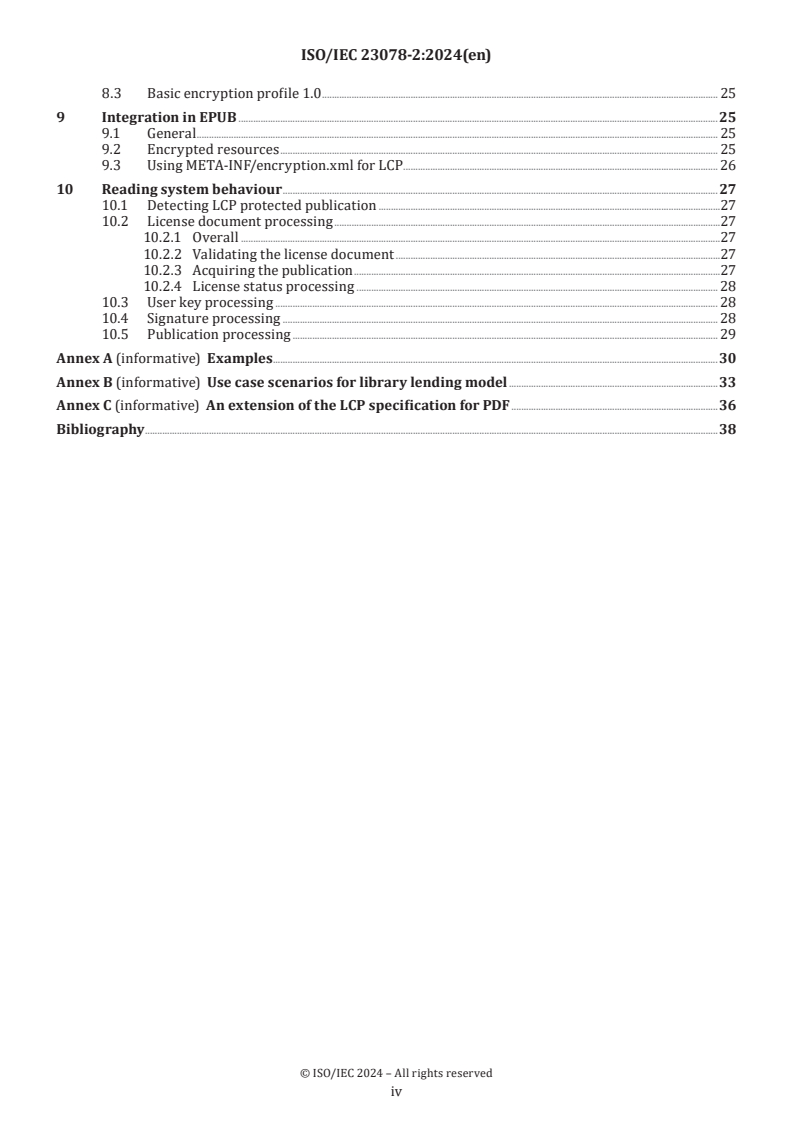
8.3 Basic encryption profile 1.0 . 25
9 Integration in EPUB .25
9.1 General . 25
9.2 Encrypted resources . 25
9.3 Using META-INF/encryption.xml for LCP . 26
10 Reading system behaviour .27
10.1 Detecting LCP protected publication .27
10.2 License document processing .27
10.2.1 Overall .27
10.2.2 Validating the license document .27
10.2.3 Acquiring the publication .27
10.2.4 License status processing . 28
10.3 User key processing . 28
10.4 Signature processing . 28
10.5 Publication processing . 29
Annex A (informative) Examples .30
Annex B (informative) Use case scenarios for library lending model .33
Annex C (informative) An extension of the LCP specification for PDF .36
Bibliography .38
© ISO/IEC 2024 – All rights reserved
iv
Foreword
ISO (the International Organization for Standardization) and IEC (the International Electrotechnical
Commission) form the specialized system for worldwide standardization. National bodies that are
members of ISO or IEC participate in the development of International Standards through technical
committees established by the respective organization to deal with particular fields of technical activity.
ISO and IEC technical committees collaborate in fields of mutual interest. Other international organizations,
governmental and non-governmental, in liaison with ISO and IEC, also take part in the work.
The procedures used to develop this document and those intended for its further maintenance are described
in the ISO/IEC Directives, Part 1. In particular, the different approval criteria needed for the different types
of document should be noted. This document was drafted in accordance with the editorial rules of the ISO/
IEC Directives, Part 2 (see www.iso.org/directives or www.iec.ch/members_experts/refdocs).
ISO and IEC draw attention to the possibility that the implementation of this document may involve the
use of (a) patent(s). ISO and IEC take no position concerning the evidence, validity or applicability of any
claimed patent rights in respect thereof. As of the date of publication of this document, ISO and IEC had not
received notice of (a) patent(s) which may be required to implement this document. However, implementers
are cautioned that this may not represent the latest information, which may be obtained from the patent
database available at www.iso.org/patents and https://patents.iec.ch. ISO and IEC shall not be held
responsible for identifying any or all such patent rights.
Any trade name used in this document is information given for the convenience of users and does not
constitute an endorsement.
For an explanation of the voluntary nature of standards, the meaning of ISO specific terms and expressions
related to conformity assessment, as well as information about ISO's adherence to the World Trade
Organization (WTO) principles in the Technical Barriers to Trade (TBT) see www.iso.org/iso/foreword.html.
In the IEC, see www.iec.ch/understanding-standards.
This document was prepared by Joint Technical Committee ISO/IEC JTC 1, Information technology,
Subcommittee SC 34, Document description and processing languages.
This document cancels and replaces ISO/IEC TS 23078-2:2020, which has been technically revised.
The main changes are as follows:
— four sentences which mentions the ‘LCP related registries’ in 6.3.3.3 (link relationships), 6.3.4 (rights),
6.3.5 (user) and 8.1 (encryption profile) have been changed into NOTE;
— four information references (RFC 6901, RFC 6570, XML Signature Syntax and Processing Version 1.1 and
XML Encryption Syntax and Processing Version 1.1) have been changed into normative references;
— Annex C has been added.
A list of all parts in the ISO/IEC 23078 series can be found on the ISO and IEC websites.
Any feedback or questions on this document should be directed to the user’s national standards
body. A complete listing of these bodies can be found at www.iso.org/members.html and
www.iec.ch/national-committees.
© ISO/IEC 2024 – All rights reserved
v
Introduction
Ever since ebooks have grown in popularity, copyright protection has been an important issue for authors
and publishers.
While the distribution of ebooks around the world is mostly based on the open EPUB standard, most ebook
retailers are using proprietary technologies to enforce usage constraints on digital publications in order to
impede oversharing of copyrighted content. The high level of interoperability and accessibility gained by the
use of a standard publishing format is therefore cancelled by the use of proprietary and closed technologies:
ebooks are only readable on specific devices of software applications (a retailer "lock-in" syndrome), cannot
be accessed anymore if the ebook distributor which protected the publication goes out of business or if the
DRM technology evolves drastically. As a result, users are deprived of any control over their ebooks.
Requirements related to security levels differ depending on which part of the digital publishing market is
addressed. In many situations, publishers require a solution which technically enforces the digital rights
they provide to their users; most publishers are happy to adopt a DRM solution which guarantees an easy
transfer of publications between devices, a certain level of fair-use and provides permanent access to the
publications acquired by their customers.
1)
This is where this document comes into play .
1) Although this document is primarily intended for the protection of EPUB publications, it can also protect digital
publications in other formats, provided that the publication format supports the encryption of resources and the
embedding of a license. This is especially the case for PDF documents contained in a Readium Packaging Format, as
presented in Annex C. This is important for owners of large PDF collections, who want to apply the same DRM to their
EPUB and PDF collections.
© ISO/IEC 2024 – All rights reserved
vi
International Standard ISO/IEC 23078-2:2024(en)
Information technology — Specification of digital rights
management (DRM) technology for digital publications —
Part 2:
User key-based protection
1 Scope
This document defines a technical solution for encrypting resources in digital publications (especially EPUB)
and for securely delivering decryption keys to reading systems, included in licenses tailored to specific
users. It also defines a simple passphrase-based authentication method for reading systems to verify the
license and access the encrypted resources of such digital publications.
2 Normative references
The following documents are referred to in the text in such a way that some or all of their content constitutes
requirements of this document. For dated references, only the edition cited applies. For undated references,
the latest edition of the referenced document (including any amendments) applies.
EPUB 3.3, W3C, available at https:// www .w3 .org/ TR/ epub -33/
ISO 8601-1, Date and time — Representations for information interchange — Part 1: Basic rules
ISO/IEC 8824-1, Information technology — Abstract Syntax Notation One (ASN.1) — Part 1: Specification of
basic notation
2)
RFC 4627 , The application/json Media Type for JavaScript Object Notation (JSON), The Internet Society
3)
RFC 5280 , Internet X.509 Public Key Infrastructure Certificate and Certificate Revocation List (CRL) Profile,
Network Working Group
4)
RFC 6570 , URI Template, Internet Engineering Task Force (IETF)
5)
RFC 6901 , JavaScript Object Notation (JSON) Pointer, Internet Engineering Task Force (IETF)
6)
RFC 7807 , Problem Details for HTTP APIs, The Internet Engineering Task Force
XML Encryption Syntax and Processing Version 1.1, W3C, available at https:// www .w3 .org/ TR/ xmlenc
-core1/
XML Signature Syntax and Processing Version 1.1, W3C, available at https:// www .w3 .org/ TR/ xmldsig
-core1/
2) Available at https:// www .ietf .org/ rfc/rf c4627.
3) Available at https:// tools.ietf .org/ html/ rfc5280.
4) Available at https:// tools.ietf .org/ html/ rfc6570.
5) Available at https:// tools.ietf .org/ html/ rfc6901.
6) Available at https:// tools.ietf .org/ html/ rfc7807.
© ISO/IEC 2024 – All rights reserved
3 Terms and definitions
For the purposes of this document, the following terms and definitions apply.
ISO and IEC maintain terminological databases for use in standardization at the following addresses:
— ISO Online browsing platform: available at https:// www .iso .org/ obp
— IEC Electropedia: available at https:// www .electropedia .org/
3.1
codec content type
content type that has intrinsic binary format qualities
EXAMPLE Such as video and audio media type.
Note 1 to entry: It is already designed for optimum compression or provides optimized streaming capabilities.
3.2
content key
symmetric key used to encrypt and decrypt publication resources (3.15)
3.3
encryption profile
set of encryption algorithms used in a specific protected publication (3.10) and associated license document (3.6)
3.4
container
EPUB container
zip-based packaging and distribution format for EPUB publications (3.13)
[SOURCE: EPUB 3.3, clause 4]
3.5
license authority
entity which delivers provider certificates (3.12) to content providers (3.11)
3.6
license document
document that contains references to the various keys, links to related external resources, rights and
restrictions that are applied to protected publication (3.10), and user (3.18) information
3.7
licensed content protection
LCP
Readium LCP
DRM technology published by the Readium Foundation
3.8
non-codec content type
content type that benefits from compression due to the nature of its internal data structure
EXAMPLE Such as a file format based on character strings (e.g. HTML, CSS)
3.9
package document
publication resource (3.15) carrying meta information about an EPUB publication (3.13)
3.10
protected publication
LCP-protected publication
publication (3.13) in which resources (3.15) have been encrypted according to this document
© ISO/IEC 2024 – All rights reserved
3.11
provider
content provider
entity that delivers LCP licenses for protected publications (3.10) to users (3.18)
3.12
provider certificate
certificate that is included in the license document (3.6) to identify the content provider (3.11) and validate
the signature of the license document
3.13
publication
EPUB publication
logical document entity consisting of a set of interrelated resources (3.15) and packaged in an EPUB
container (3.4)
[SOURCE: EPUB 3.3]
3.14
reading system
system that processes EPUB publications (3.13) and presents them to users (3.18)
[SOURCE: EPUB Reading Systems 3.3]
3.15
resource
publication resource
content or instructions that contribute to the logic and rendering of an EPUB publication (3.13)
3.16
root certificate
certificate possessed by the license authority (3.5) and embedded in each EPUB reading system (3.14) in
order to confirm that the provider certificate (3.12) is valid
3.17
status document
license status document
document that contains the current status and possible interactions with a license document (3.6), along
with historical information
3.18
user
individual that consumes an EPUB publication (3.13) using an EPUB reading system (3.14)
3.19
user key
hash value of the user passphrase (3.20), used to decrypt the content key (3.2) and any encrypted user (3.18)
information embedded in a license document (3.6)
3.20
user passphrase
string of text entered by the user (3.18) for obtaining access to the protected publication (3.10)
4 Abbreviated terms
DRM digital rights management
IANA Internet Assigned Number Authority
© ISO/IEC 2024 – All rights reserved
5 Overview
5.1 General
In order to deliver a publication to users without risk of indiscriminate redistribution, most publication
resources are encrypted and a license document is generated.
The license document can be transmitted outside an EPUB container or be embedded inside it. Following the
EPUB 3.3 specification, META-INF/encryption.xml identifies all encrypted publication resources and points
to the content key needed to decrypt them. This content key is located inside the license document and is
itself encrypted using the user key. The user key is generated by calculating a hash of a user passphrase. It is
used to decrypt the content key, which in turn is used to decrypt the publication resources.
The license document may also contain information about which rights are conveyed to the user and which
are not, and information identifying the user and links to external resources. Rights information may include
things like the time for which the license is valid, whether the book may be printed or copied, etc. Finally, the
license document always includes a digital signature to prevent modification of any of its components.
Figure 1 shows the relationships among the various components of LCP.
Figure 1 — Protected publication with a license document
5.2 Protecting the publication
To protect a publication, a content provider follows these steps.
a) Generate a unique content key for the publication.
b) Store this content key for future use in licensing the publication.
c) Encrypt each protected resource using that key, after compression if applicable.
d) Add these protected resources to the container, replacing unprotected versions.
e) Create a META-INF/encryption.xml document (as described in 9.3) which includes an EncryptedData
element for each protected resource, that contains:
1) an EncryptionMethod element that lists the algorithm used;
© ISO/IEC 2024 – All rights reserved
2) a KeyInfo element with a RetrievalMethod child that points to the content key in the license
document;
3) a CipherData element that identifies the protected resource.
f) Add META-INF/encryption.xml to the container.
The publication is now protected (i.e. has become a protected publication) and is ready for licensing to one
or more users.
5.3 Licensing the publication
After a user requests a protected publication, the following steps are followed by the content provider to
license the protected publication.
a) Generate the user key by hashing the user passphrase (as described in 6.4.2). It is assumed that the user
and associated user passphrase are already known to the provider.
b) Encrypt the content key for the protected publication using the user key.
c) Create a license document (META-INF/license.lcpl) with the following contents:
1) a unique ID for this license;
2) the date the license was issued;
3) the URI that identifies the content provider;
4) the encrypted content key;
5) information relative to the user passphrase and user key;
6) links to additional information stored outside of the protected publication and license document
(optional);
7) information on specific rights being granted to the user (optional);
8) information identifying the user (optional); some of the fields may be encrypted using the user key.
d) Generate a digital signature for the license document data and add it to the license document.
There are then two different methods to deliver the license document and protected publication to the user.
— License document included inside protected publication: The content provider adds the license document
to the protected publication’s container and delivers this to the user.
— License document delivered separately: The content provider includes a link from the license document
to the protected publication, and then delivers just the license document to the user. The reading system
processing the license document retrieves the protected publication and add the license document to the
container of this protected publication.
Whichever method is used, the reading system is presented with an EPUB container that includes the
protected publication and the license document.
5.4 Reading the publication
In order to decrypt and render a protected publication, the user’s reading system follows these steps.
a) Verify the signature for the license document.
b) Get the user key (if already stored) or generate it by hashing the user passphrase.
c) Decrypt the content key using the user key.
© ISO/IEC 2024 – All rights reserved
d) Decrypt the protected resources using the content key.
6 License document
6.1 General
This clause defines the license document’s syntax, its location in the container, its media type, file extension
and processing model.
While META-INF/encryption.xml describes how the resources are encrypted and where the encrypted
content key is located, every other relevant information for LCP is stored in the license document.
Annex A shows an example of a license document.
6.2 Content conformance
A license document shall meet all of the following criteria:
Document properties:
— It shall meet the conformance constraints for JSON documents as defined in RFC 4627.
— It shall be encoded using UTF-8.
File properties:
— Its filename shall use the file extension .lcpl.
— Its MIME media type shall be application/vnd.readium.lcp.license.v1.0+json.
— Its location in the container shall be META-INF/license.lcpl.
6.3 License information
6.3.1 General
The license document shall contain id, issued, provider, encryption, links and signature objects and may
contain updated, rights and user objects as defined in Table 1.
Table 1 — Objects list of license document
Name Value/Object Format/data type Required?
id Unique identifier for the license String Yes
issued Date and time of first issue of the license ISO 8601-1 date and time Yes
updated Date and time of last update of the license ISO 8601-1 date and time No
provider Identifier for the content provider URI Yes
encryption encryption object Object as defined in 6.3.2 Yes
links links object Object as defined in 6.3.3 Yes
rights rights object Object as defined in 6.3.4 No
user user object Object as defined in 6.3.5 No
signature signature object Object as defined in 6.3.6 Yes
The date and time format shall follow the rules defined in ISO 8601-1.
© ISO/IEC 2024 – All rights reserved
6.3.2 Encryption (transmitting keys)
6.3.2.1 General
To transmit keys, the encryption object shall contain profile, content_key and user_key objects.
6.3.2.2 Profile
The encryption/profile object shall contain the value defined in Table 2.
Table 2 — Profile information in encryption
Name Value Format/data type
profile Identifier for the encryption profile used by this LCP-protected URI
publication
6.3.2.3 Content key
The encryption/content_key object contains the content key (encrypted using the user key) used to encrypt
the publication resources. It shall contain the name/value pairs described in Table 3.
Table 3 — Content key information in encryption
Name Value Format/data type
encrypted_value Encrypted content key Base 64 encoded octet
sequence
algorithm Algorithm used to encrypt the content key, identified using the URI
URIs defined in W3C XML Encryption. This shall match the con-
tent key encryption algorithm named in the encryption profile
identified in encryption/profile.
6.3.2.4 User key
The encryption/user_key object contains information regarding the user key used to encrypt the content
key. It shall contain the name/value pairs defined in Table 4.
Table 4 — User key information in encryption
Name Value Format/data type
text_hint Hint to be displayed to the user to help them remember the user String
passphrase
algorithm Algorithm used to generate the user key from the user passphrase. This URI
URI shall match the user passphrase hash algorithm specified in the
encryption profile identified in encryption/profile.
key_check Value of the license document’s id field encrypted using the user key and Base 64 encoded octet
the same algorithm identified for content key encryption in encryption/ sequence
content_key/algorithm. This is used to verify that the reading system
handles the correct user key.
EXAMPLE Encryption information for a license document that uses the basic encryption profile for LCP 1.0.
{
"id": "ef15e740-697f-11e3-949a-0800200c9a66",
"issued": "2013-11-04T01:08:15+01:00",
"updated": "2014-02-21T09:44:17+01:00",
"provider": "https://www.imaginaryebookretailer.com",
"encryption": {
"profile": "https://readium.org/lcp/basic-profile",
"content_key": {
"encrypted_value": "/k8RpXqf4E2WEunCp76E8PjhS051NXwAXeTD1ioazYxCRGvHLAck/
© ISO/IEC 2024 – All rights reserved
KQ3cCh5JxDmCK0nRLyA xs1X0aA3z55boQ==",
"algorithm": "http://www.w3.org/2001/04/xmlenc#aes256-cbc"
},
"user_key": {
"text_hint": "Enter your email address",
"algorithm": "http://www.w3.org/2001/04/xmlenc#sha256",
"key_check": "jJEjUDipHK3OjGt6kFq7dcOLZuicQFUYwQ+TYkAIWKm6Xv6kpHFhF7LOkUK/Owww"
}
},
"links": ".",
"rights": ".",
"signature": "."
}
6.3.3 Links (pointing to external resources)
6.3.3.1 General
To specify external resources, the license document shall contain a links object. This is used to associate the
license document with resources that are not locally available.
Each link object nested in links contains the link URI, a link relationship and an optional set of other link
properties.
6.3.3.2 Link object
Each link object supports the names/values defined in Table 5.
Table 5 — Object list in link
Name Value Format/data type Required?
href Location of the linked resource URI or URI Template Yes
List of well-known relation
rel Link relationship to the document values, URIs for extensions as Yes
defined in 6.3.3.3
title Title of the link String No
Expected MIME media type value for the exter- No, but highly
type MIME media type
nal resources recommended
No, default value is
templated Indicates that the href is a URI Template Boolean
"false"
Expected profile used to identify the external
profile URI No
resource
length Content length in octets Integer No
hash SHA-256 hash of the resource Base 64 encoded octet sequence No
Templated URIs follow the RFC 6570 specification.
6.3.3.3 Link relationships
Table 6 introduces the link relationships for each link object which is used for value of rel.
© ISO/IEC 2024 – All rights reserved
Table 6 — Link relationships of link
Relation Semantics Required?
Location where a reading system can redirect a user looking for
hint Yes
additional information about the user passphrase
Location where the publication associated with the license document
publication Yes
can be downloaded
As defined in the IANA registry of link relations: "Conveys an identifier
self No
for the link's context"
support Support resources for the user (either a website, an email or a telephone number) No
status Location of the status document associated with the license document No
NOTE In addition to these link relationships, this document introduces the LCP Link Relations Registry, in which
all link relations defined in this document are referenced.
Link relationships may also be extended for vendor-specific applications. Such links shall use a URI instead
of a string to identify their link relationships.
The representation of the URI mentioned in the status link shall be a valid status document.
EXAMPLE A license document points to a publication, contains the location of a hint about its user passphrase,
several support links and uses an extension to provide authentication.
{
"id": "ef15e740-697f-11e3-949a-0800200c9a66",
"issued": "2013-11-04T01:08:15+01:00",
"updated": "2014-02-21T09:44:17+01:00",
"provider": "https://www.imaginaryebookretailer.com",
"encryption": ".",
"links": [
{ "rel": "publication",
"href": "https://www.example.com/file.epub",
"type": "application/epub+zip",
"length": "264929",
"hash": "8b752f93e5e73a3efff1c706c1c2e267dffc6ec01c382cbe2a6ca9bd57cc8378"
},
{ "rel": "hint",
"href": "https://www.example.com/passphraseHint?user_id=1234",
"type": "text/html"
},
{ "rel": "support",
"href": "mailto:support@example.org"
},
{ "rel": "support",
"href": "https://example.com/support",
"type": "text/html"
},
{ "rel": "www.imaginaryebookretailer.com/lcp/rel/authentication",
"href": "https://www.example.com/authenticateMe",
"title": "Authentication service",
"type": "application/vnd.myextension.authentication+json"
}
],
"rights": ".",
"signature": "."
}
6.3.4 Rights (identifying rights and restrictions)
To identify rights and restrictions, the license document may also express a series of rights using
the rights object. The rights object may include the fields defined in Table 7.
© ISO/IEC 2024 – All rights reserved
Table 7 — Object list in rights
Name Value Format/data type Default
Maximum number of pages that can be printed over
print Unsigned integer Unlimited
the lifetime of the license
Maximum number of characters that can be copied to
copy Unsigned integer Unlimited
the clipboard over the lifetime of the license
ISO 8601-1 date and
start Date and time when the license begins None (perpetual license)
time
ISO 8601-1 date and
end Date and time when the license ends None (perpetual license)
time
The date and time format shall follow the rules defined in ISO 8601-1.
All name/value pairs using an integer as their data type (print and copy for this document) shall not use
leading zeroes in values (e.g. “9”, not “09”).
For the print right, a page is defined as follows:
a) the page as defined in the publication, if it is pre-paginated (fixed layout), or
b) the page as defined by the page-list nav element of the EPUB navigation document, as defined in
EPUB 3.3, subclause 7.4.3, if this exists, or
c) 1024 Unicode characters for all other cases.
The copy right only covers the ability to copy to the clipboard and is limited to text (no images, etc.).
NOTE In addition to these rights, this document introduces the LCP rights registry, in which all rights defined in
this document are referenced.
The rights object may be extended to include any number of implementor-specific rights. Each extension
right shall be identified using a URI controlled by the implementor.
EXAMPLE A license document grants the following rights: print up to 10 pages and copy up to 2048 characters for
the lifetime of the license; the license has a start and an expiration date. There is also a vendor extension granting the
right to tweet parts of this book.
{
"id": "ef15e740-697f-11e3-949a-0800200c9a66",
"issued": "2013-11-04T01:08:15+01:00",
"updated": "2014-02-21T09:44:17+01:00",
"provider": "https://www.imaginaryebookretailer.com",
"encryption": ".",
"links": ".",
"rights": {
"print": 10,
"copy": 2048,
"start": "2013-11-04T01:08:15+01:00",
"end": "2030-11-25T01:08:15+01:00",
"https://www.imaginaryebookretailer.com/lcp/rights/tweet": true
},
"signature": "."
}
6.3.5 User (identifying the user)
To identify a user, the license document may embed information about the user using the user object.
The user object includes the fields defined in Table 8.
© ISO/IEC 2024 – All rights reserved
Table 8 — Object list in user
Name Value Format/data type Required?
id Unique identifier for the user at a String No, but highly
specific Provider recommended
email The user’s e-mail address String No
name The user’s name String No
encrypted A list of which user object values are Array of one or more strings matching Yes if encryption is
encrypted in this license document the above names or an extension used for any field
NOTE In addition to this user information, this document introduces the LCP user fields registry, in which all user
fields defined in this document are referenced.
As with rights, the user object may be extended to include any number of implementor-specific fields. Each
extension field shall be identified by a URI controlled by the implementor.
To protect private user data, any of these fields may be encrypted, except the encrypted field
which shall remain in plain text. If encrypted, the field values shall be encrypted using the user key and
the same encryption algorithm identified in the encryption/content_key object. The names of all encrypted
fields shall be listed in the encrypted array.
EXAMPLE A license document where an identifier, a provider and an email are provided. There is also an extension
to indicate the user’s preferred language. The email is encrypted.
{
"id": "ef15e740-697f-11e3-949a-0800200c9a66",
"issued": "2013-11-04T01:08:15+01:00",
"updated": "2014-02-21T09:44:17+01:00",
"provider": "https://www.imaginaryebookretailer.com",
"encryption": ".",
"links": ".",
"rights": ".",
"user": {
"id": "d9f298a7-7f34-49e7-8aae-4378ecb1d597",
"email": "EnCt2b8c6d2afd94ae4ed201b27049d8ce1afe31a90ceb8c6d2afd94ae4ed201b2704RjkaXRve
AAarHwdlID1KCIwEmS",
...