

ISO 7135:2009
(Main)Earth-moving machinery — Hydraulic excavators — Terminology and commercial specifications
General Information
- Abstract
ISO 7135:2009 establishes terminology and the content of commercial literature specifications for self-propelled crawler and wheeled hydraulic excavators and their equipment and attachments.
- Status
- Published
- Publication Date
- 03-Dec-2009
- Current Stage
- 9060 - Close of review
- Completion Date
- 04-Jun-2031
Buy Documents
ISO 7135:2009 - Earth-moving machinery — Hydraulic excavators — Terminology and commercial specifications Released:12/4/2009
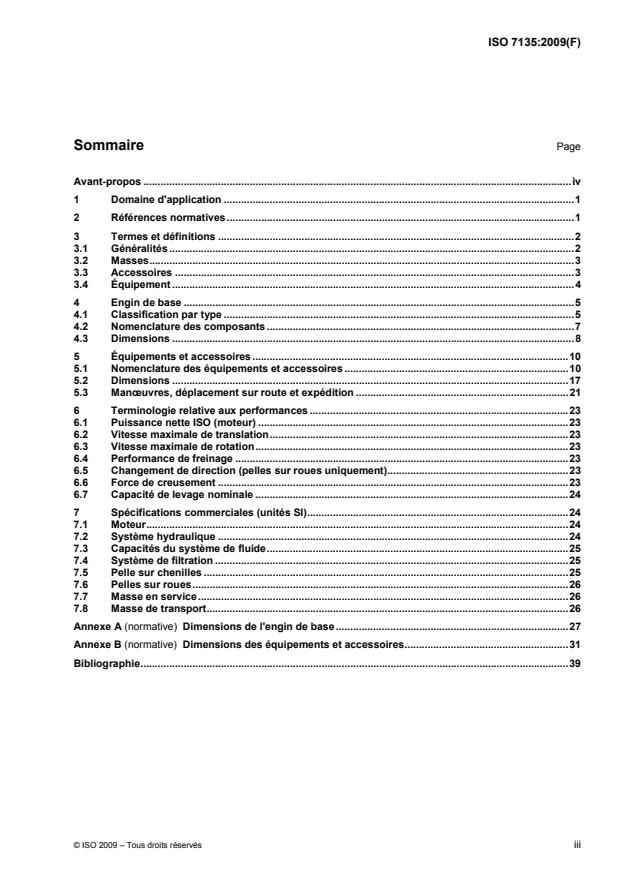
ISO 7135:2009 - Engins de terrassement — Pelles hydrauliques — Terminologie et spécifications commerciales Released:12/4/2009
Overview
ISO 7135:2009 - Earth-moving machinery - Hydraulic excavators - Terminology and commercial specifications defines the standardized terminology and the required content of commercial literature for self‑propelled crawler and wheeled hydraulic excavators, their equipment and attachments. It establishes consistent definitions (e.g., excavator types, operating mass, shipping mass, attachments and equipment types) and prescribes the information manufacturers should include in specifications and product literature (in SI units).
Key topics and technical requirements
- Scope and applicability: Applies to crawler and wheeled hydraulic excavators and common components; excludes walking‑excavator‑specific terms.
- Terms and definitions (Clause 3): Standardized vocabulary for excavator elements (base machine, cab riser, transport/manoeuvring/travel positions), masses (operating mass with a 75 kg operator; shipping mass), equipment and attachments (hoe, shovel, grab, quick coupler, blade), and equipment types (telescopic boom, hoe, shovel, clamshell, swing‑type boom).
- Base machine (Clause 4): Classification by undercarriage (crawler, wheeled) and equipment; component nomenclature and base‑machine dimensions referenced to ISO 6746‑1.
- Equipment and attachments (Clause 5): Nomenclature, dimensions, and recommended positions for manoeuvring, road travel and shipping.
- Performance terminology (Clause 6): Standardized expression of parameters such as ISO net engine power, travel and swing speeds, braking and steering performance, digging forces and rated lift capacities.
- Commercial literature specifications (Clause 7): Required specification content for engine, hydraulic system, fluid capacities, filtration, crawler and wheeled excavator particulars, operating and shipping masses (in SI units).
- Normative annexes: Annex A and B provide base‑machine and attachment dimension references (normative).
Practical applications - who uses ISO 7135:2009
- Manufacturers - to prepare consistent product data sheets, manuals and sales literature.
- Procurement and fleet managers - to compare machines on equivalent, standardized terms (operating mass, shipping mass, lift capacities, dimensions).
- Engineers and designers - for integration, transport planning and equipment selection.
- Rental companies and dealers - to create accurate spec sheets and ensure interchangeability of attachments.
- Standards bodies and test laboratories - as a reference when aligning tests and reporting results.
Related standards
ISO 7135:2009 references and works with other ISO standards including:
- ISO 6165, ISO 6746‑1, ISO 6746‑2 (terms, dimensions)
- ISO 9249, ISO 14396 (engine power/test codes)
- ISO 10567 (lift capacity), ISO 6015/6014 (tool forces/ground speed)
- ISO 3450, ISO 10265, ISO 5010 (braking/steering requirements)
Using ISO 7135:2009 helps ensure clarity, comparability and compliance across specifications for hydraulic excavators and their attachments, improving procurement decisions, technical communication and safe transport/shipping planning.
Relations
- Effective Date
- 08-May-2020
- Effective Date
- 15-Apr-2008
Buy Documents
ISO 7135:2009 - Earth-moving machinery — Hydraulic excavators — Terminology and commercial specifications Released:12/4/2009
ISO 7135:2009 - Engins de terrassement — Pelles hydrauliques — Terminologie et spécifications commerciales Released:12/4/2009
Frequently Asked Questions
ISO 7135:2009 is a standard published by the International Organization for Standardization (ISO). Its full title is "Earth-moving machinery — Hydraulic excavators — Terminology and commercial specifications". This standard covers: ISO 7135:2009 establishes terminology and the content of commercial literature specifications for self-propelled crawler and wheeled hydraulic excavators and their equipment and attachments.
ISO 7135:2009 establishes terminology and the content of commercial literature specifications for self-propelled crawler and wheeled hydraulic excavators and their equipment and attachments.
ISO 7135:2009 is classified under the following ICS (International Classification for Standards) categories: 01.040.53 - Materials handling equipment (Vocabularies); 53.100 - Earth-moving machinery. The ICS classification helps identify the subject area and facilitates finding related standards.
ISO 7135:2009 has the following relationships with other standards: It is inter standard links to ISO 7135:2009/Amd 1:2019, ISO 7135:1993. Understanding these relationships helps ensure you are using the most current and applicable version of the standard.
ISO 7135:2009 is available in PDF format for immediate download after purchase. The document can be added to your cart and obtained through the secure checkout process. Digital delivery ensures instant access to the complete standard document.
Standards Content (Sample)
INTERNATIONAL ISO
STANDARD 7135
Second edition
2009-12-15
Earth-moving machinery — Hydraulic
excavators — Terminology and
commercial specifications
Engins de terrassement — Pelles hydrauliques — Terminologie et
spécifications commerciales
Reference number
©
ISO 2009
PDF disclaimer
This PDF file may contain embedded typefaces. In accordance with Adobe's licensing policy, this file may be printed or viewed but
shall not be edited unless the typefaces which are embedded are licensed to and installed on the computer performing the editing. In
downloading this file, parties accept therein the responsibility of not infringing Adobe's licensing policy. The ISO Central Secretariat
accepts no liability in this area.
Adobe is a trademark of Adobe Systems Incorporated.
Details of the software products used to create this PDF file can be found in the General Info relative to the file; the PDF-creation
parameters were optimized for printing. Every care has been taken to ensure that the file is suitable for use by ISO member bodies. In
the unlikely event that a problem relating to it is found, please inform the Central Secretariat at the address given below.
© ISO 2009
All rights reserved. Unless otherwise specified, no part of this publication may be reproduced or utilized in any form or by any means,
electronic or mechanical, including photocopying and microfilm, without permission in writing from either ISO at the address below or
ISO's member body in the country of the requester.
ISO copyright office
Case postale 56 • CH-1211 Geneva 20
Tel. + 41 22 749 01 11
Fax + 41 22 749 09 47
E-mail copyright@iso.org
Web www.iso.org
Published in Switzerland
ii © ISO 2009 – All rights reserved
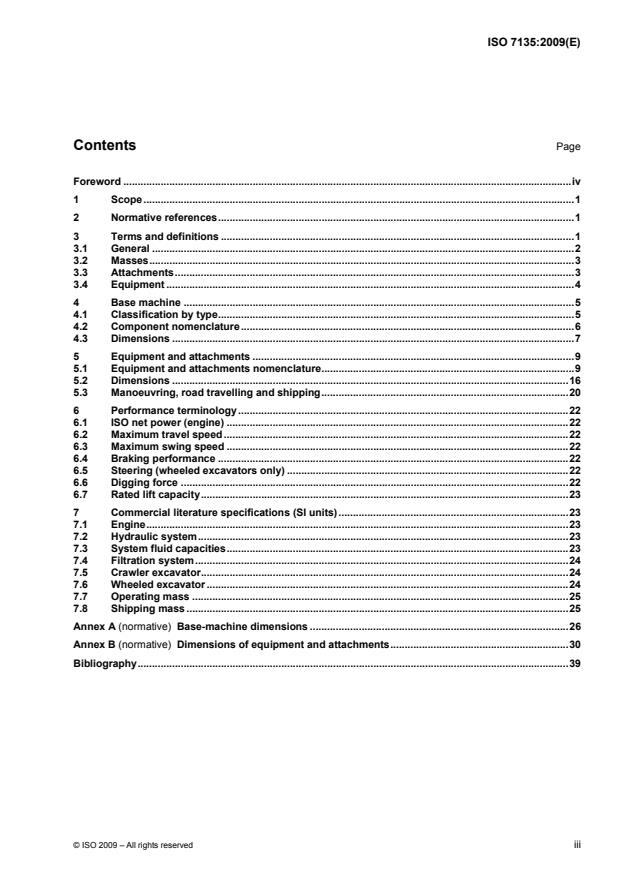
Contents Page
Foreword .iv
1 Scope.1
2 Normative references.1
3 Terms and definitions .1
3.1 General .2
3.2 Masses.3
3.3 Attachments.3
3.4 Equipment .4
4 Base machine .5
4.1 Classification by type.5
4.2 Component nomenclature.6
4.3 Dimensions .7
5 Equipment and attachments .9
5.1 Equipment and attachments nomenclature.9
5.2 Dimensions .16
5.3 Manoeuvring, road travelling and shipping.20
6 Performance terminology.22
6.1 ISO net power (engine) .22
6.2 Maximum travel speed.22
6.3 Maximum swing speed .22
6.4 Braking performance .22
6.5 Steering (wheeled excavators only) .22
6.6 Digging force .22
6.7 Rated lift capacity.23
7 Commercial literature specifications (SI units).23
7.1 Engine.23
7.2 Hydraulic system.23
7.3 System fluid capacities.23
7.4 Filtration system.24
7.5 Crawler excavator.24
7.6 Wheeled excavator .24
7.7 Operating mass .25
7.8 Shipping mass .25
Annex A (normative) Base-machine dimensions .26
Annex B (normative) Dimensions of equipment and attachments.30
Bibliography.39
Foreword
ISO (the International Organization for Standardization) is a worldwide federation of national standards bodies
(ISO member bodies). The work of preparing International Standards is normally carried out through ISO
technical committees. Each member body interested in a subject for which a technical committee has been
established has the right to be represented on that committee. International organizations, governmental and
non-governmental, in liaison with ISO, also take part in the work. ISO collaborates closely with the
International Electrotechnical Commission (IEC) on all matters of electrotechnical standardization.
International Standards are drafted in accordance with the rules given in the ISO/IEC Directives, Part 2.
The main task of technical committees is to prepare International Standards. Draft International Standards
adopted by the technical committees are circulated to the member bodies for voting. Publication as an
International Standard requires approval by at least 75 % of the member bodies casting a vote.
Attention is drawn to the possibility that some of the elements of this document may be the subject of patent
rights. ISO shall not be held responsible for identifying any or all such patent rights.
ISO 7135 was prepared by Technical Committee ISO/TC 127, Earth-moving machinery, Subcommittee SC 4,
Terminology, commercial nomenclature, classification and ratings.
This second edition cancels and replaces the first edition (ISO 7135:1993), which has been technically revised.
iv © ISO 2009 – All rights reserved
INTERNATIONAL STANDARD ISO 7135:2009(E)
Earth-moving machinery — Hydraulic excavators —
Terminology and commercial specifications
1 Scope
This International Standard establishes terminology and the content of commercial literature specifications for
self-propelled crawler and wheeled hydraulic excavators and their equipment and attachments.
It is applicable to common components and does not cover terms or commercial specifications specific to
walking excavators.
2 Normative references
The following referenced documents are indispensable for the application of this document. For dated
references, only the edition cited applies. For undated references, the latest edition of the referenced
document (including any amendments) applies.
ISO 3450, Earth-moving machinery — Braking systems of rubber-tyred machines — Systems and
performance requirements and test procedures for braking systems
ISO 5010, Earth-moving machinery — Rubber-tyred machines — Steering requirements
ISO 6014, Earth-moving machinery — Determination of ground speed
ISO 6015, Earth-moving machinery — Hydraulic excavators and backhoe loaders — Methods of determining
tool forces
ISO 6165:2006, Earth-moving machinery — Basic types — Identification and terms and definitions
ISO 6746-1, Earth-moving machinery — Definitions of dimensions and codes — Part 1: Base machine
ISO 6746-2:2003, Earth-moving machinery — Definitions of dimensions and codes — Part 2: Equipment and
attachments
ISO 9249, Earth-moving machinery — Engine test code — Net power
ISO 10265, Earthmoving machinery — Crawler machines — Performance requirements and test procedures
for braking systems
ISO 10567, Earth-moving machinery — Hydraulic excavators — Lift capacity
ISO 14396, Reciprocating internal combustion engines — Determination and method for the measurement of
engine power — Additional requirements for exhaust emission tests in accordance with ISO 8178
3 Terms and definitions
For the purposes of this document, the terms and definitions given in ISO 6165, ISO 6746-1 and ISO 6746-2
and the following apply.
3.1 General
3.1.1
excavator
self-propelled machine on crawlers, wheels or legs, having an upper structure capable of a 360° swing and
with mounted equipment, which is primarily designed for excavating with a bucket, without movement of the
undercarriage during the work cycle
NOTE 1 An excavator work cycle normally comprises excavating, elevating, swinging and discharging of material.
NOTE 2 An excavator can also be used for object or material handling/transportation.
NOTE 3 Figures 1 to 3 describe the types of excavator defined in 3.1.1.1 to 3.1.1.3.
3.1.1.1
minimal swing radius excavator
MSRX
excavator designed for operation in a confined space, having an upper structure with a short swinging radius,
with its equipment and attachment swinging within 120 % of the width of the undercarriage
3.1.1.2
compact excavator
excavator with an operating mass less than or equal to 6 000 kg
3.1.1.3
walking excavator
excavator with three or more supporting legs, which can be articulated, telescopic or both, and that can be
fitted with wheels
3.1.2
base machine
excavator with a cab or canopy and operator-protective structures if required, without equipment or
attachments, but possessing the necessary mountings for such equipment and attachments
NOTE Figures 4 and 5 describe the base machine and its dimensions.
3.1.3
cab riser
any spacer that increases the height of the SIP greater than 250 mm relative to the normal configuration or a
system that raises the cab away from the excavator in an upward direction either through a mechanical or
hydraulic system
NOTE For the SIP (seat index point), see ISO 5353.
3.1.4 Equipment and attachment positions
3.1.4.1
transport position
orientation in which the equipment and its affixed attachment is placed when the excavator is positioned for
shipment or transport on a flat level surface, such as a rail car or flat bed trailer, as recommended by the
manufacturer
NOTE The minimal overall length and height of the excavator will result from this position.
3.1.4.2
manoeuvring position
orientation in which the equipment and its affixed attachment is placed when the excavator is positioned as
recommended by the manufacturer for travel requiring numerous turns
2 © ISO 2009 – All rights reserved
3.1.4.3
travel position
orientation in which the equipment and its affixed attachment is placed when the excavator is positioned as
recommended by the manufacturer for long-distance straight-line travel
3.2 Masses
3.2.1
operating mass
OM
mass of the base machine, with equipment and empty attachment in the most usual configuration as specified
by the manufacturer, and with the operator (75 kg), full fuel tank and all fluid systems (i.e. hydraulic oil,
transmission oil, engine oil, engine coolant) at the levels specified by the manufacturer and, when applicable,
with sprinkler water tank(s) half full
[ISO 6016:2008, definition 3.2.1]
3.2.2
shipping mass
SM
mass of the base machine without an operator, and with fuel level at 10 % of tank capacity or with minimum
fuel level needed for machine shipping purposes as specified by the manufacturer, whichever is higher, with
all fluid systems at the levels specified by the manufacturer, and with empty sprinkler tank(s), if required, and
with or without equipment, ballast, attachment, cab, canopy, operator-protective structures, wheels and
counterweights as stated by the manufacturer
NOTE If the manufacturer intends that the machine be partially disassembled for shipping purposes, the masses of
the disassembled items will also be stated.
[ISO 6016:2008, definition 3.2.6]
3.3 Attachments
3.3.1
attachment
assembly of components that can be mounted onto the base machine or equipment for specific use
[ISO 6746-2:2003, definition 3.5]
NOTE Attachments for hydraulic excavators normally are the working tool attached to the end of the arm or a
telescopic boom that provides the digging, cutting, grabbing and processing function of the excavator.
3.3.2
hoe bucket
hoe-type bucket
bucket attached to the arm or telescopic boom and linkage equipment that generally cuts towards the machine
See Figure 12.
3.3.3
grab-type bucket
grab bucket
clamshell bucket
clamshell-type bucket
bucket attached to the arm and linkage equipment that digs or grabs in a generally vertical direction,
discharging below and above the ground reference plane (GRP)
See Figures 16 and 17.
3.3.4
shovel bucket
shovel-type bucket
bucket attached to the arm and linkage equipment that cuts away from the machine and generally upwards,
discharging above the ground reference plane (GRP)
See Figure 18.
3.3.5
quick coupler
assembly of components attached to the end of the arm and linkage that facilitates the quick mounting and
removal of the attachment from the arm and linkage
NOTE A quick coupler can be considered as part of the equipment if integrated directly into the arm.
3.3.6
blade
component mounted on the undercarriage of the base machine that is generally used for backfilling trenches
and for limited excavation, and which can also be used as a stabilizer
3.4 Equipment
3.4.1
equipment
set of components mounted onto the base machine to provide the primary design function of the excavator
NOTE 1 The definitions given in 3.4.2 to 3.4.6 are based on the main geometrical digging curves of most common
applications of hydraulic excavators.
NOTE 2 Other equipment and derivatives are available.
NOTE 3 Figures 6 to 21 show types of equipment.
3.4.2
telescopic boom equipment
boom, with the necessary mountings for an attachment, which can be extended and retracted, and that
generally cuts toward the machine through the telescoping action of the boom
See Figure 21.
NOTE It is primarily used for excavation and/or grading of slopes either above or below ground level.
3.4.3
hoe equipment
boom, arm and linkage with the mountings for a hoe-type bucket that generally cuts towards the machine
See Figure 6.
NOTE It is primarily used for below-ground level excavation.
3.4.4
shovel equipment
boom, arm and linkage that use a shovel-type bucket attached at the end of the arm that cuts away from the
machine and generally upwards
See Figure 18.
NOTE It is primarily used for above-ground level excavation.
4 © ISO 2009 – All rights reserved
3.4.5
grab equipment
clamshell equipment
boom, arm and linkage that uses a grab-type or clamshell-type bucket that digs or grabs in a generally vertical
direction, discharging below and above the GRP
See Figure 25.
3.4.6
swing-type boom
boom assembly mounted on the front of the undercarriage that can articulate, allowing the machine to
excavate at various angles relative to the longitudinal centreline of the machine
NOTE A swing-type boom can allow the machine to excavate adjacent to a vertical surface.
4 Base machine
4.1 Classification by type
The excavators shall be classified by their undercarriage and by their equipment.
See also Clause 5.
a) Undercarriage
⎯ Crawler excavator (see Figure 1)
⎯ Wheeled excavator (see Figure 2)
⎯ Walking excavator (see Figure 3)
Figure 1 — Crawler excavator Figure 2 — Wheeled excavator
Figure 3 — Walking excavator
b) Equipment
⎯ Backhoe (see Figure 23)
⎯ Shovel (see Figure 24)
⎯ Clamshell (see Figure 25)
⎯ Telescoping boom (see Figure 26)
4.2 Component nomenclature
Component nomenclature shall be in accordance with Figure 4 a) or b), according to whether the base
machine is a crawler or wheeled excavator.
a) Crawler excavators
b) Wheeled excavators
Key
1 undercarriage 8 crawler tracks
2 swing bearing 9 idler
3 upper structure 10 sprocket
4 cab 11 steering axle (front)
5 counterweight 12 rigid axle (rear)
6 revolving frame 13 axis of rotation
7 track frame
Figure 4 — Base machine nomenclature
6 © ISO 2009 – All rights reserved
4.3 Dimensions
The base-machine dimensions shall be in accordance with Figure 5.
The definitions of those base-machine dimensions common to earth-moving machinery are given in
ISO 6746-1.
The base-machine dimensions shown in Figure 5 that are specific to hydraulic excavators are defined in
Annex A.
a) Crawler excavators
Figure 5 — Base machine dimensions
b) Wheeled excavators
Key
1 ground reference plane (GRP)
Figure 5 — Base machine dimensions (continued)
8 © ISO 2009 – All rights reserved
5 Equipment and attachments
5.1 Equipment and attachments nomenclature
Equipment and attachments nomenclature shall be in accordance with Figures 6 to 22.
Key
1 boom pivot 8 bucket pivot
2 stub 9 bucket
3 intermediate boom 10 bucket cylinder
4 boom cylinder 11 guide linkage
5 arm pivot 12 bucket linkage
6 arm 13 attachment bracket
7 arm cylinder
Figure 6 — Hoe
Key
1 boom pivot
2 arm pivot
Figure 7 — Front-mounted one-piece boom
ISO
...
NORME ISO
INTERNATIONALE 7135
Deuxième édition
2009-12-15
Engins de terrassement — Pelles
hydrauliques — Terminologie et
spécifications commerciales
Earth-moving machinery — Hydraulic excavators — Terminology and
commercial specifications
Numéro de référence
©
ISO 2009
PDF – Exonération de responsabilité
Le présent fichier PDF peut contenir des polices de caractères intégrées. Conformément aux conditions de licence d'Adobe, ce fichier
peut être imprimé ou visualisé, mais ne doit pas être modifié à moins que l'ordinateur employé à cet effet ne bénéficie d'une licence
autorisant l'utilisation de ces polices et que celles-ci y soient installées. Lors du téléchargement de ce fichier, les parties concernées
acceptent de fait la responsabilité de ne pas enfreindre les conditions de licence d'Adobe. Le Secrétariat central de l'ISO décline toute
responsabilité en la matière.
Adobe est une marque déposée d'Adobe Systems Incorporated.
Les détails relatifs aux produits logiciels utilisés pour la création du présent fichier PDF sont disponibles dans la rubrique General Info
du fichier; les paramètres de création PDF ont été optimisés pour l'impression. Toutes les mesures ont été prises pour garantir
l'exploitation de ce fichier par les comités membres de l'ISO. Dans le cas peu probable où surviendrait un problème d'utilisation,
veuillez en informer le Secrétariat central à l'adresse donnée ci-dessous.
DOCUMENT PROTÉGÉ PAR COPYRIGHT
© ISO 2009
Droits de reproduction réservés. Sauf prescription différente, aucune partie de cette publication ne peut être reproduite ni utilisée sous
quelque forme que ce soit et par aucun procédé, électronique ou mécanique, y compris la photocopie et les microfilms, sans l'accord écrit
de l'ISO à l'adresse ci-après ou du comité membre de l'ISO dans le pays du demandeur.
ISO copyright office
Case postale 56 • CH-1211 Geneva 20
Tel. + 41 22 749 01 11
Fax + 41 22 749 09 47
E-mail copyright@iso.org
Web www.iso.org
Publié en Suisse
ii © ISO 2009 – Tous droits réservés
Sommaire Page
Avant-propos .iv
1 Domaine d'application .1
2 Références normatives.1
3 Termes et définitions .2
3.1 Généralités .2
3.2 Masses.3
3.3 Accessoires .3
3.4 Équipement .4
4 Engin de base .5
4.1 Classification par type .5
4.2 Nomenclature des composants .7
4.3 Dimensions .8
5 Équipements et accessoires .10
5.1 Nomenclature des équipements et accessoires .10
5.2 Dimensions .17
5.3 Manœuvres, déplacement sur route et expédition .21
6 Terminologie relative aux performances .23
6.1 Puissance nette ISO (moteur) .23
6.2 Vitesse maximale de translation.23
6.3 Vitesse maximale de rotation.23
6.4 Performance de freinage .23
6.5 Changement de direction (pelles sur roues uniquement).23
6.6 Force de creusement .23
6.7 Capacité de levage nominale .24
7 Spécifications commerciales (unités SI).24
7.1 Moteur.24
7.2 Système hydraulique .24
7.3 Capacités du système de fluide.25
7.4 Système de filtration .25
7.5 Pelle sur chenilles .25
7.6 Pelles sur roues.26
7.7 Masse en service.26
7.8 Masse de transport.26
Annexe A (normative) Dimensions de l'engin de base.27
Annexe B (normative) Dimensions des équipements et accessoires.31
Bibliographie.39
Avant-propos
L'ISO (Organisation internationale de normalisation) est une fédération mondiale d'organismes nationaux de
normalisation (comités membres de l'ISO). L'élaboration des Normes internationales est en général confiée
aux comités techniques de l'ISO. Chaque comité membre intéressé par une étude a le droit de faire partie du
comité technique créé à cet effet. Les organisations internationales, gouvernementales et non
gouvernementales, en liaison avec l'ISO participent également aux travaux. L'ISO collabore étroitement avec
la Commission électrotechnique internationale (CEI) en ce qui concerne la normalisation électrotechnique.
Les Normes internationales sont rédigées conformément aux règles données dans les Directives ISO/CEI,
Partie 2.
La tâche principale des comités techniques est d'élaborer les Normes internationales. Les projets de Normes
internationales adoptés par les comités techniques sont soumis aux comités membres pour vote. Leur
publication comme Normes internationales requiert l'approbation de 75 % au moins des comités membres
votants.
L'attention est appelée sur le fait que certains des éléments du présent document peuvent faire l'objet de
droits de propriété intellectuelle ou de droits analogues. L'ISO ne saurait être tenue pour responsable de ne
pas avoir identifié de tels droits de propriété et averti de leur existence.
L'ISO 7135 a été élaborée par le comité technique ISO/TC 127, Engins de terrassement, sous-comité SC 4,
Terminologie, nomenclature commerciale, classification et estimations.
Cette deuxième édition annule et remplace la première édition (ISO 7135:1993), qui a fait l'objet d'une
révision technique.
iv © ISO 2009 – Tous droits réservés
NORME INTERNATIONALE ISO 7135:2009(F)
Engins de terrassement — Pelles hydrauliques — Terminologie
et spécifications commerciales
1 Domaine d'application
La présente Norme internationale établit la terminologie et fixe le contenu des spécifications des documents
commerciaux pour les pelles hydrauliques automotrices sur roues et sur chenilles, ainsi que leurs
équipements et accessoires.
Elle s'applique aux composants communs et ne couvre pas les termes et les spécifications commerciales qui
sont spécifiques aux pelles araignées.
2 Références normatives
Les documents de référence suivants sont indispensables pour l'application du présent document. Pour les
références datées, seule l'édition citée s'applique. Pour les références non datées, la dernière édition du
document de référence s'applique (y compris les éventuels amendements).
ISO 3450, Engins de terrassement — Dispositifs de freinage des engins sur roues équipés de
pneumatiques — Exigences relatives aux dispositifs et à leurs performances, et méthodes d'essai
ISO 5010, Engins de terrassement — Engins équipés de pneumatiques — Systèmes de direction
ISO 6014, Engins de terrassement — Détermination de la vitesse au sol
ISO 6015, Engins de terrassement — Pelles hydrauliques et chargeuses-pelleteuses — Méthodes de
détermination des forces de l'outil
ISO 6165:2006, Engins de terrassement — Principaux types — Identification et termes et définitions
ISO 6746-1, Engins de terrassement — Définitions des dimensions et des codes — Partie 1: Engin de base
ISO 6746-2:2003, Engins de terrassement — Définitions des dimensions et des codes — Partie 2:
Équipements et accessoires
ISO 9249, Engins de terrassement — Code d'essai des moteurs — Puissance nette
ISO 10265, Engins de terrassement — Engins à chenilles — Exigences de performance et modes opératoires
d'essai des dispositifs de freinage
ISO 10567, Engins de terrassement — Pelles hydrauliques — Capacité de levage
ISO 14396, Moteurs alternatifs à combustion interne — Détermination et méthode de mesurage de la
puissance — Exigences supplémentaires pour les essais d'émissions de gaz d'échappement suivant
l'ISO 8178
3 Termes et définitions
Pour les besoins du présent document, les termes et définitions donnés dans l'ISO 6165, l'ISO 6746-1 et
l'ISO 6746-2 ainsi que les suivants s'appliquent.
3.1 Généralités
3.1.1
pelle
engin automoteur à roues, à chenilles ou à jambes ayant une superstructure normalement capable de tourner
de 360° avec l'équipement et dont la fonction première est de creuser avec un godet, sans que la structure
porteuse ne se déplace pendant le cycle de travail
NOTE 1 Le cycle de travail d'une pelle comprend normalement un creusement, un soulèvement, une rotation et un
déchargement des matériaux.
NOTE 2 Une pelle peut également être utilisée pour la manipulation/le transport d'objets ou de matériaux.
NOTE 3 Les Figures 1 à 3 décrivent les types de pelle définis en 3.1.1.1 à 3.1.1.3.
3.1.1.1
pelle à rayon court
pelle prévue pour le travail en espace réduit, ayant une superstructure à court rayon de rotation avec un
équipement et un accessoire dont le rayon de rotation est limité à 120 % de la largeur de la structure porteuse
3.1.1.2
pelle compacte
pelle ayant une masse en service inférieure ou égale à 6 000 kg
3.1.1.3
pelle araignée
pelle supportée par trois jambes ou plus qui peuvent être articulées, télescopiques ou les deux et qui peuvent
être équipées de roues
3.1.2
engin de base
pelle avec une cabine ou un toit et des structures de protection de l'opérateur, si nécessaire, sans équipement
ni accessoires mais comprenant les fixations nécessaires à la mise en place de l'équipement ou des
accessoires
NOTE Les Figures 4 et 5 décrivent l'engin de base et ses dimensions.
3.1.3
élévateur de cabine
cale d'épaisseur qui augmente la hauteur du point repère du siège (SIP) de plus de 250 mm par rapport à la
configuration normale ou système qui écarte la cabine de la pelle dans une direction ascendante par un
système soit mécanique soit hydraulique
NOTE Pour le SIP, voir l'ISO 5353.
3.1.4 Positions de l'équipement et des accessoires
3.1.4.1
position de transport
orientation dans laquelle l'équipement et ses accessoires sont placés lorsque la pelle est positionnée pour
l'expédition ou le transport sur une surface plane de niveau, tels qu'un wagon de marchandises ou une
remorque de transport, suivant les recommandations du constructeur
NOTE Cette position correspond à la longueur et la hauteur hors tout minimales de la pelle.
2 © ISO 2009 – Tous droits réservés
3.1.4.2
position de manœuvre
orientation dans laquelle l'équipement et ses accessoires sont placés lorsque la pelle est positionnée comme
recommandé par le constructeur en vue d'effectuer un déplacement ponctué de nombreux changements de
direction
3.1.4.3
position de déplacement
orientation dans laquelle l'équipement et ses accessoires sont placés lorsque la pelle est positionnée comme
recommandé par le constructeur pour effectuer un déplacement en ligne droite sur une longue distance
3.2 Masses
3.2.1
masse en service
OM
masse de l'engin de base avec équipement et accessoire vide dans la configuration la plus usuelle, tel que
spécifié par le constructeur, avec l'opérateur (75 kg), le réservoir de carburant et tous les circuits de fluide
(c'est-à-dire liquide hydraulique, huile pour transmissions hydrauliques, huile pour moteur et liquide de
refroidissement du moteur) aux niveaux spécifiés par le constructeur, et, le cas échéant, avec le ou les
réservoirs d'asperseurs à moitié remplis d'eau
[ISO 6016:2008, définition 3.2.1]
3.2.2
masse de transport
SM
masse de l'engin de base sans opérateur, le réservoir de carburant rempli à 10 % de sa capacité ou avec le
niveau minimal de carburant nécessaire pour le transport de l'engin selon les spécifications du constructeur
(on retiendra la valeur la plus élevée), tous les circuits de fluide aux niveaux spécifiés par le constructeur,
avec le ou les réservoirs d'asperseurs vides, si cela s'applique, et avec ou sans équipement, lest, accessoire,
cabine, toit, structures de protection de l'opérateur, roues et contrepoids, suivant les recommandations du
constructeur
NOTE Si le constructeur de l'engin envisage que ce dernier soit partiellement démonté pour le transport, les masses
des organes constitutifs démontés seront indiquées.
[ISO 6016:2008, définition 3.2.6]
3.3 Accessoires
3.3.1
accessoire
assemblage d'éléments, qui peut être monté sur un engin de base pour une utilisation spécifique
[ISO 6746-2:2003, définition 3.5]
NOTE Les accessoires des pelles hydrauliques sont généralement des outils de travail fixés en bout de bras ou sur
la flèche télescopique qui fournissent les fonctions de creusage, de coupe, de saisie et de travail de la pelle.
3.3.2
godet de type travaillant en rétro
godet fixé au bras ou à la flèche télescopique et à la biellette qui coupe généralement en direction de l'engin
Voir Figure 12.
3.3.3
godet de type benne preneuse
godet fixé au bras et à la biellette qui creuse et saisit l'excavation dans la direction généralement verticale; le
déchargement s'effectue en dessous et au-dessus du plan de référence au sol (PRS)
Voir les Figures 16 et 17.
3.3.4
godet de type pelle
godet fixé au bras et à la biellette qui coupe vers l'extérieur par rapport à l'engin, généralement à la verticale,
et qui décharge au-dessus du plan de référence au sol (PRS)
Voir Figure 18.
3.3.5
attache rapide
ensemble de composants fixés à l'extrémité du bras et de la biellette qui facilite le montage et le démontage
rapide de l'accessoire
NOTE L'attache rapide peut être considérée comme faisant partie de l'équipement si elle est intégrée directement
dans le bras.
3.3.6
lame
composant monté sur le châssis de l'engin de base qui est généralement utilisé pour reboucher des tranchées
ou petites excavations et qui peut également être utilisé en tant que stabilisateur
3.4 Équipement
3.4.1
équipement
ensemble d'éléments montés sur l'engin de base pour réaliser la fonction principale de la pelle
NOTE 1 Les définitions données en 3.4.2 à 3.4.6 sont fondées sur les courbes d'excavation géométriques principales
pour la plupart des applications des pelles hydrauliques.
NOTE 2 Il existe d'autres équipements et adaptations des équipements.
NOTE 3 Les Figures 6 à 21 montrent les types d'équipement.
3.4.2
équipement à flèche télescopique
flèche, avec les montages nécessaires pour une fixation, qui peuvent se déployer et se replier, et qui coupe
généralement en direction de l'engin grâce à l'action télescopique de la flèche
Voir Figure 21.
NOTE Il sert principalement au terrassement et/ou au nivellement des pentes soit au-dessus soit au-dessous du
niveau du sol.
3.4.3
équipement travaillant en rétro
flèche, bras et biellette avec les montages nécessaires pour la fixation d'un godet rétro qui coupe
généralement en direction de l'engin
Voir Figure 6.
NOTE Il sert principalement au creusement au-dessous du niveau du sol.
4 © ISO 2009 – Tous droits réservés
3.4.4
équipement pelle
flèche, bras et biellette utilisant un godet de type pelle en bout de bras qui coupe en direction opposée à
l'engin, généralement vers le haut
Voir Figure 18.
NOTE Il sert principalement au creusement au-dessus du niveau du sol.
3.4.5
équipement à benne preneuse
équipement à pinces
flèche, bras et biellette utilisant un godet de type benne-preneuse ou pince, l'excavation et la saisie
s'effectuant généralement à la verticale et le déchargement au-dessus et au-dessous du plan de référence au
sol (PRS)
Voir Figure 25.
3.4.6
flèche de type articulé
assemblage de flèche monté à l'avant de la structure porteuse qui peut être articulé pour permettre à l'engin
de creuser à divers angles par rapport à l'axe médian longitudinal de l'engin
NOTE Une flèche articulée peut permettre à l'engin de creuser au plus près d'une surface verticale.
4 Engin de base
4.1 Classification par type
Les pelles doivent être classées par type de châssis porteur et par type d'équipement.
Voir également l'Article 5.
a) Châssis porteur
⎯ Pelle sur chenilles (voir Figure 1)
⎯ Pelle sur roues (voir Figure 2)
⎯ Pelle araignée (voir Figure 3)
Figure 1 — Pelle sur chenilles Figure 2 — Pelle sur roues
Figure 3 — Pelle araignée
b) Équipements
⎯ Rétro (voir Figure 23)
⎯ Pelle (voir Figure 24)
⎯ Benne-preneuse (voir Figure 25)
⎯ Flèche télescopique (voir Figure 26)
6 © ISO 2009 – Tous droits réservés
4.2 Nomenclature des composants
La nomenclature des composants doit être conforme à la Figure 4 a) ou 4 b) selon que l'engin de base est à
chenilles ou à roues.
a) Pelle sur chenilles
b) Pelle sur roues
Légende
1 châssis porteur 8 chenille
2 couronne d'orientation 9 poulie de renvoi
3 superstructure; tourelle 10 barbotin
4 cabine 11 essieu directeur (avant)
5 contrepoids 12 essieu rigide (arrière)
6 châssis de la tourelle 13 axe de rotation
7 longeron
Figure 4 — Nomenclature d'un engin de base
4.3 Dimensions
Les dimensions de l'engin de base doivent être conformes à la Figure 5.
Les définitions des dimensions de l'engin de base communes aux engins de terrassement sont données dans
l'ISO 6746-1.
Les dimensions de l'engin de base données à la Figure 5 spécifiques aux pelles hydrauliques sont définies
dans l'Annexe A.
a) Pelle sur chenilles
Figure 5 — Dimensions d'un engin de base
8 © ISO 2009 – Tous droits réservés
b) Pelle sur roues
Légende
1 plan de référence au sol (PRS)
Figure 5 — Dimensions d'un engin de base (suite)
5 Équipements et accessoires
5.1 Nomenclature des équipements et accessoires
La nomenclature des équipements et accessoires doit être conforme aux Figures 6 à 22.
Légende
1 axe de pied de flèche 8 axe du godet
2 flèche 9 godet
3 flèche réglable 10 vérin du godet
4 vérin de la flèche 11 palonnier
5 axe du bras 12 biellette
6 bras 13 attache
7 vérin du bras
Figure 6 — Équipement travaillant en rétro
Légende
1 axe de pied de flèche
2 axe du bras
Figure 7 — Flèche monobloc montée à l'avant
10 © ISO 2009 – Tous droits réservés
Légende
1 fl
...