

ISO 8812:2016
(Main)Earth-moving machinery — Backhoe loaders — Terminology and commercial specifications
General Information
- Abstract
ISO 8812:2016 establishes terminology and the content of commercial literature specifications for self-propelled crawler or wheeled backhoe loaders, as defined in ISO 6165, and their equipment. ISO 8812:2016 is not applicable to loaders equipped with a backhoe attachment in accordance with ISO 7131:2009, 3.3.1.1.
- Status
- Published
- Publication Date
- 03-Apr-2016
- Current Stage
- 9020 - International Standard under periodical review
- Start Date
- 15-Jul-2026
- Completion Date
- 15-Jul-2026
Buy Documents

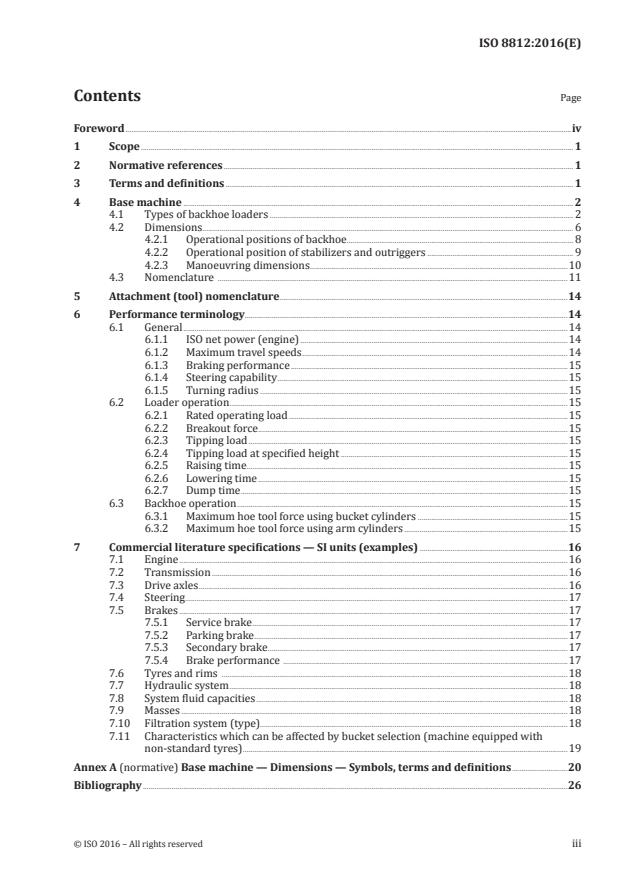
ISO 8812:2016 - Earth-moving machinery -- Backhoe loaders -- Terminology and commercial specifications


ISO 8812:2016 - Earth-moving machinery — Backhoe loaders — Terminology and commercial specifications/4/2016




ISO 8812:2016 - Engins de terrassement -- Chargeuses-pelleteuses -- Terminologie et spécifications commerciales


ISO 8812:2016 - Engins de terrassement — Chargeuses-pelleteuses — Terminologie et spécifications commerciales/4/2016
Overview - ISO 8812:2016 (Backhoe loaders terminology & commercial specifications)
ISO 8812:2016 is an international standard that defines terminology and the required content of commercial literature for self‑propelled crawler or wheeled backhoe loaders (as defined in ISO 6165). It standardizes how manufacturers and suppliers describe machine types, dimensions, performance parameters and masses so purchasers and regulators can compare equipment consistently. Note: ISO 8812:2016 does not apply to loaders fitted with backhoe attachments covered by ISO 7131:2009 (see clause 1).
Key topics and technical requirements
The standard organizes the technical content buyers and specifiers expect to find in product literature. Major topics include:
- Terms and definitions: precise definitions for base machine, equipment, attachment, component, operating mass, shipping mass, etc. (clauses 3 and 3.7).
- Base machine and types: classification of backhoe loaders by backhoe type (side‑shift, centre pivot) and drive/steering systems (rigid frame with front/all‑wheel steer, articulated steering, all‑wheel drive variants) (clause 4.1).
- Dimensions and operational positions: required dimensional references and measurement conditions (tyre pressure, stabilizer positions, ground reference plane); detailed drawing references and symbols are given, with an informative Annex A for base‑machine symbols and definitions (clauses 4.2–4.2.3, Annex A).
- Nomenclature: standard naming conventions for base machines, equipment and attachments (clause 4.3 and clause 5).
- Performance terminology: standardized performance metrics such as ISO net engine power, maximum travel speeds, braking and steering capability, turning radius and loader/backhoe operational terms (rated operating load, breakout force, tipping load, cycle times, maximum hoe forces) (clause 6).
- Commercial literature specifications (SI units): recommended parameters to publish for engine, transmission, drive axles, steering, brakes, tyres, hydraulics, system fluid capacities, masses, filtration and bucket‑dependent characteristics (clause 7).
Practical applications - who uses ISO 8812:2016
- OEMs and component manufacturers: to prepare consistent technical data sheets and catalogs for backhoe loaders and attachments.
- Dealers, rental companies and fleet managers: to compare models objectively when procuring or leasing equipment.
- Procurement and specification writers: to write clear, unambiguous contract and tender documents.
- Regulators and testing bodies: to reference standardized terminology and measurement conventions during compliance checks and type approvals.
- Technical authors and trainers: to ensure consistent usage of terms in manuals, training materials and safety documentation.
Related standards
- ISO 6165 (basic types and definitions) - referenced for machine classification.
- ISO 6746‑1 / ISO 6746‑2 (dimensions and codes) - referenced for dimension definitions.
- ISO 7131:2009 - applies to loaders with backhoe attachments (excluded from ISO 8812’s scope).
Using ISO 8812:2016 improves clarity in product literature, simplifies equipment comparison and reduces ambiguity in procurement and regulatory processes for earth‑moving machinery and backhoe loaders.
Relations
- Revises
ISO 8812:1999 - Earth-moving machinery — Backhoe loaders — Definitions and commercial specifications - Effective Date
- 23-Jun-2012
Buy Documents
ISO 8812:2016 - Earth-moving machinery -- Backhoe loaders -- Terminology and commercial specifications
ISO 8812:2016 - Earth-moving machinery — Backhoe loaders — Terminology and commercial specifications/4/2016
ISO 8812:2016 - Engins de terrassement -- Chargeuses-pelleteuses -- Terminologie et spécifications commerciales
ISO 8812:2016 - Engins de terrassement — Chargeuses-pelleteuses — Terminologie et spécifications commerciales/4/2016
Frequently Asked Questions
ISO 8812:2016 is a standard published by the International Organization for Standardization (ISO). Its full title is "Earth-moving machinery — Backhoe loaders — Terminology and commercial specifications". This standard covers: ISO 8812:2016 establishes terminology and the content of commercial literature specifications for self-propelled crawler or wheeled backhoe loaders, as defined in ISO 6165, and their equipment. ISO 8812:2016 is not applicable to loaders equipped with a backhoe attachment in accordance with ISO 7131:2009, 3.3.1.1.
ISO 8812:2016 establishes terminology and the content of commercial literature specifications for self-propelled crawler or wheeled backhoe loaders, as defined in ISO 6165, and their equipment. ISO 8812:2016 is not applicable to loaders equipped with a backhoe attachment in accordance with ISO 7131:2009, 3.3.1.1.
ISO 8812:2016 is classified under the following ICS (International Classification for Standards) categories: 01.040.53 - Materials handling equipment (Vocabularies); 53.100 - Earth-moving machinery. The ICS classification helps identify the subject area and facilitates finding related standards.
ISO 8812:2016 has the following relationships with other standards: It is inter standard links to ISO 8812:1999. Understanding these relationships helps ensure you are using the most current and applicable version of the standard.
ISO 8812:2016 is available in PDF format for immediate download after purchase. The document can be added to your cart and obtained through the secure checkout process. Digital delivery ensures instant access to the complete standard document.
Standards Content (Sample)
INTERNATIONAL ISO
STANDARD 8812
Second edition
2016-04-01
Earth-moving machinery — Backhoe
loaders — Terminology and
commercial specifications
Engins de terrassement — Chargeuses-pelleteuses — Terminologie et
spécifications commerciales
Reference number
©
ISO 2016
© ISO 2016, Published in Switzerland
All rights reserved. Unless otherwise specified, no part of this publication may be reproduced or utilized otherwise in any form
or by any means, electronic or mechanical, including photocopying, or posting on the internet or an intranet, without prior
written permission. Permission can be requested from either ISO at the address below or ISO’s member body in the country of
the requester.
ISO copyright office
Ch. de Blandonnet 8 • CP 401
CH-1214 Vernier, Geneva, Switzerland
Tel. +41 22 749 01 11
Fax +41 22 749 09 47
copyright@iso.org
www.iso.org
ii © ISO 2016 – All rights reserved
Contents Page
Foreword .iv
1 Scope . 1
2 Normative references . 1
3 Terms and definitions . 1
4 Base machine . 2
4.1 Types of backhoe loaders . 2
4.2 Dimensions . 6
4.2.1 Operational positions of backhoe. 8
4.2.2 Operational position of stabilizers and outriggers . 9
4.2.3 Manoeuvring dimensions .10
4.3 Nomenclature .11
5 Attachment (tool) nomenclature .14
6 Performance terminology .14
6.1 General .14
6.1.1 ISO net power (engine) .14
6.1.2 Maximum travel speeds .14
6.1.3 Braking performance .15
6.1.4 Steering capability .15
6.1.5 Turning radius .15
6.2 Loader operation .15
6.2.1 Rated operating load .15
6.2.2 Breakout force .15
6.2.3 Tipping load .15
6.2.4 Tipping load at specified height .15
6.2.5 Raising time .15
6.2.6 Lowering time .15
6.2.7 Dump time .15
6.3 Backhoe operation .15
6.3.1 Maximum hoe tool force using bucket cylinders .15
6.3.2 Maximum hoe tool force using arm cylinders .15
7 Commercial literature specifications — SI units (examples) .16
7.1 Engine .16
7.2 Transmission .16
7.3 Drive axles .16
7.4 Steering .17
7.5 Brakes .17
7.5.1 Service brake .17
7.5.2 Parking brake .17
7.5.3 Secondary brake .17
7.5.4 Brake performance .17
7.6 Tyres and rims .18
7.7 Hydraulic system .18
7.8 System fluid capacities .18
7.9 Masses .18
7.10 Filtration system (type).18
7.11 Characteristics which can be affected by bucket selection (machine equipped with
non-standard tyres) .19
Annex A (normative) Base machine — Dimensions — Symbols, terms and definitions .20
Bibliography .26
Foreword
ISO (the International Organization for Standardization) is a worldwide federation of national standards
bodies (ISO member bodies). The work of preparing International Standards is normally carried out
through ISO technical committees. Each member body interested in a subject for which a technical
committee has been established has the right to be represented on that committee. International
organizations, governmental and non-governmental, in liaison with ISO, also take part in the work.
ISO collaborates closely with the International Electrotechnical Commission (IEC) on all matters of
electrotechnical standardization.
The procedures used to develop this document and those intended for its further maintenance are
described in the ISO/IEC Directives, Part 1. In particular the different approval criteria needed for the
different types of ISO documents should be noted. This document was drafted in accordance with the
editorial rules of the ISO/IEC Directives, Part 2 (see www.iso.org/directives).
Attention is drawn to the possibility that some of the elements of this document may be the subject of
patent rights. ISO shall not be held responsible for identifying any or all such patent rights. Details of
any patent rights identified during the development of the document will be in the Introduction and/or
on the ISO list of patent declarations received (see www.iso.org/patents).
Any trade name used in this document is information given for the convenience of users and does not
constitute an endorsement.
For an explanation on the meaning of ISO specific terms and expressions related to conformity
assessment, as well as information about ISO’s adherence to the WTO principles in the Technical
Barriers to Trade (TBT) see the following URL: Foreword - Supplementary information
The committee responsible for this document is ISO/TC 127, Earth-moving machinery, Subcommittee
SC 4, Terminology, commercial nomenclature, classification and ratings.
This second edition cancels and replaces the first edition (ISO 8812:1999), which has been technically
revised.
iv © ISO 2016 – All rights reserved
INTERNATIONAL STANDARD ISO 8812:2016(E)
Earth-moving machinery — Backhoe loaders —
Terminology and commercial specifications
1 Scope
This International Standard establishes terminology and the content of commercial literature
specifications for self-propelled crawler or wheeled backhoe loaders, as defined in ISO 6165, and their
equipment.
This International Standard is not applicable to loaders equipped with a backhoe attachment in
accordance with ISO 7131:2009, 3.3.1.1.
2 Normative references
The following documents, in whole or in part, are normatively referenced in this document and are
indispensable for its application. For dated references, only the edition cited applies. For undated
references, the latest edition of the referenced document (including any amendments) applies.
ISO 6165, Earth-moving machinery — Basic types — Identification and terms and definitions
ISO 6746-1:2003, Earth-moving machinery — Definitions of dimensions and codes — Part 1: Base machine
ISO 6746-2, Earth-moving machinery — Definitions of dimensions and codes — Part 2: Equipment and
attachments
ISO 7131:2009, Earth-moving machinery — Loaders — Terminology and commercial specifications
3 Terms and definitions
For the purposes of this document, the terms and definitions given in ISO 6165, ISO 6746-1, ISO 6746-2
and the following apply.
3.1
backhoe loader
self-propelled crawler or wheeled machine having a main frame designed to carry both front-mounted
equipment (3.3) and rear-mounted backhoe equipment (normally with outriggers or stabilizers)
Note 1 to entry: When used in the backhoe mode, the machine is stationary and normally digs below ground level.
Note 2 to entry: When used in the loader mode (bucket use), the machine loads through forward motion.
Note 3 to entry: A backhoe work cycle normally comprises excavating, elevating, swinging, and discharging of
material. A loader work cycle normally comprises filling, elevating, transporting and discharging of material.
3.2
base machine
machine with a cab or canopy and operator protective structures if required, without equipment (3.3)
or attachments (3.5) but possessing the necessary mountings for such equipment and attachments
3.3
equipment
set of components (3.6) mounted onto the base machine (3.2), which allows an attachment (3.5) to
perform the primary design function of the machine
3.4
optional equipment
optional items of equipment (3.3) mounted onto the base machine (3.2) to increase, for example, capacity,
flexibility, and comfort
3.5
attachment
assembly of components (3.6) that can be mounted onto the base machine (3.2) or equipment (3.3) for
specific use
3.6
component
part or an assembly of parts of a base machine (3.2), equipment (3.3), or an attachment (3.5)
3.7 Masses
3.7.1
operating mass
OM
mass of the base machine (3.2), with equipment (3.3) and empty attachment (3.5) in the most usual
configuration as specified by the manufacturer, and with the operator (75 kg), full fuel tank, and all
fluid systems (i.e. hydraulic oil, transmission oil, engine oil, engine coolant) at the levels specified by the
manufacturer and, when applicable, with sprinkler water tank(s) half full
[SOURCE: ISO 6016:2008, 3.2.1]
Note 1 to entry: Ballast mass at delivery can be included if specified by the manufacturer.
3.7.2
shipping mass
SM
mass of the base machine (3.2) without an operator, with the fuel level at 10 % of tank capacity or
with the minimum fuel level needed for machine shipping purposes as specified by the manufacturer,
whichever is higher, with all fluid systems at the levels specified by the manufacturer and with empty
sprinkler tank(s), when applicable, and with or without equipment (3.3), ballast, attachment (3.5), cab,
canopy, operator-protective structures, wheels and counterweights as stated by the manufacturer
[SOURCE: ISO 6016:2008, 3.2.6]
Note 1 to entry: If the manufacturer intends that the machine be partially disassembled for shipping purposes,
the masses of the disassembled items shall also be stated.
4 Base machine
4.1 Types of backhoe loaders
Backhoe loaders are classified according to the following attributes.
4.1.1 Type of backhoe equipment
4.1.1.1 Side-shift backhoe
See Figure 1.
4.1.1.2 Centre pivot backhoe
See Figure 2.
2 © ISO 2016 – All rights reserved
4.1.2 Drive and steering system
4.1.2.1 Rigid frame, front-wheel steer, rear-wheel drive
See Figure 3 a).
4.1.2.2 Rigid frame, front/all-wheel steer, all-wheel drive
See Figures 3 b) and 3 c).
4.1.2.3 Rigid frame, all-wheel steer, rear-wheel drive
See Figure 3 d).
4.1.2.4 Articulated steering, rear-wheel drive
See Figure 4 a).
4.1.2.5 Articulated steering, all-wheel drive
See Figure 4 b).
NOTE Backhoe linkage removed to improve clarity.
Figure 1 — Side-shift backhoe
Figure 2 — Centre pivot backhoe
a) Front-wheel steer, rear-wheel drive
b) Front-wheel steer, all-wheel drive
c) All-wheel steer, all-wheel drive
4 © ISO 2016 – All rights reserved
d) All-wheel steer, rear-wheel drive
Figure 3 — Rigid frame
a) Rear-wheel drive
b) All-wheel drive
Figure 4 — Articulated steering
NOTE Front and rear wheels could have different sizes.
...
INTERNATIONAL ISO
STANDARD 8812
Second edition
2016-04-01
Earth-moving machinery — Backhoe
loaders — Terminology and
commercial specifications
Engins de terrassement — Chargeuses-pelleteuses — Terminologie et
spécifications commerciales
Reference number
©
ISO 2016
© ISO 2016, Published in Switzerland
All rights reserved. Unless otherwise specified, no part of this publication may be reproduced or utilized otherwise in any form
or by any means, electronic or mechanical, including photocopying, or posting on the internet or an intranet, without prior
written permission. Permission can be requested from either ISO at the address below or ISO’s member body in the country of
the requester.
ISO copyright office
Ch. de Blandonnet 8 • CP 401
CH-1214 Vernier, Geneva, Switzerland
Tel. +41 22 749 01 11
Fax +41 22 749 09 47
copyright@iso.org
www.iso.org
ii © ISO 2016 – All rights reserved
Contents Page
Foreword .iv
1 Scope . 1
2 Normative references . 1
3 Terms and definitions . 1
4 Base machine . 2
4.1 Types of backhoe loaders . 2
4.2 Dimensions . 6
4.2.1 Operational positions of backhoe. 8
4.2.2 Operational position of stabilizers and outriggers . 9
4.2.3 Manoeuvring dimensions .10
4.3 Nomenclature .11
5 Attachment (tool) nomenclature .14
6 Performance terminology .14
6.1 General .14
6.1.1 ISO net power (engine) .14
6.1.2 Maximum travel speeds .14
6.1.3 Braking performance .15
6.1.4 Steering capability .15
6.1.5 Turning radius .15
6.2 Loader operation .15
6.2.1 Rated operating load .15
6.2.2 Breakout force .15
6.2.3 Tipping load .15
6.2.4 Tipping load at specified height .15
6.2.5 Raising time .15
6.2.6 Lowering time .15
6.2.7 Dump time .15
6.3 Backhoe operation .15
6.3.1 Maximum hoe tool force using bucket cylinders .15
6.3.2 Maximum hoe tool force using arm cylinders .15
7 Commercial literature specifications — SI units (examples) .16
7.1 Engine .16
7.2 Transmission .16
7.3 Drive axles .16
7.4 Steering .17
7.5 Brakes .17
7.5.1 Service brake .17
7.5.2 Parking brake .17
7.5.3 Secondary brake .17
7.5.4 Brake performance .17
7.6 Tyres and rims .18
7.7 Hydraulic system .18
7.8 System fluid capacities .18
7.9 Masses .18
7.10 Filtration system (type).18
7.11 Characteristics which can be affected by bucket selection (machine equipped with
non-standard tyres) .19
Annex A (normative) Base machine — Dimensions — Symbols, terms and definitions .20
Bibliography .26
Foreword
ISO (the International Organization for Standardization) is a worldwide federation of national standards
bodies (ISO member bodies). The work of preparing International Standards is normally carried out
through ISO technical committees. Each member body interested in a subject for which a technical
committee has been established has the right to be represented on that committee. International
organizations, governmental and non-governmental, in liaison with ISO, also take part in the work.
ISO collaborates closely with the International Electrotechnical Commission (IEC) on all matters of
electrotechnical standardization.
The procedures used to develop this document and those intended for its further maintenance are
described in the ISO/IEC Directives, Part 1. In particular the different approval criteria needed for the
different types of ISO documents should be noted. This document was drafted in accordance with the
editorial rules of the ISO/IEC Directives, Part 2 (see www.iso.org/directives).
Attention is drawn to the possibility that some of the elements of this document may be the subject of
patent rights. ISO shall not be held responsible for identifying any or all such patent rights. Details of
any patent rights identified during the development of the document will be in the Introduction and/or
on the ISO list of patent declarations received (see www.iso.org/patents).
Any trade name used in this document is information given for the convenience of users and does not
constitute an endorsement.
For an explanation on the meaning of ISO specific terms and expressions related to conformity
assessment, as well as information about ISO’s adherence to the WTO principles in the Technical
Barriers to Trade (TBT) see the following URL: Foreword - Supplementary information
The committee responsible for this document is ISO/TC 127, Earth-moving machinery, Subcommittee
SC 4, Terminology, commercial nomenclature, classification and ratings.
This second edition cancels and replaces the first edition (ISO 8812:1999), which has been technically
revised.
iv © ISO 2016 – All rights reserved
INTERNATIONAL STANDARD ISO 8812:2016(E)
Earth-moving machinery — Backhoe loaders —
Terminology and commercial specifications
1 Scope
This International Standard establishes terminology and the content of commercial literature
specifications for self-propelled crawler or wheeled backhoe loaders, as defined in ISO 6165, and their
equipment.
This International Standard is not applicable to loaders equipped with a backhoe attachment in
accordance with ISO 7131:2009, 3.3.1.1.
2 Normative references
The following documents, in whole or in part, are normatively referenced in this document and are
indispensable for its application. For dated references, only the edition cited applies. For undated
references, the latest edition of the referenced document (including any amendments) applies.
ISO 6165, Earth-moving machinery — Basic types — Identification and terms and definitions
ISO 6746-1:2003, Earth-moving machinery — Definitions of dimensions and codes — Part 1: Base machine
ISO 6746-2, Earth-moving machinery — Definitions of dimensions and codes — Part 2: Equipment and
attachments
ISO 7131:2009, Earth-moving machinery — Loaders — Terminology and commercial specifications
3 Terms and definitions
For the purposes of this document, the terms and definitions given in ISO 6165, ISO 6746-1, ISO 6746-2
and the following apply.
3.1
backhoe loader
self-propelled crawler or wheeled machine having a main frame designed to carry both front-mounted
equipment (3.3) and rear-mounted backhoe equipment (normally with outriggers or stabilizers)
Note 1 to entry: When used in the backhoe mode, the machine is stationary and normally digs below ground level.
Note 2 to entry: When used in the loader mode (bucket use), the machine loads through forward motion.
Note 3 to entry: A backhoe work cycle normally comprises excavating, elevating, swinging, and discharging of
material. A loader work cycle normally comprises filling, elevating, transporting and discharging of material.
3.2
base machine
machine with a cab or canopy and operator protective structures if required, without equipment (3.3)
or attachments (3.5) but possessing the necessary mountings for such equipment and attachments
3.3
equipment
set of components (3.6) mounted onto the base machine (3.2), which allows an attachment (3.5) to
perform the primary design function of the machine
3.4
optional equipment
optional items of equipment (3.3) mounted onto the base machine (3.2) to increase, for example, capacity,
flexibility, and comfort
3.5
attachment
assembly of components (3.6) that can be mounted onto the base machine (3.2) or equipment (3.3) for
specific use
3.6
component
part or an assembly of parts of a base machine (3.2), equipment (3.3), or an attachment (3.5)
3.7 Masses
3.7.1
operating mass
OM
mass of the base machine (3.2), with equipment (3.3) and empty attachment (3.5) in the most usual
configuration as specified by the manufacturer, and with the operator (75 kg), full fuel tank, and all
fluid systems (i.e. hydraulic oil, transmission oil, engine oil, engine coolant) at the levels specified by the
manufacturer and, when applicable, with sprinkler water tank(s) half full
[SOURCE: ISO 6016:2008, 3.2.1]
Note 1 to entry: Ballast mass at delivery can be included if specified by the manufacturer.
3.7.2
shipping mass
SM
mass of the base machine (3.2) without an operator, with the fuel level at 10 % of tank capacity or
with the minimum fuel level needed for machine shipping purposes as specified by the manufacturer,
whichever is higher, with all fluid systems at the levels specified by the manufacturer and with empty
sprinkler tank(s), when applicable, and with or without equipment (3.3), ballast, attachment (3.5), cab,
canopy, operator-protective structures, wheels and counterweights as stated by the manufacturer
[SOURCE: ISO 6016:2008, 3.2.6]
Note 1 to entry: If the manufacturer intends that the machine be partially disassembled for shipping purposes,
the masses of the disassembled items shall also be stated.
4 Base machine
4.1 Types of backhoe loaders
Backhoe loaders are classified according to the following attributes.
4.1.1 Type of backhoe equipment
4.1.1.1 Side-shift backhoe
See Figure 1.
4.1.1.2 Centre pivot backhoe
See Figure 2.
2 © ISO 2016 – All rights reserved
4.1.2 Drive and steering system
4.1.2.1 Rigid frame, front-wheel steer, rear-wheel drive
See Figure 3 a).
4.1.2.2 Rigid frame, front/all-wheel steer, all-wheel drive
See Figures 3 b) and 3 c).
4.1.2.3 Rigid frame, all-wheel steer, rear-wheel drive
See Figure 3 d).
4.1.2.4 Articulated steering, rear-wheel drive
See Figure 4 a).
4.1.2.5 Articulated steering, all-wheel drive
See Figure 4 b).
NOTE Backhoe linkage removed to improve clarity.
Figure 1 — Side-shift backhoe
Figure 2 — Centre pivot backhoe
a) Front-wheel steer, rear-wheel drive
b) Front-wheel steer, all-wheel drive
c) All-wheel steer, all-wheel drive
4 © ISO 2016 – All rights reserved
d) All-wheel steer, rear-wheel drive
Figure 3 — Rigid frame
a) Rear-wheel drive
b) All-wheel drive
Figure 4 — Articulated steering
NOTE Front and rear wheels could have different sizes.
...
NORME ISO
INTERNATIONALE 8812
Deuxième édition
2016-04-01
Engins de terrassement —
Chargeuses-pelleteuses —
Terminologie et spécifications
commerciales
Earth-moving machinery — Backhoe loaders — Terminology and
commercial specifications
Numéro de référence
©
ISO 2016
DOCUMENT PROTÉGÉ PAR COPYRIGHT
© ISO 2016, Publié en Suisse
Droits de reproduction réservés. Sauf indication contraire, aucune partie de cette publication ne peut être reproduite ni utilisée
sous quelque forme que ce soit et par aucun procédé, électronique ou mécanique, y compris la photocopie, l’affichage sur
l’internet ou sur un Intranet, sans autorisation écrite préalable. Les demandes d’autorisation peuvent être adressées à l’ISO à
l’adresse ci-après ou au comité membre de l’ISO dans le pays du demandeur.
ISO copyright office
Ch. de Blandonnet 8 • CP 401
CH-1214 Vernier, Geneva, Switzerland
Tel. +41 22 749 01 11
Fax +41 22 749 09 47
copyright@iso.org
www.iso.org
ii © ISO 2016 – Tous droits réservés
Sommaire Page
Avant-propos .v
1 Domaine d’application . 1
2 Références normatives . 1
3 Termes et définitions . 1
3.7 Masses . 2
4 Engin de base . 3
4.1 Types de chargeuses-pelleteuses . 3
4.1.1 Type d’équipement rétro . 3
4.1.2 Transmission et système de direction . 3
4.2 Dimensions . 6
4.2.1 Positions de fonctionnement côté pelle . 8
4.2.2 Dimensions des stabilisateurs . 9
4.2.3 Dimensions de manœuvre .10
4.3 Nomenclature.11
5 Nomenclature d’accessoires (outil) .14
6 Terminologie relative aux performances .14
6.1 Généralités .14
6.1.1 Puissance nette (moteur) .14
6.1.2 Vitesse maximale de translation .14
6.1.3 Performance de freinage .15
6.1.4 Possibilité de changement de direction .15
6.1.5 Rayon de braquage .15
6.2 Fonctionnement côté chargeuse .15
6.2.1 Charge nominale en service .15
6.2.2 Effort d’arrachement .15
6.2.3 Charge de basculement .15
6.2.4 Charge de basculement à hauteur définie .15
6.2.5 Temps de levage .15
6.2.6 Temps de descente .15
6.2.7 Temps de déchargement .15
6.3 Fonctionnement côté pelle .15
6.3.1 Force maximale de l’outil de pelle rétro en utilisant le vérin du bras du godet .15
6.3.2 Force maximale de l’outil de pelle rétro en utilisant le vérin du godet .15
7 Spécifications commerciales — Unités SI (Système International) (Exemples) .16
7.1 Moteur .16
7.2 Transmission .16
7.3 Essieux moteur .16
7.4 Direction .17
7.5 Freins .17
7.5.1 Frein de service .17
7.5.2 Frein de stationnement .17
7.5.3 Frein de secours .17
7.5.4 Performance de freinage .17
7.6 Pneumatiques et jantes .18
7.7 Système hydraulique .18
7.8 Capacités des systèmes de fluides .18
7.9 Masses .18
7.10 Système de filtration (type) .18
7.11 Caractéristiques pouvant affecter le choix du godet (machine équipée de
pneumatiques non standards) .19
Annexe A (normative) Chargeuse-pelleteuse — Dimensions — Symboles, termes et définitions.20
Bibliographie .26
iv © ISO 2016 – Tous droits réservés
Avant-propos
L’ISO (Organisation internationale de normalisation) est une fédération mondiale d’organismes
nationaux de normalisation (comités membres de l’ISO). L’élaboration des Normes internationales est
en général confiée aux comités techniques de l’ISO. Chaque comité membre intéressé par une étude
a le droit de faire partie du comité technique créé à cet effet. Les organisations internationales,
gouvernementales et non gouvernementales, en liaison avec l’ISO participent également aux travaux.
L’ISO collabore étroitement avec la Commission électrotechnique internationale (IEC) en ce qui
concerne la normalisation électrotechnique.
Les procédures utilisées pour élaborer le présent document et celles destinées à sa mise à jour sont
décrites dans les Directives ISO/IEC, Partie 1. Il convient, en particulier de prendre note des différents
critères d’approbation requis pour les différents types de documents ISO. Le présent document a été
rédigé conformément aux règles de rédaction données dans les Directives ISO/IEC, Partie 2 (voir www.
iso.org/directives).
L’attention est appelée sur le fait que certains des éléments du présent document peuvent faire l’objet de
droits de propriété intellectuelle ou de droits analogues. L’ISO ne saurait être tenue pour responsable
de ne pas avoir identifié de tels droits de propriété et averti de leur existence. Les détails concernant
les références aux droits de propriété intellectuelle ou autres droits analogues identifiés lors de
l’élaboration du document sont indiqués dans l’Introduction et/ou dans la liste des déclarations de
brevets reçues par l’ISO (voir www.iso.org/brevets).
Les appellations commerciales éventuellement mentionnées dans le présent document sont données
pour information, par souci de commodité, à l’intention des utilisateurs et ne sauraient constituer un
engagement.
Pour une explication de la signification des termes et expressions spécifiques de l’ISO liés à
l’évaluation de la conformité, ou pour toute information au sujet de l’adhésion de l’ISO aux principes
de l’OMC concernant les obstacles techniques au commerce (OTC), voir le lien suivant: Avant-propos —
Informations supplémentaires.
Le comité chargé de l’élaboration du présent document est l’ISO/TC 127, Engins de terrassement,
sous-comité SC 4, Terminologie, nomenclature commerciale, classification et estimations.
Cette deuxième édition annule et remplace la première édition (ISO 8812:1999), qui a fait l’objet d’une
révision technique.
NORME INTERNATIONALE ISO 8812:2016(F)
Engins de terrassement — Chargeuses-pelleteuses —
Terminologie et spécifications commerciales
1 Domaine d’application
La présente Norme internationale établit la terminologie et fixe le contenu des spécifications des
documents commerciaux pour les chargeuses-pelleteuses automotrices sur roues et sur chenilles telles
que définies dans l’ISO 6165 et leurs équipements.
La présente Norme internationale ne s’applique pas aux chargeuses équipées d’une pelle rétro telles
que définies dans ISO 7131:2009, 3.3.1.1.
2 Références normatives
Les documents suivants, en tout ou en partie, sont référencés de manière normative dans le présent
document, et sont indispensables pour son application. Pour les références datées, seule l’édition citée
s’applique. Pour les références non datées, la dernière édition du document de référence (y compris les
éventuels amendements) s’applique.
ISO 6165, Engins de terrassement — Principaux types — Identification et termes et définitions
ISO 6746-1:2003, Engins de terrassement — Définitions des dimensions et des codes — Partie 1: Engin de base
ISO 6746-2, Engins de terrassement — Définitions des dimensions et des codes — Partie 2: Équipements et
accessoires
ISO 7131:2009, Engins de terrassement — Chargeuses — Terminologie et spécifications commerciales
3 Termes et définitions
Pour les besoins du présent document, les termes et définitions donnés dans l’ISO 6165, l’ISO 6746-1,
l’ISO 6746-2 ainsi que les suivants s’appliquent.
3.1
chargeuse-pelleteuse
engin automoteur à roues ou à chenilles, ayant une structure principale conçue pour recevoir, à la fois,
un équipement (3.3) à l’avant et une pelle rétro à l’arrière (généralement avec stabilisateurs)
Note 1 à l’article: Lorsque l’engin est utilisé côté pelle, il est immobile et il creuse normalement au-dessous du
niveau du sol.
Note 2 à l’article: Lorsque l’engin est utilisé côté chargeuse (utilisation d’un godet), il charge par son mouvement
vers l’avant.
Note 3 à l’article: Un cycle de travail côté pelle comprend normalement le creusement, le soulèvement, un
mouvement de rotation et le déchargement des matériaux. Un cycle de travail côté chargeuse comprend
normalement l’alimentation, le soulèvement, le transport et le déchargement des matériaux.
3.2
engin de base
engin, si nécessaire avec cabine ou toit et les structures de protection de l’opérateur, sans équipements
(3.3) ni accessoires (3.5) mais pourvu des dispositifs nécessaires à un montage de ces équipements et
accessoires
3.3
équipement
ensemble des organes constitutifs (3.6) montés sur l’engin de base (3.2), pour permettre à un accessoire
(3.5) de remplir la fonction principale de l’engin pour laquelle il est conçu
3.4
équipement optionnel
éléments optionnels de l’équipement (3.3) montés sur l’engin de base (3.2) pour augmenter, par exemple,
sa capacité, sa flexibilité et son confort
3.5
accessoire
assemblage de composants (3.6) pouvant être monté sur l’engin de base (3.2) ou sur l’équipement (3.3)
pour une utilisation particulière
3.6
organe constitutif
élément, ou assemblage d’éléments, d’un engin de base (3.2), d’un équipement (3.3) ou d’un accessoire (3.5)
3.7 Masses
3.7.1
masse en service
OM
masse de l’engin de base (3.2) avec équipement (3.3) et accessoire (3.5) vide dans la configuration la plus
usuelle, tel que spécifié par le constructeur, avec l’opérateur (75 kg), le réservoir de carburant plein et
tous les circuits de fluide (c’est-à-dire, liquide hydraulique, huile pour transmissions hydrauliques, huile
pour moteur et liquide de refroidissement du moteur) aux niveaux spécifiés par le constructeur, et, le
cas échéant, avec le ou les réservoirs d’asperseurs à moitié remplis d’eau
[SOURCE: ISO 6016:2008, 3.2.1]
Note 1 à l’article: La masse de lest présente à la livraison peut être incluse si le constructeur le spécifie.
3.7.2
masse de transport
SM
masse de l’engin de base (3.2) sans opérateur, le réservoir de carburant rempli à 10 % de sa capacité ou
avec le niveau minimal de carburant nécessaire pour le transport de l’engin selon les spécifications du
constructeur (on retiendra la valeur la plus élevée), tous les circuits de fluide aux niveaux spécifiés par
le constructeur, avec le ou les réservoirs d’asperseurs vides, si cela s’applique, et avec ou sans équipement
(3.3), lest, accessoire (3.5), cabine, toit, structures de protection de l’opérateur, roues et contrepoids,
suivant les recommandations du constructeur
[SOURCE: ISO 6016:2008, 3.2.6]
Note 1 à l’article: Si le constructeur de l’engin envisage que ce dernier soit partiellement démonté pour le
transport, les masses des organes constitutifs démontés doivent être également indiquées.
2 © ISO 2016 – Tous droits réservés
4 Engin de base
4.1 Types de chargeuses-pelleteuses
Les chargeuses-pelleteuses sont classées suivant les caractéristiques suivantes:
4.1.1 Type d’équipement rétro
4.1.1.1 Chargeuse-pelleteuse à flèche reportable
Voir Figure 1.
4.1.1.2 Chargeuse-pelleteuse à flèche non déportable
Voir Figure 2.
4.1.2 Transmission et système de direction
4.1.2.1 Châssis rigide, roues directrices avant, roues motrices arrière
Voir Figure 3 a).
4.1.2.2 Châssis rigide, roues directrices avant, toutes roues motrices
Voir Figures 3 b) et 3 c).
4.1.2.3 Châssis rigide, toutes roues directrices/roues motrices arrière
Voir Figures 3 d).
4.1.2.4 Direction par châssis articulé, roues motrices arrière
Voir Figure 4 a).
4.1.2.5 Direction par châssis articulé, toutes roues motrices
Voir Figure 4 b).
NOTE Liaison de la pelle retro supprimée pour améliorer la lisibilité.
Figure 1 — Chargeuse-pelleteuse à flèche déportable
Figure 2 — Chargeuse-pelleteuse à flèche non déportable
a) Roues directrices avant/toutes roues motrices arrière
b) Roues directrices avant/toutes roues motrices
c) Toutes roues directrices, Toutes roues motrices
4 © ISO 2016 – Tous droits réservés
d) Toutes roues directrices, roues motrices arrière
Figure 3 — Châssis rigide
a) Roues motrices arrière
b) Toutes roues motrices
Figure 4 — Direction par châssis articulé
NOTE Les roues avant et arrière peuvent avoir des dimensions différentes.
AA1
AA5
A7
4.2 Dimensions
Voir Figures 5 et 6. Les dimensions indiquées aux Figures 5 et 6 doivent être obtenues avec tous les
pneumatiques tangents au sol et à pression de gonflage recommandée.
Pour les définitions des dimensions, voir l’ISO 6746-1 et l’ISO 7131.
Pour les définitions des dimensions strictement relative
...
NORME ISO
INTERNATIONALE 8812
Deuxième édition
2016-04-01
Engins de terrassement —
Chargeuses-pelleteuses —
Terminologie et spécifications
commerciales
Earth-moving machinery — Backhoe loaders — Terminology and
commercial specifications
Numéro de référence
©
ISO 2016
DOCUMENT PROTÉGÉ PAR COPYRIGHT
© ISO 2016, Publié en Suisse
Droits de reproduction réservés. Sauf indication contraire, aucune partie de cette publication ne peut être reproduite ni utilisée
sous quelque forme que ce soit et par aucun procédé, électronique ou mécanique, y compris la photocopie, l’affichage sur
l’internet ou sur un Intranet, sans autorisation écrite préalable. Les demandes d’autorisation peuvent être adressées à l’ISO à
l’adresse ci-après ou au comité membre de l’ISO dans le pays du demandeur.
ISO copyright office
Ch. de Blandonnet 8 • CP 401
CH-1214 Vernier, Geneva, Switzerland
Tel. +41 22 749 01 11
Fax +41 22 749 09 47
copyright@iso.org
www.iso.org
ii © ISO 2016 – Tous droits réservés
Sommaire Page
Avant-propos .v
1 Domaine d’application . 1
2 Références normatives . 1
3 Termes et définitions . 1
3.7 Masses . 2
4 Engin de base . 3
4.1 Types de chargeuses-pelleteuses . 3
4.1.1 Type d’équipement rétro . 3
4.1.2 Transmission et système de direction . 3
4.2 Dimensions . 6
4.2.1 Positions de fonctionnement côté pelle . 8
4.2.2 Dimensions des stabilisateurs . 9
4.2.3 Dimensions de manœuvre .10
4.3 Nomenclature.11
5 Nomenclature d’accessoires (outil) .14
6 Terminologie relative aux performances .14
6.1 Généralités .14
6.1.1 Puissance nette (moteur) .14
6.1.2 Vitesse maximale de translation .14
6.1.3 Performance de freinage .15
6.1.4 Possibilité de changement de direction .15
6.1.5 Rayon de braquage .15
6.2 Fonctionnement côté chargeuse .15
6.2.1 Charge nominale en service .15
6.2.2 Effort d’arrachement .15
6.2.3 Charge de basculement .15
6.2.4 Charge de basculement à hauteur définie .15
6.2.5 Temps de levage .15
6.2.6 Temps de descente .15
6.2.7 Temps de déchargement .15
6.3 Fonctionnement côté pelle .15
6.3.1 Force maximale de l’outil de pelle rétro en utilisant le vérin du bras du godet .15
6.3.2 Force maximale de l’outil de pelle rétro en utilisant le vérin du godet .15
7 Spécifications commerciales — Unités SI (Système International) (Exemples) .16
7.1 Moteur .16
7.2 Transmission .16
7.3 Essieux moteur .16
7.4 Direction .17
7.5 Freins .17
7.5.1 Frein de service .17
7.5.2 Frein de stationnement .17
7.5.3 Frein de secours .17
7.5.4 Performance de freinage .17
7.6 Pneumatiques et jantes .18
7.7 Système hydraulique .18
7.8 Capacités des systèmes de fluides .18
7.9 Masses .18
7.10 Système de filtration (type) .18
7.11 Caractéristiques pouvant affecter le choix du godet (machine équipée de
pneumatiques non standards) .19
Annexe A (normative) Chargeuse-pelleteuse — Dimensions — Symboles, termes et définitions.20
Bibliographie .26
iv © ISO 2016 – Tous droits réservés
Avant-propos
L’ISO (Organisation internationale de normalisation) est une fédération mondiale d’organismes
nationaux de normalisation (comités membres de l’ISO). L’élaboration des Normes internationales est
en général confiée aux comités techniques de l’ISO. Chaque comité membre intéressé par une étude
a le droit de faire partie du comité technique créé à cet effet. Les organisations internationales,
gouvernementales et non gouvernementales, en liaison avec l’ISO participent également aux travaux.
L’ISO collabore étroitement avec la Commission électrotechnique internationale (IEC) en ce qui
concerne la normalisation électrotechnique.
Les procédures utilisées pour élaborer le présent document et celles destinées à sa mise à jour sont
décrites dans les Directives ISO/IEC, Partie 1. Il convient, en particulier de prendre note des différents
critères d’approbation requis pour les différents types de documents ISO. Le présent document a été
rédigé conformément aux règles de rédaction données dans les Directives ISO/IEC, Partie 2 (voir www.
iso.org/directives).
L’attention est appelée sur le fait que certains des éléments du présent document peuvent faire l’objet de
droits de propriété intellectuelle ou de droits analogues. L’ISO ne saurait être tenue pour responsable
de ne pas avoir identifié de tels droits de propriété et averti de leur existence. Les détails concernant
les références aux droits de propriété intellectuelle ou autres droits analogues identifiés lors de
l’élaboration du document sont indiqués dans l’Introduction et/ou dans la liste des déclarations de
brevets reçues par l’ISO (voir www.iso.org/brevets).
Les appellations commerciales éventuellement mentionnées dans le présent document sont données
pour information, par souci de commodité, à l’intention des utilisateurs et ne sauraient constituer un
engagement.
Pour une explication de la signification des termes et expressions spécifiques de l’ISO liés à
l’évaluation de la conformité, ou pour toute information au sujet de l’adhésion de l’ISO aux principes
de l’OMC concernant les obstacles techniques au commerce (OTC), voir le lien suivant: Avant-propos —
Informations supplémentaires.
Le comité chargé de l’élaboration du présent document est l’ISO/TC 127, Engins de terrassement,
sous-comité SC 4, Terminologie, nomenclature commerciale, classification et estimations.
Cette deuxième édition annule et remplace la première édition (ISO 8812:1999), qui a fait l’objet d’une
révision technique.
NORME INTERNATIONALE ISO 8812:2016(F)
Engins de terrassement — Chargeuses-pelleteuses —
Terminologie et spécifications commerciales
1 Domaine d’application
La présente Norme internationale établit la terminologie et fixe le contenu des spécifications des
documents commerciaux pour les chargeuses-pelleteuses automotrices sur roues et sur chenilles telles
que définies dans l’ISO 6165 et leurs équipements.
La présente Norme internationale ne s’applique pas aux chargeuses équipées d’une pelle rétro telles
que définies dans ISO 7131:2009, 3.3.1.1.
2 Références normatives
Les documents suivants, en tout ou en partie, sont référencés de manière normative dans le présent
document, et sont indispensables pour son application. Pour les références datées, seule l’édition citée
s’applique. Pour les références non datées, la dernière édition du document de référence (y compris les
éventuels amendements) s’applique.
ISO 6165, Engins de terrassement — Principaux types — Identification et termes et définitions
ISO 6746-1:2003, Engins de terrassement — Définitions des dimensions et des codes — Partie 1: Engin de base
ISO 6746-2, Engins de terrassement — Définitions des dimensions et des codes — Partie 2: Équipements et
accessoires
ISO 7131:2009, Engins de terrassement — Chargeuses — Terminologie et spécifications commerciales
3 Termes et définitions
Pour les besoins du présent document, les termes et définitions donnés dans l’ISO 6165, l’ISO 6746-1,
l’ISO 6746-2 ainsi que les suivants s’appliquent.
3.1
chargeuse-pelleteuse
engin automoteur à roues ou à chenilles, ayant une structure principale conçue pour recevoir, à la fois,
un équipement (3.3) à l’avant et une pelle rétro à l’arrière (généralement avec stabilisateurs)
Note 1 à l’article: Lorsque l’engin est utilisé côté pelle, il est immobile et il creuse normalement au-dessous du
niveau du sol.
Note 2 à l’article: Lorsque l’engin est utilisé côté chargeuse (utilisation d’un godet), il charge par son mouvement
vers l’avant.
Note 3 à l’article: Un cycle de travail côté pelle comprend normalement le creusement, le soulèvement, un
mouvement de rotation et le déchargement des matériaux. Un cycle de travail côté chargeuse comprend
normalement l’alimentation, le soulèvement, le transport et le déchargement des matériaux.
3.2
engin de base
engin, si nécessaire avec cabine ou toit et les structures de protection de l’opérateur, sans équipements
(3.3) ni accessoires (3.5) mais pourvu des dispositifs nécessaires à un montage de ces équipements et
accessoires
3.3
équipement
ensemble des organes constitutifs (3.6) montés sur l’engin de base (3.2), pour permettre à un accessoire
(3.5) de remplir la fonction principale de l’engin pour laquelle il est conçu
3.4
équipement optionnel
éléments optionnels de l’équipement (3.3) montés sur l’engin de base (3.2) pour augmenter, par exemple,
sa capacité, sa flexibilité et son confort
3.5
accessoire
assemblage de composants (3.6) pouvant être monté sur l’engin de base (3.2) ou sur l’équipement (3.3)
pour une utilisation particulière
3.6
organe constitutif
élément, ou assemblage d’éléments, d’un engin de base (3.2), d’un équipement (3.3) ou d’un accessoire (3.5)
3.7 Masses
3.7.1
masse en service
OM
masse de l’engin de base (3.2) avec équipement (3.3) et accessoire (3.5) vide dans la configuration la plus
usuelle, tel que spécifié par le constructeur, avec l’opérateur (75 kg), le réservoir de carburant plein et
tous les circuits de fluide (c’est-à-dire, liquide hydraulique, huile pour transmissions hydrauliques, huile
pour moteur et liquide de refroidissement du moteur) aux niveaux spécifiés par le constructeur, et, le
cas échéant, avec le ou les réservoirs d’asperseurs à moitié remplis d’eau
[SOURCE: ISO 6016:2008, 3.2.1]
Note 1 à l’article: La masse de lest présente à la livraison peut être incluse si le constructeur le spécifie.
3.7.2
masse de transport
SM
masse de l’engin de base (3.2) sans opérateur, le réservoir de carburant rempli à 10 % de sa capacité ou
avec le niveau minimal de carburant nécessaire pour le transport de l’engin selon les spécifications du
constructeur (on retiendra la valeur la plus élevée), tous les circuits de fluide aux niveaux spécifiés par
le constructeur, avec le ou les réservoirs d’asperseurs vides, si cela s’applique, et avec ou sans équipement
(3.3), lest, accessoire (3.5), cabine, toit, structures de protection de l’opérateur, roues et contrepoids,
suivant les recommandations du constructeur
[SOURCE: ISO 6016:2008, 3.2.6]
Note 1 à l’article: Si le constructeur de l’engin envisage que ce dernier soit partiellement démonté pour le
transport, les masses des organes constitutifs démontés doivent être également indiquées.
2 © ISO 2016 – Tous droits réservés
4 Engin de base
4.1 Types de chargeuses-pelleteuses
Les chargeuses-pelleteuses sont classées suivant les caractéristiques suivantes:
4.1.1 Type d’équipement rétro
4.1.1.1 Chargeuse-pelleteuse à flèche reportable
Voir Figure 1.
4.1.1.2 Chargeuse-pelleteuse à flèche non déportable
Voir Figure 2.
4.1.2 Transmission et système de direction
4.1.2.1 Châssis rigide, roues directrices avant, roues motrices arrière
Voir Figure 3 a).
4.1.2.2 Châssis rigide, roues directrices avant, toutes roues motrices
Voir Figures 3 b) et 3 c).
4.1.2.3 Châssis rigide, toutes roues directrices/roues motrices arrière
Voir Figures 3 d).
4.1.2.4 Direction par châssis articulé, roues motrices arrière
Voir Figure 4 a).
4.1.2.5 Direction par châssis articulé, toutes roues motrices
Voir Figure 4 b).
NOTE Liaison de la pelle retro supprimée pour améliorer la lisibilité.
Figure 1 — Chargeuse-pelleteuse à flèche déportable
Figure 2 — Chargeuse-pelleteuse à flèche non déportable
a) Roues directrices avant/toutes roues motrices arrière
b) Roues directrices avant/toutes roues motrices
c) Toutes roues directrices, Toutes roues motrices
4 © ISO 2016 – Tous droits réservés
d) Toutes roues directrices, roues motrices arrière
Figure 3 — Châssis rigide
a) Roues motrices arrière
b) Toutes roues motrices
Figure 4 — Direction par châssis articulé
NOTE Les roues avant et arrière peuvent avoir des dimensions différentes.
AA1
AA5
A7
4.2 Dimensions
Voir Figures 5 et 6. Les dimensions indiquées aux Figures 5 et 6 doivent être obtenues avec tous les
pneumatiques tangents au sol et à pression de gonflage recommandée.
Pour les définitions des dimensions, voir l’ISO 6746-1 et l’ISO 7131.
Pour les définitions des dimensions strictement relative
...