

ISO 20683-2:2016
(Main)Aircraft ground equipment — Design, testing and maintenance requirements for nose gear towbarless towing vehicle (TLTV) — Part 2: Regional aircraft
General Information
- Abstract
ISO 20683-2:2016 is applicable to towbarless aircraft towing vehicles (TLTVs) interfacing with the nose landing gear of civil transport aircraft with a maximum ramp mass comprised between 10 000 and 50 000 kg (22 000 and 110 000 lb), commonly designated as "regional aircraft." The requirements for main line transport aircraft with a higher maximum ramp mass are specified in ISO 20683‑1. It is not applicable to TLTVs which were manufactured before its date of publication. It specifies general design requirements, testing and evaluation requirements, maintenance, calibration, documentation, records, tracing and accountability requirements in order to ensure that the loads induced by the tow vehicle will not exceed the design loads of the nose gear or its steering system, or reduce the certified safe life limit of the nose gear, or induce a stability problem during aircraft push back and/or maintenance towing operations. It specifies requirements and procedures for towbarless tow vehicles (TLTVs) intended for aircraft pushback and gate relocation or maintenance towing only. It is not intended to allow for dispatch (operational) towing (see Clause 3). Dispatch towing imposes greater loads on nose gears and aircraft structure due to the combination of speed and additional passenger, cargo, and fuel loads. It does not apply to towbarless towing vehicles interfacing with aircraft main landing gear.
- Status
- Published
- Publication Date
- 10-Aug-2016
- Technical Committee
- ISO/TC 20/SC 9 - Air cargo and ground equipment
- Drafting Committee
- ISO/TC 20/SC 9 - Air cargo and ground equipment
- Current Stage
- 9093 - International Standard confirmed
- Start Date
- 06-May-2022
- Completion Date
- 29-Aug-2026
Buy Documents


ISO 20683-2:2016 - Aircraft ground equipment -- Design, testing and maintenance requirements for nose gear towbarless towing vehicle (TLTV)
ISO 20683-2:2016 - Aircraft ground equipment — Design, testing and maintenance requirements for nose gear towbarless towing vehicle (TLTV) — Part 2: Regional aircraft/11/2016
Overview - ISO 20683-2:2016 (Towbarless Towing Vehicle for Regional Aircraft)
ISO 20683-2:2016 specifies design, testing and maintenance requirements for nose-gear towbarless towing vehicles (TLTVs) that interface with regional aircraft (maximum ramp mass 10 000–50 000 kg / 22 000–110 000 lb). The standard’s intent is to ensure TLTV operation (pushback, gate relocation, maintenance towing) does not exceed nose‑gear or steering system design loads, reduce certified safe life limits, or create stability hazards. It does not cover TLTVs manufactured before publication, dispatch (operational) towing, or towbarless vehicles that interface with main landing gear.
Key technical topics and requirements
The standard addresses the full lifecycle of TLTVs with practical, safety‑focused requirements:
- Design requirements
- General design principles and vehicle classification for regional aircraft
- Limits on towing loads to protect nose landing gear (NLG) and steering systems
- Pick‑up and holding system design and oversteering protection
- Stability considerations to avoid inadvertent aircraft motion or load exceedance
- Testing and validation
- Static load tests and dynamic load tests to verify structural and interface performance
- Operational tests (pushback, gate relocation, maintenance towing scenarios)
- Specific checks for snubbing, jerking, vibration and aircraft braking interactions
- Computer modelling
- Use and validation of simulation models to predict TLTV–aircraft interactions
- Maintenance, calibration and documentation
- Maintenance manuals, scheduled servicing, calibration of measurement/control systems
- Training, special tools, maintenance records and quality control processes
- Traceability, accountability and modifications
- Record keeping, serial/part traceability and controlled modification procedures
- Normative references
- Links to related requirements (e.g., ISO 6966 series, FAR/CS‑25 airworthiness paragraphs)
Practical applications
ISO 20683-2 is used to:
- Guide TLTV design and prototyping to meet proven safety margins for regional aircraft
- Define test programs (static, dynamic, operational) for manufacturers and test labs
- Establish maintenance programs, calibration and documentation for operators and MROs
- Support procurement specifications and regulatory compliance checks at airports
Who should use this standard
- TLTV/OEM designers and manufacturers
- Ground support equipment engineers and test laboratories
- Airlines, ground handlers and airport operations managers
- MRO organizations, safety and quality managers
- Regulators and certification bodies assessing TLTV suitability for regional fleets
Related standards and references
- ISO 20683-1 (TLTV requirements for main line transport aircraft)
- ISO 6966-1 / ISO 6966-2 (general aircraft ground equipment requirements)
- FAR 14 CFR Part 25 and EASA CS‑25 (airworthiness/towing load guidance)
Using ISO 20683-2 helps stakeholders reduce nose‑gear damage risk, improve ground‑handling safety, and align TLTV design, testing and maintenance with internationally recognized best practices.
Relations
- Effective Date
- 04-Nov-2015
Buy Documents
ISO 20683-2:2016 - Aircraft ground equipment -- Design, testing and maintenance requirements for nose gear towbarless towing vehicle (TLTV)
ISO 20683-2:2016 - Aircraft ground equipment — Design, testing and maintenance requirements for nose gear towbarless towing vehicle (TLTV) — Part 2: Regional aircraft/11/2016
Get Certified
Connect with accredited certification bodies for this standard

BUREAU VERITAS Certification Germany
Bureau Veritas certification in Germany.

Element Materials Technology
Materials testing and product certification.

AQMS Ltd.
AQMS provides ISO certification to SMEs across the UK.
Sponsored listings
Frequently Asked Questions
ISO 20683-2:2016 is a standard published by the International Organization for Standardization (ISO). Its full title is "Aircraft ground equipment — Design, testing and maintenance requirements for nose gear towbarless towing vehicle (TLTV) — Part 2: Regional aircraft". This standard covers: ISO 20683-2:2016 is applicable to towbarless aircraft towing vehicles (TLTVs) interfacing with the nose landing gear of civil transport aircraft with a maximum ramp mass comprised between 10 000 and 50 000 kg (22 000 and 110 000 lb), commonly designated as "regional aircraft." The requirements for main line transport aircraft with a higher maximum ramp mass are specified in ISO 20683‑1. It is not applicable to TLTVs which were manufactured before its date of publication. It specifies general design requirements, testing and evaluation requirements, maintenance, calibration, documentation, records, tracing and accountability requirements in order to ensure that the loads induced by the tow vehicle will not exceed the design loads of the nose gear or its steering system, or reduce the certified safe life limit of the nose gear, or induce a stability problem during aircraft push back and/or maintenance towing operations. It specifies requirements and procedures for towbarless tow vehicles (TLTVs) intended for aircraft pushback and gate relocation or maintenance towing only. It is not intended to allow for dispatch (operational) towing (see Clause 3). Dispatch towing imposes greater loads on nose gears and aircraft structure due to the combination of speed and additional passenger, cargo, and fuel loads. It does not apply to towbarless towing vehicles interfacing with aircraft main landing gear.
ISO 20683-2:2016 is applicable to towbarless aircraft towing vehicles (TLTVs) interfacing with the nose landing gear of civil transport aircraft with a maximum ramp mass comprised between 10 000 and 50 000 kg (22 000 and 110 000 lb), commonly designated as "regional aircraft." The requirements for main line transport aircraft with a higher maximum ramp mass are specified in ISO 20683‑1. It is not applicable to TLTVs which were manufactured before its date of publication. It specifies general design requirements, testing and evaluation requirements, maintenance, calibration, documentation, records, tracing and accountability requirements in order to ensure that the loads induced by the tow vehicle will not exceed the design loads of the nose gear or its steering system, or reduce the certified safe life limit of the nose gear, or induce a stability problem during aircraft push back and/or maintenance towing operations. It specifies requirements and procedures for towbarless tow vehicles (TLTVs) intended for aircraft pushback and gate relocation or maintenance towing only. It is not intended to allow for dispatch (operational) towing (see Clause 3). Dispatch towing imposes greater loads on nose gears and aircraft structure due to the combination of speed and additional passenger, cargo, and fuel loads. It does not apply to towbarless towing vehicles interfacing with aircraft main landing gear.
ISO 20683-2:2016 is classified under the following ICS (International Classification for Standards) categories: 49.100 - Ground service and maintenance equipment. The ICS classification helps identify the subject area and facilitates finding related standards.
ISO 20683-2:2016 has the following relationships with other standards: It is inter standard links to ISO 20683-2:2004. Understanding these relationships helps ensure you are using the most current and applicable version of the standard.
ISO 20683-2:2016 is available in PDF format for immediate download after purchase. The document can be added to your cart and obtained through the secure checkout process. Digital delivery ensures instant access to the complete standard document.
Standards Content (Sample)
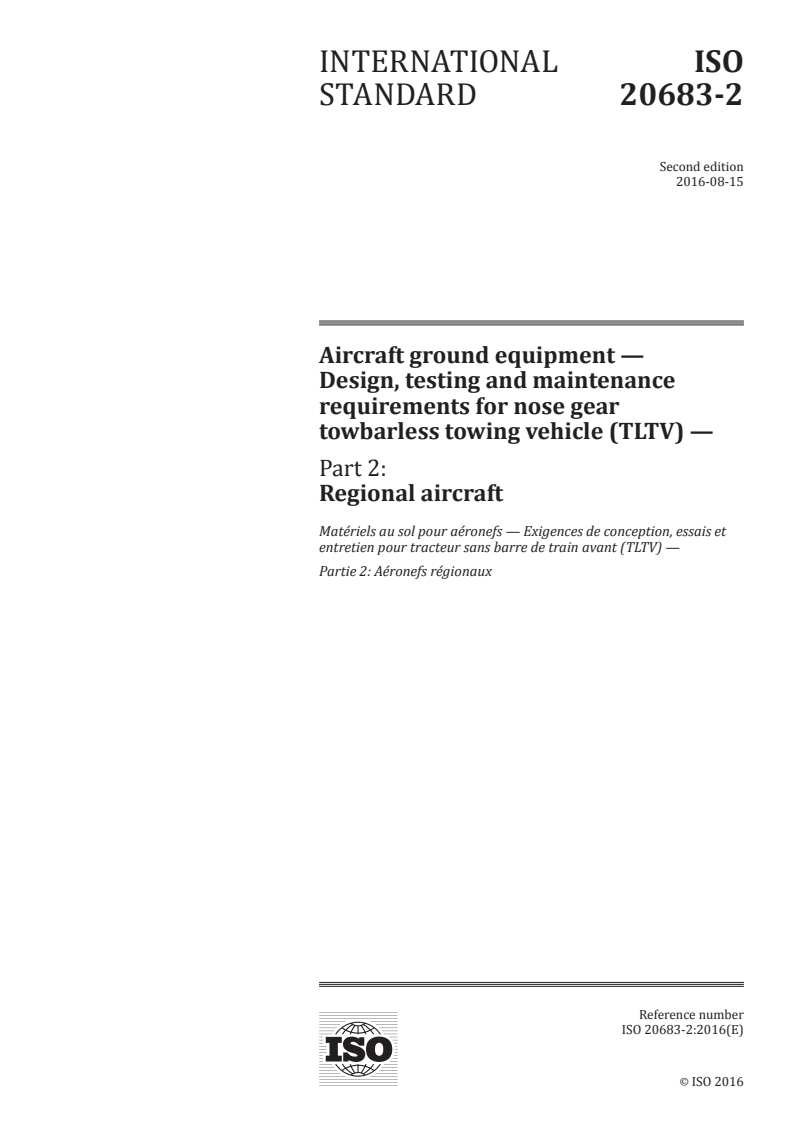
INTERNATIONAL ISO
STANDARD 20683-2
Second edition
2016-08-15
Aircraft ground equipment —
Design, testing and maintenance
requirements for nose gear
towbarless towing vehicle (TLTV) —
Part 2:
Regional aircraft
Matériels au sol pour aéronefs — Exigences de conception, essais et
entretien pour tracteur sans barre de train avant (TLTV) —
Partie 2: Aéronefs régionaux
Reference number
©
ISO 2016
© ISO 2016, Published in Switzerland
All rights reserved. Unless otherwise specified, no part of this publication may be reproduced or utilized otherwise in any form
or by any means, electronic or mechanical, including photocopying, or posting on the internet or an intranet, without prior
written permission. Permission can be requested from either ISO at the address below or ISO’s member body in the country of
the requester.
ISO copyright office
Ch. de Blandonnet 8 • CP 401
CH-1214 Vernier, Geneva, Switzerland
Tel. +41 22 749 01 11
Fax +41 22 749 09 47
copyright@iso.org
www.iso.org
ii © ISO 2016 – All rights reserved
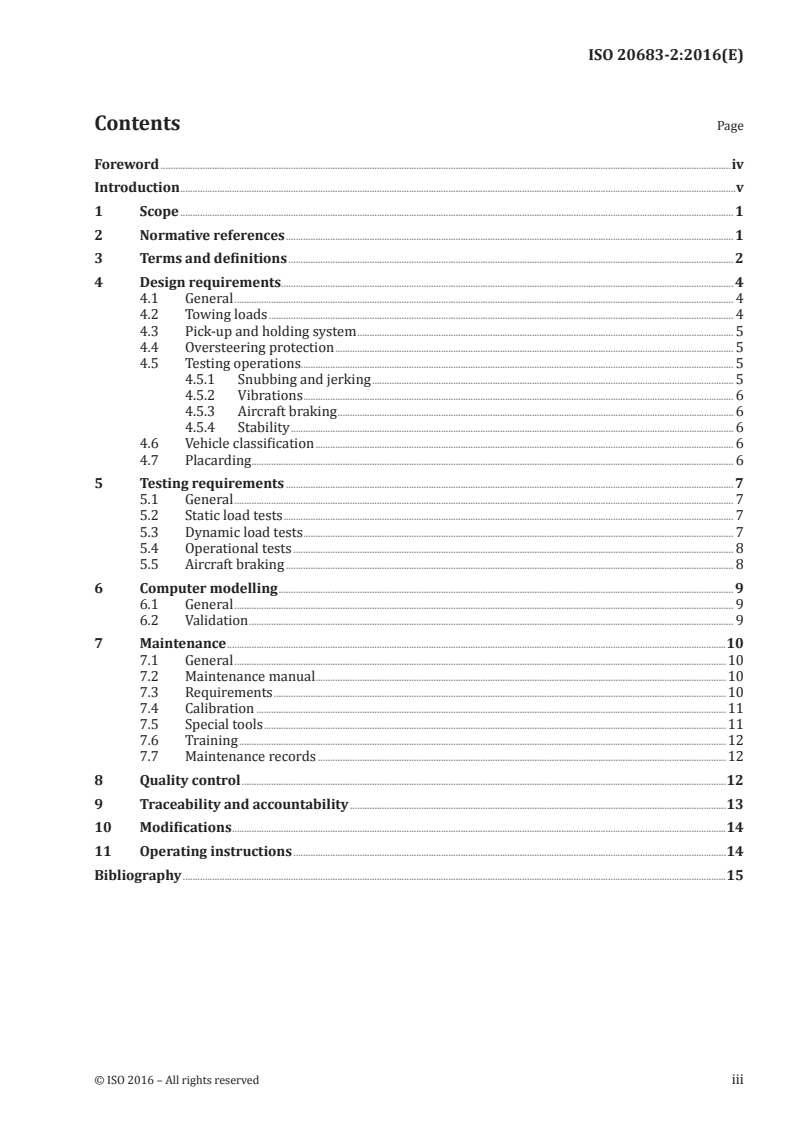
Contents Page
Foreword .iv
Introduction .v
1 Scope . 1
2 Normative references . 1
3 Terms and definitions . 2
4 Design requirements . 4
4.1 General . 4
4.2 Towing loads . 4
4.3 Pick-up and holding system . 5
4.4 Oversteering protection . 5
4.5 Testing operations. 5
4.5.1 Snubbing and jerking . 5
4.5.2 Vibrations . 6
4.5.3 Aircraft braking . 6
4.5.4 Stability . 6
4.6 Vehicle classification . 6
4.7 Placarding . 6
5 Testing requirements . 7
5.1 General . 7
5.2 Static load tests . 7
5.3 Dynamic load tests . 7
5.4 Operational tests . 8
5.5 Aircraft braking . 8
6 Computer modelling . 9
6.1 General . 9
6.2 Validation . 9
7 Maintenance .10
7.1 General .10
7.2 Maintenance manual .10
7.3 Requirements .10
7.4 Calibration .11
7.5 Special tools .11
7.6 Training .12
7.7 Maintenance records .12
8 Quality control .12
9 Traceability and accountability .13
10 Modifications .14
11 Operating instructions .14
Bibliography .15
Foreword
ISO (the International Organization for Standardization) is a worldwide federation of national standards
bodies (ISO member bodies). The work of preparing International Standards is normally carried out
through ISO technical committees. Each member body interested in a subject for which a technical
committee has been established has the right to be represented on that committee. International
organizations, governmental and non-governmental, in liaison with ISO, also take part in the work.
ISO collaborates closely with the International Electrotechnical Commission (IEC) on all matters of
electrotechnical standardization.
The procedures used to develop this document and those intended for its further maintenance are
described in the ISO/IEC Directives, Part 1. In particular the different approval criteria needed for the
different types of ISO documents should be noted. This document was drafted in accordance with the
editorial rules of the ISO/IEC Directives, Part 2 (see www.iso.org/directives).
Attention is drawn to the possibility that some of the elements of this document may be the subject of
patent rights. ISO shall not be held responsible for identifying any or all such patent rights. Details of
any patent rights identified during the development of the document will be in the Introduction and/or
on the ISO list of patent declarations received (see www.iso.org/patents).
Any trade name used in this document is information given for the convenience of users and does not
constitute an endorsement.
For an explanation on the meaning of ISO specific terms and expressions related to conformity assessment,
as well as information about ISO’s adherence to the World Trade Organization (WTO) principles in the
Technical Barriers to Trade (TBT) see the following URL: www.iso.org/iso/foreword.html.
The committee responsible for this document is ISO/TC 20, Aircraft and space vehicles, Subcommittee
SC 9, Air cargo and ground equipment.
This second edition cancels and replaces the first edition of ISO 20683-2:2004, which has been
technically revised.
A list of all parts in the ISO 20683 series can be found on the ISO website.
iv © ISO 2016 – All rights reserved
Introduction
This document specifies design, testing, maintenance and associated requirements to be applied on
towbarless aircraft towing vehicles to be used on regional civil transport aircraft in order to ensure
their operation will not result in damage to aircraft nose landing gears, their steering systems or
associated aircraft structure.
Throughout this document, the minimum essential criteria are identified by the use of the keyword
“shall.” Other recommended criteria are identified by the use of the keyword “should” and, while not
mandatory, are considered to be of primary importance in providing safe and serviceable towbarless
tractors. Alternative solutions may be adopted only after careful consideration, extensive testing and
thorough service evaluation have shown them to be equivalent.
INTERNATIONAL STANDARD ISO 20683-2:2016(E)
Aircraft ground equipment — Design, testing and
maintenance requirements for nose gear towbarless
towing vehicle (TLTV) —
Part 2:
Regional aircraft
1 Scope
This document is applicable to towbarless aircraft towing vehicles (TLTVs) interfacing with the nose
landing gear of civil transport aircraft with a maximum ramp mass comprised between 10 000 and
50 000 kg (22 000 and 110 000 lb), commonly designated as “regional aircraft.” The requirements for
main line transport aircraft with a higher maximum ramp mass are specified in ISO 20683-1. It is not
applicable to TLTVs which were manufactured before its date of publication.
It specifies general design requirements, testing and evaluation requirements, maintenance, calibration,
documentation, records, tracing and accountability requirements in order to ensure that the loads
induced by the tow vehicle will not exceed the design loads of the nose gear or its steering system, or
reduce the certified safe life limit of the nose gear, or induce a stability problem during aircraft push
back and/or maintenance towing operations.
This document specifies requirements and procedures for towbarless tow vehicles (TLTVs) intended
for aircraft pushback and gate relocation or maintenance towing only. It is not intended to allow for
dispatch (operational) towing (see Clause 3). Dispatch towing imposes greater loads on nose gears and
aircraft structure due to the combination of speed and additional passenger, cargo, and fuel loads.
This document does not apply to towbarless towing vehicles interfacing with aircraft main landing gear.
2 Normative references
The following documents are referred to in the text in such a way that some or all of their content
constitutes requirements of this document. For dated references, only the edition cited applies. For
undated references, the latest edition of the referenced document (including any amendments) applies.
NOTE TLTV designers should also take into account the requirements of documents referenced in the
Bibliography.
ISO 6966-1, Aircraft ground equipment — Basic requirements — Part 1: General design requirements
ISO 6966-2, Aircraft ground equipment — Basic requirements — Part 2: Safety requirements
Federal Aviation Regulations (FAR) 14 CFR Part 25, Airworthiness Standards: Transport category
1)
airplanes, paragraphs 25.301, Loads, and 25.509, Towing loads
Certification Specifications and Acceptable Means of Compliance for Large Aeroplanes CS-25, paragraphs
2)
25.301, Loads, 25.509, Towing loads, 25.745(d), Nose-wheel steering, and AMC 25.745(d)
1) FAR Part 25 constitutes the U.S.A. government transport aircraft airworthiness regulations and can be obtained
from US Government Printing Office, Mail Stop SSOP, Washington DC 20402-9328, U.S.A.
2) EASA CS25 constitute the European governments transport aircraft airworthiness regulations, and can be
obtained from European Aviation Safety Agency: Ottoplatz 1, D-50679 Cologne, Germany - http://easa.europa.
eu/official-publication/.
3 Terms and definitions
For the purposes of this document, the following terms and definitions apply.
ISO and IEC maintain terminological databases for use in standardization at the following addresses:
— IEC Electropedia: available at http://www.electropedia.org/
— ISO Online browsing platform: available at http://www.iso.org/obp
3.1
main line aircraft
civil passenger and/or freight transport aircraft with a maximum ramp mass over 50 000 kg (110 000 lb)
3.2
regional aircraft
civil passenger and/or freight transport aircraft with a maximum ramp mass between 10 000 kg (22
000 lb) and 50 000 kg (110 000 lb)
3.3
maximum ramp mass
maximum ramp weight
MRW
maximum mass allowable for an aircraft type when leaving its parking position either under its own
power or towed, comprising maximum structural take-off mass (MTOW) and taxiing fuel allowance
3.4
pushback
moving a fully loaded aircraft [up to maximum ramp mass (MRW)] from the parking position to the
taxiway
Note 1 to entry: Movement includes pick-up, pushback with turn, a stop, a short push or tow to align aircraft and
nose wheels, and release. Engines may or may not be operating. Aircraft movement is similar to a conventional
pushback operation with a tow bar. Typical speed does not exceed 10 km.h-1 (6 mph).
3.5
maintenance towing
movement of an aircraft for maintenance/remote parking purposes (e.g. from the parking position to a
maintenance hangar)
Note 1 to entry: The aircraft is typically unloaded with minimal fuel load (reference light gross weight, LGW),
with speeds up to 32 km.h-1 (20 mph).
3.6
gate relocation towing
movement of an aircraft from one parking position to an adjacent one or one in the same general area
Note 1 to entry: The aircraft is typically unloaded with minimal fuel load [reference light gross weight (LGW)],
with speeds intermediate between pushback and maintenance towing.
3.7
dispatch towing
operational towing
towing a revenue aircraft [loaded with passengers, fuel, and cargo up to maximum ramp mass (MRW)],
from the terminal gate/remote parking area, to a location near the active runway, or conversely,
possibly covering several kilometres with speeds up to or over 32 km.h-1 (20 mph), with several starts,
stops and turns
Note 1 to entry: Replaces typical taxiing operations prior to take-off or after landing.
2 © ISO 2016 – All rights reserved
Note 2 to entry: In the definitions of the towing modes, the frequency of operation has not been included. This
should not be interpreted to mean that no limitations are present. For limitations on the frequency of pushback
and maintenance operations, refer to the appropriate airframe manufacturer’s documentation or consult directly
with the airframe manufacturer.
3.8
towbarless towing vehicle
TLTV
towing vehicle acting without tow bar on an aircraft’s nose landing gear
3.9
nose landing gear
NLG
aircraft nose landing gear in a tricycle landing gear layout
3.10
light gross weight
LGW
reference aircraft mass for combined testing of the vehicle and aircraft, defined as the manufacturer’s
operating empty mass of the aircraft type concerned, plus fuel remaining in the tanks on landing (10 %
to 20 % of total tanks capacity)
3.11
heavy gross weight
HGW
reference aircraft mass for combined testing of the vehicle and aircraft, defined as the manufacturer’s
operating empty mass of the aircraft concerned, plus at least 50 % of the maximum total fuel tanks
capacity on the type, or its equivalent in mass (payload may be accounted if present, providing aircraft
balance condition remains within limits)
3.12
maximum limits
limits (fore and aft tractive force, torsional or angular) established by the airframe manufacturer as
not-to-exceed values intended to preclude possible damage to nose landing gear or structure
Note 1 to entry: Maximum limits are established by airframe manufacturer’s documentation and may be different
for towbarless or tow bar towing operations. All aircraft load limits are limit loads as defined in FAR/EASA CS
paragraph 25.301 (a).
3.13
operational limits
limits (fore and aft tractive force, torsional or angular) which are set at a lesser value than the maximum
limits established by the airframe manufacturer
3.14
aircraft family
grouping of aircraft types or subtypes, defined by their manufacturer, for which the same maximum
limits may be applied
Note 1 to entry: A family usually encompasses all sub-types of a given type, but may also include other types.
Testing for one (usually the lightest) model of the family results in towbarless towing approval for the whole
family. See airframe manufacturers towbarless towing evaluation documentation.
3.15
TLTV setting
grouping of aircraft types or sub-types, defined by the TLTV manufacturer, for which a single
operational limits setting is used
Note 1 to entry: A single TLTV setting usually encompasses aircraft types or sub-types, which may be produced
by different airframe manufacturers, in a same defined MRW range.
3.16
drag load
towforce
total force from the tow vehicle on the nose gear tires in the “x” axis
3.17
X axis
fore and aft axis of the tow vehicle, parallel to the ground
3.18
oversteer
exceedence of maximum torsional load or angular limits where potential damage to the nose landing
gear structure or steering system could take place
Note 1 to entry: These limits are defined in the appropriate airframe manufacturer’s documentation. Torsional
load limits typically occur after exceeding angular limits, but may occur before the angular limit is reached (e.g.
nose gear hydraulic system bypass failure).
3.19
snubbing
sudden relief and reapplication of acceleration/deceleration loads while TLTV and aircraft are in motion
3.20
jerking
sudden application of push/pull forces from a complete stop
4 Design requirements
4.1 General
4.1.1 Towbarless tow vehicles (TLTVs) shall comply with the applicable general requirements of
ISO 6966-1 and safety requirements of ISO 6966-2.
4.1.2 Airframe manufacturers should provide information for each aircraft type which allows TLTV
manufacturers or airlines to self-test or evaluate the towbarless tow vehicles themselves. Refer to the
airframe manufacturer’s documentation for evaluation requirements and detailed testing procedures
that may be different from or additional to those contained in this document.
4.1.3 TLTV manufacturers should prepare and provide customers or regulatory agencies, as required,
with a certificate of compliance or equivalent documentation, as evidence that successful testing and
evaluation of a specific tow vehicle/aircraft type combination has been completed in accordance with
this document and/or the applicable airframe manufacturer’s documentation. This certificate shall
allow the use of the vehicle on specifically designated aircraft model types. The certificate should be
established under an appropriate quality control program meeting the requirements of ISO 9001 or
equivalent pertinent industry standard.
4.1.4 Towbarless towing vehicles shall, either by intrinsic design or through appropriate load limiting
devices, ensure that the following maximum limits are not exceeded.
4.2 Towing loads
4.2.1 The push and pull towing forces induced by the TLTV onto the aircraft’s nose landing gear as a
result of either accelerating or braking shall be verified as per Clauses 5 and/or 6 hereafter, and shall not
at any time exceed the maximum values specified by the aircraft manufacturer.
4 © ISO 2016 – All rights reserved
4.2.2 Depending on the range of aircraft types the TLTV is compatible with, preset towing load values
may be used for a number of aircraft types or sub-types in a given MRW range. In this case, each TLTV
setting shall comply with the maximum limits specified by the manufacturer(s) of the designated aircraft
types, sub-types, or family(s) thereof as defined by the aircraft manufacturers, and each TLTV setting
shall be subjected to a separate verification.
4.3 Pick-up and holding system
4.3.1 The TLTV’s nose landing gear pick-up/release device should operate in a smooth and continuous
manner. Abrupt or oscillating loads during the pick-up/release sequence should not occur. It should be
designed to minimize the loads during the pick-up/release sequence. The drag loads induced during
pick-up/release should fall well below the “peak” loads experienced during a typical operation.
4.3.2 The maximum loads induced by pick-up and release sequences shall be measured either on an
aircraft or on a fixture representative of the nose gear geometry. The vertical load on the nose gear or
fixture shall be equal to the vertical load used for fatigue justification (refer to the appropriate airframe
manufacturer’s documentation). The maximum lift (height above the ground) of the nose gear shall not
exceed the values given in the airframe manufacturer’s documentation if such values are provided.
4.4 Oversteering protection
4.4.1 The maximum angular or torsional load limits stated by the aircraft’s manufacturer in the event
of oversteering shall not at any time be exceeded. See aircraft manufacturer’s TLTV assessment criteria
document.
4.4.2 This may be achieved either by oversteer protection built into the TLTV, or by an oversteer
alerting system being provided.
4.4.3 Oversteer protection may be achieved either by intrinsic design precluding the possibility of
either limit being reached or exceeded, or by a fail-safe oversteer protection system ensuring they shall
not be exceeded. Oversteer alerting shall consist in an appropriate fail-safe warning system installed on
the TLTV, providing the driver with unmistakable indication that one of the maximum limits was reached.
EASA CS requirements:
For aircraft registered or operated under EASA CS-25 paragraph 25.745(d) and associated
AMC 25.745(d), requires the TLTV manufacturers to provide a Declaration of Compliance (4.1.3) of their
unit’s oversteer protection or oversteer alerting system(s) with the present International Standard and
the criteria published by the manufacturer of each aircraft type for which it is intended, and the aircraft
manufacturers to list in their appropriate documentation the TLTV models that were specifically
accepted for each aircraft type based on this Declaration of Compliance.
4.4.4 No testing of the TLTV oversteer protection or alerting systems shall be perf
...
INTERNATIONAL ISO
STANDARD 20683-2
Second edition
2016-08-15
Aircraft ground equipment —
Design, testing and maintenance
requirements for nose gear
towbarless towing vehicle (TLTV) —
Part 2:
Regional aircraft
Matériels au sol pour aéronefs — Exigences de conception, essais et
entretien pour tracteur sans barre de train avant (TLTV) —
Partie 2: Aéronefs régionaux
Reference number
©
ISO 2016
© ISO 2016, Published in Switzerland
All rights reserved. Unless otherwise specified, no part of this publication may be reproduced or utilized otherwise in any form
or by any means, electronic or mechanical, including photocopying, or posting on the internet or an intranet, without prior
written permission. Permission can be requested from either ISO at the address below or ISO’s member body in the country of
the requester.
ISO copyright office
Ch. de Blandonnet 8 • CP 401
CH-1214 Vernier, Geneva, Switzerland
Tel. +41 22 749 01 11
Fax +41 22 749 09 47
copyright@iso.org
www.iso.org
ii © ISO 2016 – All rights reserved
Contents Page
Foreword .iv
Introduction .v
1 Scope . 1
2 Normative references . 1
3 Terms and definitions . 2
4 Design requirements . 4
4.1 General . 4
4.2 Towing loads . 4
4.3 Pick-up and holding system . 5
4.4 Oversteering protection . 5
4.5 Testing operations. 5
4.5.1 Snubbing and jerking . 5
4.5.2 Vibrations . 6
4.5.3 Aircraft braking . 6
4.5.4 Stability . 6
4.6 Vehicle classification . 6
4.7 Placarding . 6
5 Testing requirements . 7
5.1 General . 7
5.2 Static load tests . 7
5.3 Dynamic load tests . 7
5.4 Operational tests . 8
5.5 Aircraft braking . 8
6 Computer modelling . 9
6.1 General . 9
6.2 Validation . 9
7 Maintenance .10
7.1 General .10
7.2 Maintenance manual .10
7.3 Requirements .10
7.4 Calibration .11
7.5 Special tools .11
7.6 Training .12
7.7 Maintenance records .12
8 Quality control .12
9 Traceability and accountability .13
10 Modifications .14
11 Operating instructions .14
Bibliography .15
Foreword
ISO (the International Organization for Standardization) is a worldwide federation of national standards
bodies (ISO member bodies). The work of preparing International Standards is normally carried out
through ISO technical committees. Each member body interested in a subject for which a technical
committee has been established has the right to be represented on that committee. International
organizations, governmental and non-governmental, in liaison with ISO, also take part in the work.
ISO collaborates closely with the International Electrotechnical Commission (IEC) on all matters of
electrotechnical standardization.
The procedures used to develop this document and those intended for its further maintenance are
described in the ISO/IEC Directives, Part 1. In particular the different approval criteria needed for the
different types of ISO documents should be noted. This document was drafted in accordance with the
editorial rules of the ISO/IEC Directives, Part 2 (see www.iso.org/directives).
Attention is drawn to the possibility that some of the elements of this document may be the subject of
patent rights. ISO shall not be held responsible for identifying any or all such patent rights. Details of
any patent rights identified during the development of the document will be in the Introduction and/or
on the ISO list of patent declarations received (see www.iso.org/patents).
Any trade name used in this document is information given for the convenience of users and does not
constitute an endorsement.
For an explanation on the meaning of ISO specific terms and expressions related to conformity assessment,
as well as information about ISO’s adherence to the World Trade Organization (WTO) principles in the
Technical Barriers to Trade (TBT) see the following URL: www.iso.org/iso/foreword.html.
The committee responsible for this document is ISO/TC 20, Aircraft and space vehicles, Subcommittee
SC 9, Air cargo and ground equipment.
This second edition cancels and replaces the first edition of ISO 20683-2:2004, which has been
technically revised.
A list of all parts in the ISO 20683 series can be found on the ISO website.
iv © ISO 2016 – All rights reserved
Introduction
This document specifies design, testing, maintenance and associated requirements to be applied on
towbarless aircraft towing vehicles to be used on regional civil transport aircraft in order to ensure
their operation will not result in damage to aircraft nose landing gears, their steering systems or
associated aircraft structure.
Throughout this document, the minimum essential criteria are identified by the use of the keyword
“shall.” Other recommended criteria are identified by the use of the keyword “should” and, while not
mandatory, are considered to be of primary importance in providing safe and serviceable towbarless
tractors. Alternative solutions may be adopted only after careful consideration, extensive testing and
thorough service evaluation have shown them to be equivalent.
INTERNATIONAL STANDARD ISO 20683-2:2016(E)
Aircraft ground equipment — Design, testing and
maintenance requirements for nose gear towbarless
towing vehicle (TLTV) —
Part 2:
Regional aircraft
1 Scope
This document is applicable to towbarless aircraft towing vehicles (TLTVs) interfacing with the nose
landing gear of civil transport aircraft with a maximum ramp mass comprised between 10 000 and
50 000 kg (22 000 and 110 000 lb), commonly designated as “regional aircraft.” The requirements for
main line transport aircraft with a higher maximum ramp mass are specified in ISO 20683-1. It is not
applicable to TLTVs which were manufactured before its date of publication.
It specifies general design requirements, testing and evaluation requirements, maintenance, calibration,
documentation, records, tracing and accountability requirements in order to ensure that the loads
induced by the tow vehicle will not exceed the design loads of the nose gear or its steering system, or
reduce the certified safe life limit of the nose gear, or induce a stability problem during aircraft push
back and/or maintenance towing operations.
This document specifies requirements and procedures for towbarless tow vehicles (TLTVs) intended
for aircraft pushback and gate relocation or maintenance towing only. It is not intended to allow for
dispatch (operational) towing (see Clause 3). Dispatch towing imposes greater loads on nose gears and
aircraft structure due to the combination of speed and additional passenger, cargo, and fuel loads.
This document does not apply to towbarless towing vehicles interfacing with aircraft main landing gear.
2 Normative references
The following documents are referred to in the text in such a way that some or all of their content
constitutes requirements of this document. For dated references, only the edition cited applies. For
undated references, the latest edition of the referenced document (including any amendments) applies.
NOTE TLTV designers should also take into account the requirements of documents referenced in the
Bibliography.
ISO 6966-1, Aircraft ground equipment — Basic requirements — Part 1: General design requirements
ISO 6966-2, Aircraft ground equipment — Basic requirements — Part 2: Safety requirements
Federal Aviation Regulations (FAR) 14 CFR Part 25, Airworthiness Standards: Transport category
1)
airplanes, paragraphs 25.301, Loads, and 25.509, Towing loads
Certification Specifications and Acceptable Means of Compliance for Large Aeroplanes CS-25, paragraphs
2)
25.301, Loads, 25.509, Towing loads, 25.745(d), Nose-wheel steering, and AMC 25.745(d)
1) FAR Part 25 constitutes the U.S.A. government transport aircraft airworthiness regulations and can be obtained
from US Government Printing Office, Mail Stop SSOP, Washington DC 20402-9328, U.S.A.
2) EASA CS25 constitute the European governments transport aircraft airworthiness regulations, and can be
obtained from European Aviation Safety Agency: Ottoplatz 1, D-50679 Cologne, Germany - http://easa.europa.
eu/official-publication/.
3 Terms and definitions
For the purposes of this document, the following terms and definitions apply.
ISO and IEC maintain terminological databases for use in standardization at the following addresses:
— IEC Electropedia: available at http://www.electropedia.org/
— ISO Online browsing platform: available at http://www.iso.org/obp
3.1
main line aircraft
civil passenger and/or freight transport aircraft with a maximum ramp mass over 50 000 kg (110 000 lb)
3.2
regional aircraft
civil passenger and/or freight transport aircraft with a maximum ramp mass between 10 000 kg (22
000 lb) and 50 000 kg (110 000 lb)
3.3
maximum ramp mass
maximum ramp weight
MRW
maximum mass allowable for an aircraft type when leaving its parking position either under its own
power or towed, comprising maximum structural take-off mass (MTOW) and taxiing fuel allowance
3.4
pushback
moving a fully loaded aircraft [up to maximum ramp mass (MRW)] from the parking position to the
taxiway
Note 1 to entry: Movement includes pick-up, pushback with turn, a stop, a short push or tow to align aircraft and
nose wheels, and release. Engines may or may not be operating. Aircraft movement is similar to a conventional
pushback operation with a tow bar. Typical speed does not exceed 10 km.h-1 (6 mph).
3.5
maintenance towing
movement of an aircraft for maintenance/remote parking purposes (e.g. from the parking position to a
maintenance hangar)
Note 1 to entry: The aircraft is typically unloaded with minimal fuel load (reference light gross weight, LGW),
with speeds up to 32 km.h-1 (20 mph).
3.6
gate relocation towing
movement of an aircraft from one parking position to an adjacent one or one in the same general area
Note 1 to entry: The aircraft is typically unloaded with minimal fuel load [reference light gross weight (LGW)],
with speeds intermediate between pushback and maintenance towing.
3.7
dispatch towing
operational towing
towing a revenue aircraft [loaded with passengers, fuel, and cargo up to maximum ramp mass (MRW)],
from the terminal gate/remote parking area, to a location near the active runway, or conversely,
possibly covering several kilometres with speeds up to or over 32 km.h-1 (20 mph), with several starts,
stops and turns
Note 1 to entry: Replaces typical taxiing operations prior to take-off or after landing.
2 © ISO 2016 – All rights reserved
Note 2 to entry: In the definitions of the towing modes, the frequency of operation has not been included. This
should not be interpreted to mean that no limitations are present. For limitations on the frequency of pushback
and maintenance operations, refer to the appropriate airframe manufacturer’s documentation or consult directly
with the airframe manufacturer.
3.8
towbarless towing vehicle
TLTV
towing vehicle acting without tow bar on an aircraft’s nose landing gear
3.9
nose landing gear
NLG
aircraft nose landing gear in a tricycle landing gear layout
3.10
light gross weight
LGW
reference aircraft mass for combined testing of the vehicle and aircraft, defined as the manufacturer’s
operating empty mass of the aircraft type concerned, plus fuel remaining in the tanks on landing (10 %
to 20 % of total tanks capacity)
3.11
heavy gross weight
HGW
reference aircraft mass for combined testing of the vehicle and aircraft, defined as the manufacturer’s
operating empty mass of the aircraft concerned, plus at least 50 % of the maximum total fuel tanks
capacity on the type, or its equivalent in mass (payload may be accounted if present, providing aircraft
balance condition remains within limits)
3.12
maximum limits
limits (fore and aft tractive force, torsional or angular) established by the airframe manufacturer as
not-to-exceed values intended to preclude possible damage to nose landing gear or structure
Note 1 to entry: Maximum limits are established by airframe manufacturer’s documentation and may be different
for towbarless or tow bar towing operations. All aircraft load limits are limit loads as defined in FAR/EASA CS
paragraph 25.301 (a).
3.13
operational limits
limits (fore and aft tractive force, torsional or angular) which are set at a lesser value than the maximum
limits established by the airframe manufacturer
3.14
aircraft family
grouping of aircraft types or subtypes, defined by their manufacturer, for which the same maximum
limits may be applied
Note 1 to entry: A family usually encompasses all sub-types of a given type, but may also include other types.
Testing for one (usually the lightest) model of the family results in towbarless towing approval for the whole
family. See airframe manufacturers towbarless towing evaluation documentation.
3.15
TLTV setting
grouping of aircraft types or sub-types, defined by the TLTV manufacturer, for which a single
operational limits setting is used
Note 1 to entry: A single TLTV setting usually encompasses aircraft types or sub-types, which may be produced
by different airframe manufacturers, in a same defined MRW range.
3.16
drag load
towforce
total force from the tow vehicle on the nose gear tires in the “x” axis
3.17
X axis
fore and aft axis of the tow vehicle, parallel to the ground
3.18
oversteer
exceedence of maximum torsional load or angular limits where potential damage to the nose landing
gear structure or steering system could take place
Note 1 to entry: These limits are defined in the appropriate airframe manufacturer’s documentation. Torsional
load limits typically occur after exceeding angular limits, but may occur before the angular limit is reached (e.g.
nose gear hydraulic system bypass failure).
3.19
snubbing
sudden relief and reapplication of acceleration/deceleration loads while TLTV and aircraft are in motion
3.20
jerking
sudden application of push/pull forces from a complete stop
4 Design requirements
4.1 General
4.1.1 Towbarless tow vehicles (TLTVs) shall comply with the applicable general requirements of
ISO 6966-1 and safety requirements of ISO 6966-2.
4.1.2 Airframe manufacturers should provide information for each aircraft type which allows TLTV
manufacturers or airlines to self-test or evaluate the towbarless tow vehicles themselves. Refer to the
airframe manufacturer’s documentation for evaluation requirements and detailed testing procedures
that may be different from or additional to those contained in this document.
4.1.3 TLTV manufacturers should prepare and provide customers or regulatory agencies, as required,
with a certificate of compliance or equivalent documentation, as evidence that successful testing and
evaluation of a specific tow vehicle/aircraft type combination has been completed in accordance with
this document and/or the applicable airframe manufacturer’s documentation. This certificate shall
allow the use of the vehicle on specifically designated aircraft model types. The certificate should be
established under an appropriate quality control program meeting the requirements of ISO 9001 or
equivalent pertinent industry standard.
4.1.4 Towbarless towing vehicles shall, either by intrinsic design or through appropriate load limiting
devices, ensure that the following maximum limits are not exceeded.
4.2 Towing loads
4.2.1 The push and pull towing forces induced by the TLTV onto the aircraft’s nose landing gear as a
result of either accelerating or braking shall be verified as per Clauses 5 and/or 6 hereafter, and shall not
at any time exceed the maximum values specified by the aircraft manufacturer.
4 © ISO 2016 – All rights reserved
4.2.2 Depending on the range of aircraft types the TLTV is compatible with, preset towing load values
may be used for a number of aircraft types or sub-types in a given MRW range. In this case, each TLTV
setting shall comply with the maximum limits specified by the manufacturer(s) of the designated aircraft
types, sub-types, or family(s) thereof as defined by the aircraft manufacturers, and each TLTV setting
shall be subjected to a separate verification.
4.3 Pick-up and holding system
4.3.1 The TLTV’s nose landing gear pick-up/release device should operate in a smooth and continuous
manner. Abrupt or oscillating loads during the pick-up/release sequence should not occur. It should be
designed to minimize the loads during the pick-up/release sequence. The drag loads induced during
pick-up/release should fall well below the “peak” loads experienced during a typical operation.
4.3.2 The maximum loads induced by pick-up and release sequences shall be measured either on an
aircraft or on a fixture representative of the nose gear geometry. The vertical load on the nose gear or
fixture shall be equal to the vertical load used for fatigue justification (refer to the appropriate airframe
manufacturer’s documentation). The maximum lift (height above the ground) of the nose gear shall not
exceed the values given in the airframe manufacturer’s documentation if such values are provided.
4.4 Oversteering protection
4.4.1 The maximum angular or torsional load limits stated by the aircraft’s manufacturer in the event
of oversteering shall not at any time be exceeded. See aircraft manufacturer’s TLTV assessment criteria
document.
4.4.2 This may be achieved either by oversteer protection built into the TLTV, or by an oversteer
alerting system being provided.
4.4.3 Oversteer protection may be achieved either by intrinsic design precluding the possibility of
either limit being reached or exceeded, or by a fail-safe oversteer protection system ensuring they shall
not be exceeded. Oversteer alerting shall consist in an appropriate fail-safe warning system installed on
the TLTV, providing the driver with unmistakable indication that one of the maximum limits was reached.
EASA CS requirements:
For aircraft registered or operated under EASA CS-25 paragraph 25.745(d) and associated
AMC 25.745(d), requires the TLTV manufacturers to provide a Declaration of Compliance (4.1.3) of their
unit’s oversteer protection or oversteer alerting system(s) with the present International Standard and
the criteria published by the manufacturer of each aircraft type for which it is intended, and the aircraft
manufacturers to list in their appropriate documentation the TLTV models that were specifically
accepted for each aircraft type based on this Declaration of Compliance.
4.4.4 No testing of the TLTV oversteer protection or alerting systems shall be perf
...