

ISO 10216:2017
(Main)Anodizing of aluminium and its alloys — Instrumental determination of image clarity of anodic oxidation coatings — Instrumental method
General Information
- Abstract
ISO 10216 specifies an instrumental method for determining the image clarity of anodic oxidation coatings on aluminium and its alloys by measuring reflection from the surface with the help of a sliding combed shutter. The test can only be applied to a flat surface which can reflect the image onto the limited combed shutter and photo-receiver. This method can also be used to measure the optical evenness of anodic oxidation coatings on aluminium and its alloys.
- Status
- Withdrawn
- Publication Date
- 08-Oct-2017
- Technical Committee
- ISO/TC 79/SC 2 - Organic and anodic oxidation coatings on aluminium
- Drafting Committee
- ISO/TC 79/SC 2 - Organic and anodic oxidation coatings on aluminium
- Current Stage
- 9599 - Withdrawal of International Standard
- Start Date
- 02-Oct-2024
- Completion Date
- 29-Aug-2026
Buy Documents

ISO 10216:2017 - Anodizing of aluminium and its alloys -- Instrumental determination of image clarity of anodic oxidation coatings -- Instrumental method

ISO 10216:2017 - Anodizing of aluminium and its alloys — Instrumental determination of image clarity of anodic oxidation coatings — Instrumental method/9/2017
Overview
ISO 10216:2017 specifies an instrumental method for measuring the image clarity of anodic oxidation (anodized) coatings on aluminium and its alloys. The method uses an optical comb (a sliding combed shutter) and a photo‑receiver to quantify how clearly a surface reflects an image. It applies only to flat, reflective surfaces and can also assess optical evenness and light dispersion of anodic coatings. The instrumental approach provides more repeatable and objective results than visual inspection and is suitable for quality control and dispute resolution.
Key Topics and Requirements
- Principle: A slit illuminated and collimated is reflected from the specimen set at 45°; the reflected slit image is analyzed through a sliding combed shutter and measured by a photo‑receiver.
- Image clarity (C): Calculated as C = (M − m) / (M + m) × 100, where M is maximum light intensity and m is minimum light intensity. Image clarity is expressed as a percentage.
- Optical evenness (E): Expressed as the ratio of transverse and longitudinal image clarity values (E = S / L), indicating surface irregularities.
- Dispersion of light (D): Measured to quantify light scattering by the coating (formula and use are defined for higher classes).
- Apparatus essentials:
- Specimen set at 45° to incident light
- Collimating/de‑collimating lenses (focal length ~130 mm)
- Light source (filament ≤ 0.05 mm)
- Slit (≈0.02 mm ± 0.01 mm width)
- Combed sliding shutter with 1:1 transparent/opaque ratio; widths: 0.125, 0.25, 0.5, 1.0, 2.0 mm
- Photo‑receiver and black glass conforming to ISO 7668
- Specimen preparation: Representative flat area (standard size ~50 × 50 mm), clean, and prepared under the same anodizing/sealing conditions as the product.
- Classification (using 0.5 mm comb, larger of transverse/longitudinal values):
- S: C ≥ 90 (mirror finishes)
- A: 90 > C ≥ 70 (glossy)
- B: 70 > C ≥ 30 (low glossy)
- C: C < 30 (matt)
Applications and Users
- Quality control in anodizing plants and aluminium finishing lines to monitor surface clarity and uniformity.
- Test laboratories performing objective optical assessments of anodic coatings.
- OEMs and specifiers who require quantifiable finish criteria for parts and architectural components.
- Suppliers and purchasers for acceptance testing and dispute resolution where visual assessments are insufficient.
- R&D and process development to evaluate effects of pre‑treatment, anodizing and sealing on optical performance.
Related Standards
- ISO 10215 - visual chart scale for image clarity (optical comb + lightness scale).
- ISO 7583 - terms and definitions for anodizing of aluminium.
- ISO 7668 - black glass requirements and specular reflectance/gloss measurement.
Keywords: ISO 10216:2017, anodizing, anodic oxidation coatings, image clarity, instrumental method, aluminium, optical evenness, combed sliding shutter, measurement.
Relations
- Effective Date
- 04-Nov-2023
- Effective Date
- 14-Nov-2015
Buy Documents
ISO 10216:2017 - Anodizing of aluminium and its alloys -- Instrumental determination of image clarity of anodic oxidation coatings -- Instrumental method
ISO 10216:2017 - Anodizing of aluminium and its alloys — Instrumental determination of image clarity of anodic oxidation coatings — Instrumental method/9/2017
Get Certified
Connect with accredited certification bodies for this standard

DVS-ZERT GmbH
German welding certification society.
CARES (UK Certification Authority for Reinforcing Steels)
UK certification for reinforcing steels and construction.
EWF/IIW (European/International Welding Federation)
International welding personnel certification.
Sponsored listings
Frequently Asked Questions
ISO 10216:2017 is a standard published by the International Organization for Standardization (ISO). Its full title is "Anodizing of aluminium and its alloys — Instrumental determination of image clarity of anodic oxidation coatings — Instrumental method". This standard covers: ISO 10216 specifies an instrumental method for determining the image clarity of anodic oxidation coatings on aluminium and its alloys by measuring reflection from the surface with the help of a sliding combed shutter. The test can only be applied to a flat surface which can reflect the image onto the limited combed shutter and photo-receiver. This method can also be used to measure the optical evenness of anodic oxidation coatings on aluminium and its alloys.
ISO 10216 specifies an instrumental method for determining the image clarity of anodic oxidation coatings on aluminium and its alloys by measuring reflection from the surface with the help of a sliding combed shutter. The test can only be applied to a flat surface which can reflect the image onto the limited combed shutter and photo-receiver. This method can also be used to measure the optical evenness of anodic oxidation coatings on aluminium and its alloys.
ISO 10216:2017 is classified under the following ICS (International Classification for Standards) categories: 25.220.20 - Surface treatment. The ICS classification helps identify the subject area and facilitates finding related standards.
ISO 10216:2017 has the following relationships with other standards: It is inter standard links to ISO 10216:2024, ISO 10216:2010. Understanding these relationships helps ensure you are using the most current and applicable version of the standard.
ISO 10216:2017 is available in PDF format for immediate download after purchase. The document can be added to your cart and obtained through the secure checkout process. Digital delivery ensures instant access to the complete standard document.
Standards Content (Sample)
INTERNATIONAL ISO
STANDARD 10216
Third edition
2017-10
Anodizing of aluminium and its
alloys — Instrumental determination
of image clarity of anodic oxidation
coatings — Instrumental method
Anodisation de l'aluminium et de ses alliages — Détermination de la
netteté d'image sur couches anodiques — Méthode instrumentale
Reference number
©
ISO 2017
© ISO 2017, Published in Switzerland
All rights reserved. Unless otherwise specified, no part of this publication may be reproduced or utilized otherwise in any form
or by any means, electronic or mechanical, including photocopying, or posting on the internet or an intranet, without prior
written permission. Permission can be requested from either ISO at the address below or ISO’s member body in the country of
the requester.
ISO copyright office
Ch. de Blandonnet 8 • CP 401
CH-1214 Vernier, Geneva, Switzerland
Tel. +41 22 749 01 11
Fax +41 22 749 09 47
copyright@iso.org
www.iso.org
ii © ISO 2017 – All rights reserved
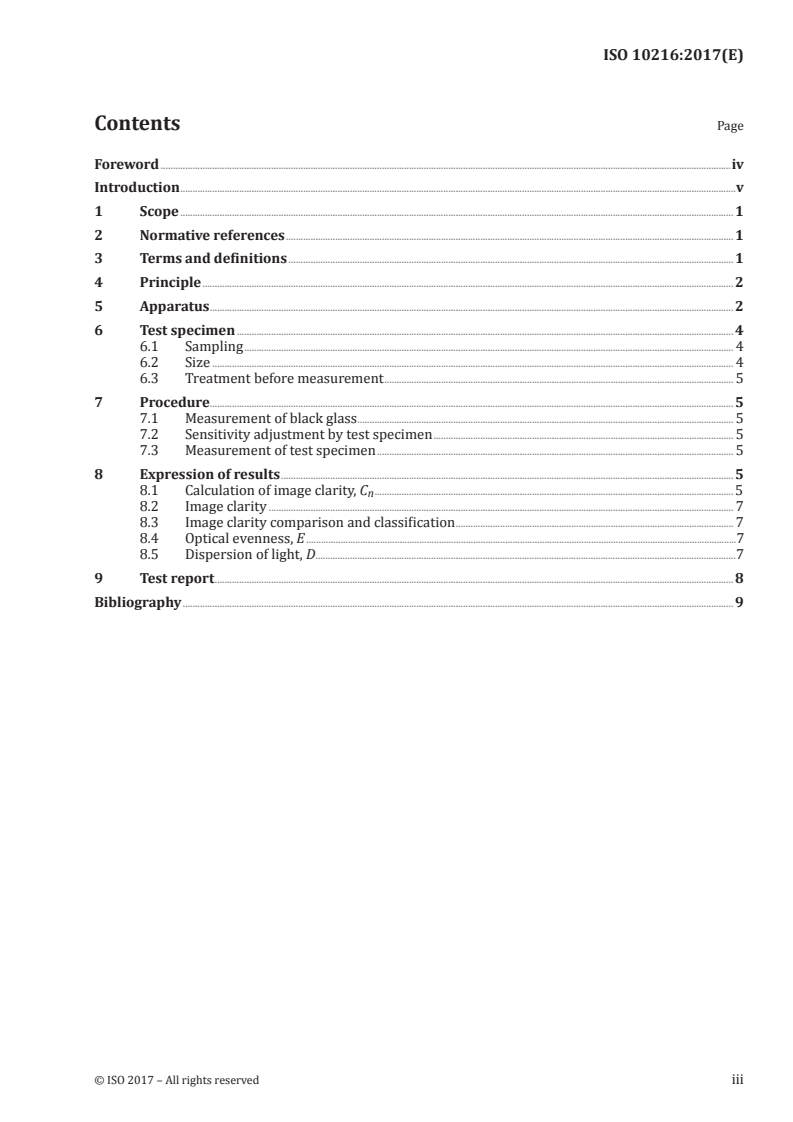
Contents Page
Foreword .iv
Introduction .v
1 Scope . 1
2 Normative references . 1
3 Terms and definitions . 1
4 Principle . 2
5 Apparatus . 2
6 Test specimen . 4
6.1 Sampling . 4
6.2 Size . 4
6.3 Treatment before measurement . 5
7 Procedure. 5
7.1 Measurement of black glass . 5
7.2 Sensitivity adjustment by test specimen . 5
7.3 Measurement of test specimen . 5
8 Expression of results . 5
8.1 Calculation of image clarity, C . 5
n
8.2 Image clarity . 7
8.3 Image clarity comparison and classification . 7
8.4 Optical evenness, E .7
8.5 Dispersion of light, D .7
9 Test report . 8
Bibliography . 9
Foreword
ISO (the International Organization for Standardization) is a worldwide federation of national standards
bodies (ISO member bodies). The work of preparing International Standards is normally carried out
through ISO technical committees. Each member body interested in a subject for which a technical
committee has been established has the right to be represented on that committee. International
organizations, governmental and non-governmental, in liaison with ISO, also take part in the work.
ISO collaborates closely with the International Electrotechnical Commission (IEC) on all matters of
electrotechnical standardization.
The procedures used to develop this document and those intended for its further maintenance are
described in the ISO/IEC Directives, Part 1. In particular the different approval criteria needed for the
different types of ISO documents should be noted. This document was drafted in accordance with the
editorial rules of the ISO/IEC Directives, Part 2 (see www.iso.org/directives).
Attention is drawn to the possibility that some of the elements of this document may be the subject of
patent rights. ISO shall not be held responsible for identifying any or all such patent rights. Details of
any patent rights identified during the development of the document will be in the Introduction and/or
on the ISO list of patent declarations received (see www.iso.org/patents).
Any trade name used in this document is information given for the convenience of users and does not
constitute an endorsement.
For an explanation on the voluntary nature of standards, the meaning of ISO specific terms and
expressions related to conformity assessment, as well as information about ISO's adherence to the
World Trade Organization (WTO) principles in the Technical Barriers to Trade (TBT) see the following
URL: www.iso.org/iso/foreword.html.
This document was prepared by Technical Committee ISO/TC 79, Light metals and their alloys,
Subcommittee SC 2, Organic and anodic oxidation coatings on aluminium.
This third edition cancels and replaces the second edition (ISO 10216:2010), which has been technically
revised.
The main changes compared to the previous edition are as follows:
— the tolerance of the width of the slit has been revised;
— the figures have been revised;
— a combed sliding shutter figure has been added;
— information about the test specimen has been added.
iv © ISO 2017 – All rights reserved
Introduction
Estimation of the image clarity of anodic oxidation coatings on aluminium and its alloys is normally
carried out visually by observing the clearness of an image on the surface. However, the image can be
observed at various angles and be confused with the gloss level of a surface, and while the degree of
image clarity is mainly influenced by the clearness of the coating, it is also affected by image distortion
caused by surface irregularities and the haziness of the coating layer. Standardized methods of
determining image clarity are therefore required.
This document specifies the use of an instrumental method for measuring image clarity using an optical
comb. A related document, ISO 10215, specifies the use of a chart scale also based on an optical comb
together with a lightness scale to rank image clarity.
NOTE This instrumental method provides more accurate measurements of image clarity than visual
evaluation and can be used in cases of dispute.
INTERNATIONAL STANDARD ISO 10216:2017(E)
Anodizing of aluminium and its alloys — Instrumental
determination of image clarity of anodic oxidation coatings
— Instrumental method
1 Scope
This document specifies an instrumental method for determining the image clarity of anodic oxidation
coatings on aluminium and its alloys by measuring reflection from the surface with the help of a sliding
combed shutter.
The test can only be applied to a flat surface which can reflect the image onto the limited combed
shutter and photo-receiver. This method can also be used to measure the optical evenness of anodic
oxidation coatings on aluminium and its alloys.
2 Normative references
The following documents are referred to in the text in such a way that some or all of their content
constitutes requirements of this document. For dated references, only the edition cited applies. For
undated references, the latest edition of the referenced document (including a
...
INTERNATIONAL ISO
STANDARD 10216
Third edition
2017-10
Anodizing of aluminium and its
alloys — Instrumental determination
of image clarity of anodic oxidation
coatings — Instrumental method
Anodisation de l'aluminium et de ses alliages — Détermination de la
netteté d'image sur couches anodiques — Méthode instrumentale
Reference number
©
ISO 2017
© ISO 2017, Published in Switzerland
All rights reserved. Unless otherwise specified, no part of this publication may be reproduced or utilized otherwise in any form
or by any means, electronic or mechanical, including photocopying, or posting on the internet or an intranet, without prior
written permission. Permission can be requested from either ISO at the address below or ISO’s member body in the country of
the requester.
ISO copyright office
Ch. de Blandonnet 8 • CP 401
CH-1214 Vernier, Geneva, Switzerland
Tel. +41 22 749 01 11
Fax +41 22 749 09 47
copyright@iso.org
www.iso.org
ii © ISO 2017 – All rights reserved
Contents Page
Foreword .iv
Introduction .v
1 Scope . 1
2 Normative references . 1
3 Terms and definitions . 1
4 Principle . 2
5 Apparatus . 2
6 Test specimen . 4
6.1 Sampling . 4
6.2 Size . 4
6.3 Treatment before measurement . 5
7 Procedure. 5
7.1 Measurement of black glass . 5
7.2 Sensitivity adjustment by test specimen . 5
7.3 Measurement of test specimen . 5
8 Expression of results . 5
8.1 Calculation of image clarity, C . 5
n
8.2 Image clarity . 7
8.3 Image clarity comparison and classification . 7
8.4 Optical evenness, E .7
8.5 Dispersion of light, D .7
9 Test report . 8
Bibliography . 9
Foreword
ISO (the International Organization for Standardization) is a worldwide federation of national standards
bodies (ISO member bodies). The work of preparing International Standards is normally carried out
through ISO technical committees. Each member body interested in a subject for which a technical
committee has been established has the right to be represented on that committee. International
organizations, governmental and non-governmental, in liaison with ISO, also take part in the work.
ISO collaborates closely with the International Electrotechnical Commission (IEC) on all matters of
electrotechnical standardization.
The procedures used to develop this document and those intended for its further maintenance are
described in the ISO/IEC Directives, Part 1. In particular the different approval criteria needed for the
different types of ISO documents should be noted. This document was drafted in accordance with the
editorial rules of the ISO/IEC Directives, Part 2 (see www.iso.org/directives).
Attention is drawn to the possibility that some of the elements of this document may be the subject of
patent rights. ISO shall not be held responsible for identifying any or all such patent rights. Details of
any patent rights identified during the development of the document will be in the Introduction and/or
on the ISO list of patent declarations received (see www.iso.org/patents).
Any trade name used in this document is information given for the convenience of users and does not
constitute an endorsement.
For an explanation on the voluntary nature of standards, the meaning of ISO specific terms and
expressions related to conformity assessment, as well as information about ISO's adherence to the
World Trade Organization (WTO) principles in the Technical Barriers to Trade (TBT) see the following
URL: www.iso.org/iso/foreword.html.
This document was prepared by Technical Committee ISO/TC 79, Light metals and their alloys,
Subcommittee SC 2, Organic and anodic oxidation coatings on aluminium.
This third edition cancels and replaces the second edition (ISO 10216:2010), which has been technically
revised.
The main changes compared to the previous edition are as follows:
— the tolerance of the width of the slit has been revised;
— the figures have been revised;
— a combed sliding shutter figure has been added;
— information about the test specimen has been added.
iv © ISO 2017 – All rights reserved
Introduction
Estimation of the image clarity of anodic oxidation coatings on aluminium and its alloys is normally
carried out visually by observing the clearness of an image on the surface. However, the image can be
observed at various angles and be confused with the gloss level of a surface, and while the degree of
image clarity is mainly influenced by the clearness of the coating, it is also affected by image distortion
caused by surface irregularities and the haziness of the coating layer. Standardized methods of
determining image clarity are therefore required.
This document specifies the use of an instrumental method for measuring image clarity using an optical
comb. A related document, ISO 10215, specifies the use of a chart scale also based on an optical comb
together with a lightness scale to rank image clarity.
NOTE This instrumental method provides more accurate measurements of image clarity than visual
evaluation and can be used in cases of dispute.
INTERNATIONAL STANDARD ISO 10216:2017(E)
Anodizing of aluminium and its alloys — Instrumental
determination of image clarity of anodic oxidation coatings
— Instrumental method
1 Scope
This document specifies an instrumental method for determining the image clarity of anodic oxidation
coatings on aluminium and its alloys by measuring reflection from the surface with the help of a sliding
combed shutter.
The test can only be applied to a flat surface which can reflect the image onto the limited combed
shutter and photo-receiver. This method can also be used to measure the optical evenness of anodic
oxidation coatings on aluminium and its alloys.
2 Normative references
The following documents are referred to in the text in such a way that some or all of their content
constitutes requirements of this document. For dated references, only the edition cited applies. For
undated references, the latest edition of the referenced document (including a
...