

ISO/IEC 7501-2:1997
(Main)Identification cards — Machine readable travel documents — Part 2: Machine readable visa
General Information
- Abstract
- Status
- Published
- Publication Date
- 30-Jul-1997
- Technical Committee
- ISO/IEC JTC 1/SC 17 - Cards and security devices for personal identification
- Drafting Committee
- ISO/IEC JTC 1/SC 17/WG 3 - Traveller identification
- Current Stage
- 9093 - International Standard confirmed
- Start Date
- 22-Oct-2024
- Completion Date
- 29-Aug-2026
Buy Documents

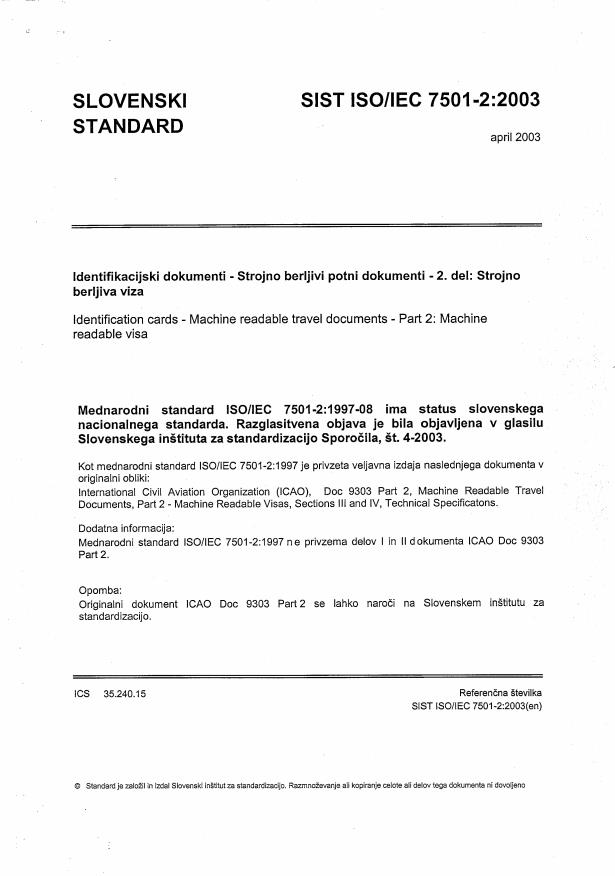

ISO/IEC 7501-2:2003 - Originalni dokument ICAO Doc 9303 Part 2 se lahko naroči na Slovenskem inštitutu za standardizacijo.



ISO/IEC 7501-2:1997 - Identification cards — Machine readable travel documents — Part 2: Machine readable visa Released:7/31/1997
Overview
ISO/IEC 7501-2:1997 is an international standard specifying the design and construction of machine-readable visas (MRVs) used in travel documentation. Developed jointly by the International Organization for Standardization (ISO) and the International Electrotechnical Commission (IEC), this standard ensures consistency and interoperability of machine-readable visa systems worldwide. It aligns with the related ICAO (International Civil Aviation Organization) Doc 9303 Part 2 specification, which addresses machine-readable travel documents.
The standard focuses on the visible and machine-readable sections of visas that contain traveler identity information-enabling rapid automated reading and verification at international border crossings. By standardizing the format and data elements, it facilitates secure and efficient processing of travelers while enhancing global travel document security.
Key Topics
- Machine-readable visa format: Defines the physical layout, character sets, and data encoding for visas that can be read by optical character recognition (OCR) systems.
- Integration with ICAO Doc 9303 Part 2: Builds on ICAO standards for travel documents to ensure global compatibility.
- Character sets and printing: Specifies use of OCR-B alphanumeric characters and printing standards for optimal machine readability.
- Physical characteristics: Aligns with ISO/IEC 7810 standards for the dimensions and durability of identification cards.
- Data interchange formats: Utilizes ISO 8601 for date/time formats and ISO 3166 for country codes, ensuring standardized data elements in MRVs.
- Security and interoperability: Promotes uniformity to enhance visa verification security and cross-border document interoperability.
Applications
- Border control and immigration: Enables efficient, automated visa inspection and traveler authentication at ports of entry worldwide.
- Visa issuance by governments: Provides a standardized guideline for developing machine-readable visas compatible with international travel systems.
- Travel document manufacturers: Assists card and passport producers in complying with global standards ensuring international acceptance and durability.
- Information technology in travel security: Supports development of software systems and OCR equipment used to read machine-readable fields on visas.
- International travel facilitation: Reduces manual data entry errors and speeds up passenger processing, enhancing traveler experience and security.
Related Standards
- ICAO Doc 9303 Part 2: Primary specification for machine-readable visas, which ISO/IEC 7501-2 adopts and supports.
- ISO/IEC 7810:1995: Specifies the physical dimensions and properties of identification cards.
- ISO 1073-2:1976: Defines OCR-B font used for machine-readable characters on visas.
- ISO 1831:1980: Printing specifications for optical character recognition to ensure legible and durable machine-readable text.
- ISO 8601:1988: Standard for data elements relating to representation of dates and times in travel documents.
- ISO 3166:1993: Codes for the representation of country names in machine-readable formats.
By following ISO/IEC 7501-2:1997, stakeholders involved in visa issuance, travel security, and border management can ensure travellers' machine-readable visas meet internationally recognized quality, security, and interoperability criteria crucial for modern global mobility.
Relations
- Effective Date
- 15-Apr-2008
Buy Documents
ISO/IEC 7501-2:2003 - Originalni dokument ICAO Doc 9303 Part 2 se lahko naroči na Slovenskem inštitutu za standardizacijo.
ISO/IEC 7501-2:1997 - Identification cards — Machine readable travel documents — Part 2: Machine readable visa Released:7/31/1997
Get Certified
Connect with accredited certification bodies for this standard

BSI Group
BSI (British Standards Institution) is the business standards company that helps organizations make excellence a habit.

NYCE
Mexican standards and certification body.
Sponsored listings
Frequently Asked Questions
ISO/IEC 7501-2:1997 is a standard published by the International Organization for Standardization (ISO). Its full title is "Identification cards — Machine readable travel documents — Part 2: Machine readable visa". This standard covers: Identification cards — Machine readable travel documents — Part 2: Machine readable visa
Identification cards — Machine readable travel documents — Part 2: Machine readable visa
ISO/IEC 7501-2:1997 is classified under the following ICS (International Classification for Standards) categories: 35.240.15 - Identification cards. Chip cards. Biometrics. The ICS classification helps identify the subject area and facilitates finding related standards.
ISO/IEC 7501-2:1997 has the following relationships with other standards: It is inter standard links to ISO/IEC 7501-2:1995. Understanding these relationships helps ensure you are using the most current and applicable version of the standard.
ISO/IEC 7501-2:1997 is available in PDF format for immediate download after purchase. The document can be added to your cart and obtained through the secure checkout process. Digital delivery ensures instant access to the complete standard document.
Standards Content (Sample)
INTERNATIONAL ISOAEC
STANDARD 7501-2
Second edition
1997-08-01
Identification cards - Machine readable
travel documents -
Part 2:
Machine readable visa
Cartes d ’identification - Documents de voyage lisibles par machine -
Parfie 2: Visa lisible par machine
Reference number
ISOAEC 750+2:1997(E)
ISOAEC 7501=2:1997(E)
Foreword
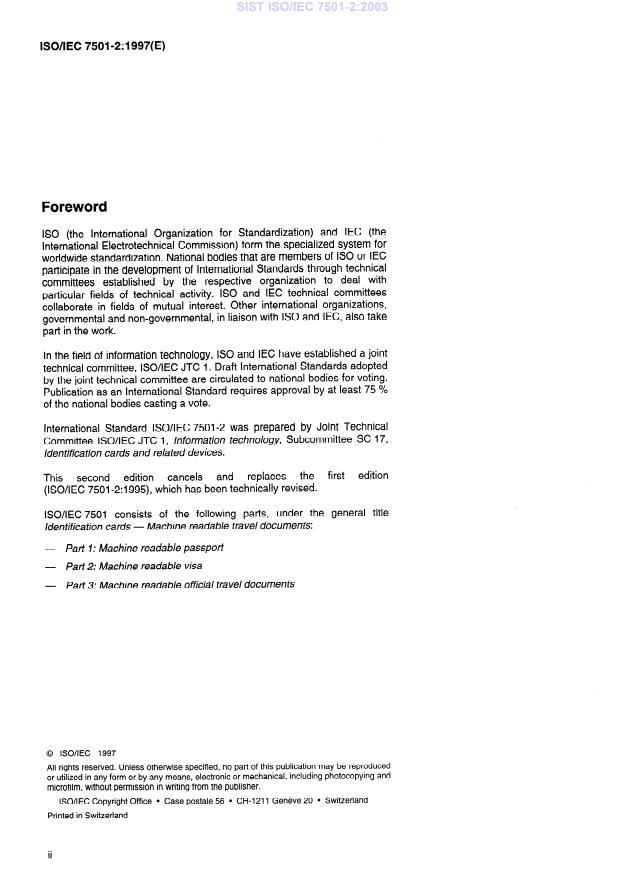
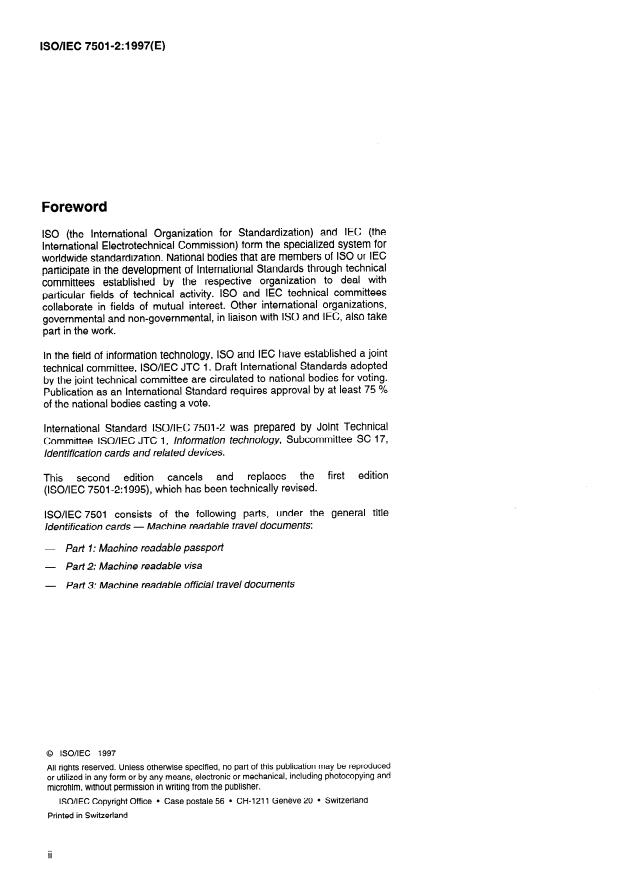
IS0 (the International Organization for Standardization) and IEC (the
International Electrotechnical Commission) form the specialized system for
worldwide standardization. National bodies that are members of IS0 or IEC
participate in the development of International Standards through technical
committees established by the respective organization to deal with
particular fields of technical activity. IS0 and IEC technical committees
collaborate in fields of mutual interest. Other international organizations,
governmental and non-governmental, in liaison with IS0 and IEC, also take
part in the work.
In the field of information technology, IS0 and IEC have established a joint
technical committee, ISOAEC JTC 1. Draft International Standards adopted
by the joint technical committee are circulated to national bodies for voting.
Publication as an International Standard requires approval by at least 75 %
of the national bodies casting a vote.
International Standard ISOAEC 7501-2 was prepared by Joint Technical
Committee ISOAEC JTC 1, information technology, Subcommittee SC 17,
ldentifica tion cards and related devices.
This second edition cancels and replaces the first edition
(ISOAEC 7501-2:1995), which has been technically revised.
ISOAEC 7501 consists of the following parts, under the general title
ldentifica tion cards - Machine readable travel documents:
- Part 1: Machine readable passpot?
- Part 2: Machine readable visa
- Par? 3: Machine readable official travel documents
0 ISO/IEC 1997
All rights reserved. Unless otherwise specified, no part of this publication may be reproduced
or utilized in any form or by any means, electronic or mechanical, including photocopying and
microfilm, without permission in writing from the publisher.
lSO/IEC Copyright Office l Case postale 56 l CH-1211 Geneve 20 l Switzerland
Printed in Switzerland
ii
...
INTERNATIONAL ISOAEC
STANDARD 7501-2
Second edition
1997-08-01
Identification cards - Machine readable
travel documents -
Part 2:
Machine readable visa
Cartes d ’identification - Documents de voyage lisibles par machine -
Parfie 2: Visa lisible par machine
Reference number
ISOAEC 750+2:1997(E)
ISOAEC 7501=2:1997(E)
Foreword
IS0 (the International Organization for Standardization) and IEC (the
International Electrotechnical Commission) form the specialized system for
worldwide standardization. National bodies that are members of IS0 or IEC
participate in the development of International Standards through technical
committees established by the respective organization to deal with
particular fields of technical activity. IS0 and IEC technical committees
collaborate in fields of mutual interest. Other international organizations,
governmental and non-governmental, in liaison with IS0 and IEC, also take
part in the work.
In the field of information technology, IS0 and IEC have established a joint
technical committee, ISOAEC JTC 1. Draft International Standards adopted
by the joint technical committee are circulated to national bodies for voting.
Publication as an International Standard requires approval by at least 75 %
of the national bodies casting a vote.
International Standard ISOAEC 7501-2 was prepared by Joint Technical
Committee ISOAEC JTC 1, information technology, Subcommittee SC 17,
ldentifica tion cards and related devices.
This second edition cancels and replaces the first edition
(ISOAEC 7501-2:1995), which has been technically revised.
ISOAEC 7501 consists of the following parts, under the general title
ldentifica tion cards - Machine readable travel documents:
- Part 1: Machine readable passpot?
- Part 2: Machine readable visa
- Par? 3: Machine readable official travel documents
0 ISO/IEC 1997
All rights reserved. Unless otherwise specified, no part of this publication may be reproduced
or utilized in any form or by any means, electronic or mechanical, including photocopying and
microfilm, without permission in writing from the publisher.
lSO/IEC Copyright Office l Case postale 56 l CH-1211 Geneve 20 l Switzerland
Printed in Switzerland
ii
INTERNATIONAL STANDARD Orso ’lEC
ISO/IEC 7501-2 : 1997 (E)
Machine readable travel
Identification cards --
documents --
Part 2:
Machine readable visa
T
...