

ISO/IEC 23090-8:2025
(Main)Information technology — Coded representation of immersive media — Part 8: Network based media processing
General Information
- Abstract
The network-based media processing (NBMP) framework defines the interfaces including both data formats and application programming interfaces (APIs) among the entities connected through digital networks for media processing. Users can access and configure their operations remotely for efficient, intelligent processing. This document describes and manages workflows to be applied to the media data. This process includes uploading of media data to the network, instantiation of the media processing tasks, and configuration of the tasks. The framework enables dynamic creation of media processing pipelines, as well as access to processed media data and metadata in real-time or in a deferred way. The media and metadata formats used between the media source, workflow manager and media processing entities in a media processing pipeline are also specified.
- Status
- Published
- Publication Date
- 26-Jun-2025
- Current Stage
- 6060 - International Standard published
- Start Date
- 27-Jun-2025
- Due Date
- 23-Jul-2024
- Completion Date
- 27-Jun-2025

Overview
ISO/IEC 23090-8:2025 - Information technology - Coded representation of immersive media - Part 8: Network based media processing (NBMP) - defines a framework for network-based media processing that standardizes interfaces, data formats and APIs among entities connected via digital networks for remote media processing. The standard describes how media is uploaded, how processing tasks are instantiated and configured, and how dynamic media processing pipelines (workflows) are created and accessed in real time or deferred modes. It also specifies media and metadata formats exchanged between media sources, workflow managers and media processing entities (MPEs).
Key technical topics and requirements
- NBMP architecture and workflow model: Logical architecture, workflow processing model, task allocation and distribution, and workflow graph semantics.
- APIs and REST resources: Definitions for Workflow APIs, Task APIs, Function Discovery APIs and MPE APIs to support discovery, instantiation, configuration and monitoring of media processing tasks.
- Descriptors and JSON schemas: Standardized descriptor types (scheme, general, input, output, processing, requirements, configuration, startup, client-assistance, failover, events) with JSON schema definitions for interoperability.
- Task and workflow lifecycles: Lifecycle management for tasks and workflows including instantiation, state transitions and impacts across entities.
- MPE capabilities and discovery: Mechanisms to describe media processing entity capabilities and enable function discovery and selection.
- Supported protocols and interoperability: Specification of supported network protocols and mapping between logical definitions, data objects and REST resources.
- Media and metadata formats: Standardized formats for exchanging media content and metadata across sources, workflow managers and processing entities.
Practical applications and users
This standard is directly applicable to implementations that require scalable, interoperable media processing over networks, such as:
- Cloud-based transcoding, real-time streaming and adaptive streaming services
- Immersive media processing for VR/AR/360 video workflows
- Live production pipelines, remote media editing and collaborative content creation
- Media analytics, automated metadata extraction, indexing and enrichment services
- Content delivery networks (CDNs) and edge processing platforms that require dynamic pipeline composition
Primary users and implementers:
- System architects and platform engineers designing media-processing platforms
- Cloud and edge service providers offering media processing APIs
- Media processing engine vendors and integrators
- Broadcast and OTT solution developers, AV software architects
- Standards implementers and interoperability test labs
Related standards
- Part of the ISO/IEC 23090 series on coded representation of immersive media. Implementers should consider other parts of the ISO/IEC 23090 family for codec, container and metadata specifications that complement NBMP.
Relations
- Effective Date
- 06-Jun-2022
Get Certified
Connect with accredited certification bodies for this standard

BSI Group
BSI (British Standards Institution) is the business standards company that helps organizations make excellence a habit.

NYCE
Mexican standards and certification body.
Sponsored listings
Frequently Asked Questions
ISO/IEC 23090-8:2025 is a standard published by the International Organization for Standardization (ISO). Its full title is "Information technology — Coded representation of immersive media — Part 8: Network based media processing". This standard covers: The network-based media processing (NBMP) framework defines the interfaces including both data formats and application programming interfaces (APIs) among the entities connected through digital networks for media processing. Users can access and configure their operations remotely for efficient, intelligent processing. This document describes and manages workflows to be applied to the media data. This process includes uploading of media data to the network, instantiation of the media processing tasks, and configuration of the tasks. The framework enables dynamic creation of media processing pipelines, as well as access to processed media data and metadata in real-time or in a deferred way. The media and metadata formats used between the media source, workflow manager and media processing entities in a media processing pipeline are also specified.
The network-based media processing (NBMP) framework defines the interfaces including both data formats and application programming interfaces (APIs) among the entities connected through digital networks for media processing. Users can access and configure their operations remotely for efficient, intelligent processing. This document describes and manages workflows to be applied to the media data. This process includes uploading of media data to the network, instantiation of the media processing tasks, and configuration of the tasks. The framework enables dynamic creation of media processing pipelines, as well as access to processed media data and metadata in real-time or in a deferred way. The media and metadata formats used between the media source, workflow manager and media processing entities in a media processing pipeline are also specified.
ISO/IEC 23090-8:2025 is classified under the following ICS (International Classification for Standards) categories: 35.040.40 - Coding of audio, video, multimedia and hypermedia information. The ICS classification helps identify the subject area and facilitates finding related standards.
ISO/IEC 23090-8:2025 has the following relationships with other standards: It is inter standard links to ISO/IEC 23090-8:2020. Understanding these relationships helps ensure you are using the most current and applicable version of the standard.
ISO/IEC 23090-8:2025 is available in PDF format for immediate download after purchase. The document can be added to your cart and obtained through the secure checkout process. Digital delivery ensures instant access to the complete standard document.
Standards Content (Sample)
International
Standard
ISO/IEC 23090-8
Second edition
Information technology — Coded
2025-06
representation of immersive media —
Part 8:
Network based media processing
Technologies de l'information — Représentation codée de médias
immersifs —
Partie 8: Traitement des médias en réseau
Reference number
© ISO/IEC 2025
All rights reserved. Unless otherwise specified, or required in the context of its implementation, no part of this publication may
be reproduced or utilized otherwise in any form or by any means, electronic or mechanical, including photocopying, or posting on
the internet or an intranet, without prior written permission. Permission can be requested from either ISO at the address below
or ISO’s member body in the country of the requester.
ISO copyright office
CP 401 • Ch. de Blandonnet 8
CH-1214 Vernier, Geneva
Phone: +41 22 749 01 11
Email: copyright@iso.org
Website: www.iso.org
Published in Switzerland
© ISO/IEC 2025 – All rights reserved
ii
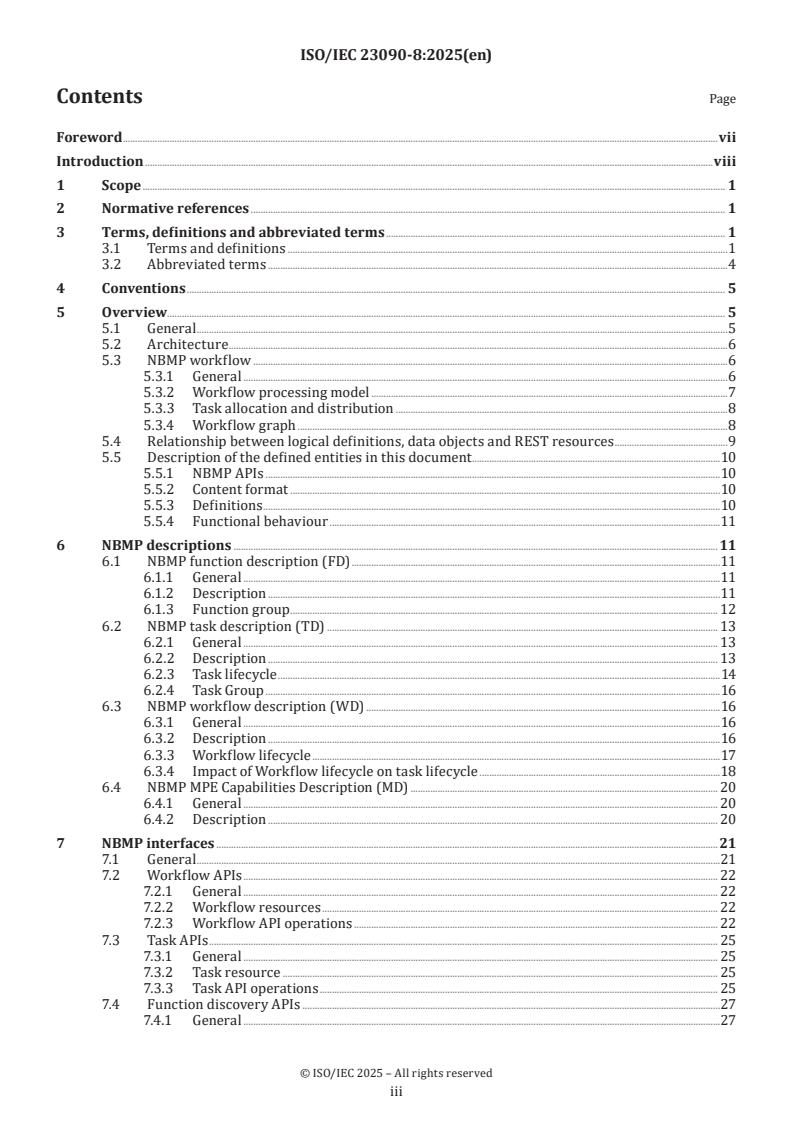
Contents Page
Foreword .vii
Introduction .viii
1 Scope . 1
2 Normative references . 1
3 Terms, definitions and abbreviated terms . 1
3.1 Terms and definitions .1
3.2 Abbreviated terms .4
4 Conventions . 5
5 Overview . 5
5.1 General .5
5.2 Architecture .6
5.3 NBMP workflow .6
5.3.1 General .6
5.3.2 Workflow processing model .7
5.3.3 Task allocation and distribution .8
5.3.4 Workflow graph .8
5.4 Relationship between logical definitions, data objects and REST resources .9
5.5 Description of the defined entities in this document .10
5.5.1 NBMP APIs .10
5.5.2 Content format .10
5.5.3 Definitions .10
5.5.4 Functional behaviour .11
6 NBMP descriptions .11
6.1 NBMP function description (FD) .11
6.1.1 General .11
6.1.2 Description .11
6.1.3 Function group . 12
6.2 NBMP task description (TD) . 13
6.2.1 General . 13
6.2.2 Description . 13
6.2.3 Task lifecycle .14
6.2.4 Task Group .16
6.3 NBMP workflow description (WD) .16
6.3.1 General .16
6.3.2 Description .16
6.3.3 Workflow lifecycle .17
6.3.4 Impact of Workflow lifecycle on task lifecycle .18
6.4 NBMP MPE Capabilities Description (MD) . 20
6.4.1 General . 20
6.4.2 Description . 20
7 NBMP interfaces .21
7.1 General .21
7.2 Workflow APIs . 22
7.2.1 General . 22
7.2.2 Workflow resources . 22
7.2.3 Workflow API operations . 22
7.3 Task APIs . 25
7.3.1 General . 25
7.3.2 Task resource . 25
7.3.3 Task API operations . 25
7.4 Function discovery APIs .27
7.4.1 General .27
© ISO/IEC 2025 – All rights reserved
iii
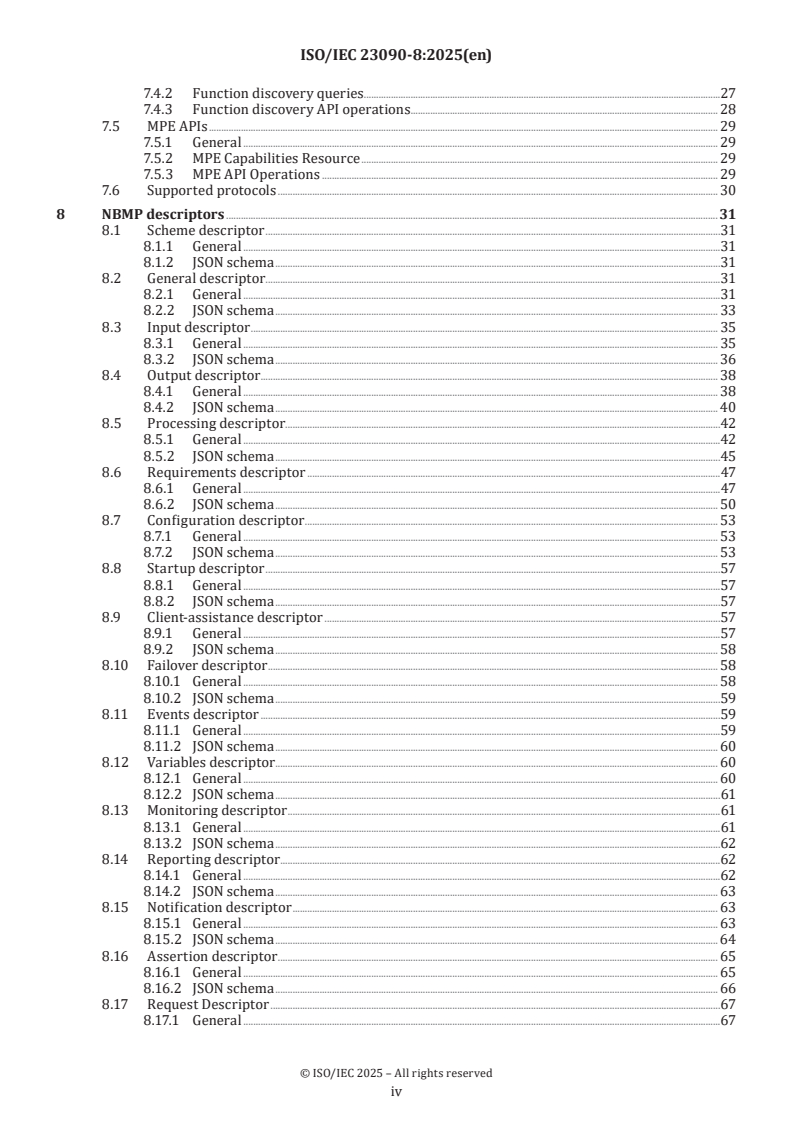
7.4.2 Function discovery queries .27
7.4.3 Function discovery API operations . . 28
7.5 MPE APIs . 29
7.5.1 General . 29
7.5.2 MPE Capabilities Resource . 29
7.5.3 MPE API Operations . 29
7.6 Supported protocols . 30
8 NBMP descriptors .31
8.1 Scheme descriptor .31
8.1.1 General .31
8.1.2 JSON schema .31
8.2 General descriptor .31
8.2.1 General .31
8.2.2 JSON schema . 33
8.3 Input descriptor . 35
8.3.1 General . 35
8.3.2 JSON schema . 36
8.4 Output descriptor . . 38
8.4.1 General . 38
8.4.2 JSON schema . 40
8.5 Processing descriptor.42
8.5.1 General .42
8.5.2 JSON schema .45
8.6 Requirements descriptor .47
8.6.1 General .47
8.6.2 JSON schema . 50
8.7 Configuration descriptor . 53
8.7.1 General . 53
8.7.2 JSON schema . 53
8.8 Startup descriptor .57
8.8.1 General .57
8.8.2 JSON schema .57
8.9 Client-assistance descriptor .57
8.9.1 General .57
8.9.2 JSON schema . 58
8.10 Failover descriptor . 58
8.10.1 General . 58
8.10.2 JSON schema .59
8.11 Events descriptor .59
8.11.1 General .59
8.11.2 JSON schema . 60
8.12 Variables descriptor . 60
8.12.1 General . 60
8.12.2 JSON schema .61
8.13 Monitoring descriptor .61
8.13.1 General .61
8.13.2 JSON schema .62
8.14 Reporting descriptor .62
8.14.1 General .62
8.14.2 JSON schema . 63
8.15 Notification descriptor . 63
8.15.1 General . 63
8.15.2 JSON schema . 64
8.16 Assertion descriptor . 65
8.16.1 General . 65
8.16.2 JSON schema . 66
8.17 Request Descriptor .67
8.17.1 General .67
© ISO/IEC 2025 – All rights reserved
iv
8.17.2 JSON schema . 68
8.18 Acknowledge descriptor . 68
8.18.1 General . 68
8.18.2 JSON schema . 68
8.19 Repository descriptor . 69
8.19.1 General . 69
8.19.2 JSON schema . 69
8.20 Security descriptor .70
8.20.1 General .70
8.20.2 JSON schema .70
8.21 Step descriptor .71
8.21.1 General .71
8.21.2 JSON schema . 72
8.22 Capabilities Descriptor . 73
8.22.1 General . 73
8.22.2 JSON Schema . . . 75
8.23 Scale Descriptor . . 77
8.23.1 General . 77
8.23.2 JSON Schema . . . 78
8.24 Schedule descriptor . . 78
8.24.1 General . 78
8.24.2 JSON schema . 79
9 NBMP parameters .80
9.1 General . 80
9.2 Scheme descriptor parameters . 80
9.3 General descriptor parameters . 81
9.4 Input descriptor parameters. 82
9.5 Output descriptor parameters . 84
9.6 Processing descriptor parameters . 86
9.7 Requirements descriptor parameters . 87
9.7.1 Flow control parameters. 87
9.7.2 Hardware parameters . 87
9.7.3 Security requirements . 88
9.7.4 Workflow/task requirements . 89
9.7.5 Resource estimator parameters . 90
9.8 Startup descriptor parameters . 90
9.9 Client-Assistant parameters . 90
9.10 Failover parameters .91
9.11 Events parameters . 92
9.12 Variables parameters. 92
9.13 Monitoring parameters . . 92
9.14 Reporting parameters . 92
9.15 Notification parameters . 93
9.16 Assertion parameters . . . 94
9.17 Request parameters . . 95
9.18 Acknowledge parameters . 95
9.19 Repository parameters . 95
9.20 Security parameters . 96
9.21 Step Descriptor parameters . 97
9.22 Capabilities Descriptor parameters . 102
9.23 Scale Descriptor parameters . 103
9.24 Schedule Descriptor parameters . 104
9.25 Configuration descriptor parameters . 105
9.25.1 Generic parameter representation . 105
9.25.2 Example of parameter representation . 106
10 Workflow manager, task, function repository, and MPE requirements .109
10.1 Workflow manager requirements . 109
10.2 Function repository requirements .110
© ISO/IEC 2025 – All rights reserved
v
10.3 Task requirements .110
10.4 MPE requirements . . 111
11 NBMP support for media formats and metadata .111
11.1 General . 111
11.2 Media formats . 111
11.3 Application formats . . 111
11.4 Metadata formats . 111
12 Security considerations in NBMP .112
12.1 Overview . 112
12.2 Secure and authenticated channels between NBMP client and NBMP workflow manager . 112
12.2.1 General . 112
12.2.2 Secure communication channel between NBMP client and NBMP workflow
manager . . 112
12.2.3 NBMP client authentication to workflow manager . 112
12.2.4 Workflow manager authentication to NBMP client . . 112
12.2.5 Secure channels for task communication . 113
12.2.6 NBMP client authentication/authorization to workflow task . 113
12.2.7 Workflow task authentication to NBMP client . 113
12.2.8 Secure channel for NBMP client and task communication . 113
12.2.9 MPE security . 113
12.2.10 Network security . 113
Annex A (normative) JSON schemas .114
Annex B (normative) NBMP workflow management .115
Annex C (normative) Schema for identifying the NBMP standard and MPEG compatible
functions .119
Annex D (normative) NBMP MIME types.120
Annex E (informative) Interface for managing function descriptions in function repository.126
Annex F (normative) Reference function templates .127
Annex G (informative) Workflow splitting .174
Bibliography .177
© ISO/IEC 2025 – All rights reserved
vi
Foreword
ISO (the International Organization for Standardization) and IEC (the International Electrotechnical
Commission) form the specialized system for worldwide standardization. National bodies that are
members of ISO or IEC participate in the development of International Standards through technical
committees established by the respective organization to deal with particular fields of technical activity.
ISO and IEC technical committees collaborate in fields of mutual interest. Other international organizations,
governmental and non-governmental, in liaison with ISO and IEC, also take part in the work.
The procedures used to develop this document and those intended for its further maintenance are described
in the ISO/IEC Directives, Part 1. In particular, the different approval criteria needed for the different types
of document should be noted. This document was drafted in accordance with the editorial rules of the ISO/
IEC Directives, Part 2 (see www.iso.org/directives or www.iec.ch/members_experts/refdocs).
ISO and IEC draw attention to the possibility that the implementation of this document may involve the
use of (a) patent(s). ISO and IEC take no position concerning the evidence, validity or applicability of any
claimed patent rights in respect thereof. As of the date of publication of this document, ISO and IEC had
received notice of (a) patent(s) which may be required to implement this document. However, implementers
are cautioned that this may not represent the latest information, which may be obtained from the patent
database available at www.iso.org/patents and https://patents.iec.ch. ISO and IEC shall not be held
responsible for identifying any or all such patent rights.
Any trade name used in this document is information given for the convenience of users and does not
constitute an endorsement.
For an explanation of the voluntary nature of standards, the meaning of ISO specific terms and expressions
related to conformity assessment, as well as information about ISO's adherence to the World Trade
Organization (WTO) principles in the Technical Barriers to Trade (TBT) see www.iso.org/iso/foreword.html.
In the IEC, see www.iec.ch/understanding-standards.
This document was prepared by Joint Technical Committee ISO/IEC JTC 1, Information technology,
Subcommittee SC 29, Coding of audio, picture, multimedia and hypermedia information.
This second edition cancels and replaces the first edition (ISO/IEC 23090-8:2020), which has been technically
revised.
The main changes are as follows:
— Annex F, NBMP function reference templates, was added;
— MPE capabilities were added;
— split rendering support was added.
A list of all parts in the ISO/IEC 23090 series can be found on the ISO and IEC websites.
Any feedback or questions on this document should be directed to the user’s national standards
body. A complete listing of these bodies can be found at www.iso.org/members.html and
www.iec.ch/national-committees.
© ISO/IEC 2025 – All rights reserved
vii
Introduction
This document defines a framework that enables initializing and controlling media processing in a network.
A network-based media processing (NBMP) source describes the requested media processing and provides
information about the nature and format of the media data. Based on that, an NBMP workflow manager
establishes the media processing workflow and informs the NBMP client that the workflow is ready, and
that media processing can start. The media source(s) can then start transmitting their media to the network
for processing.
An NBMP workflow can be understood as a connected graph of media processing tasks, each of which
performs a well-defined media processing operation. The workflow manager ensures the correct operation
of t
...